One For London Overground To Correct
I was at Walthamstow Central station last night and wanted to return home the quickest way, for which I have a choice of routes.
1. Take an Abellio Greater Anglia train to Hackney Downs and then get a 56 bus.
2. Take a Victoria Line train to Highbury and Islington and then cross the road and get a 277 or 30 bus.
3. Take a Victoria Line train to Seven Sisters and then get a bus to Dalston.
I prefer the first route, it has the least amount of walking and if it’s raining hard it’s mostly under cover. But the route has the disadvantage that you can wait fifteen minutes for a train. This is a bad picture of the information screen on the platform.
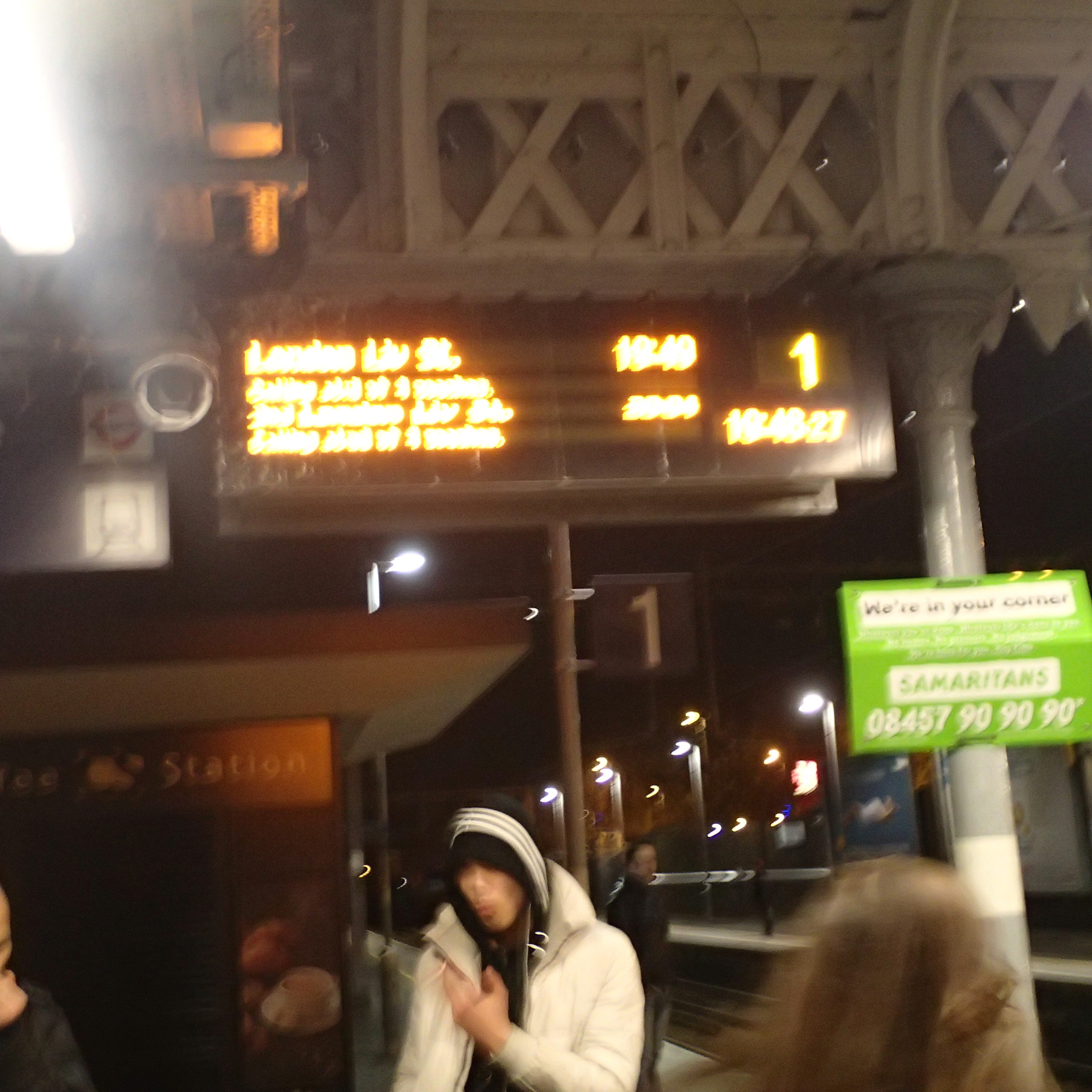
Information At Walthamstow Central
The trouble is that like all the other information screens at the station, it doesn’t give information for the Underground services in their station below.
Last night I waited about two minutes for a train, but if it had been six or so, I’d have probably dived into the Underground.
To make matters worse, if you arrive in the station using the underpass from the bus station, you do not pass any information screens at all and you have to climb the stairs to finds out the next train.
That’s not very customer friendly in my book.
Hopefully, when the Chingford services are taken over by London Overground in May, then as it will be an Overground/Underground station exclusively, then this lack-of-information problem will be resolved.
Match Twenty-Five – Ipswich 0 – Derby 1
If the biggest crowd at Portman Road for four years had welcomed Charlton, them the cowd for the visit of Derby must be one of the largest at the ground for a televised Championship match, with the exception of an East Anglian Derby.
Sadly though, Ipswich lost after giving away a silly goal and are now down to third place, one point behind Bournemouth and Derby.
Network Rail have decided to play rebuilding the railway again, so despite going to the match in style, I came home in an uncomfortable Class 321 train, with no wi-fi or onboard catering.
I don’t think I’ll be going First again, until normal service is resumed.
It’s funny, but we’ve played two lunchtime matches at home this season and lost both one-nil. The other was against Norwich.
We shouldn’t play any more!
London’s Proposed Ultra Low Emission Zone
London is proposing to have an Ultra Low Emission Zone. Here’s the summary of the proposal.
Air pollution affects the quality of life of a large number of Londoners, especially those with respiratory and cardiovascular conditions. It is estimated in 2008 more than 4,000 deaths in London were brought forward due to long term exposure to air pollution.
I’m all for this, as not only will improved air quality help my breathing, but also it will hopefully get some of the older and larger vehicles off the roads.
As a pedestrian, I’ve nearly been hit a couple of times, when something like an older 5-series BMW has been driven far too fast across lights turning red. Strangely, these near misses have never occurred with a vehicle less than a couple of years old. I think people tend to look after new vehicles better, or is it that as they are fully-taxed and insured, they are traceable. Usually, the drivers have the look of someone, I wouldn’t want as a friend.
But not everybody wants it, as this article on ITV shows.
Crossrail 2’s Tunnels Under London
Length And Stations Of The Tunnels In Crossrail And Crossrail 2
Crossrail has been designed with 42 km of rail tunnels under London., with seven new underground stations at Paddington, Bond Street, Tottenham Court Road, Farringdon, Liverpool Street Whitechapel and Woolwich. In addition there are new above ground stations at Canary Wharf and Custom House.
Crossrail 2 in contrast has according to this article in the Guardian has 35 km or as they say 22 miles of rail tunnels. According to this route shown on the Crossrail 2 web site, it will have underground stations at Alexandra Palace, Angel, Clapham Junction, Dalston Junction, Euston/St. Pancras, Kings Road/Chelsea, Seven Sisters, Tooting Broadway, Tottenham Court Road, Turnpike Lane and Victoria.
The Crossrail 2 Central Tunnel
I created this map from the one shown on the route page.
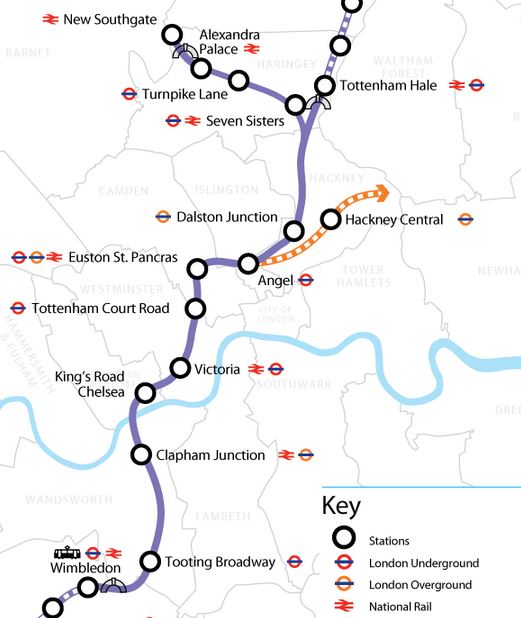
Crossrail 2 Central Tunnel
Note that there are three portals at Tottenham Hale, New Southgate and Wimbledon.
Thoughts About The Routes
Not much has been published about the finer details of the routes but some things stand out.
1. The two Northern branches to Tottenham Hale and New Southgate would appear to split around Coppermill Junction, which is close to a sizeable area of undeveloped land, that could probably serve the same purpose for Crossrail 2, as the Limmo Peninsular access shaft did for Crossrail.
2. The New Southgate branch, would appear to roughly follow underneath the route of the old Palace Gates Line. Logic says that if you tunnel along the line of an old raulway, which for much of its route, has not been built on, you can’t interfere with many buildings.
How Deep Will The Tunnel Be?
Crossrail is deep under London. This article on the Crossrail web site says that the construction shaft at the major tunnel junction at Stepney Green, has a depth of 34.5 metres. As at Tottenham Court Road station, they threaded the tunnels through within a few centimetres of the Northern Line, which is generally one of the deeper Underground lines, I suspect that there is a vast network of tunnels that have to be avoided., which in addition to the tube lines, include the Northern City line, HS1 and at least one newly-built electricity tunnel.
So would the designers of the tunnel make it deeper than all the others? The Wikipedia article on HS1 says this about the tunnels.
The depth of the tunnels varies from 24 metres to 50 metres.
As Crossrail 2 will cross HS1 in the Dalston area, it will have to go either above or below this line. I know very little about tunneling, but I do think that a deep tunnel under London at around or dseeper than 50 metres is possible.
The main problem with deep tunnels is connecting them to the stations above, so being able to do this in an affordable and acceptable manner to passengers, may limit the depth to which the tunnels go. I use Angel station with its long escalators that rise 27 metres regularly and I would prefer that an alternative solution was found, if stations on Crossrail 2 were deeper. Perhaps large modern and very fast lifts could be used, as these make the station totally step-free.
I don’t know whether this has been done on Crossrail, but when they built the Victoria Line they arranged that stations were hump-backed, so trains would slow down as they arrived in the station and accelerate away down the hill. Wikipedia says this.
Each platform constructed specifically for the Victoria line from new is 132.6 metres (435 ft) long. The line has hump-backed stations to allow trains to store gravitational potential energy as they slow down and release it when they leave a station, providing an energy saving of 5% and making the trains run 9% faster.
This sort of technique, which now is probably a lot easier using modern tunnel boring machines that can be precisely controlled, will probably be used on Crossrail 2 to in addition to the energy savings, bring the station platforms closer to the surface, which should make construction easier and more affordable.
The Tottenham Hale Portal
This Google Earth map shows the area south of Tottenham Hale station.
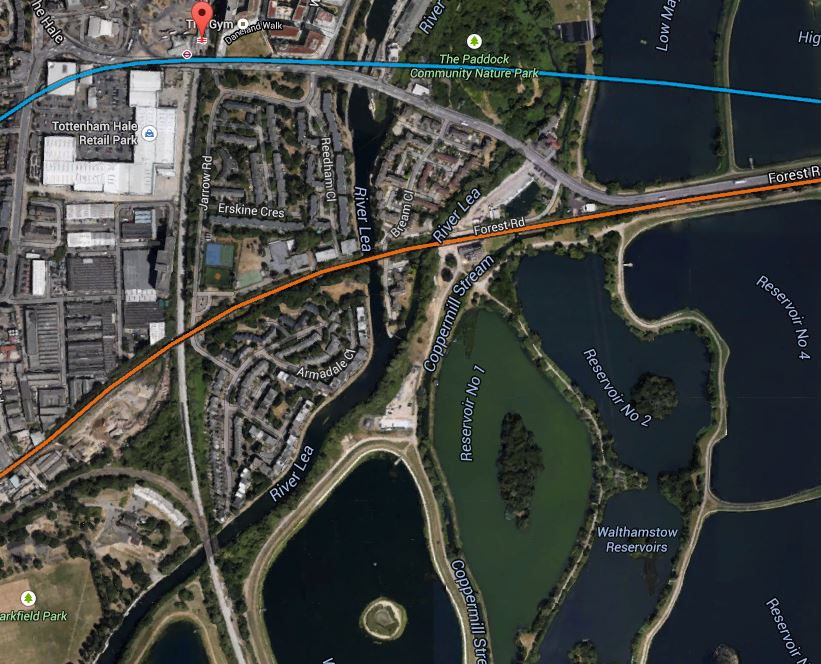
The Area South Of Tottenham Hale
Note :-
1. The West Anglia Main Line running in a north-south direction, from the red arrow that marks the station, which will be connected to Crossrail 2.
2. The blue line is the route of the Victoria Line.
3. The orange line is the Gospel Oak to Barking Line (GOBlin).
This is probably an ideal place to build a tunnel portal, as if it can’t be squeezed in alongside the West Anglia Main Line, there is a lot of open land in the area, that is only occupied by water, wildlife and illegally-dumped refuse.
There are plans to add extra tracks to the West Anglia Main Line as is detailed in Wikipedia. This is said.
It seems likely that two tracks will be built alongside the line to Cheshunt as part of Crossrail 2. Intermediate stations from Tottenham Hale will transfer to Crossrail 2 releasing capacity on the main line for additional trains.
A prudent Network Rail, would probably add these extra tracks, even if Crossrail 2 wasn’t to be built for say fifty years, as it would speed up services to Cambridge and Stansted.
The New Southgate Portal
This Google Earth map shows the area south of New Southgate station, which is the destination of the branch of Crossrail 2
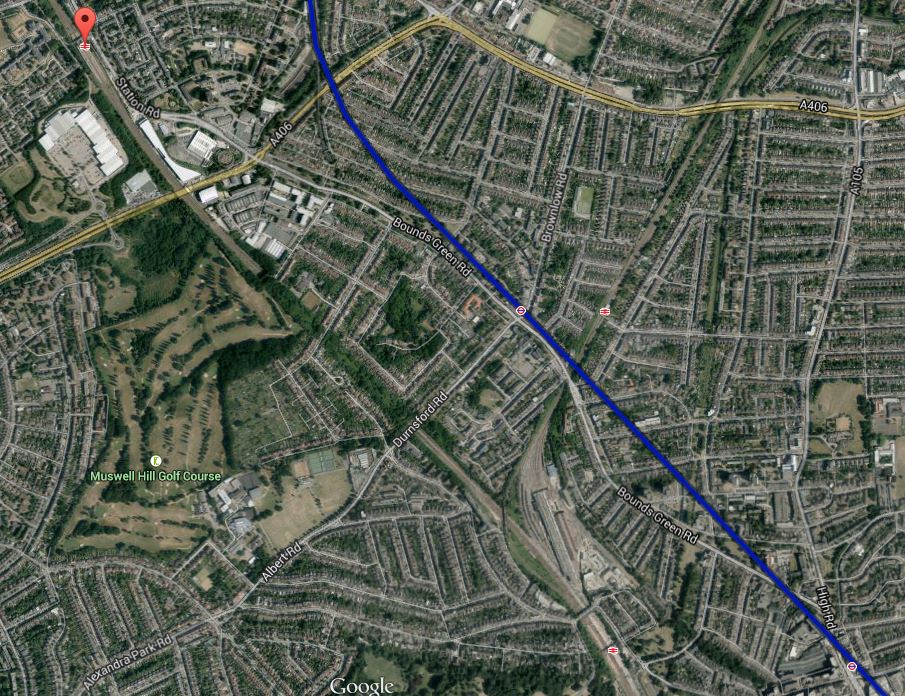
The Area South Of New Southgate Station
Note :-
1. The station is indicated by the arrow at the top, with the East Coast Main Line running roughly north-west to south-east.
2. The blue line is the Piccadilly Line.
I know the area well and it is one of the worst sections of the North Circular Road, being restricted by a railway bridge with two-way traffic. This enlarged view shows the crossing of the East Coast Main Line and the North Circular Road better.
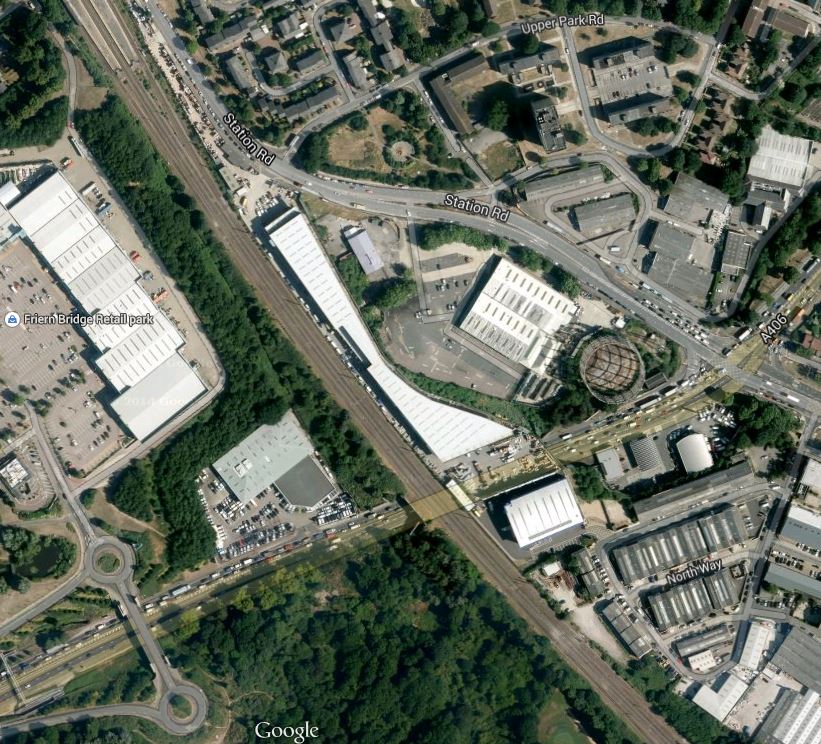
The East Coast Main Line Crossing The North Circular Road
In this view you can just see the platforms of New Southgate station at the top. The East Coast Main Line runs down the image, with the North Circular Road and the stalled traffic going across. The green area at the bottom is owned by the North London Waste Authority, who intended to build an incinerator there, But that idea seems to have been abandoned. I’m sure Transport for London can find a better use for it. This picture shows the bridge taking the Railway over the North Circular Road.
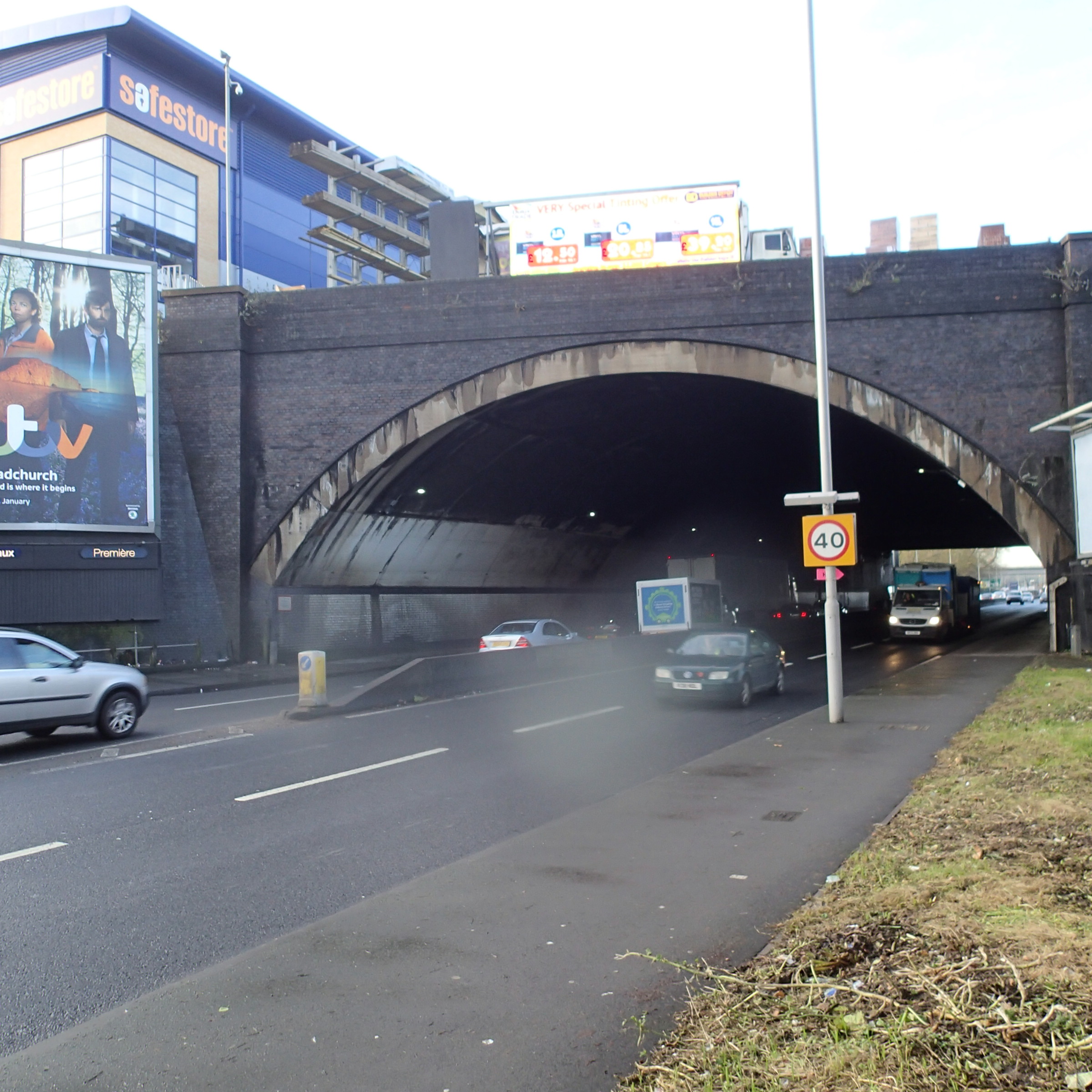
The Railway Bridge At New Southgate
I can’t imagine English Heritage rushing to save it, if Network Rail decided to replace it.
When I first heard that Crossrail 2 was being planned as going to New Southgate, I visited the station and wrote this post, in which I said this.
Looking at the map, as New Southgate station is close to the North Circular Road and is generally surrounded by industrial estates, although there is some housing, there would be scope to probably create a really good transport interchange with a large bus station and perhaps even a tram line along the North Circular Road from Brent Cross to Enfield or Southgate. If nothing else, all of the work should result in the notorious bottleneck on the road being eased.
I am still enthusiastic and very much feel that a very innovative station and transport interchange could be built here, especially if combined with putting the road in a concrete tunnel with development on top, as was done at Hatfield.
The Wimbledon Portal
This Google Earth map shows the railway line between Wimbledon station almost to Earlsfield station.
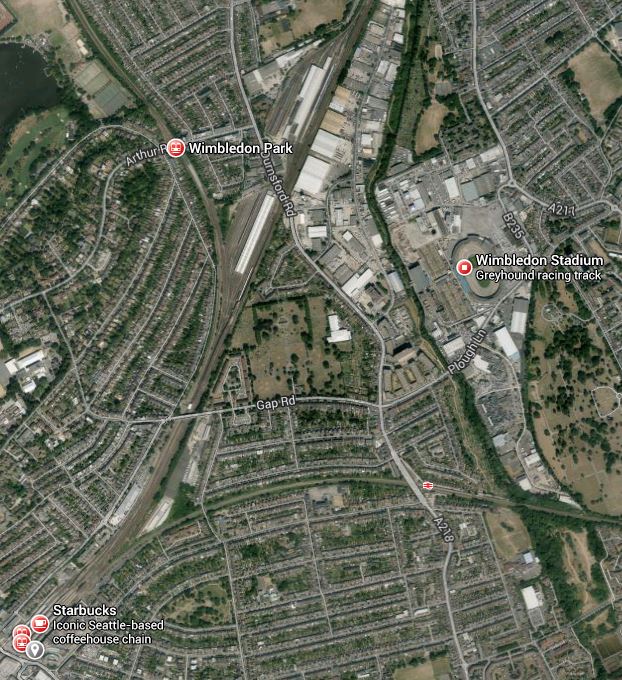
Wimbledon To Earlsfield
Note :-
1. Wimbledon station is at the bottom left and the South Western Main Line to Earlsfield runs at perhaps twenty degrees to the right of the vertical, with Earlsfield just off the image.
2. Near the top of the image level with Wimbledon Park station is Wimbledon Traincare Depot.
There would appear to be several places where the tunnels could emerge alongside the line, with somewhere around the Traincare Depot a prime candidate.
Thoughts About Stations
These are just a series of random thoughts about the stations and will be added to as time progresses.
1. Seven Sisters
As I was writing this I saw how the New Southgate branch followed the old Palace Gates Line between Alexandra Palace and Seven Sisters stations.
Look at this image showing the proximity of Seven Sisters and South Tottenham stations.
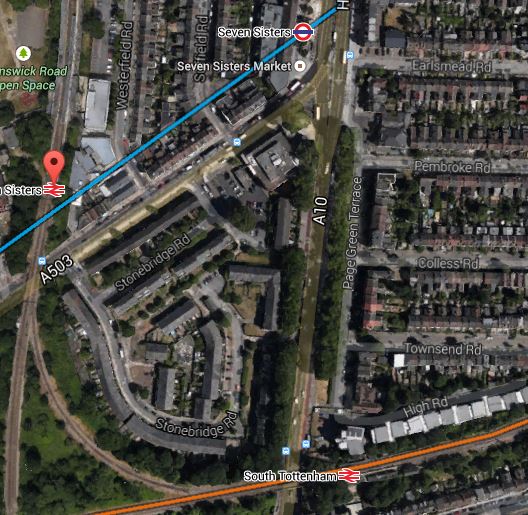
Seven Sisters And South Tottenham Stations
The blue line shows the route of the Victoria Line at Seven Sisters, which is a double-ended station of a unique and unusual design.
The orange line is the GOBlin and you can also see the curve that allows trains to pass between the GOBlin and the Lea Valley Line.
If I am correct that the junction between the two northern branches is close to Coppermill Junction, then the line of the tunnels will virtually pass under South Tottenham station in a south-east to north-west direction, probably perpendicular to the Victoria Line.
I think, if the tunnels were correctly aligned then a double-ended station could be created for Crossrail 2, where the south-eastern end could be connected by escalator and/or lifts into South Tottenham station and the north-western end could be connected into Seven Sisters station. I met an engineer who’d been in one of the new Crossrail stations and she said that to accomodate the 200 metre long Class 345 trains, the stations are massive. I can’t believe that Crossrail 2 stations will be any shorter, as they will surely use similar, if not identical trains.
One point to note, is as Crossrail 2 and the Victoria Line would cross at right-angles at Seven Sisters, the Crossrail 2 tunnels could be bored to be close underneath the bottom of the Victoria Line platforms, so that this connection, wouldn’t be a massive deep excavation, which required long escalators and lifts.
Only Transport for London would know if such a connection would be worthwhile. But I have a strong feeling that if the Gospel Oak to Barking Line was connected to Crossrail 2, the connection would be very beneficial.
2. Dalston Junction
If a double-ended station might be possible at Seven Sisters, it’s certainly possible to create one in Dalston, to connect Kingsland and Junction stations. Especially, as Dalston Kingsland station is going to be rebuilt in the next few years.
3. Euston/St. Pancras
This will be a large double-ended station and hopefully while they’re building the station, they sort out the dreadful maze of tunnels under Kings Cross and St. Pancras, which were obviously designed by an architect, who liked complicated knitting.
You have to remember that Euston to St. Pancras is not a short walk and at a rough measure it is not much short of 800 metres. So if you get in at the wrong end of the train, you’ve got a long walk.
It’s when I see messes like the Underground and Thameslink connections at Euston, St. Pancras and Kings Cross, that I feel we need to do something extremely radical.
I also feel that modern large capacity high speed lifts may be a solution to getting a simple and efficient solution, in getting up and down from a deep level railway.
4. Angel
I had a few thoughts about this station in this post.
I won’t repeat myself.
5. Tottenham Court Road
If Crossrail works out as the designers hope, we might be able to say more of the same here.
Tottenham Court Road is a bit like that trick when a magician folds a pretty young lady into a box and then puts several swords through the box without drawing blood.
Except that there are four train lines instead of swords.
6. Victoria
Victoria will be a tricky station to get right.
I also think that other developments in the next few years might make any speculation here redundant.
The lines south of the Thames are not very logical and were probably designed by the grandfather of the architect, who designed the pedestrian tunnels at Kings Cross/St. Pancras.
Hopefully Thameslink will make this better with the central stations from St.Pancras to London Bridge feeding passengers into a train every three minutes. If it does what it says on the tin, then Victoria might become a less busy station. But I doubt it!
What would help is to tie more and more services into cross-London services, where this was feasible. The East London Line could take fifty percent more trains and the West London Line is seriously underutilised.
Crossrail 2 itself might even help the situation at Victoria, as passengers will use it to get to Clapham Junction for their long distance train.
And I would also support Lord Adonis’s position of more orange trains.
7. Kings Road/Chelsea
Chelsea station or whatever it’s called is controversial. All the residents actually want is more space to park their tractors.
Seriously though, how about a station running under the Kings Road with lifts every fifty metres or so.
8. Clapham Junction
Clapham Junction will hopefully be served by the Northern Line Extension, by the time they start building Crossrail 2 and this might mean that some of the more desperate reasons for adding Clapham Junction to the tube network are partly satisfied.
As Clapham Junction is an immense station, a big underground station could be built that almost accesses all of the current platforms through individual connections.
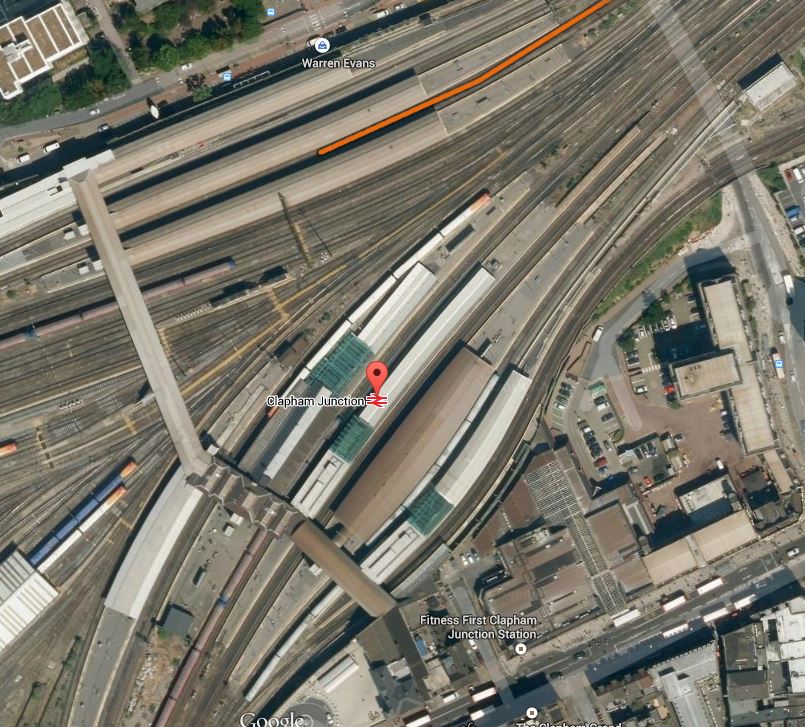
Clapham Junction Station
This would be possible, if it could be arranged that Crossrail 2 passed under Clapham Junction station at right angles to the lines through the station, in the vague direction of the overbridge towards the left of this image.
In some ways it would be like an upside down version of the new Reading station.
The Problems At London Bridge
There have been lots of problems in the evening peak at London Bridge and the Thameslink Program has issued this apology.
On this page on the Thameslink Program web site, this is said.
From 5 January 2015, for three years until January 2018, no Bedford to Brighton Thameslink trains will call at London Bridge station. A reduced service will run between Brighton and London Bridge in the off-peak and a very limited service will run in the peak.
Effectively, whilst London Bridge is rebuilt, these trains will not go through the station.
One of the solutions being applied to the current trouble is to reduce the number of trains between London Bridge and West Croydon in the evening peak times.
So you need another route to get the passengers home to West Croydon. The obvious one is to avoid London Bridge entirely and take the Jubilee Line to Canada Water or the District/Metropolitan Line to Whitechapel, where from both stations you get an Overground train to West Croydon.
But the problem with this is the lack of capacity on the East London Line. This is being cured by delivering a fifth carriage for the Class 378 trains. But not many seem to have turned up yet. I’ve only seen one 5-car train twice and I travel on the line regularly.
With my project management hat on, it strikes me that the capacity upgrade on the London Overground and particularly the East London Line should have been completed before the major interim changes and capacity reductions at London Bridge. In fact according to this Transport for London document, the East London Line should have been running five car services by December 2014.
So what has delayed the arrival of the fifth carriages?
Could it be that the delivery of the new Class 387 for Thameslink jumped the queue for building by Bombardier in front of the fifth carriages for the Class 378?
An Unnecessary Good Deed
I like to think that I can be a gentleman some of the time.
When I was going home this afternoon from London Bridge, I took the Northern Line to Old Street with the intention of getting a 141 bus from Provost Street opposite Moorfields Eye Hospital.
To get from the station to the stop I first had to cross East Road, walk past the stop for the southbound 43 bus and then cross Provost Street itself.
As I started to cross Provost Street, I noticed a classic little old lady with a white stick, who seemed rather feared to cross the other way. So I crossed over and asked if I could help. She told me that she needed to get a 21 bus south towards Lewisham. I should say that I did do a bit of training with Guide Dogs for the Blind on how to lead people, so after telling her that the stop was behind the building on our left, I guided her across the road, past the 43 bus stop and then across East Road to walk back to the step for the 21.
What was a bit frustrating was that as we crossed East Road, a 21 bus disappeared on its way south.
A few minutes later and with a bit of help from a fellow passenger, who told us a 21 was due in three minutes, I put the lady on the bus to New Cross and her home.
I used the word unnecessary in the title of this post. for two reasons.
I said the lady was a classic little old lady in the mould of Louisa Wilberforce in The Ladykillers or Mrs. Ross in The Whisperers, but she certainly was totally on the ball and without any eccentricities. She was also proud too, that she’d got the bus so easily northwards from New Cross. She also thought it a good idea to try my route next time, of a 43 to say Finsbury Square and then get the 21 from the same stop.
But the main reason, all of my guiding was unnecessary is that if there had been some clear large print signs, she would with her mental and physical faculties managed the walk without any passing assistance. Although, she thanked me profusely, she was a very independent soul, and she would probably have felt really satisfied to have been able to manage the walk unaided.
Surely outside an eye hospital, there will be quite a few people walking around, whose eyesight isn’t 20/20.
As I indicated in Is Silicon Roundabout Going To Become Silicon Peninsular, Transport for London are rethinking the Old Street Roundabout.
They have a unique opportunity to sort out the area for the visually impaired.
Paint London Orange
My Google Alert for “Overground” picked up two stories today.
1. One story in the Evening Standard had Lord Adonis arguing for most inner suburban lines to be given to and run by the Overground.
2. A second in the Croydon Advertiser argued that the Overground should run for twenty-four hours on some days, to match the Underground.
I think that both things will hapopen over the years.
Will Modern Construction Techniques Create New Stations For The London Underground/Overground?
London is under tremendous pressure to provide more and more housing and in some ways it seems we’re using up the obvious sites like Stratford, Barking Riverside and Old Oak Common. So we’re going to start building on perhaps less obvious and more cramped sites.
The area round Shoreditch High Street station is being developed more and more with tower blocks. I have talked about linking the station to the Central Line and also about a new main line station in the area, so what happens here in the next few years is going to be an experience that will be worth watching.
I also feel that the area to the east of Gospel Oak station could be opened up for development, which might involve a link to the Northern Line.
Yesterday, I mused about reopening Maiden Lane station, which would involve a lot of properly development and a possible link to the Piccadilly Line.
So all three of these developments could involve a connection to a deep level underground line, something which five years ago would have been very difficult.
A few months ago, I talked about using an uphill excavator at Whitechapel station to connect the deep level Crossrail tunnels to the other lines. I have also found this article on the New Civil Engineer website, which gives more details of the amazing construction going on at Whitechapel.
My only comment is – You ain’t seen nothing yet!
If I take the three examples above, they would all mean connecting to a working twin-bore deep Underground line between two stations. I suspect that some clever construction engineers will develop a methodology to do this, with the minimum of disruption to the working line. If the first time, they do it, it is on time and on budget, the engineers will have a job for life in adding connections to deep underground lines not just in London, but all over the wider world.
To return to London, I think we’ll be surprised at some of the seemingly crazy schemes put forward for new or extended stations in the future, that have become possible with the improvement of tunneling and other construction techniques.
Could Maiden Lane Station On The North London Line Be Reopened?
According to an entry in Wikipedia, Camden Council have proposed that Maiden Lane station on the North London Line be reopened, as it is just to the north of the extensive developments at Kings Cross Central.
This Google Earth view shows the area.
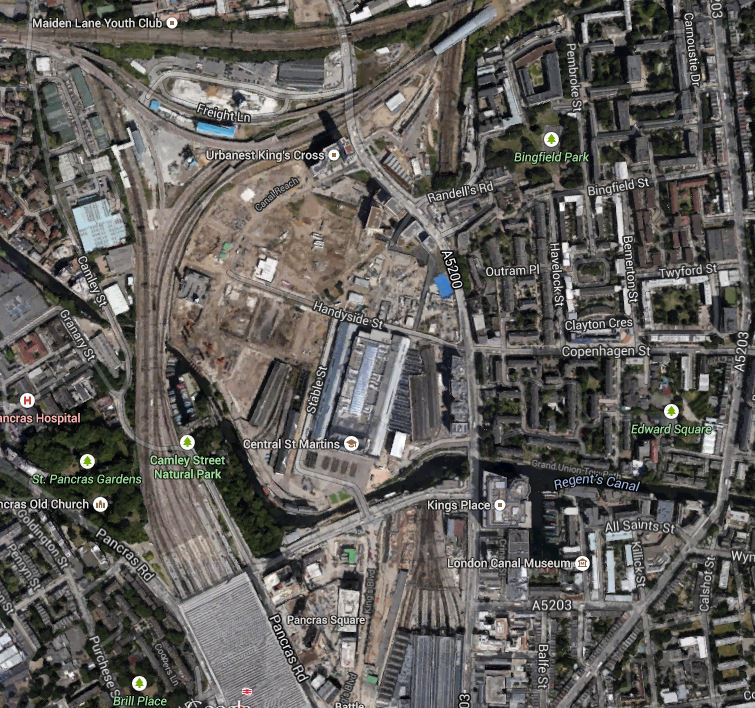
Kings Cross Central
The North London Line runs across the picture and the former station was just to the left of centre in this view, to the west of where the road crosses the railway line.
Some months ago, I walked to that area from Kings Cross station. I commented that it was not a short walk, so to build a station there to serve Kings Cross and St. Pancras stations may not be very worthwhile.
But take a look at this more detailed view of the area.
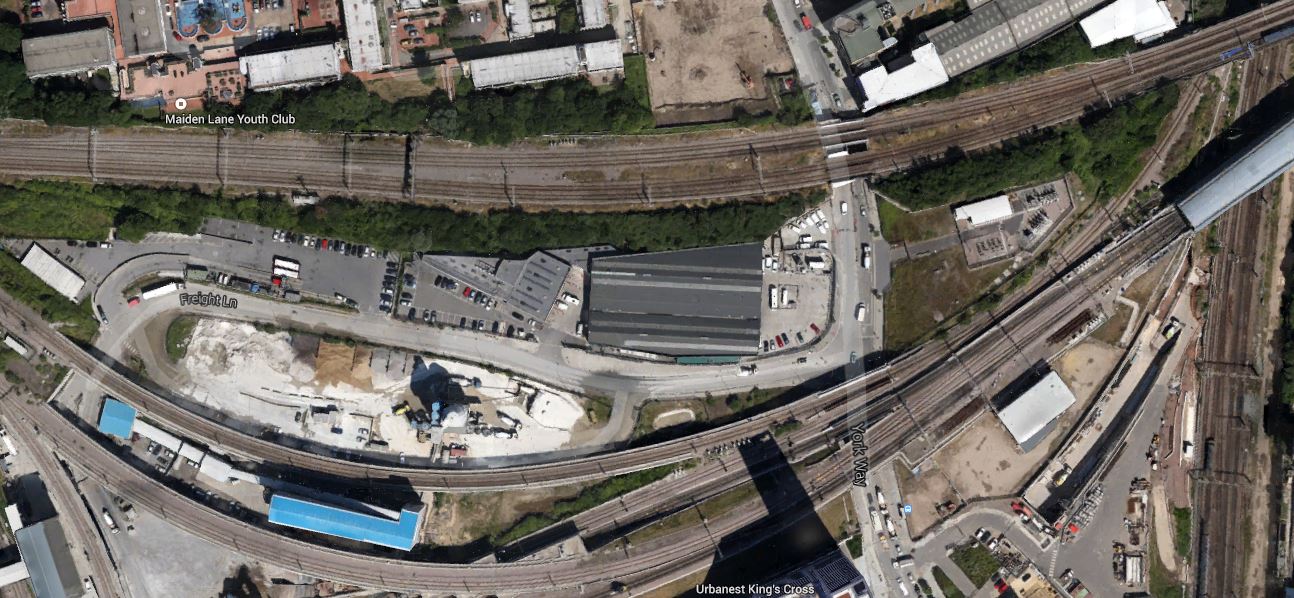
Railway Lines North Of Kings Cross
Note the distinctive acoustic cover over the Channel Tunnel Rail Link at the right, with the line sweeping across to turn towards St. Pancras.
But there does seem to be quite a bit of land in the area and it could fit that well-used cliché of development potential.
I’d also be intrigued to know if the Piccadilly Line could be reached from a station on the North London Line near here, by the use of modern construction techniques.
It probably won’t happen in the next few years, but I can’t help feeling that at some time, some very comprehensive property development in this area will incorporate a new station.
Wayfinding In Southamption
Southampton, or at least the parts I visited seems to have a comprehensive wayfinding system.
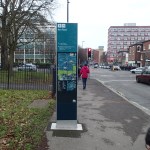
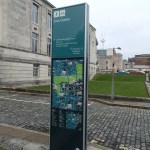
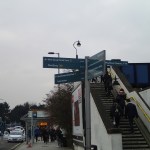
This web site shows the design, which is based on similar rules to London. A similar system will be rolled out all over Hampshire. The Hampshire web site says this.
The project team responsible for the signage is learning lessons from similar work elsewhere, including the recent Southampton legible cities project and the Legible London scheme.
So are we getting a de facto standard for wayfinding all over the country?
I hope so!
T
 The Anonymous Widower