Two Very Different Beds
I had two nights in Scotland and they couldn’t have been more different.
The first was in the Premier Inn at Lauriston Place in Edinburgh.
I’ve stayed there before and although not the best placed, it was easy to get to from the station after we finally found a taxi.
But I wasn’t prepared for what I found, although the receptionist said that my top-floor-room might be a bit hot.
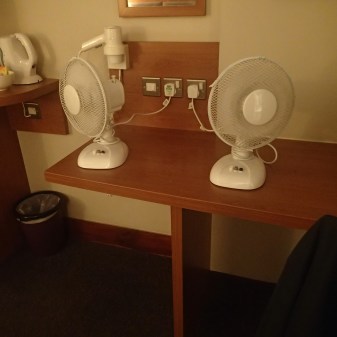
A Greeting From Two Fans
I’ve never been met by two fans as I entered a room.
It was hot and so I opened the window as far as I could. But in the morning, this is what I read on my hygrometer/thermometer.
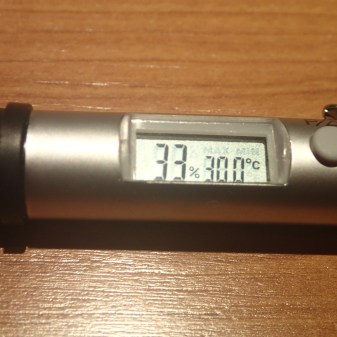
This Is Just Too Hot!
It is the worst case I’ve found of top-floor-overheating I’ve found.
It was much worst than the room, that I’d suffered in Iceland.
My second bed was on the Caledonian Sleeper. I took this picture lying in the comfortable enough bed.
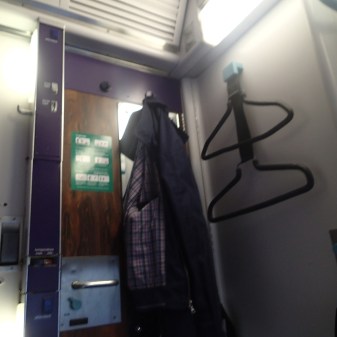
Looking Around My Cabin
When I got up it was nineteen degrees on the train, with a very pleasant humidity of 26%.
Strangely the quality of the sleep on both nights was about the same, but I have felt a lot better today, than I did yesterday.
The interesting thing though was that the single-occupancy bed on the Sleeper was cheaper than the night in Edinburgh.
A Snack On The Caledonian Sleeper
The Caledonian Sleeper is in some ways a hangover from years gone by, but the train was busy. Quite a few people like me had been to the Commonwealth Games.
I decided to see if they had anything gluten-free. The cheese and oatcakes looked promising, so the steward checked to see if the oatcakes were safe. He produced the box. I can’t remember the make, but the box said proudly that they were made without wheat.
So I gave it a try and this is what I received.
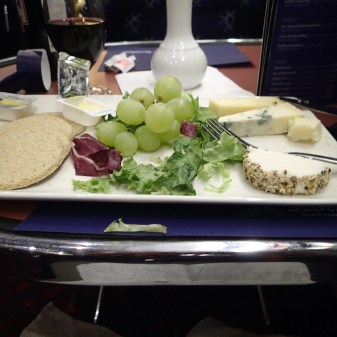
A Snack On The Caledonian Sleeper
It was very nice, even if there was a bit too much wine for my taste at the moment. But at £8.50, who cares?
As I slept well held by the suspension of the Mark 3 coaches and didn’t need to go to the toilet until just before Euston, there can’t have been much wrong with my supper.
Glasgow Crossrail
I saw this bus at Glasgow Central station, whilst I was awaiting a friend to go to the Games.
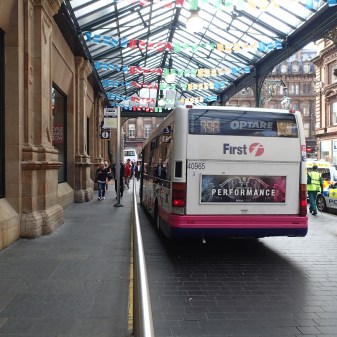
The Bus Connection Between The Two Stations
It connects the station to the other main one at Glasgow Queen Street.
It may work well, but it is needed in that Glasgow has effectively two rail networks; one going south and west from Central and another going east and north from Queen Street. This is illustrated, if you book a train from say Carlisle to the North of Scotland, where you either go via Edinburgh or use the bus to get across Glasgow.
London is adding the east-west cross city Crossrail to go with the current north-south Thameslink, which is being augmented and extended. Cross city routes have one big advantage in addition to the obvious one of linking places on either side of the city together, and that is that terminal platforms in city centres can be released for other purposes. Effectively in London, about half of the Midland Main Line platforms in St. Pancras, were released for Eurostar and High Speed services to Kent, by moving many services to Thameslink, where they effectively terminated at places like Brighton.
But it’s not just in London, that this technique of using a cross-city link to improve services and increase capacity is used.
- Liverpool has linked the Northern and Wirral lines to those going south through a tunnel, which also allowed the old Liverpool Central station to be redeveloped on its prime site as Central Village.
- Manchester is linking Piccadilly and Victoria stations, by means of new track and a bridge to create the Northern Hub.
- Cardiff, Bristol, Birmingham and Leeds don’t really have the two station problem, but many of them pair up services to save terminal platforms. The Valley and Local Cardiff routes are extensive and many services are end-to-end, stopping at Cardiff in the centre.
Obviously, as there are a lot of buildings in the way between Glasgow’s two station, a direct rail link would have to be tunnelled.
As I walked around Glasgow, I couldn’t help noticing two impressive structures. The first was the City Union Bridge.
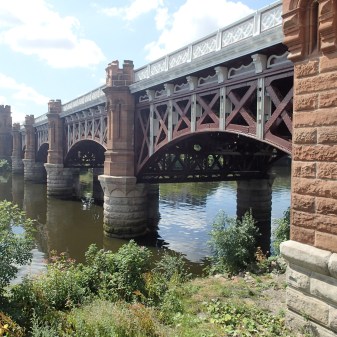
And the second was this viaduct across the centre of the city.

They were both part of the original City Union Line, which is now used for freight and empty stock movements. But it does appear to me to go from east to south across the city.
I had read about Glasgow Crossrail before, but I hadn’t realised that the missing link was so impressive and well-maintained. The Wikipedia article says this about the link.
Since the 1970s, it has been widely recognised that one of the main weaknesses of the railway network in Greater Glasgow is that rail services from the South (which would normally terminate at Central main line station) cannot bypass Glasgow city centre and join the northern railway network which terminates at Glasgow Queen Street station – and vice-versa for trains coming from the North. At present rail users who wish to travel across Glasgow have to disembark at either Central or Queen Street and traverse the city centre by foot, or by road.
Looking at the proposed project, it does seem that it might solve a few obvious problems with the rail system in Glasgow.
The proposal also includes the reopening of Cumberland Street railway station in the Gorbals, opening the area up to the passenger railway network for the first time since the 1960s and a link to the Glasgow subway at West Street station.
Amongst other developments the ability to go between the West Coast Main Line and the North of Scotland was listed.
I would be interesting to see the costs and benefits for Glasgow Crossrail.
On the first night at the Games, I went to the athletics and afterwards I needed to get to back to Edinburgh. The trains were totally overloaded and in a bit of chaos. Surely, Glasgow Crossrail might have allowed direct trains from the Hampden area to Edinburgh, which would have eased the problem, even if it meant a change of train at Central.
Searching For The Kelpies
On my visit to the Commonwealth Games, I had to travel back to Glasgow, so I thought I’d go via Falkirk and see the Kelpies. On looking it up before I left London, I found that the web site was rather vague This is what it said.
From Edinburgh to Falkirk High (25 minutes) or Falkirk Grahamston (35 minutes)
From Glasgow Queen Street to Falkirk High (20 minutes) or Falkirk Grahamston (50 minutes)
From Stirling to Falkirk Grahamston (15 minutes)
From London direct to Falkirk Grahamston (5 hours) or change at Edinburgh or Glasgow
There are also services to Polmont Station, Larbert Station and Camelon Station.
It mentions several stations but which one is the nearest?
On the way up Princes Street, I got talking to a young lady and by chance, she said she’d been and had taken the train to Falkirk Grahamston station and then walked.
I though I’d check in the Tourist Office at Waverley Station and they said to go to Falkirk High station.
As I’d got one vote for each Falkirk station, I decided to ask a Scotrail Customer Service Agent. He gave me exactly the same story as the young lady, so I went to Falkirk Grahamston.
I took these pictures at Falkirk.

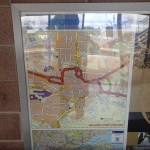
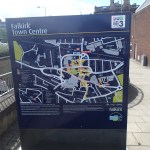
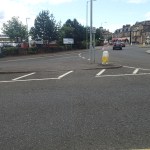

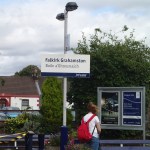
You will notice that none show any information on how to get to the Kelpies. One does show a distant picture of the Kelpies (?) from the train as I approached.
So in the end I walked back to the station and got another train to Glasgow.
Give Falkirk this, they have got the station name in Gaelic and two good maps, even if neither shows the Kelpies or the Falkirk Wheel.
Nightmare on Princes Street
Princes Street in Edinburgh may be a famous street, but the new trams haven’t improved it, with their unsightly poles and wires everywhere.
The biggest problem is crossing from one side to the other, as there aren’t enough crossings and you have to walk up and down between them to get across. I mentioned this to the young lady, who gave me the directions for the Kelpies and she said the trams had made it worse for some reason. I had wanted to cross to a Tesco to get my copy of The Times, but by the time I got to the crossing it had become blocked by buses. No wonder Scots seem to jaywalk much more than us Sassanachs. It’s the only way they can get across.
I then saw a Marks and Spencer on the other side, so as I knew they had papers and gluten-free sandwiches, I decided to give them a try.
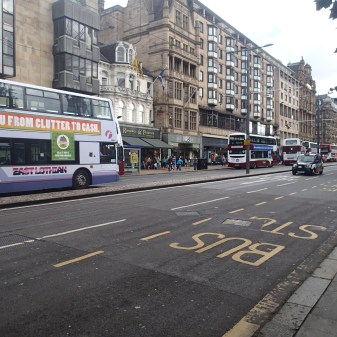
Marks and Spencer on Princes Street, Edinburgh
Firstly, I had to walk back about a hundred metres to find a crossing.
Then, I couldn’t find any gluten-free sandwiches, as they’d already sold out at nine in the morning. But then there is no other shop selling gluten-free food near the station.
So I thought I’d try the Marks and Spencer in the station on my way to the Kelpies at Falkirk.
But they didn’t have any either. I have complained.
So I bought my paper and hoped I could find something in Falkirk.
Stance Or Stand?
I was surprised at the use of stance for where I would use stand at Buchanan Street bus station.
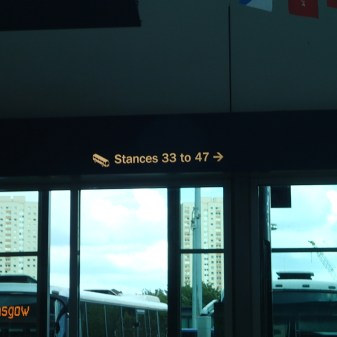
Stance Or Stand?
I’ve always felt that signs like these need an International or European standard.
London rarely makes any difference between an ordinary bus stop or a stand, where they wait before perhaps returning along the route. Londoners probably call every one a bus stop, but then they’ve had the same sign all my life.
A Lost Ulster Bus
The title says it all.
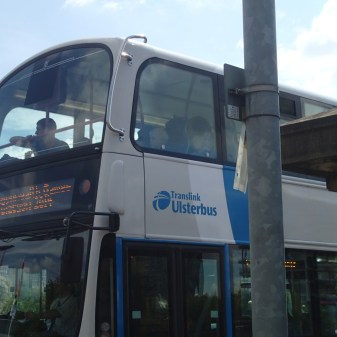
A Lost Ulster Bus
Just as London brought in buses from Scotland for the Olympics, I suspect Glasgow needs all the buses it can scrounge
Reasons To Go Virgin Or East Coast
I went up to the Commonwealth Games on the 08:30 Virgin out of Euston arriving on time at 13:01 give or take a minute or so.
The best thing about going Virgin before 09:00, is that you get a proper breakfast, which includes a gluten-free option. I had plenty of tea, some delicious scrambled egg and smoked salmon and a glass of juice.
I didn’t get my gluten-free roll though!
As I was meeting someone in Glasgow, who’d come through from Edinburgh, I could have gone up with East Coast and then across to Glasgow with her.
But it would have meant an earlier start and I had to see the builders.
I think it’s true to say that if you’re going to Glasgow or Edinburgh from London, it’s probably better to go direct. But even so, the distance between the two big Scottish cities isn’t great, with the fastest trains taking between fifty minutes and an hour.
So as Virgin run twenty trains a day up the West Coast and East Coast run eighteen and the fastest trains take about the same four hours sand a bit, it’s very much a case of you pays your money and takes your choice.
The trains are different with Virgin running tilting Class 390 trains and non-tiliting diesel InterCity 125 and electric Inter City 225 trains. My preference is for the non-tilting trains.
The only certain thing is that in the next few years, train routes between England and Glasgow and Edinburgh will gain more capacity and will get faster.
As an example, over the last year, Transpennine Express has introduced new faster Class 350 electric trains to and from Manchester. I thought I heard several northern families in Glasgow, who looked like day trippers up for the Games.
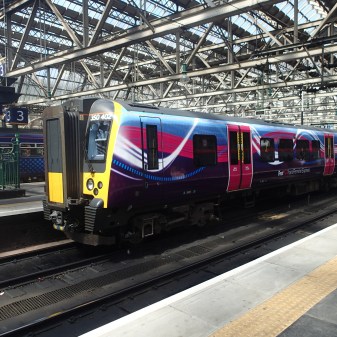
A Transpennine Class 350 In Glasgow
So is this illustrative of how fast, comfortable, high-capacity railways change our lives?
The biggest changed will be Network Rail moving to in-cab signalling, which will allow running over 200 kph on both the West and East Coast Main Lines. This could bring the journey time from London to Scotland much closer to the magic four hours, using the current trains.
When I went to Edinburgh recently by easyJet, security problems meant that I took five and a half hour from my home to Edinburgh city centre. So a four hour journey will be fast enough to give the planes a run for their money. But not everybody goes between London and the major Scottish cities and possibly the biggest beneficiaries of a faster service will be those who have easy access to intermediate stations like York, Peterborough, Preston and Carlisle.
The biggest problem will be track and train capacity on the East and West Coast routes. On the West Coast, there will probably be a further increase in the Class 390 fleet and on the East Coast the Class 800 and 801 are coming.
As with so much on Britain’s railways, the elephant-in-the-room is freight, which is increasing substantially. So will we see extra routes and tracks opened up to held the freight through, just like we have with the GNGE between Doncaster and Peterborough via Lincoln. Of course, we will!
Perhaps, in Scotland, we might even see the return of freight to a Waverley line extended to Carlisle.
Then there is the Edinburgh Glasgow Improvement Program, a project that seems to have lost its way a bit recently. But the main aim of getting about a dozen services every hour between Edinburgh and Glasgow, with some taking just over half-an-hour must be a goal for Scotland.
No Contactless Bank Cards On The Emirates Air-Line
When I rode the Emirates Air-Line, I topped up my Oyster and I asked one of the guys there, if come September, I could use a contactless bank card.
No! As they’re not part of Transport for London.
Come on! That would surely incease ridership, as anybody could just turn up and go!
The Crossrail Site At Limmo Is Winding Down
From the Emirates Air-Line it looks like serious work s winding down at the Crossrail site at Limmo, where the tunnel boring machines; Elizabeth and Victoria, were inserted into a massive hole, to start their journeys to Farringdon via Canary Wharf.


The conveyors are still in place and a ship was there to be loaded with spoil to be taken to Wallasea Island.
Over the years it has been fascinating to see how how the work for Crossrail has started, increased and is now starting to finish, from the DLR and the cable car.
 The Anonymous Widower