They’ve Painted Bordesley Station
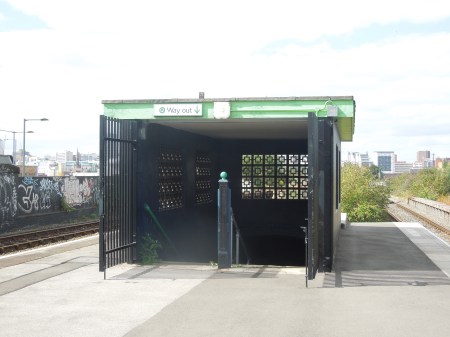
Bordesley station is how you’d imagine a station would look if it served a very large prison. It was originally built to bring cattle to the markets at the Bull Ring.
But it would appear someone has given it a coat of paint.
They’ve Painted Bordesley Station
It really, is the worst station, I’ve used in recent years. But it was marginally better than last year.
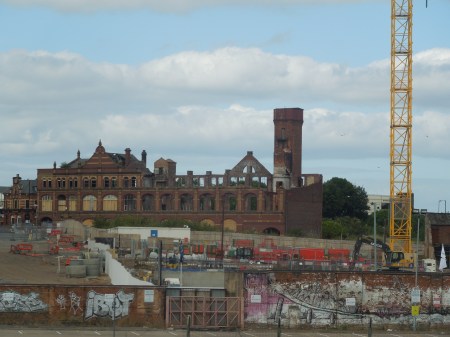
An Amazing Ruin In The Centre Of Birmingham
I saw this building yesterday, as I came into Birmingham New Street station.
An Amazing Ruin In The Centre Of Birmingham
Does anybody know what it is?
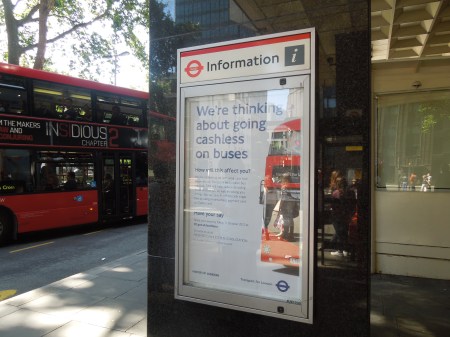
Transport for London Consults On Cashless Buses
I saw this poster at Euston yesterday.
Transport for London Consults On Cashless Buses
I have added my four pennyworth and can honestly say, it was a well-written survey. You can comment here.
Eating Alone In Restaurants
It is usually several times a week, that I eat a meal or have a drink in a pub or restaurant alone. I often do this in places where I’m known and may annoy the staff a bit, by talking to them too much!
But that is a problem of loneliness!
I remembered yesterday a story from my past. I think I’d driven to Bristol to do a presentation in something like 1990, and I’d not eaten particularly well. It was before my diagnosis as a coeliac, and I think lunch had probably been something like an egg salad sandwich and a Coke. Not what I’d eat now!
I was driving back by a cross-country route to Suffolk about seven and I knew that I’d told C that I was going to be home late and not to cook for me.
So somewhere in probably Oxfordshire, I happened to pass was looked to be a village pub with those magic words of Real Ale and Home Cooked Food on a sign. There were a couple of good cars in the car park and it all looked pretty welcoming. So perhaps I could have a pint and meal.
I walked in and approached the bar and ordered a pint of something real and after choosing a ham steak and chips, I asked the landlord where I should sit.
He told me to sit on the large table along the side of the bar, as that table was reserved for people eating and drinking alone, who might want to socialise.
I’m not sure what we talked about, but I did have a pleasant hour or so in that very friendly pub.
I just wonder why, so few pubs and restaurants seem to treat single people in a creative manner.
Do We Have Too Many Site-Seeing Buses In London?
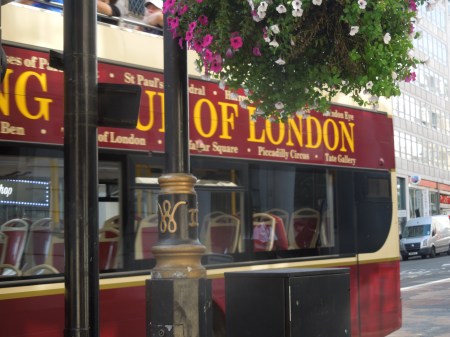
On Friday, I needed to get from Piccadily Circus to the Aldwych, which is a simple one bus journey on a 6, 13 or 23. But the whole area was in chaos because of large numbers of site-seeing buses. This one was even parked so that it blocked the Haymarket.
Do We Have Too Many Site-Seeing Buses In London?
Hopefully, when more New Buses for London are delivered and take over routes in the centre, the economics of taking of the annoying tourist-ripping-off site-seeing buses will take a well-deserved nose-dive.
I’m also getting rather fed up in some places in London by the annoying ticket touts for these buses, who I keep telling to Foxtrot Oscar.
Is This A Legitimate Use Of The Word Cripple?
Cripple is a word that was very common when I was growing up. But it is now one of those words that gets exchanged these days for something more politically correct.
On reading the latest Modern Railways, they talked about a cripple siding at Ipswich. Searching the Internet for the term found this article on the history of railway sidings. It says this about cripple sidings.
The first justification for a siding today is as a “cripple siding”. Basically if a train cannot move at normal speed under its own power, the controller will be desperate to get it off the running lines as soon as possible so that the service can continue. In effect, this is the railway operational equivalent of “any port in a storm”.
The article goes on to give two examples of such a siding in the London Underground.
Lost In Translation
This story from the BBC illustrates the perils of translating.
Two years ago I saw a really mixed up sign in Swansea.
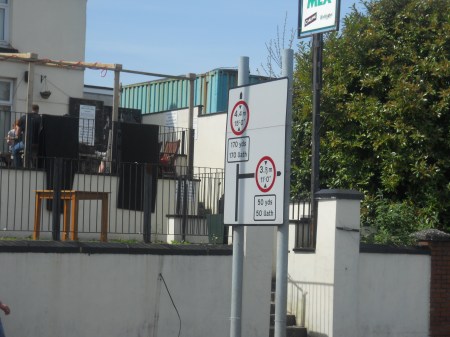
Mixed Up Signage in Swansea
I think road signs should be in one language only and understandable to everybody who drives past them. Obviously in this one, it should only be in metric units.
A Response To HS2 Sceptics
Alistair Darling and others are right to question the current proposal for HS2.
I have a lot of experience of the history and implementation of large infrastructure projects, as many were built with the help of project management software that I created.
Many of these projects get built in a form, that is very different to first envisaged and in some cases, as with the London end of HS1, they get built twice due to the mistakes and lack of vision of politicians.
Looking at the rail system in the UK, there are some major problems that must be addressed on routes from London and the South East to the North and Scotland.
Some stations like Leeds and Birmingham have been or are being rebuilt to a modern standard, but Euston and Manchester Piccadilly are in urgent need of serious improvement, as they both suffer from severe 1960s short-termism.
Most freight now arrives in the UK through the South East ports and there are no fully-electrified routes to the Midlands and the North. We’ve even worsened this situation by building the new London Gateway superport in East London, which means heavy freight trains must mix it with the London Overground.
North of Warrington and Darlington on the West Coast and East Coast Main Lines, there is a serious lack of capacity.
There are serious bottlenecks on the main routes like the Welwyn viaduct and various crossings and stations could be improved.
As Alistair Darling indicated in his article, politicians haven’t decided on what to do with Heathrow. Anybody who called themselves a project manager would say that is the first decision you must do, as it effectively defines the southern route of HS2.
I believe that the first thing we should do after deciding about the airport, is rectify the mistakes of the Victorians and their successors, and convert the East and West Coast Main Lines into continuous quadruple-tracked railways from London to Scotland. If this was accompanied by modern in-cab signalling and overhead wiring, it would be possible with the existing trains to run services at 225 kph. This could mean that London to both Edinburgh and Glasgow would be under four hours.
This high-speed ladder, would be matched by two or three electrified cross routes like Liverpool to Hull, Manchester to Sheffield and Peterborough To Nuneaton. These would not only provide more passenger capacity, but the last route would help to alleviate the freight problem, by taking all Felixstowe traffic to and from the Midlands.
Hitachi are building a factory to make new 225 kph trains at Newton Aycliffe for the East Coast Main and Great Western Main Lines. Surely, for reasons of economy of scale, these designs should also be deployed on the East Midland Main Line and the East-West routes. We must finally rid ourselves of British Rail’s different train for each route policy.
Obviously, better stations are needed, with Manchester Piccadilly and Euston at the head of the list. Perhaps these new stations could interface a lot better with the local bus routes, which is a particular failing of Piccadilly and many other important stations.
And finally, if more capacity is proven to be needed between London and Birmingham, why not electrify the Chiltern Route from Marylebone? And of course, run new Hitachi trains on the line!
the one thing we should actually do with HS2 is safeguard the route, for when it is eventually needed.
We need more capacity and faster journeys in the near future and not on some vague whim and date conjured from the air by politicians, who want to get elected in 2015.
Proof That LT7 Is Back On The Job
I’ve seen it a couple of times, since it appeared on Top Gear, but today was the first time, I managed to photograph it.
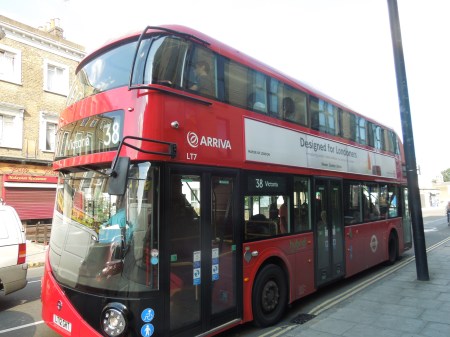
Proof That LT7 Is Back On The Job
A driver did tell me it’s all pristine now, although it didn’t return that way from Top Gear.
More Demolition At London Bridge Station
As I came back, I passed through London Bridge station.



Very little is now left of the old station.
Note the pristine refurbished Class 465 in one picture.
Some may decry our trains, but we have one of the newest fleets in the world and even ones like these, which are wenty years old, look almost fresh out of the factory.
 The Anonymous Widower