‘Assassination List’ A&E Doctor Jailed For 12 Years
The title of this post5 is the same as that of this article on the BBC.
A former A&E consultant has been jailed for 12 years for possessing firearms with intent to endanger life.
Dr Martin Watt, who worked at Monklands Hospital in Airdrie from 1994, was sacked in 2012 following disciplinary proceedings.
The 62-year-old was later found with three sub-machine guns, two pistols, ammunition and an “assassination list” of those he blamed for his dismissal.
Why do guns make people lose their minds?
I find this a chilling tale!
Charging For Single Use Plastic. Aluminium And Glass Drinks Containers
I’m all for this, but I feel we should look at how the empties are returned and refunds are obtained.
The Norwegians seem to have solved this by means of expensive machines, which give vouchers back.
But there must be something simpler.
A few of my thoughts.
Marking Chargeable Containers
All containers for which a deposit is made, should be clearly marked with symbol, which says that it is worth something to return.
Returning To Shops
Obviously, people will want to do this, but I suspect a lot of smaller shops will ask shoppers to take the empties elsewhere.
They might install a machine, but many shops couldn’t afford the expense.
Collecting For Charity Or Local Causes
Suppose, you had a simple steel bin with holes in the top, like those we had in Suffolk for bottles.
Anything that had the correct symbol could be put in the bin.
These bins would then be collected and sorted automatically at a large plant.
By weighing each bin and knowing its location and owner, it would be possible to apportion the refunds to the charity.
National charities might put recycling bins in car parks or prominent places.
But supposing, your area has a run down children’s playground, that everybody wants to improve.
A recycling bin is placed by the playground and everybody is asked to use it for bottles and other containers. All proceeds would go to the playground fund, with a collateral benefit, that the area of the playground wasn’t strewn with empty bottles.
Automatic Sorting Of Containers
If you have a large plant sorting the containers, it can do a better job, than the most expensive machine on the street.
- It would be able to sort plastic, glass and aluminium containers.
- I suspect technology exists to remove labels
- Glass would probably be washed and crushed.
- It could also sort out ordinary rubbish like fast food wrapping and boxes, newspapers and disposable nappies.
- Any washing water would be collected and reused.
The plant would calculate the various combination of materials and if the weight of the rubbish would known, could calculate the return.
Extending The System
There must be other containers, that are also recyclable. In my cupboard, I have a large glass mayonnaise jar, which would probably be recyclable if washed and the top is removed.
So perhaps the system could accept this bottle without its top. It would be washed and crushed, so it could be used instead of quarried aggregate.
Conclusion
There are much better ways to handle the charge on a drink container.
I would reckon, that some of the biggest recycling organisations in the UK are working on a solution, that benefits us all and is as widespread as possible.
My Father’s Politics
In a A Trip To The Berlin Olympic Stadium, I said this about my father’s politics.
My father hated both extreme-right and extreme-left politics with a vengeance and I can honestly say, that I never heard him tell a racist joke.
With the rows going on this morning about antisemitic elements in the Labour Party, I looked up Stalin and antisemitism in Wikipedia.
My father had a Jewish male line, but no religion of any kind, although the more I learn, his outlook on life and morals were fairly Jewish.
In the Battle of Cable Street, he was there to stop Oswald Mosley and his supporters marching through the East End.
I know he moved in left-wing Tory Party circles, nearly stood for Parliament against one of Mosley’s supporters, and once said he had been at the League of Nations in Geneva. But, he remained largely silent about what he did in the 1920s and 1930s.
But I do think his Jewish genes drove him to take up his strong centrist views, especially when you read about Stalin and the Jews.
It is one of my regrets in life, that I didn’t find out more about my father’s life, in what must have been exciting times for those, who thought about politics.
The Price Of Lust
Stormy Daniels once appeared in a video called The Price Of Lust.
I’ve no idea, how good it is from any perspective!
Is Donald Trump going to pay?
Will Trump Hit Stormy Weather?
I’ve just read this article on the BBC.
Hence the title of this post!
Will Danny Boyle Direct The Next Bond Film? Here’s What We Know So Far
The title of this post is the same as this article on the BBC web site.
Certainly today’s news gives lots of ideas for a plot.
Thoughts On Alcoholism
In the last month or so, I’ve done something that I’ve never done before in my life.
I’ve drunk perhaps half a bottle of beer when I’ve got up. Admittedly, I’d left the bottle half finished by my computer.
It was good.
In the 1960s, I could drink a lot of beer. I just seemed to need it.
About that time, I decided I needed to drink large amounts of fluids and swapped to tea and Coke.
My doctor understands my needs for fluids and the practice nurse has the same problem. The nurse puts it down to leaky skin, which he has.
I actually love walking in the rain, so that might help explain it. We all live by the laws of physics.
My father warned me off alcohol in a practical way, by giving me halves of Adnams down at Felixstowe Conservative Club, whilst we played snooker, when I was about fourteen.
My father drank a lot of fluids, but I never saw him drunk and most doctors would say he was a sensible drinker. Like me, he also drank a lot of tea!
He had a reason to control his drinking! His father had died from complications of being an alcoholic at 40, when my father was about twenty.
My grandfather had lived just around the corner from where I live now and my father had once told me, he had drunk large amounts of beer and had moved on to whisky.
Around 1900, there was very little to drink except beer, so did my grandfather’s need for fluids mean that he turned to what was available?
Now I like a good beer and know of its properties to slake a thirst when you’re dry. I’ve worked in foundries in the 1960s and beer was always available.
So is there a type of person, who needs a lot of fluids and if beer is available they turn to it. In some cases does this lead to alcoholism.
As to myself, I must have gluten-free beer and because I’m on Warfarin, I must keep my alcohol consumption down.
So I now drink a gluten-free beer, that is just 0.25 of a unit and tastes like real beer from Marks and Spencer.
But then it is real beer, as it is brewed in Southwold by Adnams.
My life has come full circle.
Hackney Wick Station And The Florida International University Pedestrian Bridge Collapse
The title of this post might seem a bit unusual, as the two locations are in different continents and thousands of miles apart.
But there is a connection, in that the new Hackney Wick station and the Florida International University bridge, were built using the same construction method called accelerated bridge construction.
There are some major differences.
- At Hackney Wick a short, fat subway was built alongside the railway and moved in using self-propelled modular transporters. In Florida a long thin span was installed , in a similar way.
- The Hackney Wick station subway, probably weighs a lot more than the pedestrian footbridge.
- The Hackney Wick subway and the platforms and track on top, was fully reinstated before trains could cross, whereas the Florida span was part of a cable-stay bridge, which hadn’t been completed.
- The Hackney Wick subway will be carrying trains of several hundred tons, whereas the Florida bridge will be carrying people.
It looks to me, that there has been some inaccurate calculations, which led to the collapse of the Florida International University bridge.
Large Scale Electricity Interconnection
We have several related problems with electricity.
- We are using more and more.
- Electric cars, buses and trucks will mean, that we’ll use even more.
- A lot of electricity will be produced in the wrong place and at the wrong time.
- Not everybody uses the same local voltages as our 250 VAC.
- We need ways of storing electricity.
- Some methods of generating electricity, emit a large amount of green-house gases.
In the UK, we have a very sophisticated energy grid, which includes a certain amount of energy storage, that moves energy around from where it is generated to where it is needed.
As an example, I’m sure we’ll see industries that need a lot of electricity, taking advantage of wind energy generated at night.
In my lifetime, I can only remember two periods of severe power shortages.
- In the 1950s, as people bought more electrical equipment like fridges, cookers, kettles and TVs, there was sometimes power cuts at Christmas.
- In theb1970s, shortages were caused by industrial action.
But in recent decades the National Grid has generally kept the electricity flowing.
Most power cuts have been local equipment failure or weather-related.
As the future unfolds, the grid will get better and of a higher capacity to handle all the extra needs of our lifestyle.
Countries, states, towns and cities will develop their own sophisticated networks to look after their people, industry and transport.
Regional Electricity Networks
These smaller networks are now increasingly being connected together to create larger networks.
One of the first interconnectors was the HVDC Cross-Channel between England and France. Wikipedia gives this history.
The first Cross-Channel link was a 160 MW link completed in 1961 and decommissioned in 1984, while the second was a 2000 MW link completed in 1986.
The current 2000 MW link, like the original link, is bi-directional and France and Britain can import/export depending upon market demands.
I’ve read that in recent years, we’ve been using French nuclear power and they’ve been using our wind power.
According to this page on UtilityWise, there are.
- Four operational interconnectors are operational.
- Four interconnectors are being constructed.
- Seven interconnectors are being planned.
They also have this diagrammatic map.
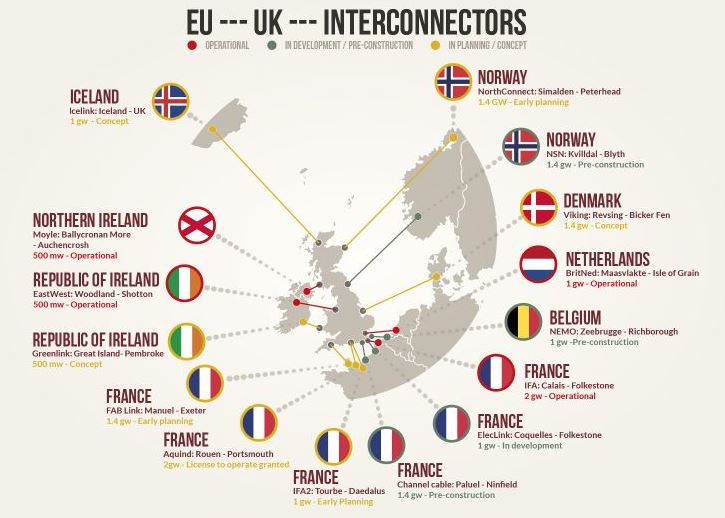
Note.
- If the Icelandic interconnector gets built, it could be a big source of zero-carbon power for the UK and Europe and a large income for Iceland.
- Two big interconnectors to Norway are planned, where there is lots of hydro-electric power.
- A big interconnector is being built between Germany and Norway, which is not shown.
- There will be seven links to France to tap into their nuclear network.
- Our contribution to Western Europe’s power will be mainly from our extensive wind farms, which will soon contribute twenty percent of our power needs.
It will all grow like a gigantic spider’s web, connecting excess power in one place to users, who need it, in another.
Large Scale Electricity Interconnection
This document on the International Energy Agency web site, gives a lot more information about Large Scale Electricity Interconnection.
HVDC Connections
Although, domestic connections have used alternating current (AC) for over a hundred years, these interconnectors use High Voltage Direct Current (HVDC)
This means the following.
- Terminal costs at the end of a link are more expensive.
- The cost of the cable is less per kilometre.
- Longer interconnectors have a cheaper cost per kilometre over about 600-800 km.
- Current technologies give a break-even distance of about 600-800 km.
The article says this about future projects.
With the increase in demand for long-distance interconnection, a number of projects have been envisioned that would greatly improve upon the current status. Projects in the pipeline include the undersea North Sea Network (NSN) link between the Nordic zone and the United Kingdom, which will deliver up to 1.4 GW of power through an undersea cable 730 km in length.
This entry in Wikipedia gives more details on the Norway-UK Interconnector.
Connecting Asynchronous Grids
The document says this.
When AC systems are to be connected, they must be synchronised.
This means that they should operate at the same voltage and frequency, which can be difficult to achieve. Since HVDC is asynchronous it can adapt to any rated voltage and frequency it receives. Hence, HVDC is used to connect large AC systems in many parts of the world.
This may seem technical, but it is important.
Connecting Large Energy Resources And Loads
As the voltage in the interconnector increases, it makes it more economic to connect remote energy resources to where the power is needed.
It gives these examples from around the world.
- Distant hydro resources in the Chilean Patagonia or in Brazil
- Hydro power in Western China
- Solar power in the Rajasthan desert in India.
In the Uk, we ae developing two long interconnectors to Norway and one to Iceland.
Acommodating Variable Renewable Electricity
The document says this.
Variable renewable energy (VRE) deployment requires flexible transmission links. One of the key drivers behind HVDC lines and interconnectors is the ability to shift intermittent renewables to areas of high demand when conditions would otherwise lead to curtailment.
Hopefully, the wind will be blowing somewhere, when the sun isn’t shining somewhere else.
Conclusion
Interconnectors will become a massive part of our distributed electricity system.
I must also say something about energy storage.
Electric vehicles could eventually turn out to be a large part of our mechanism to store excess energy.
Suppose there is excess energy at night, perhaps from wind, waves and tides and it is used to charge the batteries of electric vehicles. It has not gone to waste and is now stored for use when required.
The corollary of this will be, that every parking space or garage, where vehicles are left overnight will have to have a charging point for an electric car.
British Steel Secures Major Contract From Deutsche Bahn
The title of this post is the same as this article on Global Rail News.
I thought the article had a touch of Coals-to-Newcastle about it.
But read the article and there are a lot of things coming together to enable the order.
- British Steel have spent a seven-figure-sum at Scunthorpe, to make the longer rails, that the Germans use.
- Deutsche Bahn are Europe’s largest purchaser of rail.
- The initial order is for 20,000 tonnes of rail.
- Rails can be delivered in 120 metre lengths through the Channel Tunnel.
I should say, that I’ve read in the past, that Scunthorpe makes a quality product.
I found this video on the British Steel web site.
It all brings back memories of the time, I spent as a sixteen-year-old putting automation on heavy machines use to roll non-ferrous metals.
I doubt you get work experience like that these days!
 The Anonymous Widower