The Ventilation Shafts For Crossrail
This post is being developed together with a related one of the ventilation shafts for the Channel Tunnel Rail Link, to show the sort of buildings we can expect to be created to provide access to new rail tunnels under London and other cities.
As I travel around the city, I will be adding more pictures and when I think the details are complete, I’ll add a summary.
Crossrail goes from Stratford and Abbey Wood to Royal Oak across the city in twin tunnels.
The tunnels have to have ventilation and emergency access shafts and there are six of them for the Crossrail. The original plan for the tunnels required another eight shafts, but after a redesign they were removed, as is detailed in this note on the Crossrail web site. This is an extract from the note.
The Mayor of London, Boris Johnson, today welcomed news that Crossrail has reached agreement with the London Fire Brigade (LFB) to remove eight of the proposed permanent access and ventilation shafts from the central tunnelled section of the new railway.
This decision will particularly benefit communities in east London where four of the permanent shafts were due to be located. The removal of the shafts means the elimination of construction works impacts, including lorry journeys, in these areas. In addition, a number of properties in Hanbury Street in east London will no longer need to be compulsorily purchased and demolished.
The eight shafts no longer required are located at: Westbourne Bridge W2, Hyde Park W2, Park Lane W1, Hanbury Street E1, Lowell Street E14, Hertsmere Road E14, Blackwall Way E14 and Warren Lane SE18.
These permanent access and ventilation shafts would typically be around 9 metres in diameter, with a structure on top the size of a one- or two-storey building.
Looking at that last statement, it would appear that the ventilation shafts for the Channel Tunnel were much larger. Is that progress or just that Channel Tunnel trains are lsrger and faster?
From East to West across London the ventilation shafts that are now being built are as follows.
1. Eleanor Street Ventilation Shaft
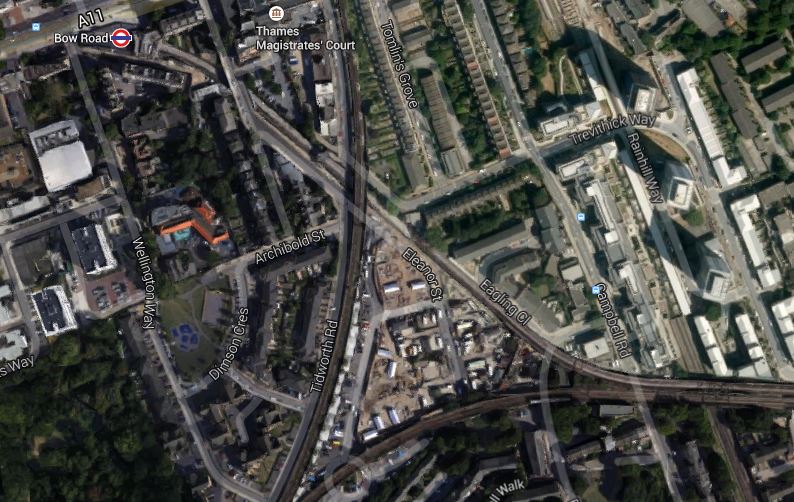
This shaft is located in a triangle of rail lines between Bow Road and Bromley-by-Bow District Line stations.
Eleanor Street Ventilation Shaft
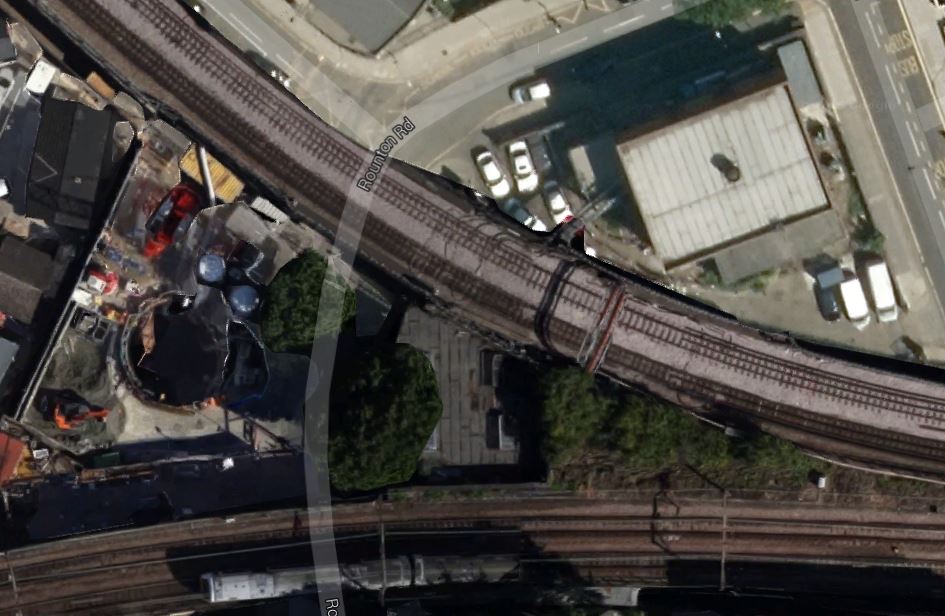
The shaft is in the point of the triangle at the eastern end and it shares the triangle with the Eleanor Street Gypsy and Travellers Site. This is another image to a larger scale.
An Enlarged View
It clearly shows the round shaft.
After construction, this part of the site has been redesigned as detailed in this page on the architect’s web site.
These are images I took of progress to date, some from a District Line train, passing by the site.







It is possibly the only Crossrail ventilation shaft that you can look into, when you see it from the train. Unfortunately, getting a clear image was diffucult, especially from a train with dirty windows.
2. Mile End Park Ventilation Shaft
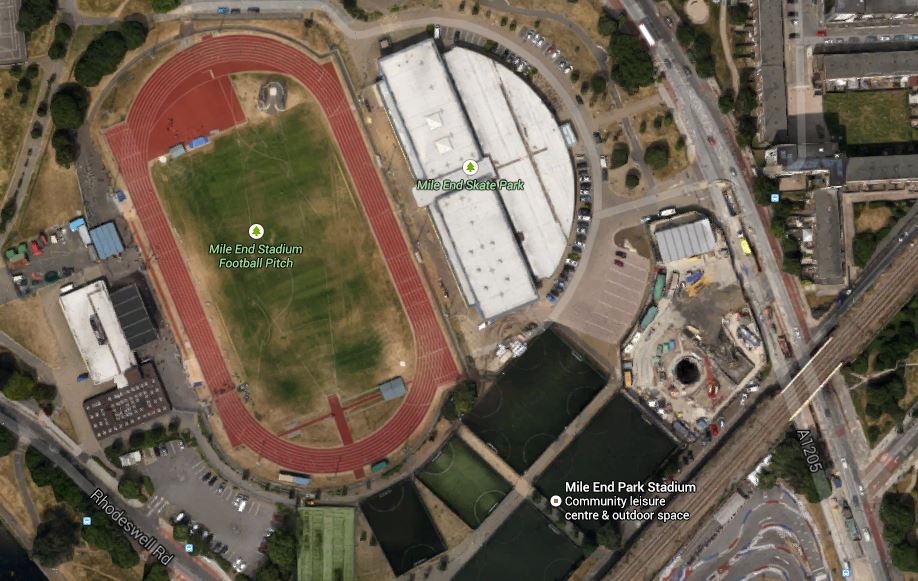
This shaft is located in Mile End Park, just north of where the rail lines into Fenchurch Street cross Burdett Road. This is a Google Earth image of the site.
Mile End Park Ventilation Shaft
Note the shaft which is clearly visible in the middle of what looks to be a site fenced off from the rest of the park.
Google found this other image of a drawing of the layout at Mile End Park.
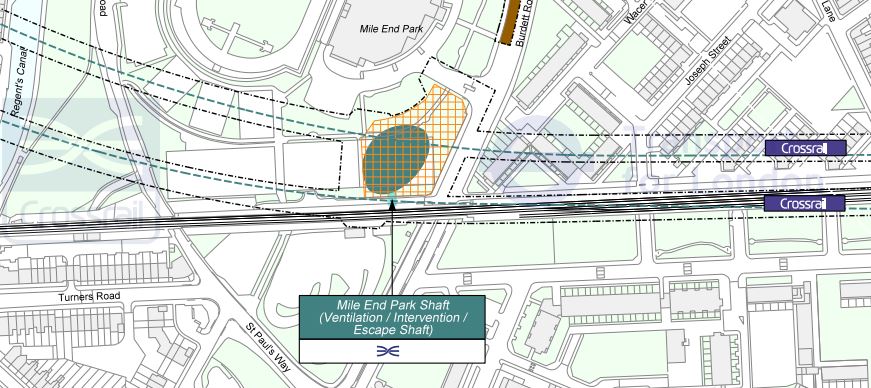
Mile End Park Ventilation Shaft
It is at a different angle, but I believe it confirms the black hole in the first image is the shaft.
This Google Earth image shows the shaft in more detail.
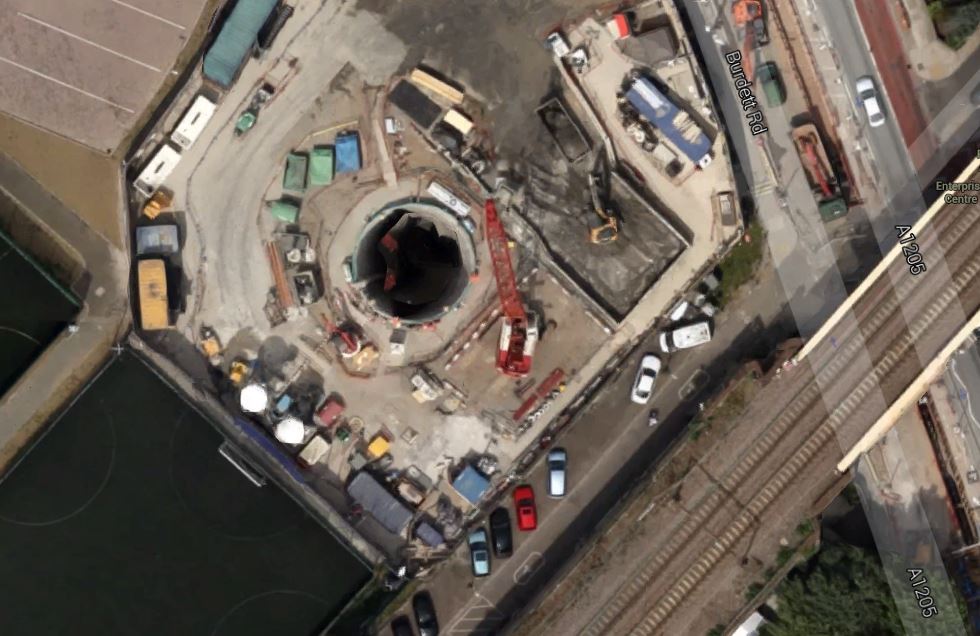
An Enlarged View
And this is a visualisation of what the shaft will look like when complete.


These are images I took of progress to date, together with several images of the park.












It looks like there will be a concrete retaining wall around the whole site. If you look at the map, visualisations and my actual pictures, I think it could be true to say, that when the ventilation shaft is complete, it will enhance rather than despoil the area. It is certainly orders of magnitude better than the Martello towers of the Channel Tunnel Rail Link
3. Stepney Green Ventilation Shaft
Stepney Green is much more than a ventilation and access shaft as thirty metres down is the junction, where the two eastern branches of Crossrail. join. This is a Google Earth image of the site and the Stepney City Farm, which shares the land.
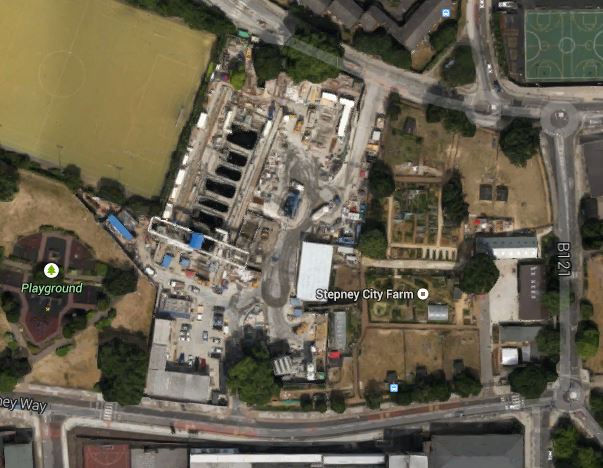
Stepney Green Ventilation Shaft
I went there today and took these pictures.











As you can see, I also had a cup of tea in a genuine willow pattern cup and saucer, that must have been fifty years old at least.
To me, this project, where one of the largest holes ever dug in Europe has been created shows how with good thinking and project management skills even the largest and most difficult projects can be carried out, without upsetting the neighbours.
Every project manager in charge of a project that is a bit sensitive, should go to Stepney City Farm to see how projects should be performed.
4. Durward Street Ventilation Shaft
Tucked away between the Blind Beggar public house and Whitechapel’s Sainsburys supermarket is the Durward Street Ventilation Shaft. This Google Earth image shows the shaft.
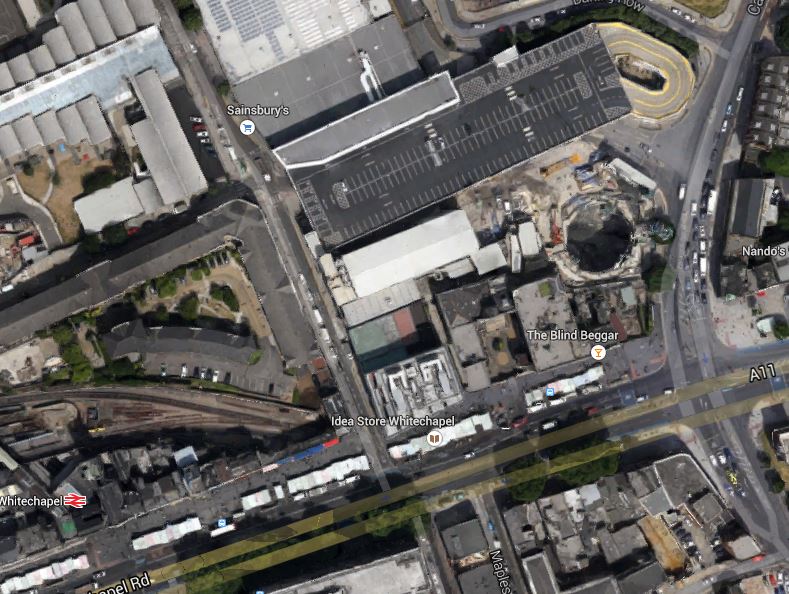
Durward Street Ventilation Shaft
Note how little space, there is in this area.
5. Blomfield Street Ventilation Shaft
This shaft is by Liverpool Street and is described on this page on the Crossrail web site. This lead paragraph describes its main functions.
At the Blomfield Street worksite we are constructing the Blomfield Box, a ventilation shaft for Liverpool Street Station; it is Crossrail’s deepest piled shaft. The shaft will house mechanical and electrical plant as well as service as an emergency escape route from the station.
The position of the shaft is shown in this Google Earth image.
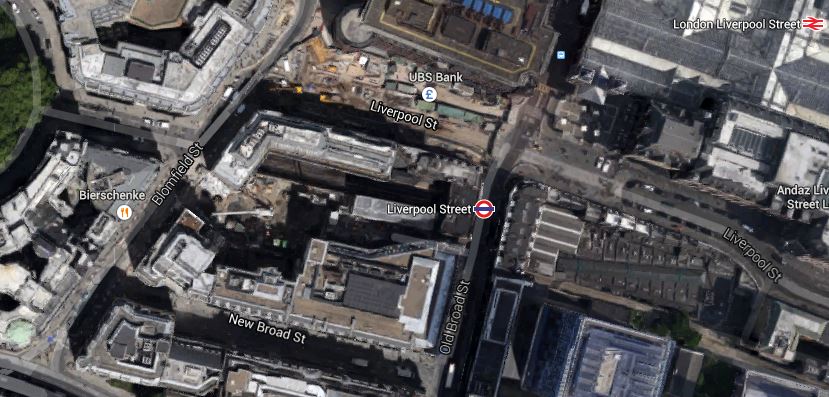
Blomfield Street Ventilation Shaft
The actual shaft is hidden by the buildings, but you should be able to read Blomfield Street. On the ground there is a gap in the buildings, where the shaft is being built.
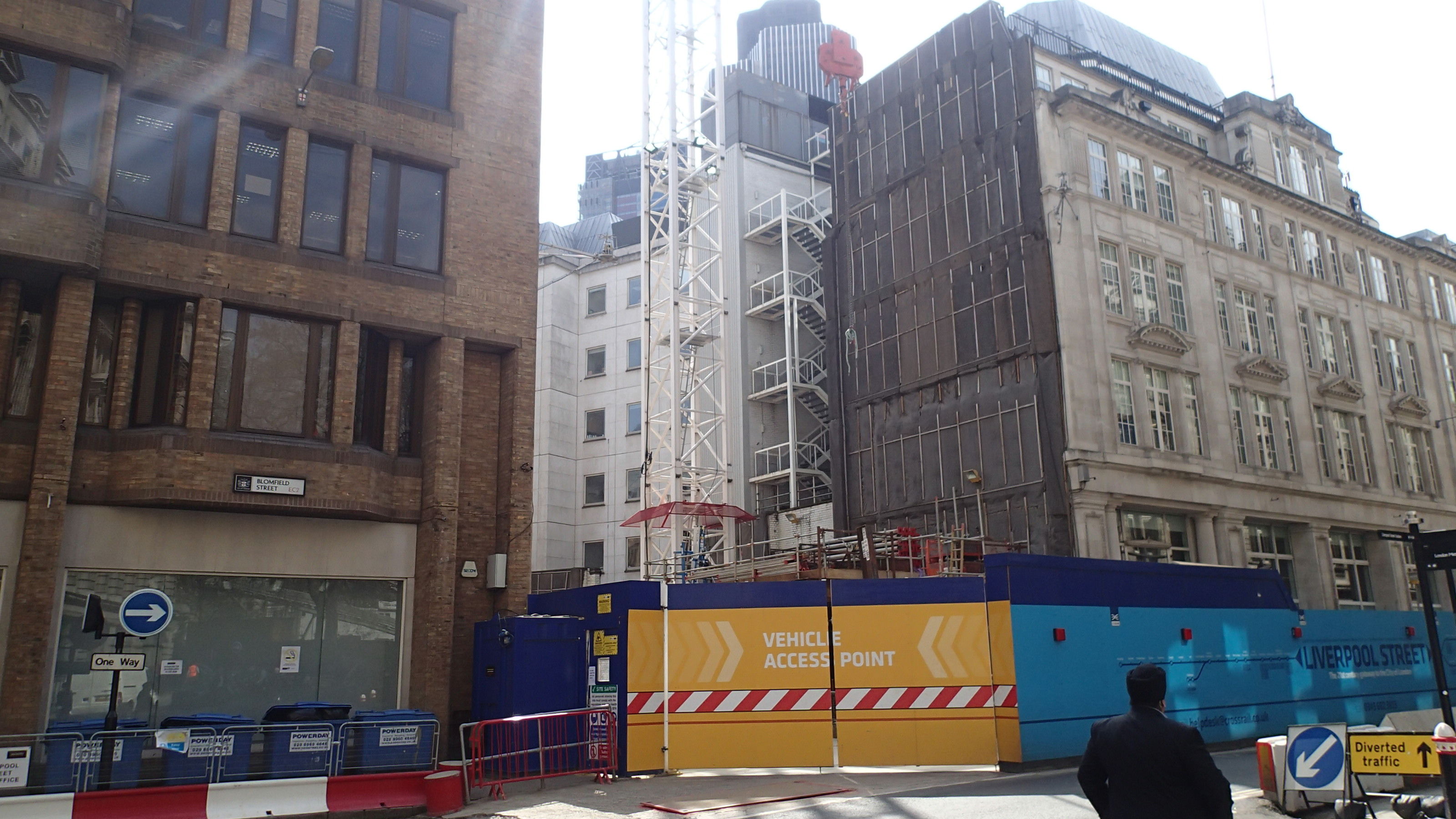
Blomfield Street Vent Shaft Location
I suspect that the shaft will be topped by a useful building in an appropriate style, as any land within the actual City is so valuable.
6.Fisher Street Ventilation Shaft
This shaft is just north of Holborn station and is shown on this Google Earth image.
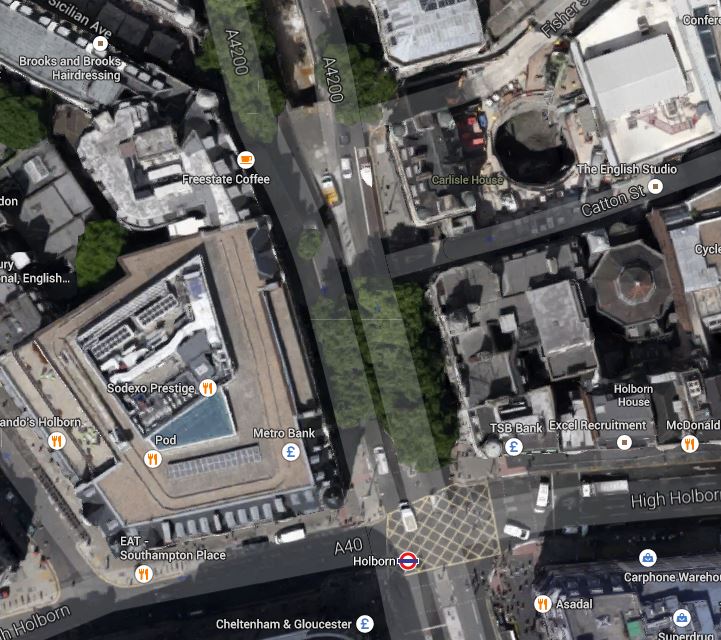
Fisher Street Ventilation Shaft
Note the shaft in the top right of the image. There is not much to see on the ground yet.
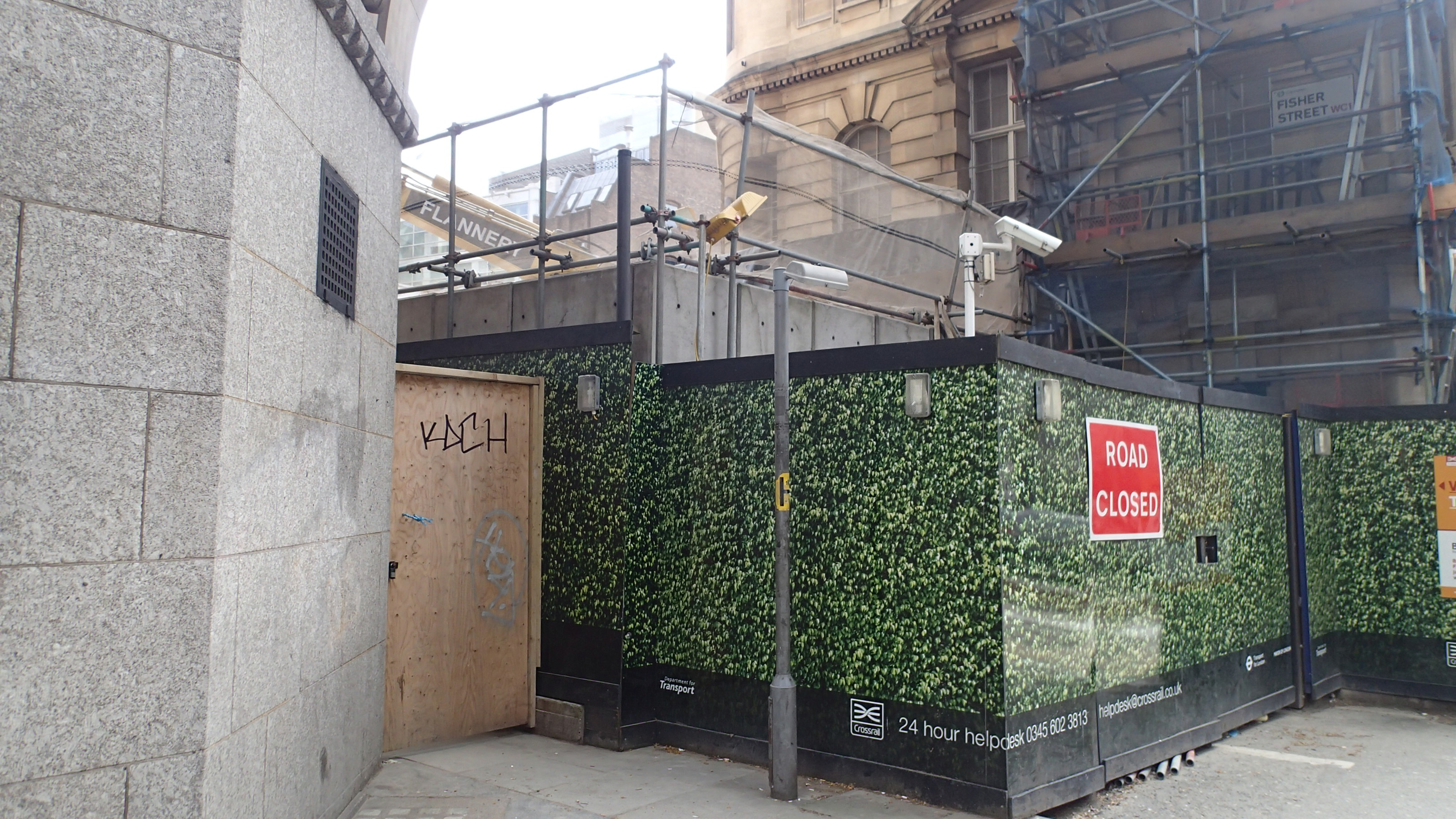
Fisher Street Ventilation Shaft
The picture shows the site from Southampton Row.
The Ventilation Shafts For The Channel Tunnel Rail Link
This post is being developed together with a related one of the ventilation shafts for Crossrail, to show the sort of buildings we can expect to be created to provide access to new rail tunnels under London and other cities.
As I travel around the city, I will be adding more pictures and when I think the details are complete, I’ll add a summary.
The Channel Tunnel Rail Link goes from Ebbsfleet to St. Pancras in two twin tunnels, which both surface on either side of Stratford International station.
The twin tunnels have to have ventilation and emergency access shafts and there are five of them for the Channel Tunnel Rail Link. From East to West approaching London they are as follows.
1. Wayside Ventilation Shaft
This shaft is in Barking and can be seen on this Google Earth image.
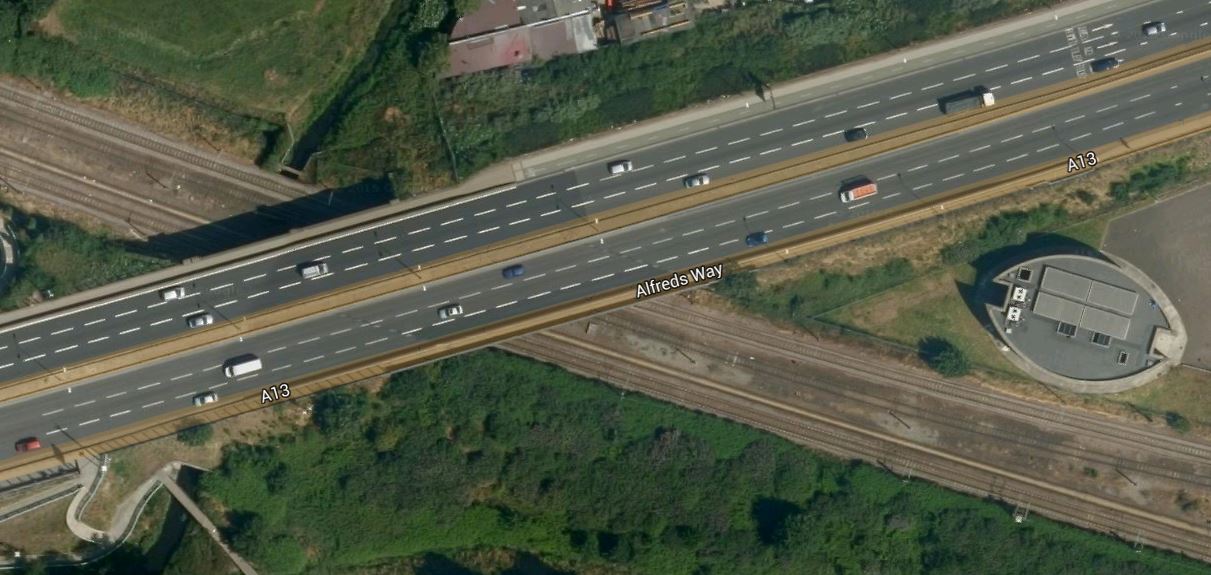
Wayside Ventilation Shaft
The shaft is nestled in the angle of where the A13 crosses the London Tilbury and Southend Line.
This page on the Bell Johnson web site, gives an interesting insight into the design of the shaft. There is also an image taken during construction.
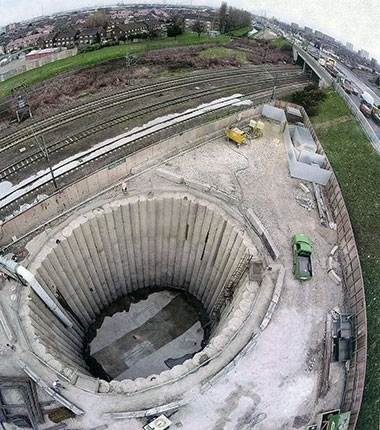
Waysite Ventilation Shaft Under Construction
The picture was taken from the east and clearly shows the road and the railway. These images were taken from a train.




The ventilation shaft is to the west of Dagenham Dock station, which is where I turned round to come back into London. As the station is in Zone 5, it is Freedom Pass territory.
2. Barrington Road Ventilation Shaft
This shaft is to the west of Barking station and is shown in this Google Earth image.
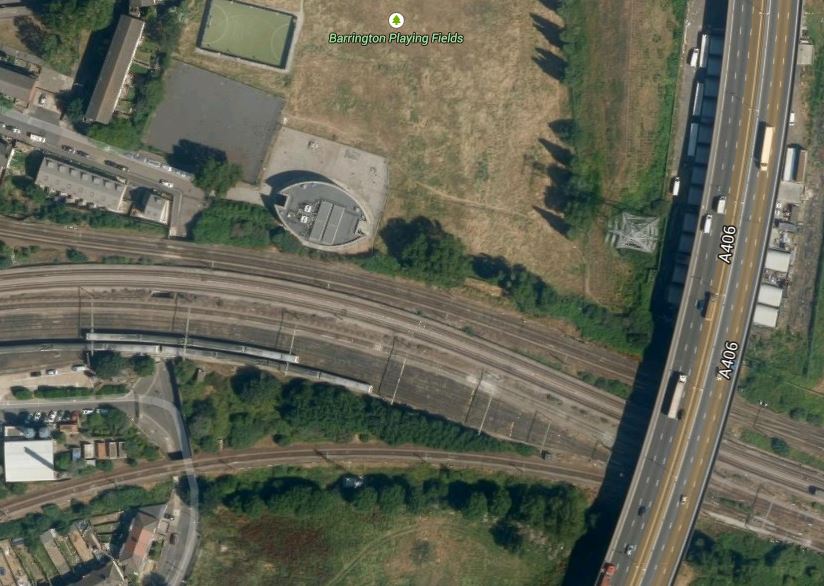
Barrington Road Ventilation Shaft
Note that the shaft is to the north of the train lines going into Barking station and to the west of the A406 road. I took these pictures from trains passing through the area.




I reckon that you possibly get the best view of the building on top of the ventilation shaft from a eastbound, District or Metropolitan Line train with clean windows. Unless of course, you walk to the Barrington Playing Field from East Ham station.
3. Woodgrange Road Ventilation Shaft
This shaft is located south of Forest Gate station and is shown on this Google Earth image.
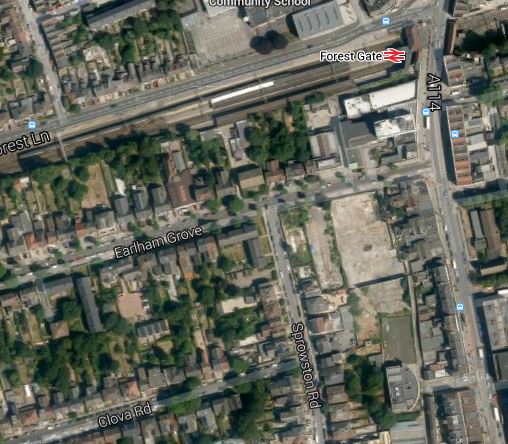
Woodgrange Road Ventilation Shaft
Forest Gate station is on the Great Eastern Main Line out of Liverpool Street and later next month, it will be taken over by Crossrail.
The shaft is directly underneath the station, but would appear to be more tucked away in buildings than the shafts at Wayside and Barrington Road.
It is also the only ventilation shaft for the tunnel, that doesn’t have a full elliptical building on top.
I tried to take a decent picture of the building, but you can only see one side between the houses.

The only point to note, is that in a previous building on the site, Jimmi Hendrix wrote Purple Haze.
4. Graham Road Ventilation Shaft
This shaft is east of Dalston and just to the west of Hackney Central station, close to the North London Line, under which the Channel Tunnel Rail Link was bored.
It is shown on this Google Earth image.
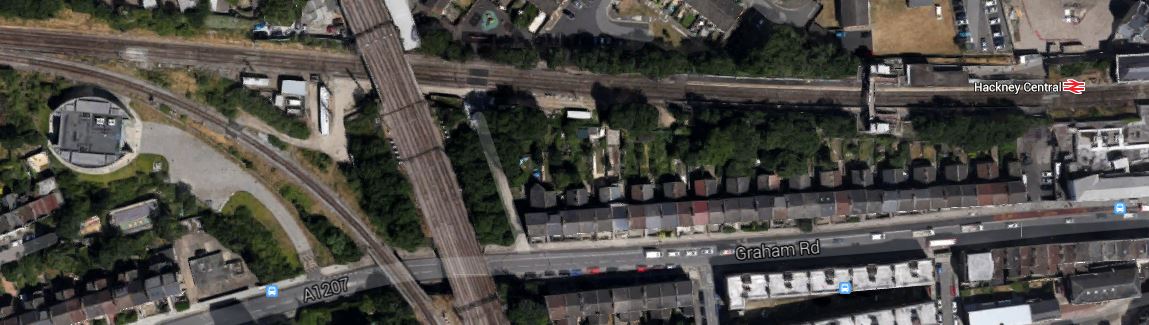
Graham Road Ventilation Shaft
Note how it lies close to the curve that links the North London and Lea Valley Lines, just to the south-west of where the two lines cross, which in turn is to the west of Hackney Central station.
I was able to take these pictures from a train on the North London Line.


I shall attempt to take a few more.
5. Corsica Street Ventilation Shaft
This shaft is just east of Highbury and Islington station and is shown on this Google Earth image.
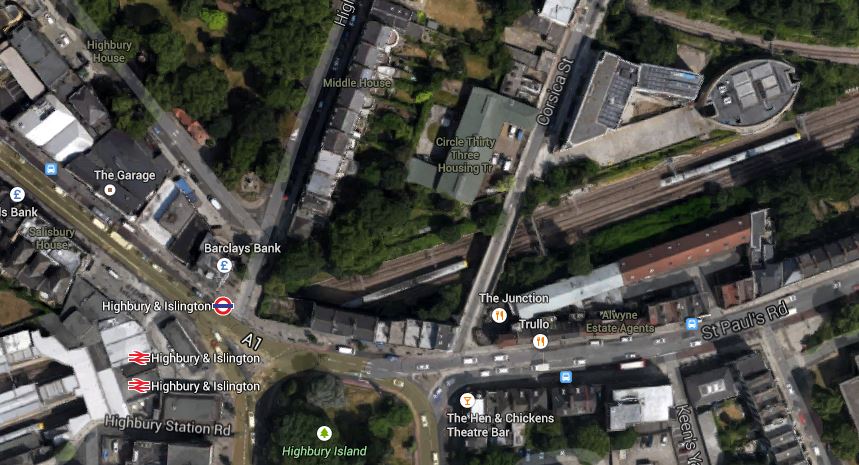
Corsica Street Ventilation Shaft
It is another shaft with an elliptical building on top, which you can see in the top-right corner of the image.
I was able to take these pictures.




Some were taken from Corsica Street looking through the gate and the others from passing trains.
These structures have more than a touch of the Martello Tower about them! Ironic really, as these ventilation shafts are there to help encourage the French to visit, whereas the Towers were built to repel Napoleon.
Sorting Out Highbury Corner And Highbury And Islington Station
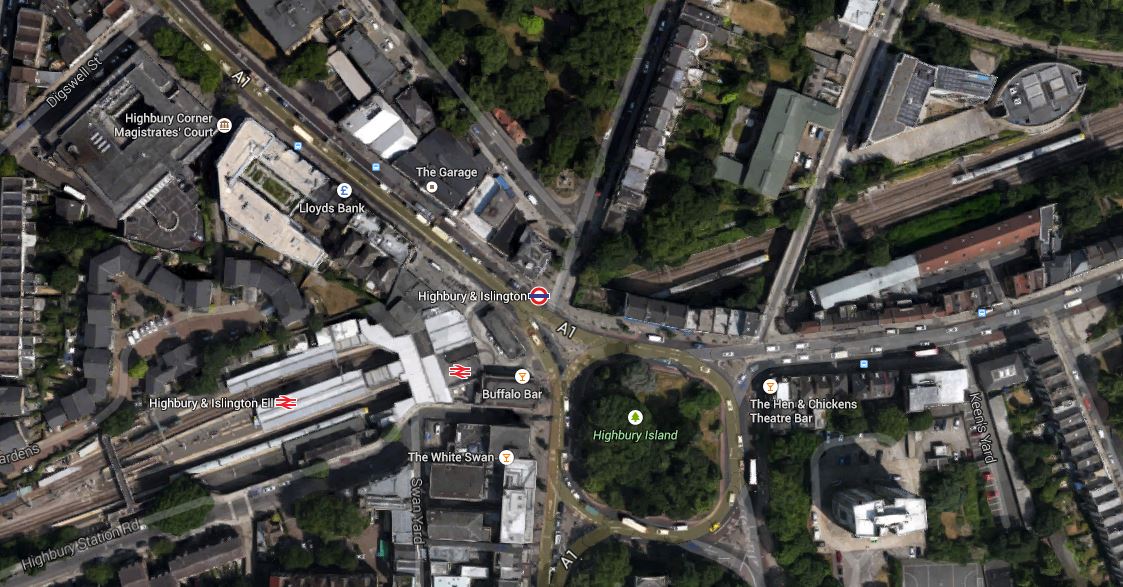
Highbury Corner is an important transport hub in Islington, where traffic from the City starts to squeeze up the A1 to get North. It also contains the important but badly-designed rail station of Highbury and Islington. This Google Earth image shows the area.
Highbury Corner
Note the green space named as Highbury Island in the middle of the junction with traffic going all the way round in both directions.
The road leading off to the North West (top-left) is the A1, which goes up the Holloway Road to Archway, which is another major junction, that needs a good sorting. The road leading to the East is St. Paul’s Road, which leads to the Balls Pond Road and Dalston Junction. The roads leading to the south from the island are extremely congested at all times and all the way to the Angel and Old Street respectively. They are the sort of roads, that make me glad, I don’t drive any more.
The junction is a pedestrian’s nightmare, as you are constantly crossing busy roads on light-controlled crossings.
What I find particularly difficult is that to get from the stop where buses from my house arrive in St.Paul’s Road to Highbury and Islington station involves two road crossings. It’s so tiresome, that often if I need the Victoria or Northern City Line at the station, I’ll walk to Dalston Junction station and get the North London Line for two stops. Coming home, I’ll get the North London Line back to Dalston Junction and then get any of four buses back towards Highbury Corner to my house.
It’s not quicker, but it’s certainly easier and definitely more pleasant in bad weather.
This illustrates how bad Highbury Corner is for buses, which like the vehicle routes need a very good sorting.
Add to this that Highbury and Islington station is a dreadful 1960s station, that has inadequate access to the two deep lines. To be fair though, access to the four London Overground platforms is a lot better. I have written before that there could also be access to these platforms from the other end, but that may well happen, when a new station is developed.
At the present time, work is ongoing to clear the area in front of the station, by removing the old Post Office, before the main bridge that carries the A1 over the railway is replaced.
In July 2004, Islington Council produced a planning framework for the area. It is packed full of information and some worthwhile proposals.
It suggests the following.
1. Giving public access to Highbury Island and turning it into a green oasis with facilities.
2. Proposals to simplify the traffic flows, with a strong hint, that traffic on the Western side of the Highbury island be closed off.
3. In the rebuilding of the station, it says that building could incorporate extensive development over the North London Line tracks for residential or other purposes.
4. Using the old Highbury and Islington station on the North side of the junction to create a new access for escalators and lifts to the lines deep under the station.
The report also told me, the purpose of the strange elliptical building on the north side of the North London Line, which is at the top-right of the Google image. It’s the vent shaft for the Channel Tunnel Rail Link.
Hopefully, in the next few years, we’ll see the sorting out of the area.
1
The Tories Will Aim To Cut Inheritance Tax
According to this article on the BBC, a future Tory government would end Inheritance Tax on family homes up to a million pounds.
I have form in opinions in this area and had a letter published in the Financial Times in 2006 about this tax, after an article in the paper on March 31st 2006 advocated the killing off of the tax. This is the first two paragraphs of the letter.
I have been against inheritance tax for years, not because I would benefit from its abolition or because I am getting to that age, when I should start to do something about it (“Inheritance tax should be killed off”, March 31). It is just that as a control engineer by training, I think it does untold secondary damage.
Consider: how many bright minds are employed on both sides of the inheritance tax war in avoiding and collecting the tax? Abolish it and they would have to do a proper wealth-creating job.
I still believe that the Inheritance Tax should be abolished, if not totally, but substantially! I don’t have current figures but in 2006, it only raised half as much as Air Passenger Duty in that year. I’m not alone on thinking this way as this article from the Telegraph in 2013 shows. This paragraph is from the article.
Yet the tax raises just £2.9bn a year, a mere 0.18pc of GDP, a tiny sum given all of the collateral damage caused and one which could easily be recouped by accelerating the Government’s savings programme.
David Cameron’s proposals are welcome, but pretty timid and will only have a limited positive effect on the economy compared to what full abolition will have.
The tax revenue would have to be replaced and as a BBC survey showed in 2006, that people would prefer a couple of pence on Income Tax. These days other and better options exist. The problems with abolishing Inheritance Tax are all political rather than economic, as if the Tories went for full abolition, the Labour Party would have a field day, saying they were looking after their friends.
They’ll probably do that with David Cameron’s announcement, even though probably nearly half of the beneficiaries of the tax reduction will be Labour voters.
The Future Of Pay As You Go (PAYG) Energy
Before I bought this house, it had been tenanted and because of the letters I’ve received since, I reckon that quite a few tenants skipped owing money to energy suppliers. Because of this, the house had a PAYG gas meter that used a key. I never used it for more than aa day or so, as the energy company I chose, replaced it with a normal one.
Using PAYG must be a nightmare for a family with problems, either monetary or organisational. So when I saw OVO Energy had brought in a PAYG system that worked on-line, I started following reports of the system.
Today I’ve picked up this comprehensive article from the Yorkshire Post. This is the first couple of paragraphs.
Thousands of Yorkshire customers who have been paying over the odds for their gas and electricity may be in for some relief – so long as they have a computer, email address and bank account.
British company Ovo Energy has just launched the UK’s first full-service, smart, pay-as-you-go (PAYG) energy platform, Smart PAYG+, which offers the cheapest pre-payment tariff in the country.
Eventually, this is how people with a computer, e-mail address and bank account will pay for PAYG energy.
OVO’s Smart PAYG+ system seems to be a very good design and will have applications outside of where the current key meters are used. OVO says this.
If you’re a prepayment energy customer, or even if you’re not, why not switch to OVO Smart PAYG energy? It takes away the hassle of paying for your gas and electricity. OVO gives you a choice of two ways to Pay As You Go.
I think that this technology will be used in some surprising places. I doubt I’ll be changing, but my energy use is rather erratic and sometimes I’m deep in credit with my energy supplier, who is OVO. PAYG would allow me to have a minimum credit at all times.
Avoiding The Real Issues In The NHS
All the political parties seem to be promising more and more to the NHS in this election, be it money, drugs, doctors, nurses or midwives.
Money could be the least of the problems, as it will probably come from improvements to the economy or some tax-the-rich measure, depending on your political point of view.
As drugs are not really a drug problem, but usually a money one, we are left with where to we get the tens of thousands of staff we need to provide health-care.
The trouble is that being a health professional, is a skill you can use anywhere in the world, as all human beings are the same under the skin, even if they come in various colours, speak different languages and have certain different diseases governed by genetics or environment. So just as we can recruit paramedics from the Antipodes, nurses from the Philippines and doctors from virtually everywhere, other countries can entice our health professionals away.
We live in an increasingly global society, and working abroad for a few years is often in many peoples desired career profile, be it in health care or not. Healthcare like certain other professions is one of those that gives you a passport to a lot of interesting places.
All manpower planning in the NHS seems to believe that those trained here, will stay here. But all good training does is hand everybody that passport to travel.
To make matters worse, good training for some professions, is an excellent grounding to starting a business or working in the private sector.
So the first issue we must face, is this one of where do we get the staff. The NHS has shown itself to be not very innovative in this area.
Some have suggested in the past, that anybody trained in the NHS must contract to work for the service for so many years. This is just cloud-cuckoo thinking.
The one positive thing that can be done to help staff is to provide better working conditions and rewards for those working in the NHS. Most of the NHS buildings, I’ve seen in the last ten years have been pretty sound, with perhaps the odd exception, so we must look at the problems of staff with respect to organisation, management, pay and pensions.
What I do find interesting is that all of the Practice Nurses I’ve met in GPs surgeries seem to be so much happier in their work than those in hospitals. It’s only a small survey, but it does say something about the difference between GP’s surgeries and hospitals.
When I’ve spent time in hospital in the past few years, it has been been twice in good NHS hospitals and once in an expensive private one in Hong Kong. There was little difference in the equipment or methods used, but as an IT professional of some years experience, I don’t believe that hospital systems are what an engineer or manager would accept if they worked in say a modern car factory in the UK.
So we must get hospital and GP health systems to the levels that patients and staff expect in their personal life.
Where is an on-line copy of my health record, that I can read to get to the bottom of my problems, that seem to occur seasonally in the Spring?
But things are changing and we must create a health communication and information system, that is an order of magnitude better than what we have today.
No political party is saying they’ll fix this important gap in the NHS.
Everything in our lives is going on to our computers or phones, but healthcare in the NHS hasn’t changed that much since I was born in 1947.
Some people rightly worry about such a computer system. But at its best it would only be like an on-line shopping system, where if you don’t see what you need on-line at your favourite store, you go and look at a physical one.
In all the politicians posturing on health, they very much ignore the users of the NHS and what they can do to improve the service and its efficiency.
I would be interested to see an analysis of how much the average patient costs the NHS. I suspect that because of the lack of a fully joined-up computer system, if I had complete access and wanted to find out how much I cost the NHS last year, no accurate value could be calculated.
Many people calculate their motoring costs to the last penny, but even if they wanted to, it’s probably impossible with healthcare, even though all the data is there.
Eventually, everybody will have this figure, as it could be a powerful tool for a GP to classify and better treat their patients and as a motivator to patients to improve their lifestyle. You’ll never change some patients, but many could be nudged in the right direction.
We must also do more to ease our load on the NHS. On a personal level, I look after my INR, by doing my own tests. A Committee of MPs has stated that all NHS patients who can, should do their own testing to save the NHS a lot of money.
How many other measurements can be taken by patients to ease the load? And are we doing enough to encourage more and better devices?
In no political party’s pontifications on the NHS, can I find anything about bringing the patient more into his or her own healthcare. But many doctors and nurses have said to me that we should take more responsibility for our own health.
After all, many of us now carry a tablet or phone, that has more computing and information accessing capability than existed anywhere ten years ago. Is this being used to give us better healthcare? Not really!
Political parties are not tackling the problems caused by our poor diet, lifestyle and environment.
Where I live, there are more unhealthy takeaways than you need to try a new one every week of the year. Not one sells any gluten-free food, so their chances of seducing me with their crap is non-existent.
Even the Sainsburys Local that I use is not a store,where you can always get the staples you need to create a healthy meal. Yesterday, I needed a couple of haddock fillets for supper, but except for some very bedraggled and unappetising cod, there was no uncoated fish. So I had to take a bus to the Angel to get some from Waitrose. Does a lack of healthy food locally mean that many don’t eat as healthily as I do? I am out and about in London most days using my Freedom Pass, so it is not difficult for me to pick up what I need on the go. But a young mother with an infant in a buggy doesn’t have that luxury. It’s not the shops’ fault, as they only stock what the shop sells!
The only positive thing government can do in this area, is to give local authorities more power to decide what shops they allow in their area.
I haven’t seen anything like this in any manifesto.
We should also do things to curb air pollution, which can get bad at times. All city centre transport, should either be electric or very low emission vehicles.
But again, no-one wants to annoy people, except the Greens, who won’t win anyway.
I suppose smoking comes into this area. Any candidate for London Mayor, who decides to ban it in public parks, squares and in the vicinity of bus stops gets my vote next time.
Perhaps candidates for the election, should have to declare if they smoke or not and what car they drive on the ballot paper!
Do we also give our children an education that will help them get through the minefield that is health? We give sex education in schools, but surely health education is just as, if not more important!
We need to think radically, about how we deliver healthcare and before we throw money at it, we should sort out the details on how it is delivered, how it interacts with patients and the fasctors that affect it.
Conservative 1940s thinking has failed and we must bring the NHS into the twenty-first century.
Crossrail In The New Yorker
According to Wikipedia, the New Yorker is an American magazine of reportage, commentary, criticism, essays, fiction, satire, cartoons, and poetry.
This serious article from the magazine, which discusses the archaeology around the new rail line, is well worth a read.
Confusion Over The Weather
This morning, the BBC ought to get its messages on the weather consistent.
Their headline is that there will be high pollution levels in the South East, which they illustrate with pictures of London.
But the weather babe on BBC London hasn’t mentioned the pollution, despite her forecast covering a lot of the South East.
And then the two presenters have just said it’s going to be a lovely day out there today.
It’s all confusing and I’ll ignore the lot of it and use my Mark One eyeballs.
How To Redesign An Everyday Object
Electricity pylons in the UK are generally made to a design that dates from the 1920s. So National Grid, who are responsible decided to have a design competition in partnership with RIBA.
According to this story on the BBC, National Grid are putting up a test line of the winner to teach engineers how to put them up.
They certainly look to be an improvement, but after nearly a hundred years, you’d expect that!
National Grid has also put up a blog.
I like the new pylons and hope to photograph them soon!
Disconnected Croydon
Connected Croydon is a programme of public works to improve Croydon’s streets, squares and open spaces.
On Tuesday, I had a simple need to go to IKEA Croydon, which is served by the Ampere Way tram stop, to meet an e-friend, who’d seen my musing about creating a new IKEA Kitchen. We’d agreed to meet at 13:00 and as I knew the journey well, I took a timely train from Whitechapel to get to Croydon about 12:30, which would have given me time to walk through Croydon to one of the tram stops like George Street that are served by trams going to Wimbledon.
But there had been no warning that the trams weren’t running through Croydon town centre and an Overground employee told me, I must walk to Reeve’s Corner tram stop.
But I don’t know Croydon at all, except from on a tram or train passing through, so I got lost and walked to East Croydon, where a sensible man told me that there were no trams and I would need a 410 bus to get to Reeve’s Corner. But the bus information system didn’t call out Reeve’s Corner, so I ended up two stops down the line at Wandle Park, where the information system said that I’d hjave to wait twenty-seven minutes for a tram to IKEA.
Luckily, the display was wrong and a geezer with a clipboard, said that was par for the course, so I eventually got to IKEA at 13:30 or so, after my friend had had to give up.
I didn’t muck about coming home and avoided Croydon by going the long way round via Wimbledon.
Connected Croydon? Pull the other one!
Or at least put up some signs that can be understood by visitors! And a Tram Replacement Bus would have helped this simple soul!
On the other hand, perhaps, they don’t want visitors!
My mother was right, when she told me not to go south of the Thames, as you get lost!
 The Anonymous Widower