My Hotel In Cardiff
I’m not going to name it, as I’d probably think about using it again, despite its problems.
It was a bit out of the City Centre and I was able to walk there easily.
But it was a bit down-market for my tastes and I can’t remember the last hotel, I stayed in with only a wash-basin in the room.
It was comfortable and clean, but in some respects, I think the hotel had another purpose, as the television was showing a gay dating site, when I switched it on.
I can understand why I prefer ladies, as middle-aged men can be so ugly, especially if they’re carrying a few extra pounds. Switching away was the problem, as the remote control needed new batteries and was rather unresponsive.
But then what can you expect for £31.50 in cash?
A Big Lith In Cardiff
I was greeted by this large lith at Cardiff Station.
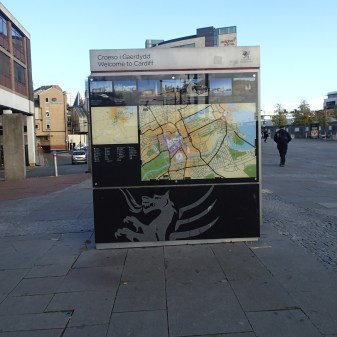
A Big Lith In Cardiff
Every main station and bus station should have one.
To Cardiff In A Factory Fresh Thirty Year Old Train
All of the InterCity 125 trains, that fly to the West, are over thirty years now. But on my trip to Cardiff in First Class for the princely sum of £24.25, I got one fresh out of the factory, with technology and style, that wouldn’t be out of place in a five-star hotel.
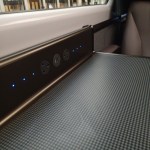
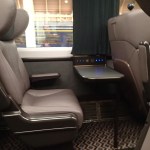

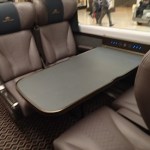

The wi-fi system was supposed not to be in operation, but I’m pretty certain I freely linked to it all the way to Wales, except for the Severn Tunnel.
As an experiment, I’ve just tried to book a train to Cardiff and back on the 29th. Return with my Senior Railcard, leaving afer 09:00 and returning after 18:00 would cost me £63. Incidentally, t would be around £90 without the Railcard.
The driving distance is 151 miles both ways, so surely you’ll be slower by road.
And you won’t get free glasses of wine to help the journey go by!
Getting To Paddington Station
Over the last couple of weeks, as I’ve been taking my Before Crossrail pictures and going to St. Ives, I’ve been going to Paddington station, rather a lot.
If I haven’t got tickets and I’m going to say Reading or Slough, I always go via Dalston Junction to get the tickets in the machine there, as I get the best price that is otherwise only available with the hassle of queuing up at a Ticket Office.
Transport for London’s recommended route says get to Highbury and Islington station and use the Victoria and Bakerloo lines to get to Paddington. It suggests a time of just over thirty minutes.
But there are some problems with this route, especially if I get a bus to Highbury and Islington.
- There is as much walking, as going to Dalston Junction.
- The ticket machines at Highbury and Islington don’t issue tickets from the Zone 6 Boundary, so I have to pay for an unneeded journey from Paddington to West Drayton.
- In the rush hour or at busy times, this route is horrendous, due to the inadequate Victoria line.
- Sometimes, buses to the station are hard to find, due to heavy traffic on the Balls Pond Road.
It may be the quickest at times, but it is never the easiest.
I tend to go one of two routes.
- I often use the Overground to Whitechapel and then the Hammersmith and City line to Paddington. This route has the advantage that it is air-conditioned all the way, but it takes about a dozen minutes longer, than the recommended route.
- If I take a bus to Kings Cross and then take the Hammersmith and City line, this can be around forty minutes.
But if I want to go on a main line train out of Paddington, it puts me at the wrong end of the station, unless I have a booked train.
Today, I’m going to Cardiff on the 13:45 train out of Paddington. As I’m taking my own gluten-free sandwiches and I won’t have to buy a drink, I shall use the Whitechapel route, leaving before 12:30.
Crossrail will change all this in that I’ll still get to Whitechapel in eight minutes and then it’ll be thirteen minutes to Paddington. So it should be under half-an-hour between the two stations and we’ll all probably be delivered to the convenient end of Paddington.
It is interesting to apply my mother’s rule of two minutes a station and five minutes for an interchange to the before and after Crossrail routes via Whitechapel.
Before Crossrail – 35 minutes
After Crossrail – 23 minutes
It’ll be fascinating to see whether the twenty-three minute figure is regularly beaten. Hopefully as the interchange at Whitechapel will be quicker, Paddington station will be much easier and the trains on Crossrail will be very frequent, this will be the case.
Before Crossrail – Iver
A Quaint Small Station With Bad Access – Rating 4/10
Iver was the last Crossrail station I visited and I didn’t save the best to last.
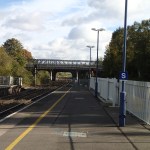


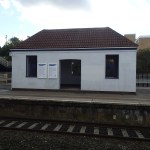
This is the Google Map of the station.
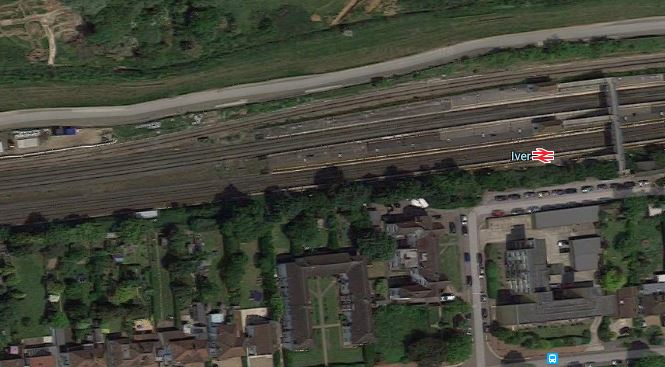
Iver station – Downloaded 6th July 2015
Iver could become part of the Heathrow Hub in the future, but for Crossrail it will need lifts and updated buildings.
An Aerial Look At West Drayton Station
In my visit to West Drayton station, I also noted a railway line going away from the main line towards the North West.
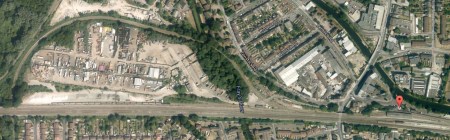
West Drayton Station
In this aerial view you can clearly see it branching away at the station, which is marked by the red arrow. It then curves round to go under the Great Western Main Line in a Southerly direction, at the far left of the picture.
This is the Staines and West Drayton Railway and the northern section from West Drayton to Colnbrook is still used by freight trains. Some take fuel to a depot near Heathrow.
It seems to me over the last few years, there have been several proposals to improve the links from places like Reading and the West and Waterloo and South London, some of which pass through this area. But none seem to build on and improve this line.
We know that trains will be able to get from Reading and the West to Heathrow, but all projects to Waterloo and South London like Airtrack, seem to have foundered until now.
On the other hand, when Crossrail and Thameslink are fully operational in 2019, it looks like the journey time between East Croydon and Heathrow, changing at Farringdon will be around an hour. Currently, it looks like it’s a couple of minutes over an hour and a half, with two changes. Fast times need a trip on the expensive Heathrow Express.
I think that the only certainty is that in the next ten years or so, Heathrow and Crossrail/Thameslink will have a tremendous influence on railways in the vicinity of West London.
The Clapham Kiss – Where East Meets West
I took these two pictures, as I went from Shepherds Bush to Dalston Junction stations this afternoon on the London Overground.
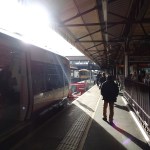
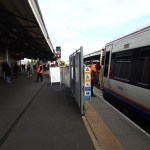
Normally, I’d take a northbound train at Shepherds Bush direct to Highbury and Islington or Canonbury, where I would use the footbridge to crossover to get on a train for Dalston Junction. The reason I like to end up in Dalston Junction station, is that there are lots of buses down the Balls Pond Road to my house and they mean, I don’t have to cross any roads.
But at Shepherds Bush, this would have meant waiting nearly ten minutes for a northbound train, so I took the first train to Clapham Junction. A factor that influenced my choice was that to change between the two trains, is just a short walk up the platform.
I spoke to the driver, who was very pleased, as they don’t always meet as precisely as this, although that is what’s intended.
But the whole layout at Clapham Junction shows that a little bit of innovative thinking can often make things better for all concerned.
Buses In West London
I have taken quite a few buses in West London in recent days.
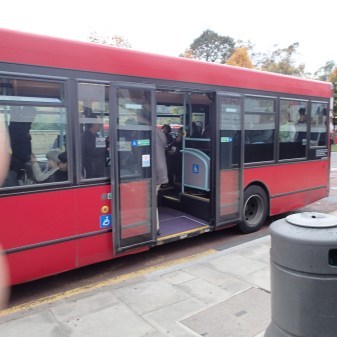
A Rather Tired West London Bus
But I can’t help feeling that the quality of some is not what we would put up with in the East.
The single-decker shown seemed rather tired with only an intermittently working information system and it seemed to struggle its way around. Luckily, I knew I wanted to get off at Ealing Hospital, which although it wasn’t announced by the bus, the hospital was obvious, as there wasn’t another large building with numerous ambulances in front.
Before Crossrail – The Wharncliffe Viaduct
Crossrail is a new railway from Reading in the West to Shenfield in the East.
But not everything is going to be brand new!
For example, the Grade 1 listed, Wharncliffe Viaduct, will be used to take the line over the River Brent, just as it has taken the Great Western Main Line since 1837.
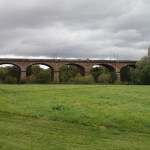
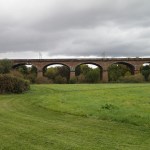
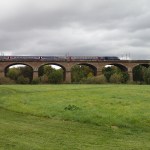
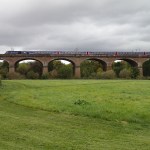
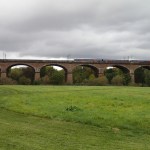

Modifications are probably quite small as the current four lines are already electrified. Two of these will be used by Crossrail.
The viaduct ticks all the boxes on everybody’s lists.
- It was designed by IK Brunel
- It is Grade 1 Listed and is part of the submission to get the Great Western Railway declared a World Heritage Site.
- Pevsner said “Few viaducts have such architectural panache” about this viaduct.
- It is inhabited by a colony of bats.
- The electrification of the bridge was carried out in a sympathetic manner.
But above all, it would appear it is up to the job for which it is to be used.
You have to admit, that the Victorians knew how to build with brick!
My Crazy Electricity Meter
My electricity meter is baffling me.
These are my dates and readings.
20-Oct – 37108
14-Oct – 37049
18-Sep – 38777
08-Sep – 38843
15-Aug – 38331
16-Jul – 36764
17-Jun – 35353
I can explain all of the figures until September the 8th, when because of the heat in July and August, I was using the air-conditioning a lot.
But the last few readings indicate to me, that something has gone wrong.
I have phoned my supplier; OVO, and they seem to be worried too. After my previous billing experience with nPower, I’m glad I’ve changed.
 The Anonymous Widower