UKIP Would Shrink Without The Internet
This was the title of an article in The Times yesterday by Hugo Rifkind, in which he comes to some interesting conclusions. I particularly liked this bit.
The decline of traditional media — of printed newspapers, limited radio stations, and everybody watching the same TV news — is best understood as the end of media deference. No longer must we gain our understanding of the world via information collected, curated and presented by others. Instead, we can go looking for whatever we like. Consciously or otherwise, we each build our own little online universe.
I think that Rifkind is right and the world will be a worse place because people will not hear any views opposed to their own.
Do As I Say Not As I Do!
I don’t support Greenpeace directly, although I follow some of their ideas and I’m happy to use their research to back up a principle I believe in.
My reasons for not supporting them financially, is that they have chugged me and I don’t support charities who do that.
But also, I feel some of their stunts are more about raising money than anything else.
I also feel in some cases their views are wrong and that these views have set back the lot of some people, who don’t live in the same decent circumstances, as most who work for and support the charity.
But today, I read the report on how one of their senior executives commutes from Luxembourg to Amsterdam by air, rather than uses the train. It’s reported in several newspapers and the report in the Daily Mail is here.
On reading this report, I suspect a lot of Greenpeace’s supporters have decided not to do so any more!
It’s not as though there aren’t other charities working in the same area.
Boys With Be Boys
There is a lot of speculation in the media, as why Muslim men are flocking to fight in Syria and Iraq.
Was it ever any different?
Go back to the Middle Ages and it was rape and pillage in the Crusades or with Henry the fifth, and later it was piracy with Drake and Grenville.
Nelson And Wellington were not short of volunteers and in Victorian times, it was all about Empire building, with a small personal fortune thrown in, if you were lucky!
Perhaps the nearest parallel to that of Syria and Iraq today, was the International Brigades of the Spanish Civil War. Many of those who fought in the Brigades or openly supported them went on to be important figures in later life.
You could also argue that both the First and Second World War was an outlet for many men, who had an excess of testosterone.
I also remember a General, saying that the Falklands War did a lot of good for Army recruitment.
I am a pacifist or more likely a coward, but we shouldn’t be too quick to condemn those, who go to fight in Iraq and Syria.
The ones we should condemn are the countries and arms dealers, who are giving the likes of the odious President Assad, the weapons they are using to kill their own people.
Getting Your Money Back On Oyster
I don’t use my Oyster card much on London’s transport system, as I have a Freedom Pass.
But I do appreciate how difficult it could be to get a refund on a journey that has gone wrong. So this story about getting refunds on-line through Oyster is to be welcomed. Here’s an extract.
Whilst the system for taking your money is very slick – automatic Oyster top-up, contactless payment – getting it back has been a laborious process, with a lengthy online or even pen-and-paper form.
Sigh no more, commuters. From today, TfL are making it easier to get a refund for late Underground and Overground trains.
Now, instead of entering all of your personal information every time your Underground or DLR train is 15 minutes late (or 30 minutes if you’re on the Overground), you can set up an account that holds it all, so you only have to put in the details of your late journey.
This does show how the way public transport ticketing is going.
With only a few days now before London’s buses go cashless and as it looks like the Underground and Overground will go the same way soon, London is eliminating the hassle from public transport.
As Oyster can now be topped-up automatically, I wonder how many companies now give employees an Oyster card, that the company tops up automatically? Take say a bit employer like University College Hospital, where there is no staff parking, would a company Oyster card be a simple perk to recruit and retain staff.
Transport for London seems to be becoming a giant computer system, with large numbers of ride-on terminals. Wouldn’t it be nice if black taxis and the bikes were able to be charged to Oyster?
The Police Workload Due To Social Media
According to this article on the BBC, social media crimes are at least half of all frontline Police work. Here’s the first two paragraphs.
Complaints originating from social media make up “at least half” of a front-line police officer’s work, a senior officer has told the BBC.
Chief Constable Alex Marshall, head of the College of Policing, said the number of crimes arising from social media represented “a real problem”.
I’m not against reporting these crimes to the Police in any way, but I do think that this is a rather large load on the Police.
As a programmer, who has worked in data analysis for many years and as I feel I understand the Internet very well, I do not feel it is beyond the wit of programmers and companies to create a robust and trusted Internet-based system to deal with all the annoyances of the modern age.
Obviously, you could still go to the Police directly, but if say forwarding an offensive message to a semi-automated system had a sensible outcome, you might find this less trouble.
There are very few things that because of my physical and mental make-up that can be said to me as abuse. Although, I do get fed-up with some spam messages that seem to come to me every day. But I can understand how some people get offended and need their tormentors stopped.
I believe that a well-programmed system could handle much of the abuse and unwanted messages we get. If it became trusted and the sanctions it had taken against persistent nuisances were respected, people would think twice before sending offensive messages.
It might even stop crime and disrupt terrorist networks. As I write this, it has been said on the BBC, that you can follow what is going on with ISIS in Iraq through Twitter.
But then politicians don’t understand the power of technology and especially don’t like being bypassed by it. So we are more likely to see draconian laws on social media.
Man Gets Stuck In A Vagina
This story was the most looked at on the BBC’s web site, so I had to link to it.
I should say it was a stone statue and the man was an American student.
I Never Thought I’d Eat A Supermarket Quiche Again!
I’m probably not a real man, as I quite like quiche. But coeliacs don’t get much chance to eat one from a supermarket or chain store, as let’s face it, they only think we like food made from cardboard. But after their sandwiches on Saturday, I just had to try Marks and Spencer’s new gluten-free quiche.
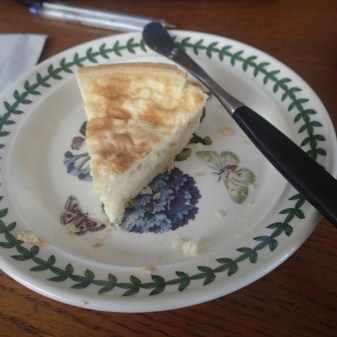
I Never Thought I’d Eat A Supermarket Quiche Again!
It was pretty good. Let’s hope that their new gluten-free foods are still being made in a few years time.
I gave my fitness trainer a piece and she said it had a touch of the home made about it.
But then I’ve never made or rolled pastry in my life.
Did Manchester Railways Ever Have A Plot?
What are the two odd ones out of these British cities?
Birmingham, Bristol, Cardiff, Derby, Edinburgh, Glasgow, Leeds, Liverpool, Manchester, Newcastle, Nottingham and Sheffield
It’s actually, Glasgow and Manchester, as they are only cities other than London with two main stations. The pedantic could argue that Birmingham has more than one, but New Street is very much larger than the others.
Glasgow’s two station; Central and Queen Street, split their services geographically, but at least they could be connected by Crossrail Glasgow, which is summed up like this.
The proposed Crossrail initiative involves electrifying and reopening the City Union Line for regular passenger use in conjunction with new filler sections of track which will connect the North Clyde, Ayrshire, and Kilmarnock and East Kilbride suburban routes together, therefore allowing through running of services through the centre of Glasgow in a North-South axis.
The scheme never saw fruition however. Will any Glaswegian tell me why, as on paper it looks sensible?
Manchester has a similar problem with two stations at Piccadilly and Victoria. If I’m going to say Burnley or Blackburn, as I often have and want to have lunch at Carluccio’s in Piccadilly, I find I have to traipse across Manchester, usually in the rain, to get the train out of Victoria.
There was a plan in the 1970s for the Picc-Vicc Tunnel, but like the Crossrail Glasgow it has been cancelled.
So now the Ordsall Chord is being built to allow trains to cross Manchester city centre.
It may work well in the end, but it has a touch of the old answer of “I wouldn’t start from here!” to the question of how to get to X.
The proof of the pudding will be in the eating, but it doesn’t seem to be a concept that can catch the imagination of the public, like some public transport schemes do.
Crossrail Of The North
Is it farther between Liverpool and Hull or from London to Norwich?
Actually, they are about the same being around two hundred kilometres for both.
But compare the train times between the two city pairs.
Liverpool to Hull takes three and a quarter hours, with at least one change, whereas London to Norwich takes five minutes under two hours.
Actually, the London to Norwich service hasn’t improved much since the 1960s, as British Rail’s aspiration then had the catchy phrase of a two-hour, two-stop service.
Since then the line has been electrified and a typical train stops up to six times on the route, with eight coach services running twice every hour.
You might think, that being that the line runs across the flat East Anglian countryside that it is a railway on which high speeds of the order of two hundred kilometres per hour are possible.
But you’d be wrong, as the line isn’t straight and the maximum speed is only a hundred and sixty!
Even so, plans are afoot to do the London to Norwich trip in ninety minutes, probably using the current trains, albeit with perhaps some new locomotives.
All this shows what a disgrace the rail routes across the North of England are.
Few are electrified and trains are often scrapyard specials. There are some new trains, but these are seriously overcrowded.
Politicians should hang their heads in shame.
At least George Osborne seems to be thinking about it, judging by reports on the BBC this morning.
The North of England needs a high frequency and high capacity, world-class railway linking the main cities together. As with London to Norwich, Liverpool to Hull should be at least twice an hour in ninety minutes or less. It should all be possible with good 1980s, let alone the best modern, technology.
The Future Of Railways In East Anglia
There are several major drivers of growth in the usage of the railways in East Anglia, which for the purpose of this analysis is the four eastern counties of Cambridgeshire, Essex, Norfolk and Suffolk.
Freight
The Port of Felixstowe and to a certain extent those of Harwich, Great Yarmouth and London Gateway are going to add considerably to the number of trains trundling around the railways of East Anglia. The interim destinations of these trains for onward journeys to the rest of the country will be London and Peterborough, using either the Great Eastern Main Line, the Ipswich to Ely Line or the London, Tilbury and Southend Line.
The LTS is mentioned as it is being connected to the London Gateway Port by a rail link and not all traffic will be directed through London.
Tourism
East Anglia has always earned a lot of income from a wide variety of tourism, from birdwatching to food and real ale and sailing to horse racing.
Many of the tourism hot-spots for East Anglia like Norwich and Cambridge already have a good rail service, although much of it is London-centric. Other places like Newmarket, Bury St. Edmunds and Great Yarmouth have the rail links, but don’t have frequent trains, but there are tourism hot-spots that are difficult to get to by public transport.
High Technology
Driven by Cambridge, high technology will be a big driver of growth in the area, but how will it effect the railways?
It already has.in that a station is being built at Cambridge Science Park, although I didn’t see any sign of construction, as I passed through yesterday. But the station is scheduled to open in 2016.
Just as with tourism everywhere, the high-technology sector in Cambridge, will generate increased passenger traffic. Just as London uses every place it can find in the South East of England as a dormitory, Cambridge will draw in workers from all the nearby towns.
But the high-technology itself will spill out from Cambridge into the surrounding towns, further increasing demand for rail services in places like Norwich, Peterborough, Newmarket and Bury St. Edmunds and possibly even unfashionable towns like Haverhill and Ipswich.
Thameslink
When Thameslink opens to Cambridge in 2018, it will be a massive feeder of passengers into the western side of East Anglia. The provisional timetable shows four semi-fast 12-car Class 700 trains to Cambridge every hour, as opposed to the two 8-car Class 365 trains at present. This will go a long way to reversing the dominant commuter flow from into London to out of London.
Incidentally, no plans have been published about what happens to the Kings Cross-Cambridge-Kings Lynn service using Class 365 trains after Thameslink opens.
If it is assumed that the current trains still go into Kings Cross, then that would mean about a quadrupling of the number of seats between Kings Cross/St. Pancras and Cambridge in each hour. If they don’t it’ll be a tripling of seats.
I know the line is crowded, but this does seem a hell of a lot of seats.
Crossrail
You might say that an east-west cross-London link won’t have any effect on East Anglia! But it will! And in ways we just don’t expect!
A fellow Ipswich supporter drives up to every home match from near Tonbridge over the Dartford Crossing and up the A12. He has stated that after Crossrail, he’ll drive to Abbey Wood and get the train to Liverpool Street for a fast train to Ipswich. I suspect Crossrail with its direct access to Liverpool Street, Heathrow and Reading will alter the travel habits of many travellers, going to and from East Anglia.
Improved Electrification
To my untrained eye, the overhead electrification being erected in the Liverpool-Preston-Manchester triangle is going up a lot faster and more robustly, than we would have expected a few years ago.
We’re just getting much better at it!
Remember too, that one of the major costs f railway electrification is getting the power to the track. Where electrification is tacked on to an existing system, it is a lot easier and more affordable.
Improved Signalling
Over the next decade signalling will move into the cabs of trains. It is a massive hidden project being undertaken by Network Rail, as is described here. This first two paragraphs say it all.
This tried and tested system will replace traditional railway signals with a computer display inside every train cab, reducing the costs of maintaining the railway, improving performance and enhancing safety.
It will offer a host of benefits to the railway and the application of its cab signalling component, the European Train Control System, ETCS, will spell the end for traditional signalling.
Who’s to say what difference this will make.
If it does nothing else, improved signalling will help slot all those freight trains between the passenger trains.
No More New Diesel Trains
I think it is very unlikely any new diesel trains will be built, although refurbished ones might come available, as lines are electrified.
Are any actually on order at the moment for any line in the UK? There are some Class 66, Class 68 and Class 88 diesel locomotives, but I can’t think of any diesel multiple units in the pipeline.
On the other hand, Thameslink, Crossrail and the London Overground will release a lot of electric multiple units, that will be very good candidates for a full refurbishment.
So what do I think will happen to railways in East Anglia in the near future?
Service Expectations
There are five major stations in East Anglia; Cambridge, Ely, Ipswich, Norwich and Peterborough. The service frequency between Ipswich and Norwich is one train every half hour, so it is probably a reasonable expectation that this is the frequency between any pair of stations
Outlying stations such as Felixstowe, Great Yarmouth and Lowestoft generally get an approximately hourly service from the nearest main town, so this should be maintained.
If we insist on half hour service frequency between Cambridge, Ipswich and Norwich, then this means that important stations like Bury St. Edmunds, Diss, Newmarket, Stowmarket and Thetford would get a half hour service frequency too.
This would mean that journeys like I did once from Newmarket to Great Yarmouth changing at Stowmarket and Norwich would be a lot easier.
Norwich in Ninety?
I’ve talked about this before here, and so has the BBC.
With the completion of the Bacon Factory Curve, one of the first projects to achieve the Norwich in Ninety goal has been completed. It will be interesting to see if London to Norwich on-time statistics improve, just as I feel they have on the Felixstowe branch.
I’ve just found this Network Rail press release, about improving the track at Colchester, which is work that is going on now. Will be see a lot more of these smaller engineering-led projects over the next few years to achieve Norwich in Ninety?
I think the answer is yes!
Network Rail’s Great Eastern Main Line engineers have lived off table scraps for years. But now that there is a political will to get something done, the fag packets and used envelopes will be retrieved from the bin and over pints of real ale in country pubs, they will be turned into viable projects.
My only question on Norwich in Ninety is that it is a typical project title chosen to ring well in the press. I wonder what is the minimum time, that has been revealed by the envelopes.
It certainly won’t be ninety!
You do have to wonder if there is anything more to come from the nearly forty-year-old Class 90 locomotives that push and pull the trains to and from Norwich. The engineers have won awards for the most improved trains, so there can’t be much improvement left. Hopefully any chances in the deterioration of the engines has been minimised.
I certainly look forward to my first sub sixty minute run to Ipswich.
Electrification Of Ipswich To Ely
I would assume, as this line all the way to Peterborough and eventually to Nuneaton has been recently cleared to take the larger freight containers that the line also has sufficient clearance to allow overhead lines to be erected.
So as the number of freight trains on this route is large, this line must be a prime candidate for electrification all the way to Nuneaton. Especially, as it crosses numerous electrifed lines, which would mean getting the power to the line won’t be too difficult.
I also found this article on Railfuture. They say this about creating an East-West electric spine.
Similarly to the already planned Freight Spine from Southampton, one from East to West would also be strategically beneficial. This would involve electrification of the whole line from Felixstowe to Birmingham, already being upgraded to take more freight trains by, for example, the new chord at Nuneaton. Broken down, Felixstowe to Ipswich would also facilitate through electric haulage for freight trains to/through London. Ipswich to Peterborough would gain access to the East Coast Mainline. Peterborough to Leicester (Syston) would do the same in respect of the Midland Main Line. Leicester (Wigston) to Nuneaton for the West Coast Mainline, and Nuneaton to Birmingham for all its freight terminals. A most useful bi-product would be for the Cross Country passenger service from Birmingham to Stansted Airport to convert to electric trains.
That all seems very sensible. Note the bi-product of releasing some much needed diesel multiple units, which would probably be replaced by larger electric units.
Electrification Of The Felixstowe Branch
As Railfuture said in the extract I used above, if you electrify to Nuneaton, you might as well electrify the Felixstowe branch, as that would virtually make the line electric freight only.
Electrification Of Ipswich To Cambridge
If the main Ipswich to Ely line is electrified, it may seem logical to also electrify the single track Cambridge branch of the line. But this may not be that easy, as there is a tunnel under Warren Hill at Newmarket and the line loading guage of the line hasn’t been updated.
But obviously, if the whole Ipswich to Ely and Cambridge system, it would make it easier to increase passenger capacity due to the easier availability of electric multiple units.
Electrification Of Ely To Norwich
There are no freight reasons to electrify the Breckland Line, but it is effectively fill-in electrification between two electrified lines, which should make it easier.
It is not cleared to a big loading gauge except around Ely, but many of the bridges are new, so I would suspect there wouldn’t be that much expensive bridgework to make the line suitable for electrification.
Unfortunately, the long distance service from Norwich to Liverpool couldn’t be converted to an electric traction, as it will still use non-electrified lines in the Sheffield area, but Nottingham trains could go electric if Nottingham to Grantham was electrified.
Consequences Of Electrification Of Ely To Peterborough
If Ely to Peterborough is electrified and the passenger trains were to run say every thirty minutes, then there would be less need for the diesel trains from Birmingham, Liverpool and Nottingham, to travel to Ipswich or Norwich, as there would just be a simple change to or from an electric train at Peterborough.
Electric services such as Cambridge to Peterborough via Ely could also be as traffic dictated, rather than infrequent as they are now! Peterborough to Cambridge services are important, as many in Cambridge feel that Peterborough could be a high-technology satellite to Cambridge. There have been proposals to extend the Cambridge Guided Busway to Peterborough, but I suspect a rail link might be preferable to passengers. The current rail service takes fifty minutes and runs once an hour, which isn’t good enough for a lot of people.
Would a frequent service between Cambridge and Peterborough, also improve employment prospects in the area?
Electrification Of The Great Yarmouth Branch
When I first moved back to near Ipswich in the 1970s, the London to Norwich trains went on to Great Yarmouth. Even in the 1980s, I can remember taking a direct train to Great Yarmouth from London to see a horse run at the racecourse there. But now, there are no direct services, except in the summer.
If the line was electrified, it would surely make it easier to more services to the town and possibly direct services to London.
Perhaps if the Breckland Line was electrified and running at the oreferred half-hour service, then every other train could be extended to Great Yarmouth. Or perhaps all of them?
The possibilities are endless.
One benefit of an electrified railway is that it might breathe new life into the outer harbour, which seems to suffer from white elephant syndrome.
Further Electrification
I don’t think any of the other branches would be worth electrifying.
Last year the electried Braintree branch carried about 800,000 passengers, whereas the Sudbury branch carried about 328,000. Felixstowe incidentally carried about 210,000, but whether that branch gets electrified depends on the freight traffic.
New Stations
East Anglia is already getting one new station at Cambridge Science Park, with another proposed for Great Blakenham, if the SnOasis gets built.
A couple of new stations have been added in East Anglia in recent years and I suspect that in the next few years several could open, especially where new housing or other developments are concerned.
New And Reopened Lines
As I said in the post about the North Norfolk Railway, most schemes for new lines have connotations with pie and sky.
Although, there will be conversion of some lines from single to double track and there could be the odd curve to allow trains to go a better route.
The only line which has been mentioned seriously for reopening, is a freight line between Spalding and March. I can’t find much detail, but I suspect it would allow freight trains from Felixstowe to the North to bypass Peterborough and join up with the GNGE, which I talked about here.
Conclusion
After reading this again in the cold light of day, the key is to electrify the main lines and this gives frequent at least half-hourly services between the major towns and cities.
Isn’t this what Essex has got into Liverpool Street? So we’re only continuing what was started after the Second World War and applying to the rest of East Anglia. If we can have a half hour service between Norwich and Ipswich, surely everyone is entitled to at least that.
 The Anonymous Widower