The Peer-To-Peer Invisible Firewall
I still have some money on deposit with my bank, as I need it to pay builders and things like that, but I don’t think I will have it there for much longer.
This morning, I got a load of messages trying to target my non-existent NatWest account. As I have never had a message targeting any of my peer-to-peer lending accounts, it would seem logical that any fraudster will more likely get my bank account details than say those of the peer-to-peer lenders.
But suppose they did break into my peer-to-peer accounts, they could only transfer money back to my main bank account, which was used to load the money to the accounts. So I doubt it would do them any good.
So to get any of my money out of the peer-to-peer sites, they’d probably need to take complete control of the site and replace the software with their own.
With my software hat on, I would propose that that is virtually impossible.
So in my view in addition to the obvious security on peer-to-peer sites, there is an additional invisible firewall, due to the design of the sites.
This would make them a very unlikely target for a sophisticated criminal. They would find it easier to set up a completely bogus site and get punters to deposit money with them, for onward transmission out of the country. Hopefully, that would be spotted, given the high-profile nature of sites like Zopa, Funding Circle and Ratesetter, who have been through the mill on credibility with the media, regulators and politicians.
They can’t all be wrong!
A Response To HS2 Sceptics
Alistair Darling and others are right to question the current proposal for HS2.
I have a lot of experience of the history and implementation of large infrastructure projects, as many were built with the help of project management software that I created.
Many of these projects get built in a form, that is very different to first envisaged and in some cases, as with the London end of HS1, they get built twice due to the mistakes and lack of vision of politicians.
Looking at the rail system in the UK, there are some major problems that must be addressed on routes from London and the South East to the North and Scotland.
Some stations like Leeds and Birmingham have been or are being rebuilt to a modern standard, but Euston and Manchester Piccadilly are in urgent need of serious improvement, as they both suffer from severe 1960s short-termism.
Most freight now arrives in the UK through the South East ports and there are no fully-electrified routes to the Midlands and the North. We’ve even worsened this situation by building the new London Gateway superport in East London, which means heavy freight trains must mix it with the London Overground.
North of Warrington and Darlington on the West Coast and East Coast Main Lines, there is a serious lack of capacity.
There are serious bottlenecks on the main routes like the Welwyn viaduct and various crossings and stations could be improved.
As Alistair Darling indicated in his article, politicians haven’t decided on what to do with Heathrow. Anybody who called themselves a project manager would say that is the first decision you must do, as it effectively defines the southern route of HS2.
I believe that the first thing we should do after deciding about the airport, is rectify the mistakes of the Victorians and their successors, and convert the East and West Coast Main Lines into continuous quadruple-tracked railways from London to Scotland. If this was accompanied by modern in-cab signalling and overhead wiring, it would be possible with the existing trains to run services at 225 kph. This could mean that London to both Edinburgh and Glasgow would be under four hours.
This high-speed ladder, would be matched by two or three electrified cross routes like Liverpool to Hull, Manchester to Sheffield and Peterborough To Nuneaton. These would not only provide more passenger capacity, but the last route would help to alleviate the freight problem, by taking all Felixstowe traffic to and from the Midlands.
Hitachi are building a factory to make new 225 kph trains at Newton Aycliffe for the East Coast Main and Great Western Main Lines. Surely, for reasons of economy of scale, these designs should also be deployed on the East Midland Main Line and the East-West routes. We must finally rid ourselves of British Rail’s different train for each route policy.
Obviously, better stations are needed, with Manchester Piccadilly and Euston at the head of the list. Perhaps these new stations could interface a lot better with the local bus routes, which is a particular failing of Piccadilly and many other important stations.
And finally, if more capacity is proven to be needed between London and Birmingham, why not electrify the Chiltern Route from Marylebone? And of course, run new Hitachi trains on the line!
the one thing we should actually do with HS2 is safeguard the route, for when it is eventually needed.
We need more capacity and faster journeys in the near future and not on some vague whim and date conjured from the air by politicians, who want to get elected in 2015.
Another Letter In The Times
I had a letter published in The Times on Tuesday about the cricket, under a title of Spin Bowling.
Sir, If the Daylight Saving Bill had been passed into law, the farce of the fifth Test at the Oval would have been avoided (Aug 26). The match would have been coming to a conclusion at effectively 6pm, when the light was certainly good enough, as events showed, for nearly an hour of play.
Those MPs who opposed the Bill should hang their head in shame.
On Monday, I did talk to someone, who’d been at the Test, that I’d met at Welling. He said that the light at six, wasn’t perfect, but it was good enough to play cricket, as they in fact did.
Proof That LT7 Is Back On The Job
I’ve seen it a couple of times, since it appeared on Top Gear, but today was the first time, I managed to photograph it.
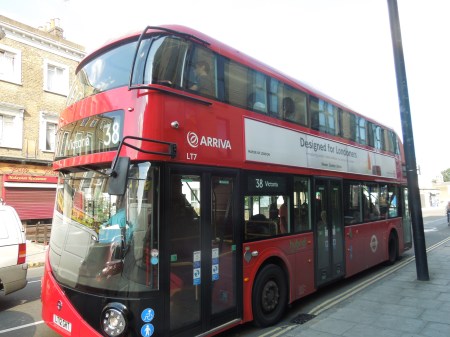
Proof That LT7 Is Back On The Job
A driver did tell me it’s all pristine now, although it didn’t return that way from Top Gear.
The Two Faces Of Ed Milliband
Ed Milliband has just stated on BBC Television, that whatever we do in Syria must be totally legal.
So where was he, when Blair decided to go into Iraq as Bush’s poodle? Answers on a properly creosoted fence please!
More Demolition At London Bridge Station
As I came back, I passed through London Bridge station.



Very little is now left of the old station.
Note the pristine refurbished Class 465 in one picture.
Some may decry our trains, but we have one of the newest fleets in the world and even ones like these, which are wenty years old, look almost fresh out of the factory.
Football At Welling
I was going to see Welling United play Salisbury City.

It was pleasant to sit in the sun . Even if it was a goalless draw, with a sending off and a missed penalty.
This was the only match yesterday in the London area.
Out Of Charing Cross Station For The First Time
It may seem strange, but yesterday was the first time, I took a train out of Charing Cross station. Here are a few pictures, as the train travelled to London Bridge.


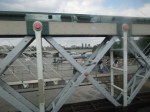


Note the Victorian replica of Charing Cross outside the station,one of the Golden Jubilee footbridges on the Hungerford Railway Bridge and Southwark Cathedral.
An Arrogant Building
I don’t like this building, as it destroyed a perfectly good Nash Terrace.
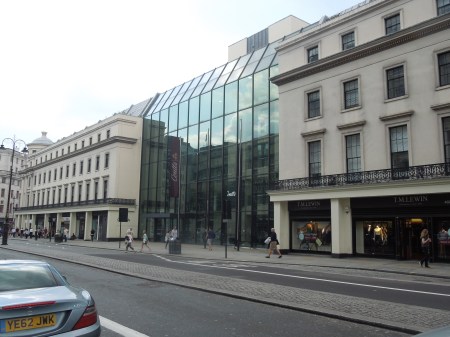
An Arrogant Building
But then it was done a few years ago and at the whim of bankers.
Wheatstone Remembered
As I passed Kings College by the Aldwych yesterday, I passed this tribute to Charles Wheatstone.
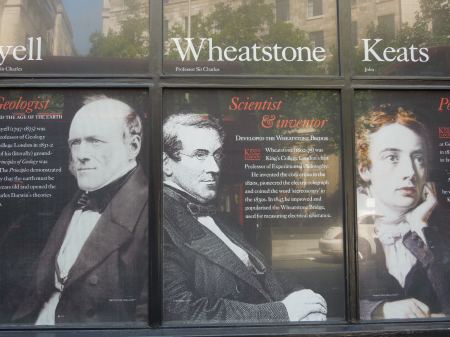
Wheatstone Remembered
He was one of the more unusual scientists this country has ever produced and was a true scientist and inventor.
 The Anonymous Widower