Airport Plans World’s Biggest Car Parks For 50,000 Cars
The title of this post, is the same as that of an article in Wednesday’s copy of The Times.
This is the first two paragraphs.
The biggest car parks in the world will be built as part of a £14 billion expansion of Heathrow amid fresh claims that the scheme will be an “environmental disaster”.
Parking for almost 53,000 vehicles will be built as part of a 30-year masterplan, even though the airport insists that expansion can be achieved without any extra cars on the road.
This sounds to be contradictory, as why would you need to build extra car parking, if there were no more extra cars on the road?
Perhaps there is a clue later in the article, where this is is a paragraph.
Heathrow said that the overall number of parking spaces would “not change materially from today”, insisting that spaces were simply being consolidated on bigger sites. It pointed out that car parks would allow for 100 per cent electric vehicle usage in the future. In total, the number of parking spaces, including those for staff and spaces at nearby offices, will grow from 64,000 today to 67,000.
Admittedly, it only says allow, but Heathrow are future-proofing themselves for the day when everyone is driving electric cars.
Heathrow and others are also planning to do the following.
- Charge a congestion charge of up to £15 a day will be imposed by 2026 to dissuade passengers from travelling to the airport by car.
- A “green loop” — a 12-mile pedestrian and cycle network — will also circle the airport.
- Finish Crossrail.
- Improve Heathrow Express.
- There will be a rail link to Reading.
- There will be a second rail link to Waterloo via Clapham Junction.
- There could be a rail link to Basingstoke, Guildford and Woking, possibly by extending Heathrow Express.
Will these measures nudge travellers in one of two positive directions?
- Using public transport to get to the Airport.
- Cycling or walking to the airport.
- Using an electric car to get to and from the Airport.
I am a Control Engineer, who spent a working life of nearly fifty years analysing data and doing mathematical calculations, hopefully to improve little bits of the world.
So What Would I Do?
It is absolutely essential that it is known, where all the vehicles to the airport are travelling to and from.
No-one is going to stop using their car, if there is no creditable alternative.
The ultimate aim must also be that, all transport within a certain distance of the Airport must be zero-carbon.
- All vehicles used by travellers and workers to get to and from the Airport.
- All vehicles bringing supplies to the Airport.
- All airside vehicles.
What will happen to those that lived in the zone?
This Google Map shows Hanwell Village to the South-West of the Airport.
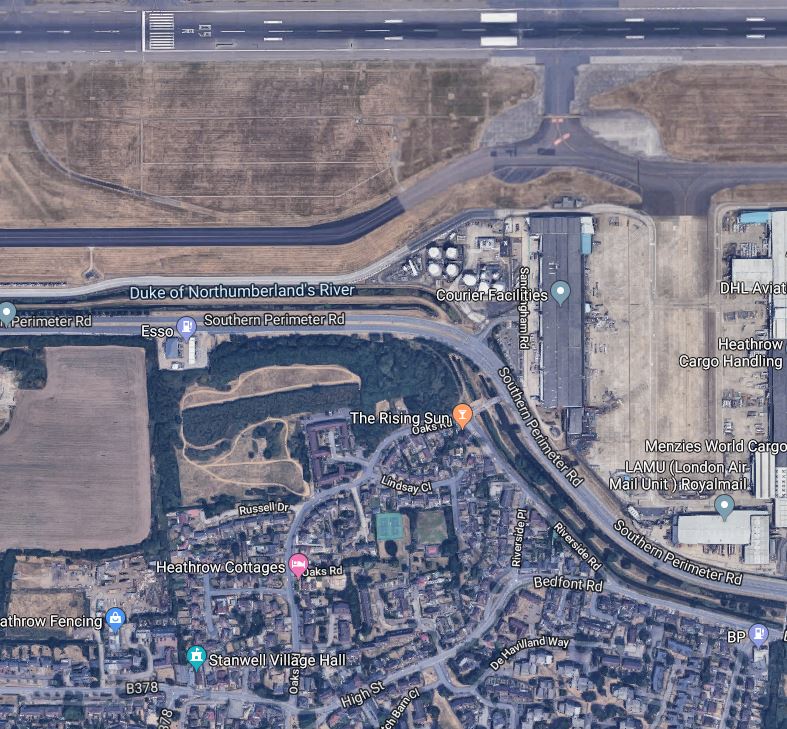
Will all those residents pay the congestion charge?
But suppose Heathrow could get ninety percent of all cars travelling to the Airport and using the car parks, to be electric vehicles.
This would be 45,000 vehicles, each with a battery of between 30-60 kWh. Let’s call it, 30 kWh.
This would mean that the total of energy storage on a typical day at the Airport would be 1.35 GWh.
Compare that to the 9.1 GWh capacity of Electric Mountain.
Electric Mountain would be bigger, but intelligent control of the batteries of these electric vehicles could create a massive electricity storage resource at the Airport.
- Vehicles would be connected to a two-way vehicle-to-grid charger (V2G), when the driver went about their business at the Airport, after telling the vehicle when they would return.
- On return to the vehicle, it would have enough charge for the next journey.
- The driver would also have an app on their phone, so they could alter their expected return time.
- Whilst the driver was away, the grid would borrow electricity from the vehicle’s battery if required.
All the technology exists and National Grid are looking at ways to use electric vehicle batteries for energy storage.
National Grid have suggested, that they might even pay for the use of your battery.
I suspect that all parking for electric vehicles in the future, will work using something like this model.
Note the following calculation.
In December 2018, there were 31.5 million cars and four million light goods vehicles in the UK.
In a few years time, suppose half of these vehicles are electric with a 20 KWh battery.
That works out at an astronomical 355 GWh or nearly forty Electric Mountains.
- Electric Mountain cost £425 million in 1984.
- Applying a web inflation calculator means it would cost around £1350 million today.
- So forty Electric Mountains would cost £54 billion.
That is a lot of money and we have no place to put them.
But we have this massive storage capability in the millions of electric vehicles, that will be on the roads in a few years.
Conclusion
All future large car parks must be built to be large storage batteries, when drivers plug in their electric cars using vehicle-to-grid (V2G) technology.
If you were to be paid for the use of your car’s battery, would that ease the expense of owning an electric car?
Stadler Receives First Flirt Akku Battery Train Order
The title of this post, is the same as that of this article in Railway Gazette International.
This is said.
Schleswig-Holstein transport authority NAH.SH has selected Stadler to supply 55 Flirt Akku battery multiple-units to operate regional services and provide 30 years of maintenance.
Announcing its selection as preferred bidder on June 19, Stadler said that it will reveal more details when the contract is signed, which is expected after the 10-day standstill period. NAH.SH called tenders for zero-emission trains to run on non-electrified lines but did not specify the technology to be used.
NAH.SH becomes the launch customer for the Flirt Akku, which was officially unveiled last year at the Stadler Pankow factory in Berlin.
Information on the order is a bit short, but that doesn’t stop me speculating.
Do The Flirt Akku Trains Have A Power-Pack Like Greater Anglia’s Class 755 Trains?
Certainly, the Stadler Flirts for the South Wales Metro, do have both a power-pack and a battery, as Stadler use the same image for both trains and the trains have batteries.
These pictures show some of Greater Anglia’s Class 755 trains in the sidings at Crown Point Depot.


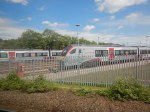
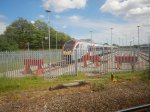
Note, these are four-car Class 755 trains with a power-pack in the middle.
In Importance Of Battery Range: Stadler’s FLIRT BMU For Greater Anglia, I referenced an article, that said that Greater Anglia’s network is too long for battery trains. But the article seemed to suggest, that Greater Anglia could go battery in the future.
Until, I get more details on the Flirt Akku, I will assume that they use a power-pack containing batteries instead of diesel engines.
As in South Wales, there could also be a mix of diesel engines and batteries in the power-pack of a Flirt Akku.
Importance Of Battery Range: Stadler’s FLIRT BMU For Greater Anglia
The title of this post is the same as a sub-section of this article on Railway News, which is entitled Stadler Presents New FLIRT Akku For The First Time.
This is said.
By contrast, Stadler recently unveiled its bi-mode (electric-diesel) FLIRT for Greater Anglia (U.K.) at InnoTrans 2018. When asked why Greater Anglia went for a diesel-electric option rather than a battery-electric option to bridge the non-electrified gaps in the network, Railway-News was told that the non-electrified distances in the U.K. are currently too great for battery-operated trains to cope with. As battery technology improves, this will hopefully change, making diesel and the need for electrification obsolete
Does this infer the following?
- Greater Anglia would have preferred to use battery-electric trains.
- It is possible to swap the diesel engines in the power-pack for battery modules.
- It could be possible to swap a diesel generator for a hydrogen fuel cell.
Option three might be difficult, as you need somewhere to put the hydrogen tank within the limited UK loading gauge.
Conclusion
I think it is highly likely that as battery technology improves and Stadler are able to package it better for the Class 755 trains, that Greater Anglia will change some of their Class 755 trains to battery-electric operation.
Scottish Government Is Considering Plans To Electrify The Borders Railway
The title of this post is the same as that of this article in The Scotsman.
These reasons are given for the electrification, of the Borders Railway.
- Electric trains would shorten journey times.
- New Class 385 trains would be more reliable than the current elderly diesel trains.
- It would be an easy line to electrify, as the line was built so that overhead electrification could be added without any gauge enhancement.
I would add a few reasons of my own.
- The route is already electrified as far as Newcraighall station. This would probably ease the grid connection to the new electrification.
- I believe that electrification of a new railway, where everything is known an well-documented has a higher change of being delivered on time and on budget.
- Running Class 385 trains may also produce operating and maintenance savings.
- The Class 385 trains are serviced at the convenient Millerhill Depot.
- Electrification might help running trains across Edinburgh.
If and when the Borders Railway is extended to Carlisle, there could be very good reasons to electrify the whole route.
I will answer a few questions.
How Much Time Would a Class 385 Train Save?
Currently, trains between Edinburgh and Tweedbank currently take fifty-five minutes with seven stops.
The Class 385 trains will probably save a few minutes at each stop, so this will make the journey time a bit shorter and turnround at each end of the route will be more relaxed.
How Long Is The Section Without Electrification Of The Borders Railway?
The distance between Newcraighall and Tweedbank stations is 30.75 miles.
How Challenging Is The Borders Railway?
It is not the easiest of routes, but it is not the most difficult either. It also has a high summit.
The current diesel trains don’t seem to be working that hard, when I’ve used the railway.
Would Electrification Be Difficult?
If I look at electrification projects over the last few years in the UK, they have been delayed and suffered cost increases because of the following.
- Difficulty of raising bridges over the route.
- Connecting to the electricity grid.
- Surprises like unexpected sewers and mine workings, when installing the electrification.
Hopefully, as the Borders Railway is new railway, that is already partially electrified, this will not be a difficult electrification.
Could the Current Route Be Served By A Battery-Electric Train?
This is the big question, as it were possible, then the current Borders Railway may not need to be electrified.
In Hitachi Plans To Run ScotRail Class 385 EMUs Beyond The Wires, I talked about Class 385 trains with batteries, that #Hitachi are proposing.
Hitachi have said this.
- It would be straightforward to add batteries to give a range of twenty miles on batteries.
- Sixty miles would be possible but more difficult.
I believe that a safety-first way to run a battery-electric Class 385 train on the Borders Railway would be to do the following.
- Procure a sin-fleet of Class 385 trains, with a range of forty miles on onboard batteries.
- The trains would handle regenerative braking to the onboard batteries.
- A charging station would be provided at Tweedbank station.
The only new infrastructure would be the charging station, which I believe should be based on Vivarail’s design, which I wrote about in Vivarail Unveils Fast Charging System For Class 230 Battery Trains
- Currently, trains take just under ten minutes to turn round at Tweedbank station, which would be time enough to charge the battery.
- Vivarail’s system is fully automatic, after the driver stops the train over a length of third-rail electrified track, which is only live, when a train is connected.
Hitachi would need to fit third-rail shoes to the trains, but then they could use the design from their Class 395 trains.
Conclusion
There is currently no need to electrify the Borders Railway, if Hitachi can do the following.
- Fit batteries to a Class 385 train, to give a range of forty miles.
- Design a fast charging system and install it at Tweedbank station.
I also believe that if and when the Borders Railway is extended to Carlisle, that there could be a strong case for electrification of the whole route.
Running battery-electric Class 385 trains on the Borders Railway would be a project with a lot of winners.
- Hitachi would have a scenic demonstration route, close to a major well-connected international city.
- The Borders would get a better and more environmentally – friendly train service to Edinburgh.
- Scotrail would have a higher proportion of one class of electric trains.
But the biggest advantage could be the possibility of terminating Borders Railway services on the other side of Edinburgh, at perhaps Stirling or Dunblane.
The Shape Of Solar Farms To Come
This article on Renew Energy is entitled Gannawarra Battery-Integrated Solar Farm – Australia’s Largest – Officially Opened.
These are the first two paragraphs.
The Gannawarra solar and energy storage project near Kerang in western Victoria has had its official launch on Friday, to mark the largest pairing of a solar farm and a grid-scale battery system in Australia.
State energy minister Lily D’Ambrosio officially anointed the landmark project, which has combined 60MW of PV panels and a 25MW/50MWh battery system – Tesla’s second-biggest battery in the country so far.
Form the video in the areticle, it appears that there are 120 hectares of solar panels and the farm provides enough electricity for 25,000 homes.
It is an interesting concept and I’m sure it will be repeated around the world.
Ausralia has lots of sun, but there is no reason, why a similar system can’t be developed with tidal, wave or wind power.
First Stadler FLIRT Train Receives Approval To Enter UK Service
The title of this post is the same as that of this article on Global Railway Review.
This is the first paragraph.
The British railway regulatory authority, the Office of Rail and Road (ORR), has granted Stadler approval for the 24 four-car bimodal FLIRT (BMU) for Greater Anglia. For Stadler, this is an important milestone in the project. It is the first FLIRT in the UK to receive an authorisation for placing the train into service (APIS). The test runs with the train for use in the UK only began at the beginning of 2019. Thanks to the excellent cooperation between Greater Anglia, Abellio, Rock Rail, Stadler and the authorities, the approval was obtained in record time.
It does make a change for a train to be able to enter service without too much trouble.
I do think that Stadler, Abellio and Greater Anglia have had a few advantages.
- These are the second fleet of Stadler bi-more FLIRTs, but could be the first to enter service.
- The electrified route between Norwich and Diss has been able to be used as a dedicated 100 mph test rtrack during the night, when no scheduled services are running.
- The trains are based at Crown Point depot, close to the Northern end of the test route.
- Abellio run fleets of FLIRTs in The Netherlands.
There also doesn’t appear to have been any major problems to delay the testing.
From reports in the local daily newspapers, it also appears that staff are fully behind these new trains and enthusiastic about their arrival.
‘Walkway’ Rail Station Plan For Magor As M4 Relief Road Scrapped
The title of this post is the same as that of this article on the BBC.
These are the introductory paragraphs.
A village heavily affected by the decision to scrap the planned M4 relief road is bidding for help to build a £7m railway station there.
Residents of Magor in Monmouthshire have the mainline rail service to London running through the village, but no station.
They want to create a “walkway” station – one with no car parking that travellers will walk or cycle to.
The original Magor station was shut in the Beeching cuts.
This Google Map shows the location of the villages of Magor and Undy.
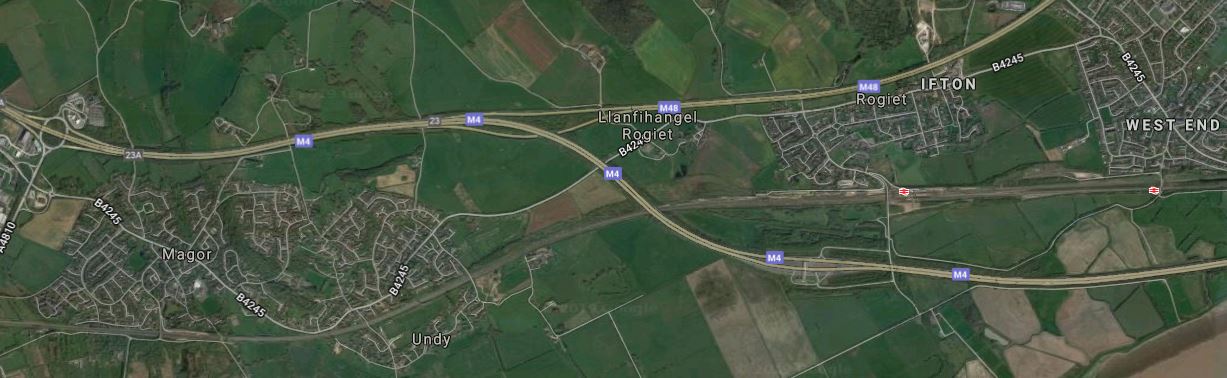
Note.
- Newport is to the West.
- Magor is at the Western end of the map, with to its South-East.
- The M4 and M50motorways joining to the North of the villages.
- Severn Tunnel Junxction and Caldicot stations indicate the South Wales Main Line.
I have also flown my helicopter from Severn Tunnel Junction station and Magor village and it is a quadruple track railway with lots of space on either side.
I certainly think, that a station could be built and a stopping train with a frequency of four trains per hour (tph), could probably be incorporated into the timetable.
- But would a station without car parking be viable?
- Perhaps the area needs a few electric shuttle buses?
But the station if it is built needs to be linked in with the South Wales Metro.
In an ideal world, there probably needs to be a Turn-Up-And-Go four tph stopping train from Caldicot all the way to Fishguard and Swansea.
Left In A Siding: The Rail Link That Could Make Heathrow Greener
The title of this post is the same as that of this article on the Guardian.
The article makes a powerful case forvthe building of the Heathrow Southern Railway.
It is a must read.
I can never understand, why the government hasn’t backed this scheme.
- It creates a four trains per hour service between Heathrow and Waterloo via Staines and Clapham Junction
- It creates an extension of Heathrow Express to Basingstoke, Guildford and Woking.
- The extended Hethrow Express creates a much needed commuter route into Paddington.
- Few properties would be affected by the new railway.
But above all, it will be built with private money.
 The Anonymous Widower