My Japanese Wallet
These pictures show my Japanese wallet.




Note.
- The pocket on the outside to hold one credit card. Unfortunately, you can’t do contactless in the pocket.
- The inside purse to hold a few coins, my door key and a few Warfarin tablets.
- Plenty of space for cards.
- The usual folder for notes.
- The zip that closes it shut.
I haven’t shown the miniature Samurai sword, that pokes out if someone, who doesn’t look like me tries to open the wallet.
The Cavalry Are Arriving!
This article in Rail Magazine is entitled First HST for ScotRail Arrives In Scotland.
I seem to remember reading accusations that Tony Blair, Gordon Brown and their governments weren’t too keen on the ageing InterCity 125 trains, that plied up to Scotland and across to Wales and the West of England. So they did a deal with Hitachi, which included a new train factory close to Blair’s constituency in the North-East of England.
But removing InterCity 125s or High Speed Trtains (HSTs) as they are commonly known, from the UK rail network, appears to be as difficult as removing Japanese knot-weed from a garden.
When delays hit the Great Western electrification, Great Western Railway started experimenting with short formation HSTs, consisted of two Class 43 power cars and four or five Mark 3 coaches. The experiments were obviously a success, as they have decided to do this according to Wikipedia.
Great Western Railway are to retain 24 powercars and 48 carriages to form 11 four-carriage sets for use on local services between Cardiff and Penzance. The carriages will be fitted with automatic doors and controlled emission tanks at Wabtec, Doncaster.
Scotrail have gone down a similar route of shortened HSTs.
This article in Rail |Engineer is entitled ScotRail’s ‘new’ HSTs, gives full details. This is the first three paragraphs of the article.
In 2012, Transport Scotland published the results of its rail passenger service consultation. This considered how the railway should develop and the types of passenger services required. Its results were incorporated into the specification for the ScotRail franchise which was renewed in 2014.
One conclusion from this consultation exercise was that passengers traveling from central Scotland to Aberdeen and Inverness much preferred to travel in Virgin Trains East Coast High Speed Trains (HSTs) from London than ScotRail’s Class 170 diesel multiple units (DMUs).
For this reason, the invitation to tender (ITT) document for the ScotRail franchise included a specification for improved rolling stock for Scotland’s internal inter-city services that could have been based on the HST’s mark 3 coach. In its franchise bid, Abellio’s response to this requirement was that it would provide refurbished HSTs on the routes that serve Scotland’s seven cities (Glasgow, Edinburgh, Stirling, Perth, Dundee, Aberdeen and Inverness).
Abellio received the franchise and ScotRail will be getting seventeen 2+5 and nine 2+4 HSTs. This paragraph from the Rail Engineer article gives more details on the trains.
The HSTs will be phased into service from summer 2018, with the full fleet operational for the May 2019 timetable change. This aligns with the completion of Network Rail’s Highland main line journey time improvements project. 54 power cars and 121 coaches will be leased from Angel Trains. These will make up 17 five-coach trains and 9 four- coach trains with two power cars spare. The 2019 timetable will require 23 trains in service each day with five coach sets operating Central Belt to Aberdeen services and the four coach trains generally running to Inverness. The number of through services from Inverness to the Central Belt via Aberdeen will also be increased.
As the first HST has now arrived in Scotland as is reported in the Rail Magazine article, it looks like everything is going to plan.
Politicians and others might say, why are the lines not being electrified or services provided by Class 802 trains.
- Network Rail’s record on electrification isn’t good.
- There would probably be opposition to overhead electrification marching all over the Highlands.
- The lines in the North of Scotland probably have a maximum speed of 100 mph at best.
- Drivers have forty years of experience of running HSTs to Aberdeen and Inverness.
- To many of the British, the InterCity 125s are the definitive High Speed Train.
Could there even be a popular feeling behind using the trains, in much the same way people cling to the past in their politics?
I think it is a sensible plan for the following reasons.
- A 2+5 shortened set running at less than the 125 mph design speed could be a very sound economic proposition.
- The trains have large windows for a good view.
- I’m sure Scotrail will add appropriate catering, on the upwards of two to three hour journeys.
- These trains could be passenger magnets for business, leisure and tourists, especially from countries like Germany, The Netherlands, Sweden, Canada and the USA.
But above all these Scottish InterCity services must be the Marketing Department’s dream!
Carlisle Joins The Fight For The Extended Borders Railway
This article in the Southern Reporter is entitled Carlisle the ‘logical step forward’.
This is the first two paragraphs.
Carlisle City Council has joined the army of organisations fighting for the Borders Railway to be extended south.
The council’s leader, Cllr Colin Glover, has held joint talks with the Campaign for Borders Rail, agreeing to stimulate economic growth through reinstatement of the railway between Carlisle, Longtown, and the Central Borders.
The article has a lot of comments about why the extended Borders Railway would be good for both Carlisle and the Scottish Borders.
This is a comment from the leader of Carlisle Council.
There are clear benefits for Carlisle, Building a new line supports plans for growth all over the city and region.
Ever since, the Borders Railway opened to Tweedbank station, it has been my view that Carlisle is key to completion of the reinstated route between Edinburgh and the North West of England.
Consider.
- Carlisle is a city of just over 100,000 people.
- The whole of the Scottish Borders only has a population of 114,000.
- Carlisle is a major railway junction with services to Edinburgh, Glasgow, Leeds, Newcastle and the South of England.
- Some of the most scenic rail routes in the UK, link Carlisle with Glasgow and South West Scotland, the Lake District, Leeds and Newcastle.
- The important scenic route to Edinburgh through the Borders is missing.
- The West Coast Main Line (WCML) needs to increase capacity through Carlisle.
- HS2 services will be arriving at Carlisle, via Crewe and the WCML, around 2033.
The Borders Railway to Carlisle is undoubtedly an Anglo-Scottish project.
Conclusion
I suspect that when the definitive report on the extension of the Borders Railway to Carlisle is published, Carlisle will be one of the biggest beneficiaries.
When Do Mark 2 Coaches Accept The Inevitable?
The title of this post has been chosen for the same reason I used When Do Mark 3 Coaches Accept The Inevitable?
As with the other article, I’m starting with a preamble.
What Is A Mark 2 Coach?
A Mark 2 Coach is the predecessor to the Mark 3 Coach.
The Wikipedia entry for the British Rail Mark 3 Coach , starts with this paragraph.
The Mark 2 family of railway carriages were British Rail’s second design of carriages. They were built by British Rail workshops (from 1969 British Rail Engineering Limited) (BREL) between 1964 and 1975. They were of steel construction
They became the mainstay of the Inter-City fleet and some are still in use today on the Caledonian Sleeper and for charters.
From Inter-City To Mozambique Via New Zealand
This post was brought about by this article on Global Rail News, which is entitled Former British Rail Trains Find New Lease Of Life In Mozambique.
What the title doesn’t say, is that the coaches were originally sold second-hand to New Zealand in the 1990s, where they were re-gauged to three foot six inches. They are now surplus to requirements and are being moved on to Mozambique, where the gauge is the same.
The Wikipedia entry for the New Zealand British Rail Mark 2 Carriage says this about the gauge conversion.
Because of construction constraints, most railway lines in New Zealand have a limited loading gauge. Great Britain uses 1,435 mm (4 ft 8in) standard gauge, but its loading gauge is only slightly larger than New Zealand’s Cape gauge. This means that British Rail rolling stock like the Mark 2 carriage can run on most New Zealand lines after gauge conversion. To fit the New Zealand loading gauge, the Mark 2s were lowered on their new bogies by 25 centimetres.
This is the introduction to the Wikipedia entry for Cape gauge.
Railways with a track gauge of 3 ft 6 in / 1,067 mm were first constructed as horse-drawn wagonways. From the mid-nineteenth century, the 3 ft 6 in gauge became widespread in the British Empire, was known as the Cape Gauge, and was adopted as a standard in Japan and Taiwan.
There are approximately 112,000 kilometres (70,000 mi) of 1,067 mm gauge track in the world, which are classified as narrow gauge railways.
There are quite a lot of raiways with this gauge.
Could modern UK rolling stock be converted to the 1,067 mm narrow gauge?
I suspect the answer is n the affirmative and new British rolling stock like a Bormbardier Aventra or CAF Civity could be adapted to fit the narrow gauge in Australia, New Zealand and large parts of Africa.
Midland Metro’s £149m Extension To Open In 2021
The title of this post is the same as an article on Global Rail News.
This is the first two paragraphs.
A 2km extension of Transport for West Midlands’ Midland Metro has been given the go ahead in the UK.
The £149 million extension will link Grand Central, in Birmingham’s city centre, with the southern suburb of Edgbaston with five new stops served by up to 10 trams an hour at peak times.
This article in the Birmingham Mail, gives more details.
The locations of five new stops to be built in the next phase of the Midland Metro extension have been confirmed.
The line is being taken an additional 1.2 miles from outside New Street station to Hagley Road.
As previously mooted, there will be stops outside Town Hall Birmingham and at Centenary Square, in Broad Street, where passengers can access the ICC, Library of Birmingham and new HSBC UK head office.
The other stops will be opposite Brindleyplace at the corner of Granville Street, outside the Cineworld cinema in Broad Street and in front of office block 54 Hagley Road, close to the Morrisons supermarket.
I think that the design of the route has been kept fairly simple and also involves some pedestrianisation.
From New Street To Broad Street
This Google Map shows the first section of the route from the current terminus of the Midland Metro at Grand Central outside New Street station to the start of Broad Street.
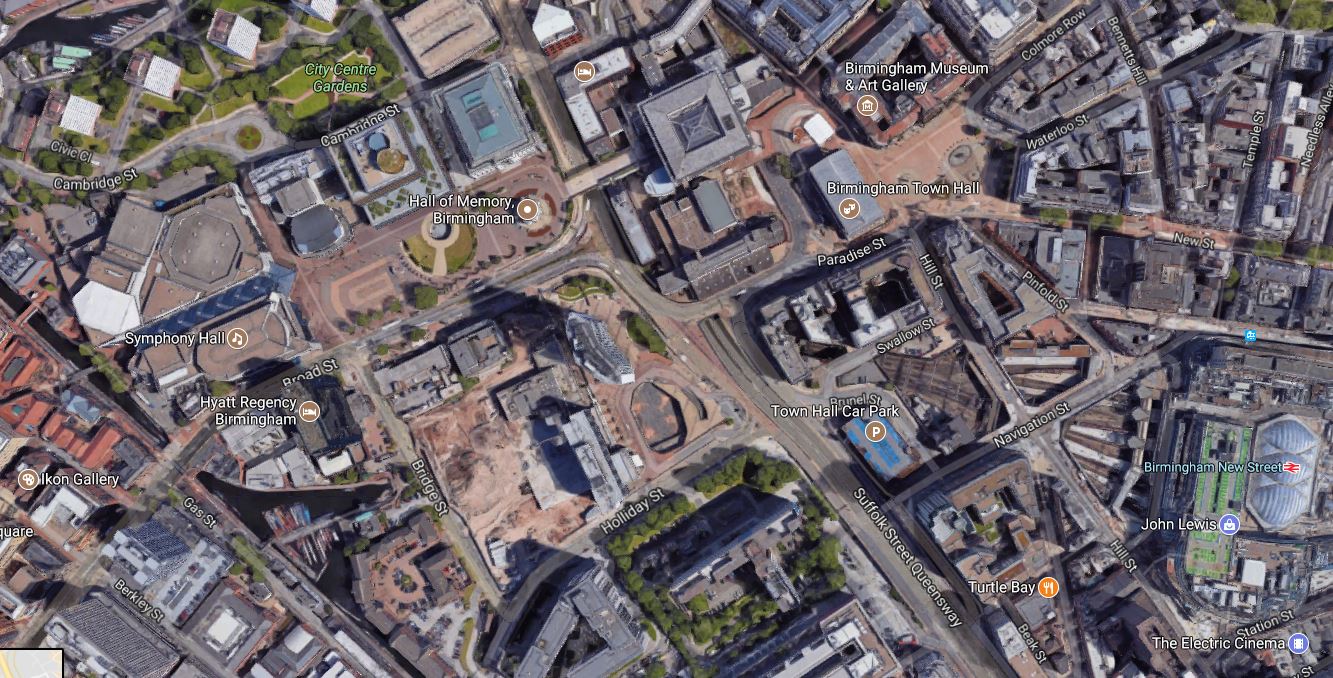
The blue dot outside New Street station shows the Grand Central tram stop.
The route goes up the hill, to the stop at Birmingham Town Hall before twisting to go down Broad Street to stop in Centenary Square.
Along Broad Street
This Google Map shows Broad Street from the Symphony Hall to the Cineworld Cinema.
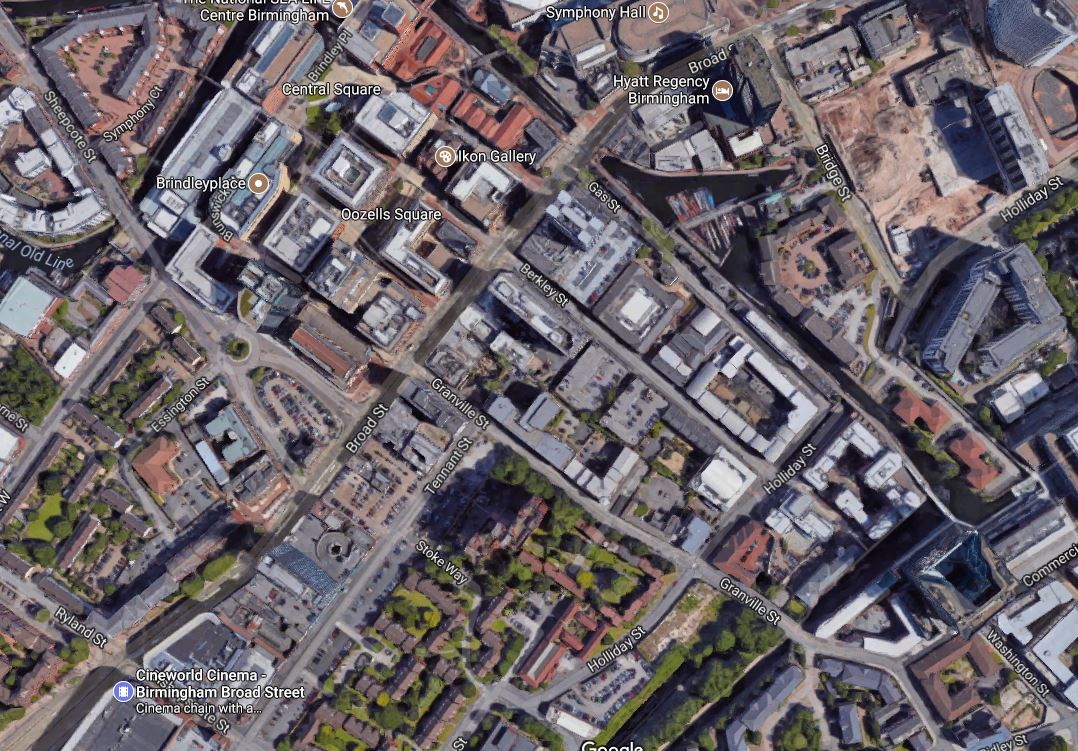
Three stops are on this section.
- Brindleyplace
- Granville Street
- Cineworld Cinema
This visualisation shows the route at the cinema.

Note.
- The view is looking towards Five Ways.
- Overhead electrification is used on this section.
Will the route be pedestrian only?
Through Five Ways Roundabout And On To 54 Hagley Road
This Google Map shows the last section of the route.
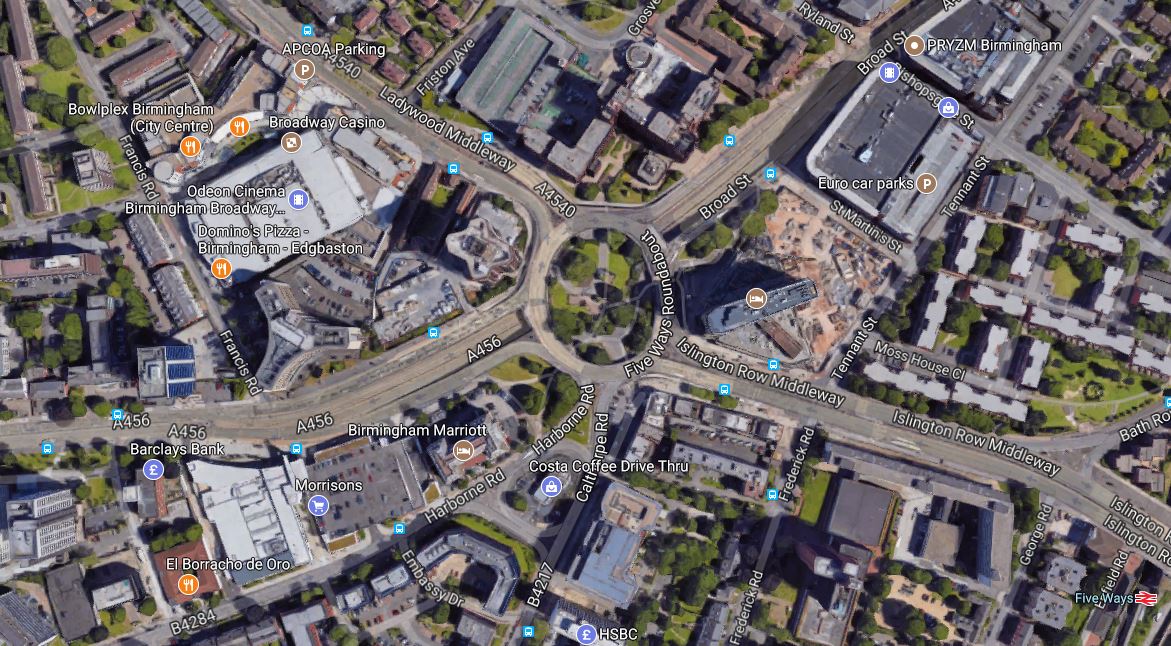
The roundabout looks to have plenty of space to thread the tram lines through.
54 Hagley Road is the office tower in the South West corner of the map, on the South side of Hagley Road. Again there seems plenty of space.
Sections Without Wires
The route bwtween Grand Central and Hagley Road will use a mixture of overhead wiring and onboard energy storage to power the trams.
It has been stated that in the historic centre, the trams will not use wires, as in this visualisation.
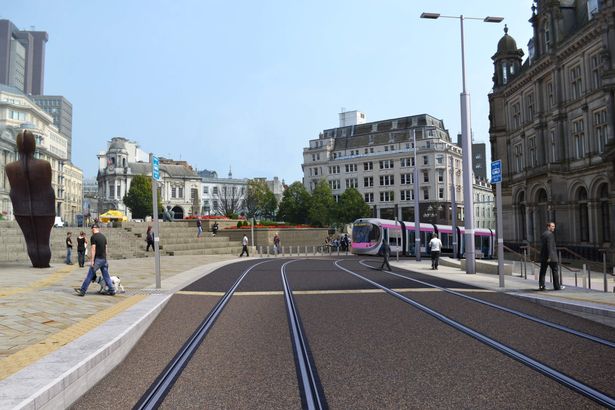
It appears that there will be wired sections either side of this section without wires in the centre.
This will ensure, that the onboard energy storage is well-charged before entering the section.
Cost And Timescale
Comments on the Birmingham Mail article, think the line is expensive and it will take a long time to build.
Looking at the route the two tricky sections are around Paradise Street and Five Ways, as there will need to be a lot of reconstruction of the road network.
But the sections running on onboard energy storage should be a lot easier to build.
At £149 million for 3.38 kilometres, the extension will cost £44 million a kilometre.
Manchester Metrolink’s Trafford Park Line will cost £350 million for 5.5 kilometres or £64 million a kilometre.
Is the lower cost/km. of the Birmingham Extension due to the sections without wires?
I suspect, it’s probably more complicated than that!
Conclusion
It looks a good scheme.
My only reservation is what will drivers think about a pedestrianised Broad Street, if that is part of the design.
Cargo Hub Is Latest Plan To Get Manston Airfield Off Ground
The title of this post is the same as a news item in the business section of The Times today.
This is the first paragraph.
It is the airport that refuses to take off. But the latest attempt to turn the Battle of Britain airfield if Manston into a sstainable commercial proposition could take wing this autumn.
The Plan
The plan for Manston Airport is roughly on the following lines.
- The airport becomes a passenger and freight airport.
- Help create employment in a depressed area.
- Talk of a £300 million investment.
- A potential to take air cargo out of Gatwick and Heathrow.
But I’m fairly sceptical given that so many attempts have failed in the past.
This Google Map shows the position of the airport.
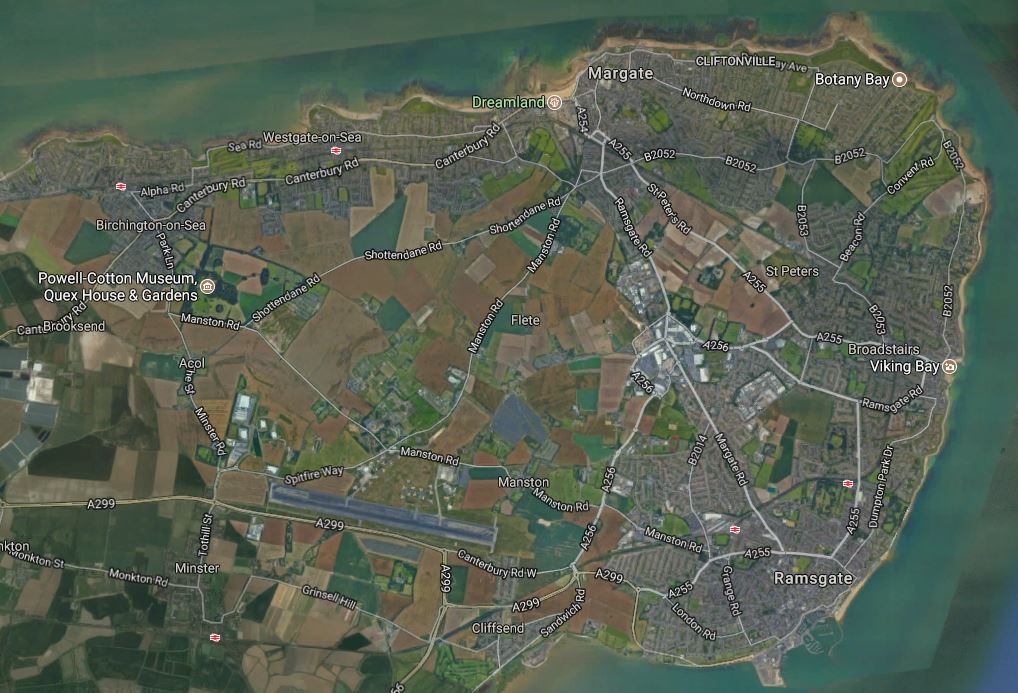
Note how the airport is ringed by the Thanet towns.
This Google Map is a close-up of the Airport.
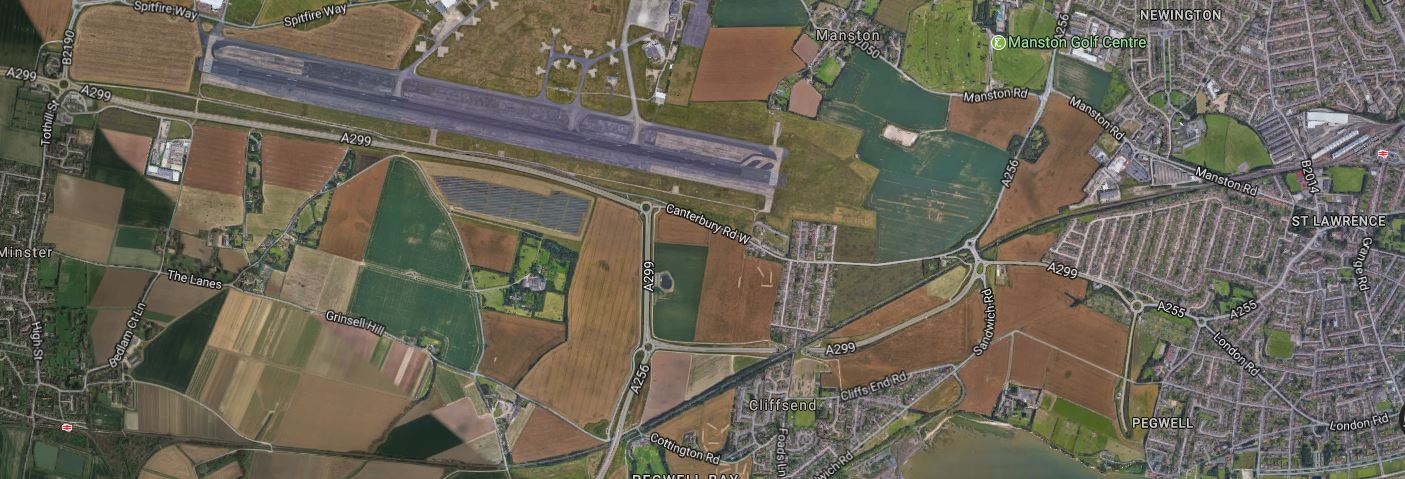
Note
- The Ashford to Ramsgate railway line running East-West to the South of the airport.
- Minster station is in the South-West corner of the map with Ramsgate station in the East.
- The A299 road runs along the South of the airport.
These are my observations.
Local Residents
The runway is roughly East-West on an alignment of 10-28.
Most take-offs and landings will probably we towards the West using Eunway 28.
I don’t know the area well, but I did get this image from Google Maps.
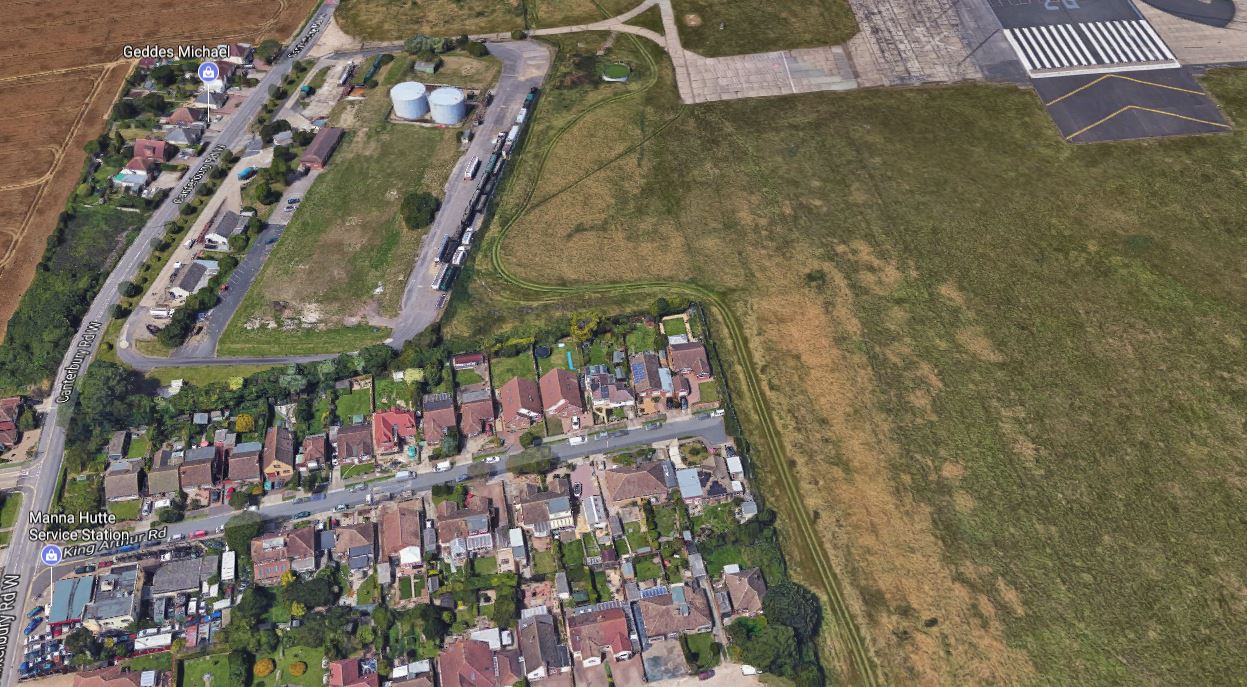
Note this housing just to the South of the final approach to Runway 28.
This Google Map shows the housing, the runway and the A299.
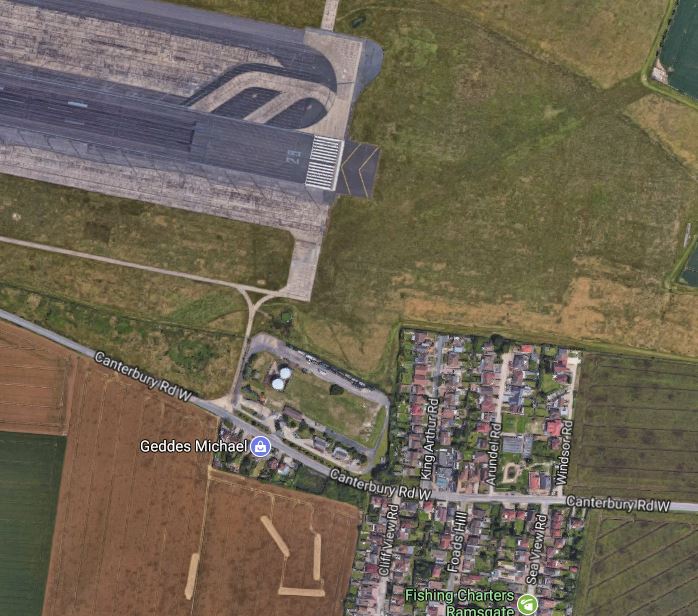
The residents can’t be too pleased of the plans.
Especially, as Google StreetView shows some of these houses to be newly-built sizeable bungalows.
Road Access
Road access to the airport would need to be substantially improved.
I can’t expect that the residents of Thanet will be pleased if a motorway is built across the countryside from the A2 South of Canterbury.
Rail Access
London’s newest airport is Southend Airport on the North bank of the Thames. The airport is growing as a base for easyJet and other low-cost airlines.
Southend Airport has several advantages, one of which is that the terminal is only a hundred metres from Southend Airport railway station, which is fifty minutes from Liverpool Street station.
In this day and age, I don’t believe that planning permission will be given for Manston Airport, unless a large proportion of freight, travellers and airport workers travel to and from the airport by rail.
Consider the current situation.
- As the Ashford to Ramsgate Line passes just to the South of Manston Airport, I would expect that the development would involve diverting this rail line, so it passed close to the airport.
- Current passenger services on the line, link to Ashford, Canterbury, Dover, Margate and Ramsgate, so at least it would be ideal for local airport workers.
- There are also a couple of trains per hour (tph) to and from London Victoria.
- Class 395 trains or Javelins also run using HS1 into St. Pancras. Currently, the fastest trains from |St. Pancras to Ramsgate take 79 minutes, so I suspect that to Manston Airport will take about 75 minutes.
The new Southeastern Franchise, which is currently being bid for will see improved access to this area of Kent, which could include.
- A second HighSpeed route opened into either Victoria or Waterloo using the route that used to be taken by Eurostar to Waterloo.
- Increase in HighSpeed services to Kent.
- Replacement of all the slow trains to speed up faster services.
I wouldn’t be surprised to see that Ramsgate gets the following HighSpeed services to London in every hour, that would call at Manston Airport.
- Two fast trains to St. Pancras.
- Two fast trains to Victoria
- Two fast trains to St. Pancras via the Medway towns.
Certainly, the frequency will be good.
Getting Passengers To And From The Airport
It is 2026 and these will be the times from Oxford Circus to the various London airports.
- Birmingham – 45 minutes – via HS2
- Gatwick – 68 minutes
- Heathrow – 27 minutes
- London City – 20 minutes
- Luton – 43 minutes
- Manston – 75 minutes
- Southend – 60 minutes
- Stansted – 43 minutes
Access from London might be by HighSpeed train, but people complain about the time it gets to Stansted now, so a time of 75 minutes may be a discouragement, when there are so many alternatives.
I believe that coupled with road access, which will be difficult to improve, that Manston Airport, will never be a significant player in the passenger market.
Getting Cargo To And From The Airport
The local residents are not going to want large numbers of trucks taking cargo to the airport.
But I believe that a lot of parcel and pallet transport, can go by train.
Doncaster-Sheffield Airport, which is also serious about cargo, is proposing to divert the East Coast Main Line, so that cargo trains can call at the airport. Manston Airport would have equally good rail access.
The interesting concept is what I call a HSPT or High Speed Parcel/Pallet train. The idea was first proposed in the June 2017 Edition of Modern Railways there is an article entitled Freight, Not All Doom And Gloom, which talks about high-value parcel carriers.
I have developed the concept, as I’m inclined to do in The Go-Anywhere Express Parcel And Pallet Carrier (HSPT).
I would use some of the soon-to-be redundant Class 321 trains and convert them into parcel and pallet carriers.
- They are four-car 100 mph dual voltage electric multiple units.
- They can run in lengths of twelve-cars if required.
- There are over a hundred of them of which the large proportion will need new caring owners.
- The trains may be thirty-five years old, but they are reliable and built out of steel to take punishment.
- They can easily be converted to bi-mode units, by adding underfloor diesel engines, so they can go anywhere in the UK.
- They could even go through the Channel Tunnel and run on the the French 25 KVAC network.
How many trucks would be taken from the UK’s crowded roads.
An Integrated Cargo Airport
An integrated cargo airport may have appeal.
Consider.
- Air cargo is increasingly containerised.
- Gatwick and Heathrow Airports are short of slots for passenger aircraft.
- Manston has a long runway, that could handle the largest cargo planes.
- The airport could easily have rail access to the |Channel Tunnel.
- The proposed HSPTs could use the Channel Tunnel with the correct signalling.
I worry that the poor road access would be a problem.
The Competition
Doncaster Sheffield Airport could be a serious competitor with equally good train and much better road access.
Conclusion
As in the past, it will be a difficult project to get working well
I also think the road access problems might kill it.
Improving The UK Rail Network
The BBC is moaning today about the time it takes to get by train across the North.
Somebody has already texted in about the South-West and I suspect that other areas will complain as well.
In Faster Trains For Slower In Scotland, I examined the effects of introducing new Class 385 trains in Scotland, where a lot will replace older electric trains.
These new trains will have the following characteristics.
- 100 mph maximum speed with faster braking and acceleration.
- The ability to execute a station stop with the minimum possible dwell time.
- On-board wi-fi and possibly 4G signal boosters.
- Regenerative braking, which is possibly handled by onboard energy storage.
I came to the following overall conclusion.
Modern 100 mph trains with the ability to execute fast stops at stations are good for operators and passengers alike.
I will illustrate the importance of new trains like these with a few simple examples.
Waterloo To Chessington South
The current Class 455 trains between Waterloo to Chessington South stations take around 36-38 minutes with nine stops on the journey.
So a typical return journey takes the following times.
- Waterloo to Chessington South – 36 minutes
- Turning train at Chessington South – 15 minutes
- Chessington South to Waterloo 38 minutes
Giving a total time of 89 minutes.
This means that three trains are needed to provide a two train per hour (tph) service on the route.
The new franchise holder; South Western Railway, is going to replace the Class 455 trains with new Class 701 trains
Wikipedia says this about the trains.
The Class 701 will feature regenerative braking, wide gangways between coaches, wide doors for ease and efficiency of boarding and alighting, 2+2 seating arrangement, Wi-Fi and at-seat USB charging points, as well as real-time passenger information screens, air conditioning and accessible toilets for disabled passengers.
Comparing the new and current trains shows.
- The Class 701 trains are 100 mph trains, whereas the Class 455 trains are only capable of 75 mph.
- The Class 701 trains will be capable of running under ERTMS, which will allow higher frequencies between Wimbledon and Waterloo.
But most importantly, the Class 701 trains could be able to save between one and three minutes at each station stop.
Also on this route.
- The outer four stations are on the double-track Chessington Branch Line, so there is probably time to be saved by good driving.
- Surely, the turnround time at Chessington South can be reduced.
On this example route, I think it is highly likely that the return journey can be reduced to a few minutes under the hour.
This would mean that two trains would be needed for the two tph service and it also opens up the possibility of providing a four tph service on the route with just four trains.
Would four five-car trains per hour, be better than two ten-car trains for both the operators and passengers?
Ipswich To Cambridge
The current Class 170 trains between Ipswich and Cambridge stations take around 80 minutes with seven stops on the journey.
So a typical return journey takes the following times.
- Ipswich to Cambridge – 80 minutes
- Turning train at Cambridge – 5 minutes
- Cambridge to Ipswich 80 minutes
Giving a total time of 165 minutes, which is bulked up to three hours with a generous turn round at Ipswich.
This means that three trains are needed for 1 tph and six trains would be needed to provide a 2 tph service.
Greater Anglia have said they will do the following.
- Run a train between Peterborough and Colchester at a frequency of 1 tph.
- This extra service will overlap with the Ipswich to Cambridge service and provide a much-needed 2 tph service between Ipswich and Bury St. Edmunds.
- Replace the Class 170 trains with Class 755 trains.
But a 2 tph service is needed on the whole route.
So how will the new Class 755 trains help achieve this aim?
- Although the Class 170 trains are relatively modern having been built around the Millenium, the new Class 755 trains will quite likely have an improved dwell time. So expect to see a small saving at each stop.
- Both trains are 100 mph trains, but the route is probably timetabled for a Class 153 train, which is only a 75 mph train.
- Greater Anglia have said, they will use electrical power in every place possible.
- The Ipswich to Cambridge route, shares the track between Ipswich and Haughley Junction with the electrified Great Eastern Main Line, so the trains may well save more minutes on this section with its two stops at Needham Market and Stowmarket.
- Network Rail can also do their bit, by removing some of the many level crossings and improving the speed limit on the sections of the route without electrification. The Class 755 trains will take advantage.
- Stadler have been experimenting with onboard energy storage and have committed to supply trains with batteries to Merseyrail. Handling regenerative braking under diesel mode using energy storage would give a fuel saving and improved accelerastion.
I suspect that Greater Anglia’s have to a plan to eventually reduce the journey time between Ipswich and Cambridge to an hour.
This would mean that only two trains would be needed for a 1 tph service or four trains for a 2 tph service.
Having lived along that line for over thirty years, I know that passengers will flock to an enhanced service.
As Greater Anglia have ordered 14 x three-car and 24 x four-car trains to replace about thirty assorted diesel trains, they certainly have ambitious plans.
Manchester Victoria To Huddersfield
The current slow services between Manchester Victoria and Huddersfield stations take around 45 minutes with six stops on the journey.
Northern is replacing the current 75 mph Class 156 trains with new 100 mph Class 195 trains, which have a much shorter dwell time.
So could we see the forty-five minute timing improved to a thirty minutes service, which is achievable by TransPennine Express with their current Class 185 trains?
I think we could, and it could even be fast enough to achieve a two tph stopping service with the same number of new trains.
Summing Up
In these examples, I have applied the following improvements to the current routes.
- Trains with a 100 mph operating speed.
- Trains with an improved station dwell time.
- Trains with regenerative braking using onboard energy storage, where possible.
- Rewritten timetables assuming faster modern trains are always available.
- Selective Network Rail improvements like removal of level crossings and improved signalling.
In most cases, this results in the following.
- Improved journey times.
- Higher frequencies.
Generally, this can be achieved with the addition of a couple of trains.
In addition there are all the benefits of new or refurbished trains.
- Better passenger facilities.
- Wi-fi and increasing 4G connectivity.
- Reduced fuel and/or electricity consumption.
- Increased reliability and better timekeeping.
- New trains generally are longer or have a higher capacity.
I can’t see a loser, if new or refurbished trains are introduced on a route.
Unless of course, the trains introduced are real dogs!
Extensive Fleet Renewal
These are some of the franchises, that have been renewed in the last few years.
- Greater Anglia
- Northern
- Scotrail
- South Western Railway
- TransPennine Express
- West Midlands Trains
All have embarked on extensive fleet renewals.
The reasons are as follows.
- The current fleet contains a lot of scrapyard specials.
- The passengers want better facilities.
- New trains allow faster and more frequent services, as I outlined earlier.
- Money is freely available at realistic prices, from competitive train leasing companies.
- Saying you will buy new trains, helps you succeed in your bid for the franchise.
The only problem, is if a franchise promises too much and gets the sums wrong.
Improving The Infrastructure
To get the most of the new and refurbished trains, the infrastructure will need to be improved, in various ways.
- Improved track layouts, with perhaps new chords and passing loops.
- Removal of level crossings .
- Improved signalling.
- New stations.
There might even have been some elective new electrification.
Conclusions
The trains in this country can be improved significantly, by just getting rid of all the slow trains and improving the infrastructue to cope in small ways.
The train operating companies have realised this and are adjusting their franchise bids accordingly.
Waterloo Upgrade August 2017 – Waterloo To Sevenoaks
During this week Network Rail are working on the OverJubilee or the lines between London Bridge, Waterloo East and Charing Cross, so capacity from places like Sevenoaks station is reduced.
To compensate Southeastern are running a two trains per hour (tph) service between Sevenoaks and Platform 22 at Waterloo station.
- One train goes to Dover Priory station and the other goes to Ramsgate station.
- The trains take the old Eurostar route into Waterloo station over the Waterloo Curve or the Nine Elms Flyover.
So I thought I’d have a look, hoping to perhaps have a lunch in Sevenoaks.
These are a few pictures I took.

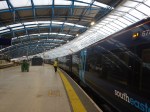








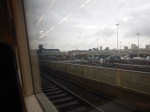
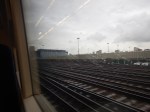
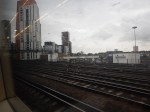

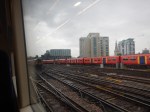
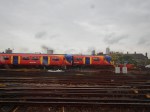
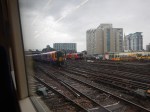
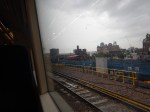

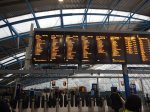
There would have been more, but it was chucking it down and the ones I took were terrible.
The Linford Street Junction And The Waterloo Curve
This map from carto.metro.free.fr shows the Linford Street Junction and the Waterloo Curve.
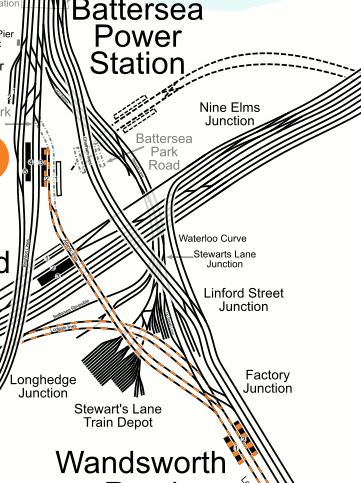
The Junction and the Curve are used by trains to connect from Waterloo in the North East, to the lines from Victoria that go across South London via Denmark Hill and Peckham Rye stations.
Note how the train going into Waterloo and the train coming out passed on the flyover. I assume this was for safety so that trains could leave and join the lines to Victoria at Linford Street Junction.
These pictures of the flyover were taken on another journey to Clapham Junction station.


The flyover is recent and was built for Eurostar and completed in May 1993. There’s a page called Nine Elms Flyover on the Kent Rail website, which gives a detailed history of the flyover.
The Route Between Waterloo And Sevenoaks
The journey between Waterloo And Sevenoaks passed through the following stations without stopping.
- Vauxhall
- Wandsworth Road
- Clapham High Street
- Denmark Hill
- Peckham Rye
- Nunhead
- Lewisham
- Hither Green
- Grove Park
- Elmstead Woods
- Chislehurst
- Petts Wood
- Orpington
- Chelsfield
- Knockholt
- Dunton Green
From Lewisham station onwards the route is on the South Eastern Main Line.
Overall Impressions
The route seemed to work well, although between Waterloo and Lewisham, the train was rather slow, with a slight delay joining the lines out of Victoria.
The journey was timed at 47 minutes, with the fastest normal services between London and Sevenoaks being around ten minutes faster.
It certainly seems to be providing an extra two tph between London and Sevenoaks. In Eurostar days, it handled up to six tph.
I also suspect it could handle twelve-car trains, although my journey was in an eight-car train.
Future Developments Along The Route
There are going to be more developments to rail services along the route and also into Kent. Many will be driven, by the bidding for the new Southeastern Franchise.
Ashford International Station
In Kent On The Cusp Of Change – Ashford Spurs, I talked about the completed upgrading of Ashford International station, so that more Eurostar and other Continental services can call.
As the station is going to get more Highspeed services, I can envisage some innovative ways to make more and better use of this station.
Bakerloo Line Extension To Lewisham
The Bakerloo Line Extension will provide passengers with the option of using the Underground from Lewisham to access Central and North London.
Brockley Lane Station
The Lewisham Line runs between Peckham Rye and Lewisham stations and is used by Southeastern trains from both Victoria and Waterloo.
There used to be a Brockley Lane station, where the route crosses the current London Overground’s East London Line, close to Brockley station.
This is said under Future in the Wikipedia entry for the station.
According to the Department for Transport and the Transport for London rail prospectus report released in 2016, it has been listed as one of the Southeastern franchise planned improvements in the document entitled “New interchange at Brockley”, suggesting that there might be a case to reopen the station.
Creating an interchange here would certainly open up lots of travel opportunities.
It should be noted that Brockley station will from 2020, have a ten tph service to Canada Water and Whitechapel stations, with all their Crossrail and Underground connections.
Charing Cross Station
Charing Cross station is bursting at the seams, with typically fourteen and more trains in each hour.
This extract comes from Network’s Kent Route Study.
Charing Cross has just six 12-car platforms and Platforms 4, 5 and 6 are very narrow, leading to operational restrictions.
Class 465 units cannot operate in 12-car into these platforms and selective door operation is used on Class 375 units.
A major rebuild of the station could allow it to be extended south over the river, like Blackfriars, providing compliant platforms and greater passenger circulation.
At concept level, a new link to Waterloo from a southern entrance to Charing Cross may supersede Waterloo East allowing the station area to be used for additional track capacity, but there are likely to be many issues with a project on this scale.
One of the many issues would be how to keep services running during the rebuild of the station.
I suspect that Waterloo could have a role to play in handling some of the services.
Fawkham Junction Link
In Kent On The Cusp Of Change – Fawkham Junction Link, I talked about the proposal to reopen the Fawkham Junction Link, which was originally used to allow Eurostar trains to get to Waterloo station.
If this link were to be reopened, coupled with what has been happening between Waterloo and Sevenoaks, this would enable extra Southeastern HighSpeed services to Thanet to be run to either Victoria or Waterloo.
Victoria Station
Victoria station will periodically need work and might even be subject to a major upgrade project.
As with Charing Cross, I’m sure Waterloo could be used as an alternative terminus for a few trains.
Could Southeastern Services Into Waterloo Become Permanent?
I suspect that as has been successfully shown this week, that it is a feasible proposition.
But whether it actually happens would be up to the train operators.
Consider.
- Eurostar used to run a 6 tph service on this route.
- A single well-designed platform can handle 4 tph.
- The new platforms can handle twelve-car trains.
But most importantly, the train operators will have all the passenger data!
Conclusion
Southeastern and Network Rail have certainly shown it is possible to run a two tph service successfully between Sevenoaks and Waterloo.
If nothing else, it could prove to be a useful alternative route during engineering works or other diversions.
Waterloo Upgrade August 2017 – A First Trip Into Platform 1
I took these pictures as my train went from Clapham Junction into Platform 1 at Waterloo station.
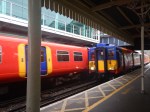
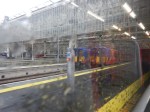
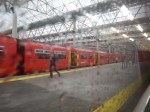
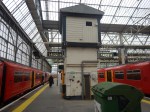
It appears that if your train is going into Platforms 1 to 6, Platform 6 shows on the National Rail web site.
Then just outside the station, it appears that this changes to the actual pltform when it is allocated.
My train was actually held for a minute or two, whilst another train left the platform.
It all seems to happen very smoothly.
Despite the rain!
I certainly think that they’ll achieve their objective of running twenty-two trains per hour into platforms 1 to 6.
Note how in this display from about 16:00.
- There are still quite a few delayed and cancelled trains due to the overrunning engineering work.
- Platforms 1 to 4 and 6 have a departure.
- Platforms 20-24 don’t appear. in the display.
It appears that a lot of the objectives have been completed.
Waterloo Upgrade August 2017 – A First Trip Out Of Platform 4
I took these pictures as my train left Platform 4.
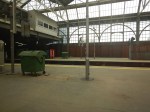

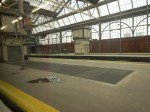
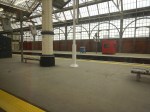
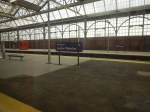
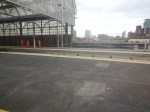
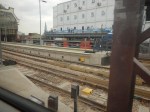
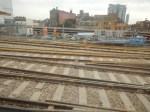
It does seem that most of Platforms 1 to 6 have been seen in the Departures display.

Note how in this display from about 16:00.
- There are still quite a few delayed and cancelled trains due to the overrunning engineering work.
- Platforms 1 to 4 and 6 have a departure.
- Platforms 20-24 don’t appear. in the display.
It appears that a lot of the objectives have been completed.
 The Anonymous Widower