Could We Just Double The Width Of The Digswell Viaduct?
The Digswell Viaduct and the associated double-track railway through Welwyn North station at its northern end, on the East Coast Main Line is probably one of the biggest bottlenecks on railways in the UK. Wikipedia says this about the Grade II* Listed viaduct.
The viaduct carries the East Coast Main Line, which has to narrow from four tracks to two to cross the viaduct, making it a bottleneck restraining capacity over this strategic transport route. This problem is exacerbated by Welwyn North railway station situated at the northern end of the viaduct, which blocks the line while trains are stationary and two tunnels to the north. Several ideas to overcome the limitations of the viaduct and station without damaging the viaduct’s essential historic character and rhythmic design are periodically discussed. The line was electrified in the 1970s.
Various plans have been put forward to remove the bottleneck cause by this masterpiece of Victorian engineering.
The Current Capacity
Network Rail have published this report, which is entitled The Capacity Of The Welwyn Viaduct. This is said about the capacity of the twin-track section.
The two track section between Woolmer Green Junction and Digswell contains both Welwyn Viaduct and Welwyn Tunnel and is approximately 2.5 miles in length.
In pure theoretical terms the capacity of the viaduct is dictated by the headway over the section.
There is a planning headway of 3 minutes over the two track section which therefore results in a theoretical maximum capacity of 20 trains per hour. To achieve this capacity would require a fully homogeneous service (for example same rolling stock and calling patterns) and 100% use of planning capacity.
The usable capacity is below the theoretical and is determined by the service specification which needs to use the capacity. The current and future specifications for the section require calls at Welwyn North Station which is on the two track section. This reduces the number of paths that can be achieved in a single hour over the viaduct. The usable capacity is also determined by the fast line capacity between Finsbury Park and Digswell and the difference in speed of rolling stock approaching the two track section which will determine whether trains can be flighted over the viaduct at 3 minute slots to achieve the theoretical capacity.
There is no defined permitted number of paths on the viaduct as the capacity available is a function of demand and therefore the type and number of services which need to use it.
Network Rail concludes that eighteen trains per hour is a theoretical maximum on the current track layout.
Reason For Removal Of The Bottleneck
Whether or not HS2 is built, the East Coast Main Line must be improved to handle the large and ever growing traffic between London and Leeds, Newcastle and Edinburgh.
If more of the line was four-track, it would make the train companies aim of a frequent four-hour service to Edinburgh achievable. It could be even faster, if a lot of the line could handle trains at one hundred and forty mph, rather than the current one hundred and twenty-five.
Proposed developments are detailed in Wikpedia.
One of the most important is removing the bottleneck at Welwyn.
One Problem Or Two?
I think that when outsiders look at this bottleneck, they see one problem, but I think it is fair to describe it as two.
- Welwyn North station and the tunnels to the North.
- The Digswell Viaduct itself
In my view both problems need their own solutions.
We shouldn’t also forget other smaller changes, that can take the pressure of the area.
- More and better use of an upgraded Hertford Loop Line.
- More precise and better timetabling of trains.
- As Thameslink beds down, we’ll see other improvements.
I also wonder, if a fully-electrified freight route could be created between Peterborough and London, through March, Ely and Cambridge, that used the extra capacity of a four-tracked West Anglia Main Line.
Welwyn North Station
In some ways the station is as big a bottleneck as the viaduct, as the two trains an hour that stop in the station, effectively block the line for a few minutes.
It is also one of those heritage problems, that Network Rail love so much. This is said in the Wikipedia entry for the station.
The station is a rare survival of architecture from the early days of the GNR and this is now recognised with listed building status. The main station building, the footbridge, the tunnel portal to the north and Welwyn Viaduct to the south are all Grade 2 listed.
So I doubt that modifying the station will be easy.
This Google Map shows the lines through the station.
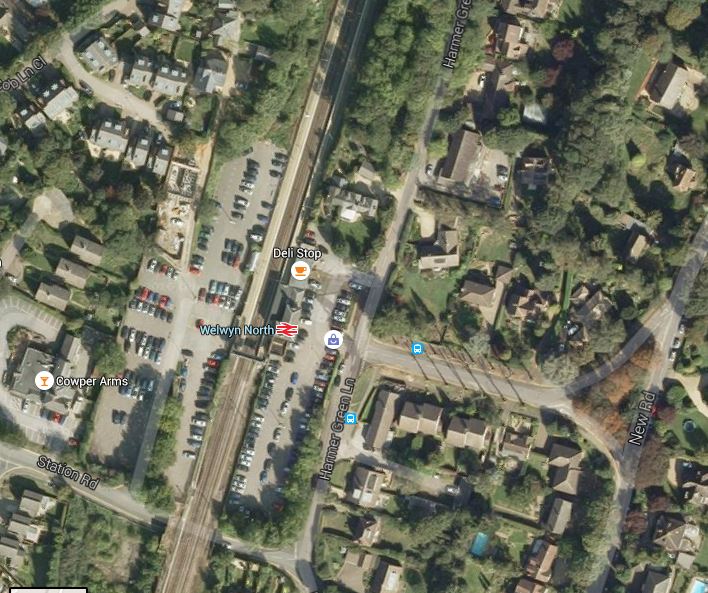
Welwyn North Station
These are some pictures of Welwyn North station taken on another day.


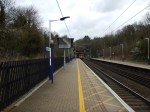


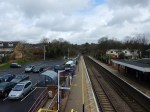
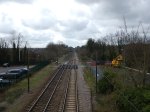


The images, probably shows another problem in that four-tracking the line through Welwyn North station would probably close the car parks.
The Digswell Viaduct
The Digswell Viaduct is an iconic structure and if the views of the viaduct and the valley it crosses were to be altered in any negative way, there would be a battle that would make the protests over HS2 look like a child’s tea party.
Around 1890, they had a similar capacity problem at the Stockport Viaduct, which was successfully widened from two tracks to four.
It is my view, that with major advances in structural engineering and construction methods, that widening the viaduct would be one of the better methods to improving the capacity through the area, without changing the look of the viaduct.
Intriguingly, if the East Coast Main Line was not already electrified, with the recent development of IPEMU-technology, I suspect now that Network Rail would think seriously about not electrifying the viaduct.
Trains would cross using their on-board energy storage, raising and lowering their pantographs appropriately.
Knebworth Station
This Google Map shows Knebworth station, a few miles to the North of Welwyn North.
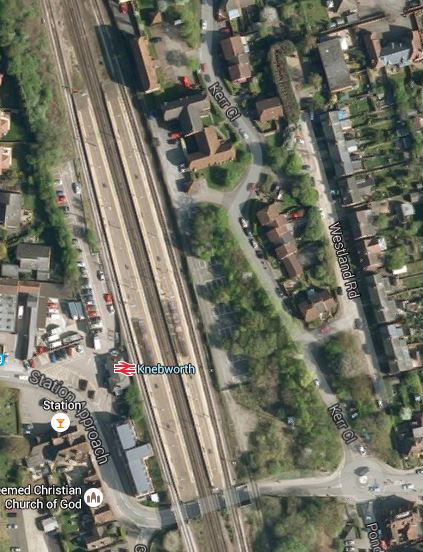
This station has four platforms arranged on two islands.
For comparison, this is an image of Welwyn North station to the same scale.
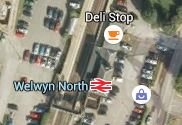
I think that four-tracking Welwyn North station will be a tight fit.
Comclusion
At some point, I feel that Network Rail will bite the bullet on four-tracking this section of line and the fight will be a big one.
Is HS2 At Risk Of Derailing?
There is an article in The Telegraph entitled HS2 at risk of derailing at top speeds, report finds.
I have read the article and the report by Professor Woodward at Heriot-Watt University is obviously, based on sound mathematics and enginering principles.
We have a problem with HS2, which is not unlike the problem with the new Hinckley Point nuclear power station.
There is a big need for extra capacity, but it will cost an awful lot of money.
In both projects too, there is a lot of opposition.
Professor Woodward’s research has one serious consequence, even if the high design speed of the line doesn’t make the trains derail.
It is that if you reduce the speed of the line, the economic case for HS2 is shot to pieces.
If you decide that there could be a safety problem with the embankments, you have to strengthen them and that ruins the economic case too.
If we look at Hinckley Point C nuclear power station, not building it, is not as serious as not building HS2.
We have several other ways to generate power and also lots of ways to save it. Also, the widely quoted strike price of £92.50/MWh would make a lot of other much cheaper schemes like tidal power viable.
But this doesn’t solve the problem of creating more capacity on the rail lines between north and south for both passengers and freight.
HS2 doesn’t carry freight, but hopefully, it will free up paths on traditional routes to the north, that could be used by freight trains.
If you think we don’t, travel between Euston and Glasgow on Virgin Trains and look at the passenger loading.
At present, Network Rail are carrying out various schemes to squeeze more capacity out of the current lines and it is hoped that in the short term, this will help.
But in some ways all it will do is create more demand for travel on the routes.
So at some time we’re going to have to build a new line, which will allow faster speeds than the current lines.
If you look at Phase 1 to the West Midlands, this will have the following effects.
- Extra capacity between London and the West Midlands.
- Journey times of around fifty minutes.
- Making Birmingham Airport, a viable one for those living in North London.
- Paths released for freight on the West Coast Main Line.
- Reorganisation of traditional services on the West Coast Main Line to serve more places.
In Phase 1, there would probably be no more than half-a-dozen trains in both directions on the southern section of HS2, south of Birmingham International station.
On the other hand, when Phase 2 to Manchester and Leeds opens there will be upwards of twenty trains per hour both wayson the same southern section.
I can understand, why those in the Chilterns are getting angry.
So to the protesters, Professor Woodward’s research could be manna from heaven.
For some time, my view has been that we need new tracks between London and the North via Birmingham, as even if all existing lines were upgraded, there wouldn’t be enough capacity.
I think we’re going to need some radical thinking.
For instance, suppose you made Birmingham International a hub, where the lines from the North met a line to London and one into Birmingham city centre.
This might help in the design of HS2 to the north of Birmingham, but that is not the area, where there is major opposition to the line. That is between Birmingham International and London, where land is limited and wherever you build it, you’ll annoy someone.
I suspect, a lot of people working on the project, sometimes feel like going and working elsewhere.
But whatever we do with HS2, we must improve the traditional routes.
- Electrify the Midland Main Line to Derby. Nottingham and Sheffield,
- Electrify the Chiltern Main Line to Birmingham.
- Electrify the routes across the Pennines from Preston and Liverpool to Hull, Leeds and Newcastle via Manchester.
- Sort out the Digswell Visduct on the East Coast Main Line.
- Improve speeds to as high as possible on all routes to the North.
The only trouble, is that the more we improve traditional routes, the more people will travel by train and the need for HS2 will become more urgent.
A Trip To Cardiff
Yesterday, I went to Cardiff to see Ipswich lose to Cardiff City.
These are some pictures I took on the way.
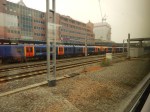

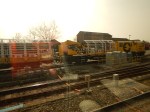


I think it is true to say that the electrification is being put up by snails and there seems to be little progress since I wrote Passing Didcot Power Station twelve months ago.
Note the following.
- Very little seems to be happening around Reading station, except the erection of a few masts.
- The cause of a lot of the trouble – the HOPS train at Swindon.
- The depot for the Class 800/801 trains at Filton Triangle.
- The extra platforms at Cardiff Central station.
- The work at Cardiff to create a new Central Square.
A lot of the work, that is this side of Bristol, is a total disaster.
Small Annoyances In Travel
I have some big things, that annoy me, but in my travels, I constantly come across small things that can be improved.
1. Beggars Selling Tissues
A complete pain and an annoyance to train companies too!
One day, an annoyed drunk, will tell one to get lost very forcibly!
2. Bi-Lingual Signs
If the Welsh want to have station signs in Welsh that’s for them to decide, but having everything in Welsh and English just clutters the station and makes doing simple things like finding toilets difficult.
3. Bus Information Outside London Is Mainly Useless
London’s bus maps and text Countdown system, sets a very high standard for bus information.
But why is it, that no area of the UK, or few in Europe for that matter, has a system that works as well for visitors?
4. Bus Pass Restriction In Other Countries Of The UK
Today, I was in Cardiff and had to buy a ticket. I had no small change, so I held everybody up and in the end a kind Welshman paid.
I believe that if all bus passes worked all over the UK, it would be a self-financing scheme, as more of us would travel to the other three countries and probably spend money which would generate VAT and other taxes.
Supposing too, we also allowed those from other countries over sixty-five or disabled to use buses for free. Would this encourage tourism and create revenue?
It certainly would be an experiment that would be worth trying.
5. Buses With Only One Door
All of London’s buses, except for the very smallest have two or more doors. It speeds loading and unloading, especially for those in wheelchairs or pushing buggies, so the buses go faster.
6. Cities And Towns With Two Disconnected Main Stations
Some cities and large towns have two main stations. Birmingham, Blackpool, Glasgow and Manchester come to mind.
If they can’t be connected by a proper rail connection, then at least there should be a ticketless way of getting between the stations.
Several times a year, I do journeys, where I have to go across Manchester between Victoria and Piccadilly stations. I have to buy a ticket on the tram, but if say I have a ticket from Euston to Burnley or Blackburn, the tram should be included.
It is not a system designed for the real needs of travellers.
7. East Croydon Station
East Croydon Station is the ideal changing point for journeys to Surrey and Sussex.
But despite the rail lines being in place, it is not easy to get there from East London. You use one of these routes.
- Bus or Bus/Tube to London Bridge station and then use Thameslink.
- Bus or Bus/Tube to Victoria station and then use a direct train.
- East London Line to West Croydon station and then a tram
The last method can’t be used coming north, as the trams don’t serve West Croydon when going west.
At present, you can take the East London Line to New Cross Gate or Norwood Junction stations and change, but this will be stopped, when the full Thameslink opens.
8. Ordsall Chord
I fear that due to the persistent opposition of one misguided and obstinate individual, that the Ordsall Chord will never be built.
9. Paddington Station
For those of us in East London, Paddington station is a very difficult station to get to. Unless you’re happy to crawl along the Hammersmith and City Line and walk a long way to your train.
10. Stations With No Information On How To Use Local Buses
Manchester Piccadilly station is particularly bad and in many cases you have to walk to Piccadilly Gardens to get the bus you need.
Some towns and cities like Sheffield have the main bus station by the train station.
If this is not possible, then at least have comprehensive information.
11, Stations Without A Marks & Spencer Simply Food
Paddington and Nottingham stations annoy me, as these two important stations don’t have a Marks & Spencer Simply Food store, which is the only one I trust for gluten-free sandwiches, snacks and ready meals.
12. Stations Without Ticket Machines
Most stations have them these days, but I’ve come across a couple recently which don’t.
They should also be as close to the platforms as possible, under a shelter from the weather.
13. Taxi Drivers That Are Incompetent
In London we’re spoilt as our black cab drivers know where they’re going and everything is on a meter.
I think because of this, all the mini-cabs seem to work to a very good standard of knowledge.
But I’ve had some very incompetent taxi drivers in parts of the UK! One was even a black cab!
14. Toilets That Need Money
I know that providing toilets is expensive and that there are other reasons to charge, but why can’t someone develop a toilet that can be entered using a contactless bank card.
15. Urban Area Ticketing
If I wasn’t old or infirm enough for my Freedom Pass, I could use any contactless bank card to pay my fare on all of London’s transport.
But why can’t I do this in places like Birmingham, Edinburgh, Glasgow, Leeds, Liverpool, Manchester and Newcastle?
Are these transport authorities worried that if passenger numbers rise like they have in London with contactless ticketing, that they couldn’t afford the extra buses, trains and trams?
Heathrow Express Class 332 Trains Are Back
On my trip to Cardiff today, I took this picture of a Class 332 train back running the Heathrow Express.
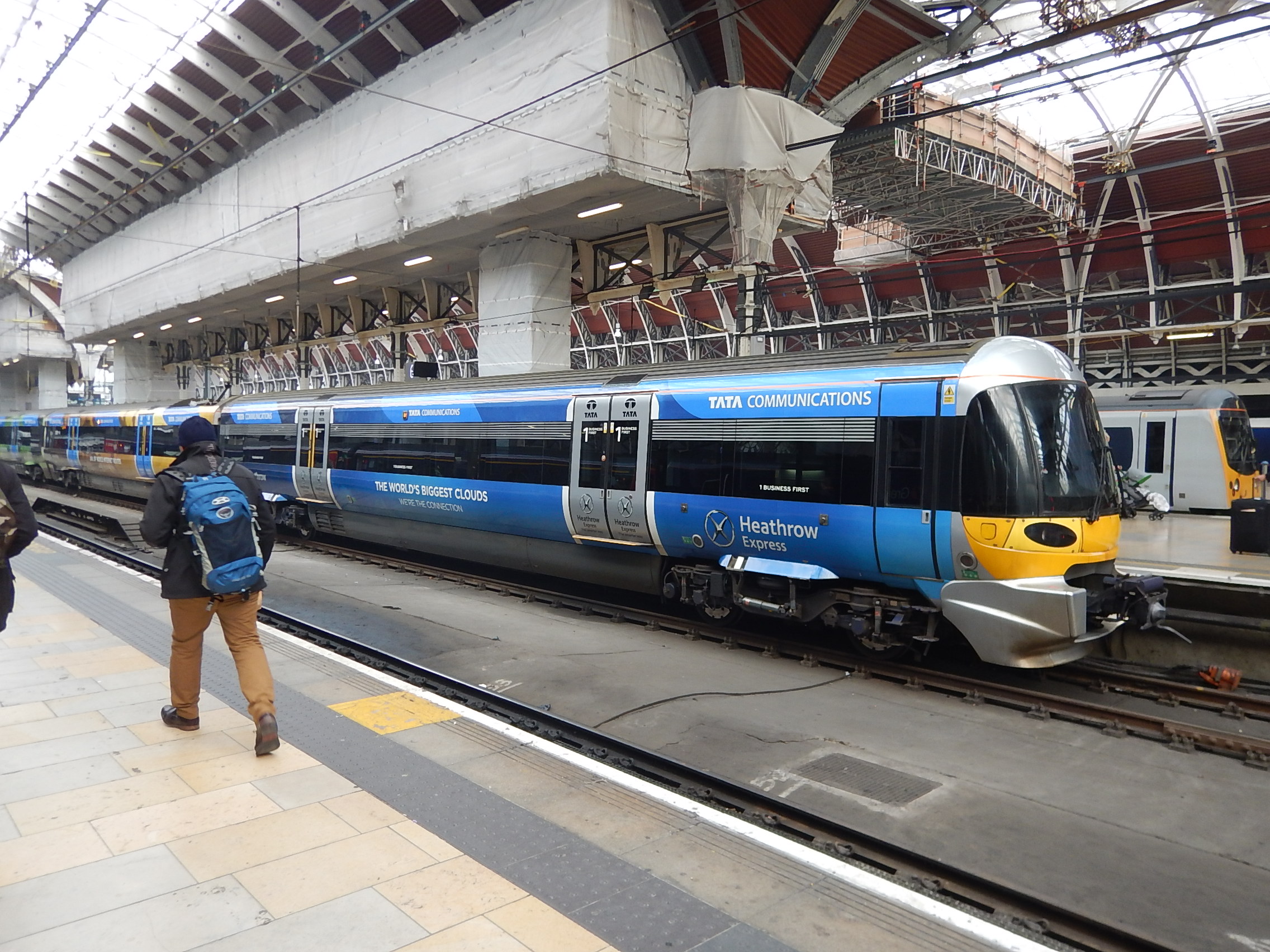
Heathrow Express Class 332 Trains Are Back
When I got home, I found this recent article on Rail News.
I still won’t be using them, as to get to Paddington is not easy from Dalston withiout using a taxi, as I did when going out.
On return, I needed to get some supper and as Marks and Spencer is closed at Paddington, I had to get the tube to Kings Cross to get the food I needed.
From there I got a taxi home.
It won’t be easy to get to Paddington until Crossrail opens and if it opens as planned, there will be no need for those of us in the East to use Heathrow Express.
Stopping Your Computer Upgrading To Windows 10
I never upgrade my computers to the new version of an operating system, unless it is absolutely necessary.
No-one has convinced me of a valid reason yet! And I doubt anyone will!
They are my computers, so I decide when to upgrade, not some idiot who might vote for Donald Trump and believes in the right to bare arms and the death penalty. Not you Bill, but can you vouch for all your employees?
But I have been pointed to this little program entitled GWX Control Panel, that immunises your computer against unwanted junk from Micros**t!
Energy Switch Inertia
I’ve just heard Paul Lewis on BBC Breakfast talking about some of the new rules to find the best energy deal. It sounds a real mess, which is all to the advantage of the Big Six.
I wrote Read This Article If You’re With The Big Six Companies, when I read a good article by Stewart Dalby, where he advocated self help.
Talking to a few friends who are still with the Dreaded Big Six, I’m convinced that the biggest problem is brain inertia and making the decision to switch.
But against this, I’ve never met anyone, who is dissatisfied with a small supplier after switching.
There are various methods, I’ve heard of where people found their new small energy supplier.
- Recommendation from a friend or someone they trust.
- One lady was pointed to her supplier by her doctor.
- From the consumer pages of a daily or local paper. One was even recommended by the Daily Star!
- I’ve seen one supplier advertised above urinals in a pub toilet.
- From a local councillor.
I chose my supplier, as I saw an interview with OVO’s founder in the Sunday Times. I liked what I read and as I still do, I have no reason to change!
Questions About Solar Panels
Yesterday, despite the temperature being about eight or nine outside, because the evil devil had switched the radiant heaters on, the temperature had risen to twenty-eight inside my house, due to heat coming in through my skylight and by radiation from the flat roof.
Now the flat roof has been relaid and insulated, so to make matters worse the heat once in can’t get out.
So I decided I’d had enough and have decided to do what I had already ascertained was to be the next steps.
- Put an electric shutter over the skylight.
- Fit solar panels to both generate electricity and shade my house from the sun.
Hopefully, I’d generate enough electricity to run the air-conditioner, when the sun is on.
I entered my details into a comparison site and they said they’d select six local installers.
Within half an hour, I had a call on my phone and as the guy was in his van just round the corner, he was in my house doing a survey within five minutes.
He was also very much a local supplier, as both his flat and office were within five hundred metres.
He quoted for a four kilowatt system with sixteen panels, which he said would cost £5,000 as standard including installation and VAT.
I could also have micro-inverters which would up the cost to £6,300.
He indicated that micro-inverters were more efficient and had a loner life. He also enclosed the data sheet for the Enphase microinverters.
So I asked myself what are micro-inverters and what advantages do I get.
I found this web page entitled Should I Get Micro-Inverters For My Solar PV System?
Read the page and you’ll find there are two kinds of inverters;string and micro.
With a string inverter, you have one device that converts the DC of the panels to the AC of the house. So it’s like having one charger for all your devices.
With a micro inverter, each panel has its own inverter.
So the number of electronic components probably explains the difference in cost.
But there are other differences.
- String inverters have typically a five year guarantee, whereas micro inverters have one of twenty-five. Only a madman would offer such a guarantee, if the devices failed regularly.
- String inverters gear their output to the poorest performing panel, whereas with micro-inverters each panel performs according to the sun it gets.
- If there is a chance of major shading, go for micro inverters.
- Failures do happen and surely if each panel is an complete system, if one should fail, it is a problem, which is easier to locate and remedy.
Now I’m no expert, but my electrical engineering training says that micro-inverters are a better bet.
Years ago, when I worked at ICI, some others in the office were working on automating a chemical plant. Up until 1970, traditionally each temperature, pressure and position sensor input went into a massive and extremely expensive analogue to digital converter to link to the computer. But in this development, every input had its own converter.
I ‘m not in automation these days, but I doubt they use a massive and expensive converter and each input is handled individually.
So with my panels, I’m tempted to pay the extra £1,300.
I’m still waiting for the other five installers to phone.
Will Walthamstow Central Station On The Victoria Line Be Expanded?
This post is prompted by this article on London Reconnections, which looks at Transport for London’s World Class Capacity Upgrades for the Victoria, Jubilee and Northern Lines.
After the upgrade of the crossing at Walthamstow last summer, the Victoria Line now has a capacity of 33 trains per hour and most trains run all the way between Walthamstow Central and Brixton stations.
Sometime this year the limit will be further increased to 36 tph, which will be a very high limit considering the design of the line.
The London Reconnections article says this about future upgrades.
With the Victoria line pushing towards what must be the theoretical limit for a line with that amount of rolling stock and – more importantly – two-platform termini, there are no plans to further improve the service. Indeed the challenge of procuring more trains and finding the depot space for them would probably discourage any such plans on its own. This does not mean that the line will be forgotten, as both Oxford Circus and Walthamstow Central are on TfL’s top ten hit list of stations in need of a major capacity upgrade. Simply that the days of pushing more trains through the same stations more quickly have passed. In the case of Walthamstow Central it is highly likely that the next step will be making the station double-ended, with an entrance near or in the shopping centre.
Certainly with just two escalators, Walthamstow Central station can be busy with both working. At the moment it is on my list of stations to avoid, as one of the escalators is being replaced.
Is the idea of creating a double-ended station at Walthamstow Central worth pursuing?
Look at this map from carto.metro.free.fr, which shows the lines at the station.
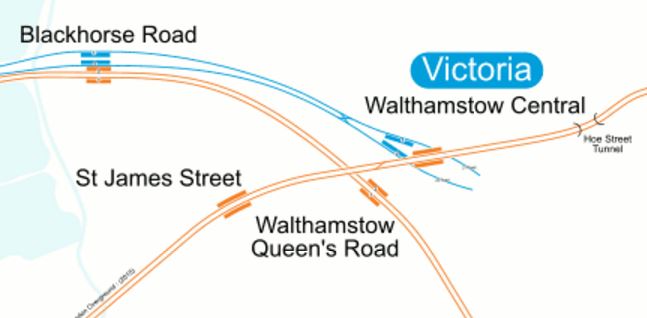
Walthamstow Central Lines
So it would appear that the Victoria Line platforms could be somewhere under the bus station and the shopping centre.
It certainly isn’t an impossible dream to create a second entrance to the Victoria Line platforms.
Walthamstow Central station was one of London Transport’s economy stations. Wikipedia says this.
The underground station, like many stations on the Victoria line, was never completely finished. White ceiling panels were never fixed to the ceilings above the platforms; instead the steel tunnel segments were painted black and used to support the fixtures and fittings. This has had a detrimental effect on the lighting levels. There is a concrete stairway between the two escalators instead of a third escalator; this caused a hugely disruptive station closure for several weeks in 2004 when both escalators went out of service.
It would be hoped that any upgrade of the station finishes the 1960s era construction.
But surely creating a double-ended station is the way to go.
- It would take the pressure off the passageways in the existing station.
- The existing station is not step-free and there is no deep lift.
- If the second entrance had two escalators and lifts, it would give a lot of redundancy in platform access.
- There is plenty of space in the shopping centre for a new entrance.
Passengers interchanging with the Chgingford Brancxh Line and those interchanging with buses or going shopping, could possibly be persuaded by good design to use appropriate and different entrances.
Conclusion
It’s feasible.
But the biggest advantage is surely that by planning carefully, the second entrance can be built around the current station, without disrupting passenger entrance and exit.
Related Posts
Improving The Chingford Branch Line
Could Electrification Be Removed From The Chingford Branch Line?
Could Reversing Sidings Be Used On The Chingford Branch Line?
Could The Hall Farm Curve Be Built Without Electrification?
Crossrail 2 And The Chingford Branch Line
New Stations On The Chingford Branch Line
What Will The Northern Line Extension TBMs Be Called?
This article in Global Rail News is entitled Northern Line TBMs Complete.
So all that is needed now is to find two suitable female names for the machines.
As the extension goes to Battersea, surely they should be given the names of famous dogs.
How about?
- Beauty – The world’s first rescue dog – Awarded the Dickin Medal in 1945.
- Judy – A pointer, who helped keep morale high in a Japanese prisoner-of-war camp – Awarded the Dickin Medal in 1946.
- Sasha – A labrador, who died with her handler in Afghanistan – Awarded the Dickin Medal in 2014.
- Susan – The queen’s first corgi.
There must be quite a few others.
 The Anonymous Widower