A Tale Of Two Trains
Last week I attempted to have rides in two ground-breaking trains.
- A battery-powered version of Vivarail‘s Class 230 train.
- A hydrogen-powered Alstom Coradia iLint.
Some months ago, I also had an early public run in a Crossrail Class 345 train.
The latter trains have now been introduced more fully into service, although there are still some Class 315 trains in service between Liverpool Street and Shenfield stations.
Transport for London performed the introduction with plenty of well-trained staff about to both handle any problems and ask passengers for feedback.
It was all very professional and despite Crossrail’s well-reported lateness, it is difficult to find bad reports about the performance of the Class 345 trains between Liverpool Street and Shenfield.
Vivarail’s Class 230 Train
I went to the Bo’ness and Kinneil Railway, to see this train last Wednesday and wrote about the train in Battery Class 230 Train Demonstration At Bo’ness And Kinneil Railway.
- This service was not a paid-for public service but a free demonstration open to all, who wanted to turn up.
- Many people did for the first run at 11:00 and they looked to be a mixture of locals, people with transport interests, families and enthusiasts.
- Vivarail came mob-handed with engineers, designers, public relations staff and the Chairman; Adrian Shooter.
- There was no restrictions as to who talked to whom.
Search the Internet and it is very difficult to find negative reaction to the demonstration.
This article with a video in the Scotsman is entitled Video: Battery Trains On Track To Cut Emissions and gives a lot of information.
- Each car weighs thirty tonnes.
- Chassis and body are aluminium.
- Each car has two 100 kWh batteries underneath.
- New batteries in 2019 will enable sixty mph for forty miles and take just four minutes to charge.
- Regenerative brakes recharge the batteries.
The article has a very positive, typified by this paragraph.
Beyond the recycled exterior, Adrian explains how renewable energy and eco-friendliness are at the heart of the train’s design and a sign of things to come.
I haven’t read any reports from bloggers, enthusiasts or the general public about the train, but like myself, I suspect many went home quietly satisfied after watching a very professional demonstration.
My only negative comment about the Vivarail demonstration, is that it could probably have done with a modicum of classic marketing and upsexing.
Alstom’s Coradia iLint
Last week was the second time, that I tried to get a ride on this train.
- But as with my first trip, although I saw a train, none were actually running.
- This time, I heard that there was a shortage of drivers and one train had gone back to the manufacturer.
- These innovative trains are going to attract visitors from all over the world and I think that Alstom are not being at all professional with their handling of the testing.
- There was just no information, let alone staff at any of the stations, that will be served by the hydrogen-powered trains.
The important people were happy enough to turn up for the grand launch, but did not see fit to provide the information for the general public, who are interested in a genuine innovation, that could cut carbon emissions.
Conclusion
We will see a diesel-powered Class 230 train in service this December and it will then be possible to judge this innovative train on a fair basis.
But after the professional demonstration I saw in Scotland, I very much feel that this launch will not be handled in a sloppy way, such that it leaves a lot of disillusioned travellers.
But I am beginning to wonder, if Alstom’s project was launched too early without real planning to gain lots of brownie points about green issues.
It is one thing to get a new train working on a test track, but passengers with their own needs and appointments to keep, add a whole new dimension.
Alstom may well not be alone, as Porterbrook seem to be having troubles with launching their innovative Class 769 train.
Will There Be Hydrogen-Powered Class 230 Trains?
In the October 2018 Edition of Modern Railways, there is an article which is entitled Vivaral Delivers First Class 230.
In addition to discussing the deployment on the Marston Vale Line, the article has various sub-sections describing future plans for the Class 230 trains.
One such sub-section is entitled Isle of Hydrogen Hybrid?.
This is the first paragraph.
Vivarail is still waiting to hear whether it will receive a European Union grant to develop a hydrogen fuel cell version of the Class 230, although Mr. Shooter was hopeful confirmation of this would be received in September. The application has been made with a range of other organisations including Canadian fuel cell company Ballard.
Other points from the sub-section include.
- The train will be a hydrogen-battery hybrid.
- The design would be similar to the diesel-battery hybrid for the Borderlands Line.
- The hydrogen fuel cells would be in the centre vehicle.
It is also said that hydrogen storage can’t be on the roof, due to the UK’s restrictive loading gauge.
Conclusion
At the moment, it’s just adding another prototype train to a long list of trains with a better environmental footprint.
If this train is successful, it will be a three-car independently-powered train, with no emissions and low noise, which will be ideal for a lot of routes in the UK and possibly other countries, which share out passenger loading gaue and requirements.
Class 230 Trains On The Conwy Valley Line
I suspect to some people, the use of Class 230 trains, which are rebuilt London Underground D78 Stock on the Conwy Valley Line is a challenge to far.
Class 230 Trains
I wrote about these trains in First D-Train With Transport for Wales In March 2019, where I stated that the train formation will be.
- DM – Driving Motor with battery
- T – Trailer with four generators
- DM – Driving Motor with battery
As the trains will have regenerative braking, this will be used to help charge the batteries.
Note that batteries and traction motors are only in the Driving Motor cars.
The Conwy Valley Line
The route of the single-track Conwy Valley Line can be summsarised as follows.
- From Llandudno to Llanrwst it is a fairly level route alongside the River Conwy.
- From Llanwrst the line climbs to a 240 metre summit in the Ffestiniog tunnel, with gradients as steep as 1-in-47.
- From the summit, the train descends into Blaenau Ffestiniog with gradients as steep as 1-in-43.
It has some of the characteristics of a roller-coaster.
Class 230 Trains On The Conwy Valley Line
Provided the trains can handle the gradients either side of the summit, they can just roll down the other side. During the descent, the regenerative braking will charge the batteries.
This will have the following effects.
- Trains on the downhill sections will not need to use their diesel engines.
- Trains waiting in Blaenau Ffestiniog station, won’t need to use their diesel engines until they start back to Llandudno.
- I suspect some Northbound services, trains would be able to reach Llandudno without using their diesel engines.
Gravity is being used as an energy store to create an efficient railway!
Energy Of A Class 230 Train On The Conwy Valley Line
I am curious to know how much energy is needed to get a fully-loaded train up the hill from Llandudno to Blaenau Ffestiniog.
Consider the following.
- A D78 Driving Motor car weighs 27.5 tonnes
- A D78 Trailer car weighs 19 tonnes
- Wikipedia says “For the Country layout, each D-train unit is to be a three-car formation, which would accommodate 163 seats along with a total capacity of 291.”
- I assume each passenger weighs 90 Kg with baggage, buggies and bicycles.
- I think it is fair to say that each generator and battery weighs about a tonne.
- The summit of the line in the Ffestiniog Tunnel is 240 metres above sea level.
- I will assume that the coastal end of the route is at sea level.
This means that the empty train weighs eighty tonnes and a full load of passengers weighs twenty-six tonnes.
Using Omni’s Potential Energy Calculator, this gives a potential energy for the train of seventy kWh, at the summit with a full load of passengers.
This figure means that if two 55 kWh batteries from a New Routemaster bus were used on the train and they were fully-charged, then they could power the train to the summit and on to Blaenau Ffestiniog.
It should be noted that Vivarail talk about using 106 kWh battery rafts on the Class 230 train.
A Few Questions
I have these questions.
Are These Class 230 Trains Serial Hybrids?
I ask this question, as it could be key to making the operation of the trains more efficient on this line.
The train would always be powered directly from the batteries.
- The diesel engines would cut in to charge the batteries, when the battery charge level got to a certain low level.
- The diesel engines would cut out, when the battery charge level, got to a certain high level.
As the train has four generator sets, an appropriate number could be used as required.
A well-trained driver or an intelligent control system could make these trains very efficient.
In this article on RAIL Magazine, this is stated.
Shooter told RAIL that the trains will save around 20% on fuel consumption.
Adrian Shooter is Chairman of Vivarail, who are creating the Class 230 trains.
Possible Electrification Of The Ffestiniog Tunnel
The Class 230 trains are created from London Underground D78 Stock and I suspect it would be possible for the Class 230 trains to be powered by third-rail electrification.
The Ffestiniog Tunnel is the summit of the Conwy Valley Line.
- It is a single-track.
- It is 3.5 kilometres long.
- One end of the tunnel is close to Blaenau Ffestiniog.
Would it be a sensible idea to electrify the tunnel either fully or partially, to top up the batteries?
Consider.
- The third-rail electrification would be no intrusion in the landscape.
- The electrification could only be switched on when a train is present.
- I don’t think supplying power would be difficult.
- There could be less need to run on diesel.
The electrification could even be extended to wards Blaenau Ffestiniog station, so that trains leaving the station could have electrical power to climb to the summit.
Will The Class 230 Trains Attract Passengers?
I think that the Class 230 trains have several passenger-friendly features.
- All new interiors.
- Ten percent more seats and almost twice the capacity.
- Lots of space for bicycles
- Large windows
- Wi-fi and power sockets
- Accessible toilet
Hopefully, there will also be step-free access between train and platform.
This package of improvements should encourage more to travel.
I also suspect, that having a decent train with a novelty appeal that connects to the Ffestiniog Railway will tap a new market of travellers.
Conclusion
I have no doubt, that Class 230 trains will be able to provide a successful service on the Conwy Valley Line.
New Heathrow Rail Link To Lead The Way For Future Transport Funding Schemes
The title of this post, is the same as that of this Press Release on the Department of Transport web site.
This is the opening two paragraphs.
Private companies have been asked to come forward with ideas to deliver a new southern rail link to Heathrow Airport.
The link will be one of the first projects under government plans to invite third parties – such as local authorities and private sector companies – to invest in the rail network, over and above the £47 billion the government is already planning for the next 5 years.
In the past, I have talked about two privately-funded schemes for access from the South to Heathrow.
The Times is saying today, that it could be the second scheme.
But Heathrow can be such a money-earner, you do wonder if other schemes to serve the airport will be put forward.
How Would A Scheme Work In Practice?
A consortium consisting of engineering, financial and railway interests would put forward a scheme.
They would do the following.
- Design the scheme and ensure it was acceptable to all stakeholders, including Network Rail, the Office of Rail and Road, local authorities, train operating companies, passengers, residents and in the case of Heathrow, the airport itself.
- Raise the finance to build the scheme from appropriate institutions like insurance companies, banks and pension funds.
- Build the scheme and get it approved by the appropriate companies, authorities and regulators.
- Once the scheme is commissioned, trains using the scheme would pay appropriate track access charges, in the same way, that they do now, when they use Network Rail’s tracks.
- Maintenance would be the responsibility of the consortium, that built the scheme.
In some ways the consortium functions like a mini-Network Rail, as it obeys all the same standards with regards to engineering and safety.
But.
- The finance is not provided by taxpayers.
- Any profits go to those, who conceived, built or financed the project.
- Risks associated with the project are not borne by the Government or taxpayers.
If say in ten years time, the consortium goes bust, then I suspect that the assets would be bought on the cheap, by either Network Rail or another investor, who would learn from the original consortium’s mistakes.
Not that I think that will happen!
Has Anything Similar Been Done Before In The UK?
I think it is true to say, that various innovative ways have been found to fund railways in the UK.
The article from the Independent, which was written in 1992 is entitled Canary Wharf Banks Agree Funding For Jubilee Line.
This is a paragraph from the article.
The Government has always insisted that the scheme will not go ahead without private funding. In return for the financing, the banks are believed to be insisting that the Government chooses Canary Wharf as the site for the relocation of about 3,000 civil servants from the Department of Environment and the Department of Transport. It is also considering three other sites in the area.
So it looks like relocating three thousand civil servants got the Jubilee Line built!
Chiltern Railways have expanded by leaps and bounds over the years and some of their methods have been professional and innovative.
Project Evergreen with three phases has expanded and improved their passenger services.
This is an extract from the section of Wikipedia, that talks about the project.
Chiltern Railways former chairman Adrian Shooter said, “This is the biggest passenger rail project for several generations not to call on the taxpayer for support. Working closely with Network Rail, we are going to create a new main-line railway for the people of Oxfordshire and the Midlands. This deal demonstrates that real improvements to rail services can be paid for without public subsidy by attracting people out of their cars and on to trains.”
I don’t know whether this relates to all of Project Evergreen or just one part.
This is also said.
Network Rail provided the capital for the upgrade and will recover this through a facility charge over the subsequent 30 years, initially payable by Chiltern until its franchise expires, and then by the next franchisee. The infrastructure upgrade was carried out by main contractor BAM Nuttall, in partnership with Jarvis and WS Atkins.
It may all sound complicated, but Chiltern Railways is a train operating company that commuters don’t seem to complain about.
Could Any Other Schemes Be Funded Using The Department for Transport’s New Model?
Building the southern access into Heathrow Airport will be a large project costing more than a billion pounds.
But that doesn’t that all projects need to be that size!
I suspect, that the DfT’s model will be applied to some projects, as small as a hundred million pounds.
These are my thoughts on future projects, which I have split into various sections.
Airports
If a scheme like the Heathrow scheme gets the go-ahead, then I think this could lead to other airport links being designed, funded and built using a similar model.
At present, Aberdeen, Bristol, Doncaster-Sheffield, East Midlands, Glasgow, Leeds and Liverpool airports are looking to improve rail access and the DfT’s model may be a way to build some, if the demand is there.
Network Extensions
The proposed Heathrow Southern Railway is effectively a well-thought out extension to three networks; Crossrail, Heathrow Express and South Western Railway to all of their mutual benefit.
I doubt there’ll be such big extensions, but there are some useful ones being planned.
- Bramley Line -The track-bed of this route is still there and connecting March to Wisbech could create a new commuter route for Cambridge.
- Fawley Branch Line – This would provide a passenger service and serve new housing developmemts in Hythe and Fawley.
- Ivanhoe Line – Proposals to improve this service in Leicestershire with new stations.
- Merseyrail Northern Line Extensions – The £300 million extension to Skelmersdale is being planned and another from Ormskirk to Preston is proposed using battery trains.
- North Downs Line – This line could be updated to provide an improbred Reading- Gatwick. Would it make a freight route for Minis from Oxford to the Channel Tunnel?
- Skipton To Colne Reinstatement – This project of just a dozen miles is high profile amongst Conservative politicians and would provide another route across the Pennines.
- West London Orbital – This £264 million extension to the London Overground would create two new lines in North West London.
This is by no means a complete list, but it shows how many routes could benefit with reinstatement or improvement.
Electrification
Why shouldn’t electrification be privately funded, with the builders and investors getting their returns, through an electrification access charge, which would be similar to a track access charge.
I discuss possible electrification schemes in Charting An Electric Freight Future.
The linked article is mainly about freight, but I suspect there are examples, where some shortish stretches of electrification could be privately-funded.
If electrification experts identified the problems of the past few years and how to solve them, there must be a case to formulate a business that merged engineering, finance and construction, that was able to install electrification on time and on budget.
Depots
Greater Anglia has commissioned a new depot at Brampton on a design, finance and build basis and it’s not the only depot built this way.
But that is more traditional financing.
Stations
The financing of some stations has been extraordinarily innovative.
I suspect that that some deals will get even more so.
Some will even charge for passengers per day.
Conclusion
One of the reasons, I like the DfT’s proposal of mixing design, finance and build with a good helping of innovation, is that this closely follows the model that we used with Metier Management Systems, when we started the company in the 1970s, to develop our Project Management system called Artemis.
- We designed the systems.
- We financed the systems.
- We installed the systems
- We maintained the systems.
- The customers wanted the systems.
- Customers paid so much a month.
The cream on top was the lashings of innovation.
There might be a lot of extra finance flowing into UK railways!
,
In Pursuit Of The Perfect Train Design
This is the title of an article in Rail Technology Magazine, in which Adrian Shooter, the chair of Vivarail discusses their Class 230 train, which is soon to go into trial service on the Coventry to Nuneaton Line.
The article is certainly worth reading.
A Trip To Aylesbury Vale Parkway Station
Aylesbury Vale Parkway station is one of Chiltern Railway’s termini in Buckinghamshire.
It is on the London to Aylesbury Line with services to Marylebone via Amersham, with a journey time of five minutes over the hour.
Plans also exist for the station to be calling point on the proposed service between Marylebone and Milton Keynes. The plans for the station in Wikipedia say this.
East West Rail plans to extend passenger services northwards to Bletchley and Milton Keynes by 2019 using parts of the former Varsity Line. The platform has been built to accommodate a second track if ever implemented, which would create an island platform. At present trains (currently run only as specials onBank Holidays) between Aylesbury and Quainton Road cannot serve Aylesbury Vale as there is no platform on the through route.
The track between Aylesbury and the new station was upgraded to continuous welded rail with a maximum line speed for DMU passenger trains of 60 mph (97 km/h). It is proposed that when services are extended to the north, trains will run via High Wycombe and not Amersham. Trains currently serving the station will thereafter terminate at Aylesbury.
These are some pictures I took of the station.


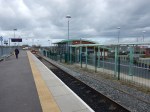
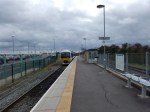


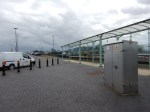
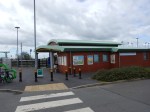
It is just a simple affair with a bus stand, car parks and the usual facilities, that appears will be soon surrounded by houses.
Chiltern Railways And Electrification
Before discussing how services will link up and down the London to Aylesbury Line, I will look at Chiltern Railways and electrification.
Under Developments and Announcements in the Wikipedia Entry for the East West Rail Link, this is said.
On 10 January 2013 Network Rail announced its intention to construct the western section between Bedford and Oxford, Aylesbury and Milton Keynes, as part of their five-year strategic business plan (2014–2019). The target date for train services to be operational on this section is December 2017. Electrification of the line between Oxford and Bedford was also included in the budget and target completion date was March 2017.
So electrification of the East West Rail Link is included in the project, even if the dates in the announcement are very much out of date now.
Given the following facts about the Chiltern Main Line, I believe it is likely that at some point, everybody will look seriously at providing electric trains from Marylebone to Birmingham Snow Hill station.
- The line has a close relationship with the East West Rail Link and other electrified or soon-to-be electrified lines.
- Chiltern finds it difficult to acquire more diesel-powered trains to fulfil their ambitions.
- Chiltern would like to run faster, larger, more efficient and greener electric multiple units.
Under Electrification in the Wikipedia entry for Chiltern Railways, this is said.
No section of the line is electrified, but in 2010 the chairman of Chiltern Railways, Adrian Shooter, indicated that electrification is being considered, though not in the immediate future. He added: “We could do some very interesting things with high-acceleration EMUs and possibly some further infrastructure work.
At some time in the next ten years, we’ll probably see electric trains between Marylebone and Birmingham Snow Hill.
But there will not necessarily be full electrification, as I believe IPEMU technology will change the way electrification is carried out.
Consider as well that the Chiltern Main Line is just one hundred and eighty kilometres long and the current maximum range of an IPEMU is being quoted as about sixty miles or just under a hundred kilometres, so with the following electrification.
- Marylebone and for perhaps twenty miles or so to handle local metro services.
- Birmingham Snow Hill, Birmingham Moor Street and the Snow Hill Lines, where there are local metro services.
- Banbury to Leamington Spa and other places, so that freight trains powered by bi-mode Class 88 locomotives, could use the line efficiently.
The Local lines from Marylebone and the Snow Hill Lines would be electrified using the techniques in A Modern Electrified Metro Network Using IPEMU Technology
IPEMUs would be able to run the full length of the line without the need for full electrification in an environmentally-sensitive area, inhabited by touchy people.
Northward To The East West Rail Link And Milton Keynes
Northward from Aylesbury Vale Parkway station, the Wikipedia entry for East West Rail Link, says that the line will be single track and allow 90 mph working. But as my pictures and a quick gander on Google Maps show, there is quite a bit of space available around the current single track. So as the East West Rail Link seems to be being designed as a double-track 100 mph railway, with full electrification, I think there are three possible options between the East West Rail Link and Aylesbury Vale Parkway and Aylesbury stations.
- Double-track 100 mph with electrification.
- Single-track 90 mph with electrification.
- Single-track 90 mph without electrification.
I think the line will be built with some form of electrification, so that electric trains can run from Aylesbury to Milton Keynes.
The line is also used by some freight trains, so double-track might be a good idea.
Aylesbury To London Via Amersham
Returning from Aylesbury today, I was surprised to see that the train ran from Amersham to Harrow-on-the-Hill on the same tracks as the Metropolitan Line. In fact for sixteen of the thirty-nine miles of the line from Marylebone to Aylesbury Vale Parkway, the line has full London Underground electrification.
Amersham to Aylesbury is about fifteen miles, with the distance between the two Aylesbury station being four miles, which means that Harrow-on-the-Hill to Marylebone is just a few miles.
So if an IPEMU could use the London Underground’s rail-based electrification, starting at Milton Keynes the train would easily arrive at Harrow-on-the-Hill with a full battery, that would take the train to Marylebone and back.
I don’t believe that the technical problems of an IPEMU starting at any station between Aylesbury and Milton Keynes and going to Marylebone and back are insurmountable.
Aylesbury To London Via High Wycombe
This uses the single-track Aylesbury to Princes Risborough Line, which is about a dozen miles long, before running to Marylebone along the Chiltern Main Line, which is another forty miles or so.
So some electrification will be needed.
According to Wikipedia, Chiltern have various plans to improve their network.
- The restoration of the quadruple track between South Ruislip (Northolt Junction) and West Ruislip, allowing trains to call at both stations without blocking the line. Triple track currently exists at West Ruislip, with the up platform loop still in situ, and at South Ruislip, with the Down Main through line also in situ. This would involve the reconstruction of the new down platform at West Ruislip, and the reconstruction of the up platform at South Ruislip. This ‘Chiltern Metro’ service was not programmed into the last round of franchising agreements.
- Restoration of fast through lines at Beaconsfield as part of a longer-term aspiration for a 90-minute journey time between London and Birmingham
- Double-track the line from Princes Risborough to Aylesbury.
- New Chiltern Metro Service that would operate 4+tph for Wembley Stadium, Sudbury & Harrow Road, Sudbury Hill Harrow, Northolt Park, South Ruislip and West Ruislip. This would require a reversing facility at West Ruislip, passing loops at Sudbury Hill Harrow, and a passing loop at Wembley Stadium (part of the old down fast line is in use as a central reversing siding, for stock movements and additionally for 8-car football shuttles to convey passengers to the stadium for events)
Some would also fit well with adding electrification, so I think that enough electrification can be added to allow an IPEMU to go from Aylesbury to Marylebone.
Oxford To London
Given that there will be electrification between Oxford and Bicester Village stations courtesy of the East West Rail Link, IPEMUs could start at Oxford and reach Princes Risborough, from where they used the same methods as Aylesbury and Birmingham services to get to London.
This article on the BBC, which is entitled Cowley line passenger train service planned for Oxford, says this.
Chiltern Railways has revealed plans for a passenger service to run on the Cowley branch in Oxfordshire.
The line, currently only used for freight, would see two new stations on the route at Oxford Science Park and Oxford Business Park.
So if this service goes to London, it would certainly be another job for an IPEMU.
Watford Junction To Amersham And Aylesbury
The Croxley Rail Link has been designed so it can have a link to Amersham. Wikipedia says this about the link.
A further proposal is to use the existing but seldom-used Metropolitan line chord which allows trains to run from Watford towards Amersham via Rickmansworth. In conjunction with the Croxley Rail Link, this route would allow direct services between Watford Junction and Amersham, thus improving local public transport in Hertfordshire and Buckinghamshire.
These are pictures I took, as the train passed the junction of the branch line to Watford.
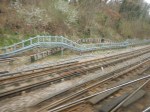
It would certainly be a new use for a substantial piece of infrastructure, but would it do much more than link Amersham to Watford Junction.
Chiltern Trains could run an IPEMU from Watford Junction to Aylesbury Vale Parkway calling at all stations, but as passengers could also get to Aylesbury from Milton Keynes, I wonder if it would be well used.
 The Anonymous Widower