The Proof That Good Design Doesn’t Have To Be Expensive
I’ve watched the transformation of Manchester Victoria station from a dirty dump over the last few years. These are a few posts.
- Manchester’s Disorganised Public Transport
- Victoria Gets A Posh Umbrella
- Will Manchester Victoria Station Be Promoted To The Premier League?
- Coffee And Seats At Manchester Victoria
But now as this article on the BBC shows, it’s all finished.
Compared to other station works in the UK, the title of the report is surprising – Manchester Victoria reopens after £44m upgrade
But then the best design is often not as expensive as the crap!
Long may Victoria reign in Manchester!
A John Lewis With Its Own Station
John Lewis didn’t have a store in Birmingham, but they opened one in the Grand Central Shopping Centre on Thursday above the reopened New Street station.
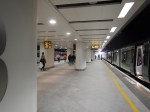




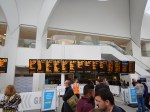




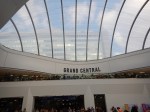


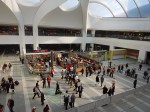





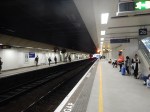


It is pretty spectacular to say the least.
The comedians will start to be calling the West Midlands, the White Country, if stations of this style appear all over the area.
I wonder when you last saw the sun in the main Birmingham station!
A Perfect Storm In Ilford
This article from the Ilford Recorder is entitled Redbridge Council leader says Ilford town centre has ‘the perfect storm’ for regeneration.
It talks about a billion pound of investment in the next six years.
So it does look like one of the more dreary parts of East London is going to be improved.
In my view, it shows how Crossrail is going to regenerate large swathes of London.
Although, in the article, I do think that that the design for homes on the Sainsburys site on Roden Street, is very much out of the design manual of Soviet Russia, that I saw in Nova Huta.
The Piccadilly And Victoria Lines, Manor House Station And Harringay Green Lanes Station
The planners and the politicians created a real dog’s breakfast here, when the Victoria Line was designed and built in the 1960s.
A Few Facts
I’ll start with a few facts, as far as we can trust Wikipedia.
From the Planning and construction section of the entry for the Victoria Line.
A test tunnel from Tottenham to Manor House under Seven Sisters Road had been bored in 1959 and was later incorporated into the running tunnels.
From the entry for Seven Sisters station.
The section of Victoria line between Seven Sisters and Finsbury Park stations is the longest between adjacent stations in deep level tunnels on the London Underground network.
From our own observations.
There is a ventilation station at the junction of Green Lanes and St. Ann’s Road. This was put in, as it’s a long way between Turnpike Lane and Manor House stations. The Cockfosters Extension section of the entry for the Piccadilly Line says this.
It was also planned to build a station between Manor House and Turnpike Lane at the junction of Green Lanes and St Ann’s Road in Harringay, but this was stopped by Frank Pick, who felt that the bus and tram service at this point was adequate. However, a ‘Ventilation station’, in similar architectural style to tube stations of the time was provided at the site, and is visible today. There was also some opposition from the London and North Eastern Railway to the line.
I think we underestimate the influence the LNER had on shaping London’s railways. Much was positive, but some was about protecting their interests.
I had a great uncle, who lived in Harringay and in the 1950s, we’d go and visit him on the 29 bus, as it was a long walk from Turnpike Lane.
What Might Have Been
Here again from various parts of Wikipedia.
From the Victoria Line section of the entry for the Piccadilly Line
During the planning stages of the Victoria line, a proposal was put forward to transfer Manor House station to the Victoria line, and also to build new “direct” tunnels from Finsbury Park to Turnpike Lane station, thereby cutting the journey time in and out of central London. This idea was eventually rejected due to the inconvenience to passengers that would have been caused during rebuilding, as well as the costs of the new tunnels.
From the entry for Seven Sisters station.
During the planning phase of the Victoria line, thought was given to converting Manor House into a Victoria line station and diverting the Piccadilly line in new tunnels directly from Finsbury Park to Turnpike Lane via Harringay Green Lanes, but the idea was abandoned because of the inconvenience this would cause, as well as the cost.
From fifty years and more after construction of the Victoria Line it might seem to be a feasible plan on a cursory look.
- It would speed trains on the Piccadilly Line to Kings Cross and Central London, as the route is shorter.
- There would be an extra station at Harringay Green Lanes on the Piccadilly Line, which would replace Manor House.
- It might also be feasible to turn the ventilation station at Green Lanes into a station.
- There would be an extra station at Manor House on the Victoria Line.
Also affecting these services will be this summer’s upgrade to the Victoria Line which will allow thirty-six trains per hour on that line.
So if you take the two improvements together passengers on both the Victoria and Piccadilly Line would get a better service with extra stations.
Enter Crossrail 2
Crossrail 2 will add another dimension to the planning in this area.
I’ll start with a personal observation from my childhood.
Many times, I travelled from Oakwood to Leicester Square or South Kensington and it’s a long way! It probably still is! And in trains that are a lot more crowded.
The opening of Crossrail 2 will affect the Piccadilly and Victoria Lines.
- Passengers on the Piccadilly Line from Wood Green northward may switch to Crossrail 2 at Turnpike Lane.
- Passengers on the Victoria Line from Walthamstow may switch to Crossrail 2 at Tottenham Hale.
- Many passengers from the London Boroughs of Barnet, Enfield, Harringey and Waltham Forest, will change their route to Central London with the arrival of Crossrail 2. And before that an upgraded Thameslink.
I think overall, we’ll see an easing of the lot of passengers on both the Piccadilly and Victoria Lines, by the end of the next decade. The Piccadilly Line should also have been upgraded with new and larger trains, running to an increased frequency. The Future Upgrades section for the Wikipedia entry for the Piccadilly Line says this.
On current plans, resignalling work on the Piccadilly line will begin in 2019 and new trains should be in service by 2022.
If the Piccadilly Line eases South of Turnpike Lane, then there may be scope for opening more stations on the line at perhaps the ventilation station on Green Lanes and Harringay Green Lanes.
And what about an interchange to the North London Line at Maiden Lane to serve the Kings Cross Central development?
How Could New Stations Be Built?
Doing anything at present to create any new stations on the Piccadilly Line is probably not feasible, as it would be impossible to shut the Piccadilly or Victoria Lines for long enough to do anything substantial. There’s been enough chaos caused by shutting the outer reaches of the Victoria Line this summer.
Transport for London have a similar problem about creating a link between the Central Line and the East London Line at Shoreditch High Street station. Transport for London feel that nothing can be done until Crossrail opens. I discussed that link in Will Shoreditch High Street Be Connected To The Central Line?.
Creating new stations on the Piccadilly Line probably can’t be done, until Crossrail 2 is opened, as how do the passengers get to work, rest and play?
I think that in a few years time actually creating the stations will not be as difficult as it would be today, from a construction point-of-view. The experience gained on building Whitechapel station on Crossrail, where a technique called uphill excavation has been used, might be applicable.
Conclusion On The Piccadilly Line In Harringay
My view is that a sort out of the Piccadilly Line and its stations in Harringay is possible and probably very worthwhile, but only after Crossrail 2 has been opened.
Planned Rail Development At Harringay Green Lanes Station
Over the next few years, there will be two major developments on the GOBlin through Harringay Green Lanes station.
The line is going to be electrified with 25 KVAC overhead lines, which will mean putting up structures to support the cables. The bridge across Green Lanes will probably be replaced, as it doesn’t look to be in the best of condition and to be safe, it will probably be replaced before the wires are erected.
The new electric trains will be four-car and this will probably mean the platforms have to be extended. I suspect that Transport for London may well future-proof the station and extend the platforms for perhaps six or even eight-car trains.
There is definitely space at the eastern end of the station to do the platform extension, but why not extend the platforms over the bridge and perhaps even use glass sides, as they’ve done at Deptford. Extending over the road will also mean that in future a western entrance or link to Harringay station could be created.
As no plans to replace the bridge have been published that I can find, could it be that Network Rail and their architects are working with property developers to design a proper flagship station?
I also think that designing a station to carry the overhead wires in its structure, as I’ve seen at Liege station, may simplify the design and save on the cost of the building.
Property Development And Harringay Green Lanes Station
If you want a profitable development, building car parking is a waste of money, so good access to public transport is essential.
For this reason and especially for housing, property development will be the force that drives the development of London’s transport system.
There is a lot of scope for property development in the area around Harringay Green Lanes station.
This document from the London Borough of Harringey entitled Harringay’s Local Plan lists a large number of development sites around the station.
On Page 92 the document details the St. Ann’s Hospital Site, which lies to the north of the GOBlin. It details how the South West corner of the hospital site will be connected to Green Lanes and the station.
On Page 94 the document goes on to talk about the Arena Retail Park, which adjoins the station.
Both sites have something that developers love. They are both in single ownership; one public and the other private.
So you can have control of the sites without the sort of problems that Tottenham Hotspur have had on building their new stadium, which has delayed the development for some years.
As it will be in the developers’ interest and profitability to have good public transport, I would be very surprised not to see a very good station built at Harringay Green Lanes to serve their developments and also to improve the transport opportunities for locals. This is said in the document.
Access to Harringay Green Lanes Station should be improved by creating a
new entrance on Portland Gardens.
Also, no sane developer would build this station without a secret place, where the escalators and lifts to the Piccadilly Line could be installed. As an example, Tottenham Court Road and perhaps Angel stations, are already ready to accept Crossrail 2.
I believe that given the amount of property development that will take place in the area, a new station at Harringay Green Lanes will be one of the first new buildings to be constructed.
Imagine the advertising potential for your development to see a shiny glass and steel station built over Green Lanes, as you drive or ride a bus through the area. Buiilding the station partly over the road would mean you need to use less valuable land and it would be easier to create a Hackney style link to Harringay station along the railway. If you want to see what can be done, go to Deptford station.
Tailpiece
If you have a flagship station at one end of Green Lanes in Harringay, why not have one at the other by converting the ventilation station into a real one?
I just wonder if that should and could be done before Turnpike Lane is rebuilt for Crossrail 2, so that there is an alternative station, if Turnpike Lane had to be closed.
Crossrail have shown that they like to be good neighbours and converting the ventilation station could be something they’d look at to cool the anger of diverted passengers and local residents. The superb new Pudding Mill station on the DLR was built by Crossrail, as the old station was in their way and had to be demolished. I was very surprised that the new station is so spectacular, but I suspect that through good design, clever use of space and leaving out expensive escalators and various utilities not needed if there are driverless trains and no booking office, that the station wasn’t as expensive as it looks. The property developers and West Ham United won’t be complaining.
The New Northampton Station
Surely, a town trying to sell itself as a town to both develop and build cutting-edge products, needs a modrn gateway to the world.
Over the last couple of years, Northampton station has been rebuilt and it is now a superb gateway to the town.
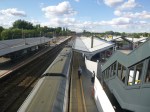
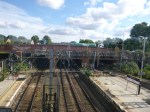


When the platforms and stairs have been finished, it’ll be one of the best medium-sized stations in the country.
Birmingham’s Four-Poster Station
When I put forward the concept of a Four Poster Station, I was kite flying and didn’t know one had already been built.
Smethwick Galton Bridge station has been built where the electrified New Street to Wolverhampton Line crosses the Snow Hill to Worcester Line. This is a Google Map of the station.
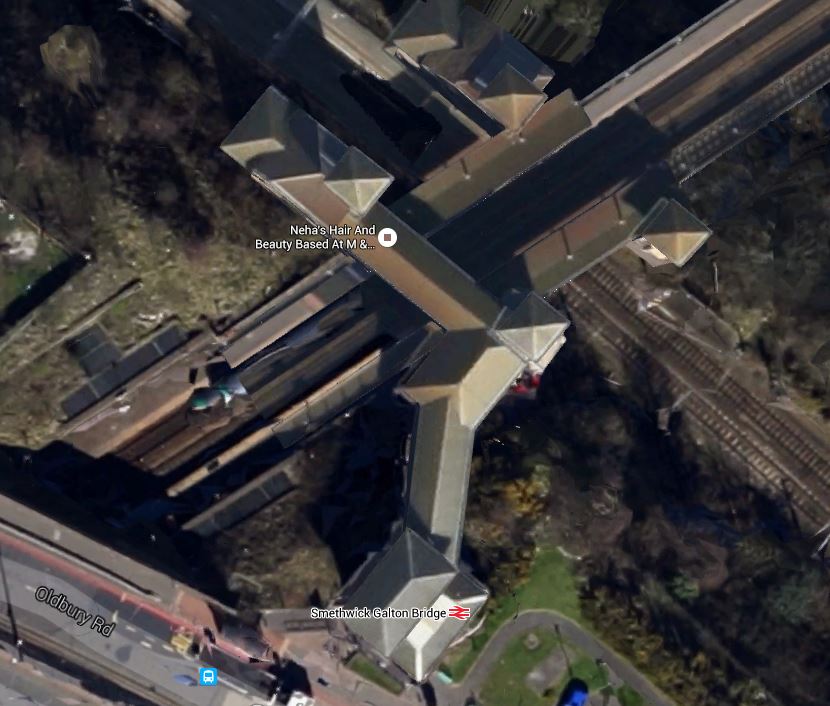
Smethwick Galton Bridge Station
Note the pyramids on top of each of the four lifts.
New Street is towards the South East, with Wolverhampton to the North West.
Worcester is to the South West with Snow Hill to the North East
I just had to go and see the station and took these pictures.
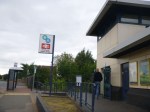


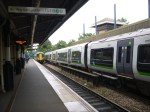
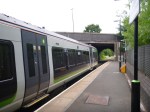
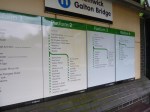

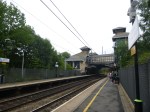
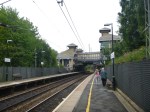
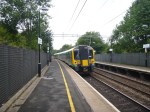
Considering it was opened in 1995, it was pretty radical for the time.
But it seemed to be working well, when I saw the station in the middle of the rush hour.
I do think, if they were building a station like this today, the various platforms and walkways would be made wider and if one was on the London Overground, they would leave spaces to put coffee stalls, passenger shelters and staff refuges. It probably illustrates how much more people friendly new stations are compared with twenty years ago.
I have a feeling that the design principles used here might be used at Brockley, Brixton and Penge.
But how many other places in the UK and perhaps the wider world could copy the basically simple design principles used here in Smethwick.
Could The Various Lines At Brixton Be Connected?
In their Transport Infrastructure Plan for 2050, Transport for London are proposing a Brixton High Level station.
As they have also proposed interchanges at also Brockley and Penge in the plan, I suspect they have found expertise and equipment to create multi-level stations, where lines cross, in an affordable manner.
The problem at Brixton is best explained in this Google Map.
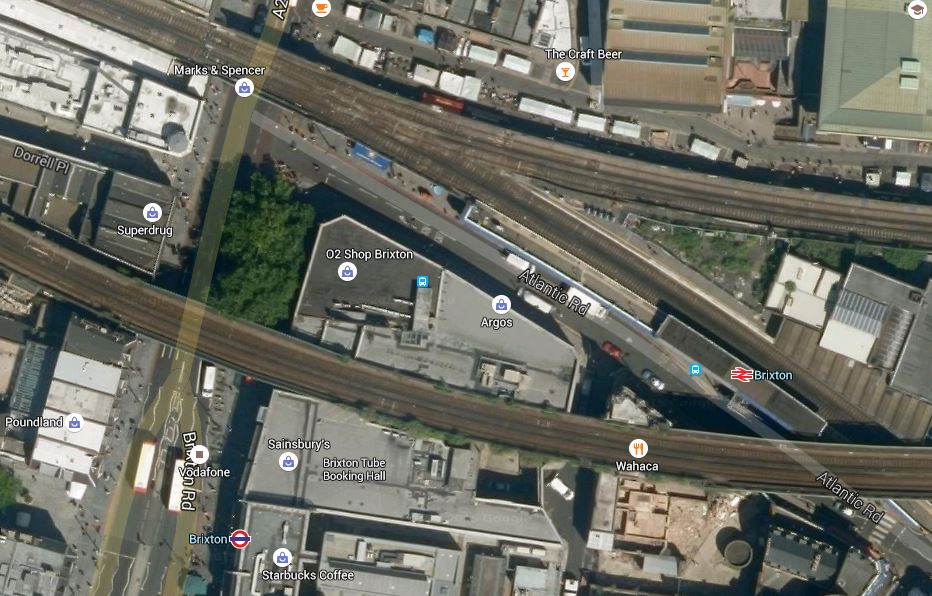
Brixston Station
The line across the middle of the map carries Overground services to and from the terminus at Clapham Junction, whereas the two merged lines go off roughly north-westerly towards Victoria. The southerly of the branches goes south towards Herne Hill, whilst the northernly branch going towards Loughborough Junction. This schematic from Wikipedia may explain it better.

Lines Through Brixton
The Overground, Thameslink and the Victoria Line are shown in orange, pink and blue respectively.
The only conclusion that is worth saying is that it’s all very complicated. The big advantage that they now have compared to a few years ago, is that much better 3D design software is available.
In TfL’s plan a rough estimate of £25million is given for each of these interchange stations. Some will cost less and some will cost more.
I think Brixton will not be one of the more affordable stations, although it could be one with a high return.
There are various options for connections at Brixton and TfL will probably limit the interchanges to the ones that are most used.
For instance, would there be much point in linking the Victoria Line to the services between Victoria and Orpington, as they both serve Victoria?
Also, as after this summer, the big constraint on frequency on the Victoria Line will be the reversing of trains at Brixton. Under Future Projects for the Victoria Line, Wikipedia says this.
For many years there have been proposals to extend the line one stop southwards from Brixton to Herne Hill. Herne Hill station would be on a large reversing loop with one platform. This would remove a critical capacity restriction by eliminating the need for trains to reverse at Brixton. The Mayor of London’s 2020 Vision, published in 2013, proposed extending the Victoria line “out beyond Brixton” by 2030.
I would suspect this will be done in the near future, as it both increases Victoria Line capacity and it gives an alternative link between the Victoria Line and services between Victoria and Orpington.
Brixton Underground station has recently been refurbished and is pretty-much step-free from the street.
So it would appear that substantial improvement at Brixton could be achieved by creating a High Level station linking the various lines together and perhaps using an iconic lift tower to the ground.
Brixton needs an iconic creation to go with the vibrancy of the area, that doesn’t destroy everything. This could be the High Level station. Having seen the way that the walkway was threaded through at Hackney, I think there are at least one set of engineers and architects up to the challenge.
Brixton doesn’t need a boring station, but one that is exciting, bold and supremely practical for passengers and staff.
Haggerston – A Simple Viaduct Station
Haggerston station is on the East London Line. It sits on top of the Kingsland Viaduct that used to take the line between Dalston Junction and Broad Street.
The platforms and the access are about as simple as you can get, but they are not of a low quality and standard.
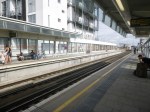

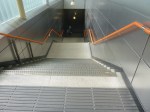
Hoxton station which is the next one south on the line is similar.
I must have gone through the old Hoxton and Haggerston stations several times, when in the 1980s, I took the East and North London Lines to get to Stonebridge Park, where Metier’s offices were situated.
I can remember slam-door trains smelling of urine, but that could have been from earlier times.
A Four-Poster Station
When most railways in the world were built, no-one bothered about the disabled, the elderly and people pushing prams or trailing heavy cases, so station design was based around able-bodied people.
There were examples, like Caledonian Road, where the step-free access is up with the best of modern practice, but stations like that are a rarity.
In my visits around the country, I’m increasingly finding stations where there are several lifts, often made by the same company who made the stairlift advertised by Dame Thora Hird. I don’t know the cost of lifts but it strikes me that they must make all of these lift installations value for money.
Over the last few weeks, I’ve come across several places in this country, where two lines cross at an angle on different levels, where a connection might be of value to passengers.
The link between Hackney Downs and Hackney Central stations, is such a connection and it would appear to be successful. I’ve certainly not read any criticism in the media on either operational or aesthetic grounds. I’m sure if an incident as small as a child dropping and losing a ten pence piece had happened, there’d be headlines all over the place blaming Boris.
In Birmingham, there is the Cross-City Line, which conveniently passes in a cutting under Birmingham Moor Street station after stopping at New Street station. But there is no connection.
Then today, I was at Brockley, where in their Transport Infrastructure Plan for 2050, Transport for London are proposing a Brockley High Level station.
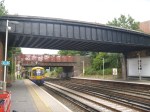
Brockley station sits underneath and is crossed by the Bexleyheath Line and these pictures show the station and the line crossing above.
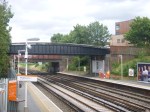
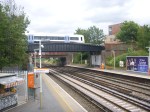
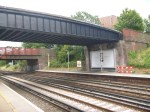
This Google Map shows the two lines crossing.
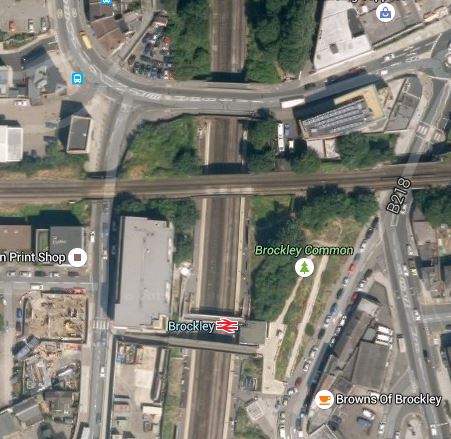
Brockley Station
There was a station called Brockley Lane on the Bexleyheath Line, but it closed in 1917.
I believe that modern structural engineering would allow the addition of two platforms to the sides of the rail bridge carrying the Bexleyheath Line. From the look of the bridge, it seems to be in very good condition.
In the case of Brockley station, the current platforms already reach under the bridge and to connect the two pairs of platforms. There would be four lifts with one in each corner. So there would be a lift between both North-South platforms and both East-West platforms! At Brockley, because the height between the two levels isn’t too great, stairs could also be provided if it felt passenger traffic required it. Some form of alternative way of getting off the high level platforms would be needed for emergency reasons.
The advantages of this approach are.
1. There is no serious track changes necessary at Brockley, as the new platforms are built alongside an existing rail line, but obviously there would need to be some signalling work.
2. The lifts would be the standard structures we see all over the UK rail network, modified to fit the application.
2. All interchanges will be step free.
3. As much station infrastructure can be provided on each platform, as it felt the passengers would need, thus keeping costs to a minimum. At Brockley, perhaps a shelter and a refuge for the staff, would be sufficient.
4. If gated access was not provided to the two high-level platforms on the Bexleyhealth Line, a safe Emergency Exit would probably meet the needs of evacuation.
The only disadvantage I can see, is that the two high-level platforms would need to be well-sheltered, as I suspect, it could be very cold and blowy up there at times.
In all my travels, I’ve never seen a station designed like this. Although some of the stations on the Docklands Light Railway like Deptford Bridge feature platforms suspended alongside the railway with access at both ends. But the budget there didn’t stretch to four lifts! That station incidentally is suspended on a bridge across a major road.
A Station That Needs Its Lifts
Crystal Palace station is an architectural gem, although it has no Listed status.
It has been restored sympathetically by Transport for London to comply with modern disability access routines, but the station does not seem to have lost the Victorian persona that would have been obvious, when it opened in the mid-1850s.
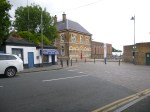
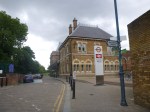
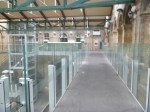
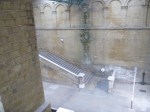
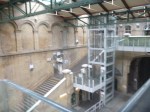
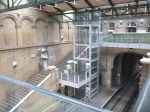
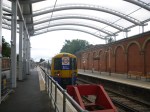
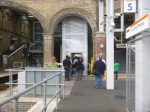
The pictures don’t do it justice.
But they do show the height that modern free-standing lifts can handle. Even if, as was happening today, the lifts are rather busy.
Certainly, Crystal Palace station is one that needs its lifts.
It makes you wonder how ladies in full Victorian dress with long wide skirts, tightly laced into corsets coped with the stairs.
It looks like the way the station has been restored would allow an appropriate film with a Victorian theme to be filmed without getting the modern lifts into shot.
 The Anonymous Widower