Reinstatement Of Rail Access To Devizes Via A New Station At Lydeway
This is one of the successful bids in the First Round of the Restoring Your Railway Fund.
Devizes is a growing town without a railway station.
The Wikipedia entry for the former Devizes station, says this about providing a new station.
Although Devizes was denied a railway station due to its stagnant population, as of 2017 the population had grown to 31,000, which could warrant its re-establishment. However, much of the vital land agreements and rights of way were sold off reducing the chances of reinstatement. An alternative plan has been proposed: to build Devizes Parkway Station at Clock Inn Park, three miles east of Devizes on the Reading–Taunton line, near to the site of the original junction for the branch at Etchilhampton.
It appears to have been taken from Baldrick’s book of cunning plans, where you create a virtual branch line using the A342, travellers’ personal transport and a shuttle bus service.
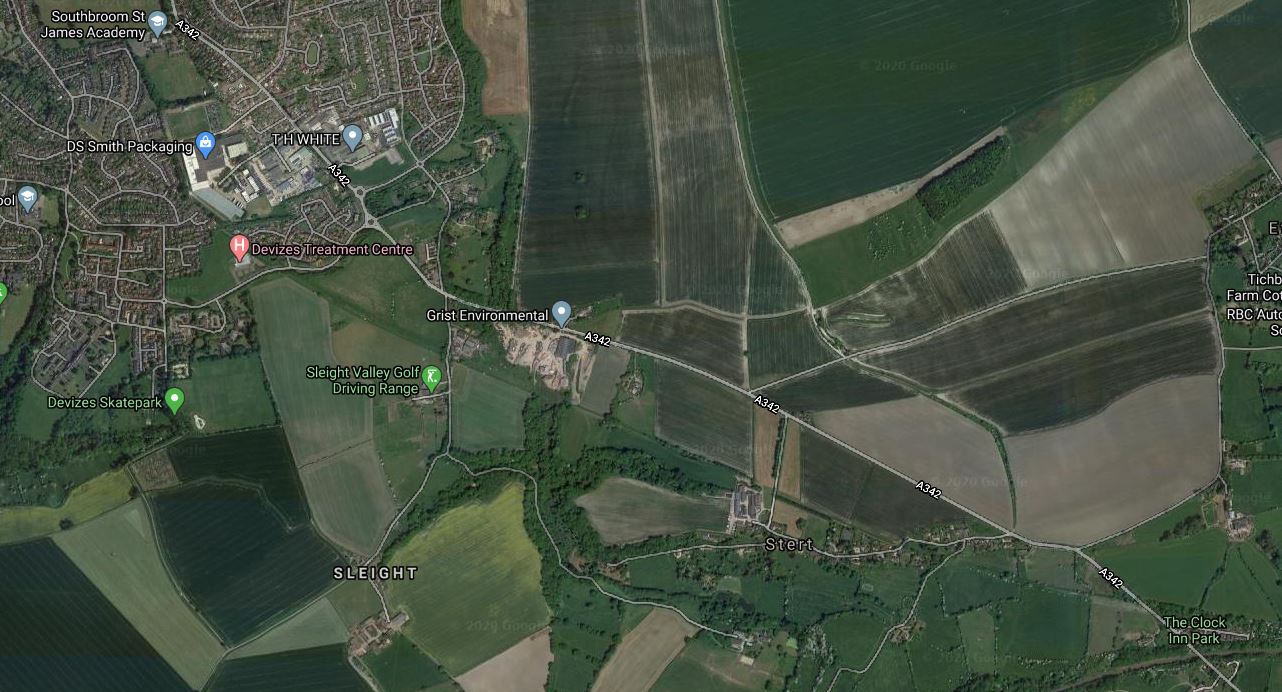
This Google Map shows the position of the station site at Clock Inn Park, with relation to Devizes.
Note.
- Devizes in the North-West corner of the map.
- Clock Inn Park in the South-East corner of the map.
- The A342 road connecting the town with the station site.
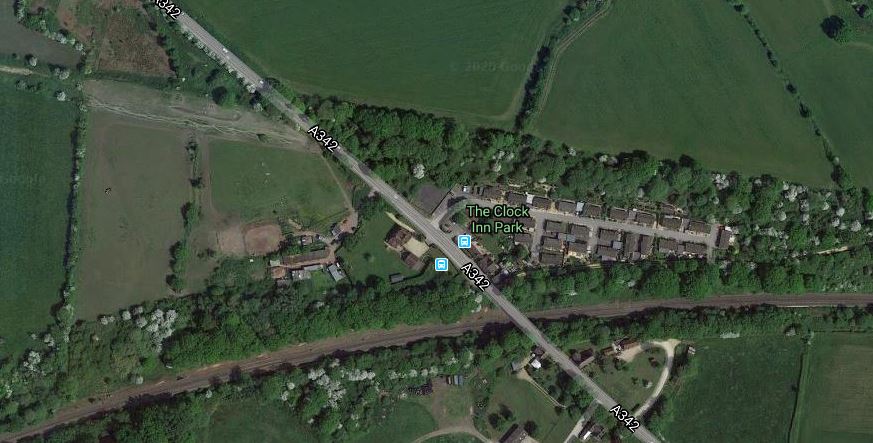
This more detailed Google Map shows the station site.
Note.
- The A342 going diagonally across the map.
- The Reading-Taunton Line going across the map.
- There’s even bus stops by the station site.
As the site could be fairly generous, I think a station with adequate parking could be created.
The Train Service
The train service is currently two hourly on this route between Paddington and Exeter St. David’s stations.
Perhaps, with an extra stop and more passengers, the service could be increased to hourly.
Another alternative would be to run battery-electric trains on the route between Paddington and Westbury, that called at all stations West of Newbury.
- Trains would use the electrification between Paddington and Newbury and would leave Newbury with a full battery.
- This service would be an extension of the current hourly service to Bedwyn station.
- Between Newbury and Westbury stations is forty-two miles of unelectrified lines, which should be possible with a battery electric version of the Class 802 train.
- Charging facilities would be needed at Westbury station.
- Between Paddington and Westbury stations takes one hour and thirteen minutes.
- Hitachi are quoting a ten minute charge time for one of their battery-electric trains.
- The trains would turn at Westbury station, which has refreshments and toilets for the crew.
- No extra electrification would be needed to run electric services to Westbury.
I think it could be feasible.
The Concept Of An Electrification Island
Westbury could be what I would call an electrification island.
Consider
- The Reading-Taunton Line passes through the station.
- The Wessex Main Line both passes through the station.
- The town of Westbury has a population of around 17,000 and some substantial heavy industries, so I suspect that it has a robust electricity supply.
- Taunton is 47 miles away.
- Newbury is 42 miles away.
- Weymouth is 59 miles away.
- Bristol Temple Meads is 40 miles away.
- Swindon is 32 miles away.
- Hitachi are claiming a range of between 55 and 65 miles for a battery-electric train.
Suppose the two routes through the station and perhaps for up to ten miles away from the town, were to be electrified.
- A battery-electric train turning back at Westbury would pan-up in the station and charge the battery. Leaving the station, the driver would leave the pantograph up for acceleration and then make sure pan-down was performed before the end of the electrification.
- A through battery-electric express between Paddington and Exeter would pan-up when under the electrification and pan down before it left the electrification.
- It might be prudent that all passing expresses stopped in Westbury station, to make sure, trains didn’t stop with a flat battery in the middle of nowhere, until procedures were seen to be totally reliable.
- A battery-electric train to and from Weymouth would probably need to run for about 45 miles between the electrification island at Westbury and the third-rail electrification at Dorchester Junction.
I believe that a well-designed electrification island at Westbury coupled with perhaps electrification between Exeter and Taunton, would enable battery-electric trains to work the following routes.
- Paddington and Exeter
- Westbury and Bristol
- Westbury and Weymouth
- Westbury and Swubdon
I suspect that Transwilts services could also be run by battery-electric trains, as they could charge at Westbury, Swindon and other electrified stations.
Conclusion
Devizes Parkway station would appear to be a simple way to provide a new station, at a town that has grown substantially since the days of Dr. Beeching.
Did Dr. Beeching and the Government of the day, have a view on population growth in the UK? They certainly didn’t take it into the account in their rail closure program. Or if they did, they got it spectacularly wrong!
Electrification Between Exeter And Plymouth
Eventually, there will be electric passenger trains between Exeter and Plymouth! Great Western Railway’s objective must be for passengers to board their Hitachi AT-300 train at Paddington and be powered all the way to Penzance by electricity, without using a drop of diesel. The added ingredient will be battery power.
In Sparking A Revolution, I gave Hitachi’s specification for a proposed battery-electric train.
- Range – 55-65 miles
- Performance – 90-100 mph
- Recharge – 10 minutes when static
- Routes – Suburban near electrified lines
- Battery Life – 8-10 years
As the distance between Exeter and Plymouth is 52 miles, the Hitachi specification could have been designed around this route, which as these pictures show is in places, very close to the sea, where the line runs along the South Devon Railway Sea Wall.

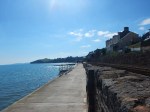
Global warming will probably mean, we’ll see a repeat of the major sea wall breach that happened at Dawlish in 2014.
I would suspect that the Network Rail’s solution to the problems of efficient low or zero-carbon traction between Exeter and Plymouth includes the following.
- A very robust railway.
- Extreme protection from almost everything the sea and the weather can produce.
- Could we see some concrete tunnels, like the Swiss and others use in mountainous areas to protect from snow? Rail Magazine says yes! At Horse Cove.
- No electrification as water and electricity are not a good mix, except in an electrolyser to produce hydrogen, oxygen and/or chlorine.
- Battery or hydrogen-powered passenger trains or freight locomotives.
- Digital in-cab signalling. Traditional signalling is even more expensive equipment to be swept away.
From media reports, this looks like the way Network Rail are thinking.
Charging The Trains
Battery-electric trains will need to be charged. There are three convenient stations; Exeter St. Davids, Newton Abbott and Plymouth.
- All have multiple platforms.
- The stations could be given the ability to charge battery-electric trains, either using 25 KVAC overhead electrification or a specialist charging system, like the one designed by Vivarail, that I wrote about in Vivarail Unveils Fast Charging System For Class 230 Battery Trains.
- Newton Abbot station would also charge any trains running on the eight mile branch to Paignton station.
As far as passenger services are concerned, it could be a very efficient zero-carbon railway.
Electrification At Exeter St. Davids
Exeter St. Davids is an important hub for services between Devon and Cornwall and the rest of Great Britain.
- GWR services run to London Paddington via Newbury.
- GWR services run to London Paddington via Bristol
- GWR services run to Plymouth and Penzance via Newton Abbott.
- GWR local services run to Barnstaple, Exmouth and Paignton.
- CrossCountry services run to the Midlands, North and Scotland via Bristol.
- South Western Railway services run to London Waterloo via Basingstoke.
In future, there could be services running to Plymouth on the reopened route via Okehampton and Tavistock.
All these services could be run by battery-electric trains for sixty miles from Exeter, if they could be fully-charged at the station.
Note.
- Trains to London Paddington and Bristol could easily reach Taunton, which is thirty miles away.
- Trains to London Waterloo could reach Yeovil Junction, which is fifty miles away.
- Trains to the West could reach Plymouth, which is fifty-two miles away.
- Barnstaple is forty miles away, so would probably need some help to get back.
- Exmouth is eleven miles away, so a return journey is probably possible.
- Paignton is twenty-eight miles away, so a return journey is probably possible, with a top-up at Newton Abbot if required.
Exeter is going to be very busy charging trains.
It should be noted, that trains to and from London Paddington and Bristol, all share the same route as far as Cogload Junction, where the London Paddington and Bristol routes divide.
- Cogload Junction is thirty-six miles from Exeter.
- Cogload Junction and Newbury, where the electrification to London Paddington starts are eighty-five miles apart.
- Cogload Junction and Bristol Temple Meads, where the electrification to London Paddington starts are forty miles apart.
I wonder if it would be sensible to electrify between Exeter St. David station and Cogload Junction.
- From my virtual helicopter, the line doesn’t look to be in the most difficult category to electrify.
- There is only one tunnel and a few old bridges and a couple of level crossings.
- Some of the route is alongside the M5.
- Trains would arrive in Exeter with full batteries and could do a quick stop before continuing their journeys.
- Trains would arrive at Cogload Junction and could reach Bristol Temple Meads without stopping for a recharge.
- Bristol services that are extended to Taunton and Exeter could be run by battery-electric trains.
I also feel, that with upwards of twenty-five miles of extra electrification between Cogload Junction and Newbury, that battery-electric trains could run between London Paddington and Exeter via the Reading-Taunton Line.
Electrification At Plymouth
As with Exeter St. Davis, Plymouth is an important hub for services between Devon and Cornwall and the rest of Great Britain.
- Most services run to Penzance in the West and Exeter in the East.
- There is a local service to Gunnislake, which is fifteen miles away.
Lots of charging capacity, will enable battery-electric trains to reach their destinations, except for Penzance
Trains Between Plymouth And Penzance
Hitachi must have despaired, when it was pointed out that the distance between Penzance and Plymouth is eighty miles! This is fifteen miles longer than the range of their proposed battery-electric train.
The simplest solution would be to build a battery-electric train with an eighty mile range, that could travel between Plymouth and Penzance on a single charge. With charging at Penzance it could return to Plymouth.
The longer range, would also mean that, with perhaps ten extra miles of electrification, that battery-electric trains could bridge the electrification gap between Cogload Junction and Newbury.
Other solutions range from selective electrification, all the way up to full electrification of the Cornish Main Line.
It should be noted that there are the following branches on the Cornish Main Line.
- The Looe Valley Line at Liskeard station – 8.75 miles – Uses a separate platform at Lskeard
- The Fowey Branch At Lostwithiel station – 4.75 miles – Possible reopening
- The Atlantic Coast Line at Par station – 20.75 miles – Uses a separate platform at Par
- The Maritime Line at Truro station – 11.75 miles – Uses a separate platform at Truro
- The St. Ives Bay Line at St. Erth station – 4.25 miles- Uses a separate platform at St. Erth
If these branches are going to be served by battery-electric trains, arrangements will have to be made for their charging. This could either be on the main line, at the remote terminal or at both.
Would it be easier to run the branches using battery-electric trains, if the Cornish Main Line was fully electrified?
The Cornish Main Line also carries a number of heavy freight trains, most of which seem to be going to or from Burngullow, so I suspect they are in connection with the movement of china clay.
Currently, these heavy freight trains appear to be hauled by diesel locomotives, but if the Cornish Main Line were to be fully electrified, could they be run by electric locomotives?
Electrification Of A Reopened Northern Route
In the May 2020 Edition of Modern Railways, there is an article, which is entitled Beeching Reversal Fund Bids.
This is the introductory paragraph.
Bids have been submitted to Government for a share of the £500 million ‘Restoring your railway’ fund launched by the Department for Transport in January. The fund is to be used to support proposals to reinstate axed local services, to accelerate schemes already being considered for restoration and also to promote new and restored stations.
One of the bids is for the Tavistock-Okrhampton Reopening scheme (TORs), which would reopen the former Exeter to Plymouth railway of the LSWR, as a new route between Exeter and Taunton in the East and Plymouth in the West.
- The original railway was double-track.
- Most of the infrastructure is intact.
- The route would totally avoid Dawlish.
This is also said in the Modern Railways article.
It proposes journey times could be as little as six minutes longer than via the existing route between Exeter and Plymouth and that there could be opportunities for freight trains to avoid the steep gradients over the Devon banks between Newton Abbott and Plymouth. Provision of electrification for TORs as part of a wider programme for main lines in the region is also advocated.
Could an electrified route via Tavistock and Okehampton be connected to an electrified Cornish Main Line, to create an electrified route across Devon and Cornwall?
Connecting At The Royal Albert Bridge
This Google Map shows the Royal Albert Bridge and the Tamar Bridge over the River Tamar.
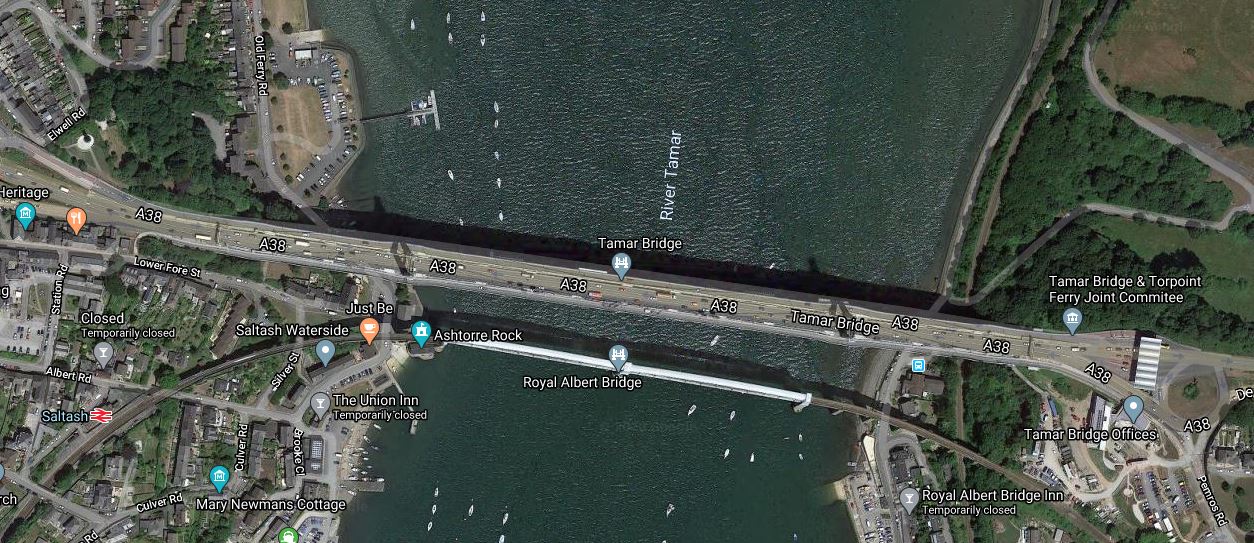
Note.
- The Royal Albert Bridge to the South of the modern Tamar Bridge.
- The Great Western Main Line running East to Plymouth and West to Penzance.
- The Tamar Valley Line running up the Eastern bank of the River Tamar and under the Eastern approaches to both bridges.
- Going North on the Tamar Valley Line leads to the TORs and going South leads to Plymouth station.
I can see a difficult design problem at the Eastern end of the Royal Albert Bridge, as a very complicated junction will be needed to allow all trains go the way they need.
Trains wanting to call at Plymouth station and use TORs will need to reverse in the station.
Connecting At The East Of Exeter
This Google Map shows The Tarka Line and the Bristol-Exeter Line join at Cowley Bridge Junction.
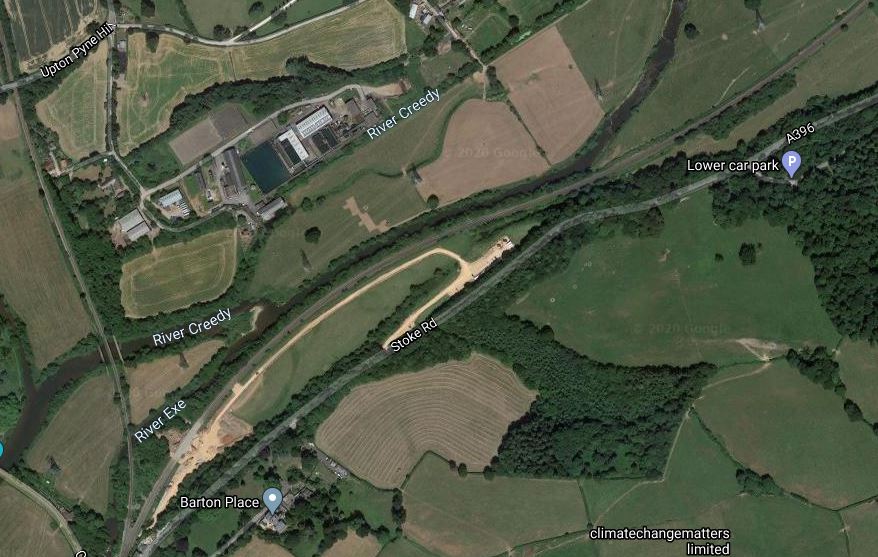
Note.
- The Tarka Line to Barnstaple and TORs leaves the map in the North West corner.
- The Bristol-Exeter Line to Taunton, Bristol and London Paddington leaves the map in the North East corner.
- Cowley Bridge Junction is in the South West corner of the map.
- Cntinuing South West leads to Exeter St. David’s station.
It looks to me, that Cowley Bridge Junction will need to be made into a full triangular junction, so that trains can go directly between the Bristol-Exeter Line and the Tarka Line.
Trains wanting to call at Exeter St. David’s station and use TORs will need to reverse in the station.
The Reversal Problem
If you wanted to run a passenger service between Taunton and Penzance using TORs with stops at Exeter, Okehampton, Tavistock, Plymouth and Truro, the train would need to reverse twice at Exeter and Plymouth.
These days with modern fast bi-mode multiple units, it’s not a problem, but in the days of Beeching, when the Tavistock and Okehampton route was originally closed in 1968, there probably wasn’t a suitable train other than a slow two-car diesel multiple unit.
I think, that fast expresses to and from Penzance will still take the current route.
- Battery-electric trains can handle the route at 100 mph.
- No reversals will be needed.
- There is a call at Newton Abbott for connections to Torquay and Paignton.
- Passengers wanting Okehampton, Tavistock and other stations on the TORs route can change at Exeter or Plymouth.
The Modern Railways article says this about services on the TORs route.
The case suggests that services could operate as an extension of the SWR Waterloo to Exeter service, or potentially as an extension of CrossCountry services beyond Exeter. During periods when the coastal route is blocked, additional services could use the TORs route, potentially running non-stop.
Note.
- As the extension of the SWR service would run the other way through Exeter St. David’s station, there would be no need to reverse.
- But I suspect the CrossCountry service would need the reverse.
- I feel for efficiency, that diverted freight services would need the efficient junctions at each end of TORs.
It probably would have helped if the Great Western and the London and South Western Railways had had a better crystal ball.
Fast Electric Freight Services To And From Devon And Cornwall
If the following lines are electrified.
- Cogload Junction and Exeter
- TORs
- Cornish Main Line
I feel that electric freight services will be able to run between Taunton and Penzance.
All it would need to complete the electrified route would be to electrify the following.
- Cogload Junction and Bristol
- Cogload Junction and Newbury
What would a high-speed freight route do for the economy of the two South Western counties?
Beeching Reversal Fund Bids
The title of this post, is the same as that of an article in the May 2020 Edition of Modern Railways.
This is the introductory paragraph.
Bids have been submitted to Government for a share of the £500 million ‘Restoring your railway’ fund launched by the Department for Transport in January. The fund is to be used to support proposals to reinstate axed local services, to accelerate schemes already being considered for restoration and also to promote new and restored stations.
Some of the bids are detailed.
Okehampton And Tavistock
If you were deciding what lines shouldn’t have been closed by British Rail in the 1960s, by hindsight, the Exeter to Plymouth railway of the LSWR, would be a railway that you wouldn’t close.
- The Northern route would be a valuable diversion, when the sea and the weather decide to attack Dawlish again. as they did in 2014.
- When COVID-19 is over, there will be more people going to Devon and Cornwall. A second rail route would be invaluable to get traffic off the roads.
- Attitudes are changing about zero-carbon travel and this will also nudge passengers towards rail.
- Four tracks between Exeter and Plymouth would allow more freight services to take trucks off the road.
- There may be new developments along the Northern route.
- It may be even be possible to electrify the Northern route.
At least, British Rail left the viaducts and bridges intact.
The Modern Railways article says this.
In the West Country, a new Northern Route Working Group has submitted a bid to the fund to develop a Strategic Outline Business Case for reopeing the former London and South Western Railway Main Line between Exeter and Plymouth via Okehampton and Tavistock. The proposal is backed by four local MPs and the working group of industry personnel.
These points are also made.
- The reopening is crucial to the resilience of the network.
- Reopening is complimentary to the ongoing work at Dawlish.
- Devon County Council is leading plans to reopen the 5.5 miles between Bere Alston and Tavistock.
- Devon County Council is pushing for a daily service between Exeter and Okehampton.
- The previous two developments, would leave the 16 miles between Tavistock and Okehampton to be restored.
- Much of the route is intact and structures survive, but some track has been sold off.
- The route will be useful during closure of the coastal route through Dawlish.
- Journey times might be only six minutes longer.
- It might be an easier route for freight trains.
As I said earlier, the proposers of the scheme think electrification could be possible.
Stratford And Honeybourne
The Modern Railways article says this.
A bid has been submitted for £75,000 to carry out an Economic Impact Assessment regarding reopening of the Stratford-upon-Avon to Honeybourne route.
These points are also made.
- The Honeybourne station and Long Marston section is in use to connect the Cotswold Line and the rail facility at Long Marston.
- The Long Marston and Stratford-upon-Avon station section has been safeguarded for reopening.
- Reopening is estimated at £110million.
- The assessment would enable benefits to be quantified.
Nothing is said about whether the route will be single or double track or what services will be run on the line.
There’s more on the Shakespeare Line web site.
This is said about train services.
- A reopened railway could provide the ability to operate orbital train services in both directions between Birmingham-Stratford-Evesham-Worcester-Birmingham providing connections for South Wales and South West at the new Worcestershire Parkway station.
- The reopened line would provide the ability to operate direct train services with a 12 mile shorter route between Stratford upon Avon, the Cotswolds, Oxford, Reading, Heathrow Airport and London Paddington.
I also think, I’ve read that the line could be used by freight services and heritage services on the Gloucestershire Warwickshire Railway, which could link Birmingham and Cheltenham.
It does appear to be a rail link with potential.
Rawtenstall Line
The Modern Railways article says this.
Meanwhile, Rossendale Council has submitted an application to the fund seeking to propose reinstatement of passenger services on the Rawstenstall Line, now part of the East Lancashire Railway.
A study published in 2018 determined that reinstating services along the ELR and then joining the Manchester to Rochdale Line would be feasible.
These points are also made.
- Rossendale is the only council in Lancashire without a rail link.
- 60 % of residents leave the borough each day for work.
Tram-trains have also been proposed for this route, as I wrote about in Could A Class 399 Tram-Train With Batteries Go Between Manchester Victoria And Rochdale/Bury Bolton Street/Rawtenstall Stations?
Conclusion
This is the closing paragraph of the article.
In addition to those mentioned, it is likely that other bids will have been submitted to the fund.
It certainly looks like the money in the fund, will be bid for, by worthwhile projects.
£500m Fund To Restore Beeching Rail Cuts Goes Ahead Amid Criticism
The title of this post is the same as that of this article on the BBC.
This is the introductory paragraph.
A government fund is to be launched later to restore historic railway lines closed more than 50 years ago under the so-called Beeching cuts.
The two initial grants are for studies about reopening the Northumberland Line to Blyth and Ashington in the North East and to Fleetwood to the North of Blackpool.
Blyth And Ashington
Consider.
- The tracks already exist.
- There may still be some freight traffic on the route.
- Connections to the Tyne and Wear Metro appear possible.
- The Tyne and Wear Metro already shares tracks with other freight and passenger services.
- New stations and probably new signalling will be needed.
- The distance between the proposed Northern terminals and the connections with the Tyne and Wear Metro are under twenty miles, which could make battery operation easily possible.
- The Tyne and Wear Metro is currently procuring a new fleet of trains.
I believe that these branches could be integrated into the Tyne and Wear Metro, providing that the new trains have the right specification.
Light rail vehicles like the Class 398 tram-trains being procured for the South Wales Metro should be able to run these services.
But other manufacturers might have better solutions!
Fleetwood Branch
This extension would need the following.
- Restoration of the existing track between Poulton-le-Fylde and Fleetwood.
- One or more new stations.
- Probable resignalling.
In a simple installation, there is probably space to put a bay platform in Poulton-le-Fylde station, so that a shuttle service could be run to Fleetwood.
But services could also be extended to Preston.
Blackpool though has other rail problems like what are they going to do with the Blackpool South Line.
I believe Blackpool could use similar solutions on both the Blackpool South and Fleetwood Lines to create a bigger solution for the whole of the area.
Conclusion
It looks to me that the government has started with two schemes that are possible and where the track still exists.
It is to be hoped that the two studies come up with easy-to-build and fundable schemes, which are the first of many.
No-Frills Mini Trains Offer Route To Reopening Lines That Beeching Shut
That long title appeared in The Times today above a picture of a stylish single-carriage lightweight train.
This page on the Warwick University web site is entitled Revolution Very Light Rail Project, describes the project on which the Times article is based.
This is said.
The main objective of the project is to reduce the weight and cost of a railcar by half in order to facilitate low cost connectivity of suburban and rural areas. The Radical Train will demonstrate unique self-powered bogies (with integral hybrid propulsion and kinetic energy recovery system) combined with a modular, lightweight body-shell utilising advanced materials. WMG will be transferring expertise in lightweighting technology from the automotive sector into this project. Automotive lightweighting solutions are already employing advanced materials including ultra-high strength steels and fibre-reinforced polymer composites.
Other points from The Times include.
- 18m. long, but could be 12m. or 9m.
- 3.8 litre Cummins diesel hybrid engines. Routemaster buses have 4.5 litre Cummins engines
- Speed of up to 70 mph.
- Lithium-titanate battery similar to a Routemaster bus.
- Target price of £500,000
The Times also says that the prototype could be running in 18 months.
So how feasible is what the article says?
The Short Branch Or Connecting Line
The most obvious application is the short branch or connecting line, which is worked by either a single train or perhaps a small number of small trains.
On their web site, Warwick University have an image of the train at St. Erth station, ready to depart on the St. Ives Branch. I wrote about this branch in St. Erth Station And The St. Ives Branch.

You have to admire the group in picking a station of character for their web site.
But it would also make a good test site for the train.
- St. Erth station has two platforms.
- The line is single track throughout.
- There is a two trains per hour (tph) service run by a single Class 150 train.
- The route has a high level of baggage.
- The Class 150 train takes 14-15 minutes for each journey.
- A well-designed modern train could save a few minutes.
But above all Cornwall has better weather than many places.
This line probably gets very busy in the Summer and I also suspect that Great Western Railway would like to run four tph on the branch.
They could probably do this with a passing loop around halfway and two trains with a better station calling performance than the Class 150 train. ERTMS, which would probably be fitted to the trains, would ease the problems of signalling on the line.
There are several branch lines in the UK, which are currently run by a single train and perhaps 1-2 tph, that could benefit with a 4 tph service, which these trains could provide.
In A Look At New Station Projects and also in The Times article, there are some branch line projects that may be suitable.
- The reopened Anglesey Central Railway.
- The reopened Brentford Branch Line.
- The reopened Cheadle Branch Line.
- The reopened Fawley Branch Line.
- The reopened Cockermouth, Keswick and Penrith Line.
- The reopened Bramley Line.
- The reopened Aldeburgh Branch Line.
Most of these lines are reopened lines that were closed in the Beeching era.
Are The Trains Big Enough?
At eighteen metres long, I reckon that the capacity of a single unit is slightly less than a twenty-three metre long Class 153 train. An estimate gives somewhere between 50-55 passengers.
But pictures in The Times and on the Warwick University web site show a standard railway coupling, which can be used for the following.
- Creating longer trains of two or more units working together.
- Allowing one train to rescue another.
- Allowing a train to be rescued by a compatible train.
So it would seem that creation of a train with a capacity of around 100 passengers by linking two units together is probably in the specification.
Working With Other Trains
The Times article says that the lightweight design means they can probably only run on captive lines with no other heavy trains.
But it also says that this will change with ultra-safe digital signalling, that enforced separation between trains.
By the time, these trains enter service, ERTMS will have been proven to be safe on UK railways.
I also suspect that the trains will use the most modern automotive industry structures. Pacers they are not!
The Longer Distance Service
A typical longer distance service would be one shown in The Times, which is to run a service between Newcastle station and a new Ashington station in the North East.
- Most if not all of the track is intact.
- Stations would need to be rebuilt or built from scratch.
- To work the desired frequency of two tph would probably need two units.
- Digital signalling would be needed, as there are freight trains on the same lines.
More details of the route are given on the South East Northumberland Rail User Group web site.
Running Under The Zwickau Model Into A Town Centre
These trains could almost have been designed to run as trams, as the diesel multiple units of the Vogtlansbahn do in Zwickau town centre.
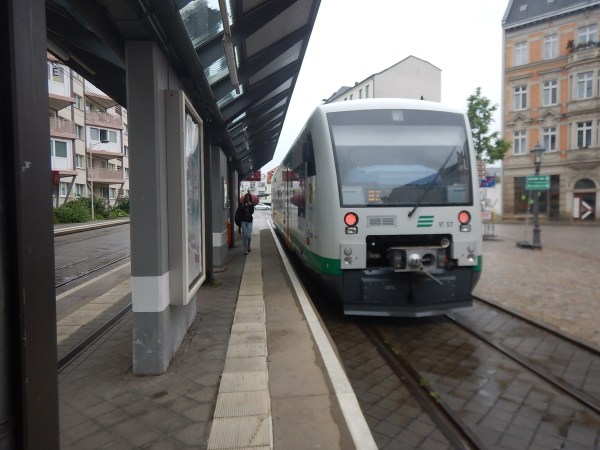
The picture shows one of the trains at the terminus of Zwickau Zentrum, after arriving at the town centre terminus from the Hauptbahnhof over a tram-style track under tram tram-style rules.
- Note the tram-style infrastucture with a simple stop and track laid into the roadway.
- The driver has large windows to keep a good look-out.
- Horns and other warning devices are fitted.
- Note the orange warning lights.
- The train travels at a slow safe speed.
- The stations or are they stops have no footbridges. Pedestrians and cyclists can cross the track, as they need.
I think that Warwick’s vehicles could travel like this to provide route extensions into a city or town centre of perhaps to an attraction like a theme park.
Have track! Will travel!
Conclusion
I think that Warwick have come up with a fresh design, that shows a lot of innovation and flexibility.
Not only is it affordable to build, but also probably can work with lower-cost infrastructure.
I look forward to seeing the prototype in action.

