Borders Railway: More Than 4 Million Journeys In 3 Years
The title of this post is the same as that of this article in Global Rail News.
The Borders Railway may only be a thirty mile route with a frequency of two trains per hour, but I believe it shows the economic and lifestyle benefits that new rail routes can bring.
And all at a cost of around £200million.
We should be looking to build other lines like this in the UK.
And all over the World!
Borderlands Deal Bid Gathers Pace
The title of this post is the same as this article on the BBC.
I feel it would be a good idea for the England-Scotland border to get a growth deal, as every time I go there, it seems to me that the Borderlands are economically interdependent.
This is a paragraph.
Among the schemes potentially involved is a study looking at extending the Borders Railway to Carlisle.
This railway would surely be very beneficial in industries like tourism and forestry.
The Stone Arch Railway Bridges Of Scotland
There are a lot of stone arch railway bridges in the UK, but they do seem to more numerous in Scotland, than in England.
These pictures show a selection of bridges on the Borders Railway.








I counted to about fifteen between Edinburgh Waverley and Galashiels stations.
There were probably about an equal number of bridges where a stone arch bridge had been replaced by a modern concrete structure, like this one.
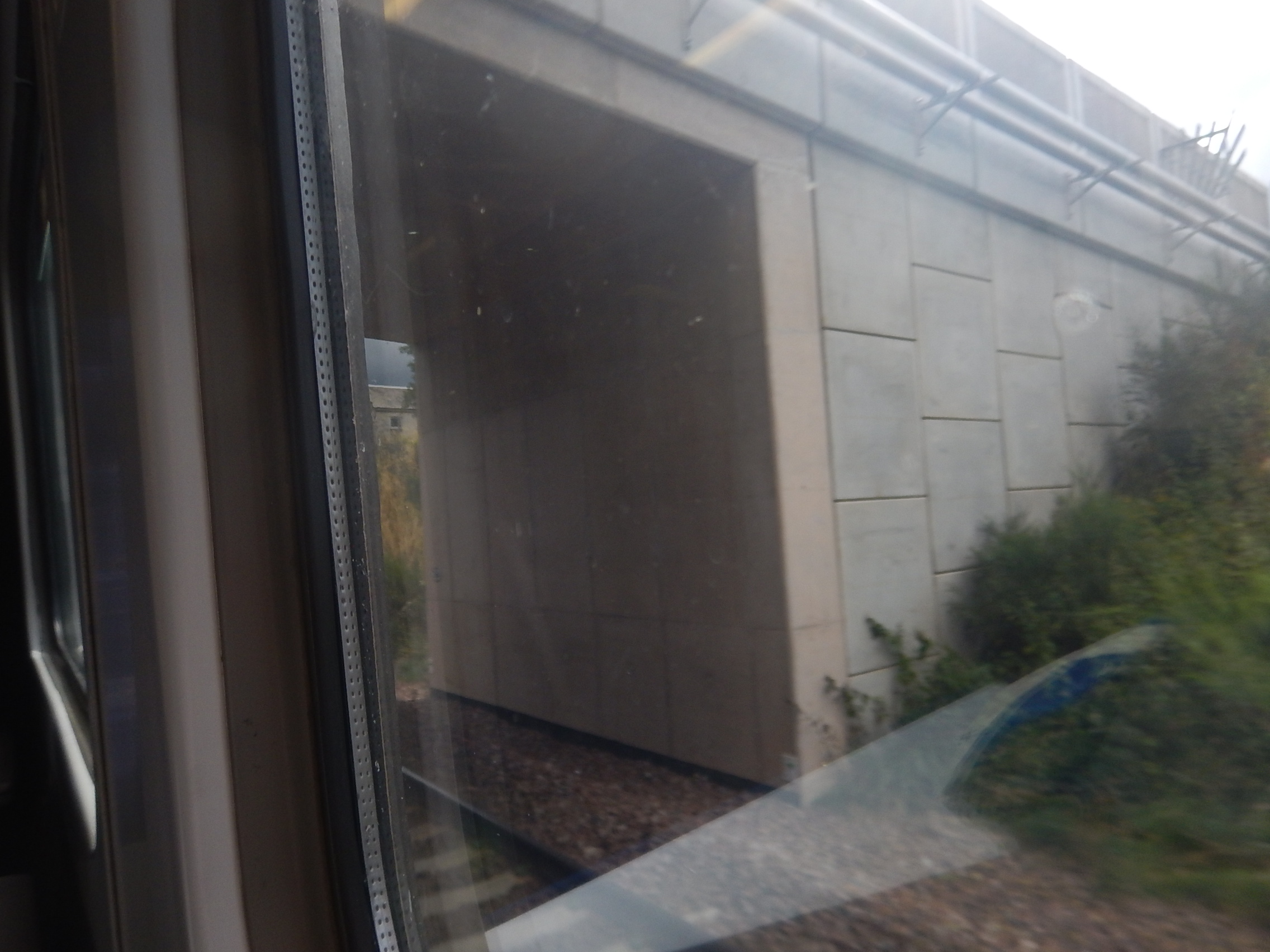
They’ll probably last a thousand years, but they lack the charm of the stone arch bridges.
These pictures show a selection of bridges on the Busby Railway between Glasgow Central and East Kilbride stations.




These pictures show a selection of the many bridges between Aberdeen and Montrose stations on the Edinburgh – Aberdeen Line.








I took pictures of at least twenty.
Freight Trains
Freight trains, especially those with the larger containers need a loading gauge, that is big enough to accept them.
The loading gauge in the UK, is summed up by these two sentences from Wikipedia.
Great Britain has (in general) the most restrictive loading gauge (relative to track gauge) in the world. This is a legacy of the British railway network being the world’s oldest, and having been built by a plethora of different private companies, each with different standards for the width and height of trains.
These are the commonest gauges.
- W6a: Available over the majority of the British rail network.
W8: Allows standard 2.6 m (8 ft 6 in) high shipping containers to be carried on standard wagons.
W10: Allows 2.9 m (9 ft 6 in) high Hi-Cube shipping containers to be carried on standard wagons and also allows 2.5 m (8 ft 2 in) wide Euro shipping containers.
W12: Slightly wider than W10 at 2.6 m (8 ft 6 in) to accommodate refrigerated containers.
W12 is recommended clearance for new structures, such as bridges and tunnels
The Borders Railway appears to have been built to at least W8, so it could handle standard freight containers.
But the line doesn’t carry freight!
On the other hand, I suspect the following were considered, when designing the Borders Railway.
- Network Rail and rail maintenance companies, may need to bring some large rail-mounted equipment along the line for regular or emergency maintenance.
- If the line is extended to Carlisle, the route could be used as a diversion for freight trains, if the West Coast Main Line is closed, due to weather or engineering works.
- There may be a need to use the Borders Railway to extract timber from the forests of the Borders.
The need for freight on the Borders Railway, explains why there are so many new overbridges.
Electrification
Electrification with overhead wires needs extra clearance.
It looks to me, that the Borders Railway has been given enough clearance for future electrification.
Problems With EGIP
Electrification under the Edinburgh to Glasgow Improvement Program (EGIP), proved to be difficult.
It wasn’t helped by the standards changing half-way through the project and the numerous bridges and tunnels that had to be rebuilt.
An important route like Edinburgh to Glasgow probably needs to be fully-electrified, but the difficulties encountered and those in Lancashire have encouraged Network Rail and the engineering consultants to look at other methods of electrifying lines in the UK.
Electrification Between Edinburgh And Aberdeen
I doubt this will ever happen in a conventional manner.
- Would electrification of the Forth Bridge and Tay Rail Bridge be allowed?
- The disruption of rebuilding the stone bridges would be enormous.
- The line only has a maximum speed of 100 mph.
Diesel and alternative power sources like hydrogen will be able to maintain the fastest speeds, that are possible on the line.
Money would probably give better value, if it were to be used to increase line speed.
Opposition To Rebuilding Bridges
This article on Rail Technology Magazine is entitled Network Rail Electrification Plans Stalled After Council Rejects Bridge Removal Bid.
This is first paragraph.
Campaigners are celebrating after plans from Network Rail to demolish a bridge as part of its electrification scheme were rejected by a local council.
The bridge in question is a Grade II listed overbridge at Steventon in Oxfordshire.
It is not unlike those in Scotland, that are shown in my pictures.
In the 1960s, British Rail would have just blown it up and replaced it with a concrete monstrosity.
I am not advocating a return to this policy, but Network Rail has a problem at Steventon, that they need to fully electrify the line, if electric trains are to use the route on electric power, rather than using environmentally-unfriendly diesel power.
Since the new Class 800 trains for the route were designed and ordered, the technology has moved on.
In South Wales, discontinuous electrification and trains with a battery capability will be used.
Conclusion
Scotland and other parts of the UK, like the Pennines and in the valleys of South Wales, have a serious problem with the way the Victorians built our railways.
\development of the UK rail network with electrification and an enhanced freight capability needs to be thought out carefully and with great ingenuity.
Financial Trouble At TfL: Can It Stay Afloat?
The title of this post, is the same as that of this article on Railway Technology.
This is the first paragraph.
London’s public transport provider, TfL, is under increasing pressure. Not only has its government operating grant been slashed but a funding freeze is also expected to cost £640m across the course of the current mayoralty. Can TfL create the commercial income needed to keep it afloat or are there serious causes for concern?
The government is cutting subsidy to TfL, but Sadiq Khan knew that when he stood for Mayor.
So what did he do? He offered a fare freeze until 2020.
It looks like more fantasy Socialist accounting to me, to ensure victory in an election.
The article also says this about the future.
Nevertheless, TfL’s hopes for the future are pinned on the completion of its upcoming Elizabeth Line project, scheduled for the end of the year. The £14.8bn project, which will create a brand new line running underground across London, is expected to be a big revenue raiser. TfL predicts that ridership will increase from the current 46 million passengers on TfL Rail, to nearly 270 million by 2022-2023.
If these predictions are wrong, TfL will be in trouble.
For myself, I suspect that Crossrail will suffer with its own version of London Overground Syndrome, with passenger numbers much higher than predicted. In The Scottish Borders Have Caught London Overground Syndrome, I talked about an outbreak in the Scottish Borders, after the opening of the Borders Railway, and said this.
This disease, which is probably a modern version of the Victorian railway mania, was first identified in East London in 2011, when it was found that the newly-refurbished East London Line and North London Line were inadequate due to high passenger satisfaction and much increased usage. It has now spread across other parts of the capital, despite various eradication programs.
But for the Mayor to rely on that, is clutching at straws.
MP Calling For Borders Link To High-Speed Rail Network
The title of this post, is the same as that of this article in the Southern Reporter.
My feeling is that I don’t think the MP should worry about this one.
Consider.
- When High Speed 2 opens to Crewe in 2027, London to Glasgow trains will take under four hours.
- The West Coast Main Line will be improved between Carlisle and Glasgow.
- Freight traffic between England and Scotland is increasing.
- A large freight interchange could be built at Longtown.
- Increased services between Liverpool/Manchester and Edinburgh/Glasgow are starting.
- Carlisle station is being refurbished.
All this will lead to more through traffic at Carlisle.
I would think it would be extremely likely, that the West Coast Main Line between Carlisle and Longtown will be improved substantially.
If this happens, then any extension of the Borders Railway will have a fast link to HS2 at Carlisle, from where it will probably join the West Coast Main Line in the Longtown area.
It should also be noted, that High Speed 2 is being designed to give benefits to as many places as possible.
A Borders Railway connected to Carlisle fits this strategy.
Are The Geordies Backing The Extended Borders Railway?
This article in the Morpeth Herald is entitled The Positive Impact Of Dr Beeching.
The author reviews what Doctor Beeching did and gives him credit for the good to go with the bad.
This is a paragraph.
It is often thought that Dr Beeching was negative, closing lines and stations, but his positive suggestions resulted in InterCity express trains and high density ‘commuter’ services, while his most dramatic change was to create bulk-load freight services, Freightliners, using containers. These have been really successful.
The author then goes on to give reasons, why the Borders Railway should be extended South, including using the line to bring timber from the maturing Kielder Forest to where it is needed.
He also suggests that the route from St. Boswells to Tweedmouth be reinstated to create an inland diversion route for the East Coast Main Line, which runs close to the sea.
The article makes some very valid points and it all builds a strong case for improved railways in the Borderlands between Edinburgh, Carlisle and Newcastle.
Campaign For New Cross-Border Rail Link Gathers Pace
The title of this post is the same as that of this article in the Carlisle News And Star.
The interesting thing about the article is that it shows the growing co-operation between Councils and organisations on both sides of the border.
That co-operation and the need to increase capacity on the West Coast Main Line through Carlisle will eventually get a reinstated railway between Edinburgh and Carlisle via Galashield, Melrose and Hawick.
East-West and North-South Railways
When politicians talk about East-West links in the UK, they tend to be very parochial. Some are getting improved and some are not!
These can be considered major East-West links in the UK.
- Inverness to Aberdeen – Being upgraded.
- Glasgow to Edinburgh – Undergoing a major upgrade and electrification.
- Carlisle to Edinburgh via Hawick – Still a study
- Carlisle to Newcastle- Could be improved.
- Carlisle to Leeds – Recently upgraded and safeguarded.
- Preston to Leeds – Needs upgrading.
- Manchester to Leeds – Desperately needs upgrading.
- Manchester to Sheffield- Desperately needs upgrading.
- Holyhead to Manchester – Needs some improvement.
- Nuneaton to Felixstowe – Needs upgrading and electrification.
- Oxford to Cambridge – Being rebuilt slowly.
- Cardiff to London – Being upgraded and electrified slowly.
- Exeter to Ashford via Southampton and Brighton – Needs upgrading.
East-West links are not in the same state as the major North-South routes.
- West Coast Main Line
- Midland Main Line
- East Coast Main Line
- Brighton Main Line
- West Anglia Main Line
- Great Eastern Main Line
It could be argued that the last three are in need of some improvements, but the first three will be augmented by HS2.
Look at the quality of trains on East-West routes compared to those on North-South routes.
HS2’s Needs
It could also be argued that all East-West routes should be substantially improved to compliment the building of HS2.
Carlisle, Crewe, Leeds, Manchester, Nottingham, Preston and Sheffield will probably have excellent single-station interchange between HS2 and classic routes and good East-West connections will benefit a lot of passengers.
However, as things stand at present,Birmingham is getting rather a dog’s breakfast with passengers having to transfer between Curzon Street and New Street stations for onward travel.
Birmingham deserves better!
Carlisle Joins The Fight For The Extended Borders Railway
This article in the Southern Reporter is entitled Carlisle the ‘logical step forward’.
This is the first two paragraphs.
Carlisle City Council has joined the army of organisations fighting for the Borders Railway to be extended south.
The council’s leader, Cllr Colin Glover, has held joint talks with the Campaign for Borders Rail, agreeing to stimulate economic growth through reinstatement of the railway between Carlisle, Longtown, and the Central Borders.
The article has a lot of comments about why the extended Borders Railway would be good for both Carlisle and the Scottish Borders.
This is a comment from the leader of Carlisle Council.
There are clear benefits for Carlisle, Building a new line supports plans for growth all over the city and region.
Ever since, the Borders Railway opened to Tweedbank station, it has been my view that Carlisle is key to completion of the reinstated route between Edinburgh and the North West of England.
Consider.
- Carlisle is a city of just over 100,000 people.
- The whole of the Scottish Borders only has a population of 114,000.
- Carlisle is a major railway junction with services to Edinburgh, Glasgow, Leeds, Newcastle and the South of England.
- Some of the most scenic rail routes in the UK, link Carlisle with Glasgow and South West Scotland, the Lake District, Leeds and Newcastle.
- The important scenic route to Edinburgh through the Borders is missing.
- The West Coast Main Line (WCML) needs to increase capacity through Carlisle.
- HS2 services will be arriving at Carlisle, via Crewe and the WCML, around 2033.
The Borders Railway to Carlisle is undoubtedly an Anglo-Scottish project.
Conclusion
I suspect that when the definitive report on the extension of the Borders Railway to Carlisle is published, Carlisle will be one of the biggest beneficiaries.
A Branch To Penicuik From The Borders Railway
I started this post as part of Extending The Borders Railway To Carlisle, but as I research it more and talk to my correspondent in the Borders, I feel it needs to be a separate post.
There is an article in the Scotsman from 2013, which is entitled Borders rail link: £150m plan for Penicuik spur. This is the first paragraph.
A vital £150 million rail line connecting Penicuik to central Edinburgh could be reopened for the first time in half a century.
The article then gives a lot of favourable comments about the possibility of the link. My correspondent, grew up in the town and feels that a rail link is needed, especially, as when he was a boy, the town had three rail lines.
In the Wikipedia entry for the Borders Railway, this is a paragraph about a future branch to Penicuik.
In May 2013, it was reported that Heriot-Watt University had been asked by Midlothian Council to carry out a feasibility study on a 10-mile (16 km) rail link connecting Penicuik with the Borders Railway. At least 6 miles (9.7 km) of the new line would follow the Edinburgh, Loanhead and Roslin Railway, the alignment of which is generally intact between Millerhill and Straiton.
This proposal is not mentioned in the recent CBR report, which is entitled A Summary Case For A New Cross-Border Rail Link, that can be downloaded in PDF form from this location.
Newcraighall Station And Park-And-Ride
Newcraighall station will be North of where the proposed branch to Penicuik joins the Borders Railway.
This Google Map shows the station and the surrounding area.
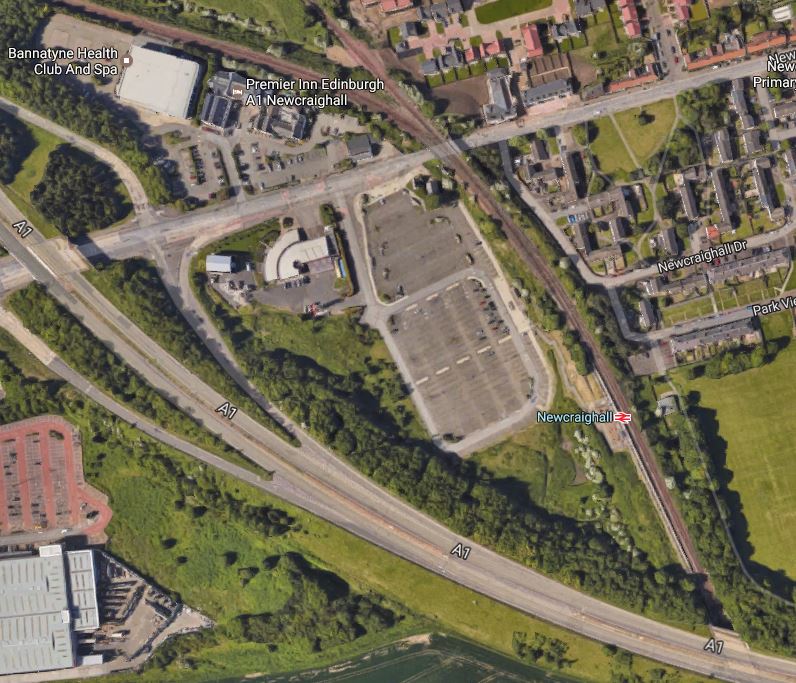
Note the A1 and the convenient Park-and-Ride.
Wikipedia says this about Services from Newcraighall station.
Monday to Saturday daytimes there is a half-hourly service to Edinburgh and to Tweedbank, and an hourly evening and Sunday service. Four weekday morning peak services run beyond Edinburgh to Glenrothes with Thornton via Kirkcaldy and a similar number run in the opposite direction in the evening. When the station was a terminus, many services ran through to/from the Fife Circle Line but this practice ended prior to the reopening of the full route to Tweedbank.
I believe that a Park-and-Ride of this size, location and probable importance needs at least four trains per hour (tph) all day.
Currently, two tph between Edinburgh and Tweedbank call at Newcraighall. As it takes two hours for a train to do the round trip, this means that four trains are needed to provide a two tph service.
Four tph all the way to Tweedbank would need eight trains, but due to limitations in the design of the Borders Railway would probably be very difficult to operate.
Terminating them at Newcraighall and perhaps running beyond Edinburgh to Fife is obviously a possibility, but Newcraighall station only has one bi-directional platform.
Two Trains Per Hour To Penicuik
Opening a branch to Penicuik and running two tph would give Newcraighall station and the Park-and-Ride the four tph train service it needs, when combined with the two tph along the Borders Railway.
The Edinburgh, Loanhead and Roslin Railway
Wikipedia says the route would probably follow the route of the Edinburgh, Loanhead and Roslin Railway.
- Much of the route is visible on Google Maps.
- The original line closed in the 1960s.
- There were stations at Gilmerton, Loanhead, Roslin and Glencourse.
- The major engineering feature of the line was a visduct over Bilston Glen.
Penicuik was served by a freight-only line.
Shawfair Station
It would appear that the Northbound and Southbound trains on the Borders Railway seem to call at Shawfair station around the same time.
This must make operation of the line much simpler and it probably meant that Newcraighall station only needed one platform.
This Google Map shows the Borders Railway passing through Shawfair station.
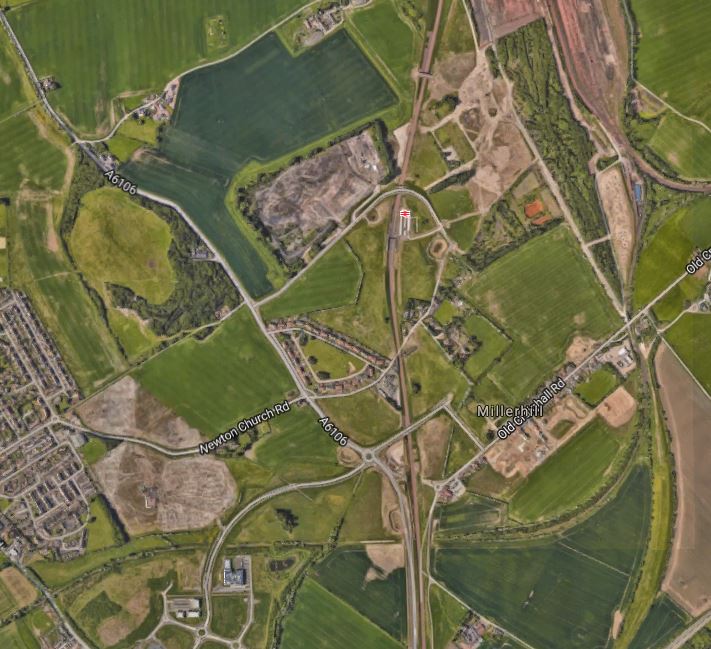
Note the disused track of the Edinburgh, Loanhead and Roslin Railway crossing the Borders Railway at right-angles and then curving Northwards to the freight yard at Millerhill.
Trains could go via Millerhill, to join the Borders Railway South of Newcraighall station, but surely, it would be better if the branch to Penicuik, joined the Borders Railway South of Shawfair station.
This would allow trains to and from Penicuik to pass at Shawfair station.
As trains to and from Tweedbank station seem to call between
- XX:08 to XX:10
- and XX 38 to XX:40
So Penicuik trains could use times of perhaps .
- XX:23 to XX:25
- and XX 53 to XX:55
Which would mean a train would have thirty minutes to go from Shawfair to and from Penicuik.
The way Shawfair station is used also means the following for the Borders Railway.
- A convenient spacing is imposed for trains to call at the single platform at Newcraighall station, as that is just four minutes towards Edinburgh.
- Effectively, the Borders Railway to Tweedbank station runs a two tph service with two widely-seperated trains South of Shawfair station at any one time.
- Two widely-separated trains, South of Shawfair station enables the use of single-platform stations at all stations except Stow and Tweedbank.
- Shawfair station is the only station with an expensive footbridge.
I also suspect that four tph is possible, with trains passing at Shawfair and Stow stations, perhaps with faster trains and improvements to the signalling.
By clever design and selective use of two-platform stations and double-track, it would appear that the engineers have designed an efficient affordable railway, that is mainly single track and has only one footbridge.
The Junction Of The Borders Railway And The Penicuik Branch
This Google Map shows where the track-bed of the Edinburgh, Loanhead and Roslin Railway passes under the Borders Railway to the South of Shawfair station.
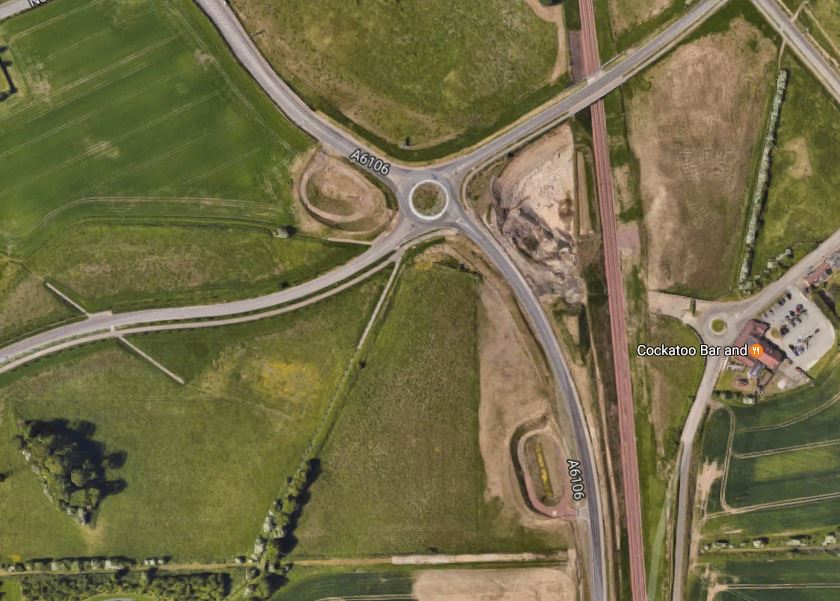
Note the old track-bed of the Edinburgh, Loanhead and Roslin Railway running East-West across the bottom of the map.
The roads in the area don’t appear to have been built with a suitable space for a chord to connect.
But even so, I suspect it would be a practical proposition for a single-track chord to be built between the Borders Railway and the Edinburgh, Loanhead and Roslin Railway.
The only difficult construction would be crossing the A6106 road to the South-East of the roundabout.
A cross-over would be needed South of Shawfair station to allow Southbound trains to access the branch to Penicuik. But as there would only be no more than four tph South of Shawfair station, this wouldn’t be a large operational problem.
Single-Track To Penicuik
Wikipedia says that the proposed Penicuik branch is ten miles in length.
Surely, if it were a single-track branch, trains could go from Shawfair to Penicuik station and return within thirty minutes.
Consider.
- It would take five minutes for the driver to change ends at Penicuik
- Two stops each way with a modern train could take a total of just five minutes.
- The train would be the only one on the branch.
- A well-designed line could have an operating speed of at least 75 mph and possibly 90 mph.
All this would mean that there would be ten minutes for each leg of the journey between Shawfair and Penicuik.
Should A Future Penicuik Branch Be Electrified?
Electrification of a future Penicuik Branch would not be difficult.
- Electrification would need to be extended from Newcraighall station.
- Electrification would be easier, if the branch were single-track with single-platform stations.
- Electrification of a new railway must be easier than electrifying an existing line.
Electrifying between Newcraighall and Penicuik may give advantages.
- There will be a fairly plentiful supply of cascaded electric trains, that could be suitable for the route.
- Electrifying may allow electric trains to access the Millerhill TMD.
- Electrifying would help in running bi-mode trains on the Borders Railway, if that were thought necessary.
- Electrifying may save a few minutes between Shawfair and Penicuik.
Obviously, electrification would allow politicians to boast about their green credentials.
The only disadvantage of electrification is that some bridges may need to be raised.
Surely, if the ten-mile branch was well-designed as mostly single-track, perhaps with electrification, and run by modern trains, two tph would be possible, even with one or more intermediate stops.
Could A Future Penicuik Branch Be Worked By Bi-Mode Trains?
A bi-mode train like a Class 319 Flex train could certainly work the route and as they have lots of power, they could probably achieve the Shawfair to Penicuik and return time of thirty minutes.
Could A Future Penicuik Branch Be Worked By Battery Trains?
As it is only ten miles between Shawfair and Penicuik, I suspect that in the future,, trains with onboard energy storage will be able to work the branch.
Single-Platform Stations
If the future Penicuik Branch could be a single-track railway, where only one train was on the branch at any one time, all stations could be built with a single-platform and no expensive footbridge, as most stations were built on the existing Borders Railway.
As five-cars seems to be becoming the new standard train length, I would build all platforms to accept five-car trains.,
A North-South Service Across Edinbugh
Peak Hour services link Tweedbank and Newcraighall beyond Edinburgh to Glenrothes with Thornton via Kirkcaldy.
There is obviously a need for a service in the Peak, but if there was a second Southern terminus at Penicuik would it be sensible that if a total of four tph were running from Newcraighall to Edinburgh, that a proportion cross the Forth.
Note that Cross-Forth services.
- Call at both Edinburgh and Haymarket stations in the City Centre.
- Have an easy interchange with the Edinburgh trams at Haymarket and Edinburgh Gatway station.
- Probably have an easier route to Edinburgh Airport.
There are certainly lots of possibilities.
Could A Future Penicuik Branch Be Worked By Tram-Trains?
The Germans would probably use tram-trains in a city the size of Edinburgh.
Compared to the tram networks in Nottingham and Birmingham, Edinburgh trams always strike me that it was a network designed without ambition and that doesn’t provide the maximum benefit to the largest number of residents and visitors.
If you look at Edinburgh Gateway station, it could have been modified to allow tram-trains like the Class 399 tram-train to come from the Airport and then go straight onto the Fife Circle Line to South Gyle, Haymarket and Edinburgh stations.
At present this line is not electrified, but doing that is probably in Scotrail’s wish-list.
Once at Edinburgh station, the tram-trains could take any of the electrified routes to North Berwick, Dunbar or perhaps Penicuik.
Passengers would finally get a proper interchange between trains on the East Coast Main Line and the Edinburgh tram.
I also think that the Germans would run tram-trains on the Fife Circle Line and its proposed extension to Leven.
Currently, the frequency of trains on the Fife Circle Line is low and tram-trains could probably give a four tph service to all stations, if electrification was put in place.
Conclusion
I believe that it would be possible to open a single-track branch to Penicuik with single-platform stations and these objectives.
- Provide a two tph service between Penicuik and Edinburgh.
- Boost the service between the Park-and-Ride at Newcraighall and Edinburgh to four tph.
- Provide an alternative Southern terminal for a North-South service across Edinburgh.
Electrification of the line might give operational advantages to Millerhill TMD, the Borders Railway and the branch itself.

