By Coach to the Football at Ipswich
Tuesday’s match against QPR is best forgotten and I did think about abandoning my trip to see Ipswich host Cardiff today. But in the end I took the Supporter’s Club coach from Haverhill. And very comfortable and sociable it was too!
The only problem was crossing to Tesco’s in Haverhill after being dropped at the bus station, so that I could get my supper. You just had to brave the traffic as the crossing was in the wrong place. But then supermarkets aren’t designed to be accessed on foot, as the average person can’t carry much!
But I did come quickly in a taxi!
Is Lincolnshire a Nanny State?
This story, about a father being threatened with action because his seven-year old daughter walk twenty metres to the bus stop to go to school is ridiculous.
At the age of six or seven in the early 1950s, I used to be taken to the bus stop at Oakwood by my mother to catch the 107 bus to Enfield for piano lessons with my Aunt Mabel. I had my couple of pence for the ticket and used to sit in one of the back three seats by the conductor. When I got to the stop just past Enfield Town station, I would get off and run down to my aunt’s. It should also be said that my aunt didn’t have a phone at the time. Were my family responsible or not? Perhaps, my illnesses are all down to letting me look after myself from an early age!
An Express Return to Suffolk
I must admit, I did leave a few minutes before the end of the match, but time was tight, if I was to make my taxi home, as he had a later booking to collect someone from Gatwick.
So by 17:14, I was on a London train out of Fratton station.
Waterloo to Liverpool Street is one of those journeys that isn’t the best on the Underground. You can change from Northern to Central at Tottenhsm Court Road, but because I had my case with me, I’d found out before that there was a direct bus; the 26, which stops just outside the back entrance to Waterloo and goes directly to Liverpool Street. It was a good choice, especially as it dropped me at the Bishopsgate entrance at Liverpool Street. I just had time to purchase a ticket from a machine that worked, unlike at Whittlesford, and then board the train.
Admittedly, it was a few minutes late into the station, but the taxi was there and I was watching the television by a quarter to nine. So it was about three and a half hours door-to-door!
London Buses
In the two and a half days or so, that I spent in London, I used the buses a lot. They worked well, especially, as the information at stops, generally allows you to choose the right bus for your journey with ease. There is one thing, that I’d like to see and that is some form of route map actually on the buses, so that if you are unfamiliar with the route, you can make the right decision about which stops to use. I think this is often brought about, by the fact that I’m unable to recognise where I am from the lower deck of a bus.
But I can still use the top deck, as this picture of the inside of a Routemaster on Route 15 shows.
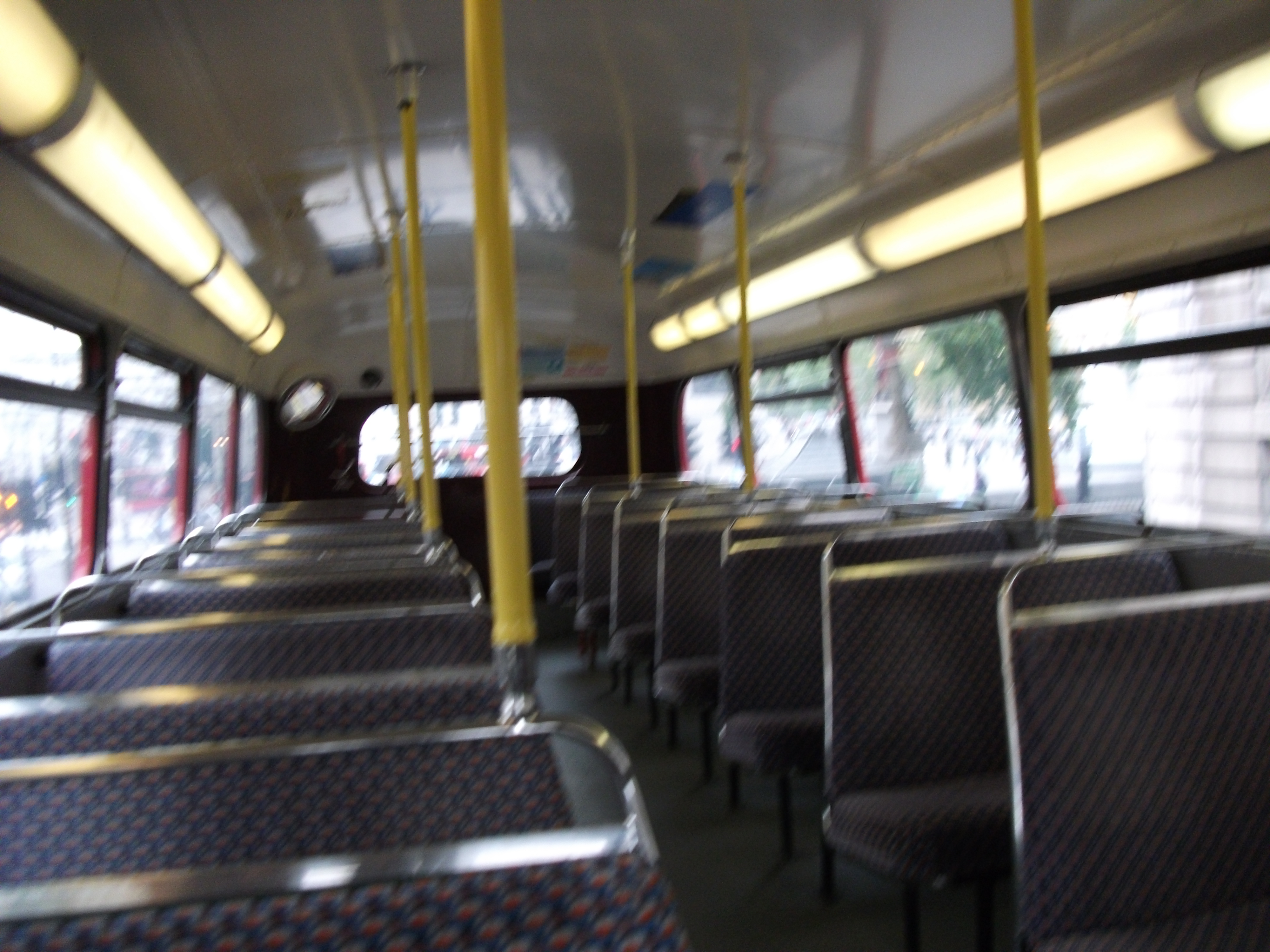
Top Deck of a Routemaster
Stranglely as a child, I didn’t travel on these iconic buses very often, as they weren’t introduced into the suburbs, like Cockfosters where I lived, until after I left. The first place I saw them was at Wood Green, where they replaced the trolley buses.
But when C and our young family lived in St. John’s Wood, we used them extensively to get around London. It may surprise people to read that we could manage three small children and a large double pushchair with ease on these buses. But then in those days, it was either use the bus or walk! Or in C’s case push!
I should say that on my trip from Trafalgar Square to St. Pauls on the Routemaster, I had no difficulties with the stairs. So that was another victory against the Devil!
Doubts About Guided Busways
Over the last few months, I have been watching the progress, or should that be non-progress, of the Cambridge Busway with interest. Now one of the transport experts from Salford University, Richard Knowles, has been very forthright about the project and another busway proposed for Greater Manchester. His views are in this report on the BBC.
This is an extract.
“The idea is a good one,” he added, “but guided busways have always been promoted on the basis that they’re a lot quicker and cheaper to build than light rail systems.
“However, in Cambridgeshire, it’s 10 years since the multi-modal study recommended it and the budget at that time was half what it looks like it’s going to cost, and it’s well out of time.
“The contract was let in 2006. It’s now 2010 and it’s still not open.”
Prof. Knowles said the Cambridgeshire guided bus scheme was “a guinea pig”.
“It’s the national trial project, if you like, for guided busways.
“This is why the government put a huge amount of money into it, because it is the pilot project for guided busways in Britain.
“So other guided busway schemes clearly want to see what happens in Cambridgeshire and learn the lessons.”
It’s a pity for Cambridge, that the guinea pig wasn’t some other council.
In fact, I needed the busway today, as I had to get from the city centre to Addenbrookes. So I had to get a normal bus, which incidentally was very convenient and reliable.
D & G Buses in Crewe
I noticed that some of the buservices in Crewe are run by a company call D & G Bus.
Obviously as Crewe is in Cheshire, these buses must be the first choice of the many footballers wives who live in the area.
London Underground and Overground Interchanges
As I have gold older, I’ve tended to avoid some interchanges between lines, as they are either difficult or they make the journey longer. Now after my strokes, I’m a bit more careful, as some stations are a bit claustrophobic and just too busy.
I was also got on this train of thought, by a friend, who has to get King’s Cross and Gerrards Cross regularly. Usually, they end up taking a slow taxi up Marylebone Road. I thought there must be a better way. In some ways it’s a pity that when they built the new Wembley, that they didn’t find some way to connect the Chiltern, Metropolitan and Jubilee Lines in the area, as this would have given access directly from places like Aylesbury and High Wycombe to the City and East London. As yesterday, I had to go to Oxford Circus I did check out the Bakerloo Southbound to Victoria Northbound connection and I think it is up one short escalator, a few steps and then down another escalator. But you wouldn’t do it with a heavy bag!
I think it illustrates how you must get to know your interchanges in London. Here’s a few of the things I like and dislike.
Access to the Northern Line is much slower than the other lines at Kings Cross, now that they have virtually rebuilt the interchange. So I usually avoid it.’
Green Park always seems to be a slow interchange, as you walk for ever.
Bank is not for the faint hearted, especially as there are a lot of works going on at the moment.
In fact these days, I’ll often look for a bus route that does the transfer and perhaps avoids the difficult stations.
Parking and Clamping
This was discussed on Radio 5 Live yesterday morning, after reports that the government were to ban clamping on private land. It is probably right to ban the aggressive aspects of this, but what do you do if say you have a private car park on your offices that is always being blocked by illegal parkers. They also interviewed the man who refused to get out of his clamped car, so it could be towed away. Most had sympathy with the man, but I don’t, as he shouldn’t have parked where he did in the first place.
When I could drive, I never parked illegally and I think that in over forty years of driving, I’ve only had a handful of tickets. most of which were because I misread a sign or put the wrong amount of money in a meter.
Now that I use buses a lot, I realise how illegal parkers are a complete menace and slow the traffic a lot more. My post about chaos in Trafalgar Square was partly about illegal parking, but mainly about stupid idiots, who were trying to drive where they shouldn’t.
The irony about the BBC phone-in was that the stand-in presenter, Stephen Nolan admits that he gets lots of parking tickets outside the BBC in Belfast, because he claims there is nowhere to park. Surely, he should use the bus. But then he is almost proud of his very obese state, so I suppose the extra walk would be just too much for him.
I hope the BBC don’t pay his parking tickets.
Edinburgh’s Transport Systems
Edinburgh is supposed to be one of the big tourist destinations in the world. So it needs to get its public transport up to the standard visitors expect. The buses are just not up to scratch and late and static trams give the wrong message.
I also read in The Scotsman, that the city doesn’t have a big enough dock for the largest cruise ships to berth, so they are losing out to places like Belfast and Liverpool.
Walking around the city is not difficult, but of course there are few maps. Incidentally, my eyesight isn’t good enough to read a paper map in the rain and I suspect that for many visitors to Edinburgh, clear eye level maps are best.
At least though the taxis are reasonably plentiful and affordable. The drivers also give you chapter, verse and every last word about the trams and the buses. But then taxi drivers are the same the world over!
I didn’t use the local trains, but it would appear that they work well! That is if you can find out which bus you catch to get to the station!
Edinburgh’s Buses
Since my stroke, I tend to use buses a lot more. My mobility means that I have no trouble boarding or even getting upstairs on a double-decker for the view. At least now these days, you get a comfortable seat in places like London, Cambridge and Edinburgh. And I suspect most places in the UK! So in most towns and cities across the UK, a bus is a sensible part of the transport network.
But good bus systems only work with easy ticketing, sensible fare policies and good signage. London is the benchmark, by which every otherb system shoiuld be judged in my mind, as being a Londoner, I’ve used them since I was a child. C and I also used to use Routemasters in the early seventies with three children under three, so my views on buses are not blinkered.
So how does Edinburgh stack up?
I was surprised that my over-60s bus-pass is not valid in Scotland. But then Scottish ones are not valid in England. I know there would be political problems, if they were interchangeable, but surely there could be a better system.
- Perhaps, there could be an extra charge for a free bus-pass, which might allow things like Scottish buses anywhere, London trains and tubes, and Manchester Trams. I think a lot of people would pay for a Senior Superpass, just as many buy a Senior Railcard.
- Or should there be a method of purchasing an Edinburgh bus pass for say your time in Edinburgh, when you buy your rail ticket. If that was the case, you’d get one of the old British Rail-style orange tickets, that work so well. After all, some tickets on Cambridge-Ipswich trains have an extension to buses at the destination.
And then there is the ticket you get in Edinburgh for a days travel. You don’t hand money to the driver, as you do in say London, but put it in a slot. Obviously, there is no change and a flimsy paper ticket is delivered from behind the driver. I know Scotland, likes to think of itself as a foreign country, but this system isn’t very tourist friendly. The ticket was good value at £3.00, but because it is just a scrap of paper, it could be easily lost. Surely, a credit card sized card would be better for a day ticket, as this can carry paid-for adverts. You could also sell weekly tickets for more money.
I think it is true to say, that rarely do you find flimsy paper tickets in mainland Europe, so why is the UK so keen on this type? Cost probably, but then London buses cope with Oystercards and rail travelcards with no problem at all.
Where Edinburgh buses are poor though is in the lack of signage on bus stops.
London sets the gold standard in this, but then as a Londoner, I would say that wouldn’t I! But if London’s policy of a local map in tube stations and on bus stops, coupled with a local bus map/index, wasn’t so good, why would it be virtually copied by several cities across the world including its big rival Paris.
Edinburgh gives no information at all on bus stops, except for little numbers saying what buses you can catch from the stop. So if you’re not sure which bus you need or where you are going, you’re lost!
I had thought there was no information of trhis kind until I found this at Waverley station, next to the train information booth.
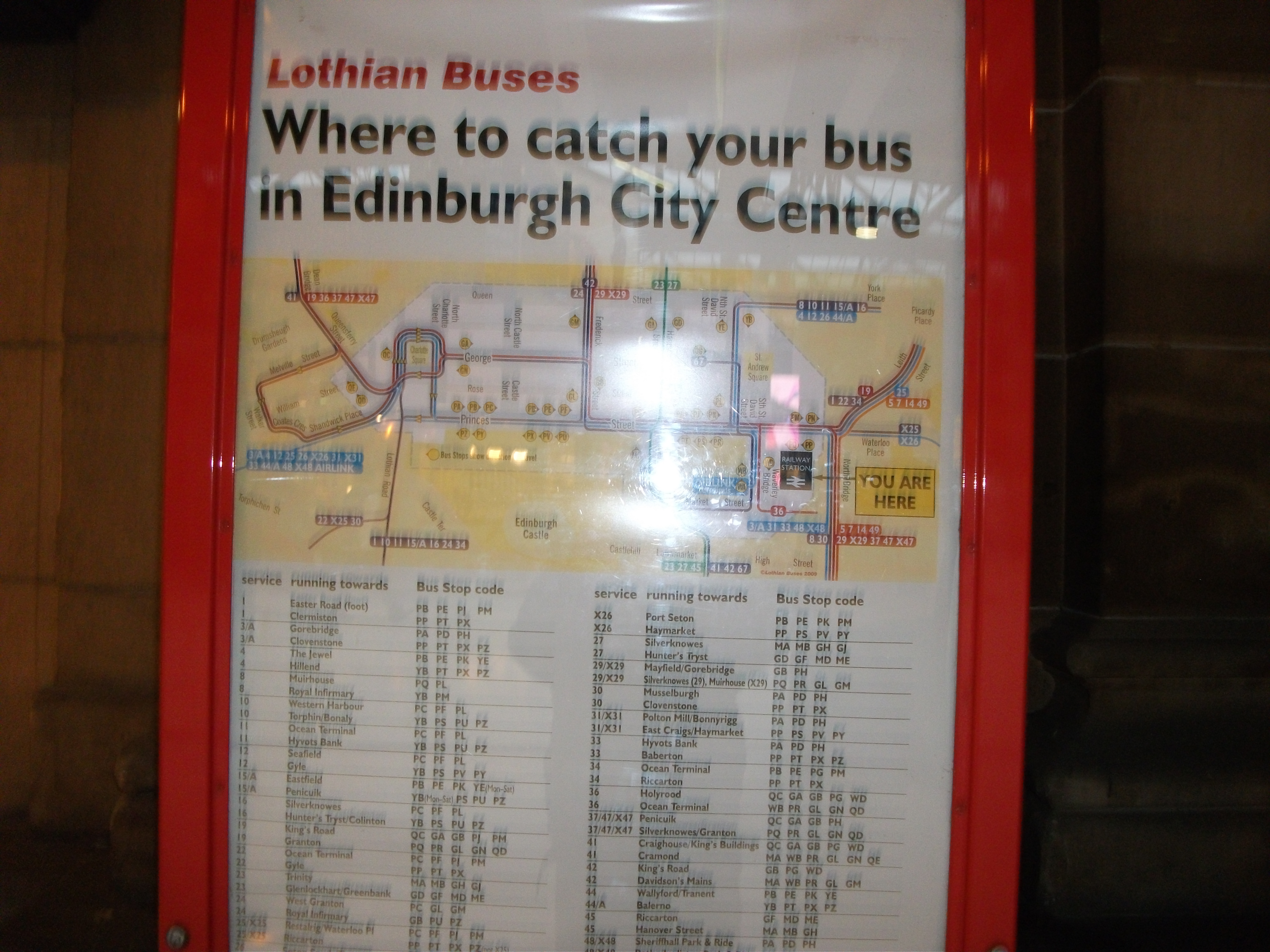
Edinburgh Bus Stop Map
There are also other problems with Edinburgh’s buses. Apparently, the routes and stops are always moving, so even locals can’t find their bus. They also have computerised displays telling ewhen the bus is supposed to arrive. These are different to everyone other one I’ve seen and are unreadable for someone with limited vision and aretoo high up for short people. Red displays under the bus shelter like London, Cambridge, Colchester etc. are so much better. The one we stood at said a bus was due and then it never came.

