Decarbonising The Mid-Cornwall Metro
Although the Mid-Cornwall Metro will probably run initially using what diesel multiple units, after a year or so, the route will be converted to zero-carbon operation.
Newquay To Falmouth Docks
This map shows the Mid-Cornwall Metro.

These are current timings.
- By train can take almost three hours with changes at Par and Truro.
- By car should take 45 minutes to drive the 24.4 miles according to Google.
Note.
- The train timings are for a typical British Rail-era Diesel Multiple Unit on the branches and something smarter between Truro and Par.
- A Day Return ticket would cost £8.90 without a Railcard.
- If there was a through train, that meant you didn’t have to change trains, I estimate that the time could be as low as one hour and 35 minutes.
I feel that most travellers, who had access to a car, would use that to travel between Newquay and Truro.
Newquay To Falmouth Docks By Electric Train
I have ridden in three battery-electric trains.
- Class 379 train – Manningtree and Harwich in passenger service.
- Class 230 train – Vivarail demonstration
- Class 777 train- Liverpool Central and Headbolt Lane in passenger service.
Note.
- All were mouse-quiet.
- There was no detectable difference, when running on battery power in the trains.
It is my view that battery-electric trains are no second-class solution.
Consider.
- Newquay and Par is 20.8 miles.
- Falmouth Docks and Par is 30.8 miles.
- Newquay and Falmouth Docks is 51.6 miles.
- The maximum speed between Par and Newquay is around 30 mph
- The maximum speed between Par and Falmouth Docks is around 50-70 mph
- There are twelve intermediate stations.
- There is a reverse at Par station.
- Charging would be easy to install at Falmouth Docks, Newquay and Par.
- In Par Station – 10th February 2024, I suggested that Par station could be fully-electrified, so that expresses could have a Splash-and-Dash on their way to London and Penzance. If all platforms at Par were electrified the Mid-Cornwall Metro trains could charge from the electrification, as they reversed.
There are two main ways that the Mid-Cornwall Metro might operate.
- There would be chargers at Newquay and Falmouth Docks and trains would shuttle the 51.6 miles between the two stations.
- There would only be charging at Par and trains would after charging at Par go alternatively to Newquay and Falmouth Docks.
The first might need smaller batteries and the second would only need one charger.
Newquay To Falmouth Docks By Hydrogen-Powered Train
There is only one hydrogen-powered train in service and that is the Alstom Coradia iLint, which is running in Germany.

I feel it is very much an interim design, as Alstom has taken a diesel-mechanical Lint train and swapped the diesel for a hydrogen-powered electricity generator and an electric motor.
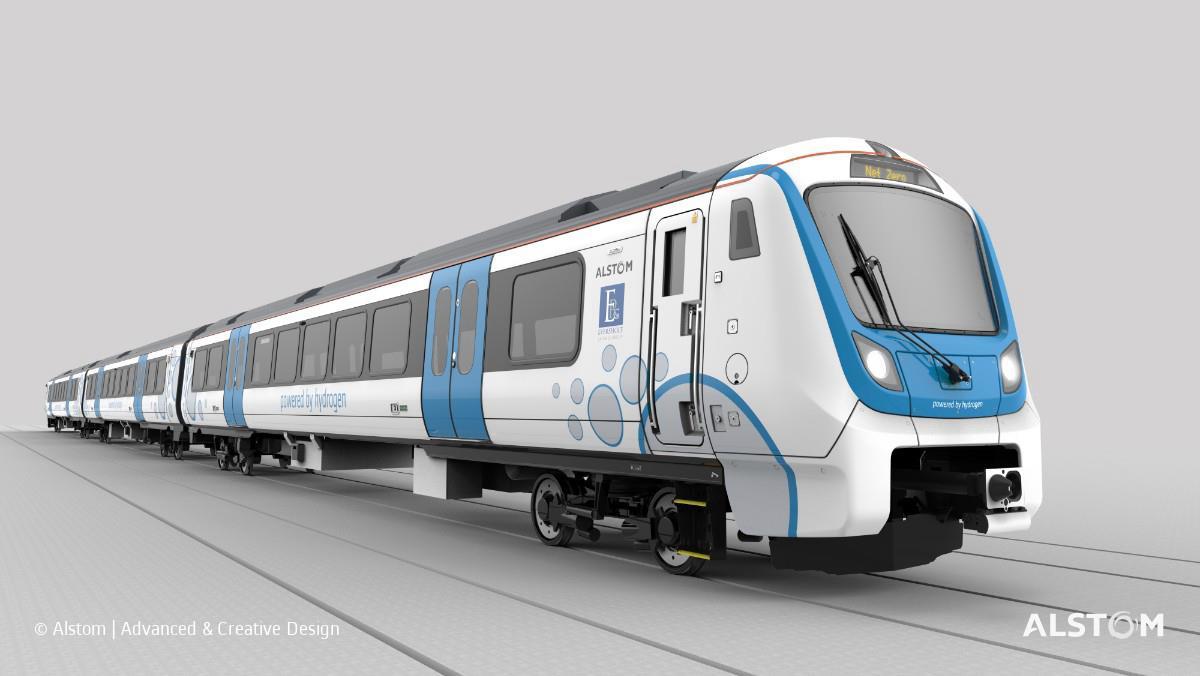
But Alstom are putting together a hydrogen-powered train based on an Aventra.
Note.
- The train is three cars.
- I would envisage performance of the hydrogen train would be very similar to that of a similar battery-electric train.
- I wouldn’t be surprised that refuelling of the train would not be a problem, as with all the china clay working nearby, there may well be developments to use hydrogen in the industry to decarbonise the mining.
The Mid-Cornwall Metro and Alstom’s Hydrogen Aventra could be ideal for each other.
Conclusion
I believe, that although the Mid-Cornwall Metro will start operation with diesel multiple units, it will be running in a zero-carbon mode within a few years.
Electrification Between Exeter And Plymouth
Eventually, there will be electric passenger trains between Exeter and Plymouth! Great Western Railway’s objective must be for passengers to board their Hitachi AT-300 train at Paddington and be powered all the way to Penzance by electricity, without using a drop of diesel. The added ingredient will be battery power.
In Sparking A Revolution, I gave Hitachi’s specification for a proposed battery-electric train.
- Range – 55-65 miles
- Performance – 90-100 mph
- Recharge – 10 minutes when static
- Routes – Suburban near electrified lines
- Battery Life – 8-10 years
As the distance between Exeter and Plymouth is 52 miles, the Hitachi specification could have been designed around this route, which as these pictures show is in places, very close to the sea, where the line runs along the South Devon Railway Sea Wall.




Global warming will probably mean, we’ll see a repeat of the major sea wall breach that happened at Dawlish in 2014.
I would suspect that the Network Rail’s solution to the problems of efficient low or zero-carbon traction between Exeter and Plymouth includes the following.
- A very robust railway.
- Extreme protection from almost everything the sea and the weather can produce.
- Could we see some concrete tunnels, like the Swiss and others use in mountainous areas to protect from snow? Rail Magazine says yes! At Horse Cove.
- No electrification as water and electricity are not a good mix, except in an electrolyser to produce hydrogen, oxygen and/or chlorine.
- Battery or hydrogen-powered passenger trains or freight locomotives.
- Digital in-cab signalling. Traditional signalling is even more expensive equipment to be swept away.
From media reports, this looks like the way Network Rail are thinking.
Charging The Trains
Battery-electric trains will need to be charged. There are three convenient stations; Exeter St. Davids, Newton Abbott and Plymouth.
- All have multiple platforms.
- The stations could be given the ability to charge battery-electric trains, either using 25 KVAC overhead electrification or a specialist charging system, like the one designed by Vivarail, that I wrote about in Vivarail Unveils Fast Charging System For Class 230 Battery Trains.
- Newton Abbot station would also charge any trains running on the eight mile branch to Paignton station.
As far as passenger services are concerned, it could be a very efficient zero-carbon railway.
Electrification At Exeter St. Davids
Exeter St. Davids is an important hub for services between Devon and Cornwall and the rest of Great Britain.
- GWR services run to London Paddington via Newbury.
- GWR services run to London Paddington via Bristol
- GWR services run to Plymouth and Penzance via Newton Abbott.
- GWR local services run to Barnstaple, Exmouth and Paignton.
- CrossCountry services run to the Midlands, North and Scotland via Bristol.
- South Western Railway services run to London Waterloo via Basingstoke.
In future, there could be services running to Plymouth on the reopened route via Okehampton and Tavistock.
All these services could be run by battery-electric trains for sixty miles from Exeter, if they could be fully-charged at the station.
Note.
- Trains to London Paddington and Bristol could easily reach Taunton, which is thirty miles away.
- Trains to London Waterloo could reach Yeovil Junction, which is fifty miles away.
- Trains to the West could reach Plymouth, which is fifty-two miles away.
- Barnstaple is forty miles away, so would probably need some help to get back.
- Exmouth is eleven miles away, so a return journey is probably possible.
- Paignton is twenty-eight miles away, so a return journey is probably possible, with a top-up at Newton Abbot if required.
Exeter is going to be very busy charging trains.
It should be noted, that trains to and from London Paddington and Bristol, all share the same route as far as Cogload Junction, where the London Paddington and Bristol routes divide.
- Cogload Junction is thirty-six miles from Exeter.
- Cogload Junction and Newbury, where the electrification to London Paddington starts are eighty-five miles apart.
- Cogload Junction and Bristol Temple Meads, where the electrification to London Paddington starts are forty miles apart.
I wonder if it would be sensible to electrify between Exeter St. David station and Cogload Junction.
- From my virtual helicopter, the line doesn’t look to be in the most difficult category to electrify.
- There is only one tunnel and a few old bridges and a couple of level crossings.
- Some of the route is alongside the M5.
- Trains would arrive in Exeter with full batteries and could do a quick stop before continuing their journeys.
- Trains would arrive at Cogload Junction and could reach Bristol Temple Meads without stopping for a recharge.
- Bristol services that are extended to Taunton and Exeter could be run by battery-electric trains.
I also feel, that with upwards of twenty-five miles of extra electrification between Cogload Junction and Newbury, that battery-electric trains could run between London Paddington and Exeter via the Reading-Taunton Line.
Electrification At Plymouth
As with Exeter St. Davis, Plymouth is an important hub for services between Devon and Cornwall and the rest of Great Britain.
- Most services run to Penzance in the West and Exeter in the East.
- There is a local service to Gunnislake, which is fifteen miles away.
Lots of charging capacity, will enable battery-electric trains to reach their destinations, except for Penzance
Trains Between Plymouth And Penzance
Hitachi must have despaired, when it was pointed out that the distance between Penzance and Plymouth is eighty miles! This is fifteen miles longer than the range of their proposed battery-electric train.
The simplest solution would be to build a battery-electric train with an eighty mile range, that could travel between Plymouth and Penzance on a single charge. With charging at Penzance it could return to Plymouth.
The longer range, would also mean that, with perhaps ten extra miles of electrification, that battery-electric trains could bridge the electrification gap between Cogload Junction and Newbury.
Other solutions range from selective electrification, all the way up to full electrification of the Cornish Main Line.
It should be noted that there are the following branches on the Cornish Main Line.
- The Looe Valley Line at Liskeard station – 8.75 miles – Uses a separate platform at Lskeard
- The Fowey Branch At Lostwithiel station – 4.75 miles – Possible reopening
- The Atlantic Coast Line at Par station – 20.75 miles – Uses a separate platform at Par
- The Maritime Line at Truro station – 11.75 miles – Uses a separate platform at Truro
- The St. Ives Bay Line at St. Erth station – 4.25 miles- Uses a separate platform at St. Erth
If these branches are going to be served by battery-electric trains, arrangements will have to be made for their charging. This could either be on the main line, at the remote terminal or at both.
Would it be easier to run the branches using battery-electric trains, if the Cornish Main Line was fully electrified?
The Cornish Main Line also carries a number of heavy freight trains, most of which seem to be going to or from Burngullow, so I suspect they are in connection with the movement of china clay.
Currently, these heavy freight trains appear to be hauled by diesel locomotives, but if the Cornish Main Line were to be fully electrified, could they be run by electric locomotives?
Electrification Of A Reopened Northern Route
In the May 2020 Edition of Modern Railways, there is an article, which is entitled Beeching Reversal Fund Bids.
This is the introductory paragraph.
Bids have been submitted to Government for a share of the £500 million ‘Restoring your railway’ fund launched by the Department for Transport in January. The fund is to be used to support proposals to reinstate axed local services, to accelerate schemes already being considered for restoration and also to promote new and restored stations.
One of the bids is for the Tavistock-Okrhampton Reopening scheme (TORs), which would reopen the former Exeter to Plymouth railway of the LSWR, as a new route between Exeter and Taunton in the East and Plymouth in the West.
- The original railway was double-track.
- Most of the infrastructure is intact.
- The route would totally avoid Dawlish.
This is also said in the Modern Railways article.
It proposes journey times could be as little as six minutes longer than via the existing route between Exeter and Plymouth and that there could be opportunities for freight trains to avoid the steep gradients over the Devon banks between Newton Abbott and Plymouth. Provision of electrification for TORs as part of a wider programme for main lines in the region is also advocated.
Could an electrified route via Tavistock and Okehampton be connected to an electrified Cornish Main Line, to create an electrified route across Devon and Cornwall?
Connecting At The Royal Albert Bridge
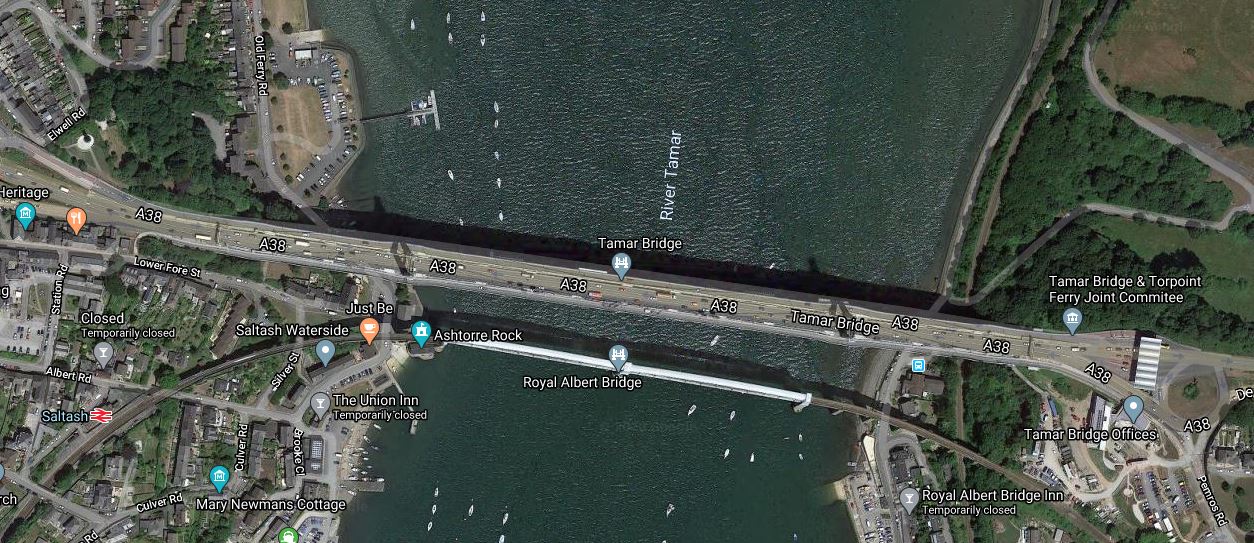
This Google Map shows the Royal Albert Bridge and the Tamar Bridge over the River Tamar.
Note.
- The Royal Albert Bridge to the South of the modern Tamar Bridge.
- The Great Western Main Line running East to Plymouth and West to Penzance.
- The Tamar Valley Line running up the Eastern bank of the River Tamar and under the Eastern approaches to both bridges.
- Going North on the Tamar Valley Line leads to the TORs and going South leads to Plymouth station.
I can see a difficult design problem at the Eastern end of the Royal Albert Bridge, as a very complicated junction will be needed to allow all trains go the way they need.
Trains wanting to call at Plymouth station and use TORs will need to reverse in the station.
Connecting At The East Of Exeter
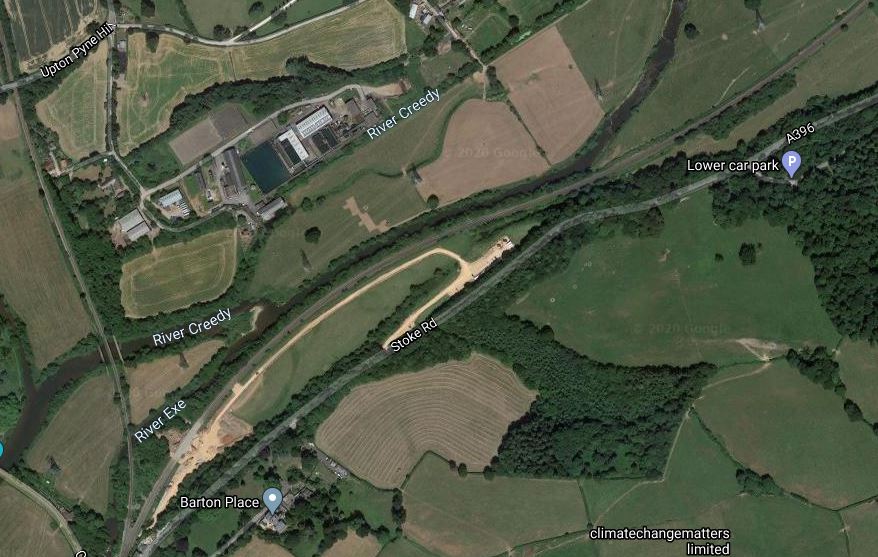
This Google Map shows The Tarka Line and the Bristol-Exeter Line join at Cowley Bridge Junction.
Note.
- The Tarka Line to Barnstaple and TORs leaves the map in the North West corner.
- The Bristol-Exeter Line to Taunton, Bristol and London Paddington leaves the map in the North East corner.
- Cowley Bridge Junction is in the South West corner of the map.
- Cntinuing South West leads to Exeter St. David’s station.
It looks to me, that Cowley Bridge Junction will need to be made into a full triangular junction, so that trains can go directly between the Bristol-Exeter Line and the Tarka Line.
Trains wanting to call at Exeter St. David’s station and use TORs will need to reverse in the station.
The Reversal Problem
If you wanted to run a passenger service between Taunton and Penzance using TORs with stops at Exeter, Okehampton, Tavistock, Plymouth and Truro, the train would need to reverse twice at Exeter and Plymouth.
These days with modern fast bi-mode multiple units, it’s not a problem, but in the days of Beeching, when the Tavistock and Okehampton route was originally closed in 1968, there probably wasn’t a suitable train other than a slow two-car diesel multiple unit.
I think, that fast expresses to and from Penzance will still take the current route.
- Battery-electric trains can handle the route at 100 mph.
- No reversals will be needed.
- There is a call at Newton Abbott for connections to Torquay and Paignton.
- Passengers wanting Okehampton, Tavistock and other stations on the TORs route can change at Exeter or Plymouth.
The Modern Railways article says this about services on the TORs route.
The case suggests that services could operate as an extension of the SWR Waterloo to Exeter service, or potentially as an extension of CrossCountry services beyond Exeter. During periods when the coastal route is blocked, additional services could use the TORs route, potentially running non-stop.
Note.
- As the extension of the SWR service would run the other way through Exeter St. David’s station, there would be no need to reverse.
- But I suspect the CrossCountry service would need the reverse.
- I feel for efficiency, that diverted freight services would need the efficient junctions at each end of TORs.
It probably would have helped if the Great Western and the London and South Western Railways had had a better crystal ball.
Fast Electric Freight Services To And From Devon And Cornwall
If the following lines are electrified.
- Cogload Junction and Exeter
- TORs
- Cornish Main Line
I feel that electric freight services will be able to run between Taunton and Penzance.
All it would need to complete the electrified route would be to electrify the following.
- Cogload Junction and Bristol
- Cogload Junction and Newbury
What would a high-speed freight route do for the economy of the two South Western counties?
 The Anonymous Widower