Could Thameslink Connect To Heathrow?
This may seem an outrageous idea.
But I think it could be possible.
Can Class 345 Trains And Class 700 Trains Use The Same Tracks And Platforms?
Crossrail may use Class 345 trains and Thameslink may use Class 700 trains, but can the two trains use the same tracks and platforms?
Recently, Cambridge North station has opened and it will certainly be compatible with Class 700 trains and Greater Anglia’s Class 720 trains, which are closely related to the Crossrail trains.
Heathrow’s platforms do not have platform-edge doors.
Both trains are designed to work at high frequencies using ERTMS.
So I think the answer to my question is a solid yes!
How Would Thameslink Trains Get To Heathrow?
The original plan for Heathrow Express envisaged using both Paddington and St. Pancras as terminals in Central London.
It would have used the Dudding Hill Line as a connection between the Great Western Main Line and the Midland Main Line.
This Google Map shows the tracks to the East of Acton Main Line station.
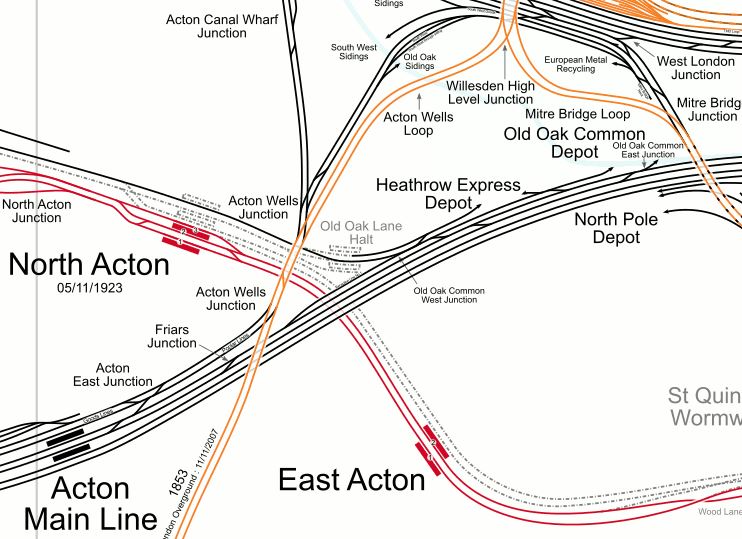
Note.
- The four tracks of the Great Western Main Line run through Acton Main Line station.
- The most Southerly pair of tracks are the fast lines, whilst the next pair are the slow lines as used by Crossrail.
- The tracks shown in orange are the North London Line.
- The two extra lines to the North of Acton Main Line station are the Goods Lines, connect at Acton Wells Junction to the North London Line, so freight trains can go across London between the Great Western Main Line and Stratford.
After crossing over the Central Line, the route splits with the North London Line going East to Stratford and the Dudding Hill Line going North through Acton Canal Wharf Junction.
To get to and from Heathrow, the services would take the same route as Crossrail to the West of Acton Main Line station.
The services would use the existing Cricklewood Curve Junction to connect with the Thameslink route to the North of Cricklewood station.
What New Infrastructure Would Be Required?
The infrastructure needed would not be of the sort of scale needed for Crossrail or Thameslink.
- The Dudding Hill Line is would need to be electrified.
- The Dudding Hill Line is double-track throughout.
- The 30 mph speed limit of the Dudding Hill Line would need to be increased.
- Would Harlesden and Dudding Hill stations be reopened or other new ones built?
- The stations at Heathrow could probably handle Class 700 trains without too much difficulty.
- There might be a need for a flyover to sort out the tangle of lines between Cricklewood and St. Pancras.
But nothing is too complicated or difficult.
What Frequency Of Thameslink Trains Would Serve Heathrow?
Currently, the following services are provided
- Heathrow Express has four tph to Terminal 5 via Heathrow Central
- There is a shuttle between Heathrow Central and Terminal 4, run by Heathrow Express.
- Heathrow Connect run two tph to Heathrow Central.
When Crossrail opens in December 2019, the service to Heathrow will be four trains per hour (tph) to Terminal 5 and two tph to Terminal 4.
Crossrail will also provide the shuttle between Heathrow Central and Terminal 4.
It is certainly not a system designed by any individual or committee with any sense of good design.
At least, both Terminal 4 and Terminal 5 stations have two terminal platforms, so the two stations should each be able to handle up to eight tph.
If they did this would mean up to sixteen tph on the Heathrow spur, which would be well within the capability of the route and trains running using ERTMS, which will handle up to 24 tph on both Crossrail and Thameslink in the few years.
Under current plans, it appears that when Crossrail opens, the stations will get the following services.
- Heathrow Central – 10 tph
- Heathrow Terminal 4 – 2 tph plus shuttles
- Heathrow Terminal 5 – 8 tph
I’m assuming that Heathrow Connect will quietly fade away.
With a bit of reorganisation of the services, it should be possible to squeeze another six tph into the airport, without building any new terminal platforms.
So I feel that say four tph Thameslink trains to Heathrow would be possible.
Could Crossrail Handle The Extra Trains?
The Thameslink trains would have to run on the Crossrail tracks between Acton Main Line station and Heathrow Airport Junction.
Currently Crossrail are proposing running 12 tph on this section, so as ERTMS can handle double this, I suspect there shouldn’t be too much of a problem.
Could Thameslink Handle The Extra Trains?
This article on Rail Engineer, which is entitled Thameslink Signalling Update, says this about possible Thameslink frequencies.
To meet the specification of 24 tph through the Thameslink core section, it is necessary to deploy Automatic Train Operation (ATO). This will provide a peak theoretical capacity of 30 tph, thereby creating a reliable 24 tph service with acceptable recovery margins.
So an extra six tph could be possible.
Would A Service Between Heathrow and Gatwick Airports Be Possible?
In my view it would be the logical service.
It would certainly be possible!
And it could also be a journey without any change of train!
Would There Be Any Other Useful Connections?
These are a few thoughts and ideas.
Same Platform Interchanges
Cross-city lines like Crossrail, Merseyrail’s Northern Line and Thameslink, have the advantage, that if you are going in the right direction, but are on a train to the wrong destination, you can just get off the train and wait for the correct train.
So if you leave Heathrow on a Gatwick train and you need to go to Maidstone East, you would get off at any of the stations in the central core and wait until the next Maidstone East train arrives.
Everybody will have their own favourite interchanges. Mine would probably be Blackfriars station, as it is above the Thames, has lots of seats and there is a large coffee shop on both platforms.
The ability to do this will mean that all stations South of West Hampstead Thameslink station will have a very easy link to and from Heathrow.
Reversing Stations
Crossrail has several stations where you can reverse your direction of travel by just walking across the platform. Whitechapel station will allow passengers to go between Abbey Wood and Shenfield stations without going up or down any steps or escalators.
Thameslink only has one reversing station at London Bridge station, although St. Pancras Thamslink has escalators and lifts to allow passengers to change direction in a short time.
West Hampstead Interchange
If plans for a West Hampstead Interchange materialise, this will link the following lines.
- Chiltern Railways
- Jubilee Line
- Metropolitan Line
- Midland Main L:ine
- North London Line
Note.
- This could be a very good interchange to be connected to Heathrow.
- West Hampstead Interchange would be a good alternative until Old Oak Common station is built.
- Passengers going between Heathrow and stations on the Midland Main Line to the North could change here.
Those like me living along the North London Line would find it a convenient way to get to and from Heathrow.
Kings Cross And St. Pancras Stations
The massive complex at Kings Cross and St. Pancras stations currently links the following lines.
- Eurostar
- Midland Main Line
- East Coast Main Line
- Southeastern Highspeed services
- Circle Line
- Hammersmith and City Line
- Metropolitan Line
- Northern Line
- Piccadilly Line
- Victoria Line
But the only way to get directly to Heathrow is a nearly hour long journey on the Piccadilly Line. Thameslink could be just over half that time, in a less cramped train.
Blackfriars Station
I use Blackfriars station a lot, as it is my the Tate Modern.
But others will use it as a same platform interchage for reasons I outlined erlier.
London Bridge Station
London Bridge station is another important interchange, with links to the following lines.
- Southeastern services to Kent
- Southern services to Surrey and Sussex.
- Jubilee Line
- Northern Line
Note.
- This new station is well-equipped and interchange is totally step-free.
- It is also a short walk to the city across London Bridge.
- This station will be a very good same platform interchange.
- The station allows passengers to reverse direction by just walking across the platform.
As with West Hampstead, this could be a very good interchange to be connected to Heathrow.
East Croydon, Orpington and Wimbledon Stations
East Croydon, Orpington and Wimbledon stations, which are important local hubs, would all be well-connected to Heathrow.
Collateral Benefits
Crossrail 2
Crossrail 2 is planning to have a Euston St. Pancras station, which is described like this in Wikipedia.
It would be a “mega station” serving the existing Euston, King’s Cross and St. Pancras main line stations. If funded and completed, it will be one of two such stations on the Crossrail 2 route (the other being Dalston).
If this station is designed properly, I am sure it will have the following.
- A step-free and convenient link to both Thameslink and Eurostar.
- Some form of high-capacity hi-tech people-mover, stretching under Euston Road, linking Kings Cross, St. Pancras and Euston stations.
I believe a station design is possible that makes the connection between HS1 and HS2 a no-hassle transfer for all passengers in less than ten minutes.
The people-mover should be in place when HS2 opens in December 2026, so that a credible HS1 to HS2 link opens at the same time.
Gatwick, Heathrow, HS1 And HS2 Will Be On One Rail Line
This could be of tremendous benefit to Londoners, travellers, tourists, rail companies and airlines, but Heathrow might not like it, as it could undermine their dominant position.
If Crossrail 2 opens around 2030, this will bring Stansted into the hub.
The Most Important Railway Station In The World
Eventually, Euston St. Pancras station will become the busiest and most important railway station in the world.
How Will Terminal Development At Heathrow Affect Crossrail And Thameslink?
Heathrow are disclosing a master-plan, for rebuilding a lot of the airport to make it more efficient and up with the best.
- There will be two main terminals; Heathrow West and Heathrow East with satellites in between handling the actual planes.
- These two terminals and the satellites will be between the two existing runways, with a passenger and baggage transport system beneath.
- Terminal Five will become Heathrow West.
- An extended Terminal Two will become Heathrow East.
- Crossrail, Heathrow Express and the Underground will serve both main terminals.
I believe that this rebuilding could start in the next few years.
Heathrow will make sure they future-proof rail access, so we could see.
- More terminal platforms at both Heathrow East and Heathrow West
- Through platforms at Heathrow West to allow trains to go West from both terminals.
- Freight shuttles bringing in provisions for the airport, the airlines and the aircraft.
This will allow Crossrail, Thameslink, Heathrow Express and other operators to have as many services as is thought necessary.
The biggest constraint will be the capacity of the Great Western Railway and the two tracks used by Crossrail.
Will Other Operastors Be Allowed Use Heathrow?
This probably depends more on politics than anything else, but technically these facts apply.
Bombardier Aventras
Bombardier have hinted that the design of an Aventra can provide commuter trains like Crossrail’s Class 345 trains and 125 mph expresses.
So it would be likely that a 125 mph Aventra of appropriate length would be able to serve Heathrow, if that were thought necessary!
All Trains Would Be Electric
I suspect that regulations would mean all trains would be electric, as you don’t want diesel or hydrogen fuels in the tunnels under Heathrow.
ERTMS
I also suspect that all trains using the eathrow stations would need to be equipped with ERTMS.
Possible Routes
Who knows what routes will become possible, but as the list of trains grows that are acceptable to Heathrow, various possibilities will arise.
- Great Western Railway to Bristol
- Great Western Railway to Cardiff
- London Overground to Clapham Junction station
- London Overground to Stratford
- South Western Railway to Southampton
- East Midlands Trains to Bedford/Kettering/Corby
- West Midlands Trains to Watford/Milton Keynes/Birmingham
After Heathrow terminals are updated to East and West, there would be scope for cross country routes going vaguely South-West to North-East calling at both terminals in Heathrow.
Will Thameslink And Crossrail Strangle Heathrow Express?
I wonder if a ink to Thameslink will be more valuable to Heathrow, than Heathrow Express.
- Abandoning Heathrow Express would release valuable platform space at Heathrow and Paddington.
- Crossrail and Thameslink together would have connections all over London, rather than just Paddington.
- Crossrail to and from Paddington would only take about five or six minutes longer.
- Heathrow Express will have to update their trains with ERTMS and to compete with Crossrail.
- Heathrow Express usually means a taxi to your hotel to and from Paddington.
- Crossrail will connect the West End, The City and Canary Wharf to Heathrow.
Convenience and cost will eventually strangle Heathrow Express.
Conclusion
The following statements would appear to be true.
- Class 345 and Class 700 trains can use the same infrastructure.
- Crossrail and Thameslink both use ERTMS.
- The stations at Heathrow,the Western section of Crossrail and the Thameslink core have spare capacity.
This means it should be possible to extend Thameslink services to Heathrow with a frequency of at least four tph, using an electrified Dudding Hill Line.
Some new infrastructure would be required, but nothing as comprehensive, as that for Crossrail and Thameslink.
Why Do UK Train Operating Companies Dislike Siemens Trains?
This post was suggested by this article on Global Rail News, which is entitled TransPennine Express Class 397 Fleet Taking Shape.
The following sections describe how the various train companies are replacing their trains built by Siemens.
TransPennine Express
TransPennine Express (TPE) currently have two fleets of Siemens trains; Class 350 and Class 185 trains.
Class 350 trains
TPE currently has a fleet of ten four-car Class 350 trains, which were built by Siemens and are used on electrified services between Manchester Airport and Scotland. They are being replaced by twelve five-car Class 397 trains.
The comparison between the two trains gives clues as to why the fleet is being replaced.
- The Class 397 trains are 125 mph capable, which means they can mix it with the Virgin’s Class 390 Pendelinos of a similar performance.
- The Class 350 trains are only capable of 110 mph.
- The fleet needed to be increased in number to handle services between Liverpool and Scotland.
- The five-car Class 397 trains fit the capacity needed for the Scottish routes better than the four-car Class 350 trains.
- The Class 350 trains don’t have wi-fi/4G and power-points to the current standard on some of the latest trains, like the Aventra.
I’ve not ridden in these trains, so I can’t comment on their quality.
I suspect it’s that the Class 397 trains have the 125 mph capability and adding another 110 mph train from Liverpool to Scotland would be too much for the West Coast Main Line to handle.
If you look at the current scheduled times of Virgin and TPE between Wigan North Western and Glasgow and Scotland, you get the following.
- Virgin – Wigan North Western to Glasgow – 2 hours 31 minutes
- TPE – Wigan North Western to Glasgow – 2 hours 46 minutes
- Virgin – Wigan North Western to Edinburgh – 2 hours 39 minutes
- TPE – Wigan North Western to Edinburgh – 2 hours 53 minutes
So it looks like the new 125 mph trains could save around fifteen minutes on a journey between North West England and Scotland. In addition to the quicker journey time for passengers, it might mean that TPE can use their trains more efficiently.
Nothing has been said, but I suspect that the new Class 397 trains can couple and uncouple automatically, as the Class 395 trains do regularly.
This would allow TPE to run a service like this.
- Two five-car trains start independently from Liverpool and Manchester Airport.
- The trains would couple together at Wigan North Western or Preston.
- They would then run to Carstairs at 125 mph.
- The trains would then split.
- One train would go to Glasgow and the other would go to Edinburgh.
The Southbound service would reverse the process.
In the 1960s, I travelled from Glasgow to Manchester on a service like this. T remember, that I was very late into Manchester, as we were delayed at Carstairs by the late arrival of the train from Edinburgh.
It looks to me, that TPE have decided to replace their Class 350 trains, with a faster and more flexible fleet, that can be run according to passenger demand.
Class 185 Trains
TPE also have a fleet of fifty-one three-car Class 185 trains, that were built by Siemens in 2005-2006.
These trains were in some ways very badly-specified for the route and have some deficiencies.
- There are not enough of them and they suffer badly from overcrowding.
- They are 100 mph trains, which means they are inadequate on the West Coast and East Coast Main Lines.
- They lack wi-fi and power sockets.
- They are diesel trains, that sometimes work on electrified lines, like Liverpool to Manchester and Leeds to Newxastle.
It is no surprise that TPE have decided to replace twenty-two of the Class 185 trains with Class 68 locomotive-hauled Mark 5 coaches and Class 802 trains.
- This gives a twenty-seven percent increase in the number of carriages.
- The Class 802 trains are 125 mph capable, so will be very handy for Liverpool to Newcastle and in a few years time to Edinburgh.
- The coaches are also built to be capable of 125 mph, but they would need faster locomotives to run at that speed.
- The new fleet will have the wi-fi and power sockets that passengers require.
This new fleet will certainly be better suited to TPE’s needs.
Greater Anglia
Greater Anglia are replacing all their trains, including their fleet of twenty-one four-car Class 360 trains, that were built by Siemens in 2002-2003.
However, in the August 30th Edition of Rail Magazine, there is an article entitled Trio Of Class 360 Desiros Reach Norwich For GA Timing Test.
It appears that, as the fastest trains in Greater Anglia’s fleet, they are being tested in case the new Class 745 trains are not ready before January 1st, 2020, when the Mark 3 coaches have to be retired.
South Western Railway
South Western Railway have a mixed fleet, which includes a lot of trains built by Siemens.
Class 707 Trains
South Western Railway (SWR) are still taking deliveries from Siemens of a fleet of thirty five-car Class 707 trains, that they inherited from South West Trains.
However, they have decided to replace the trains and their Class 455 trains with new Aventras.
I think that the main reason for having a fleet of 100 mph suburban trains, is that they get lots of advantages when it comes to creating passenger-friendly timetables.
But there are other reasons.
- SWR have said that all their trains will have toilets. The Class 707 trains don’t.
- The new fleet contains a lot of ten-car trains, whereas the Class 707 trains are all five cars.
- If all the trains are identical, this must give advantages with respect to management of trains and staff.
It looks to me, that South West Trains choice of fleet wasn’t in tune with SWR’s philosophy.
The Return Of The Class 442 Trains
Surprisingly, SWR are bringing back thirty-year-old Class 442 trains for the London to Portsmouth routes.
SWR probably need more trains to augment their forty-five Class 444 trains and a hundred plus Class 450 trains, which were all built by Siemens around the turn of the millennium.
Refurbishing the Class 442 trains is probably more affordable than ordering more trains from Siemens.
They can also be fitted with wi-fi, which the Class 444 and Class 450 trains lack.
West Midlands Trains
West Midlands Trains will takeover from London Midland in December 2017.
Currently, London Midland operate seventy-seven four-car Class 350 trains, built by Siemens in 2004-2014.
West Midlands Trains have promised to introduce 225 new carriages on Euston services.
As these trains work on the West Coast Main Line will they be 125 mph units like the Class 397 trains, so they can mix it with the Pendelinos?
Whatever happens, it does seem that the 100-110 mph Class 350 trains without wi-fi, may be living on borrowed time.
Thameslink
Thameslink is now a rail line run exclusively by Class 700 trains, built by Siemens in the last few years.
The trains were ordered without wi-fi and passengers are often critical of the trains.
In my opinion, the trains are inferior to Crossrail’s Class 345 trains, which have both wi-fi and 4G connectivity.
Conclusions
When I travel in a train that Siemens have built for the UK network, I often feel disappointed and think that they could have done better.
Perhaps the exceptions are South Western Railway’s Class 444 and Class 450 trains, but they lack wi-fi. These trains were built some years ago before it had been invented.
Wi-Fi
The Department for Transport now insists that passengers get free wi-fi and Crossrail is throwing in 4G connectivity as well.
I’m not sure, if there’s a Siemens train in the UK with wi-fi.
But then most trains in Germany have very poor wi-fi in my experience.
Could the design of Siemens trains make fitting of wi-fi and UK-sized power sockets difficult?
Contracts
Most trains these days are leased on long-term contracts, which includes maintenance. Could this cause problems with updating trains?
With the old BR-era trains, there are several depots and factories where trains can be updated and Bombardier seem to update their old tranis regularly at Derby. So is Siemens unprepared to update its older trains on the UK network?
The Aventras Are Coming
The first Class 345 trains are appearing with a quiet and smooth ride, excellent performance and wi-fi and 4G connectivity.
Siemens will have to raise their game to compete.
Is A Bi-Mode Aventra A Silly Idea?
In How Long Will It Take Bombardier To Fulfil Their Aventra Orders?, when discussing the new West Midlands Trains franchise, that has recently been awarded, I said this about the proposed eighty new carriages for the Snow Hill Lines.
As it is unlikely that the Snow Hill Lines will be electrified in the near future, could we be seeing an Aventra bi-mode for the Snow Hill Lines?
So is the bi-mode Aventra a silly idea?
The Five-Car Aventra
It looks like the formation of a five car Aventra like a Class 720 train is something like DMSLW+MS+MS1+PMS+DMSL
The codes are as follows.
- D – Driving
- L – Lavatory
- M – Motor
- S – Standard Class
- W – Wheelchair
So this means the following.
- All cars are motored for fast acceleration and smooth regenerative braking.
- As all cars are motored, there must be a heavy-duty electrical power bus running the length of the train.
- Both driving cars have a toilet.
- The wheelchair area and the fully-accessible toilet are probably together in one driving car.
- The pantograph is on one of the middle three cars.
It should also be noted that the Aventra has a slightly unusual and innovative electrical layout.
This article in Global Rail News from 2011, which is entitled Bombardier’s AVENTRA – A new era in train performance, gives some details of the Aventra’s electrical systems. This is said.
AVENTRA can run on both 25kV AC and 750V DC power – the high-efficiency transformers being another area where a heavier component was chosen because, in the long term, it’s cheaper to run. Pairs of cars will run off a common power bus with a converter on one car powering both. The other car can be fitted with power storage devices such as super-capacitors or Lithium-ion batteries if required.
This was published six years ago, so I suspect Bombardier have refined the concept
It would appear that this could be the reason, why in the document I found MS1 was used for one of the intermediate cars, as this is the car with space for the energy storage.
Do Aventras Have Batteries For Regenerative Braking?
Until I get a definitive statement from Bombardier, that they don’t, I will believe that they do for the following reasons.
- In Do Class 800/801/802 Trains Use Batteries For Regenerative Braking?, I said I would be very surprised if the answer to this question is No!
- In Class 345 Trains And Regenerative Braking, I showed that there were no giveaway electric fires on the roof to handle regenerative braking.
- Batteries would be the ideal way to drag a Class 345 train to safety in case of complete electrical failure in the Crossrail tunnel.
- The Germans, the Japanese, the Swiss and probably the Basques are experimenting with batteries to handle regenerative braking.
- Hybrid vehicles like cars and buses do it all the time.
But the main reason, is that as an Electrical Engineer, I believe it to be stupid and seriously bad design to not use some form of energy storage to handle the energy produced by regenerative braking.
Energy Storage In A Bi-Mode Train
If you look at the five-car Class 720 train, all axles are motored. This will give fast acceleration and smooth regenerative braking, which is just what both train operators and passengers want.
If a bi-mode train had energy storage, if say its speed was checked by a yellow signal, it would be able to regain line speed using the energy stored when it slowed down. So passengers wouldn’t have to endure the vibration of the diesel engine and the jerks as it started.
No competent engineer would ever design a modern bi-mode train without energy storage.
Where Would You Put The Power Pack On An Aventra?
Although space has been left in one of the pair of power cars for energy storage, as was stated in the Global Rail News article, I will assume it is probably not large enough for both energy storage and a power pack.
So perhaps one solution would be to fit a well-designed power pack in the third of the middle cars, which would then be connected to the power bus to drive the train and charge the battery.
This is all rather similar to the Porterbrook-inspired and Derby-designed Class 769 train, where redundant Class 319 trains are being converted to bi-modes.
Diesel Or Hydrogen Power Pack
Diesel will certainly work well, but London and other cities have hydrogen-powered buses.
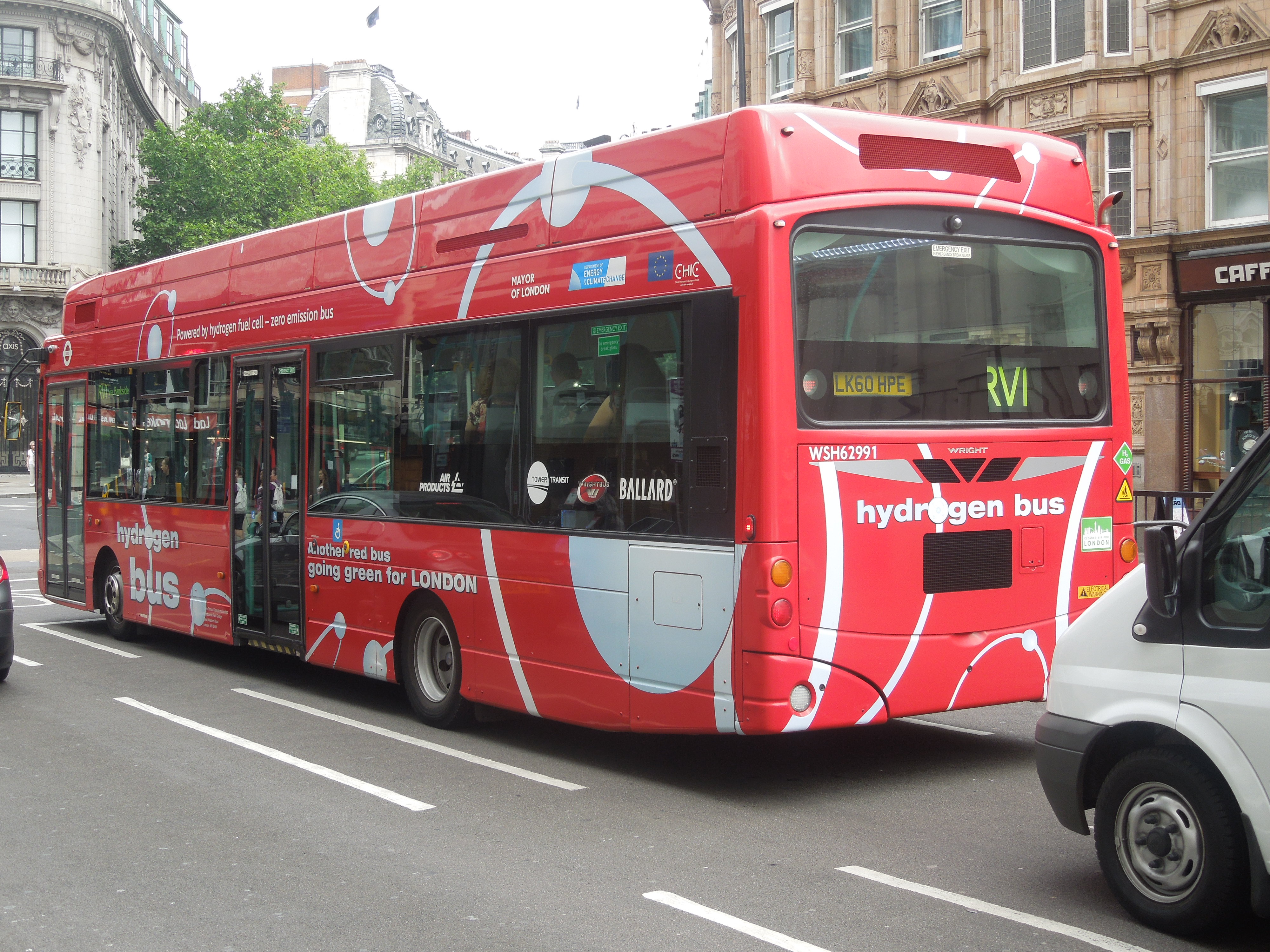
The picture is from 2013, so the technology has probably moved on. This Fuel Cell Bus section in Wikipedia gives the up-to-date picture.
Automatic Power Source Selection
Effectively, the ideal bi-mode train will be a tri-mode and will have the following power sources.
- Traditional electrification.
- On board diesel or hydrogen power.
- Energy storage, charged from the electrification or from regenerative braking.
The power source would be chosen automatically to minimise the use of both diesel/hydrogen power and electric power from the electrification.
Modern trains like an Aventra can raise and lower the pantograph automatically, so they can do this to make best use of what electrification exists to both power the train and charge the energy storage.
Techniques like these will be used to minimise the use of the diesel or hydrogen power pack.
Intermittent And Selective Electrification
On lines like the Snow Hill Lines sections could be electrified, where the engineering is easy and affordable, to with time reduce the use of unfriendly diesel or expensive hydrogen.
Strangely, one of the first places to electrify, might be the tunnels, as after the electrification of the Severn Tunnel, our engineers can probably electrify any railway tunnel.
I also don’t see why third rail electrification can’t be used in places like on top of viaducts and in well-designed station installations.
The 125 mph Bi-Mode Aventra
This article on Christian Wolmar’s web site is entitled Bombardier’s Survival Was The Right Kind Of Politics. This is said.
Bombardier is not resting on its laurels. Interestingly, the company has been watching the problems over electrification and the fact that more of Hitachi’s new trains will now be bi-mode because the wires have not been put up in time. McKeon has a team looking at whether Bombardier will go into the bi-mode market: ‘The Hitachi bi-mode trains can only go 110 mph when using diesel. Based on Aventra designs, we could build one that went 125 mph. This would help Network Rail as it would not have to electrify everywhere.’ He cites East Midlands, CrossCountry and Wales as potential users of this technology.
So Bombardier don’t think it is silly. Especially, the statement that Bombardier could build an Aventra that could do 125 mph running on diesel.
Applying, what we know about the power in the bi-mode Class 800 and Class 769 trains, which have three and two diesel power-packs respectively, I suspect that to create a five-car Aventra, that is capable of 125 mph on diesel, would need the following.
- At least three diesel power-packs.
- Regenerative braking using onboard energy storage.
- Automatic pantograph deployment.
- Automatic power source selection.
The light weight of the Aventra would be a big help.
It is my belief that energy storage is key, for the following reasons.
- Stored energy from braking at a station from 125 mph, would be used to get the train back to operating speed, without using a large amount of diesel power.
- Braking and acceleration back to operating speed, perhaps after being slowed by another train, might not need the diesel engines to be started.
- Starting a journey with an optimum amount of power in the battery might make getting to operating speed easier.
It would be a rough engineering challenge, but one I believe is possible.
Consider the routes mentioned.
East Midlands
Consider.
- 125 mph running would certainly be needed on this route.
- Battery power could be used to boost the trains to 125 mph.
- Electrification will be available between St. Pancras and Kettering.
- Electrification might be impossible between Derby and Sheffield because the Derwent Valley is a World Heritage Site.
Some form of charging might be needed at Derby, Nottingham and Sheffield.
A bi-mode train would be ideal for Norwich to Liverpool, although there’s not a great deal of electrification.
Cross Country
CrossCountry use several electrified lines on their various routes..
- York to Edinburgh
- Birmingham New Street to Manchester Piccadilly
- Bournemouth to Basingstoke
- Stansted Airport to Ely
Note that parts of some of these routes allow125 mph and Bournemouth to asingstoke is electrified using third-rail.
A dual voltage, 125 mph bi-mode train would probably fit CrossCountry’s routes well.
Wales
Except for the South Wales Main Line, there’s little electrification in Wales, but a 125 mph bi-mode train could be used on the following several partially-electrified routes.
- Carmarthen to Manchester Piccadilly.
- Holyhead to Manchester Piccadilly
- Holyhead to Liverpool via the Halton Curve.
- Birmingham to Shrewsbury.
- Swansea to Newport
Currently most of these services are served by 100 mph Class 175 trains. If nothing else, they would probably be more spacious, faster and fuel-efficient.
Conclusion
A five-car Aventra bi-mode is definitely not a silly idea.
It would be a sophisticated train with the following characteristics.
- Electric drive
- Regenerative braking.
- 25 KVAC overhead and 750 VDC third rail capability.
- Automatic pantograph deployment.
- Onboard energy storage.
- Automatic power source selection.
- Diesel or hydrogen power-pack
- 125 mph capability.
The first four are probably already in service in the Class 345 train.
.
How Long Will It Take Bombardier To Fulfil Their Aventra Orders?
I was reading this article in The Guardian, which is entitled Full speed ahead for train builders as minister pulls plug on electrification, when I found this useful nugget of information, from the General Manager of Bombardier’s Derby plant.
Building trains in an “ergonomically correct” fashion, he says, means completing and testing the carriage’s constituent parts, then assembling them, rather than wiring them up afterwards – and also takes the risk away from a production line which boasts a rate of 25 carriages per week.
It sounds like Bombardier’s engineers have been drinking and swapping ideas, with Toyota’s production engineers a few miles down the road at Burnaston.
But even so 25 carriages a week is an impressive figure, as that is almost three Class 345 trains for Crossrail in a week.
Bombardier have not been producing at that rate until now, as if they had, there would be Aventras in sidings all over the place. In The Class 345 Trains Are More Numerous, I described how I saw four yesterday and Transport for London have said they will have they will have eleven in service by September.
But this is all consistent with not going into full production, until you are sure, that you’ve got everything right, as any prudent company would do!
The Trains On Order
Bombardier have the following orders for Aventras.
- Crossrail – Class 345 – 70 x nine-car – 630 cars – To be delivered in 2015-2018
- London Overground – Class 710 – 45 x four-car – 180 cars – To be delivered in 2017-2018
- Greater Anglia – Class 720 – 89 x five-car – 445 cars – To be delivered in 2018-2020
- Greater Anglia – Class 720 – 22 x ten-car – 220 cars – To be delivered in 2018-2020
- South Western Railways – Class xxx – 30 x five-car – 150 cars – To be delivered in 2019-2020
- South Western Railways – Class xxx – 60 x ten-car – 600 cars – – To be delivered in 2019-2020
- West Midlands Trains – Class xxx – 36 x three-car – 108 cars – To be delivered from 2020
- West Midlands Trains – Class xxx – 45 x five-car – 225 cars – To be delivered from 2021
- c2c – Class xxx – 10 x six-car – 60 cars – To be delivered from 2021
This gives a total of 2,618 cars to be built.
The Building Schedule
Orders 1 and 2 are both directly or indirectly for Transport for London, with Wikipedia stating that the Class 710 trains for the Lea Valley Lines are being stabled at Ilford TMD, where the current Class 345 trains are also stabled, whilst they are being tested between Liverpool Street and |Shenfield stations.
I suspect that this close relationship between the orders means that Bombardier and Transport for London have agreed a delivery schedule, that brings in trains as they are needed. There’s not much point in building Class 345 trains for Crossrail, when some won’t be needed until 2019, if there is a more urgent need for Class 710 trains for the Overground.
To improve matters for Bombardier, Orders 3 and 4 for Greater Anglia, will probably be stabled in part at Ilford TMD.
Bombardier have not only got four substantial initial orders, but because they can all be introduced into service from Ilford TMD, they must have a tremendous advantage in terms of testing, introduction into service, manpower and costs.
So it looks to me that the two London orders will be built first, followed by the Greater Anglia and then the South Western Railways.
The London orders total 810 cars, which would take 32 weeks using Bombardier’s figure of 25 cars per week in The Guardian.
But assuming they started full production on the 1st of August, that gives them seventy-two weeks until the end of 2018, which gives a equired production rate of under twelve cars a week.
Surely, given their past history of building around a couple of thousand Electrostar cars, that must be achievable. Especially, as the modular structure of the Aventra, which has been developed with suppliers, must make building quicker.
The Greater Anglia and South Western Railways orders, which total 1,415 cars, would need to be built in 2019-2020 or lets say a hundred weeks.
So the build rate would be 14 cars a week, which is well below Bombardier’s figure.
The Body Shells
It should also be stated that Bombardier make their body shells at Derby, whereas Hitachi make their’s in Japan and ship them to Newton Aycliffe. This must ease having a high production rate for Bombardier, as for this you must have timely and reliable deliveries.
The Class 345 and 710 trains seem to have different car lengths, so it would appear that their production of body shells is flexible.
Little can be discerned about the production process from the Internet, as articles like this one on Global Rail News, which is entitled Bombardier completes first Crossrail body shell, are short on production details.
If they have a capacity to produce twenty-five body shells a week, I don’t believe that this can be done without the use of sophisticated designs assisted by large amounts of automation, as used in most car and van body production.
I have found this picture of a number of Aventra car body sides on the Internet.
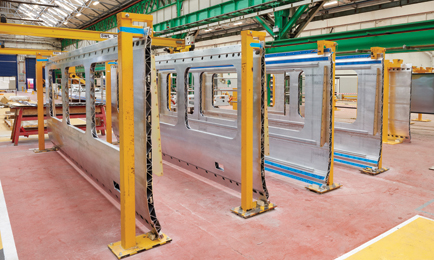
Note the double-skinned nature of the body sides, with reinforcing ribs inside, which must have great strength, light weight and a minimum number of components. I have read somewhere, that Bombardier are extruding aluminium for body components.
All of the holes could then be automatically cut by robots.
The joys of modern manufacturing!
Final Assembley
Modern manufacturing methods, as employed by car companies for years doesn’t mean you have to produce a sequence of identical vehicles on the line. Computer systems make sure all the components to build each car arrive at the right time.
A Class 345 train might have four or five different types of car, so similar methods would be used to speed production of the individual cars.
West Midlands Trains
Abellio, who own Greater Anglia, have decided they want to use Aventras on their new West Midlands Trains franchise.
According to Wikipedia, the new franchise is proposing to introduce the following trains
- 333 new Aventra carriages in three and five-car trains.
- 80 new CAF Civity carriages in two and four-car trains.
Some of the trains are direct replacements for other trains.
- The 36 x three-car Aventras will replace the 26 x three-car Class 323 trains.
- The CAF Civity trains will replace various diesel multiple units around Birmingham.
In some ways the puzzle is that there are 29 x five-car Aventras on order for electrified suburban lines.
Adding up the current and future number of electrified carriages on Birmingham suburban routes, shows that the number of carriages to be used will increase by three times.
New electrification is on the way.
- Chase Line to Rugeley Trent Valley.
- Cross-City Line to Bromsgrove.
But these short schemes won’t need all those trains, unless West Midlands Trains are going to run ten-car trains across Birmingham.
But possibilities exist.
- Electrification further towards places like Nuneaton and Worcester.
- Electrification of the Camp Hill Line across the City Centre.
- Aventras will be using batteries to reach places without electrification.
- Some Aventras could be bi-mode. I discuss the concept of a bi-mode Aventra in Is A Bi-Mode Aventra A Silly Idea?.
All will become clear in the next couple of years.
The West Midlands Trains orders for Aventras total 333 new carriages, which will all be pretty similar to previous orders, except in details like car length, number of cars, top speed and the interiors.
At Bombardier’s quoted production rate of 25 cars per week,l that means they would take jus fourteen weeks to build them, after the design was finalised.
That sounds unbelievable!
c2c
This order is for just sixty carriages, which will be delivered as six x ten-car trains.
This is an extract from c2c’s Press Release.
The Aventra is one of the fastest-selling trains in the UK rail industry, and these new trains will be manufactured at Bombardier’s factory in Derby. Each new train, which will operate in a fixed set of 10-carriages, will include over 900 seats, plus air-conditioning, wifi, plug sockets and three toilets onboard. Each new carriage is larger and contains more seats than on c2c’s current trains, so each 10-carriage new train provides capacity for 15% more passengers onboard compared to a current 12-carriage c2c train.
So three x four-car trains working as a twelve-car train are replaced by one ten-car train, which results in.
- A modern instead of a twenty-year-old train.
- 15% more capacity.
- Wi-fi and plug sockets.
- Better passenger experience.
- Two cabs instead of six.
- Fixed-formation trains don’t have end gangways.
- Twenty bogies instead of twenty-four.
Revenue per train will surely increase, but electricity and maintenance costs will also decrease.
So the accountants get a double dose of pleasure!
c2c also hint that more new trains are on thew way.
But as they are also reported to have extended the lease on their Class 387 trains, they have excellent cover whilst waiting for delivery of new Aventras.
Currently, they have the equivalent of 25 x twelve-car trains with a few spares.
So a complete train replacement if they like the Aventras, will probably be something like another twenty to thirty trains.
This would seem to be a very low-risk plan!
The New South Eastern Franchise
The needs of the current South Eastern and West Midlands franchises are surprisingly similar.
- High speed running on HS1 and the West Coast Main Line.
- Suburban services in city networks; London and Birmingham.
- A few short branch lines.
- Some lines without electrification.
- An ageing fleet without wi-fi.
So could we be seeing a mass fleet replacement with Aventras, as in West Midlands Trains.
Note that one of the bidders for this franchise is the same consortium of Abellio, East Japan Railway Company and Mitsui, who successfully bid for West Midlands Trains.
Abellio bought a large number of Aventras for Greater Anglia and helped develop battery power for the trains.
So could we be seeing a large number of Aventras added to the fleet for the South Eastern franchise?
Currently, the franchise runs 824 Electrostar and 674 Networker carriages.
To replace the Networkers would be 27 weeks of production at Bombardier’s rate of 25 carriages a day.
The South Eastern franchise also needs more high speed trains for HS1. I can’t believe that Bombardier couldn’t achieve a top speed of 140 mph with an Aventra. They probably will have a solution for covering the line between Ashford and Hastings. My money’s is on some form of energy storage.
Conclusion
Bombardier would not quote the capability of being able to make 25 trains per week to a newspaper like the Guardian, if they didn’t know it was possible.
But to meet the deliveries needed by the four initial customers, probably needs about half the quoted production rate, which is the sort of conservative thinking I like.
This gives Bombardier the float to sort out production problems or non-delivery of sub-assemblies outside of their control.
But it would also give them the capacity to fit in other orders. Suppose Crossrail decided to extend to Gravesend or Southend and needed another five Class 345 trains, then in theory, that is only two days production, provided the suppliers can deliver.
The UK’s railways are going to be full of Aventras.
Toilets In Class 345 Trains
I visited this topic in Do Crossrail Trains Need Toilets? over two years ago, when I said this.
Surely, a much better and more affordable solution would be to update the ribbon maps in all Underground and Crossrail trains to show if the station had toilets, in the same way, they show the step free access. Some extra signs on stations showing the status and location of toilets would also be a good idea.
Incidentally on the Essex and Reading legs of Crossrail, several of the stations already have decent toilets. Getting off a train and catching the next one, to have a relaxed toilet break, is probably not a huge delay, due to the high frequency of the trains.
London has a chance to set high standards in this area, without putting toilets on any trains.
My views haven’t changed, but I do think that now the Aventra is in limited service, I can speculate further.
Walk-through Trains, First Class And Toilets
London now has five walk-through trains.
- Class 378 trains on the London Overground.
- S Stock on the London Underground
- Class 700 trains on Thameslink.
- Class 707 trains on South West Trains
- Class 345 trains on Crossrail.
In some ways the Class 700 train is the odd train out, as it has both First Class seating and toilets.
It should also be noted that Greater Anglia’s new Class 720 trains don’t have First Class, but it appears they have toilets.
Walk-through trains are an undoubted success, as any Overground or Underground passenger will confirm, after seeing the way other passengers move around the train to both get a seat and be able to make a convenient exit.
First Class causes problems, as it blocks off this passenger circulation, unless it as one end of the train. But this means that First Class passengers might have a long walk to their seat at the wrong end of the day.
I wonder if walk-through trains encourage passengers to not use First Class, as the freedom to circulate in Standard Class makes the travel experience better.
It will be interesting to see how posh commuters from Frinton take to Greater Anglia’s new Class 720 trains.
Another problem of First Class sitting at one end of the train, is that if toilet provision is made, there must be a toilet near to First Class.
So if you don’t have First Class in a train up to perhaps ten cars, you can get away with perhaps a universal access toilet and a standard one.
From comments I get, most people seem to like the Class 395 trains or Javelins, that work the Highspeed services to Kent. These trains are six-car, with no First Class and two toilets.
So are these trains setting the standard for the Greater Anglia’s Class 720 trains?
Toilets On Class 345 Trains
The initial layout of Crossrail with terminals at Abbey Wood, Heathrow, Reading and Shenfield, has a longest journey from Reading to Shenfield of 102 minutes according to the Crossrail web site. But there are toilet facilities at Reading and Shenfield.
However, there is the possibility, that Crossrail trains may serve other terminals like Gravesend, High Wycombe, Southend and Tring.
Tring to Southend would be a journey of two hours, so a toilet is probably a necessity.
The current Class 345 trains have been designed to be nine-car units, although at present they are running as seven cars because of platform length issues at Liverpool Street.
I’ve read somewhere that Crossrail has been designed so that the trains can be increased to ten cars, if there should be a need for more capacity.
- Platforms have been lengthened to at least two hundred metres.
- All stations seem to have been updated for a large number of passengers.
- Lengthening from seven to nine cars is obviously a simple matter.
- A similar lengthening of the Class 378 trains was not a major exercise.
So surely, it would be a simple matter to slot in a car with a toilet.
So perhaps we might see an extra tenth car added to Class 345 trains, that is tailored to the route, as this ability to add and remove cars, is a feature of all Aventras.
Hitachi’s Class 800 trains also have the capability, as I suspect every well-designed train has.
The Ultimate Airport Train
Imagine a tenth car on Heathrow services.
- Disabled toilet.
- Ticket machine.
- Visitor information and shop.
- Space for large luggage.
The mind boggles!
Conclusion
If an operator wanted Aventras with a disco car, I’m sure Bombardier would oblige! At a price!
The Class 345 Trains Are More Numerous
I took the train to Ipswich today to see Town host Brentford.
There were three Class 345 trains in a neat row at Ilford EMU Depot and another in Shenfield station.
Wikipedia now says that there are seven in service, but eleven are planned by September according to this article in the International Railway Journal.
Are Crossrail And Bombardier Having Us On?
A rail journalist sent me this sentence in an e-mail.
Everyone who’s been on a 345 tells me it takes half its time at stations waiting for the timetable to catch up.
So it would appear that they are saving time at each stop.
Liverpool Street To Shenfield
Currently, this twelve stop journey takes 43 minutes in a 75 mph Class 315 train.
It is also scheduled at 45 minutes in the 10:35 service, which is run by a Class 345 train.
The journey time calculator for Crossrail gives 41 minutes.
This works out at a saving of just ten seconds a stop.
Paddington To Reading
Currently, this nine stop journey takes 60 minutes in a 90 mph Class 165 train.
Crossrail will call at five more stations
The journey time calculator for Crossrail gives 49 minutes.
This works out at a saving of forty-seven seconds a stop.
Reading To Shenfield
Currently, the fastest this journey can be done is 103 minutes with two changes and the Underground between Paddington and Liverpool Street.
The journey time calculator on Crossrail gives 102 minutes.
Liverpool Street To Paddington
Currently, this journey rakes 21 minutes on the Circle Line,
The journey time calculator on Crossrail gives 10 minutes.
Conclusion
These figures don’t make sense.
- More time is predicted to be saved on the Reading branch.
- The current trains are faster on the Reading branch.
- I would assume that the current Class 345 train to Shenfield is timed at 45 minutes for scheduling reasons or in case something goes wrong.
- The Shenfield to Liverpool Street times seem to be based on the current timetable with a minute taken off.
- The Reading to Shenfield times can’t be right.
I do wonder if the figures in the journey time calculator on the Crossrail web site are the best estimate that could be made, when the web site was created.
Now, that an Aventra is running, they are not very good estimates.
Crossrail Tests Its Trains In Southend
The title of this post is the same as that of this article in the Southend Echo.
This is the first paragraph.
Crossrail trains are being tested from Southend to London – raising hopes that in future they could run to and from the town on a regular basis.
As the title of the article indicates, it could be that Bombardier and Crossrail are seeing how a Class 345 train performs on the route, prior to the delivery of Greater Anglia’s similar Class 720 trains, which are another train in Bombardier’s Aventra family.
Southend Victoria Station
Southend Victoria station could be a destination for Crossrail in the future, but consider these facts.
- Southend Victoria station is 41.5 miles from London Liverpool Street station and the fastest services take about an hour.
- Southend Victoria has a frequency of three trains per hour (tph) to London Liverpool Street.
- Southend Victoria station has four terminal platforms and is a short walk to the Town Centre.
- Reading station is 36 miles from London Paddington station and the fastest services take just over half-an-hour.
- Fast-growing Southend Airport with its station is on the Shenfield to Southend Line and the Airport would surely welcome a direct link to Central London and Heathrow.
- The three tph on the Shenfield to Southend Line doesn’t have a good interchange with the one train every forty minute service on the Crouch Valley Line.
If there is a major problem, it is that Greater Anglia is losing passengers to c2c with its station at Southend Central.
Between 2013/14 and 2015/16 Southend Victoria has lost 2.79 million passengers, whereas in the same period Southend Central has gained 1.14 million.
From what I have seen Greater Anglia intend to speed up the Liverpool Street to Norwich services to ninety minutes and run at a frequency of 3 tph. They are also going to add a fourth train that goes to Ipswich. So again, the three tph service to Southend, isn’t the best fit to services on the Great Eastern Main Line for passengers travelling between say Southend and the County Town of Chelmsford.
There are probably not too many reasons for Crossrail to be extended to Southend for its own sake, but if Greater Anglia and Crossrail decide that an integrated service is to be provided between Shenfield and Southend, then everything is up for discussion.
Fast Trains Between London And Southend Victoria
The current Southend to London trains stop seven times to the East of Shenfield.
They would probably need to stop at Southend Airport and perhaps two of the busiest stations, but cutting out five stations would probably bring the journey time down to fifty minutes, which would attract passengers and make it easier for Greater Anglia to run the service, as trains could do the round trip in comfortably under two hours.
Running three tph, as now, would need just six trains and running a desirable four tph would need eight trains.
I’d be very interested to see what time a one of the new Stadler Class 745 trains, could achieve on the route, with just four stops at Stratford, Shenfield, Billericay and Southend Airport.
Slow Crossrail Trains Between Shenfield And Southend Victoria
Paired with the fast trains could be a number of extended Crossrail services.
Based on Crossrail’s projected timings between Liverpool Street and Shenfield of 41 minutes and the current 35 minutes between Shenfield and Southend, a timing of 76 minutes is estimated.
- Crossrail’s trains could save as much as two minutes at each of the seven stops, East of Shenfield.
- The Shenfield to Southend Line has an 80 mph speed limit, which I suspect could be improved.
So could we see Slow Crossrail trains achieving the times that Fast Greater Anglia trains do now?
I think the answer is yes and it shows how trains have improved in the last few decades.
How Many Trains Could Use The Shenfield To Southend Line?
The capacity must be quite high, as the only complication is the totally independent Crouch Valley Line.
Southend Victoria station has four platforms, so the station could probably handle sixteen tph, which is more than enough.
I feel that it would be possible to run four Fast expresses and four Slow Crossrail trains in an hour.
Whether that would be an acceptable timetable is another matter.
Interchange With The Crouch Valley Line
The Crouch Valley Line’s one train every forty minutes must be a nightmare for Greater Anglia and passengers alike, and I suspect that Greater Anglia have a cunning plan to run a two tph service on the line.
It appears that the track layout can achieve this, with the two trains passing at North Fambridge station. But as they don’t run two tph on this branch there must be other limitations.
Foremost of these could be the three tph service on the Shenfield to Southend Line.
So sorting out the Shenfield to Southend Line might improve the service on the Crouch Valley Line.
Conclusion
I have come to these conclusions about services between Liverpool Street and Southend Victoria stations..
- A Fast Greater Anglia express service could probably achieve a sub-fifty minute time.
- A Slow Crossrail service, could probably do the trip in an hour.
- Better interchange with Crouch Valley Line and Great Easstern Main Line services would be achieved.
- Four Fast and four Slow services in each hour is possible.
My choice for the Liverpool Street to Southend Victoria service would be as follows.
- Four tph – Crossrail Class 345 trains – Stopping at all stations.
- Four tph – Greater Anglia Class 745 trains – Stopping at Southend Airport, Billericay, Shenfield and Stratford.
Or the simple option of just running the four Crossrail trains.
Crossrail to Southend, isn’t a ridiculous aspiration.
Your Class 345 Train Has Arrived
I took this picture at Stratford today.

Note the extra information on both screens.
Class 345 Trains And Regenerative Braking
Bombardier don’t seem to talk much about regenerative braking on Class 345 trains.
In the Wikipedia entry for the train, there is a section called Background And Specifications. This is the first paragraph.
In 2008, the UK government’s rolling stock plan stated a requirement for around 600 carriages for Crossrail, expected to be similar in design to the Thameslink rolling stock, to meet the design improvement requirements of the 2007 ‘Rail Technical Strategy’ (RTS), including in-cab signalling/communication including satellite and ERTMS level 3 technologies, regenerative braking, low cost of operation and high reliability, with low weight and high acceleration.
Perhaps Bombardier aren’t letting on how they achieve efficient braking of the trains.
One thing I proved today, was that the trains have no give away electric fires on the roof, where braking energy is traditionally dissipated.
This bad picture was taken through safety netting at Forest Gate station.
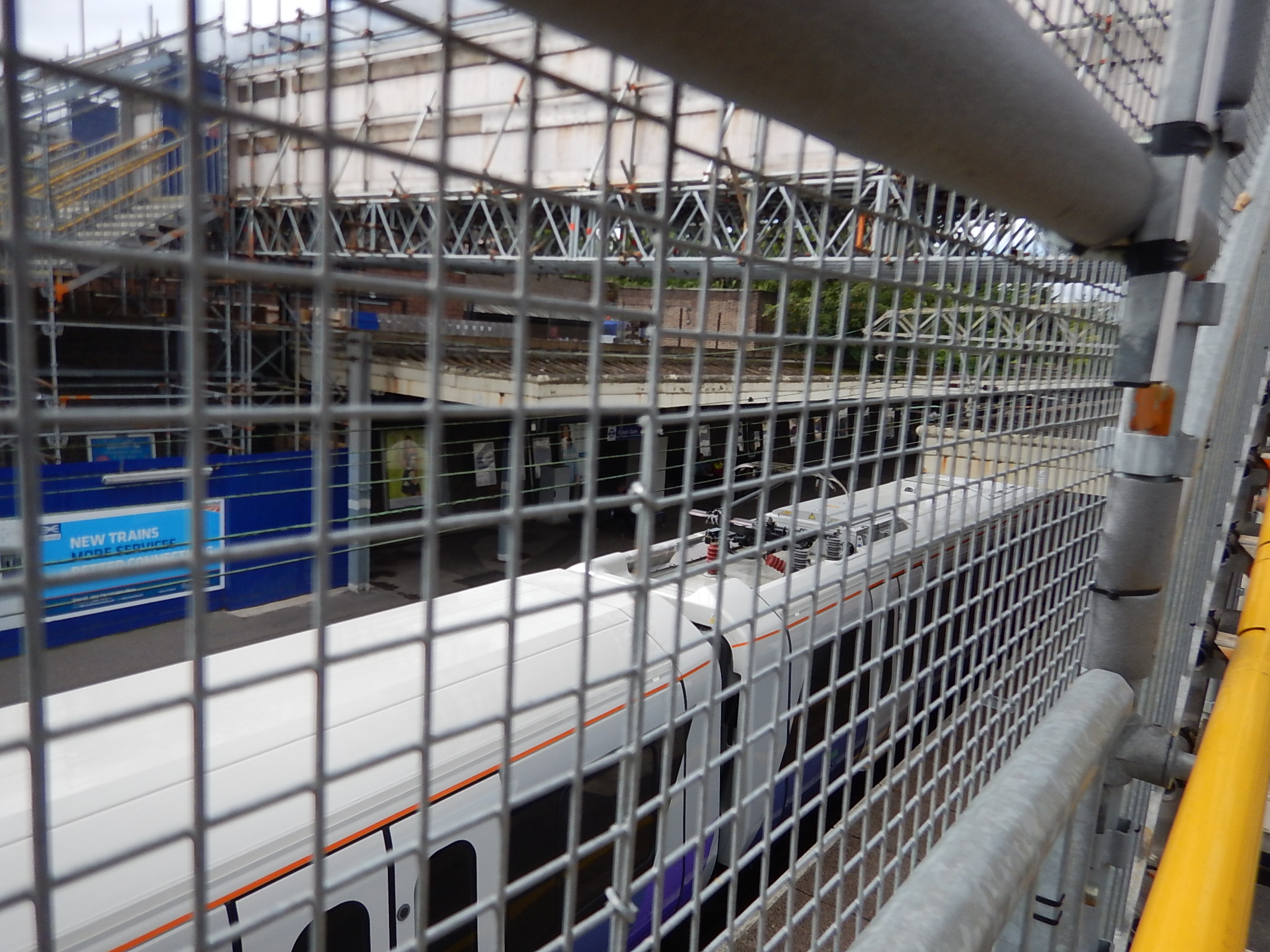
The roof is mainly-smooth with just grills for the air-conditioning and ventilation.
There certainly wasn’t any electric fires on the roof!
So does the braking energy get stored on the train for reuse?
 The Anonymous Widower