An Exciting New Aventra
The title of this post is the title of an article in Rail Engineer.
It is actually dated the 31st of January 2014, so you might think it is out of date.
But surely, with the first Aventras appearing in service, now is the time to revisit.
I found the article this morning by accident and it is a fascinating read, Especially when you consider the article was written before the train had received any orders. Bombardier had actually just missed out on the Thameslink order, which resulted in the Class 700 trains.
A Blank Sheet Of Paper
The loss of the Thameslink order allowed Bombardier to start from scratch.
This paragraph indicates one of their start points.
And then we looked at it and thought we’ve also got depot engineers from Strathclyde to Surrey, all over the place, all looking after these trains in the field. How are they performing? Is there something we can do better there?
As the article says Aventra was reborn after Thameslink!
They also talked extensively to possible customers.
Suppliers
Suppliers were invited on board and given space with the design team in a new Design Office in Derby.
This paragraph described how everyone worked together.
We basically started from scratch, and in a completely different way. It isn’t engineering-led any more. It’s a joint collaboration of our depot people, our manufacturing guys, procurement and engineering.
I would describe it as a project-led structure similar to one that ICI used to use in the 1960s.
I wrote my first scheduling program to allocate the office space needed.
A Modular Approach For The Future
Each Electrostar had been different to the previous, but this sums up the Aventra philosophy.
Aventra will be a single modular product, capable of being easily modified for different applications but in each case referring back to the core design. So whether the actual class will be a 90mph metro train or a 125mph main-line express, it will have the same systems and components as its basis. In fact, Jon thinks that the distinctions are becoming blurred anyway.
They had looked forward ten years.
Away From The Wires
Aventra will be an electric train, but what happens, when the wires run out?
This was their solution.
So plans were made for an Aventra that could run away from the wires, using batteries or other forms of energy storage. “We call it an independently powered EMU, but it’s effectively an EMU that you could put the pantograph down and it will run on the energy storage to a point say 50 miles away. There it can recharge by putting the pantograph back up briefly in a terminus before it comes back.
I rode the prototype in public service in January 2015!
I was totally convinced that Bombardier’s battery trains have not even the smallest touch of Mickey Mouse!
Although the experience was magical!
Bombardier’s Iron Bird
Bombardier have borrowed the Iron Bird concept from the plane-makers.
This is an extract.
A leaf has been taken out of the aircraft designers’ handbook. They use something termed an Iron Bird – basically an aeroplane without wings – to test new systems.
Bombardier’s Iron Bird is a train without bogies. However, it does contain control systems, wiring looms and other bits of kit and it is being assembled at Derby.
I think that this shows, that they are not against borrowing other concepts from other industries.
The Most Affordable Train
The article describes how the train was designed to give the best whole life cost.
This sentence sums up the philosophy.
It’s actually about a 50/50 split between the whole life cost and the first capital cost. That makes it a bit more difficult because we’ve got be competitive on the first practical cost, but additionally we have to offer a really high availability, strong reliability, combined with much better energy consumption and less track damage.
As someone, who used to own a finance company, that leased trucks and other expensive equipment, the product described is the sort of product that leasing companies love. If the train is economical to run, if the first train operating company goes bust, you’ll still have an asset that other train operating companies will fight over.
Trains are also a predictable long-term investment, as well-built efficient trains have a thirty or forty year lifetime.
In my view the big winner of a train like this is the manufacturer, as they’ll get happy owners, train operating companies and passengers, which must lead to repeat orders.
Conclusion
I’ve never ridden a more well-designed, comfortable, smooth and quiet suburban electric train, than the Class 345 train in trial service on the Shenfield Metro, anywhere in the UK or Europe.
Construction Of The Platform Structures And Tracks For Crossrail At Abbey Wood Was Cimpleted By Network Rail In May 2017
The title of this post, was stated under a picture in the August 2017 Edition of Modern Railways.
The picture had been taken on site from the other side of the fence through the station to this picture I took in July 2017.
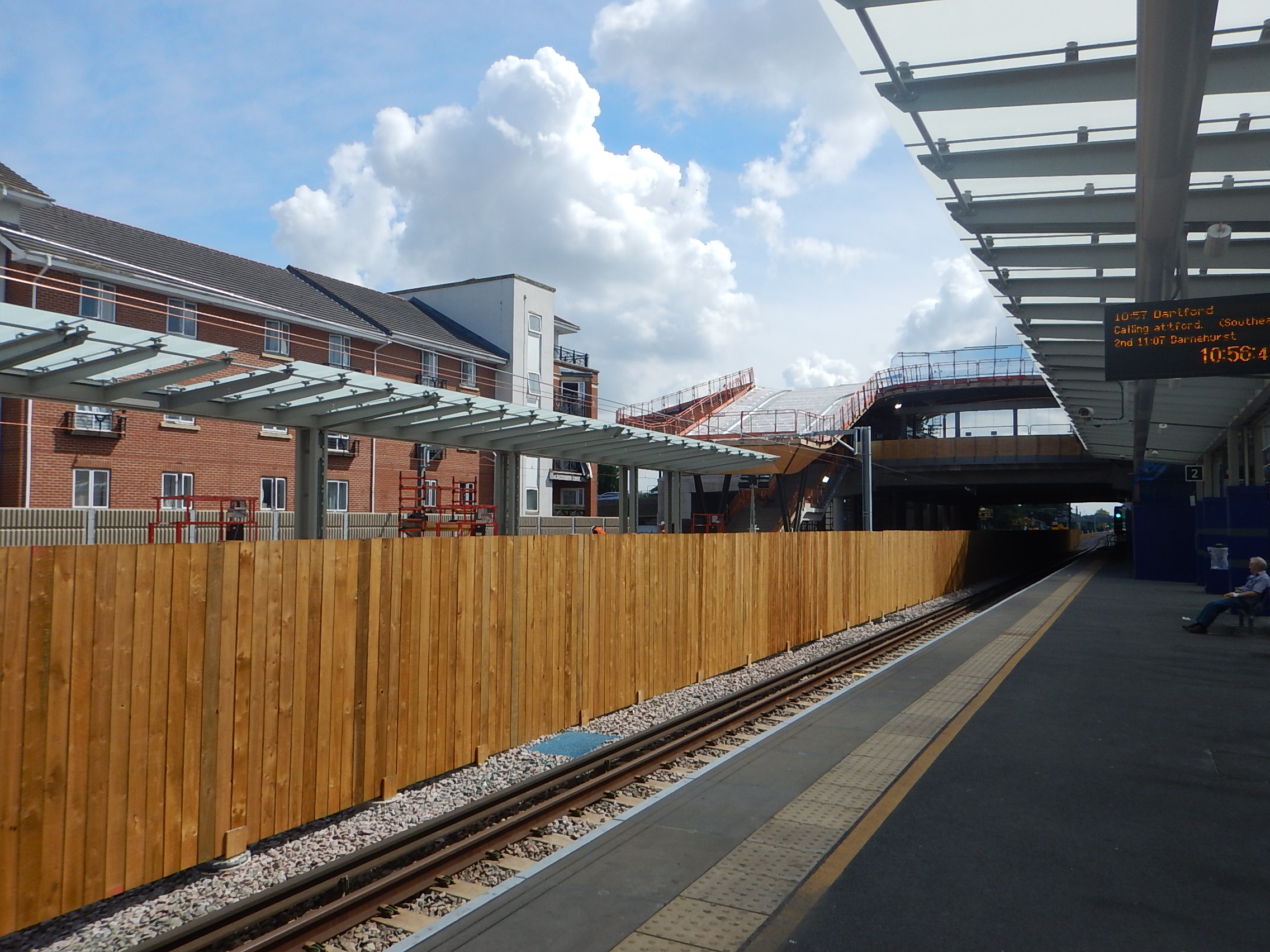
My later picture shows some of the canopies for the Crossrail platforms in position.
If Network Rail’s statement that formed the title of this post is correct, then is the track layout to the East of the station complete?
This picture shows the unelectrified line leading away from the station.
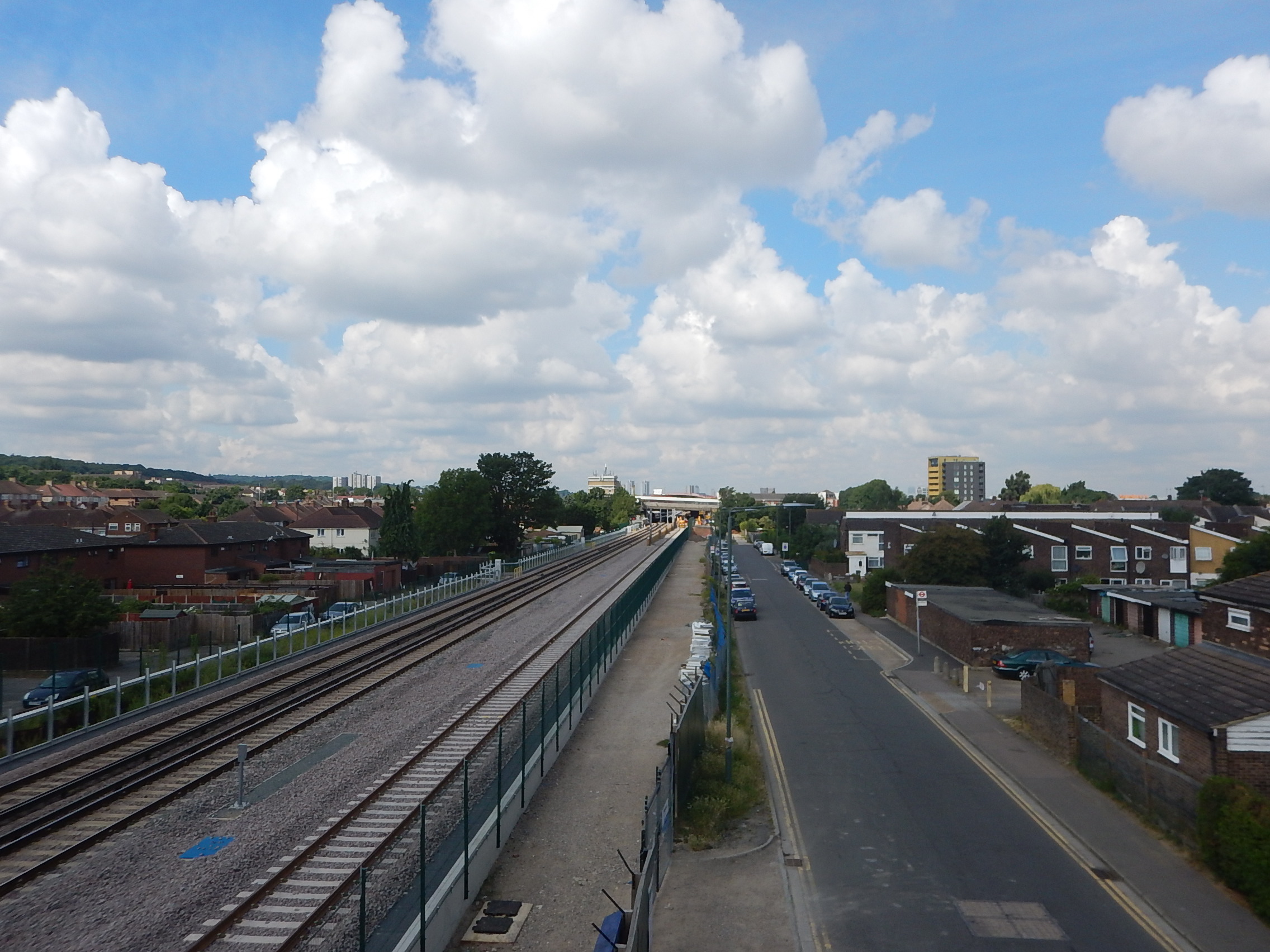
Note the track without any electrification by the fence in the right foreground and the two third-rail electrified North Kent tracks in the left background.
This picture shows the track going towards Belvedere station.

Note the cross-over by the signal.
Can Crossrail Reverse All The Scheduled Trains At Abbey Wood?
Crossrail have now published a more detailed schedule for the services.
The schedule shows that a maximum of twelve trains need to be reversed at each of Abbey Wood, Paddington and Shenfield stations.
In this article on Rail Engineer, which is entitled Signalling Crossrail.
The Class 345 trains are fitted with a system called Auto-Reverse, which I explained in Crossrail Trains Will Have Auto-Reverse.
The driver selects auto-reverse and walks back through the train, as it changes platforms automatically. By the time the driver is in the other cab, the train is in position in the other platform, ready to go back to London.
But the article in Rail Engineer also says this.
Auto reverse (AR) is not provided on Network Rail infrastructure. There will also be the possibility to use AR into and out of the stabling sidings at Abbey Wood so the driver will be at the correct end of the train to finish a shift or, when coming on duty, to start a new run westwards. Service trains will, however, normally reverse in the station. AR may also be used at Custom House and anywhere using crossovers in the central section.
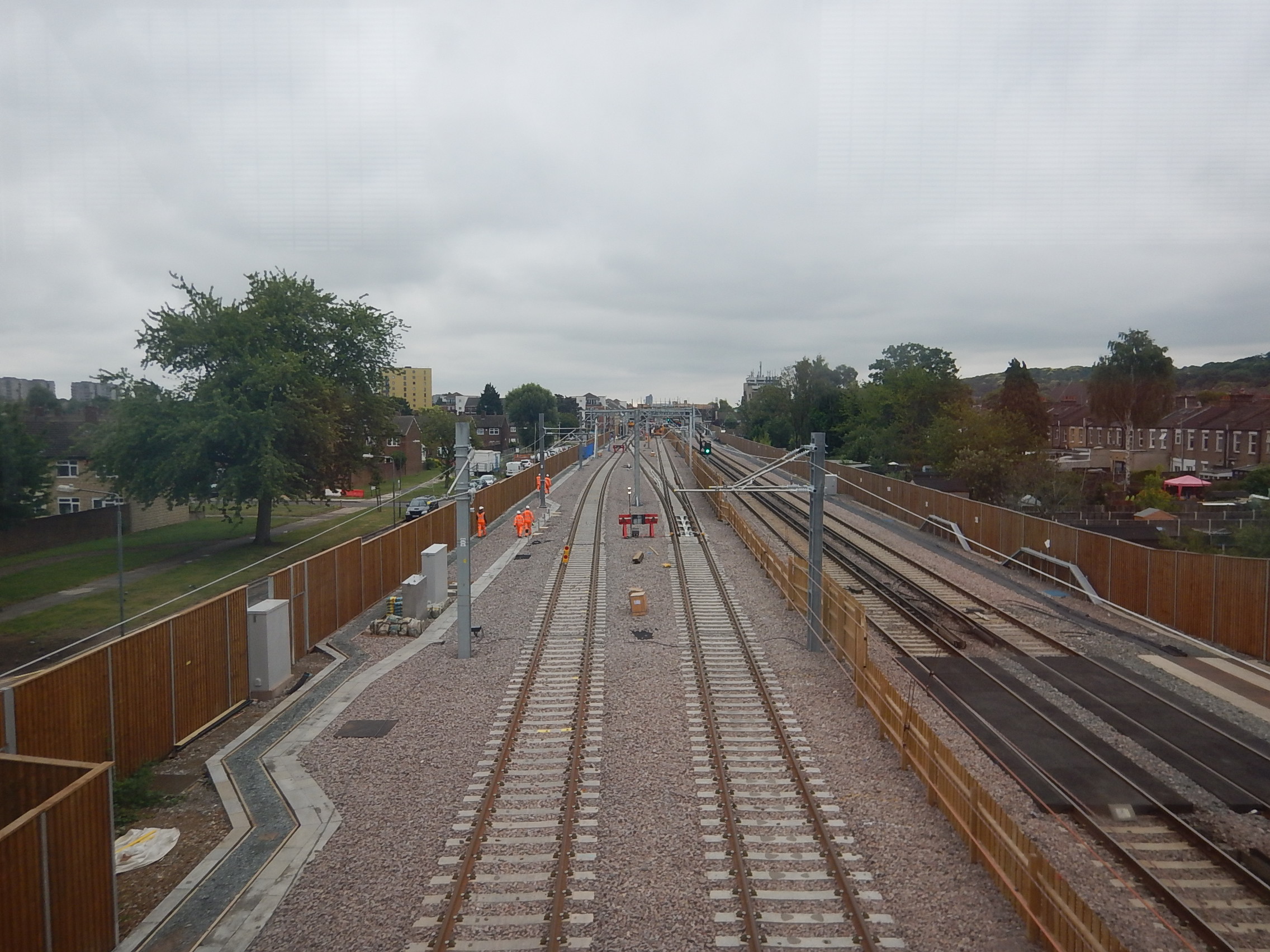
As the normal twelve trains per hour (tph) making up the service, will be using both platforms, cross-overs are provided to the West of Abbey Wood station, as is shown in this picture.
The system used at Abbey Wood will also be used at Shenfield.
Why Has The Reversing Siding Not Been Electrified?
In my view there can only be two explanations, if Modern Railways have got their picture caption right, which categorically said work was finished.
- My reconnaissance was wrong.
- Full electrification is not needed to reverse the trains.
On digging deeper, I took these four pictures at Abbey Wood station.


The pictures show in order.
- The overhead wires for Platform 4 fixed to the station building. Look under the top of the staircase.
- The overhead wires for Platform 3 passing under the station building.
- The overhead wires for Platform 3 passing under the station building.
- The overhead wires for Platform 3 anchored to a solid girder on the other side of the station building.
I couldn’t see the track layout because the wooden fence was in the way, but it would seem logical that the track through Platform 4 will eventually connect to the track through Platform 3.
This would allow the following.
- Trains arriving in Platform 4 to transfer to Platform 3 using the reversing siding.
- Crossrail trains to continue East on the North Kent Line using the single track and the crossovers to the East of the station.
- A failed train could be pushed into the reversing siding, which could probably accommodate two trains.
- Service and maintenance trains to access Crossrail’s Plumstead depot from the East.
But even if there is no connection, two independent platforms can handle the twelve trains per hour, as they will do at Shenfield.
What Service Will Eleven Class 345 Trains Provide On The Shenfield Metro?
This article in the International Railway Journal is entitled Crossrail Trains Enter Passenger Service.
This is the third paragraph.
In the initial phase of operation from Liverpool Street TfL Rail will operate 11 trains, which have been formed as 160m-long seven-car sets to cope with shorter platforms. All 11 of these trains will be in service by September, replacing pairs of class 315 EMUs, which date from the early 1980s. Some of these trains will be retained until the full Elizabeth Line service begins in 2019.
So it would appear that when these eleven trains are all in service, the Shenfield Metro service will be run by new Class 345 trains.
A Class 345 Train At Shenfield Station
These pictures show a Class 345 train at Shenfield station.


There’s still only one train running.
Note how the step-free access isn’t much better than the Class 315 train on the left.
Crossrail Expands Before It Opens
This is certainly something you don’t hear often about a new rail line.
This article in Global Rail News is entitled TfL To Order More Elizabeth Line Trains.
Four new Class 345 trains are being ordered, which will mean that in the Off Peak the following will happen.
- Trains between Whitechapel and Paddington will increase from 16 trains per hour (tph) to 20.
- Trains between Paddington and Shenfield will increase by two tph
- Trains between Paddington and Abbey Wood will increase by two tph
- Trains between Paddington and Reading will double from two tph to four.
- Trains between Paddington and Maidenhead will increase from four tph to six
- From December 2019, six tph will call at Heathrow Terminal 5.
So have Transport for London miscalculated the capacity of the line?
I suspect not!
It’s just that they wanted to be sure that the trains and the signalling can handle the frequency of twenty tph, before ordering the trains.
That has probably been ascertained by now thorough thorough testing.
This article on the BBC, is entitled Crossrail Stations In West London Delayed Until 2019.
I wonder, if this is within the float of these station builds, so that the whole project is not delayed.
Have Crossrail only announced the actual completion date, when it is certain it can be met?
If it is, these two apparently disconnected stories show Project Management at its best, where a project is delivered on the date agreed before as much as a humble spade had entered the ground.
- If it is late the client and the general public complain.
- It it is early, the construction team have probably spent too much money.
So hopefully, everybody’s happy!
I would love to see Crossrail’s schedule of announcements until December 2019.
Like the ordering of more trains mentioned in the first article, I suspect some will be pleasant surprises.
The first article also has this paragraph.
The increased service frequency will be achieved, in part, by replacing five Great Western Railway services with Elizabeth line trains.
So could we see Greater Anglia and Southeastern losing paths and becoming better integrated with Crossrail?
In Abbey Wood Station in my series of Kent On The Cusp Of Change posts, I said that it looks like the track layout allows trains to run on to Dartford, Gravesend or even Rochester, as other trains on a modern signalled North Kent Line.
At Shenfield station, provision has been made in the track layout for trains to continue from Platform 4 to Southend Victoria station and Greater Anglia trains already do it.at a frequency of three tph.
I don’t think it will happen, as the journey is too long for a train without toilets.
But if Platforms 4 and 5 at Shenfield were bi-directional, this would allow Crossrail trains to venture down the Southend Branch.
Kent On The Cusp Of Change – Abbey Wood Station
The Kent On The Cusp Of Change article in the July 2017 Edition of Modern Railways talks about Kent and Crossrail.
This is said.
In December 2018, the Elizabeth Line is due to reach its south-eastern terminus at Abbey Wood, where there will be interchange with the North Kent line.
A wide range of new journey opportunities will open up, which over time will influence many choices over work and home locations. A train every five minutes from Abbey Wood to Canary Wharf and central London is expected to have a dramatic effect in North Kent.
The article goes on to say that a working group called Crossrail Gravesend is pushing to extend the Elizabeth Line to Ebbsfleet International station for High Speed One.
In this post, I will talk about issues at Abbey Wood station.
The Modern Railways article says that Abbey Wood station is a cross-platform interchange, as do other articles.
Track Layout At Abbey Wood Station
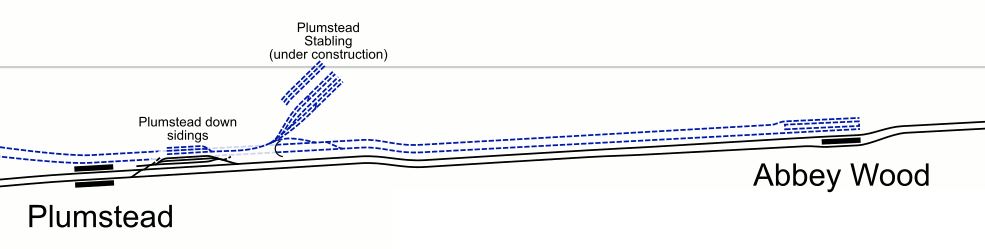
This map from carto.metro.free.fr shows the layout of lines at Abbey Wood station.
Compare this with this track layout, that I posted in Abbey Wood Station – 29th August 2016.
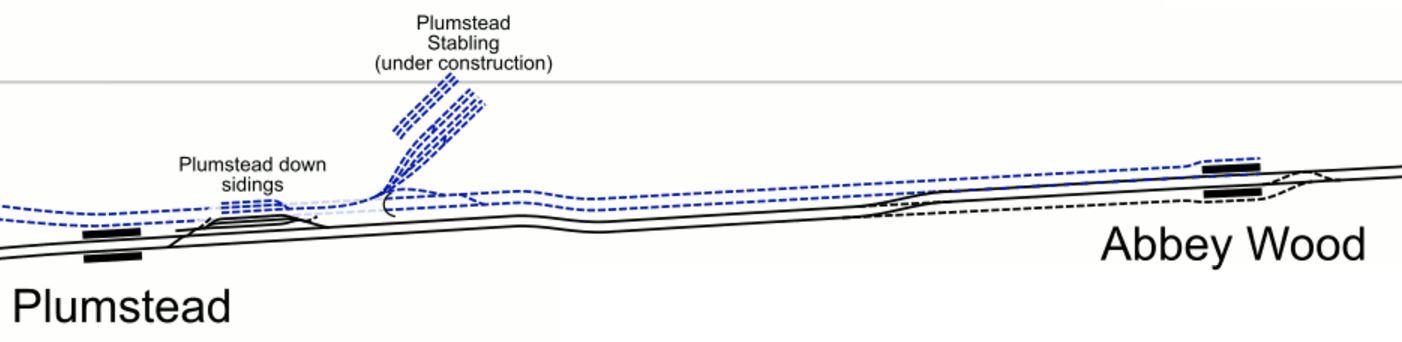
Note the following.
- The older layout shows cross-platform interchange.
- The current one has two pairs of platforms, with Platforms 3 and 4 for Crossrail and Platforms 1 and 2 for other services.
- The current layout probably connects better to the existing lines to Dartford.
These pictures were taken on the 28th June 2017 and show pictures generally taken from the West of the station.


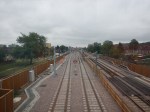


They show a similar layout, of two Northern platforms (3 & 4) for Crossrail and two Southern platforms (1 & 2) for all other services.
Note.
- The two cross-overs to the West of Abbey Wood station to get the Crossrail trains to and from the right platforms.
- The station building and the two footbridges over the lines.
- The solid wooden fence between the two pairs of lines.
- The robust nature of the overhead wiring.
I suspect, that if they had wanted to have Eastbound and Westbound lines each share an island platform, it would have required a flyover, which would have been a large expense.
These pictures were taken on the 10th July 2017 to the East of the station.
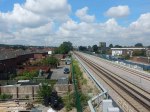
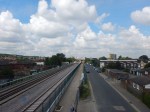

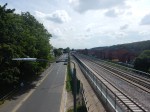
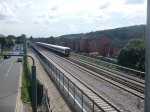
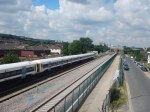


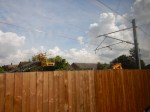

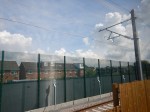


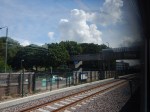

Note that the first seven pictures were taken from a public footbridge that crosses the tracks about five hundred metres to the East of Abbey Wood station and the last few pictures were taken from a train leaving Abbey Wood station for Dartford station.
This recent Google Map shoews from Abbey Wood station, to where the reversing siding ends close to where Aliske Road turns North
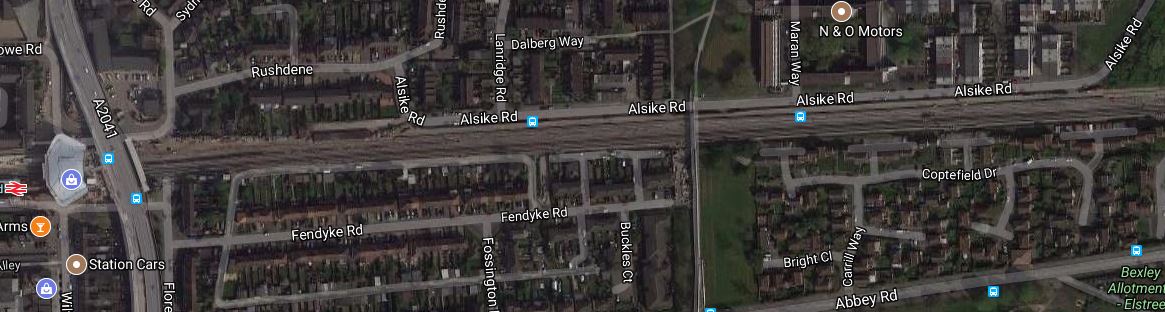
The pictures and the map show the following.
- The two third-rail electrified tracks of the North Kent Line run between Platforms 1 and 2 at Abbey Wood station to Belvedere station.
- The North Kent tracks are fully in use, by services between London and Kent.
- The two Crossrail Platforms 3 and 4 at Abbey Wood station are electrified with overhead wires.
- The two tracks in Platforms 3 and 4 would appear to join together into a single line mainly without electrification, that connects to the North Kent Line about a kilometre to the East of Abbey Wood station.
- There is only a short length of electrification to the East of the station.
It is not what I expected, as it means that there is no cross-platform interchange between services going to North Kent and Crossrail, as various sources including the The Kent On The Cusp Of Change article have said.
Passengers changing between the North Kent Lines and Crossrail will have to go over through the station or use the bridge.
So how will the station handle the various train movements?
Comparison Between Abbey Wood and Shenfield Stations
Abbey Wood will after rebuilding be a station with two North Kent and two Crossrail platforms
Shenfield station has now been converted into a station with six platforms, three of which can be used as Crossrail platforms.
In the Peak, services to the two stations are as follows.
- Shenfield – 10 trains per hour (tph)
- Abbey Wood – 12 tph
In addition 4 tph on the Shenfield Branch turn-back at Gidea Park station.
In the Off Peak, services to the two stations are as follows.
- Shenfield – 8 tph
- Abbey Wood – 8 tph
So it would appear that Abbey Wood is the harder station to operate with more services in the Peak and one less platform.
Train Stabling At Abbey Wood Station
Train stabling needs to be provided on a busy branch line, as it makes it easier to adjust the number of trains running to the demand throughout the day.
At Shenfield, the stabling sidings are beyond the station, which must be easier operationally, than the position of the sidings at Abbey Wood, where they are back down the line at the Plumstead tunnel portal.
If you look at the second set of pictures taken to the East of the station, spaqce would appear to be very limited. So is this why stabling is not ast of Abbey Wood station.
Turning Back Crossrail Trains At Abbey Wood
At Shenfield, train operators have been turning back Class 315 trains at a rate of six tph since 1980, so with the addition of a new platform and modern trains and signalling, the handling of ten tph should be achievable.
But at Abbey Wood in the Peak, there is a need to turn trains round at a rate of twelve tph or a train every five minutes.
The operation could involve each of Platform 3 and 4 handling six tph, using the cross-overs to the West of the station to get the train between each platform and the right Crossrail track, but handling six tph on two platforms feeding a 12 tph double track railway is a tough ask.
From what I have seen, I think that Crossrail will turnback their trains like this.
- All Crossrail trains from London arrive in Platform 4.
- All Crossrail trains to London depart from Platform 3.
- All trains arriving in Platform 4 use the unelectrified single track line as a reversing siding to get to Platform 3
- As the pictures show, the single track line is probably long enough to store a failed train, for later recovery.
But the Class 345 trains have a system called Auto-Reverse.
When the train is ready to leave Platform 4,the driver initiates an Auto-Reverse and the train moves automatically into the reversing siding, whilst the driver starts to walk back through the train to the other cab.
- By the time, the train is in the reversing siding, the driver is ready to drive the train into Platform 3.
- The process will have to be done within five minutes.
- The process could also involve the basic cleaning and removal of rubbish, with cleaners getting on at Platform 4 and getting off at Plstform 3.
Crossrail is not your bog-standard railway.
Trains Leaving Service At Abbey Wood
Suppose a train was leaving service at Abbey Wood.
Normally, it would probably perform the Auto-Reverse and go to the stabling sidings at the Plumstead tunnel portal.
It might even go the wrong way directly out of Platform 4, if the signalling was bi-directiomal.
Remember too, that Class 345 trains could be two independent half-trains, so if one half fails, the other could be designed to get the train to safety and out of the way.
Class 345 trains are not a bog-standard trains.
Running Crossrail Trains To And From Gravesend
From what I have seen, I’m convinced that the track layout at Abbey Wood station, means that Crossrail can be easily extended to and from Dartford, Gravesend, Rochester, Gillingham or Rainham.
Let’s assume the terminal for four tph is Gravesend.
Crossrail trains from London to Gravesend will do the following.
- Stop in Platform 4 at Abbey Wood station.
- Lower the pantograph
- Take the single uon-electrified line alongside the North Kent Line.
- Cross over to the Down North Kent Line.
- Use the third-rail electrification to travel to Gravesend.
Crossrail trains from Gravesend to London will do the following.
- Use the third-rail electrification to travel from Gravesend.
- Cross over to the single non-electrified line alongside the North Kent Line before Abbey Wood station.
- Stop in Platform 3 at Abbey Wood station.
- Raise the pantograph.
The Crossrail trains would be needed to be fitted with third-rail shoes.
Interchange BetweenThe Extended Crossrail And Other Services.
Suppose you are going from Ramsgate to Paddington, you would get a Highspeed service to Gravesend and then wait for a Crossrail train to call at the same platform.
To repeat myself, Crossrail is not a bog-standard railway.
Crossrail’s Trump Card
When the trains turnback at Abbey Wood or extend to and from Gravesend, the Class 345 trains will have to use the non-electrified single track line shown in the pictures.
It may be electrified in the next year! But why bother?
The distances that need to be handled without power are not much more than a kilometre at slow speed.
The Class 345 trains could be fitted with batteries to bridge the gaps in the electrification.
These batteries will also do the following.
- Handle regenerative braking.
- Provide emergency power, in the event of complete tunnel power failure.
Conclusion
To repeat myself again, Crossrail is not a bog-standard railway.
See Also
These are related posts.
- Ashford Spurs
- Crossrail
- Elimination Of Slow Trains
- Fawkham Junction Link
- Highspeed Routes
- High Speed To Hastings
- Historic Routes
- Longfield Station
- Maidstone
- Reading To Tonbridge
- Thameslink
- Thanet Parkway Station
- Track Improvements
- Ultimate Class 395 Train
- Victoria As A Highspeed Terminal
To know more read Kent On The Cusp Of Change in the July 2017 Edition of Modern Railways.
Gibb Report – Depot Issues
The Gibb Report, looks in detail at GTR’s depot capacity and especially the stabling for Thameslink.
The section on depots starts like this.
The way in which the train fleet has expanded in recent years has resulted in a shortage of stabling facilities. New facilities have been located away from train crew depots (e.g. Hove from Brighton) and are less efficient, involving driver time in taxis. Siemens new depot at Three Bridges is now the main centre for the Thameslink fleet, and overall the depot capacity on Southern is just about sufficient from what I have seen, although it is inflexible and inefficient.
It then goes on to list problems at specific locations.
Ashford
Perhaps the late choice of Maidstone East station, as a terminus, has meant that a site hasn’t really been found for a depot at Ashford.
Bedford
The depot is unsuitable for 12-car fixed formation Class 700 trains, which block the entrance.
Cambridge
The facility is currently unsuitable for 12 car fixed formation trains and the current trains have to be uncoupled to be accommodated.
North Kent
The original plan was to increase stabling facilities at Slade Green, but this has now been established to cost £72m and too expensive. An alternative is urgently needed.
The report sums up the depot issues like this.
All of the above issues need to be finalised before the driver recruitment plans can be commenced, as the driver recruitment strategy must be decided around the stabling locations of the trains, and driver depot facilities, including parking, must be included in the scheme
implementation.
It also goes on to say, that more trains may need to be ordered to increase capacity on the Brighton Main Line and that a new depot will be needed.
Bombardier’s Class 345 Trains For Crossrail
Before I add my fourpennyworth on depot issues, I will look at some of the features of Bombardier’s Class 345 trains.
All Trains Are The Same Length
It is intended that all trains will be the same nine-car length, although at the present time, the trains under test in East London are a couple of cars short of a full train.
This is mainly because the platforms in Liverpool Street, are not long enough for a full train and won’t be lengthened until a year or so.
I suspect too, it enables Bombardier to build the trains in a more efficient manner and test out each type of coach fully.
One of the advantages in having all trains of the same length, is that you maximise the capacity in a depot and as on both routes, the manufacturer pays for the main depots, a correctly-sized depot will reduce costs.
Note that Thameslink’s main depots don’t seem to have issues, so can we assume they were well-designed?
The Class 345 Trains Have No Toilets
There was a bit of a fuss, when this was announced, as I wrote about in Do Crossrail Trains Need Toilets?.
But given that many Crossrail stations have toilets on the platforms and trains are every ten minutes, no toilets on the train gives advantages.
- There is no toilet on the train that needs regular cleaning and fails occasionally.
- Overnight servicing of the train does not need the toilet to be emptied.
I also suspect that the modular nature of the Class 345 train would allow one to be fitted if required.
Class 345 Trains Are Designed For Remote Wake-Up
Remote wake-up is discussed in Do Bombardier Aventras Have Remote Wake-Up?.
So imagine a Class 345 train finishes its last journey of the day in a platform at Shenfield station or a convenient stabling siding.
- The driver checks the train for sleeping bankers, locks up and goes home.
- The train reports to Ilford, that a couple of light bulbs have failed.
- The servicing and cleaning team arrive and get the train pristine for the morning.
- The train shuts down fully and all power is switched off to the overhead wires, so trespassers won’t be electrocuted.
- At an appropriate time, the train is signalled to come to life and warms up ready for the day, using battery power.
- The driver arrives and when signalled joins the main line, raises the pantograph and takes the train on its way.
When I once described this process to a driver from Northern going to pick up a Class 156 train in Halifax, he had a big smile.
In some ways, it’s a bit like parking your car out on the street.
- Except that for trains, you need a convenient piece of track.
- As power will be needed to warm the train up in the morning and you don’t want 25 KVAC live wires about, the only source of power possible is a battery.
- If the train had a toilet, it would be a more complicated process.
What will the devious Derbians think of next?
Solving GTR’s Depot Problems
In my view there is one big difference between Thameslink and Crossrail.
With Crossrail, which was in part a new railway line, every component was designed so it fitted together like a giant three-dimensional jigsaw.
But Thameslink was designed by different teams over a series of decades.
As we can’t go back to square one on Thameslink we have to make the best of what we’ve been left with.
Bombardier’s remote wake-up concept is a straight steal from some upmarket road vehicles, so why haven’t Siemens stolen it? Especially, as the Derby Telegraph article dates from June 2011. Perhaps, their press cuttings agency doesn’t read that newspaper?
If they had developed the technology, it would certainly help with remote stabling of trains, as you can have a much simpler facility.
The Problem Of Cambridge
I discuss this in Cambridge Depot
The Problem Of North Kent
Chris Gibb suggest creating a new depot at Hoo Junction, which I discuss in Hoo Junction Depot
Thameslink’s Mixed Length Fleet
Thameslink also have a curious mix of eight-car and twelve-car trains, whereas Crossrail have sensibly opted for a common length, which as I said, must be much easier to store.
Intriguingly, both Greater Anglia and South Western Railway have ordered mixed fleets of five and ten-car Aventras. But most six-year-olds can tell you that 5+5=10.
The decision to buy a mixed length fleet of twelve and eight-car trains for Thameslink has caused a lot of these depot and a few other problems.
I wrote more about the problem in Has Thameslink Got The Wrong Length Of Train?.
I think in the end, Thameslink will lengthen the eight-car trains to twelve-cars and then lengthen the short platforms on the Sutton loop Line and a few other places.
This would create sixteen per-cent more capacity through the central tunnel, by making all trains twelve-cars.
But that is an expensive way to solve the problem created by not designing Thameslink as a continuous twelve-car railway.
Conclusion
It’s a bloody-great mess.
If you compare depot philosophies at Crossrail, Greater Anglia and Thameslink, the first two companies seem to have developed a comprehensive purchase and maintenance solution for all their new trains, whereas Thameslink have worked on the basis that it will be alright in the end.
These factors don’t help Thameslink.
- The choice of a mix of eight- and twelve-car trains.
- The inability to join two short trains together to make a long train.
- The design of a Class 700 train, which appears to be geared more towards a traditional depot.
I will be accused of being patriotic, but having ridden in both Class 700 and Class 345 trains, I’m coming to the conclusion, that Thameslink should have bought Aventras.
I would also have to ask, if Krefeld in Germany is a better place than Derby, for decision makers to visit.
The Class 345 Train Has An Updated Information Display
Bombardier have updated the information display on the Class 345 train, that I rode on the The 10:35 From Liverpool Street To Shenfield.
In that post I said this about the Information.
The current on-train information is simple, but then as I suspect the screens are software driven, any degree of required complication can be added.
I don’t know whether it is deliberate but everything is large and easy to read. There is also no maps or exhortations about security.
Long may it stay that way!
Simple is efficient!
So it looks like a new version of the software has been installed.
These pictures show the new display.


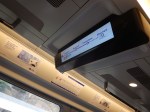
I wonder what the final version will be like.
I hope it’s not to fussy or full of advertising.
Will London Build Any More New Tube Lines?
In this post, by Tube, I mean one of London’s narrow-bore Underground lines like the Bakerloo, Central, Jubilee, Northern, Piccadilly and Victoria Lines.
Tube Lines And Crossrail
Yesterday, I rode a Jubilee Line train and after The 10:35 From Liverpool Street To Shenfield, it struck me as a cramped experience.
As I got up to leave from one of the areas of the train with metro-style seating along the train sides, I tripped all over everybody else’s feet.
Compare this to the Class 345 train on Crossrail.
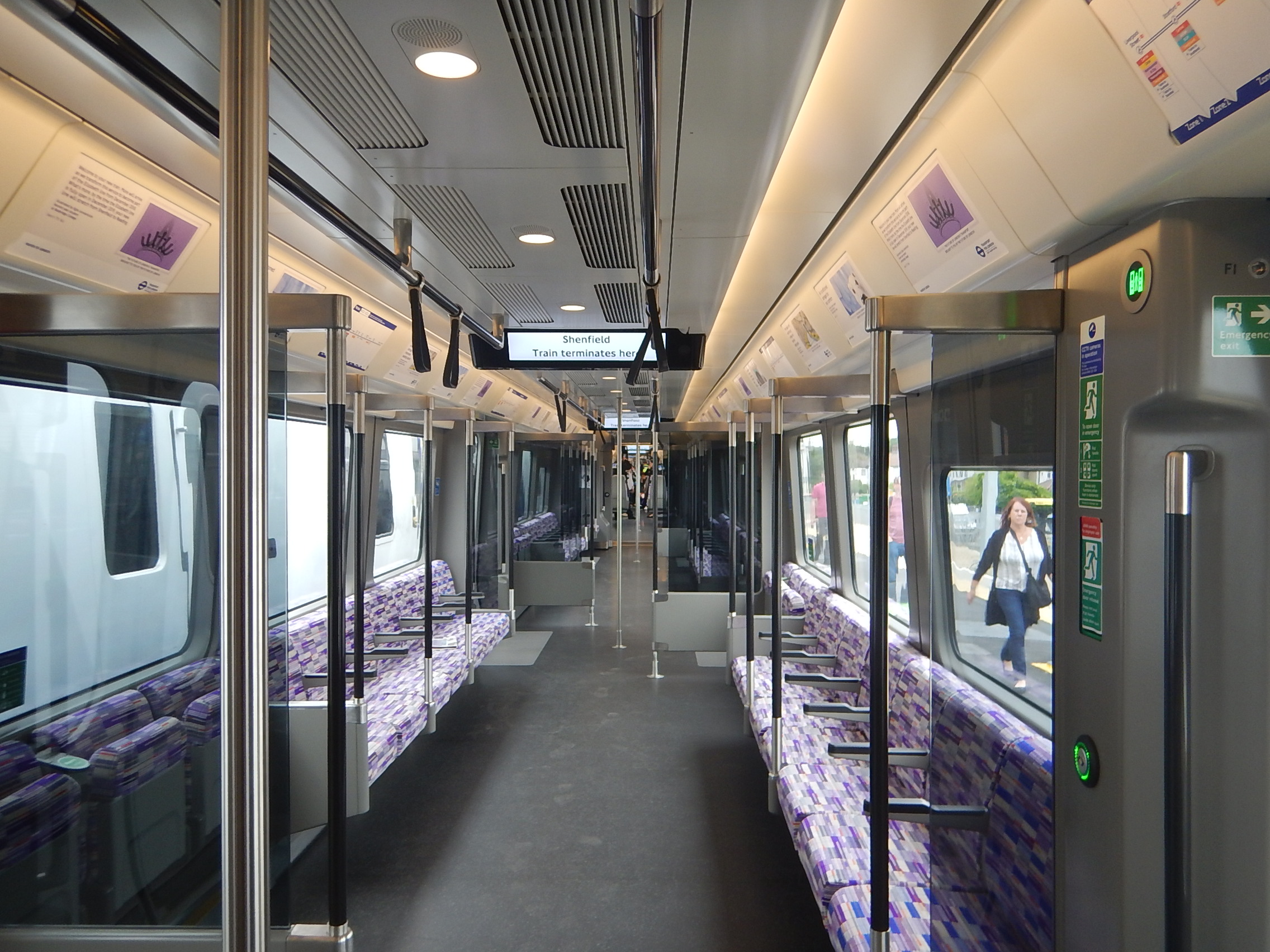
You could seat basketball players either side and they’d have difficulty playing footsie, given the width of the train.
Note too the space under the seats for their kit.
And then there is the air-conditioning, which of course the Tube lines don’t have.
So what is the point of building new narrow-bore Tube lines under London? Especially, as I doubt the cost of a line is much less than the wider-bore Crossrail on a per kilometre basis.
Build extensions to existing Tube lines, by all means, as these probably have a better economic case.
The Bakerloo Line Extension
This is a portion of London’s famous Tube Map.
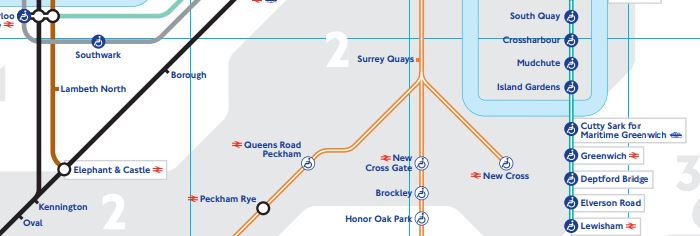
The Bakerloo Line Extension runs between the following stations.
- |Elephant and Castle
- Burgess Park
- Old Kent Road
- New Cross Gate
- Lewisham
It is a simple scheme to put new transport infrastructure into South-East London.
Conclusion
I doubt, we’ll see a complete new Underground line in London, built to the narrower-bore of the Tube.
The 10:35 From Liverpool Street To Shenfield
I took these pictures on the untimetabled 10:35 TfL Rail service between Liverpool Street and Shenfield stations and on the return to Liverpool Street.


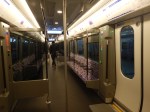


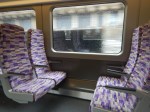
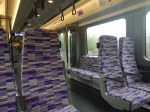

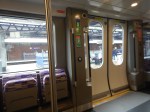


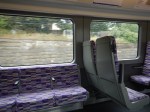
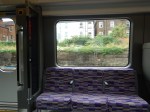


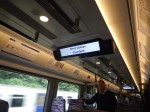


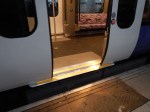

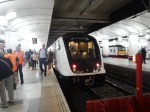
As you can see it is a new Class 345 train.
There were a lot of Crossrail and Transport for London staff about, talking to passengers.
These are my thoughts on various issues.
Ride Quality
This is up with the best or the legendary British Rail Mark 3 coach, which was designed in the 1960s.
One of the Crossrail staff was wearing stiletto heels close to four inches and she was walking up-and-down with no difficulty.
For someone who suffered a bad stroke, my balance is good and I had no difficulty walking along the seven-car train.
Cabin Height And Width
I don’t know how Bombardier have done it, but the cabin seems higher and wider than any other train I’ve ridden in the UK.
Next time, I ride one, I’ll take a couple of tall guys and a tape measure.
Information
The current on-train information is simple, but then as I suspect the screens are software driven, any degree of required complication can be added.
I don’t know whether it is deliberate but everything is large and easy to read. There is also no maps or exhortations about security.
Long may it stay that way!
Simple is efficient!
Seats
Not everybody was completely satisfied with the seats, but I found them much more comfortable than those in the Class 700 trains on Thameslink.
There were some good points.
- The sets of four seats were arranged as they were in the original InterCity 125 around a large window.
- The metro-style seating had a wide aisle in the middle, that would satisfy a basketball team.
- An amply-proportioned man, thought the seats comfortable.
- Most seats had well-designed armrests.
- There was plenty of space under the seats for airline-size carry-on baggage or a labrador.
On the other hand, there were no cupholders, tables or litter bins. But there aren’t any on the Class 378 trains or London Underground‘s S Stock.
Entry And Exit
I feel that trains should be a level step across from the platform.
This train wasn’t as good as a Class 378 train on many Overground stations, but it was better than some.
As many Crossrail stations will be one train type only there is probably scope to get this better.
I regularly see a lady in a simple wheel-chair on the Overground and I feel she would probably be able to wheel herself in and out, which she does at Dalston Junction station with ease.
It should be noted that each coach has three sets of wide double doors and a large lobby, so perhaps a mother with triplets and a baby in a buggy would find entry easier than any train on the Underground.
Walking Up And Down The Train
I found this very easy on a train that was no more than a third full, as it was an extra service to introduce the train to passengers.
There were numerous hand-holds and vertical rails in the centre of the lobbies. Unlike on some trains in France, Italy or Germany, the rails were very simple. They also borrowed heavily from the Overground’s Class 378 trains.
Wi-Fi And 4G
I didn’t try the wi-fi, as it is not something I use very often.
But I was getting a strong 4G signal all the way to and from Shenfield. Was this direct or was I picking up a booster in the train? I suspect it was the latter at some points close to Liverpool Street.
Windows
The windows on the train are large and well-positioned.
The simple seat and window layout, seems to appeal to all classes of rail user.
A Train For Families
When Celia and I had three children under three, with two able to toddle-along (they had too!) and the youngest in his McClaren, I could imagine us taking a train from Barbican station to perhaps go shopping on Oxford Street, sitting in one of those set of four seats by that large window.
A Train For Commuters
The Class 378 trains of the Overground cram them in and the metro layout of much of the Class 345 train will accommodate large numbers of commuters.
I would question, if there are enough seats, but the proof should be apparent by the end of the year, as eleven of the current seven-car trains will be in service between Liverpool Street and Shenfield.
For the full Crossrail service, they will be lengthened to nine cars and there is a possibility of adding a tenth.
A Train For Shoppers
If say, I’d been to Eastfield at Stratford and was coming back to Moorgate heavily loaded with shopping to get a bus home, I could probably put some bags under the seat. Try that on the Underground!
A Train For The Not-So-Young
From what I saw today, I couldn’t make too many observations, as the train wasn’t crowded, but the few older travellers that I did see were smiling at the experience.
A Train For The Disabled
As I’m not disabled, I can’t comment and would love to hear from those who are.
A Train For The Tall
Compared to other trains in London, the headroom seemed to be generous, but then I didn’t see anybody who was much more than six foot.
A Train For The Airport
Class 345 trains will serve Heathrow Airport. I feel they will cope, as the metro layout of the Class 378 trains, seems to accommodate large cases well!
Comparison With A Class 700 Train
The Thameslink Class 700 trains are designed for running over a longer distance at a higher speed and they have toilets.
But for a thirty minute journey through a busy part of London, there is no doubt in my mind, as to which train I would choose.
The Class 345 train, with its large windows, more comfortable seating, space for bags, uncluttered views and the appearance of more space, is undoubtedly in my view a better designed train.
Incidentally, for every metre of a nine-car Class 345 train, 7.31 passengers can be accommodated, as opposed to 7.07 in an eight-car Class 700 train.
I think we can put all this comparison down to Derby 1 – Krefeld 0!
Comparison With A Class 387 Train
The trains will be compared with Bombadier’s last Electrostar, the Class 387 train, which will be in service with GWR between Paddington and Reading, alongside the Class 345 train.
Passengers will be able to take whichever train they want on this route.
Will they choose the Class 387 train, with its tables, very comfortable seats and toilets or the Class 345 train?
I’d choose the Class 387 train, as I like to lay out my newspaper for reading.
No matter what happens Derby wins again.
Moving Forward On Approach To Liverpool Street
I was surprised how many people walked to the front as we approached Liverpool Street.
But were they only demonstrating the Londoners’ ducking and diving ability of getting to the right place for exit.
Regular passengers on regular routes will anticipate their stops and I will be interested to see how much passenger behaviour increases the capacity of the train.
Conclusion
This first Aventra feels like it is a very good train.
Consider how Bombardier improved the Electrostar since it was first produced in 1999.
So what will an Aventra be like in 2035?
 The Anonymous Widower