Riding Sunbeams Deploys Solar Array
The title of this post is the same as that of this article on Railway Gazette.
These are the introductory paragraphs.
Riding Sunbeams Ltd has installed a 30 kWp solar test unit with around 100 panels near Aldershot which is directly supplying electricity to power signalling and lighting on Network Rail’s Wessex Route.
This will enable data to be gathered to assess how much larger solar arrays could be used to power trains.
Note that kWp is peak kW. On a very sunny day, 30 kW is the highest power level that will be supplied.
This page on the Energy Saving Trust is entitled Costs and Saving and this is said.about solar generation in the South of England.
A 4kWp system in the south of England can generate around 4,200 kilowatt hours of electricity a year – that’s the same amount of electricity as it takes to turn the London Eye 56 times. It will save around 1.6 tonnes of carbon dioxide every year.
For comparison, they say this about solar generation in Scotland.
A 4kWp system in Scotland can generate about 3,400 kilowatt hours of electricity a year – that’s the same amount of electricity as it takes to turn the Falkirk Wheel 2,200 times. It will save approximately 1.3 tonnes of carbon dioxide every year.
I’d be interested to know, the two locations, where they measured the sunlight.
It was a lovely sunny day recently, when I passed through Aldershot station, so I’ll use the Southern England figures.
- Uprating the Energy Saving Trust figures by 30/4 gives a yearly output of 31,500 kWh,
- The daily output is 86.3 kWh.
- The hourly output based on a 0600-2200 sixteen hour day is 5.4 kWh
There would probably be a battery to make the most of the electricity generated.
Powering Feeder Stations For Third-Rail Electrification
As the Railway Gazette article says, the trial installation at Aldershot station will be used to power signalling and the station, which will then give figures to assess how trains can be powered.
In the September 2017 Edition of Modern Railways, there is an article entitled Wires Through The Weald, which discusses electrification of the Uckfield Branch in Sussex, as proposed by Chris Gibb. This is an extract.
He (Chris Gibb) says the largest single item cost is connection to the National Grid, and a third-rail system would require feeder stations every two or three miles, whereas overhead wires may require only a single feeder station for the entire Uckfield Branch.
It would appear that 750 VDC rail-based direct current electrification needs many more feeder stations, than 25 KVAC overhead electrification.
Could a solar system from Riding Sunbeams supply power in the following situations?
- Places where there was space for a solar array.
- Remote locations, where a connection to the grid is difficult.
- Places, where the power supply needed a bit of a boost.
How large would an individual solar feeder station need to be?
Consider a feeder station on a rail line with these characteristics.
- Third-rail electrification
- Four-car trains
- Each train uses three kWh per vehicle mile.
- Two trains per hour (tph) in both directions.
- Electrification sections are three miles long.
- Trains run from six in the morning to ten at night.
- Trains pass at speeds of up to 100 mph.
The hourly electricity need for each section would be 144 kWh or 2304 kWh per day and 841 MWh for the whole year.
The Energy Saving Trust says this.
A 4kWp system in the south of England can generate around 4,200 kilowatt hours of electricity a year.
Using these figures says that a solar array of 800 MWp will be needed to provide the power for one feeder station.
Consider.
- The largest solar array in the UK is Shotwick Solar Farm, which has a capacity of 72 MWp.
- Shotwick covers 730 acres.
Am I right to question if that enough electricity to create a feeder station to power trains, can be produced reliably from a solar array and a battery?
I’d love to have the electricity usage and bill for one of Network Rail’s typical third-rail feeder stations. Not that I’d want to pay it!
How Would Station Stops Be Handled?
When a modern electrical multiple unit stops in a station, there is a three-stage process.
- The train decelerates, hopefully using regenerative braking, where the braking energy is returned through the electrification to hopefully power nearby trains.
- The train waits in the station for a minute or so, using power for air-conditioning and other hotel functions.
- The train accelerates away using track power.
Would a Riding Sunbeams system provide enough capacity to accelerate the train away?
In What Is The Kinetic Energy Of A Class 710 Train?, I calculated the kinetic energy of a very full Class 710 train, which is just about as modern and probably efficient, as you can get.
These were my results.
- 50 mph – 15.3 kWh
- 60 mph – 22.1 kWh
- 90 mph – 49.4 kWh – Operating speed of a Crossrail Class 345 train.
- 100 mph – 61.3 kWh – Operating speed of many electric multiple units.
These kinetic energy values are low enough to make it possible that a modern electric multiple unit can run using on-board batteries.
- Regenerative braking would be captured in the batteries.
- Hotel power in the station can be provided by batteries.
- Batteries can cruise the train through sections of line without electrification or with a poor electrical supply.
Suppose there is a twenty mile gap between two stations; A and B, where trains cruise at 90 mph.
- The train arrives at station A, with a battery that has been charged on previous parts of the journey from the electrification.
- Regenerative braking energy will be stored in the battery on braking.
- Acceleration to 90 mph will need 49.4 kWh of electricity from the battery.
- Using my 3 kWh per vehicle mile figure, going from A to B, will need 4 cars * 20 miles * 3 = 240 kWh of electricity.
It looks like a battery with a capacity of 300 kWh would handle this situation
Could this be fitted into a four-car train, like an Aventra?
In this article in Global Rail News from 2011, which is entitled Bombardier’s AVENTRA – A new era in train performance, gives some details of the Aventra’s electrical systems. This is said.
AVENTRA can run on both 25kV AC and 750V DC power – the high-efficiency transformers being another area where a heavier component was chosen because, in the long term, it’s cheaper to run. Pairs of cars will run off a common power bus with a converter on one car powering both. The other car can be fitted with power storage devices such as super-capacitors or Lithium-ion batteries if required. The intention is that every car will be powered although trailer cars will be available.
Unlike today’s commuter trains, AVENTRA will also shut down fully at night. It will be ‘woken up’ by remote control before the driver arrives for the first shift
This was published over eight years ago, so I suspect Bombardier have refined the concept.
If 424 kWh can be fitted under the floor of a two-car Class 230 train, I’m sure in a train designed for energy storage at least 500 kWh or maybe as high as 1000 kWh could be fitted to a four-car Aventra.
A 500 kWh battery would give a battery range of just under forty miles, whilst a 1000 kWh battery would give a ninety-five mile range.
Obviously, the battery would need to be charged, but in many cases the range would take the train between two existing electrified lines. Think Ipswich -Cambridge, Newcastle-Carlisle, the Fife Circle Line, the Uckfield Branch and Ashford-Hastings!
Conclusion
Riding Sunbeams may be suitable for providing local power for signalling and stations, but batteries on trains looks like it could be a better way of powering trains.
The London Overground Is Still Running Four-Car Class 378 Trains
This picture shows the three spare cars, that were taken from three five-car Class 378 trains to make them short enough to work the Gospel Oak to Barking Line.

I would have thought that the trains would have returned to their full length, but they have been put into service on the Watford DC Line.
Perhaps, London Overground want to keep them at four-cars, as a precaution against a serious bug in the Class 710 train’s computer system.
Only when the Class 710 trains are behaving impeccably will the full length be restored.
Trains On The Watford DC Line
As it is, the services on the Watford DC Line are being changed from three x five-car trains per hour to four x four-car trains per hour.
This is roughly the same number of cars per hour, but at a higher frequency.
According to Wikipedia seven Class 710 trains are needed for the full service.
The Coolest Trains In London
It was hot in London today, so I thought I’d investigate how well the New Class 710 trains on the Gospel Oak to Barking Line.
I did the following journeys.
- A 141 bus from my house to Harringay Green Lanes station.
- A Class 710 train between Harringay Green Lanes and Gospel Oak stations.
- A Class 710 train between Gospel Oak and Blackhorse Road stations.
- A Victoria Line train between Blackhorse Road and Highbury & Islington stations.
- A Class 707 train between Highbury & Islington and Moorgate stations.
- After doing some shopping, I took a 141 bus to my home.
I took these pictures on the route.
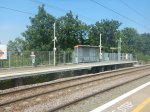
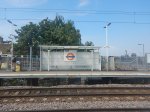
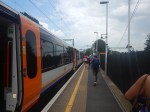
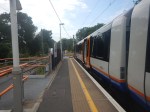

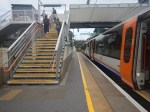
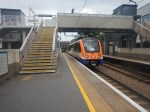
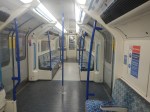
Some observations.
Passengers Towards Gospel Oak Weren’t Numerous
The train going to Gospel Oak station wasn’t very full, wil only about half the seats taken.
The Train From Gospel Oak Was Packed
It was rather different going back, as every seat on the train was taken and there were passengers standing.
The Seats And Air In The Train Were Comfortable
I would certainly recommend a trip in a Class 710 train on a hot day, as a means to cool off.
Let’s hope that all the other classes of Aventras have the same quality of air-conditioning.
The Victoria Line Wasn’t Busy
The air and temperature ion the Victoria Line wasn’t bad, but it wasn’t of the same quality as the Class 710 train.
But the trip made me think that passengers avoid the deep tube in hot weather.
Class 707 Train To Moorgate
I used the cross-platform interchange at Highbury & Islington station to switch to a Class 707 train, running a Great Northern service to Moorgate station.
The air-conditioning was working well and the two other passengers remarked that it was good in this hot weather.
It’s a pity that these trains have ironing-board seats.
Will These Trains Cut Crime?
When I moved to Dalston in 2010, the service along the North London Line was just being launched and wasn’t fully running until May 2011.
Dalston was the haunt of aimless youth and it wasn’t the best place to live.
Nine years on and it has all changed.
The youths have disappeared and the perceived threat of crime seems down. So where have they all gone?
From stories I have heard, public transport has improved so much, that a large proportion of the youths, have discovered something better to do! It’s called work.
- New Class 378 trains
- North London Line trains have gone from four trains per hour (tph) to eight.
- East London Line trains didn’t exist in 2010 and are now sixteen tph.
- There are several fleets of new buses.
- Increases in train frequencies are planned.
Dalston is now a much better place to live.
The new Class 710 trains will soon be running on the following routes.
- Gospel Oak to Barking Line
- Liverpool Street to Cheshunt
- Liverpool Street to Chingford
- Liverpool Street to Enfield Town
And the new Class 707 trains will soon be running on the following routes.
- Moorgate to Hertford East
- Moorgate to Stevenage
- Moorgate to Welwyn Garden City
Most new trains will be in service by the end of this year.
The following will be delivered.
- More capacity
- Increased frequencies
- Better comfort
- Wi-fi and power sockets
- On-train CCTV
A lot of the previous ancient trains will be scrapped.
Will the new trains cut crime and the perception of crime in the areas of North-East London, that they serve.
It is too early to tell, but good public transport has had a remarkable affect on Dalston.
So will the same thing happen in Enfield, Hasringey and Wathamstow?
Conclusion
I wonder how many people with a Freedom Pass like me are cooling off in this weather by using these and other trains.
Class 710 Train Roofs At Blackhorse Road Station
I took these pictures at Blackhorse Road station.


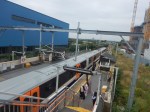



I couldn’t spot any resistor banks on the roofs, that could be used to burn off excess energy, that is generated by regenerative braking.
Consider.
- The roofs do have a rather clean aerodynamic look.
- I’ve never seen resistor banks placed anywhere other than on the roof of a train.
- Regenerative braking must either return the energy through the electrification or store in in some form of onboard energy storage.
It looks to me, that Bombardier have designed a very efficient train.
Ride Quality In Class 345 And Class 710 Trains Compared
Yesterday, I had rides in two different Bombadier Aventras.
- Two Class 710 trains on the Gospel Oak to Barking Line.
- Three Class 345 trains on Crossrail.
Both have a smooth ride, that we come to expect from modern trains.
But my bottom was telling me, that the ride on the Class 710 train was smoother.
I have read somewhere, that the train control system on the Class 345 train is a version of the MITRAC system used on many of Bombardier’s earlier trains and trams, which was certainly used on Class 379 trains.
As has been widely reported, Bombardier are introducing a new Train Management and Control System on the Class 710 trains.
They have also had a lot of trouble getting it to work properly.
If I am right about the ride being smoother, could it be that the new TMCS, has much better control of the traction motors and their power supply?
In The Formation Of A Class 710 Train, I stated that the formation of a Class 710 train is as follows.
DMS+PMS(W)+MS1+DMS
Note that all cars have motors, which must increase the smoothness of acceleration and braking.
But then Class 345 trains have lots of motors too!
In this article in Global Rail News from 2011, which is entitled Bombardier’s AVENTRA – A new era in train performance, gives some details of the Aventra’s electrical systems. This is said.
AVENTRA can run on both 25kV AC and 750V DC power – the high-efficiency transformers being another area where a heavier component was chosen because, in the long term, it’s cheaper to run. Pairs of cars will run off a common power bus with a converter on one car powering both. The other car can be fitted with power storage devices such as super-capacitors or Lithium-ion batteries if required. The intention is that every car will be powered although trailer cars will be available.
Unlike today’s commuter trains, AVENTRA will also shut down fully at night. It will be ‘woken up’ by remote control before the driver arrives for the first shift
This was published over eight years ago, so I suspect Bombardier have refined the concept.
Note this phrase.
The other car can be fitted with power storage devices such as super-capacitors or Lithium-ion batteries if required.
Could the Class 710 train be the first Aventra to take advantage of energy storage devices to provide a smoother power supply to traction motors?
The trains could be serial hybrids, like London’s Routemaster buses.
In a serial hybrid vehicle, the following happens.
- The power supply charges the energy storage device.
- The energy storage device provides power to the traction motors
- On braking, the traction motors use regenerative braking and the electricity generated is stored in the energy storage device.
- Power to provide services for the train comes from the energy storage device.
It is a very efficient system, which also has other advantages.
- The train can move for a short distance without external power.
- When the power supply is diesel, it doesn’t need to be run in sensitive areas, like stations.
- Depots and sidings don’t need to be electrified, which increases safety.
- As the extract said earlier, trains can have a remote wake-up capability.
The energy storage device between the power source and the traction system would have the effect of smoothing power fluctuations in the supply.
Energy storage devices also have a very low impedance.
- When the driver asks for maximum power, the energy storage devices can give all they’ve got immediately.
- When the driver applies the brakes, if they’ve got space, the energy storage devices, will lap it up the energy like a pack of thirsty hounds.
I have no proof, that Class 710 trains are serial hybrid trains, but I think there’s more than a good chance they are.
The trains run very smoothly, with good acceleration and smooth braking.
Perhaps, because the Class 345 trains were designed and built earlier, they had to use the less sophisticated MITRAC control system.
What Size Is The Energy Storage Device On A Class 710 Train?
In What Is The Kinetic Energy Of A Class 710 Train?, I calculated the energy of a Class 710 train.
I calculated the figures for a train with 700 passengers, each weighing 90 Kg for different speeds.
- 90 mph – 49.4 kWh – Operating speed of a Crossrail Class 345 train.
- 100 mph – 61.3 kWh – Operating speed of many electric multiple units.
Note that the amount of energy is proportional to the square of the speed.
As the energy storage device must be able to capture all of the braking energy if a train is trundling around North London, I would suspect that two fifty kWh batteries would be more than enough!
But a good control algorithm might cut this considerably!
A total of 100 kWh, would certainly be possible to put under a train, and could be a mix of the following.
- Fast response supercapacitors.
- High capacity lithium ion batteries or similar.
This is not an unknown combination on a battery-electric train or tram.
Conclusion
Supercapacitors could be the reason for the perceived smoother ride.
But don’t trust my nearly seventy-two year-old bottom!
Go and experience the trains for yourself and then post your thoughts here!
A London Overground Replacement For Southern’s East Croydon And Milton Keynes Service
In July 2017, I discussed this suggestion by Chris Gibb in Gibb Report – East Croydon – Milton Keynes Route Should Be Transferred To London Overground.
In an article, in the July 2019 Edition of Modern Railways, , which was entitled ‘710s’ Debut On Goblin, this was this last paragraph.
On the West London Line, TfL is curremtly working with the Department for Transport on options for the devolution of services originally suggested in Chris Gibb’s report on the Govia Thameslink Railway franchise, which could lead to ‘710s’ being deployed here.
It made me think, that further investigation was called for.
An Apology
I apologise, if you think I’m repeating myself.
What The Gibb Report Says
The Gibb Report, says this about the current service between East Croydon and Milton Keynes Central stations.
I believe there is an option to transfer the East Croydon – Milton Keynes operation to TfL and it’s London Overground concession in 2018.
TfL may decide to change the service, for example by not running it north of Watford Junction, or running it to an alternative southern destination other than East Croydon. They could also develop the combined West London line service to better match available capacity to demand.
They would have a number of crewing and rolling stock options, but should be able to operate the service more efficiently than GTR in the longer term, without the involvement of Selhurst.
Selhurst TMD is the depot in South London, where the current Class 377 trains are based.
A few of my thoughts.
The Trains
Using Class 710 trains as suggested in the Modern Railways article, would surely offer a suitable crewing and rolling stock option for the route, if they were based at the convenient Willesden TMD, where the fleet of up to twenty-five dual-voltage Class 710/2 trains are stabled.
The Northern Terminus
Chris Gibb suggested the service might not go past Watford Junction.
I think that could be difficult.
- The longitudinal seating of the Class 710 train, is probably not suitable for outer suburban services North of Watford.
- East Croydon to Watford Junction takes 69 minutes, which is not a good journey time to create an efficient service.
It would also appear to be tricky for a train to transfer between the West London Line and the Watford DC Line.
This map from carto.metro.free.fr shows the complicated track layout in the Willesden Junction area.
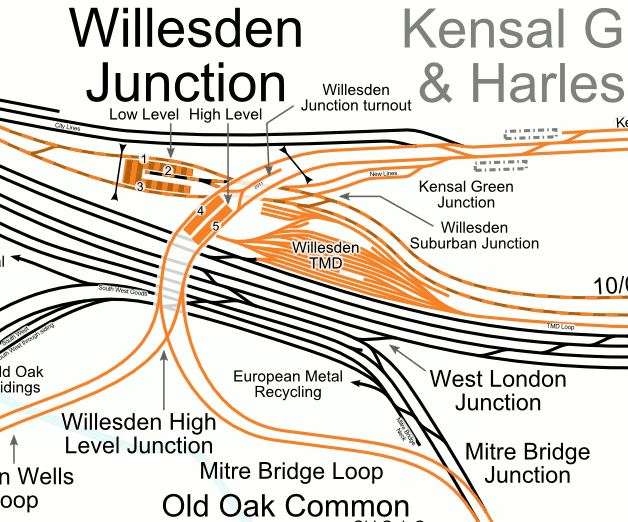
Note.
- The two Willesden Junction stations, labelled High Level and Low Level.
- The Watford DC Line, which is shown in black and orange, passing to the North of Willesden TMD. and through the Low Level station.
- The four tracks shown in black are the West Coast Main Line, with Watford to the West and Euston to the East.
- The North London Line to Richmond and the West London Line to Clapham Junction splitting at Wilesden High Level Junction.
The current service between East Croydon and Milton Keynes, is only one train per hour (tph) and uses a succession of flat junctions to take the slow lines to and from Watford.
This is not a good operational procedure and I suspect Network Rail and various train operators, would like to see it discontinued.
So if trains in a new London Overground version of the service, don’t go up the Watford DC Line or the West Coast Main Line, where do they turn back?
Note the siding to the East of the High Level platforms, which is labelled Willesden Junction Turnout.
This is regularly used to turnback London Overground services on the West London Line.
I feel that London Overground will be turning their replacement service in Willesden Junction High Level station.
Current train services at the station include.
- For passengers, who want to go further North, there is a good connection to the Watford DC Line for Wembley Central, Harrow & Wealdstone and Watford Junction stations.
- The Watford DC Line can also take you to Euston.
- The Bakerloo Line between Stonebridge Park and Elephant & Castle via Central London.
- Frequent North London Line services between Stratford and Richmond.
The station has kiosks, coffee stalls, toilets and waiting rooms.
There are certainly worse places to change trains.
The Southern Terminus
Obviously, existing travellers on the route would like to see as few changes as possible.
East Croydon station must be a possibility for the Southern terminus, as it is the currently used.
But East Croydon is a busy station and perhaps it is not a convenient station for trains to wait in the platform.
On the other hand, West Croydon station offers some advantages.
- The station has a long bay platform, which might be long enough for nine or ten cars.
- There is a separate turnback siding.
- It has space to add another bay platform, but this may have been sold to a developer.
- It already has a four tph London Overground service to Highbury & Islington station.
- Using West Croydon avoids the crowded lines to the North of East Croydon station.
It is also managed by London Overground, so the landlord would be co-operative.
How Many Trains Would Be Needed For A West Croydon And Willesden Junction Service?
West Croydon station has two possible routes, that trains could take to Willesden Junction.
- Via Norwood Junction and Clapham Junction in 55 minutes.
- Via Selhust and Clapham Junction in 45 minutes.
These times mean that a two-hour round trip between West Croydon and Willesden Junction should be possible.
Trains required for various frequencies would be as follows.
- One tph – Two trains.
- Two tph = Four trains.
- Four tph – Eight trains.
They would need to be dual voltage Class 710/2 trains, as are now running on the Gospel Oak to Barking Line.
Compare the figures with those for the current East Croydon and Milton Keynes service, which needs four pairs of four-car trains for an hourly service.
What Would Be The Frequency?
I think one, two and four tph are all possibilities!
One tph
One tph would be a direct replacement for the current service. But is it enough?
Services at West Croydon could probably share the bay platform with the existing Highbury & Islington station service.
Two tph
Two tph could be a compromise frequency.
Two tph could probably still share the current bay platform with the Highbury & Islington service.
Four tph
Four tph would be a full Turn-Up-And-Go service,
- It would probably be London Overground’s preference.
- It would give a very passenger-friendly eight tph between Willesden Junction and Clapham Junction stations.
- The two services would call at opposite sides of Clapham Junction station.
- It would give a four tph link between Croydon and High Speed Two.
- Westfield wouldn’t mind all the extra shoppers at Shepherds Bush!
But there could be downsides.
- The service could need an extra bay platform at West Croydon.
- Would it be possible to turn four tph at Willesden Junction?
- Will the train paths be available through South London.
But four tph would probably would be London Overground’s preference.
It will be interesting to see the reasons, why Transport for London choose a particular frequency.
A Trip Between Imperial Wharf And East Croydon Stations
Today, I took a trip between Imperial Wharf and East Croydon stations at around 11:30.
- The train was two four-car Class 377 trains working as an eight-car train.
- After Clapham Junction it wasn’t very busy.
- I was in the last car, which was empty, except for myself.
I came to the conclusion, that an eight-car train was too much capacity for the Southern section of the journey.
I suspect that Transport for London have detailed passenger estimates for this route, so they should be able to determine the frequency and length of replacement trains required.
The Upgraded Norwood Junction Station
In Major Upgrade Planned For Norwood Junction Railway Station, I talked about a plan to upgrade Norwood Junction station.
The idea behind the upgrade is to improve connectivity and capacity in the crowded Croydon area.
If the West Croydon and Willesden Junction service, was routed via Norwood Junction station, the upgraded station would give easy access to both East and West Croydon stations.
Conclusion
I’ve always liked Chris Gibb’s suggestion of the transfer of the service between East Croydon and Milton Keynes stations to the London Overground and I can now start to see flesh on the bones!
At the present time and until better data is available, I think the replacement service should be as follows.
- The Northern terminus should be Willesden Junction.
- The Southern terminus should be West Croydon station, where there are good tram and train connections.
- The route would be via Shepherds Bush, Kensington Olympia, West Brompton, Imperial Wharf, Clapham Junction, Wandsworth Common, Balham, Streatham Hill, West Norwood, Gipsy Hill, Crystal Palace and Norwood Junction.
- Going via Gipsy Hill, rather than the current route via Selhurst, would give access to the connectivity at Norwood Junction.
- The frequency should be four tph.
- Trains will be four- or five-car Class 710 trains.
The benefits would be as follows.
- The rail hubs of Clapham Junction, Norwood Junction, West Croydon and Willesden Junction would be connected together by a Turn-Up-And-Go service.
- The proposed four tph service would need eight Class 710 trains, whereas the current one tph service needs eight Class 377 trains. Would this be better value?
In the future with a connection to High Speed Two in the Old Oak Common area, the benefits would increase.
- There would be a simple interchange with High Speed Two.
- South London from Clapham to Croydon, would get a direct service to High Speed Two.
- There would also be a better connection to Heathrow Airport and other rail services through Old Oak Common.
I think that the connection to High Speed Two trumps everything else.
‘710s’ Debut On Goblin
The title of this post is the same as an article in the July 2019 Edition of Modern Railways.
The article is mainly about the introduction of the Class 710 trains on the Gospel Oak to Barking Line.
But the last sentence of the article is worth more investigation.
On the West London Line, TfL is curremtly working with the Department for Transport on options for the devolution of services originally suggested in Chris Gibb’s report on the Govia Thameslink Railway franchise, which could lead to ‘710s’ being deployed here.
I investigate it fully in A London Overground Replacement For Southern’s East Croydon And Milton Keynes Service.
This was my conclusion.
At the present time and until better data is available, I think the replacement service should be as follows.
- The Northern terminus should be Willesden Junction.
- The Southern terminus should be West Croydon station, where there are good tram and train connections.
- The route would be via Shepherds Bush, Kensington Olympia, West Brompton, Imperial Wharf, Clapham Junction, Wandsworth Common, Balham, Streatham Hill, West Norwood, Gipsy Hill, Crystal Palace and Norwood Junction.
- Going via Gipsy Hill, rather than the current route via Selhurst, would give access to the connectivity at Norwood Junction.
- The frequency should be four tph.
- Trains will be four- or five-car Class 710 trains.
The benefits would be as follows.
- The rail hubs of Clapham Junction, Norwood Junction, West Croydon and Willesden Junction would be connected together by a Turn-Up-And-Go service.
- The proposed four tph service would need eight Class 710 trains, whereas the current one tph service needs eight Class 377 trains. Would this be better value?
In the future with a connection to High Speed Two in the Old Oak Common area, the benefits would increase.
- There would be a simple interchange with High Speed Two.
- South London from Clapham to Croydon, would get a direct service to High Speed Two.
- There would also be a better connection to Heathrow Airport and other rail services through Old Oak Common.
I think that the connection to High Speed Two trumps everything else.
I will keep returning to this vital link down thw West London Line.
 The Anonymous Widower