The Future Of Class 378 Trains
This post is a musing on the future of the Class 378 trains.
The Thames Tunnel
The Thames Tunnel is the tail that wags the East London Line, when it comes to trains.
- For evacuation and safety purposed, trains running through the tunnel, must have an emergency exit through the driver’s cab.
- It hasn’t happened yet, as far as I know, but a version of Sod’s Law states if you ran trains without this emergency exit, you’d need to use it.
- London Overground’s Class 378 trains have this feature, but their Class 710 trains do not.
So it would appear that until Bombardier build an Aventra with an emergency exit through the driver’s cab, that the existing Class 378 trains must work all services through the Thames Tunnel.
Incidentally, I can’t think of another long tunnel, that might be served by the London Overground, so it could be that Class 378 trains will be the only trains to go through the Thames Tunnel, until they wear out and need to go to the scrapyard.
Six Car Trains On The East London Line
I covered this in Will The East London Line Ever Get Six-Car Trains? and I came to this conclusion.
I will be very surprised if Network Rail’s original plan on six-car trains on the East London Line happens in the next few years.
It might happen in the future, but it would need expensive platform extensions at Shadwell, Wapping, Rotherhithe and Canada Water and Surrey Quays stations.
Increased Frequency On The East London Line
If five-car Class 378 trains are the limit, the only way to increase capacity of the East London Line would be to increase frequency.
The current frequency of the East London Line is sixteen trains per hour (tph)
There are four tph on each of these routes.
- Dalston Junction And Clapham Junction
- Dalston Junction And New Cross
- Highbury & Islington And Crystal Palace
- Highbury & Islington And West Croydon
Two increases are planned.
- 2018 – 6 tph – Highbury & Islington And Crystal Palace
- 2019 – 6 tph – Dalston Junction And Clapham Junction
This would increase the frequency of the East London Line to twenty tph.
It will probably mean an updated digital signalling system on the East London Line.
Eventually, I think it likely, that a full ERTMS system as is fitted to Thameslink and Crossrail will be fitted to at least the East London Line, but possibly the whole Overground network.
Digital signalling would certainly allow the twenty-four tph frequency of Thameslink and CXrossrail, which could mean that the four routes all received a frequency of four tph.
But Thameslink and Crossrail are theoretically capable of handling thirty tph or a train every two minutes, through their central tunnels.
If the two modern multi-billion pound tunnels can handle 30 tph, why can’t their little brother, that started life as a half-million pound pedestrian tunnel in 1843,
The Number Of Trains Needed For The Current Service
If I go through the routes of the original Overground, I find the following.
Dalston Junction And Clapham Junction
Trains take 46 minutes to go South and 44 minutes to come North and a round trip would take two hours.
This means that the current four tph service would need eight trains.
A six tph service in the future would need twelve trains.
Dalston Junction And New Cross
Trains take 22 minutes both ways and a round trip would take an hour.
This means that the current four tph service would need four trains.
A six tph service in the future would need six trains.
Highbury & Islington And Crystal Palace
Trains take 44 minutes to go South and 43 minutes to come North and a round trip would take two hours.
This means that the current four tph service would need eight trains.
A six tph service in the future would need twelve trains.
Highbury & Islington And West Croydon
Trains take 52 minutes both ways and a round trip would take two hours.
This means that the current four tph service would need eight trains.
A six tph service in the future would need twelve trains.
This means that the current four tph on all four routes needs twenty-eight trains.
The Proposed 2020 Service
This will have two extra tph to Crystal Palace and Clapham Junction and will need thirty-six trains.
Six Trains Per Hour On All Four Routes
as each route terminates at both ends in a single platform, which can handle six tph, with the right signalling, I feel that this could be the design objective of the East London Line, when it was built in the early-2010s.
This could be achieved with forty-two trains, leaving perhaps twelve to fifteen trains for other duties, depending on how many are needed on stand-by or are in maintenance.
What Could Be Done With Twelve Trains?
As I calculated earlier, three routes need twelve trains to provide a six tph service.
- Dalston Junction And Clapham Junction
- Highbury & Islington And Crystal Palace
- Highbury & Islington And West Croydon
All three services take between 44 and 52 minutes.
So could another six tph service that takes around this time be added to the current four services?
Willesden Junction As A Northern Terminal
Trains could take the North London Line to Willesden Junction and terminate in the Bay Platform 2.
I estimate the following timings from Willesden Junction.
- Highbury & Islington – 27 mins
- Dalston Junction – 31 mins
- Whitechapel – – 41 mins
- New Cross – 49 mins
- Crystal Palace – 64 mins
- Clapham Junction – 73 mins.
- West Croydon – 74 mins
It would appear that the only possible Southern terminal of the current four, would be New Cross, as that is the only terminal within the 44-52 minute range of journey time.
So could a service between Willesden Junction and New Cross replace the current one between Dalston Junction and New Cross?
- It would need to be run using dual-voltage trains
- Voltage changeover could be at Highbury & Islington station.
- Extending the New Cross service would free up a bay platform at Dalston Junction station.
- It should be possible to have a frequency of six tph.
- Serious modifications or additions to infrastructure would probably not be required.
As running to Willesden Junction was talked about before the Overground opened, I wonder if the numerous crossovers on the North London Line, already allow trains from the East London Line to terminate at Willesden Junction.
Southern Terminals Via New Cross Station
This map from carto.metro.free.fr shows the lines at New Cross station.
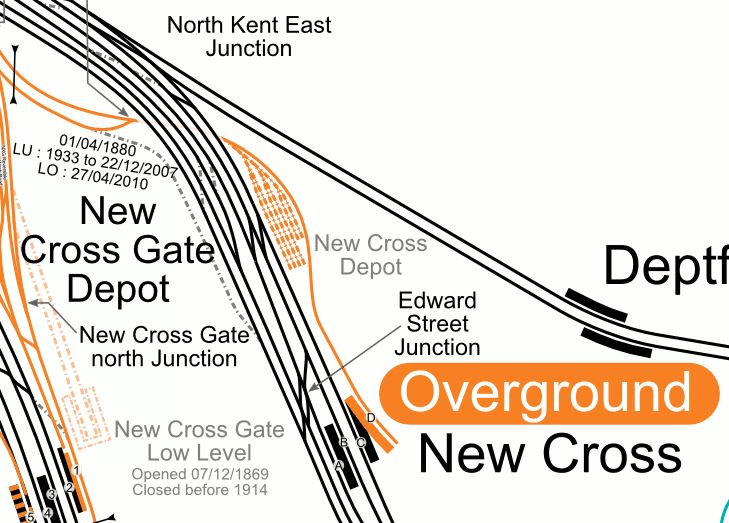
Note how the double-track East London Line, shown in orange, arrives from Surrey Quays station arrives in the North-Western corner of the map, becomes a single-track and then goes under the main lines before going into the bay platform D.
This Google Map shows the same area.
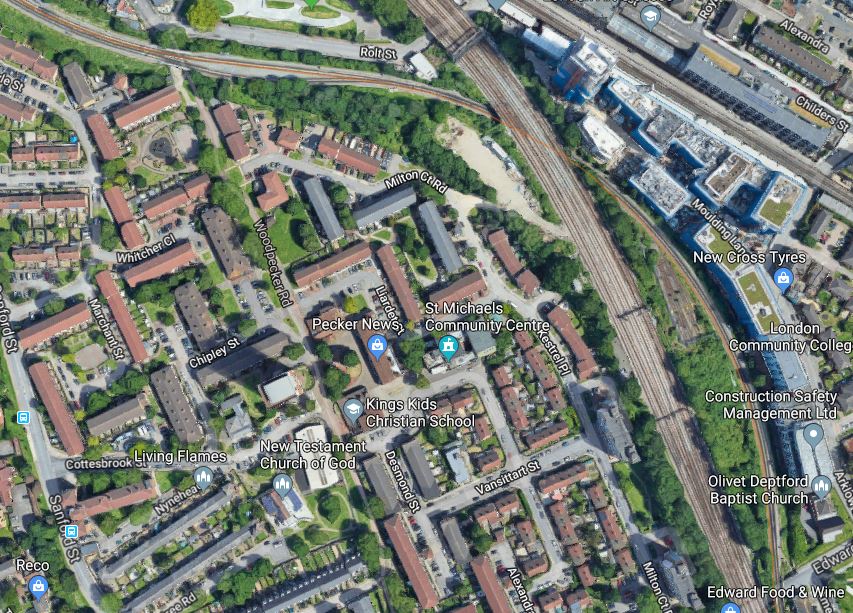
The London Overground track is clearly visible.
Could extra track be added, to enable the following?
- Southbound trains could join the main line and stop in Platform C
- Northbound could leave the main line after stopping in Platform A and go towards Surrey Quays station.
If this is possible, then trains could run between Dalston Junction and Lewisham stations.
Once at Lewisham they would have choice of Southern terminal,
Hayes As A Southern Terminal
Consider a service between Dalston Junction and Hayes stations.
- I estimate that a train could go between the two stations in 53 minutes.
- Hayes station has two terminal platforms
Six tph would probably be too many services, but 2-3 tph might be very welcome.
Orpington As A Southern Terminal
Consider a service between Dalston Junction and Orpington stations.
- I estimate that a train could go between the two stations in 47 minutes.
- Orpington station has three terminal platforms.
Six tph would probably be too many services, but 2-3 tph might be very welcome.
A Combined Hayes And Orpington Service
As a case can be made for services to both Hayes and Orpington via Lewisham, I think the ideal service could be two tph to both Hayes and Orpington.
- There would be four tph between Dalston Junction and Lewisham.
- Stations on the East London Line would have access to the important interchange station at Lewisham.
- Several stations on the routes to Hayes and Orpington would have a two tph service to Crossrail and the Jubilee Line.
Other Stations Via New Cross
Looking at rail maps, there would seem to be several possibilities including with their times from Dalston junction station.
- Beckenham Junction – 41 mins
- Bromley North – 40 mins
- Gove Park – 35 mins
There are probably others.
Southern Terminals Via Peckham Rye Station
As an example Streatham Common station is planned to be a major interchange and is 43 minutes from Dalston Junction.
Would a bay platform work here as an East london Line terminal?
Conclusion
If all fifty-seven Class 378 trains worked the East London Line, they could run six tph on the current routes.
- Dalston Junction And Clapham Junction
- Dalston Junction And New Cross
- Highbury & Islington And Crystal Palace
- Highbury & Islington And West Croydon
It would need forty-two trains.
Suppose the Dalston Junction and New Cross service was replaced with a Willesden Junction and New Cross service.
- This would provide a useful direct four tph service between East and North London.
- Changing at Highbury & Islington station would be avoided for a lot of journeys.
- The journey time wold be around 49 minutes.
- A two tph service would need four trains.
- A four tph service would need eight trains.
- A six tph service would need twelve trains.
- Many journeys between North and South London would now be possible with just a single same platform interchange.
To run the following frequencies on this route would mean these total frequencies on the East London Line and total numbers of trains.
- 2 tph – 20 tph – 40 trains
- 4 tph – 22 tph – 44 trains
- 6 tph – 24 tph – 48 trains
I think that if the figures are juggled a bit, there is enough trains to run extra services to one or more Southern destinations from Dalston Junction.
My preference would be a split service of 2 tph to both Hayes and Orpington via New Cross, where some new track would be needed.
This would do the following.
- Create a frequent connection between South-East and North-East London.
- Both areas would be connected to Crossrail and several Underground Lines, including the future Bakerloo Line Extension.
- The Hayes Line would be shared between Overground and Southeastern trains.
No more new trains or large amounts of new infrastructure would be needed.
I suspect that London Overground and the new Southeastern franchise can do better than my musings.
Why Do Some Train Operators Still Buy Half-Trains?
This picture shows the unloved-by-SWR Class 707 trains.

South Western Railway‘s predecessor; South West Trains bought thirty of these trains and SWR is replacing them with Class 701 trains.
Sixty of these new trains will be ten-cars in length and thirty will be five-car.
Why?
Consider.
- Most Class 707 trains, always seem to run as ten-car units, formed of two trains.
- There are four cabs, rather than two.
- A ten-car Class 701 train has twenty more seats than two five-car trains.
- Including standing passengers, a ten-car Class 701 train has eight percent more capacity, than two five-car units.
- Staff have to get out of the train and back in, to go between the front and back of the train.
- I’ve even seen trains delayed because the conductor was helping a disabled passenger in the other train.
Running two half-trains as a full-size train must surely be more stressful for the staff and more uneconomic for train operators.
The only place for five-car trains, is surely on routes with short platforms.
The Cut-And-Paste Aventra
It should also be noted that Bombardier’s new Aventras and other recently-designed trains, can be cut and pasted to adjust the trains that an operator needs.
At the present time, services on the Gospel Oak to Barking Line, which can only accept four-car trains are being run by four-car Class 378 trains, which have been shortened from their normal five-car length by removing a car.
So for instance if on a route, South Western Railway needed to run eight-car trains due to a temporary length restriction, they could shuffle a ten-car and a five-car train to get an eight-car and a seven-car,
In a list of Aventra variants, the following are detailed.
Tfl Rail
Class 345 trains will be nine-car, but currently they are running as seven-cars.
London Overground
Class 710 trains will be used in three ways.
- As pairs of eight-cars on the Lea Valley Lines.
- As four-cars on the Gospel Oak to Barking Line and the Watford DC Line.
- As five-cars on the North London Line.
It has puzzled me, why the Lea Valley sets are not to be built as eight-car trains and I discuss this in Latest On The New London Overground Class 710 Trains.
Greater Anglia
Class 720 trains will be `22 ten-car and 89 five-car trains.
I think that Greater Anglia have some routes, that cannot accept ten-car trains.
As I showed for Hertford East station in Could London Overground Extend To Hertford East Station?
So will we be seeing some creative shuffling to get a tailored fleet, with perhaps some eight-car trains for routes like those to Hertford East?
I think that six ten-car trains and four five-car trains can be converted into ten eight-car trains.
South Western Railway
Class 701 trains will be 60 ten-car trains and 30 five-car trains.
Do South Western Railway need a sub-fleet of eight-car trains?
They can easily create one, by shuffling the trains.
West Midlands Trains
Class 730 trains will be 36 three-car trains and 45 five-car trains.
These are like-for-like replacements of the current fleet.
c2c
Class 711 trains will be six ten-car trains.
They will be replacing Class 387 trains on a short-term lease.
Conclusion
It appears to me, that for the train operator to have maximum flexibility, that you need to start with a long train and a short train and be able to shuffle cars around to get the train fleet you need.
Certainly a fleet of both ten-car and five-car Aventras gives you the possibility of creating a sub-fleet of eight-car trains.
Interestingly, the Hitachi Class 800 trains appear to have a similar ability.
The Dalston Kingsland Station Problem
One of my local stations on the North London Line is Dalston Kingsland station.
Unlike Hampstead Heath station and the three neighbouring stations of Canonbury, Dalston Junction and Hackney Central, there are no lifts at Dalston Kingsland station and the stairs are narrower without a central rail.
Looking at the passenger traffic at the stations I have mentioned, gives the following numbers for 2017-18 in millions.
- Canonbury – 3.0
- Dalston Junction – 5.7
- Dalston Kingsland – 5.5
- Hackney Central – 4.3
- Hampstead Heath – 3.3
Dalston Kingsland serves almost as many passengers as does the nearby Dalston Junction, but it is a very inferior station.
- Recently, a high capacity wide gate-line has been installed.
- When trains call at the station, it is difficult to get to the platforms, unless you wait until arriving passengers have come up the stairs.
- There are no lifts.
- More housing is being built around Dalston Kingsland station.
- In December 2018, the train frequency through Dalston Kingsland was raised to eight from six trains per hour (tph).
Is Dalston Kingsland station an accident waiting to happen?
Various plans and other improvements will effect the passenger traffic through Dalston Kingsland station.
More Trains Through Dalston Kingsland Station
In Gospel Oak-Barking Fleet Plan Remains Unclear, I calculated that running the current combined eight tph service between Stratford and Clapham Junction/Richmond needs twenty trains.
- Increasing this service from four tph to five trains per hour to both Western termini, would increase the frequency between Stratford and Willesden Junction to ten tph.
- It would also require twenty-five trains to run the service.
- London Overground has six five-car Class 710 trains on order, that will be used to improve the service on the North and West London Lines.
This would leave a spare train to cover failures and maintenance.
So it would appear that Dalston Kingsland station could get a train every six minutes in both directions.
Passengers would appreciate this, but what about the freight operators, that use the line?
Will a twenty-five percent increase in train capacity result in a similar increase in passengers using the stairs at the station?
The Effect Of London Overground Syndrome
In London Overground Syndrome, I described the syndrome like this.
This benign disease, which is probably a modern version of the Victorian railway mania, was first identified in East London in 2011, when it was found that the newly-refurbished East London Line and North London Line were inadequate due to high passenger satisfaction and much increased usage. It has now spread across other parts of the capital, despite various eradication programs.
The North London Line through Dalston Kingsland station seems to have a particularly strong form.of the syndrome.
In December 2018, the frequency through the station was increased by thirty-three percent, but overcrowding in the Peak seems not to have reduced.
Could it be that because the line offers a more pleasant and easier connection between Stratford, Highbury & Islington, Camden, Hampstead, Willesden, Clapham Junction, Acton and Richmond, that any increase in capacity is welcomed and passengers transfer from a more crowded Underground?
There will be more Ducking and Diving!
Crossrail Effects
I suspect only educated guesses can be made, as to what effects Crossrail will have on Dalston Kingsland station.
Judging by the number of passengers, who get on and off Overground trains at Highbury & Islington station, a lot of passengers use the North London and Victoria Lines for commuting and other journeys.
Crossrail, with its connection to the North London Line at Stratford and eventually at Old Oak Common will take passengers from the North London Line and the various connections between the two lines, will further even out passenger traffic.
If it does, it will be Londoners Ducking-and Diving again!
Avoiding Dalston Kingsland Station
I think that some groups of passengers will avoid Dalston Kingsland station.
- Like me, some travellers have a choice of station.
- Passengers walking between the two Dalston stations, may choose to use the shorter step-free interchange at Canonbury.
- As the frequencies on the Overground increases, passengers may find that a less obvious route is better for them.
- I suspect some savvy passengers take a train from West Croydon at Dalston Junction station and then cross the platform at Highbury & Islington station.
It’s classic animal behaviour to avoid problems and go by a better way.
Northern City Line Effects
The Northerrn City Line between Highbury & Islington and Moorgate stations could have an effect on passenger numbers at Dalston Kingsland station.
In a couple of years, the line will be much improved.
- Services will be running seven days a week.
- Elderly Class 313 traiins will have been replaced by new Class 717 trains.
- There will be a step-free connection to Crossrail at Moorgate station.
- Frequencies will be significantly increased.
Overall, there will be a new high-capacity line running North-South within walking distance or a couple of bus stops of the two Dalston stations.
I have already started to use the line more, by catching a bus to Essex Road station for a train to Moorgate station. It’s quicker in the morning Peak.
HS2 Effects
I remember using the North London Line in the 1970s, between Broad Street and Willesden stations. It was terrible. But now, when High Speed Two opens in 2026, London’s Mucky Duck which has grown into a swan, will speed you to Old Oak Common station for your journey to the North.
Because many of these travellers will have heavy bags with them, all stations on the North London Line must be made step-free.
Highbury & Islington Station Improvements
Highbury & Islington station was rebuilt for the Victoria Line in the 1960s, when costs were much more important than passenger convenience.
The area outside the station is being sorted, but the plans are starting to be developed to create better and step-free access to the deep level platforms.
A much improved Highbury & Islington station would create a lot of easier routes from both Dalston stations.
Essex Road Station Improvements
Essex Road station has lifts, but is not step-free as the lifts go to well below the platforms, to which the final connection is a long set of steps.
The station sits on what must be a valuable site in Islington, which would be ripe for redevelopment.
Redevelopment of this station will happen and it will make things a lot better for me, as it is within my walking range or a short bus ride.
Bus Improvements
When I moved to Dalston in 2010, there was a good bus service to Highbury & Islington station along the Balls Pond Road.
But now, a South London Mayor has cut this, because I suspect we can use the Overground.
But this assumes that Dalston Kingsland station is has quality access. Which of course it doesn’t!
The buses must be improved along the Balls Pond Road.
Six-Car Trains Through Dalston Kingsland Station
I’ve deliberately left this to last, as it is the biggest and most difficult.
There are two routes through Dalston Kingland station.
- Four tph on that use the West London Line to go to Clapham Junction station.
- Four tph on that use the North London Line to go to Richmond station.
One or both of these routes might be possible to be run by six-car trains using selective door opening on the short platforms.
Lengthening the new Class 710 trains will not be a problem, as a few extra coaches would be ordered.
On the other hand lengthening the existing Class 378 trains may be more problematical, as they are out of production. I suppose that two five-car trains could be converted into a six-car and a four-car.
Six-car operation would surely add twenty percent to the passengers going through the station.
The Future Of Dalston Kingsland Station
The extra trains and capacity through Dalston Kingsland station will increase the pressure on the inadequate access at the station.
But some of the other improvements will divert passengers from the station and take the pressure off.
I suspect that Transport for London are hoping this will be sufficient action to keep the station functioning at a comfortable level, until it is rebuilt for Crossrail 2.
But that is a tough ask and could contain a lot of wishful thinking.
Conclusion
Dalston Kingsland station needs lift and wider and safer stairs in the near future.
 The Anonymous Widower