The Class 88s are Coming
according to this article in the International Railway Journal, the first Class 88 locomotive has been moved to a test track in the Czech Republic.
The article also says this.
The four-axle class 88 has a maximum output of 4MW under 25kV 50Hz ac electric traction and 700kW under diesel power, delivering tractive effort of 317kN in both modes. The 160km/h units are equipped with regenerative braking and will have a 500kW electric train heating rating.
So it looks like, the locomotive like its cousin, the Class 68 locomotive, which is used by Chiltern Railways, can also be used on passenger trains.
As Chiltern have shown hitching a rake of refurbished Mark 3 coaches and a driving van trailer to a diesel locomotive makes for a very acceptable train for passengers and operator alike.
Creating such a train using a Class 88 locomotive would be at least as good and it could work efficiently on electrified lines.
It would be doing a similar job to to the bi-mode Class 800 trains destined for the East Coast Main Line and Great Western Main Line.
The specification would be different and this might suit some mainstream or niche operators better.
- It would only be a 100 mph, rather than a 125 mph train.
- The length of the train and its configuration could be geared to the operator’s needs.
So which of the train operating companies, could use a new electro-diesel passenger locomotive with bags of grunt?
Direct Rail Services
Direct Rail Services ordered the first batch of Class 88 locomotives, so they must have a business plan.
Still owned by the Government, they have a main duty of moving nuclear flasks around the country, but they seem to be developing a business of spotting gaps in the locomotive market and specifying suitable locomotives and ordering them. Wikipedia has a section on the use of Class 68 locomotives, which says this.
The Class 68 is a mixed-traffic locomotive intended for use on both passenger and freight trains. DRS has a contract with VSOE to provide locomotives for its Northern Belle service. DRS has indicated that the locomotives will likely be used on container traffic, and on Network Rail trains for which it is contracted to operate, but that they will not be used on nuclear flask trains.
The first passenger trains hauled by Class 68s were DRS special services for the 2014 Ryder Cup at Gleneagles.
Chiltern Railways have sub-leased six Class 68s from December 2014, which have replaced Class 67s on its Chiltern Main Line services between London and Birmingham. These are painted in Chiltern mainline silver livery and are fitted with Association of American Railroads (AAR) push-pull equipment to allow them to operate with Mark 3 coaching stock sets. Two DRS-liveried locomotives (68008 and 68009) have also been fitted with AAR push-pull equipment.
You could sum up DRS’s use of Class 68s, as providing a smart diesel locomotive for quality passenger services.
I suspect use of the Class 88 locomotive will be similar.
East Anglia
The new East Anglia franchise must be a good prospect.
Up to at least the 1970s, there were regular services from London to Great Yarmouth and Lowestoft and I can remember in the late 1970s getting the train from Woodbridge direct to London, at least a couple of times.
And it was no clapped multiple unit, but a proper rake of Mark 2 coaches, that included a buffet car, with a big diesel locomotive on the front.
There has been speculation that the new franchise would include direct services between London to Lowestoft, but as the route is not electrified from Ipswich, an alternative type of train must be used.
The tender document for the franchise gives the operator a way to provide these services. It says this.
Improve the quality of trains running on East Anglia’s network, providing a modern service with state of the art trains – extra points will be awarded to bidders who include plans to trial new technologies in rolling stock.
In my view there are two ways to provide a Lowestoft service, that would score extra points.
- Use an IPEMU, charging the on-board energy storage between London and Ipswich and at Lowestoft.
- Use a Class 88 locomotive on a rake of Mark 3 coaches and a driving van trailer.
I suspect, that the operator would extend an appropriate number of London to Ipswich services to Lowestoft.
The IPEMU would probably be at maximum energy storage range, but the Class 88 locomotive option, would give them other possibilities.
- They could replace the 1980s-built Class 90 locomotives on Norwich services, where necessary.
- London to Norwich services could be selectively extended to Great Yarmouth.
- They could run an alternative London to Norwich service via Cambridge, either as a regular service or when the Great Eastern Main Line is having one of its many blockades.
It should also be noted that the power of a Class 90 locomotive is only 930kW, which is less than a quarter of the Class 88 locomotive, working in electric mode and just 230kW less when in diesel mode.
I don’t know anything about how the power of the locomotive affects journey times, but it could help the operator achieve the much-wanted Norwich-in-Ninety and Ipswich-in-Sixty targets.
But the regenerating braking of the modern locomotive, must surely contribute to energy savings.
One problem that the East Anglian operator wouldn’t have is a shortage of coaches and driving van trailers, as they have 130 and 16 respectively of each.
But they would need to upgrade the coaches, so they met the latest access and disability regulations, but as Chiltern have shown, this is not only possible, but creates one of the best railway coaches in the world.
They may need to lengthen a few platforms, but that will be needed whatever trains are used.
In the future, Class 800/801 trains or another manufacturer’s equivalent will probably work the long-distance services, but there is a gap of a few years to fill, by which time the Class 88-hauled trains will hopefully have defined the market.
I estimate that direct trains from Great Yarmouth and Lowestoft to London, could be up to twenty minutes quicker than the current services, once Norwich-in-Ninety was achieved. Given other examples of increased passenger usage after this type of speed improvement, I’m sure the potential operators have a handle for the increased revenue that would result and will bid accordingly.
The Two Virgins
I doubt whether Virgin West Coast and Virgin East Coast will have too much use for a Class 88 locomotive pulling a rake of coaches and a driving van trailer.
It would probably not be fast enough to mix it with the current 125 mph trains on their routes, but there might be particular operations for which such a train would be an affordable solution.
One that comes to mind, is running the direct service between Euston and Holyhead, if it ever needed more capacity on the route.
But what do I know?
East Midlands Trains
The routes run by East Midlands Trains will be electrified in the next decade and as the electrification grows out of London to the North, they may have a temporary need for a train, that can run on both electrified and non-electrified lines.
They could probably hire in a Class 800 train, but a Class 88 and a rake of coaches would be an alternative.
Chiltern Railways
Chiltern Railways already run six Class 68 locomotives, which is a diesel cousin of the Class 88. So when services start to the electrified Milton Keynes in a couple of years, a Class 88 could be used on these services to take advantage of the wires at the Northern end.
Conclusion
The Class 88 locomotive will probably be a very good niche locomotive for passenger trains, especially if it is as well-received as the Class 68.
But it could be a very large niche!
Before GOBlin Electrification – Crouch Hill
I’d never been to Crouch Hill station before, but I went to take these pictures.


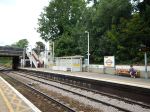

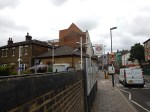
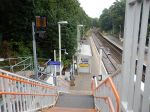

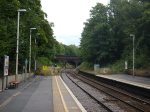


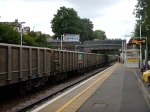
It is another tidy station with fairly long platforms, steep staircases and no lifts. Although unlike Leyton Midland Road, the station is in a cutting, rather than on a viaduct.
My pictures were as you can see interrupted by a dreaded Class 66 locomotive, with all its noise and smell passing through. After electrification, hopefully we’ll see something more environmentally-friendly like an elderly Class 90 or a brand new Class 88 locomotive. Unfortunately, I think we’ll see mainly Class 66s pulling freight trains for some years, as there are so many of them and they seem to be pretty reliable, although unloved by the drivers.
More Class 68 Locomotives On The Way
So far there have been twenty-five orders for the new Class 68 locomotive and as there is no adverse criticism of the new locomotive on the web or in the railway press, it has to be assumed that they are working fairly well.
So it was no surprise to see this article on Global Rail News, with a title of DRS orders further seven Class 68 locomotives.
Let’s hope when the related Class 88 locomotives from the same manufacturer generate such a small amount of negative publicity, when they are introduced in the next year or so.
The New Age Of The Train
The Independent today has an article which talks about the proposed costs of building HS2. Buried in the text is this paragraph.
Tomorrow, George Osborne, the Chancellor, will announce plans for what has been dubbed HS3, a line across the Pennines that would act as a major economic boost to the North. Writing on page 42 today, the Shadow Chancellor, Ed Balls, and former Transport secretary Lord Adonis dismiss the promise as “pre-election posturing”.
I shall be awaiting what the Chancellor says with interest.
The problem of trains in the North has existed for years and so if the Labour Party was in government unchallenged for over ten years, what did Balls and Adonis do about the problem?
Since 2010, and the Coalition Government, the closet trainspotter, has signed off the first part of the improvement in the North, the Northern Hub and extended electrification in the area.
In my view this improvement across the Pennines is the most important rail project outside London.
It is worthwhile looking at the list of large rail projects that are scheduled for completion in the current decade.
Crossrail and Thameslink
Crossrail and Thameslink should always be thought of together, as they will have an important hub at Farringdon and will revolutionise travel across the wider South East and possibly further. So many journeys like Ipswich-Gatwick, Reading-Cambridge and Brighton-Heathrow will be easy journeys with a just a change or two.
Last night, I had an awful taxi journey back from the Gherkin, as roadworks meant that the whole area was gridlocked. The taxi driver was sceptical about trains, so I asked him, where he lived. As he said Goodmayes, I asked him how he got to Gatwick and he replied it was an awful drive of well over an hour. By train today it takes nearly an hour and a half, with two changes, although both are step-free at Stratford and London Bridge. After Crossrail/Thameslink is fully open the first leg to Farringdon will take 24 minutes and currently the Farrington-Gatwick link takes 50 minutes. But there is only one change at Farringdon and I suspect that trains on the Farringdon-Gatwick leg will be much more numerous and perhaps even quicker.
This sort of improvement will be delivered all over the South East.
But that is not the end of it!
Many towns and cities will be just a train ride away from a Crossrail or Thameslink terminus. Bristol, Norwich, Nottingham, York, to name just three, all have fast trains, that link to the network. So for many there will be no humping heavy cases across the Underground network to go to and from places like Heathrow, Gatwick, Brighton, Cambridge and the Thames Valley.
I think the only problem many passengers will have is choosing the best change to get to their destination. For instance with a journey from Nottingham to Gatwick or Brighton, would you change at Bedford, Luton or St. Pancras. I suspect it wouldn’t be the badly-designed St. Pancras. So if one of the others was just a simple walk across that would get the traffic.
Some main lines out of London and the areas they serve though, are not well-connected to Crossrail or Thameslink. If I go round London, the only major lines that come to mind are the West Coast Main Line and South Western Main Line. There are published ideas about taking Crossrail to Tring or Milton Keynes, which solves the problem of the former, but getting to Waterloo or Clapham Junction from Crossrail or Thameslink is a problem. But then Basingstoke to Reading is down to be electrified as part of the Electric Spine, so surely if this is done properly, this could mean Basingstoke was almost part of Crossrail.
Great Western Main Line Electrification
After Crossrail, the full modernisation of the Great Western Main Line is the next most expensive project at £5-billion.
It is comprehensive and includes resignalling and electrification of the line all the way to Swansea.
It will be interesting when both this project and Crossrail are complete how the passengers use the two lines to get to say Bristol and South Wales. I for one, might get my Crossrail train to Reading to pick up the Great Weatern there, if the interchange is easier.
I suspect too, that in the first few years of the next decade there are various tweaks to the Great Western/Crossrail interface.
Plans at present are for a lot of Crossrail trains to turnback at Paddington, but will train companies tend to run some of these trains past Reading to perhaps Oxford or Basingstoke.
It will all depend on what the passenger statistics throw up!
Northern Hub
Talk to most people, including many in the North, about the Northern Hub and they won’t have heard of it. Even if they’ve seen some of the related projects like Huyton station.
If Crossrail is unlocking tremendous potential for London’s rail network, then the Northern Hub should do the same for the Greater Manchester area. On a personal note, getting from London to places like Bolton, Burnley, Blackburn and Huddersfield should be a lot easier, but even from December 2015, the first tangible benefit of the Northern Hub should be seen, when faster electric trains between Liverpool and Manchester start to run. So they are 1980s-vintage Class 319 trains, but being Mark 3 coach-based, they should scrub-up well and be magnitudes better than Northern Rail’s scrapyard specials.
Electric Spine
If the Northern Hub is invisible, then the Electric Spine is even more so, although it is costed at £800-million.
It will have a big effect, as it creates an all-electric railway from Southampton to the Midlands and ultimately Sheffield, Doncaster and the North, which will enable more freight trains to travel up and down the spine of the country, helping to free up road space on the A34 and the motorways.
Midland Main Line Electrification
Th Midland Main Line electrification is effectively now part of the Electric Spine and the two proects should probably be treated as one large one.
East-West Rail Link
The East West Rail Link is the reinstatement of the old Varsity line between Oxford and Cambridge, via Bletchley and Bedford.
The Western section will be opened first and part of it will be in the Electric Spine. This section of the line will also be used by Chiltern’s new Oxford service, which according to this press release should be fully running by Spring 2016.
But the line’s main use will be probably be freight winding it’s way between Southampton and the West Coast and Midland Main Lines. In some way the East West Rail Link is a new section of the M25 for freight trains.
Cardiff Valley Lines
I explored the Cardiff Valley Lines on my recent trip to Cardiff. This £350-million project is a follow on to the Great Western Electrification. A good proportion of the track-work seems to have already been done.
Greater Bristol Metro
The Greater Bristol Metro is a proposal to upgrade all the local lines around Bristol. The upgrade is not as comprehensive as that in South Wales, but it should provide a substantial improvement to train services in the area.
Waverley Line
Like the East-West Rail Link, the Waverley Line or Borders Railway is another reinstatement of a line closed in the 1960s. I said in this post, that this line has more significance than anybody thinks. If it’s the success I think it will be, it could mean that we see more proposals for reopening lines turning from dreams to reality.
Class 88 Locomotive
I like to think I’m an innovative engineer and the Class 88 locomotive is the sort of idea I like. It is effectively an electric engine with an onboard diesel engine, so that it can work away from the wires if necessary.
I was talking to a freight locomotive driver yesterday and as an example, he said that they have to use diesels like Class 66 or Class 70 to take trains into Felixstowe, as they can’t put wires up in the port, due to cranes loading and unloading the trains.
But I do think that the concept of the Class 88, may well be well suited to the UK, where there are still a considerable number of places like Felixstowe, where there is no overhead wiring, but electric lines aren’t far away.
If the first engines delivered in the next few years, prove to be up to the work, I could see lots of Class 88s working the network.
Conclusions
It is a good time to be any sort of railway engineer!
But the public don’t seem to realise what is happening for the better! And in some places like South Wales, they still think it won’t happen!
There’s certainly an awful lot of taxpayers investment going in! Only time will tell, if it’s worth it!
London Overground’s 2026 Map
Transport for London (TfL) have published a map of what they feel the London Overground will look like in 2026.
Most of the changes actually will occur next year, so I suspect there will be other things added before 2026.
My money would be on some of these being completed.
- Electrification of the Dudding Hill Line as a westward extension of the Gospel Oak to Barking Line to rejoin the North London Line.
- A More Comprehensive Interchange at West Hampstead station.
- Some developer-led station rebuilds and perhaps additions.
- Reopening Of the Hall Farm Curve to enable services between Chingford and Stratford, with a stop at Lea Bridge.
- Extra Overground branded services in a loop across South London.
With the exception of the electrification of the Dudding Hill Line and the works at West Hampstead, most of the other projects could probably be classed as smallish ones in terms of cost to TfL. But they may have a high return.
At present the Overground is being upgraded to take five-car trains, but judging by this picture taken at Camden Road station, it would appear that where they can fit them in, platforms are being readied for the next upgrade to six cars.
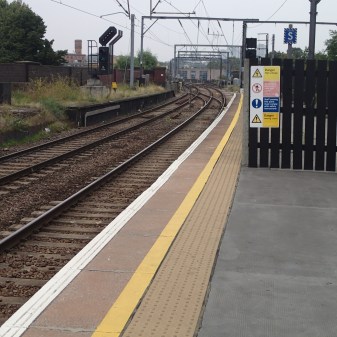
Platform Extension At Camden Road Station
TfL have said, that where stations can’t be extended selective door opening will be used. As the Class 378 trains are walk-through and have a full information system, I’m sure the self-loading cargo, will get used to it.
This afternoon, I travelled along the North London Line and it would also appear that TfL are taking the opportunity presented by the platform lengthening to widen a few of the narrower platforms, like those at West Hampstead. This picture was taken at Brondesbury Park.
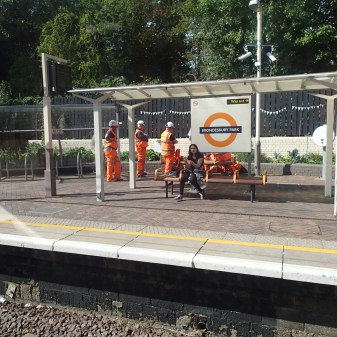
An Oasis At Brondesbury Park
It would appear that they’ve created a much wider platform with a roof and a garden.
TfL also don’t seem to be using a one-size-fits-all at the stations. Too often railway lines seem to be designed to a very limited set of rules to save costs. The London Overground inherited a series of run-down and mismatched stations, which they have almost used to advantage. Some like Hampstead Heath, were probably beyond saving, so they have rebuilt them to a station that befits their location.
In asddition, three external factors will drive the development of the London Overground; freight, the need for the development of more homes and commercial properties of all sorts and Crossrail.
Freight
The Overground gives over a lot of paths to freight, especially on the northern lines. A lot of these trains are still hauled by unfriendly Class 66 diesel locomotives. Alternative electric locomotives or the new Class 88, should be an aspiration for all lines that go through cities.
Bear in mind that once, the Midland Main Line, the Great Western Main Line and the Gospel Oak to Barking Line are electrified, which should all be complete by 2020, the Dudding Hill Line would be the only line, habitually used by freight trains in the northern part of London, not to be electrified.
So for freight reasons alone, I would think electrifying the Dudding Hill Line is a good idea.
But expect a few surprises if Option 1 is implemented, as Transport for London and especially the Overground has a history of doing the unexpected but excellent. Look at the one platform solution at Clapham Junction, where the West and South London Lines of the network meet.
Development of New Homes and Commercial Properties
London may need new railways to cope with the increased population, but it also needs new homes and commercial properties. Land in London is at a premium, but see what was done here in building flats over the new Dalston Junction station.
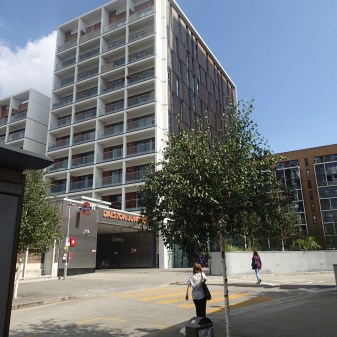
Residential Development Over Dalston Junction
It is not the highest quality of developments, but it was probably the best that could be done at the height of the recession. Small scale development is already taking place at some stations like Highbury and Islington and West Hampstead.
But in this country, we have some very good architects and developers, so I would expect to see some innovative development proposals all round the London Overground.
I must admit, that if I had to live in a modern development, surely one on top of a well-connected railway station is probably best!
Crossrail
London’s new railway; Crossrail, will change a lot of things in London’s transport system.
As a simple example if I go to Heathrow from home, the journey takes about an hour and twenty-two minutes. But after Crossrail is running, the journey will take less than an hour.
But this means, I’ll take the East London Line to Whitechapel to connect with Crossrail.
In addition, Crossrail and the Overground have interchanges at Stratford, Whitechapel and probably by 2026 at Old Oak Common.
So I suspect that many journeys in London will change because of Crossrail.
Predictions made now will be valueless after Crossrail opens in 2019.
Innovations In Diesel Locomotives
All across Europe there is a shortage of locomotives to pull both freight and passenger trains. In some ways this may well be good news, as it could be said that the economies of some countries are at last picking up.
In the UK, there have been orders for the new Class 68 to pull both freight and passenger trains and for some more of the ubiquitous Class 66. As the latter class doesn’t meet the current emission standards, the order for the Class 66 will probably be the last for the type. In my view that is a good thing, as I’ve talked to drivers and although the engines are reliable, the working environment could be better. They also aren’t popular with some residents, who live near busy freight routes, as they aren’t the quietest.
So in the UK, we’ve seen a scraping around for motive power, and this partly explains, why some elderly engines, like the Class 20, I saw a couple of days ago, are still working.
But we have also ordered some new Class 88, which are an electric engine, with an on-board diesel engine, so are capable of going all over the network. So for say Felixstowe to Manchester via the routes through London, could be done without changing the engine en route.
I also found another interesting idea on the web yesterday. This article in Global Rail News describes the delivery of a new TRAXX locomotive in Germany. What is unique about the TRAXX P160 DE is that instead of one large diesel engine, it has four smaller ones. So the power can be adjusted to the load, therefore using less fuel and creating much less noise.
This technique has been used on some diesel multiple units like the Class 185 used by Trans Pennine. On their hilly routes, some parts need more power than others, so these trains have an eco-mode.
Over the next few years, we will see a lot more serious developments with respect to more power, better fuel economy and less noise.
Enthusiasm For Class 68 And Class 88
I found this article from Rail Engineer about the new Class 68 and Class 88 locomotives that will soon be pulling freight and passenger trains on the UK rail network.
The article is enthusiastic about the two classes, but notes that the Class 68 will not meet the toughest EU pollution regulations. This is particularly appropriate given that the UK and some European countries are suffering high levels of air pollution. The Rail Engineer article says this about compliance to the new regulations.
The CAT engines meet European Stage IIIA emission standards, and can be modified to meet 2012 IIIB emission standards by replacing the exhaust silencer with a diesel particulate filter. However, because of the UK’s restricted loading gauge, this would involve considerable re-design work if it were to be applied to the Class 68.
It is important that rail locomotives are improved, as the current mainstay, the Class 66 is not liked by those who live on busy freight routes, due to its noise. I’ve also talked to drivers, who feel they have other problems too.
As an engineer, I feel that the best solution is the next generation of locomotives like the Class 88, which will be a 200 kph electric locomotive with an on-board diesel for running on non-electrified track. I wrote about the Class 88 here.
An Open Letter To GreaterAnglia
As I have been travelling up and down to Ipswich from London since probably about 1963, when I used to put my bicycle in the guard’s van and have it hauled by a Britannia between my parent’s main and retirement homes, it was inevitable, that one day I’d end up in the sort of incident that I did last night.
I should say, that after the death of my wife and son to cancer, and a serious stroke, I retired to London from Newmarket, and as I’m still a season ticket holder at Portman Road, I come up for every Ipswich Town home match.
Yesterday incidentally, was the first day, when my chosen train up (down in your terminology) to Ipswich, the 13:30 from Liverpool Street hasn’t been within a minute of its scheduled arrival time of 14:43 and I missed the first few minutes of the match. Luckily, Ipswich left the excitement for later. As I’ve taken this train, perhaps fifty times in the last three years, that is probably not a bad record.
I usually go home on the 17:09, so that I can experience the comfort of First in a Mark 3 coach. Yesterday though, we were advised to take the Football Special and in common with everybody else, I ended up on Colchester station. At least the buffet was open, and I was able to get a decent cup of hot chocolate, as from my knowledge of railway electrification, I knew from the fact that all the lines for London, were blocked by fallen trees, we could be in for a long wait.
But Ipswich fans tend to be fairly stoic and resourceful, especially after the troubles of the last few years. I thought and hoped, that my mate, Ian, who lives in Kent and had also been at the match, might be in the area, and as luck would have it for me, but not I suspect for him, he was visiting his father in Colchester Hospital.
So unlike others, just after 18:30, I was sitting comfortably on my way south. Ian lives near Ebbsfleet, so he was able to drop me at the station there, to get the High Speed service to Statford, which is an Overground ride away from where I live in Hackney.
I was starting to get hungry, but as I’m a coeliac, getting food at Stratford and the nearby Eastfield shopping centre is difficult, as not even Marks and Spencer, has anything like a gluten-free sandwich and there is no restaurant that I trust to serve a meal without gluten.
So instead of getting home at about seven, I was home just before nine, which given the circumstances and probably the experiences of other passengers, wasn’t too bad.
It is interesting to compare the trip[, with one I took on Deutsche Bahn in similarly awful weather, where I was abandoned at Osnabruck on a trip from Hamburg to Amsterdam, and left to my own devices. With incidentally no offer of compensation.
Obviously, you will always have problems with trees by the line, if we continue to get this awful weather. And obviously now, unlike in the 1950s and 1960s, there are no Britannias to periodically clear the trees, by setting fire to them.
In some ways, you suffered from one of the problems of an all-electric railway, which is obviously vulnerable to an event as last night. It would of course have helped if the line from Ipswich to Cambridge had been electrified, as it would have enabled the ferrying of Ipswich passengers for London to Cambridge, for onward travel. But that infill won’t happen for some years, if it ever does.
I think that the only solution, that might help, would be if you had a couple of Class 88 engines to run direct services to Yarmouth, as their go-anywhere capability would have allowed a shuttle via Cambridge. But then the first of these is a few years away from being built.
I think, under the circumstances, you did as well as could be expected. But probably the fact, that Ipswich had won, meant most fans were in a good mood. But you can’t please everybody!
Certainly though, your performance in times of smaller troubles over the last few years, has in my experience, been a lot better than some other companies I could name.
Greater Anglia Get It Together
I travel to Ipswich regularly to see Ipswich Town play.
My last two tickets cost me £34.95 and that was made up by buying a Senior ticket from the Zone 6 boundary (Harold Wood) to Ipswich and then upgrading it to First.
Yesterday’s ticket was much simpler in that it was a Senior First Class ticket all the way and back for £32.60.
I’ve just looked it up the 19th of October, when Ipswich play Burnley and I can now buy one on-line for £32.60.
it also looks like that for a Tuesday night match, I can get an Off-Peak First Return to Ipswich for the same price, provided I leave before 16:30. I don’t remember that being possible before. i could of course be wrong. The only returns to Ipswich I can find in my credit card statements are £34.95.
It looks like the price has got down for me and I’ll now be able to avoid the queues at Liverpool Street station on a Saturday morning, by buying my ticket on-line. I’ll also have time for a proper lunch before I travel.
That’s progress.
I’ve never found any fault with the staff on the trains to Ipswich, but today they seemed to have gone up a gear in cheeriness. The steward was also offering more than the usual single complimentary drink with your First Class ticket.
I have no complaints and let’s hope it all gets even better.
For instance, it is known that Herculean efforts are sometimes needed to keep the Class 90 locomotives on top form. As passengers generally like the smooth riding Mark 3 coaches, could a small injection of the new Class 88 locomotives, allow some Norwich services to be extended to Great Yarmouth, as they used to be in the past. Would they also enable proper trains to be run to Bury St. Edmunds and Lowestoft?
Hopefully We Won’t See This Much Longer
Whilst waiting for a train at Canonbury station today, a Class 70 diesel engine went through with a long train of intermodal freight.
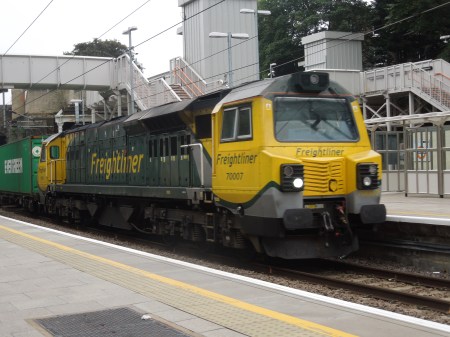
Hopefully We Won’t See This Much Longer
They are noisy beasts and hopefully, they will be replaced by more environmentally friendly electric locomotives soon. Note the overhead wires used by most trains on this line.
An order has been placed for Vossloh Eurolite engines, which are effectively electric locomotives, with the ability to work off the electrified network, using an on-board diesel engine. They will be called Class 88, when they are delivered.
There’s more about the Class 88 order here.
The Class 88 increasingly looks like a very good design to solve one of big problems of freight on UK railways; the need to use diesel engines on most trains, as there is not a large enough continuous electrified system.
If we take a simple example of a freight train from Felixstowe to Manchester via London, which at present needs a diesel engine to Ipswich and then an electric one for the rest of the journey, this could be Class 88-hauled all the way.
I think we could see a lot of Class 88s and similar engines in the future.
It won’t just be on freight, as the engine has a top speed of 200 kph, when working passenger trains. Could they be used on difficult services like Euston to Holyhead, where much of the route past Crewe is not electrified?
Surprisingly, the electro-disel concept is not new, as the old Class 73, which dates from the 1960s, was also an electric engine with an onboard diesel, designed for the third rail lines south of London.
Some of the original 49 engines are still in use.
Does this show that you can’t keep a good idea down?
 The Anonymous Widower