Will The Northern Line Extension Go All The Way?
There has been masses of reports about the Northern Line Extension in the special rail media and on the BBC and in other publications, like Time Out and the Standard.
Despite the long term aim of taking the extension to Clapham Junction, mentioned in the Wikipedia entry for the project.
Provision will be made for a possible future extension to Clapham Junction railway station by notifying the London Borough of Wandsworth of a reserved course underBattersea Park and subsequent streets
There has been no discussion about the extra station.
There has also been no statements from the consortium building the line about how they will actually construct the line.
As it is not the longest of tunnels, I suspect to save money, at the expense of possibly some extra time, they will use just one tunnel boring machine (TBM). It won’t be one of the ten-million-pounds-a-time beasts used for Crossrail, as Underground tunnels are generally much smaller in diameter. Although, I wouldn’t be surprised to see the tunnels made slightly larger than normal for reasons of safety and perhaps to re-use a refurbished TBM from another project.
One thing that London Underground doesn’t like is lines that end deep in the ends of tunnels. For reasons of cost in the 1960s, the Victoria line is like this at both ends and according to Wikipedia, there have been proposals for creating a large reversing loop at Brixton to both reach Herne Hill and increase capacity.
Reversing loops also eliminate any possibility of a Moorgate disaster, which has still not been satisfacorily explained. But operationally they remove the need for trains to crawl into the end station for safety reasons, and reduce the time it takes to turn trains, thus increasing the frequency on the line.
Reversing loops with stations are not unknown in the UK. Terminal 4 at Heathrow is served by the Piccadilly Line in this way and the Merseyrail Loop Line, is a larger example, that reverses and provides several stations for the Wirral Line. It could also be argued that Bank station on the Docklands Light Railway is two platforms on a reversing loop.
So could a similar solution be used at Battersea to turn the trains? Look at this map of the area.
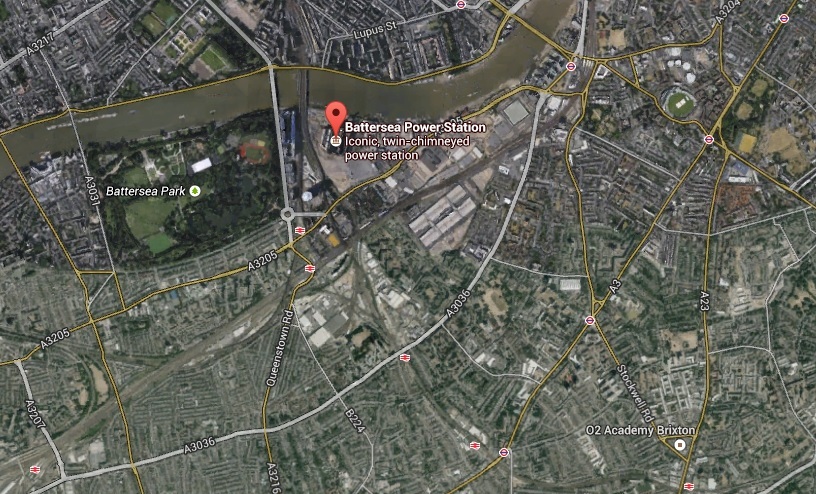
Around Battersea
Battersea Power Station and Battersea Park are obvious, but notice the Underground roundel marking Kennington station in the top-right corner and the British Rail symbol marking Clapham Junction station in the bottom-left.
The extension joins the current Northern line at Kennington and the Battersea station is proposed to be somewhere near the power station.
At present, Charing Cross branch trains reversing at Kennington, can go round the Kennington Loop. Wikipedia says this about the loop.
A loop tunnel south of the station enables southbound Charing Cross branch trains to be terminated at Kennington, leave the station in a southward direction and, traversing the loop, enter the northbound Charing Cross branch platform.
So instead of building two tunnels from Kennington to Battersea, with all the cost of two TBMs or the hassle of turning a single one round, I do wonder, if a cheaper and easier way of building the tunnels, would be to start in the Kennington Loop with a single TBM, tunnel via Nine Elms to Battersea and then create a wide reversing loop before returning to Battersea to dig the second tunnel back to the other side of the Kennington Loop.
One of the consequences of good project management is often that what the engineers build in the end is quite different, but better, more affordable and earlier to what the politicians said they wanted. For this reason alone, I wouldn’t be surprised if the Northern Line Extension is just a single tunnel, dug by a single refurbished TBM.
The cost savings are probably small change in a one-billion pound project, but the time spent inserting and removing a second machine, probably comes off the overall project time.
It then doesn’t take a great leap of the imagination to see that this construction/reversing loop could be extended so that it passes under Clapham Junction station.
There are other advantages too.
Operations, Safety and Reliability
I’ve mentioned the operational advantages of the reversing loop in quicker turn back of the trains and possible safety advantages, but as the extension is going to be a continuation of the Charing Cross branch of the Northern line and an extension of the Kennington Loop, there could be no complicated track work at Kennington. This will mean that the branch used through Central London, will determine the ultimate destination of the train. But this would allow London Underground to split the two lines and probably arrange dedicated platforms for the two northern branches at the operational nightmare that is Camden Town.
The reliability of two continuous lines would probably be a lot higher, than one that was constantly splitting and joining back again.
But whatever happens to the rest of the line, if the extension was a continuous reversing loop with no points or sidings, it could be built faster and would probably cost less, have a higher capacity and probably be more reliable.
The only problem would be if a train were to break down in the loop. But what happens on the Heathrow loop on the Piccadilly line?
Battersea and Nine Elms Stations
Digging the extension as a loop, also means that the two stations at Battersea and Nine Elms, become classic below ground stations of the Underground, like say Southgate and Manor House of the 1930s, and the modern Canary Wharf, where escalators and lifts descend to a wide lobby between the two lines.
Costs could even mean that they were identical below the surface, although architects would probably exercise some flare on the surface.
I also wonder if stations could be built with no escalators, but large efficient lifts, that were scheduled, so they went up and down in time with the trains.
Lift-only stations would be best as double-ended, with the lifts even coming up into car parks of the over-site development.
There is tremendous scope here for a good architect to build passenger-friendly and lower cost stations.
I’ve always believed that urban stations should have development on top, just like my local one at Dalston Junction. But how many stations anywhere make efficient use of expensive land?
Ventilation
A big problem with London Underground’s deep level lines, like the Northern, is keeping everything cool. All over London, you see structures like I photographed here. A continuous reversing loop must have advantages as all three stations would double as ventilation shafts, so there would be no need for any extra holes in the ground. If modern regulations mean that the tunnels have to be built with a walkway for evacuation, like those on the Docklands Light Railway, these larger diameter tunnels would probably help ventilation.
A secondary advantage of a well-ventilated reversing loop, is that it would be cool, so any trains on the loop could cool themselves down, just like many deep-level trains, do by basking on the surface in the suburbs.
Clapham Junction Station
In the future when the station at Clapham Junction is added, little or no tunnelling will be needed, as construction will probably involve sinking a shaft to link it to the current Clapham Junction rail station and creating a new platform or platforms alongside the reversing loop.
I would go for the single platform. In some ways then, this station would be like the Piccadilly Line station at Heathrow Terminal 4, which has a single platform on a one-way loop from Hatton Cross to Heathrow Central.
No surface buildings would be required and space would only be needed to sink the shaft during the construction phase.
Opening Clapham Junction station could give a problem in that some passengers will transfer off the trains from Basingstoke, Portsmouth, Southampton and other places to complete their journeys. Will the Northern Line cope?
On the other hand the new Clapham Junction station will link to Crossrail at Tottenham Court Road, so Clapham Junction would get a hopefully step-free link to Crossrail and on to Heathrow.
Platform Edge Doors
Regulations will probably mean that all the stations would have to be constructed with platform edge doors. A loop extension would probably have the minimum number of platform faces, thus subtracting another saving from the cost.
If I was designing the stations, all platform faces would be identical to save costs.
But if you went for lift-only stations, this could mean that a better design evolved, where the safety functions of the platform edge doors were achieved in better ways.
Train Stabling
A loop extension, if built in its simplest form, would not have any sidings for storing trains overnight or perhaps holding them when there was a problem on the Northern line.
But as the loop would of necessity be rather long between Battersea and Clapham Junction, the trains could be stabled or held in the loop. If staff needed to leave or join the trains and if the tunnel had a walkway, they’d just walk along to the nearest station.
Ease Of Construction
There has been a report in Global Rail News that the Northern Line Extension might be completed before Crossrail.
A loop extension leading off the Kennington Loop has implications for building the extension in a quick and affordable manner, so this might explain the optimism.
Consider the following.
1. No terminal station, platforms, junctions or sidings would need to be built.
2. As the main construction at Kennington only takes place on the Kennington Loop, trains on the Bank branch running to Morden will be unaffected. Trains on the Charing Cross branch would probably be suspended, unless some other way of turning them back could be found.
3. One TBM digs the whole tunnel in a continuous operation.
4. The project length is determined by the time to dig the tunnel, fit it out with track and signalling, connect it to the existing network and then give it an extensive testing, as once the TBM has passed, the construction of the platforms can be started in parallel with the rest of the project.
5. It would probably be easier to adjust the route of a loop tunnel to avoid other infrastructure and the proposed route of Crossrail 2. Victorian engineers didn’t have machines of the accuracy of today’s modern TBMs.
6. Crossrail needed a lot of shafts to insert and extract the TBMs and other equipment and materials. I’m no expert, but surely material could be brought in by service trains on the Morden branch of the Northern line, to avoid digging too many shafts.
Conclusion
I strongly believe the first phase of the Northern Line Extension will be built as a loop off the Kennington Loop and include all the tunnelling for the extension to Clapham Junction.
Clapham Junction station would not look like a terminus, as it would only be a single platform on a reversing loop.
So the second phase would solely be the fitting out of the station and connecting it to the rail station.
Victoria Gets A Posh Umbrella
Manchester Victoria was a terrible station, with a difficult connection to Manchester Piccadilly. The connection improved with the Metrolink, but as they are now rebuilding Victoria, it’s got worse again. As I’m now familiar with the walking route, I was able to put a couple right about the way to go.
There must be something in the Manchester civic psyche, that likes to confuse people.
But Victoria seems to be getting on with its rebuilding, which includes a posh roof over everything and a new footbridge.
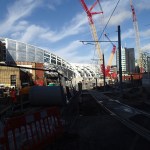
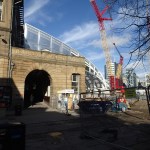

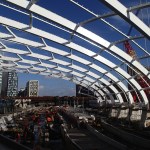
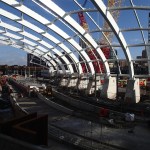
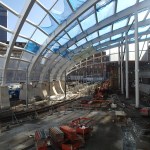
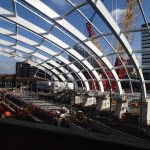
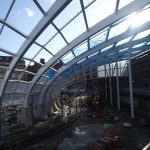
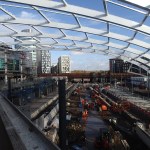


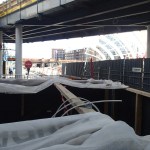
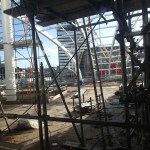
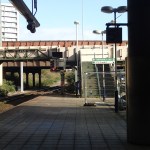
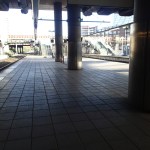
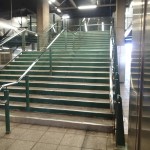
Unfortunately, the electrification to Liverpool Lime Street seems to be having problems and it will be some months before Class 319 electric trains are working the route, hopefully before next spring.
It does look to me, that when complete, anywhere on the tram routes in Manchester will have easy access to the electrified Trans-Pennine links at Manchester Victoria, which could become an architectural icon of the North. You’ll get the tram to Victoria and then totally under the new roof, you’ll go through the ticket gates and across the fully-accessible footbridges to the appropriate platform to await your train.
In addition, those who arrive from London and the South at Piccadilly and are perhaps going on to places like Burnley, Blackburn and Hebden Bridge from Victoria, will have a completely dry route, which is of course important in Manchester, using the trams. The trams must use contactless bank card tickerting though to be compatible with what other cities, like London, are doing.
This is Network Rail’s page on the £44million work.
I think everyone will agree that it’s all a bit different to the concrete crap that British Rail built forty to fifty years ago, like Euston and Manchester Piccadilly, when those with special access needs or advanced age didn’t exist, as everybody was adult and fit as a butcher’s dog.
I can remember meeting a friend in the newly-opened extension to Kings Cross station and looking with amazement at the structure that had been created.
Why shouldn’t other rail stations be given an added wow factor?
Especially now, when we have the architects, computers, techniques and materials to build them in an affordable manner. How many stations could be rebuilt using the same methods as New Cross Gate?
Good stations, like good clean electric trains, have one common problem. They are passenger magnets and very often attract so many extra paying passengers, that we have to expand the system.
I have a feeling that after they see the completed scheme, they’ll be wanting some of their other architectural disasters like Salford Crescent and Oxford Road stations, at least given the treatment that Network Rail have applied at Huyton.
The Footbridge At Westbourne Park
I mentioned in this post, that I’d seen a footbridge, that spanned the lines as you approached Paddington.
This is referred to locally as the Hampden Street bridge or as the Westbourne Park footbridge. Take your pick!
So this morning, I went to have a look.
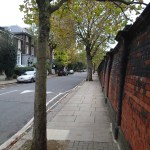
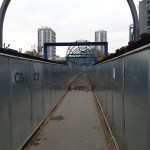
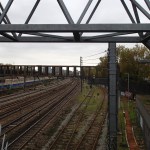
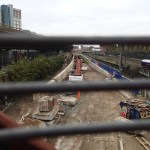
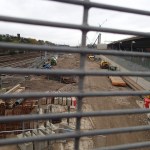
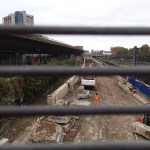
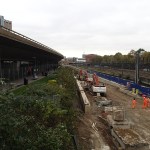
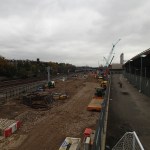
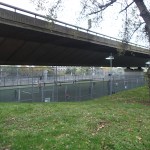
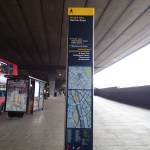
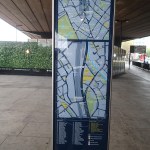
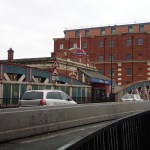
The bridge does mean you can see the workings well, but photographing them is difficult, as you have to look through a wire mesh.
It will be fascinating to go back here, to see the area, as the railway and its infrastructure progresses.
If you want to see it, just go to Royal Oak station, walk along Westbourne Park Villas and the footbridge is on the railway side of this road on the right.
After crossing the bridge, you can either complete the circle back to Royal Oak or take a bus.
Another Bit Of London Bridge Station Opens
In March I posted pictures of the opening of platform 14 and 15 at London Bridge station. Yesterday, the next two platforms 12 and 13 opened.
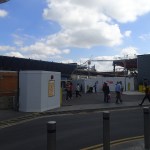

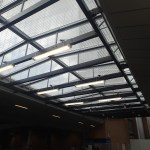
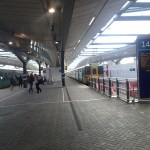
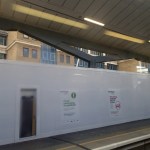
10 and 11 are now closed for rebuilding and should reopen in January 2015, according to this web page.
The list of key dates and service changes is given here, with finish set out in 2018.
Let’s hope it’s all worth it!
An Unusual Picture
I have cut this picture out of Google Earth of the railway north-west of Chorley.
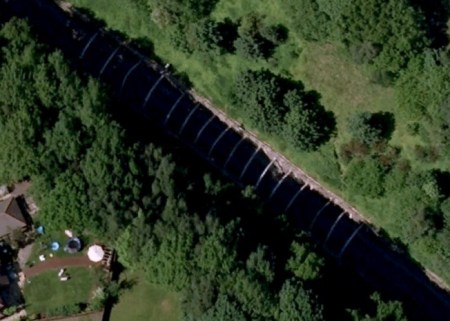
Sixteen Butresses
There would appear to be sixteen buttresses over the twin track railway.
They are actually some of the last examples of flying arches on UK railways. There’s more about the Chorley Flying Arches here.
I’m posting this, as the line through Chorley has just reopened after the related Chorley Tunnel has been expanded to allow for electrification. That is reported here on Modern Railways. It says this about the arches.
As well as upgrading the tunnel, the 16 historic Chorley flying arches – Grade II listed structures on the approach to the tunnel which are the only remaining examples on the British rail network – were refurbished following co-operation and consultation with English Heritage.
On the 22nd of this month, I’m going to see Ipswich play at Wigan. I think, I’ll go and look at these unique structures.
How many countries would actually restore te arches, rather than replace them with modern steel structures?
Is Whitechapel Station Going To Be A Jewel In The East?
When I wrote about Crossrail as a tourist attraction, I said nothing about the station at Whitechapel.
I probably didn’t as although I use the station regularly, you don’t see much as you pass through except for hoardings with lots of graphics, pictures and information. When I went through last time, I took these pictures.
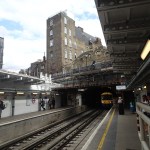

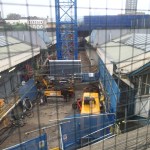

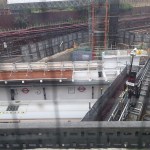

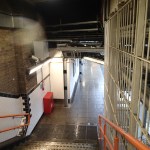

It shows the construction going on over the two north-south Overground platforms. Crossrail will run east-west about forty metres down. Note how the Underground is on top of the Overground.
I was told by a man in an orange suit, that there will be a bridge over the Overground platforms connecting it all together. Escalators to Crossrail will be going down from between the two Underground platforms, where the blue crane is now situated. The space between the Underground platforms will then be filled in to create a wide island platform with the two lines on either side. It will be an easy step-free interchange from Crossrail to the Underground.
There are some detailed architect’s impressions of the new station here. The page also says this.
The new Whitechapel Crossrail station will use the existing Whitechapel Road entrance to the Whitechapel London Underground and London Overground station.
The Crossrail platforms will be in deep tunnels to the north of the existing station but they will all share a concourse, ticket hall, gateline and station operations room, leading to a fully integrated station that provides an easy step-free interchange between the Crossrail, Hammersmith and City, District and Overground lines.
Transport for London’s, Transport Infrastructure Plan for 2050, states that at some point twenty-four trains per hour will run through this section of the Overground in both directions.
This matches the Crossrail and Thameslink frequencies, so once all these lines are complete, London will have gained a high-frequency H-shaped railway, where journeys like Luton, Brighton or Peterborough to Crystal Palace or Walthamstow might be accomplished using two easy step-free changes. In fact, the biggest problem after 2019 about travel in London, will be choosing which of two or three equally fast and convenient routes is best for you.
Travel is going to be fun!
I suspect Whitechapel might be my entry into Crossrail and Thameslink. I’ll just walk to Dalston Junction, take a four stop journey to Whitechapel and then fan out to the myriad destinations, that can be reached directly from there.
Crossrail As A Tourist Attraction
Today, I took the Docklands Light Railway to Custom House station to see progress and then came back to see the works at Canary Wharf station.

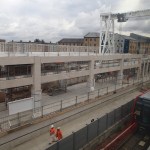
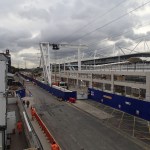
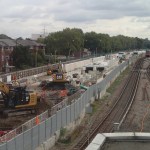

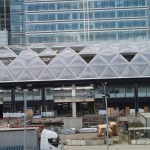
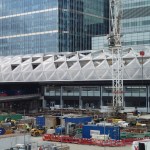
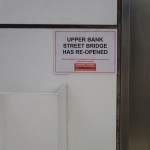
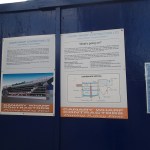

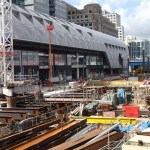
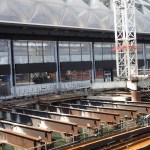
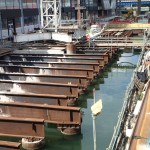


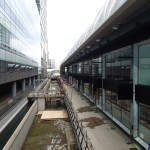
In one of the pictures of Custom House station, you can just see the portals for the Conaught Tunnel. This was a particularly challenging rebuild of an old Victorian tunnel, which was one of the subjects covered in the BBC documentary; Fifteen Billion Pound Railway.
One thing I was trying to see, was one of the trees they are planting in the gardens on top of the station, that are mentioned in this article in the Wharf.
There seemed to be others looking around and now that you can walk from Poplar DLR station over the bridge at Bank Street, there are better opportunities for looking at the sites.
A Vision Of Old Oak Common In The Future
Transport for London’s Transport Plan for 2050 is particularly forceful about what will happen at Old Oak Common.
A key aim beyond this is to integrate Old Oak Common as a Canary Wharf of the future, with around 90,000 jobs and 19,000 homes
They also have a detailed map, showing lines reaching out in all directions, from the junction of Crossrail, HS2 and the Overground. In addition to the links through the Goblin Extension, I’ve traced earlier, there are a possible extension of the West London Line to Balham and a service northwards on the Midland Main Line to somewhere like St. Albans.
So London is getting another hub to complement Stratford and Canary Wharf in the East and Clapham Junction in the South.
London Has A New Island And Bridge
City Island is a housing development in a bend of the River Lee. The island has been connected to Canning Town, by a new bridge, that was lifted in place by the UK’s largest mobile crane.
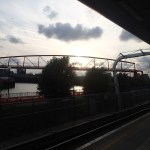
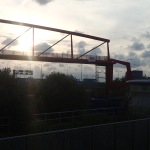
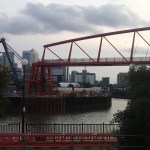

Unfortunately, by the time I got there the bridge was in place and the crane was virtually dismantled.
Sharp Infrastructure Growth Predicted
That is the headline on this report in New Civil Engineer. Here’s the first two paragraphs.
The infrastructure new build market will grow by more than 50% over the next five years, according to respected forecasts published today.
The Construction Products Association’s closely-watched summer forecasts predicted a strong and steady increase in the value of new civils work to 2018.
So if you’re a manufacturer of orange high visibility clothing, you must be pleased.
 The Anonymous Widower