Improving London’s Transport In Small Ways
I feel there are two ways of getting more out of London’s crowded transport system.
The first is the obvious ones of capital projects, which at the top end is Thameslink, Crossrail and Crossrail 2, and at the bottom end it is projects of the order of small numbers of millions, which might include.
- Remodelling major junctions like Archway, Elephant and Castle, Highbury Corner and Old Street.
- Reorganising bus routes around train and Underground stations, with more shelters and better information.
- New and rebuilt stations like Crystal Palace, Deptford and Lea Bridge
- Inclined lifts like that installed at Greenford.
- Step-free access at stations like Clapham Junction, Gospel Oak, Honor Oak Park, New Cross and South Tottenham.
I’m sure that new technology epitomised by the inclined lift at Greenford, will increasingly be seen.
But with any complex system, there is always improvements to be made in small ways.
The recent extension of contactless cards to Gatwick Airport, could be the sort of improvement, that increases ridership on the trains to the airport and is very much a win for the airport, the train companies and passengers alike.
We need more small improvements to London’s transport system to squeeze more capacity and improved efficiency out of the network.
1, London’s Airports And Other Places Should Have Contactless Ticketing
Heathrow, Luton and Southend Airports will join City and Gatwick in coming within London’s contactless ticketing network.
But why stop at just airports?
I feel that within a few years, the following will be within London’s contactless ticketing area.
- Chafford Hundred for the shopping at Lakeside.
- Ebbsfleet International for trains to Europe.
- Greenhithe for the shopping at Bluewater.
- Thorpe Park and other places for the fun!
- Windsor and other places for the tourists!
The benefits to residents, tourists, business and train companies won’t be small.
I suspect that as the contactless ticketing network grows, attractions and towns outside the area, will be enthusiastic to join and might even bribe Transport for London.
2. Buses Should Trial Entry Through All Doors
The bus journey I do most commonly is to get a 38 or 56 bus between my house and the Angel, where I tend to do my food shopping.
The 38 route uses New Routemasters with three doors, all of which can be used for entrance and exit, whereas on the 56 route, standard two door buses are used, where you enter through the front door and exit through the one in the middle.
There is no question that the Routemasters get through a typical stop quicker, as drivers and passengers use their brains to get on and off the bus as fast as possible. However, on the standard buses, threading a push-chair into the middle of the bus can be difficult and time consuming.
I think that an experiment should be trialled, where in perhaps areas, where there are a lot of Routemasters, passengers can board the standard buses from the middle door and touch-in on a convenient reader.
Obviously, it would be open to fraud, which is why an experiment would have to be performed first. But from several years of watching passengers on New Routemasters, I don’t think losses would be substantial. Many a time, I’ve seen passengers collectively stare at another passenger, who didn’t touch in! It’s East London peer pressure at work!
Remember too, that the doom-mongers of the left, felt cashless buses and contactless payments would be a disaster and discriminate against the poor. Try finding an incident, where someone was severely inconvenienced by London’s contactless ticketing system!
3. All Stations Should Indicate The Train Direction
On some stations this is obvious, or can be worked out, as on heavy rail routes, trains drive on the left.
But on many Underground stations, it is not obvious from which direction your train will arrive.
Often regular passengers will know that when going to a specific station, they will need to be in a particular carriage. If I am coming North to Angel on the Northern Line, I want to be in the first or second car, as this saves the effort of walking down the platform.
A simple arrow above the sdverts say, would orient you on the platform.
Hopefully, it would distribute passengers in a better manner along the platform.
4. Some Rail |And Underground Maps Could Be Larger
The standard maps are fine, but over the years, I’ve seen some really large transport maps around the world.
There’s no doubt in my mind that with maps, big is beautiful and the bigger the better.
In many stations there is a large tiled wall, for which no-one has really found a sensible use. Often you’ll come down an escalator into the bowels of an Underground station and face such a wall.
So why not put a really large map there?
It would be out of the way too and if passengers just wanted to stand in front of it and look, no-one would bother.
5. More First Train Indicators At Terminal Stations
Some terminal stations have more than one platform from which stations start their return journeys.
At Walthamstow Central on the Victoria Line, where there are two platforms, an indicator tells you, from which platform the first train will leave.
But at other stations like Stratford on the Overground, it is difficult to ascertain which will be the first train to travel west.
All terminal platforms should be fitted with First Train Indicators.
6. Better On Board Bus Information
London’s buses have a simple display, which gives a selection of the following information.
- The route and the destination.
- The name of the next stop
- Any customer information like delays, strikes or closures.
- The time.
I know the size of the display is limited, but it is poorly arranged and could be much better.
It should also show the five-number code of the next stop, so that passengers changing there could check out their next bus.
7. All Stations Should Have TfL-Standard Rail/Tube, Bus Spider And Walking Maps
When you arrive at a Transport for London (TfL) managed station, you find the following maps prominently displayed.
- The Rail and Tube version of the iconic Underground map.
- A bus spider map for all the routes serving the area.
- A comprehensive walking map.
At most TfL stations, there is increasingly a Legible London lith.
But this is not the case at some stations in London, that are managed directly by railway companies.
All stations should be made to adhere to London’s standards.
8. Below Ground Information Needs To Be Improved
Crossrail will bring some truly labyrinthine stations to London, to add to those difficult to navigate ones like Bank, Green Park, Kings Cross St. Pancras and Waterloo.
Transport for London needs to provide more bus and walking maps on the platforms and in the passageways, so that passengers can find their way to the entrance they need to continue their journey.
9. Rail And Tube Map On All London-Bound Platforms
The need for this was illustrated at Coventry station, where two tourists were asking the Virgin station-man, how to get to Ewell West from Euston. He told me, he had asked for a London Rail and Tube Map for the station, as this would have answered a large proportion of the questions he was asked.
The map could also have full details on how to use London’s contactless ticketing, which should reduce the queues at London terminals.
The only station outside London, I’ve seen such a map is Cardiff Central.
If it’s good enough for Wales, then the map should be displayed in Amsterdam, Brussels, Cologne, Lille, Marseilles and Paris.
Obviously, with information in the correct languages!
10. There Needs To Be More And Better Ticket Machines
Increasingly, I use the Internet less and less to buy tickets for travel out from London, unless it’s a longer journey and I want to reserve a seat.
I get the best Internet price from the latest ticket machines at Dalston Junction station, where I can buy the following tickets.
- Singles and returns, for today or a date in the near future between any two stations in the UK.
- Extension tickets from the Zone 6 boundary to certain stations close to London.
I get the best Internet price, without having to sign-up to be bombarded with spam by the train or ticket company.
The Zone 6 extension tickets are often a big money saver. Recently a return to Woking cost me just £5.15 with my Senior Railcard. The Standard Class Return Ticket costs £14.10, so the saving almost paid for my lunch in Woking.
These ticket machines need to be in a lot more places and not just on the Overground.
11. Ban Diesel Trains As Much As Possible From London
Despite lots of electrification on the lines into and through London, their are still quite a few noisy and smelly diesel trains to be found in London. They fall into the following categories.
- Long-distance trains like those to the West Country, Wales and Scotland.
- Freight trains on through routes, like the North London and Gospel Oak to Barking Lines.
- Commuter services using diesel multiple units.
- Engineering trains haled by diesel locomotives.
I believe that many of these can be replaced by trains hauled by quieter and greener electric traction.
Many residents of London, especially those who live on the feight routes of North London, would back this small improvement.
Conclusion
I have detailed ten small ideas, that might be used to improve London’s transport network.
I think that only the provision of more and better ticket machines will cost serious amounts of money, but from what I see as I travel around London, I suspect it’s already being done.
If I was the London Mayor, I would ask Londoners and regular travellers for simple ideas to improve the network.
Some would be bonkers, some would be so-so, but I believe that some would be brilliant.
I also believe that those good ideas, that were worthwhile implementing, should result in a reward to the proposer.
After all, London’s transport network belongs to London and Londoners, so why shouldn’t they have a say in its design?
Tottenham Court Road Station Gains A Giant Fosterito
The second new entrance to Tottenham Court Road station opened today.









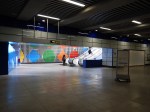




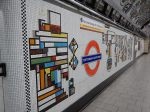
The entrance under the shadow of Centre Point, is a giant British version of the fosteritos on the Bilbao Metro.
Tottenham Court Road station, is probably one of first stations to be designed since London adopted contactless ticketing.
In my view, the design has certainly benefited, with its vast ticket hall, wide gate line and uncluttered area, where people can pass through quickly.
Simple is certainly efficient!
Transport for London Are Leading The Contactless Revolution
This article from Rail Magazine is entitled Contactless Ticketing Booms In London.
It states the following.
- In the first year, 180 million journeys have been made using contactless cards.
- This accounts for a fifth of all pay-as-you-go journeys.
But what isn’t said is the fact that despite the predictions of some left-wing and green politicians, there has been no hint of any problems. If there had been, the various tabloids would have had a field-day.
When are the rest of the large cities of the UK going to copy London, so I don’t need to use that nineteenth century technology of paper tickets?
Transport for London’s Visitor Centre At Liverpool Street
One of the things that Transport for London said it would do, when it closed Ticket Offices, was to open Visitor Centres at major stations.
This one at Liverpool Street station has been rebranded. It is one of several at main line stations and airports.
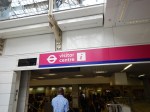
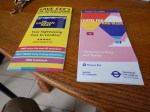
I know it was early on a Saturday, but I was the only person looking at what was on offer.
Looking at the London Pass, I think it could be something that a serious visitor would buy.
I can’t help feeling though, that as time progresses, the Visitor Centres in Central London will see fewer and fewer visitors, as London’s contactless ticketing system, will make travel advice something that can be handled easily by the station staff.
I may be wrong, but I think only Liverpool and Edinburgh have proper Visitor Centres. The one in Liverpool is placed on the platform where Virgins arrive from London and the one in Edinburgh is on Princes Street at the top of the escalators from the station.
Every large destination should have a comprehensive Visitor Centre, especially if they are a major interchange to other trains, trams and buses. The oferinmgs in some places is certainly not good enough.
A Ticketing Problem For Crossrail
Ipswich are playing at Reading tonight and as it’s an easy trip out from London, I bought a ticket in case I wanted to go.
I certainly won’t have a problem getting back, as there are fast trains to London after midnight.
But the match is on television and the weather looks to be pretty good, so I might just go and not waste my fifteen pound ticket.
As going to Reading in time for the match would mean a journey out restricted by the rush hour, I could go via any number of places like Windsor, Maidenhead or Slough to have a late lunch.
It got me thinking!
The Mayor has said, that when Crossrail opens, you’ll be able to use a Freedom Pass to Heathrow, just as you can now on the Piccadilly Line.
But how far will you be able to use a Freedom Pass on the branch to Reading?
The problem is complicated by the fact that there are three branches off the line between London and Reading; Henley, Marlow and Windsor.
To further complicate matters, direct peak-hour services operate between the Henley and Marlow branches and London.
Putting together snippets in the news and from Theresa May’s web site, led me to the conclusion which I talked about in this article, that all three branches will probably be served by new IPEMU trains (Class 387 or Aventra), as this would avoid the need for electrification.
So we’ll end up with a main line Crossrail service with a frequency of at least four trains per hour to Reading and shuttles and the occasional through trains from the branches.
The whole area will certainly end up with contactless ticketing using Oyster and bank cards, with perhaps a travel card or Ranger ticket thrown in.
But the real problem is organising the charging structure, as contactless will work well at collecting the fares, but how do you charge.
Crossrail will effectively link Windsor to Central London with a fast train and one change, so for tourists going to Windsor will be as easy as going to other important suburban venues like Wembley or the Olympic Park.
Get the ticketing right and the Thames Valley will get a lot of extra visitors.
To return to my earlier question, how far will my Freedom Pass get me in the West?
Crossrail’s journey calculator says that Bond Street to Shenfield, which will be the Freedom Pass limit in the East will take me 48 minutes.
Projected times from Bond Street for the West are as follows.
- Maidenhead – 40 minutes
- Twyford – 46 minutes
- Reading – 52 minutes
I do wonder if TfL and Crossrail will adopt the same rule as they have for Shenfield, as Reading is projected to only take four minutes longer than Shenfield.
This rule would mean that you can travel to Reading, provided you use Crossrail.
I can see an awful lot of protests, if passenger to Reading, got a worse deal than those going to Shenfield.
Which leaves us with the problem of the branches.
- Will the branches follow London rules on ticketing and be cashless and contactless, but still allow through paper tickets?
- Will direct trains to London still be run in the peak hours?
- Will the branches be part of the Great Western franchise or Crossrail?
- Will Booking Offices be closed on the branches?
I suspect that however the branches are managed, passengers from London will consider them part of Crossrail and will want to use contactless ticketing all the way.
The most contentious issue would be if it was decided that there would be no direct trains between Marlow and Henley and London.
All of these problems will hopefully be sorted before Crossrail opens.
Getting To The Falkirk Wheel And The Kelpies
I took a train to Falkirk Grahamstown station and then got a pink bus called The Loop.
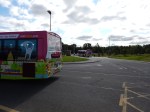


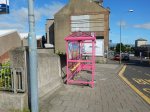

I know it is relatively early days, but information for the bus needs to be improved. You can find the stops easily, but knowing how long to wait is difficult, unless you are psychic. A big poster is needed in every stop, with the times that the buses arrive clearly marked.
The stops should also be clearly marked on the maps on the liths!
This type of tourist bus is crying out for a contactless ticketing system using bank/credit cards. Every time, the bus is used you touch in and at the end of the day your card would be charged appropriately.
In the next few years, this will become the gold standard for small payments and buses like this, that don’t embrace the technology will get lots of complaints.
If the Falkirk Wheel attracts a massive number of visitors, I feel that the area could support a rail station. Look at this Google Map of the lower basin at the wheel.

The Railway Passing The Falkirk Wheel
The railway is the line between Stirling and Glasgow and the bridge across the railway leads to the car park for the Falkirk Wheel.
To actually build a simple station should be fairly easy and visitor numbers and the level of success of the attraction will determine, if the station is ever built.
I think it will be built, as it has so many factors going for it.
Crossrail Will Affect The Buses
This article from GetWest London is entitled Improved bus services for Hayes to prepare for Crossrail.
The article talks about how Bus Route 90 is going double-deck and buses through Hayes will be improved as Crossrail, with the new Hayes and Harlington station is constructed
Provision of improved and rerouted bus services will happen at many of the new Crossrail stations.
My nearest Crossrail station will be the double ended giant at Liverpool Street that will serve both the current Liverpool Street and Moorgate stations.
From close to my house I can get a 21 or 141 bus to just outside Liverpool Street station, although coming back I have to walk to Moorgate for a northbound bus.
After Crossrail is opened, I predict that when I use Liverpool Street station, I will get a bus to a stop that will be connected by weather-free subways to any of the existing lines in the area and of course Crossrail. Coming back, these or other subways will connect me to a northbound stop to get a bus home.
I actually suspect to get the bus, it might be best to be at one particular end of a Crossrail train, so that you use an entrance to the station, that is convenient for your bus. Getting the carriage right could save you quite a walk with a two-hundred ,metre long train.
If what is provided, is not better than the current interim arrangement at Liverpool Street/Moorgate, I will be very surprised and will complain like an irate rhinoceros.
Most of the stations on Crossrail are served by London buses, also under the control of Transport for London. So improving the buses, as at Hayes and Harlington will be a matter for Transport for London, with input from the appropriate London Borough.
But what will happen at places like Brentwood, Burnham, Iver, Langley, Maidenhead, Reading, Slough, Shenfield and others,which are outside of Transport for London’s influence.
So that Crossrail has one holistic design from East to West, buses at these outer stations must conform to the rules that apply in the London area.
- Buses must be cashless, with payments either by Oyster, contactless card, concessionary pass or an extension to an orange rail ticket.
- London-style bus spider maps must be provided at all stations.
- A state-of-the-art bus arrival system must be provided in the same manner as in London, either by display or text message.
- All buses must be fully-accessible to match the fully-accessible stations.
- In an ideal world, all buses must display the next stop and be front entrance and centre exit, to help blind and disabled passengers and speed the buses on their way.
Looking at text message bus alerts like TfL’s Countdown, allowing a sixth digit to the text system would probably enable every stop in the South East to be covered.
Incidentally, according to this article in The Guardian, there are less than 500,000 transport stops in the whole UK, so six digits and one text number would cover the whole of the country.
But would the Scots, Mancunians and the Cornish, embrace a system that was designed in and for London?
Crossrail is a rail system, but it is going to affect lots of parts of our lives.
What Does The Left Know About The Economic Views Of The Man On The Dalston Omnibus?
London’s buses went cashless on the 6th July 2014, as was reported in the Guardian. The system has now expanded so you can use contactless payments on Buses, Underground, Overground, trams and National Rail in Greater London. And recently ApplePay has been allowed!
According to the Left and the Greens, this was going to result in all sorts of problems for passengers. But from what I can tell, the only thing suffering is the Oyster Card, as those on the Dalston Omnibus, would prefer their spare cash sitting in their bank account, rather than on an Oyster card, they will probably mislay.
I have extensive Google Alerts trying to locate problems with the system and I can’t find anything.
So so much for the competence of the economics of the Left Wing of British Politics!
I am surprised that we haven’t seen more special offers with contactless ticketing like Fare Free Friday to promote Mastercard.
Supposing someone like Highland Spring, wanted to promote their water and gave you say twenty pence every time, you used your contactless card on the system. This might appear on your credit or bank card statement as.
Keep hydrated on the Tube with Highland Spring.
It could be coupled with water vending machines all over the place.
I think if the prices and rewards were got right, it could be a winner.
My Credit/Charge Cards Got Cloned
I use an American Express Charge Card for my travel, for the insurance and also because, if I know I’m picking up rail tickets, I don’t have to think which card I’m using. It is contactless, so I kep it separate from my Freedom Pass to avoid card class and often I don’t take it out with me.
I also have a John Lewis Partnership Card, which I use for everyday purchases and on-line, as it doesn’t use that non-protection system Verified by Visa, which is a pain in the arse.
Over the last two weeks, both have been cloned and used online for substantial purchases. With both cards, the fraud protection systems at the card companies picked up the illegal uses and the cards were stopped , causing me the hassle of having to update various web sites, where the card is stored.
So how did the cards get cloned?
I’m not sure, but both of the card statements often come in the post on the same day. I doubt it’s anything to do with the Royal Mail, although because they are moving buildings in the main sorting office that serves me, there has been a couple of things that have gone astray or turned up late.
Normally, when the statement arrives, I put it by my computer and pay it the next time, that I go on-line. I then shred the statements.
But I’ve been away a lot in the last month or two and I’ve had builders around, which caused the shredder to be out-of-use for a time.
So perhaps I was less than zealous in shredding a statement!
I suspect that as I put the green sacks for recycling outside late on a Wednesday night, someone has been raking them over and removing ones that might be promising
One thing I have done is make the American Express card paperless, so there is nothing incriminating from that going in the rubbish.
Unfortunately, the John Lewis card has no paperless facility and as it is not contactless, I am seriously thinking of giving it the order of the boot. It will certainly be going into temporary retirement.
In fact, I would say don’t get a new credit card unless the following conditions apply.
- The card’s call centre and processing is based in the UK.
- All statements can be paperless.
- Past statements are available on-line in an easily readable form.
- Cards are contactless.
I think contactless cards are important. Most contactless payments are in big retailers or in London on transport. Transactions are probably caught on CCTV and there is often no handy piece of paper that could be taken by untrustworthy staff. The twenty pound limit also means that you can’t use them for the sort of purchases criminals like.
I have worked on very secure projects in the past and only access my bank accounts from one computer that never leaves my house.
People ask me if I would use ApplePay or the future AndroidPay. I certainly would, as if say the system was cloned and I lost money, Apple or Google would be finished. Until proven otherwise, I feel that they are more secure than contactless cards.
If you worry about contactless cards, just reflect on the fact, that I have been unable to find any negative comment about their use on London’s transport system, which is one of the largest contactless card-based systems in the world. There are so many out there who hate Boris with an absolute passion, that if anything had happened, it would be repeated ad infinitum.
The weak link in all these systems isn’t the technology, it’s the fact that we do stupid things, like drop our phone or card (Guilty, as charged!) and that criminals end up in retailers and card companies in positions, where they have access to sensitive data.
How can you be sure, that the nice man in the corner hardware store hasn’t taken your card details and sold them on to someone, who has the knowledge to take card numbers, expiry dates and names and addresses to defraud on-line retailers and service providers?
Manchester’s Ticketing In Disarray
According to this article on Global Rail News, Manchester’s plans for smart ticketing have gone down the pan.
Could the failure of this system be caused, by not using the same successful system as London?
After all the minimum requirements of any smart electronic ticketing must include :-
- A Smart card like Oyster
- The ability to use contactless bank cards from all over the world.
- The ability to use ApplePay and the future AndroidPay.
London isn’t quite there yet, but when AndroidPay arrives and they can accept any contactless bank card, they will have set the global standard, to which all transport ticketing systems must aspire.
Any city or region, that doesn’t have a system that matches London, will lose out on the independent visitors.
The biggest benefits of contactless ticketing on buses, trams and trains are.
- Cash money and its associated costs and problems are taken out of the system.
- Attacks on staff are reduced.
- Boarding is quicker, so services are faster.
- Ridership increases.
- I have a feeling that by analysing the enormous amounts of joirney data generated, prediction of where new and improved services should go is very much better.
- The book is open on fare evasion, but I think it has dropped.
So come on Manchester, join the twenty-first century!
 The Anonymous Widower