Expensive Bikes To Be Banned From Cycle To Work Scheme
The title of this post, is the same as that of this article in The Times.
This is the sub-heading.
Rachel Reeves is said to be targeting rich commuters by limiting the amount you can claim for bike gear through salary sacrifice
These two paragraphs add some detail.
Workers could be banned from buying ultra-expensive bikes through salary sacrifice schemes amid government concerns that they are being exploited by “high earners in the Surrey Hills”.
The Treasury is understood to be considering limiting the generosity of the government’s Cycle to Work scheme, which allows employees to buy bikes and accessories through an interest-free loan from their employer.
Over the years, I’ve worked with many, who have cycled to work and in the early 1970s, I regularly cycled to my clients in London.
Rachel from Accounts seems to have a death wish for the electoral chances of the Labour Party.
Stopping The Irresponsible Parking Of Hire Bikes
This sort of parking of bicycles is becoming a real curse in London.
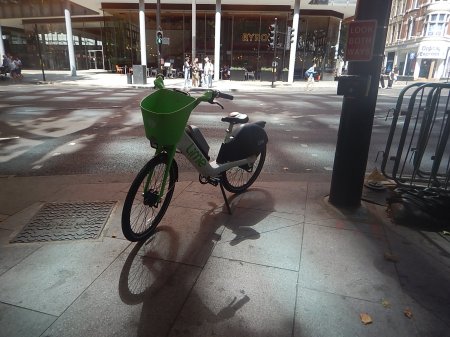
I have problems outside my house and this morning a hire bike was blocking my entrance for my Ocado delivery.
I believe that as each hire of a bike is known in detail by the hire companies, so they can charge riders, illegal parking of these bikes could be easily enforced.
We would need a law that could be enforced.
Each bike would need to have a clearly-marked serial number and/or QR-Code.
If you see a bike illegally parked, anybody can take a photograph and note the bike’s serial number, which they can then send to a central office by text message, e-mail or even an app.
The central office would then assess if any offence had been committed and if it had, would inform the hire company.
The hire company would charge the hirer, if an offence had been committed and charge them a fee.
The fee could even be split three ways to the hire company, the local authority and the person, who reported the offence.
Is It illegal To Read Your Phone While Cycling In London
I was just trying to cross the road and saw a young lady about twenty, riding towards me on a bicycle reading her mobile phone which was held in one hand and balanced on the handlebars. She was wearing a helmet and steering with one hand.
I asked Google AI, the question in the title of this post and received this answer.
No, it’s not explicitly illegal to read your phone while cycling in London, as the specific law prohibiting phone use while driving doesn’t apply to bicycles. However, it is very dangerous and you can still be prosecuted for the offense of careless cycling if your actions endanger yourself or others, with potential fines of up to £2,500.
In the past, I’ve used mobile phones, in ways that might become illegal.
- Several times, I’ve exercised a horse with a Nokia 6310i phone in my pocket, so that, if I fell off, I could call for help. I must admit, that I have received and made a few calls from the back of a horse. But in all cases, it was a well-behaved horse, that would stand quietly in a safe place.
- I once with prior arrangement of UK Air Traffic Control requested an Airways Join on a mobile phone at Ipswich Airport. But my second pilot that day, was a fully-qualified airline pilot.
I used to enjoy flying light aircraft and I do wonder sometimes, if I could still do it, after a gap of thirty years and a serious stroke? Obviously, I’d make it legal with an instructor in the right-hand seat.
E-Bike Injuries Are A Massive Burden, Say Surgeons
The title of this post, is the same as that of this article on the BBC.
This is the sub-heading.
We’re in the morning meeting on the orthopaedics trauma ward on the 10th floor at the Royal London Hospital in Whitechapel.
These three introductory paragraphs add more detail.
Like every morning, the team are here to talk through the cases that will face them in the day ahead, and a familiar theme pops up.
From one side of the room a surgeon talks about his patient: “A 32-year-old, fit and well student… a couple of days ago he fell off an e-bike sustaining a closed left tibial plateau fracture.”
And a few moments later a voice next to us describes another case: “Six-year-old girl, she was hit by an electric bike, she has a closed tib/fib fracture.”
There is a lot more like this in the article.
The introduction of e-Bikes into London has been like the Wild West, with no suitable regulation and a powerless and afraid to act Police force.
Cycling and e-bikes in particular are going to be a big issue in the next London elections in May 2026.
Silvertown Tunnel Easing Congestion, TfL Says
The title of this post, is the same as that of this article on the BBC.
This is the sub-heading.
Transport for London (TfL) has shared the first insights about the impact on traffic of the new Silvertown Tunnel, as part of commissioner Andy Lord’s latest report to the TfL Board.
These two initial paragraphs gives a summary of about three weeks traffic.
Analysis of data between 21 April and 11 May shows the Silvertown and Blackwall tunnels are being used by an average of about 88,000 vehicles on a typical weekday. Of these, about 20,000 are using the Silvertown Tunnel.
Before the tunnel opened on 7 April, about 100,000 vehicles used the Blackwall Tunnel on weekdays.
TfL are claiming that this 12,000 drop in traffic is helping to ease congestion.
Logically, a drop in traffic will ease congestion, but the BBC article also says this.
However, it said it was aware of some increased traffic volumes at other river crossings, including the Woolwich Ferry.
The only other river crossings in the area are the Rotherhithe Tunnel and the Woolwich Ferry, both of which are free to all users.
So is the drop in traffic through the Blackwall and Silvertown Tunnels, due to drivers objecting to paying a toll and taking a free route instead?
On The Buses
The BBC article says this about bus passengers.
Mr Lord’s report also provided ridership data about the three bus services that operate through both tunnels: the new Superloop SL4, the extended route 129 and the 108, which already ran through the Blackwall Tunnel before 7 April.
Across the routes there is a daily average of more than 20,000 passengers making use of these services, of which typically about 7,000 are crossing the river using one of the two tunnels. In March 2025, there were about 2,700 crossings a day made using route 108.
The increase in bus passengers is not surprising.
Before the opening of the Silvertown Tunnel, there was just this bus service through the Blackwall Tunnel.
- London Bus 108 – Stratford and Lewisham via North Greenwich.
This has now been joined by, these bus services through the Silvertown Tunnel.
- London Bus 129 – Great Eastern Quay and Lewisham via City Airport and North Greenwich.
- London Bus SL4 – Canary Wharf and Grove Park via East India, Blackheath and Lee.
Note how the buses call at rail stations, an airport and other important traffic interchanges.
In Could The Silvertown Tunnel Handle More Buses?, I asked if buses through the Silvertown Tunnel should be increased?
Given that traffic through the combined Silvertown/Blackwall complex has dropped by 12,000 vehicles per day, that must leave space for a few buses or coaches.
- Assuming, that one bus or coach takes up the space of four cars, that would be space for 3,000 buses/coaches per day.
- Also assuming the bus and coach services are run on a twenty-four hour basis, that would be 125 buses/coaches per hour.
If the bus and coach services ran every ten minutes, that would say, there is space in the tunnel for up to a dozen new bus or coach routes.
There could develop a virtuous circle and feedback loop, which drives the tunnel to a state of equilibrium, where traffic grows through the tunnels, until it is maximised.
Consider.
- Research shows a bus route from A to B through the tunnel would attract passengers.
- Drivers and their passengers decide that on balance a bus ride is more convenient, no slower and more affordable than driving.
- Congestion charges and other charges for non-electric vehicles will play their part.
- Green issues will also will play their part.
- Fewer cars will use the tunnels.
- Increasing tunnel charges will only drive more car users to the buses.
- More free space in the tunnel, will allow more bus and coach routes.
- More bus and coach routes will attract drivers from their cars.
Eventually, equilibrium will be reached.
A similar effect happens, when a new bypass is opened and as if by magic it fills up.
When it happens with train services I call it, London Overground Syndrome.
On Your Bike
The BBC article says this about cyclists.
There is also a cycle shuttle service, enabling cyclists to take their bikes free of charge on a bus through the Silvertown Tunnel. TfL said some 100-150 people were using it on a typical day.
While this is below its capacity, TfL believes usage will grow as cyclists adapt their routes to benefit from this safer crossing option.
When I used to cycle around London in the 1970s, I never cycled under the Thames, but I did generally cycle as fast as I could across the city. I wouldn’t have put my bicycle on a free bus.
So, is this why the cycle shuttle service is below capacity?
The BBC article says this.
TfL believes usage will grow as cyclists adapt their routes to benefit from this safer crossing option.
I believe, that if TfL should ever charge for the cycle shuttle service, they’d kill it.
In my opinion, they’d be better off providing secure bike parking, but even some of that seems lightly used.
Tunnel Performance
The BBC article says this about tunnel charging and performance.
TfL said it intended to publish quarterly factsheets on the operational performance of the tunnels’ toll scheme.
This will include information about how many people pay the charge, the compliance rates for vehicles using the tunnels and the number of Penalty Charge Notices that are issued.
The first of these factsheets will be published later this year, but initial data shows that compliance has steadily increased, with about 90% of motorists either paying a charge or benefiting from an exemption.
Surprisingly, so far, I haven’t met anybody who has driven through the Silvertown Tunnel, except for a couple of bus drivers.
Critical Mass London: Hundreds Of Protesting Cyclists Ride Through Silvertown Tunnel In ‘Mass Trespass’
The title of this post, is the same as that of this article on Yahoo News in Canada.
These paragraphs describe the mass trespass.
Around 1,000 cyclists descended on the newly opened Silvertown Tunnel in a protest calling for greater road safety amid anger it has no bike lane.
Riders from Critical Mass London swarmed the northbound entrance near the O2 Arena in “a mass trespass” on Friday night.
Entering from the Old Kent Road, they took over both lanes near North Greenwich and blocked incoming motorists.
The ride through the tunnel took about 10 minutes before the cyclists moved off towards Poplar.
But on X, formerly Twitter, people reported that the road was closed for over an hour after they had left.
The £2.2bn Silvertown tunnel – opened by London mayor Sir Sadiq Khan earlier this month – has faced criticism from transport pressure groups for its lack of provisions for cyclists and pedestrians.
I suppose, at lease they weren’t riding on the pavement, as they do all the time near me.
I was even hit by one, on a zebra crossing, as he passed a bus on the wrong side, that had stopped to let me cross.
There is not one law for cyclists and one law for everybody else!
TfL May Increase e-Scooter Speed Limit And Lower Age Restriction
The title of this post, is the same as that of this article on the Telegraph.
This is the sub-heading.
Riders would be able to travel at 15.5mph including 16-year-olds who hold a provisional driving licence
I’m now seventy-seven and I’ve never ridden one of these devices. I didn’t even have one of the push-only variety, as a child in the 1950s.
The article says this about serious injuries.
The authority’s own data shows that e-scooter operators have reported 35 serious injuries since 2021. A serious injury is classified as those requiring hospital “in-patient” treatment, fractures, concussion, internal injuries, crushing, burns, severe cuts or injuries causing death 30 or more days after the collision.
A death figure is not given, but deaths have happened.
My feeling is that thirty-five serious injuries in three years is too high.
But then allowing those as young as sixteen to use these devices without adequate training is surely asking for trouble. I was sixteen once and know how irresponsible, I was on an unpowered bike, at that age.
I have to ask the question, if safety would be improved, if some form of training were to be compulsory?
My parents had a relaxed attitude to my road safety training.
- I was allowed on a bike in the suburban streets of London without training.
- I never took any Cycling Proficiency training.
- At sixteen, I used to cycle down the A45, which is now the A14, between Ipswich and Felixstowe amongst all the heavy trucks.
- I never had any formal driving lessons and had my own car soon over my seventeenth birthday.
In all the miles, I cycled and drove, I never had a serious accident.
- But I am still unhappy at the two proposals in the title of this post.
- Is it that many e-Scooters are ridden irresponsibly or outside the law?
- I am also worried about the propensity of e-Scooters and e-Bikes to catch fire.
I would certainly be happier if a reasonable set of rules for these devices had been devised and was strictly enforced.
Will 22 Ropemaker Street Have Shops?
As I walked past 22 Ropemaker Street on Sunday, the builders appeared to be finishing off the Ground Floor.
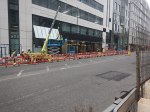
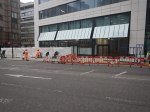
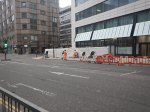
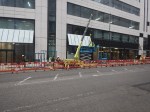
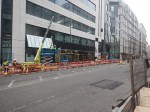
Looking at the building’s web site, there is no mention of retail.
- But the web site does show off the transport and walking connections.
- It also has its own entrance for cyclists.
- Car parking is not mentioned on the web site.
- The web site also details the building.
It’s certainly a well-designed office building.
London’s Cluttered Pavements Are A Chronic Issue, Report Finds
The title of this post is the same as that of this article on the BBC.
This is the sub-heading.
Central London has “chronic issues” with street clutter, making it a worse place to live, visit and work in, a think tank has warned.
And this is the first paragraph.
A-boards, disused phone boxes and rubbish bags all make pavements unwalkable, especially for those who are mobility or sight impaired.
As someone, who was stopped from driving because of bad eyesight, I’ll agree with that paragraph.
But the biggest clutter are hire bikes just left anywhere in the middle of the pavement.
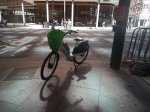
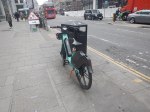
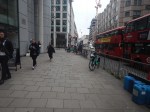
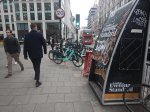
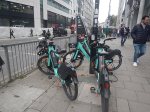
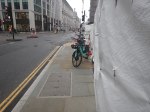
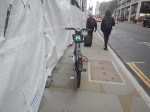

How do we stop idiots doing this?
This problem is one, where we need sensible action from the Mayor.
One of my criteria, in who gets my vote at the next Mayoral election, will be what they will be doing about street clutter.
Bikes left in places, where they shouldn’t be is easy to solve.
Transport for London should have a few trucks picking up bikes, that have been left in illegal places.
The hire companies would then need to pay an appropriate fine to get the bikes back.
I would also allow private individuals and companies to collect illegally-parked bikes. It could be a nice little earner.
Should There Be Limits To The Type Of Vehicles Allowed In The Blackwall And Silvertown Tunnels?
When the Silvertown Tunnel opens in 2025, the tunnel and the nearby Blackwall Tunnel will be tolled.
But will there be any restrictions on the vehicles that can use the tunnels, other than those that apply to the Blackwall Tunnel at the present time, which are detailed in Wikipedia.
The tunnels are no longer open to pedestrians, cyclists or other non-motorised traffic, and the northbound tunnel has a 4.0-metre (13.1 ft) height limit.
Note.
- I suspect that pedestrians, cyclists or other non-motorised traffic will also be banned from the Silverton Tunnel.
- But the height limit will be relaxed for the Silverton Tunnel to allow large trucks and double-deck buses to use the tunnel.
According to this web page, which is entitled the Silvertown Tunnel Bus Network Proposals, the planned buses through the tunnel include.
- 108 – As now, with a minor route change.
- 129 – As now, but extended from North Greenwich station to Great Eastern Quay.
- X329 – An express bus from Grove Park station to Canary Wharf, which runs non-stop through the Silvertown Tunnel.
Note.
- The 108 goes through Blackwall and is a single decker bus.
- The 129 and the X329 will go through Silvertown and could be double decker buses.
- There appears to be no mention of any provision for cycles.
- I would assume wheelchairs, buggies and cases will be accommodated as they are on current London buses.
I also think, that the buses must be zero-carbon, which would mean battery-electric or hydrogen.
In Hydrogen-Powered Vehicles And Trains In Tunnels, I looked at the feasibility of running hydrogen buses through the tunnel and came to this conclusion.
I am confident, that we will achieve a safety regime, that allows hydrogen-powered vehicles and trains to be certified to pass through tunnels.
The great advantage of hydrogen buses on the three routes would be that they would probably only need to be filled up once a day, but electric buses might need constant charging.
Provision For Cycles
I think it is essential to have provision for cycles across the river.
- Folded cycles can be taken almost anywhere on London’s transport system.
- Non-folding cycles can be taken most places on London’s transport system, but the hours are restricted.
- There’s always the Woolwich Ferry.
- Given that the 108 bus seems to weave its way through the East End, I suspect that this bus couldn’t be longer to carry cycles.
I have seen double-deck buses, with provision for cycles at the back of the lower deck in Europe.
- Perhaps buses like these, could be used on the 129 and X329 routes.
- A search of the Internet found some buses in East Yorkshire with provision for two standard cycles.
- The 129 bus could ferry bikes between North Greenwich station and a convenient stop on the North side of the river.
- The X329 bus could ferry bikes over the non-stop section of the route between the Sun in the Sands and Leamouth roundabouts.
There could be shorter routes adding extra capacity between the stops, where bikes are loaded and unloaded.
Large Trucks Through The Tunnel
If buses become zero-carbon through the Blackwall and Silverton Tunnels, then why shouldn’t large trucks be zero-carbon?
I think this could be the carrot combined with free passage for zero-carbon vehicles that could clean up Central London’s polluted air.
Smaller Vehicles
Why not gradually reduce the size of vehicles going through the tunnels that must be zero-carbon?
Conclusion
The Silvertown and Blackwall Tunnels can be used as the drivers to clean up Central London’s air.
 The Anonymous Widower