The Platform For The Future
The June 2016 Edition of Modern Railways has a section about The Railway Industry Innovation Awards 2016.
One is labelled the Platform for the Future.
That probably sounds rather boring, but I’m a great believer in disruptive technology and using new and innovative methods to replace something that is rather dull, with something that is better, quicker to be installed and get working and more affordable.
This is said.
Abellio Greater Anglia and Dura have pioneered the use of a composite platform at Needham Market station in Suffolk, which was installed in just 36 hours.
This installation might be considered surprising as Needham Market station is a Grade II Listed building. So it can’t look like.
A monstrous carbuncle on the face of a much-loved and elegant friend.
But the product comes with these advantages.
- The design life is sixty years.
- A financial saving of 25% is reported.
- As the platforms are built in a factory, the quality should be tip-top.
- Other features like Harrington Humps could be built-in.
Hopefully, this would dissuade even the most determined member of the Heritage Taliban from objecting.
There’s more here on the Dura website. There’s also this video, of the platform being installed at Needham Market station.
This is a picture I took from a p[passing train.
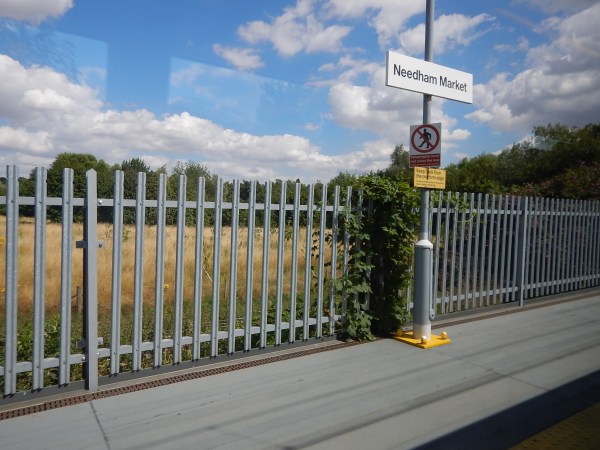
It looks good and who would think it was long-life hard-wearing plastic.
Only members of the Taliban tendency of the Green and Heritage lobbies would probably object!
I think that this product could find lots of applications, in traditional heavy rail, light rail and tramways. Certainly, it could be used to create some of the needed extensions to platforms on the Gospel Oak to Barking Line.
Look at these pictures taken at Harringay Green Lanes station.





Would composite platforms make extending these platforms an easier process?
The company might also have the solution to the dual-height platforms, that some people feel are needed for tram-trains. The Germans certainly use stepped platforms so that different types of tram-trains have step-free access.
In fact, why restrict it to rail applications?
It could be used to provide a disabled viewing platform at somewhere like a horse racecourse or other sporting venue.
Or how about helping to create step-free bus stops, that I wrote about in One Of London’s Step-Free Bus Stops?

One Of London’s Step-Free Bus Stops
It’s certainly a very good innovation.
Is Vivarail True Disruptive Innovation?
Disruptive innovation is defined like this in Wikipedia.
A disruptive innovation is an innovation that helps create a new market and value network, and eventually disrupts an existing market and value network (over a few years or decades), displacing an earlier technology.
I’ve always been a great believer in this sort of innovation.
When we started Metier Management Systems and created Artemis, project management was worthy, time-consuming and if a computer was used it was an expensive mainframe. So we took a small but powerful industrial computer put it in a desk, added a VDU and a printer to do the same PERT and financial calculations much faster and often much physically closer to where the answers were needed. I have heard argued that one of our reasons for great success in the early days of North Sea Oil, was that you could find space for an Artemis system in Aberdeen, but not for a mainframe. The city was crawling with dozens of our systems.
After Artemis, project management was never the same again!
If we look at the building of trains, it is supposed to be an expensive business, with large manufacturers like Alstom, Bombardier, Hitachi and Siemens make expensive complicated trains, that are virtually computers on wheels. But at a price and to a time-scale that is such, that say a train company needs perhaps some extra four coach diesel multiple units to support say a Rugby World Cup or Open Golf venue, there is nothing that can be delivered in a short time.
Over the last few years, disruptive innovation has been alive and well in the train building industry. In the 1970s and 1980s, we built a large number of trains and electric and diesel multiple units based on the legendary Mark 3 coach. Wikipedia says this about the coach.
The Mark 3 and its derivatives are widely recognised as a safe and reliable design, and most of the surviving fleet is still in revenue service on the British railway network in 2015.
It is truly one of the great British designs. My personal view is that the ride in a Mark 3 coach, is unsurpassed for quality by any other train, I’ve ever ridden, in the UK or Europe.
A Mark 3-based multiple unit also survived the incident at Oxshott, where a 24-tonne cement mixer lorry fell on top of the train. There were injuries, but no-one was killed.
So what has the Mark 3 coach got to do with disruptive innovation?
They are like a well-built house, that constantly gets remodelled and improved by successive owners.
The structure and running gear of a Mark 3 coach is such that it is often more affordable to rebuild and improve Mark 3-based trains, rather than order new ones.
If Terry Miller and his team in Derby, had not designed the Mark 3 coach and the related InterCity 125 in the 1960s, I suspect that UK railways would be in a truly terrible state today.
These trains still remain the benchmark against which all other trains are judged. Two journeys sum up the class of a Mark 3 coach.
- Travel in First and enjoy Pullman Dining on a First Great Western service between London and Wales or the West. Is there any better rail journey available without a special ticket in the world?
- Travel in Standard on Chiltern to Birmingham and enjoy the ride and the views from the large windows, in the style that the designers envisaged for all passengers.
But the Mark 3 coach has created this industry in the UK, that can take well-built old trains and turn them into modern trains, that are often the equal of shiny new ones from the factory.
So where do Vivarail fit in all this?
London Underground has always specified the best for its railways and expected the trains to last a long time. In some ways it had to, as when it depended on Government favours for new trains, it could not predict if the replacements would ever be forthcoming.
Until the 1980s, most trains were built by Metro-Cammell in Birmingham and regularly fleets have lasted for forty or fifty years, as they were built to handle the heavy use in London, where journeys can be over an hour of full-speed running with frequent stops and often with far more passengers than the trains were designed. Take a Piccadilly Line train from say Kings Cross to Heathrow in the rush hour, if you want to see the sort of punishment that London Underground trains are built to take. The last of these Piccadilly Line trains were built in 1977 and under current plans, they will have to stay in service to 2025.
The oldest London Underground trains still in regularly passenger service, are the Class 483 trains used on the Isle of Wight. Admittedly, they are running a service in a less-stressful environment after fifty years service in London, but the trains were originally delivered to London Underground in 1939 or 1940.
The London Underground D78 Stock, that has been purchased by Vivarail for conversion into the D-train, were first delivered in 1980, so they have only taken about thirty-five years of London’s punishment.
The trains were also extensively refurbished in the mid-2000s.
It also has to be born in mind, that although London works its Underground trains very hard, they also get first class servicing.
Several factors have all come together to create an opportunity for Vivarail.
- There is a desperate shortage of diesel multiple units all over the UK. Partly, this is because of a need to replace the ageing Pacers, but mainly because of the growth in passenger numbers and the reluctant of Government in the 2000s to invest in much-needed new diesel trains.
- Network Rail’s well-publicised problems with electrification, only makes the need for more diesel trains more important.
- A lot of trains will have to be taken out of service as they don’t meet the disability regulations.
- The UK’s world-class train refurbishment business, which has honed its skills on creating new trains from old for forty years, is ready for a new project.
- There is now a supply of well-maintained, corrosion-free D78 Stock, that may not be sexy, but are as tough as teak, that are surplus to requirements.
It should also be said, that train operators and passengers want more flexible and better specified train services on difficult lines that are unlikely to be electrified in the near future and are difficult lines on which to provid a decent reliable train service.
Read any of the serious literature about the D-Train and it shows that the engineers are taking the project very seriously and are thinking very much outside the box.
- Power units are based on Ford Duratorq diesel engines mounted on rafts under the train, with two to each power car.
- These rafts can be changed using a fork lift at a remote location.
- Flexibility of interior layout to suit the route.
- Extensive use of LED lighting, Wi-fi and other modern technology.
- The crash test has been released as a video. How often do you see that?
But perhaps this article from Rail Magazine entitled Catering for VivaRail’s rebuilt D-Stock, illustrates their innovative thinking better than ever.
The more I read about the D-train, the more I think it will surprise everybody.
It is true world class disruptive technology. And British technology too!
Zopa Goes With The Flow
This article on CrowdfundInsider talks of a tie-up between a boiler maker; Flow and a peer-to-peer lender; Zopa. This describes the link.
The Flow boiler will be launching in January 2015 and will be available to customers through a new finance package. This will provide a payback time of five years for the complete cost of the boiler. Customers may purchase the Flow boiler using a separate unsecured personal loan via Zopa, with repayments being off-set by reductions in your home energy bill from the value of the electricity generated.
I think we’ll see a lot of deals like this, where two new companies in different fields link up to make two and two add up to six.
This is disruptive innovation at its best.
The NHS And Disruptive Innovation
I’m a great fan of disruptive innovation. It summed up in Wikipedia as follows.
A disruptive innovation is an innovation that helps create a new market and value network, and eventually goes on to disrupt an existing market and value network (over a few years or decades), displacing an earlier technology.
In some ways the classic disruptive innovation is iTunes, where Apple changed the music industry totally.
I, of course, would be a fan, because my first great success was Artemis, which took the project management industry out of the domain of large mainframe computers and cumbersome management structures into a computer that fitted under a desk.
But I have given this post, the title I have, as the NHS and other health systems is coming under pressure from disruptive innovation.
My other big innvation success was also disruptive innovation.
I was one of the backers of the technology that led to Respimat, a metered-dose inhaler.
That device seems to be too disruptive, as despite many years of development, I don’t think it is in general use.
It doesn’t use any batteries, compressed gases, nasty chemicals and is affordable to be throwaway. But despite their HCFC propellants, the incumbents in the healthcare industry, have not given market share.
But I have the satisfaction, that because of my scientific knowledge and practical experience, I spotted that the guys I backed could do something special. At least too, when I sold my share, I was well rewarded.
I do feel though that the NHS doesn’t do things in the same way as perhaps John Lewis would, when it comes to handling new methods of working.
As an example I was talking to my excellent GP about how having my cholesterol results on my blog, helped the doctors in Hong Kong when I had my stroke. I said it would be great if all our medical records were searchable on line. We were also discussing a small operation I had on my nose ten years ago and wondering if it should be done again to stop the nose bleeds I sometimes get.
We then both said that computerisation had been an expensive farce, but we were both agreed it would be a good thing, especially if like me you travel a lot. He did say Google launched something called Google Health, but that has now been discontinued. Read about it here.
So did the general conservatism of health professionals and a lot of the general public kill the project. Google don’t have many failures.
Reading about it, it seems that it would have been something I would have used.
If I look too at my Coaguchek, that is classic disruptive innovation. I don’t know how many use the device in the UK, but I suspect it’s not a large proportion of those who could benefit from such a device.
I suspect though that in a few years this device and its probably simpler successors will be as accepted as the monitors used by diabetics.
Small personal patient used technology like this will become more common. After all, we now have a population, who love their gadgets and what better gadget is there, than one that helps you improve your health.
The NHS is going to have to get used to new technology and especially where that technology shows substantial cost savings. But a lot of it, will mean changes in methods and management structures.
Disruptive innovation will improve the NHS, but it will be an NHS with a different number and type of hospitals, and staff not always deployed as they are now.
Disruptive Innovation
I’ve not heard the term before, but read this article. It starts with this question and answer.
Question: what do these companies have in common?
Skype, Spotify, Marks and Spencer, Whipcar, Zopa, Zilok, Kiva, Patagonia, Kickstarter, Café Direct, Taskrabbit, Buzzcar and InterfaceFLOR.
Two of my favourite innovators; Zopa and Kiva are mentioned in the same breath as quite a few companies like, Skype, Spotify and M&S.
If the article has a fault, it’s that it misses out a couple of well known names, who the writer would call disruptive innovators.
I would have thought ARM Holdings and Dyson should be on the list. And I would think that a certain company called Metier Management Systems was one of the first! So we were only a shark in a small pond, but we completely rebuilt the pond.
 The Anonymous Widower