The Future Of East West Rail
There is an article with this title in Rail Technology Magazine.
This is the opening paragraph.
Shortly before the end of last year, transport secretary Chris Grayling announced unprecedented proposals to create a new and independent East West Rail operation tasked with designing, managing and running services between Oxford and Cambridge.
After the opening of the first section of the route, from Oxford to Bicester and on to Marylebone, which I wrote about in Oxford To Marylebone Opens For Business, things seem to be moving on.
- The Government has announced that the East West Rail Link could be privately financed, built and run.
- This article in Rail Magazine, which is entitled Verster to leave ScotRail for East West Rail, states that Phil Verster from ScotRail will head up the East West Rail Project.
Let’s hope it all means full steam ahead.
Cambridge Thinks About More Stations
This article in the Cambridge News has a headline of Support for re-opening South Cambridgeshire railway station is gathering pace.
It talks mainly about the reopening of Fulbourn station between Newmarket and Cambridge.
This is said.
The Reopen Fulbourn Railway Station group is calling for the station to be reinstated as part of a drive to boost rail connectivity in the area.
Later in the article it says that the Council also wants to open a new station at Addenbrooke’s Hospital and reopen the closed station at Cherry Hinton.
A station at Addenbrooke’s Hospital is pencilled in for the East West Rail Link and the other two stations are on the Ipswich to Cambridge Line.
Wikipedia says this about a previous attempt to reopen the station at Cherry Hinton.
Reopening of the station was proposed by Cambridgeshire County Council in May 2013 as part of an infrastructure plan to deal with projected population growth up to 2050. A proposal to reopen the station had previously been made in 1996 but 70% of residents who responded to a Council questionnaire were against it; in any event, a new station was not considered viable at that time.
There are some cynical comments to the article as well.
But circumstances have changed since 1996.
- Cambridgeshire County Council has more responsibility for this type of spending.
- As I said in Will We Be Seeing More Railway Stations?, it looks like design, technology, new trains and costs are making it easier to make a good case for a new station.
- Greater Anglia will be running new high-performance trains through Fulbourn and Cherry Hinton in a couple of years.
- Network Rail are removing level crossings in East Anglia and there are several in the area, including one at the site of Cherry Hinton station.
The level crossings could be the clincher, as there is a lot of opposition in some places to their removal.
Would Network Rail duck the problems and leave everything as it is?
Levitation Magic
How do you raise a 200 tonne masonry arch bridge by 900 mm, so that you can fit overhead electrification and freight trains with large containers under the bridge?
You used to call in Paul Daniels, but now he’s gone you have to use other forms of magic!
If finesse doesn’t work, you resort to the brute force technique that IK Brunel used to launch the Great Eastern – hydraulic power.
This article on the Freyssinet web site, describes how the bridge was lifted.
For an encore, the engineers then lowered the bridge by 465 mm.
Why raise a bridge like this?
Surely, to use a simple method, like explosives or a large hydraulic breaker and rebuild is a lot easier.
The trouble is it isn’t as this method disturbs the working railway much less and is quicker.
Network Rail also have five hundred bridges like this that need to be raised.
It would certainly make an interesting live stream from the Internet. Perhaps, a fee could be charged to watch for a charity like Cancer Research UK.
Brunel, who played the showman at times, would have approved of that!
Why Grayling’s Proposal For The East-West Rail Link Could Be Right?
I’m not saying it’s right that one company will build the line and then operate it, but I do think it could have advantages.
Track
With the exception of a few short lengths of existing track, most of the construction is a green field site or one where there is just rusty worthless track from decades ago.
This must give opportunities to design a future-proofed route, that in say the 203os or 2040s could run trains much faster, frequent, heavier and longer, than envisaged today.
The route can also be optimised for what is mow believed to be the likely scheduled service.
Stations
This line could have stations optimised for the modern level of working, that the line will.use.
Nothing should be ruled out in station design, if it makes for a more efficient railway.
I would also hope that stations could be modular, so that improvements and new stations could be added by the operator as ttaffic changes.
Get the design right and the company, passengers and staff will benefit.
It would be easier to get the design right, if all stakeholders are in the same team.
Electrification
Parts of the route are electrified and it will have connections to existing electrified lines at Bedford, Cambridge, Milton Keynes, Oxford and Reading.
I believe that there could be considerable savings to be made, by designing the electrification so that it is integrated with the trains bought for the line.
For instance, I believe in a few years time that all new trains will have on-board energy storage, so could this be taken advantage of to perhaps?
- Enable regenerative braking on trains, rather than trackside
- Not put overhead wires in stations.
It could be difficult for freight trains and other electric trains, but there could be scope to simplify the electrification.
Signalling
Go digital to save money.
Operation
I have sat in the cab of a High Speed Train as it went between Edinburgh and Inverness. You see a lot and surely some that drivers see could be safety related.
Surely, if the same company is responsible for both trains and track, reporting and fixing problems must be much more direct.
Conclusion
Good design could really.make the railway cheaper to build and operate.
So if it’s one company, with everybody working to the same objectives, it must benefit that company, if someone has a good idea at any point.
If they have a bad idea, then hopefully it will.be ignored.
A Good Idea For The Railways?
I’ve just read this article on the BBC, which is entitled Trains and Track Come Together In Rail Management.
It could be a good idea.
If I take the railway I know best, the London Overground, the track and stations, may still be owned by Network Rail but TfL work strongly with NR in deciding what gets done and when it gets done. You could almost say that LO is the tenant and NR is the landlord, but that both bofies sit together on the same management structure. It seems to work well however they do it. But it’s mainly good management and probably good people too.
You might ask, why doesn’t LO own the tracks and have their own maintenance teams! But do you do all the work on your house yourself or call in a specialist?
But as with a block of flats having a central.focus gives all owners and tenants a central point to get something fixed.
As the BBC article says, Network Rail has split itself into the various routes. So in East Anglia, NR’s local team are responsible for tracks and Greater Anglia for trains.
I can see interesting possibilities opening up. Say you are a developer and you have obtained planning permission to build a large industrial park or thousands of houses on an old military site, that lies alongside the railway.
As the joint management now has all the assets and permissions to fit a new station into their network, the developer might get the new station they need to make their development very successful.
Some will argue that trains and track should be in one enormous nationalised industry, but how would the little man on the Felixstowe Class 153 get a handle on that?
An Understated Headline
This article on Business Insider is entitled A rail link between Oxford and Cambridge could help create a massive tech hub in the UK.
Could is not the word I’d use!
This page on the Government web site, contains a summary of the report, on which the article is based.
This is the second paragraph of the report.
The Commission’s central finding is that a lack of sufficient and suitable housing presents a fundamental risk to the success of this area. Without a joined-up plan for housing, jobs and infrastructure across the corridor, it will be left behind its international competitors. By providing the foundations for such a strategy, new east-west transport links present a once in a generation opportunity to secure the area’s future success.
As housing is so important to any development, this is crucial. The interim report makes a series of recommendations. This is the first.
- Government should go ahead with East West Rail’s initial phase, a new link cutting journey times by more than half on the route from Oxford to Bedford and Milton Keynes, ensuring it is delivered before 2024; and it should invest in developing as soon as possible detailed plans for both the next phase of East West Rail (which would complete the link to Cambridge) and for a new Oxford-Cambridge Expressway.
So why is the Government farting about?
I blame the following.
- The route via Bedford, contains lots of great-crested newts, in all the disused brick works.
- The name; East West Rail Link, doesn’t have North in it.
- Oxford doesn’t want a railway, that might encourage more visitors who would interfere with academic life.
- The Sir Humphries of this world went to one of two universities; Oxford or Cambridge. They believe the two academic cities shouldn’t be connected and certainly not via Milton Keynes.
- Addenbrooke’s hospital has objected, as it will bring lots of patients from the route to their world-class facilities.
- It doesn’t go near Islington for the Labour Party or Edinburgh for the SNP.
- Democracy
The Chinese would have built it last week or possibly yesterday, as it calls at Bicester Village!
A Level Crossing That Should Be Closed
One of my Google Alerts found this article in the Bicester Advertiser, which is entitled Tunnel could be dug under Bicester London Road railway line to keep route open.
So I found a Google Map of the crossing and Bicester Village station.
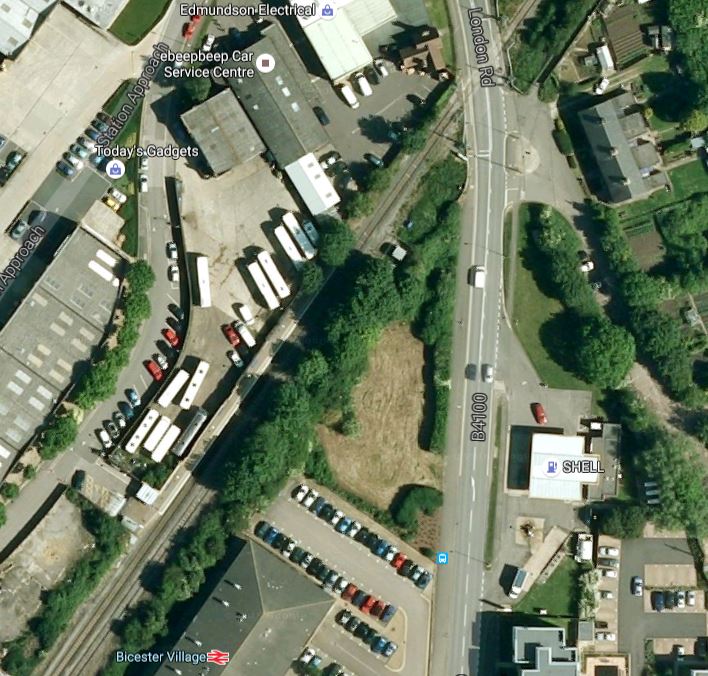
Bicester Village Station And The London Road Level Crossing
If you consider that when the next phase of the East West Rail Link opens in a few years time, the following passenger trains will be going through the station.
- 2 trains per hour (tph) from London Marylebone to Oxford
- 2 tph from Oxford to London Marylebone
- 2 tph from Reading to Bedford/Milton Keynes
- 2 tph from Bedford/Milton Keynes to Reading
That is 8 tph for a start and when you add in a few long freight trains, it is surely a good idea to close the level crossing and dig a road tunnel under the rail line.
Sometimes You Win Slow
Announcements on the East West Rail Link, haven’t exactly come thick and fast, the last one being the route of the section between Bedford and Cambridge, that I talked about in Is Cambridge University Being Pragmatic About The East West Rail Link?, was published in March 2016.
This article on Mix96 is entitled Winslow’s Station Is One Step Closer.
This is said.
Now a station for the town is one step nearer as Bucks County Council has paid £900,000 for a site to build it.
That looks like nine hundred thousand small steps to me.
Winslow station is to be built to the North-West of the town and this Google Map shows the location.
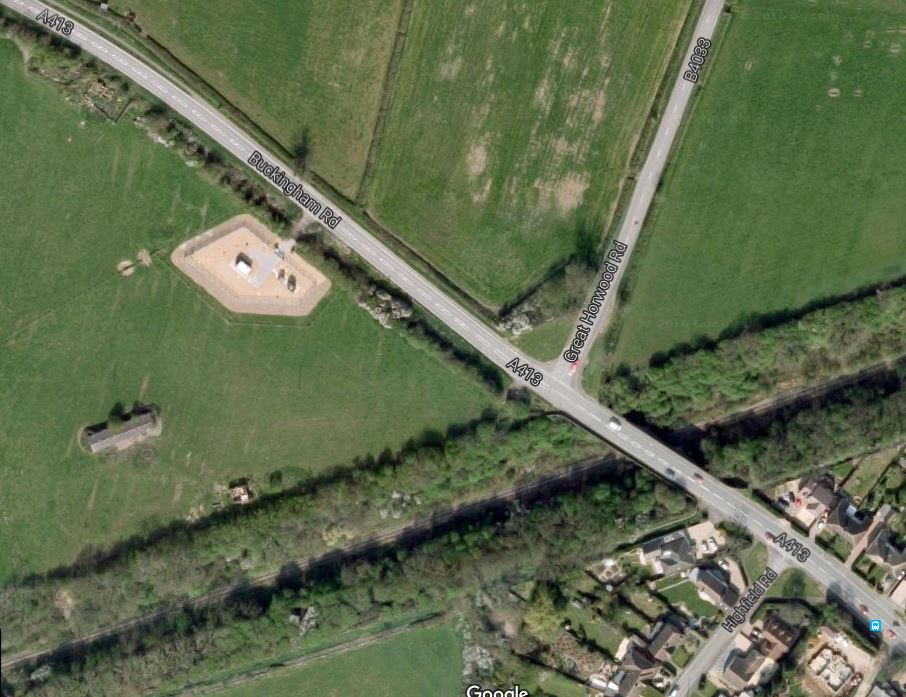
Winslow Station Site
The lower black scar contains a rusty single-track and is all that remains of the original Varsity Line
When open the station will have two services.
- London Marylebone to Milton Keynes Central via Aylesbury, Winslow and Bletchley
- Reading-to Bedford via Oxford, Winslow, Bletchley and possibly Milton Keynes Central.
Wikipedia talks about opening one train per hour on both services in 2019.
Is Cambridge University Being Pragmatic About The East West Rail Link?
I must admit, I was a bit surprised, when it was announced in this article in Global Rail News, that the East West Rail Link would go via Sandy between Bedford and Cambridge. This is said.
Network Rail has selected the Bedford-Sandy-Cambridge corridor as its preferred route for the Central Section of the East West Rail project.
The preferred route was chosen from 20 options and will now be developed further with a view to producing a ‘line on a map’ route in May.
They also show this map.
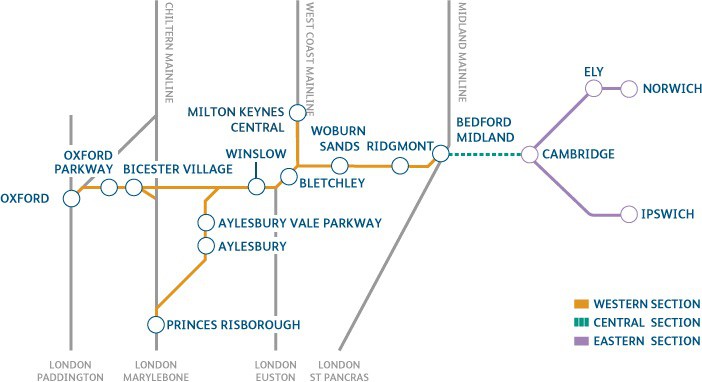
East West Rail Link
Various other articles suggest that the route will also be via Bourne Airfield and Addenbrooke’s Hospital.
I have traced the old route of the Varsity Line and very little seems to have been built on the route of the old line. Much too, seems to be on flat Cambridgeshire farmland and farmers are usually easily persuaded by alternative and profitable land uses.
The big problem is the old line is used as the track for the Mullard Radio Astronomy Observatory‘s Ryle Telescope. I’ve heard several times from astronomers in Cambridge was that it is very important and it was the major reason, why the railway line couldn’t be rebuilt on the old track-bed.
I do wonder, if Cambridge University values a direct link to Oxford highly and that as the Ryle Telescope is getting quite old, that it is better value to move it to allow the railway to be built.
A Quick Look At The Route
I’m starting at the Cambridge end and going East, as that is the area I know better.
The Varsity Line In Cambridge
This Google Map shows how the old Varsity Line connected to Cambridge station.
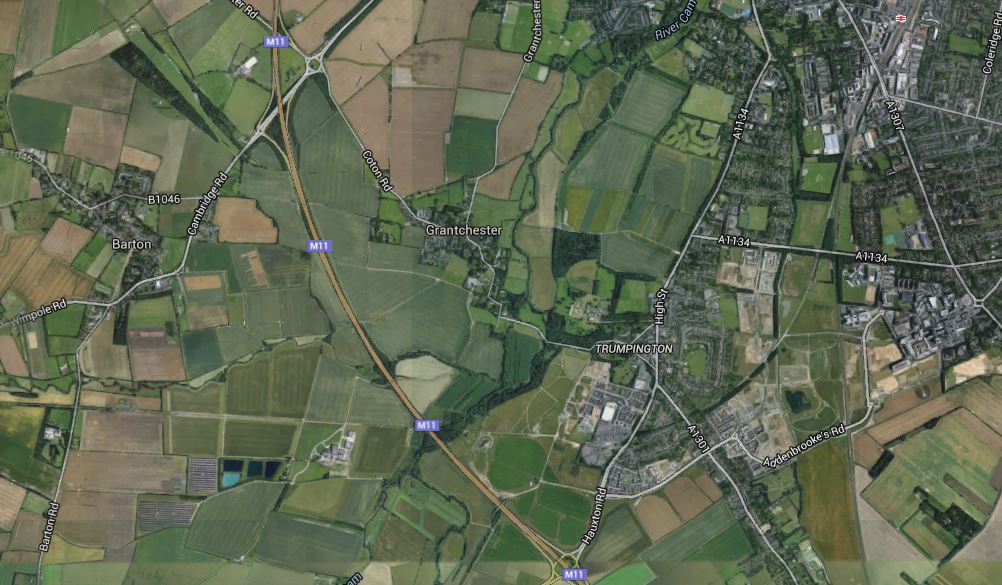
The Varsity Line In Cambridge
Note how the M11 curves to the West of Cambridge. You will notice, that there is a sandy coloured line going West from the motorway, which starts at the second blue market by the kite-shaped field, that identifies the road on the map. This is the disused trackbed of the Varsity Line and after passing under the motorway, through some housing in a cutting and under another road, it turns North to join the main Cambridge to London Rail Line.
Cambridge station is in the North-East corner of the map.
Cambridge Station
This Google Map shows Cambridge station and the rail lines going South from the station.
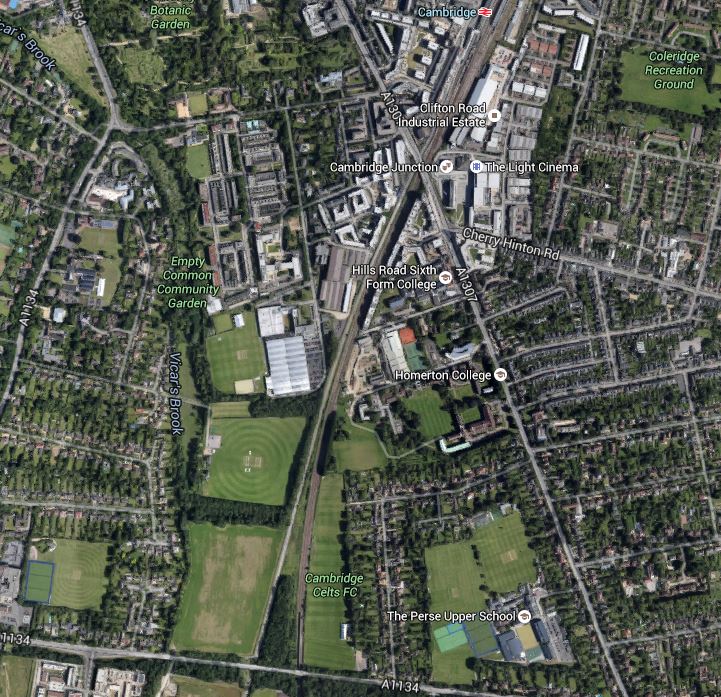
Note how after going under the bridge at the South End of Cambridge station, the main rail line goes off in a southerly direction pass the sports ground and then under the A1134.
Branching off from this rail line and going slightly to the West, there appears to be a second rail line. This is the trackbed of the Varsity Line, which has been converted into the Cambridge Guided Busway.
Cambridge station is a very busy station and has recently been upgraded with a long pair of island platforms and it is going to get even busier with Cambridge North station opening soon and Thameslink services due to call in a few years time.
The opening of Cambridge North station, may ease access to Cambridge station, as those living in or to the North of Cambridge, will be able to use the second station.
Addenbrooke’s Hospital
I have believed for many years, that there needs to be a Cambridge South station at Addenbrooke’s Hospital. This is the view of many in Cambridge and the surrounding areas.
This Google Map shows Addenbrooke’s Hospital and the land to the West.
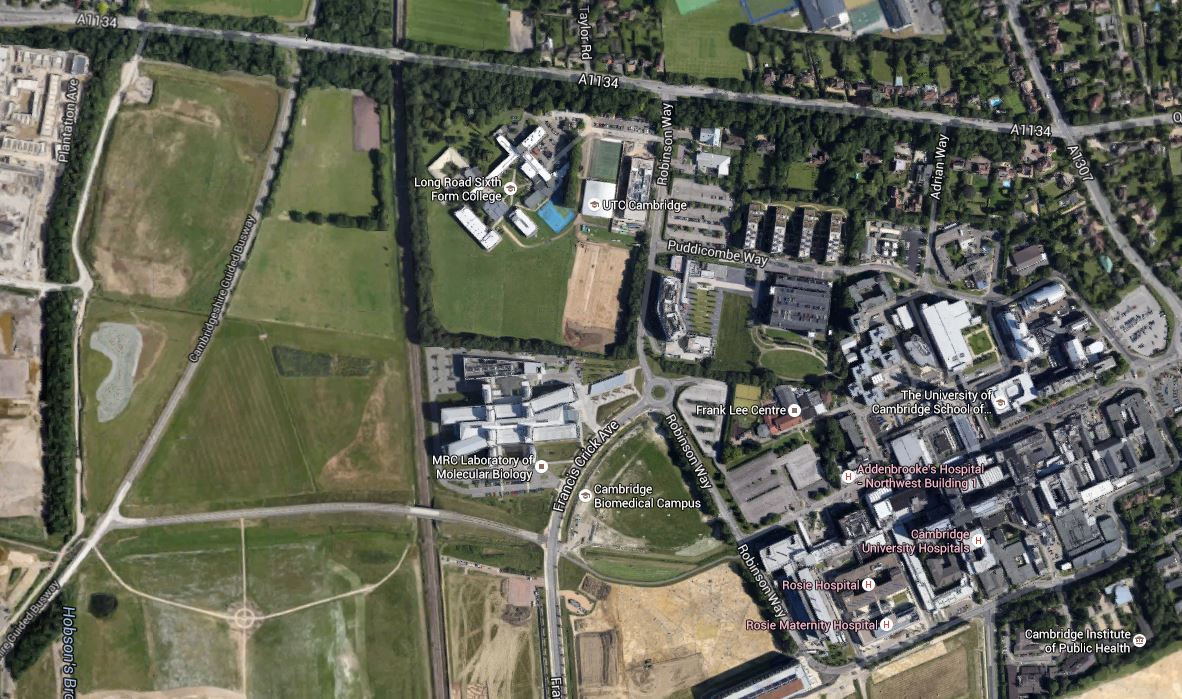
In addition to being a large general hospital, Addenbrooke’s is surrounded by major research institutions as the map shows.
It is generally sited to the East of the main railway line between Cambridge and London, which runs North-South down the map, with Cambridge station to the North and the junction where the Cambridge Line to Hitchin and the West Anglia Main Line divide just off the map to the South. The diagonal line to the South-West corner of the map, is the route of the Varsity Line, which has been partially reused for the Cambridge Guided Busway.
But there appears to be plenty of space to build a station for the hospital, which would be on both the main line and the East West Rail Link.
There is scope and space on this site to create a truly world-class station.
- It would serve the hospital.
- It would provide services on the West Anglia Main Line to London, Cambridge, Cambridge North, Ely, Kings Lynn and Stansted Airport.
- Thameslink would provide services to all parts of London and many places in the South like Gatwick Airport.
- The East West Rail Link would provide services to Bedford, Ipswich, Milton Keynes, Norwich, Oxford and Reading.
- Cross country services would call, but would passengers use the East West Rail Link and a change at Beford or Milton Keynes?
- Would the station be connected to Haverhill and Sudbury, by reopening the Stour Valley Railway? This would give Essex good access to the East West Rail Link.
I think that a truly bold station will take the pressure of the current Cambridge station, which is squeezed into the centre of the city.
The Mullard Observatory
The next section West of Cambridge and the M11 is currently the Mullard Observatory.
This Google Map shows the area.

Mullard Observatory
The telescopes seem to be clustered to the north of the track in a triangular grouping around the middle. They used to be strung out along the line. So perhaps, the astronomers don’t need it any more, as their research has moved in a different direction.
Bourne And Gamlingay
From the Observatory, the old line is more or less intact and it curves to the South of Bourne Golf Club and through the village of Gamlingay, which used to have a station. An industrial estate has been built on the trackbed.
A more northerly route could also be taken, if it was desired to have a station to serve Cambourne.
There is certainly a lot of open countryside and a couple of sizeable villages, that could benefit from a station.
Potton
The line then goes on to Potton, where this Google Map shows the village, which had a station.
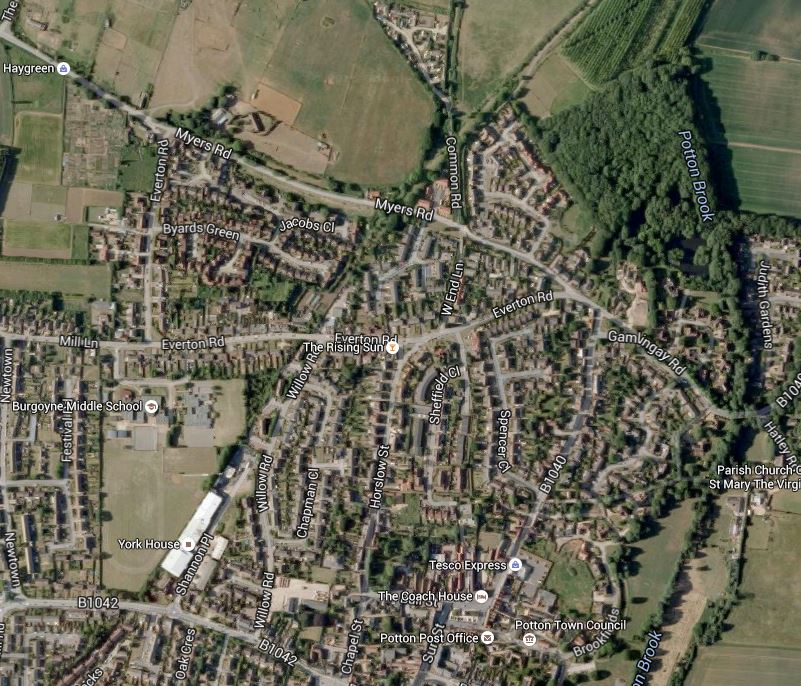
Potton
The green scar of the line can be seen, as it curves around the North-West of the village. I wonder if York House was the station.
Sandy
After Potton, the line goes through the countryside to Sandy, where the old Varsity Line came alongside the East Coast Main Line through Sandy station, before crossing the main line.
This Google Map shows the area.
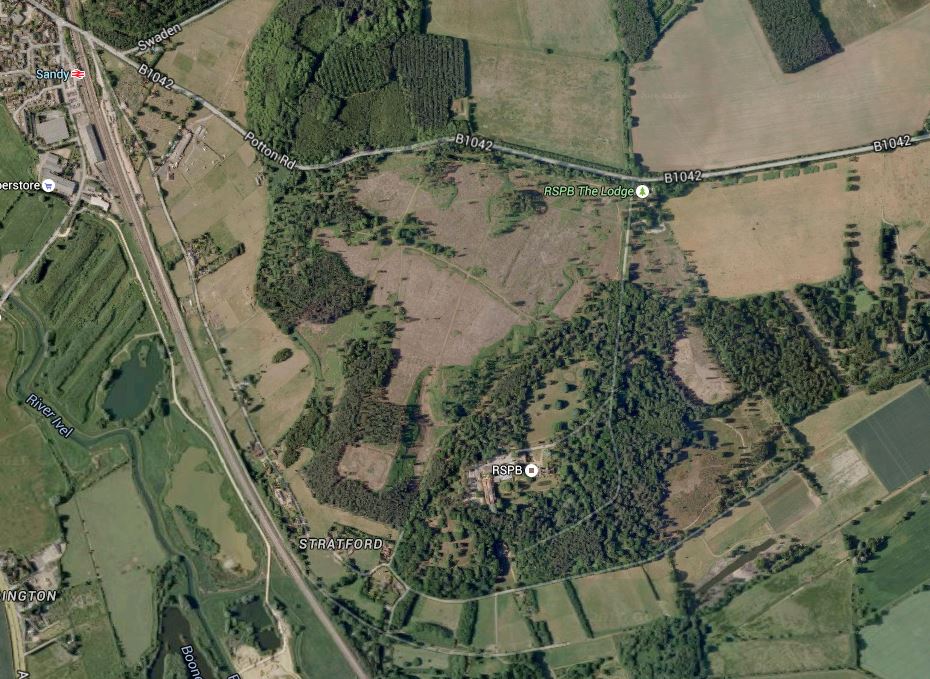
Sandy, The East Coast Main Line And The Varsity Line
Sandy station is towards the top of the map and you can just see how the old line curves around the headquarters of the RSPB.
One possibility in this area, is that there are proposals for a Sandy-Beeston by-pass on the A1, to remove a bottleneck. Surely, if the routes of the by-pass and the railway were considered together, planners might come up with a superior solution.
Bedford
The original route went via stations at Blunham, Willington and Bedford St. Johns and it still shows on the Google Map.
This Google Map shows the route as it joins the East West Rail Link at Bedford St. Johns station, which is on the Marston Vale Line, which is being incorporated into the East West Rail Link, to form the link between Bedford and Bletchley.
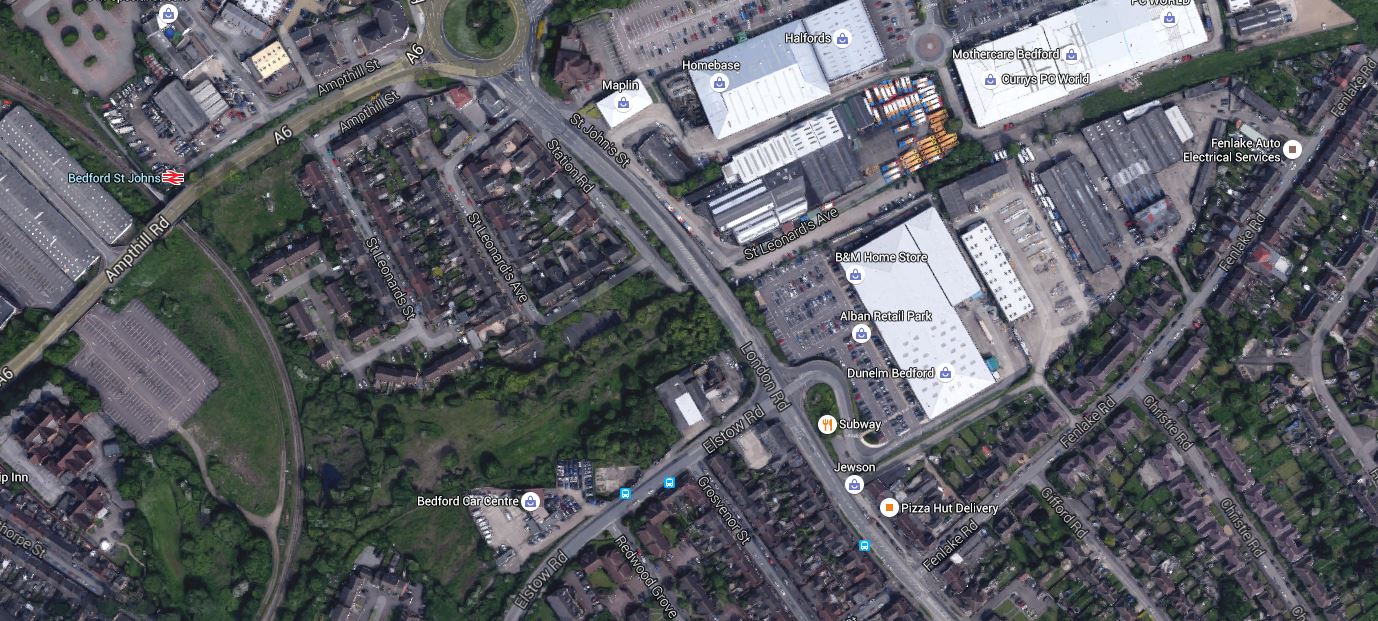
Bedford St Johns Station And The East West Rail Link
Note the green scar going between the bus garage (?) and the retail warehouses to the East. This was the old Varsity Line to Sandy.
If it were to be connected directly to the Marston Vale Line as it originally used to be, not all traffic would need to go to Bedford station.
Questions
I have some questions.
- How many of the old stations at Gamlingay, Potton, Blunham and Willington will be rebuilt?
- Will a more northerly alternative route from the Mullard Observatory to Sandy be better?
- Will there be a station at Sandy to link the East West Rail Link to the East Coast Main Line?
- Will a route be safeguarded to reopen the Stour Valley Line to Haverhill and Sudbury in the future?
Hopefully, these and other questions will be answered, when the definitive route is published.
Conclusions
After writing this, I’m surprised how much of the original line can be reinstated.
Certain factors have helped.
- The desire of Cambridge to have a station at Addenbrooke’s Hospital.
- A change in direction of the research at the Mullard Observatory or a pragmatic attitude on the part of the University.
- The need to build a bypass on the A1 at Sandy and Beeston.
- The ability to thread the railway through Bedford to link up with the Marston Vale Line.
I doubt there’ll be too much demolition of domestic properties or opposition to the route.
I also think, it will be pretty easy to build, as there don’t appear to be many bridges and viaducts.
How Would IPEMUs Fit With The East West Rail Link?
I feel very much, that IPEMUs or battery trains are very much going to be a part of the UK rail network in the next few years.
When I was writing Are The TOCs Arguing Over The Class 387 Trains?, I kept coming across the Oxford end of the East West Rail Link, so I got to thinking how IPEMUs would fit in with the line.
Will the Line Be Electrified?
The Government certainly thinks so, as Wikipedia reports.
The Secretary of State for Transport, the Rt. Hon Justine Greening MP, today announced that the Western section of East West Rail (EWR) will be part of the government’s strategy for rail transport, confirming not only funding for the project but also for electrification of the Oxford to Bedford part of the route. EWR will provide an electric link between the electrified Great Western, West Coast and Midland main lines. This further investment in the project upgrades it to form a key part of the new ‘Electric Spine’ passenger and freight route between the South Coast, the East Midlands and Yorkshire
But I’m not sure.
- Will freight operators pay out for new electric locomotives or will they stick with their old noisy and smelly Class 66 locomotives? I’m afraid most will stick with what they’ve got!
- The new Class 88 electro-diesel locomotive will be delivered this year and what effects will they have on locomotive procurement?
- One of the major intersecting lines is Chiltern, which is not electrified. Will the Chiltern Line be electrified to make things easier? It could be! But I doubt it!
- After the fuss about the aesthetics of the electrification on the Great Western Main Line, that I wrote about in Aesthetic Problems With Overhead Wires On The Great Western, I have a feeling the natives might object.
- When they see the total bill for the Great Western Electrification, will the Government have second thoughts about electrification?
I think the line will eventually be electrified, but it may not be built with electrification, just as the first section between Bicester Village and Oxford Parkway stations was.
It would be built however, so that it would be easy to electrify in future.
- All over-bridges would have sufficient clearance for overhead wires.
- Space would be left for overhead gantries and other essential electrification equipment.
- Piles for gantries might even be put in.
- Everything would be properly documented.
Too many railway lines in the past were just built and assumed no improvements would ever be made.
Connection To Existing Electification
One of the most expensive items in an electrification scheme can be connecting the new wires to a suitable electricity supply.
This is why Crossrail and the Great Western Electrification share a sub-station to the West of London.
The East West Rail Link crosses a succession of lines at its Western End from Oxford to Bedford. In order from the West they are.
Only the Chiltern Main Line will not be electrified, when the Oxford to Bedford part of the link opens.
The route from Bedford to Ipswich and Norwich is not fully defined yet, but it is likely it will cross these electrified lines.
So the link, isn’t short of connectivity to electrified lines, which will help with full electrification.
The Route
This map from the East West Rail Link web site shows the route.
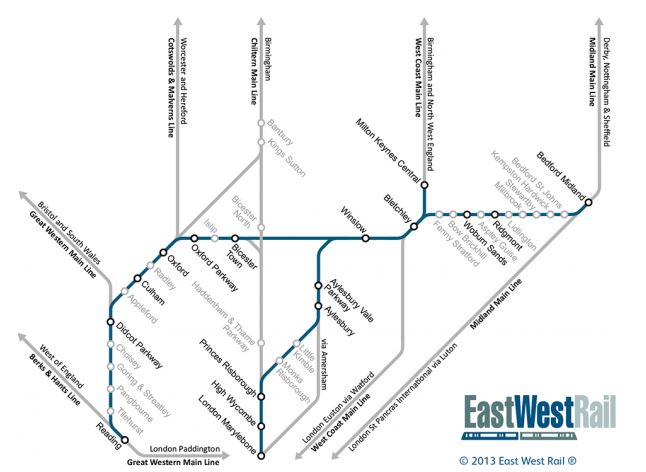
East West Rail Link
Starting from the West stations are.
- Reading on the Great Western
- Tilehurst on the Great Western
- Pangbourne on the Great Western
- Goring and Streatley on the Great Western
- Cholsey on the Great Western
- Didcot Parkway on the Great Western
- Appleford on the Cherwell Valley Line
- Culham on the Cherwell Valley Line
- Radley on the Cherwell Valley Line
- Oxford on the Cherwell Valley Line
- Oxford Parkway
- Islip
- Bicester Village
- Winslow
- Bletchley on the West Coast Main Line
- Milton Keynes Central on the West Coast Main Line
- Fenny Stratford on the Marston Vale Line
- Bow Brickhill on the Marston Vale Line
- Woburn Sands on the Marston Vale Line
- Apsley Guise on the Marston Vale Line
- Ridgmont on the Marston Vale Line
- Lidlington on the Marston Vale Line
- Millbrook on the Marston Vale Line
- Stewartby on the Marston Vale Line
- Kempston Hardwick on the Marston Vale Line
- Bedford St. Johns on the Marston Vale Line
- Bedford on the Midland Main Line
It’s quite a few stations, many of which are simple affairs in rural locations.
IPEMUs And The East West Rail Link
Proposed services when they start in 2019 will include.
- Bedford – Oxford – Reading
- Milton Keynes – Oxford – Reading
- Milton Keynes – Aylesbury – Marylebone
The first two services could be easily run by IPEMUs, but the third might need other arrangements.
According to the latest Great Western electrification schedule Oxford is not scheduled to be electrified until June 2019, so as I believe that Oxford will be reached by IPEMUs until that date, I suspect that we’ll see IPEMUs on the line, as they will be able to easily bridge the fifty mile electrification gap between Didcot on the Great Western and Bletchley on the West Coast Main Line, charging their batteries at both ends of the route.
The London to Aylesbury Line is thirty-nine miles of which sixteen miles are owned by the London Underground. Could it be if the line between Aylesbury and Winsford were to be electrified and some form of third-rail power was made available on the sixteen miles of the London Underground, that IPEMUs could work the services between Marylebone and Milton Keynes?
If they can’t, then it will be more diesels from Chiltern. But Chiltern’s ambitious nature, says they would prefer some form of electric train.
If the lines were eventually to be fully electrified, the IPEMUs would still have a valuable part to play as their self-contained regenerative braking would mean that the power supply wouldn’t have to be able to accept a return current, which lowers the cost of electrification.
Conclusions
IPEMUs will have to play some part in providing services on the East West Rail Link, because of the late running of the Great Western electrification.
Also with some selective electrification, Chiltern could use them for a service between Marylebone and Milton Keynes.
As these trains can provide a service on the whole line using existing electrification, the electrification of the East West Rail Link should be enabled but delayed to allow wires to be put up in more important places.
 The Anonymous Widower