A Branch To Penicuik From The Borders Railway
I started this post as part of Extending The Borders Railway To Carlisle, but as I research it more and talk to my correspondent in the Borders, I feel it needs to be a separate post.
There is an article in the Scotsman from 2013, which is entitled Borders rail link: £150m plan for Penicuik spur. This is the first paragraph.
A vital £150 million rail line connecting Penicuik to central Edinburgh could be reopened for the first time in half a century.
The article then gives a lot of favourable comments about the possibility of the link. My correspondent, grew up in the town and feels that a rail link is needed, especially, as when he was a boy, the town had three rail lines.
In the Wikipedia entry for the Borders Railway, this is a paragraph about a future branch to Penicuik.
In May 2013, it was reported that Heriot-Watt University had been asked by Midlothian Council to carry out a feasibility study on a 10-mile (16 km) rail link connecting Penicuik with the Borders Railway. At least 6 miles (9.7 km) of the new line would follow the Edinburgh, Loanhead and Roslin Railway, the alignment of which is generally intact between Millerhill and Straiton.
This proposal is not mentioned in the recent CBR report, which is entitled A Summary Case For A New Cross-Border Rail Link, that can be downloaded in PDF form from this location.
Newcraighall Station And Park-And-Ride
Newcraighall station will be North of where the proposed branch to Penicuik joins the Borders Railway.
This Google Map shows the station and the surrounding area.
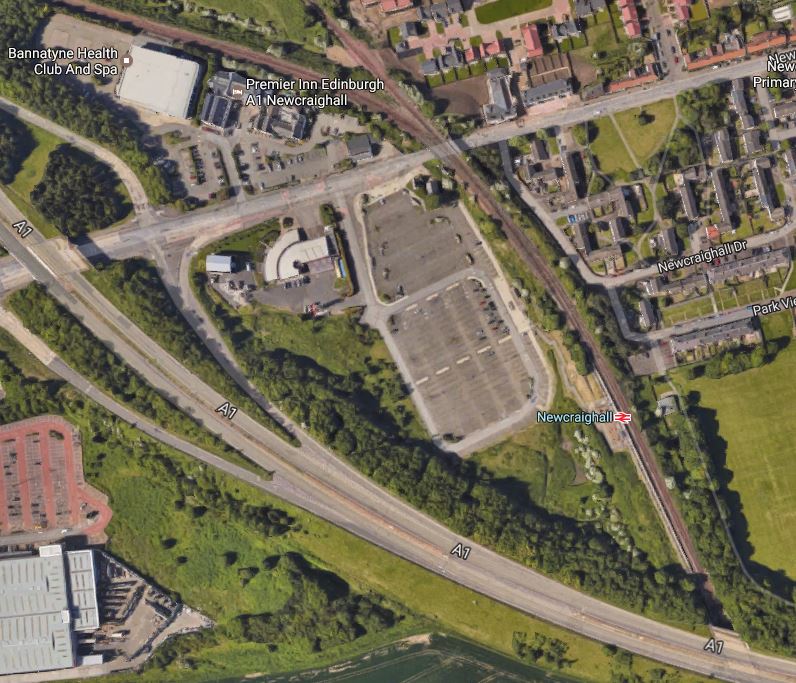
Note the A1 and the convenient Park-and-Ride.
Wikipedia says this about Services from Newcraighall station.
Monday to Saturday daytimes there is a half-hourly service to Edinburgh and to Tweedbank, and an hourly evening and Sunday service. Four weekday morning peak services run beyond Edinburgh to Glenrothes with Thornton via Kirkcaldy and a similar number run in the opposite direction in the evening. When the station was a terminus, many services ran through to/from the Fife Circle Line but this practice ended prior to the reopening of the full route to Tweedbank.
I believe that a Park-and-Ride of this size, location and probable importance needs at least four trains per hour (tph) all day.
Currently, two tph between Edinburgh and Tweedbank call at Newcraighall. As it takes two hours for a train to do the round trip, this means that four trains are needed to provide a two tph service.
Four tph all the way to Tweedbank would need eight trains, but due to limitations in the design of the Borders Railway would probably be very difficult to operate.
Terminating them at Newcraighall and perhaps running beyond Edinburgh to Fife is obviously a possibility, but Newcraighall station only has one bi-directional platform.
Two Trains Per Hour To Penicuik
Opening a branch to Penicuik and running two tph would give Newcraighall station and the Park-and-Ride the four tph train service it needs, when combined with the two tph along the Borders Railway.
The Edinburgh, Loanhead and Roslin Railway
Wikipedia says the route would probably follow the route of the Edinburgh, Loanhead and Roslin Railway.
- Much of the route is visible on Google Maps.
- The original line closed in the 1960s.
- There were stations at Gilmerton, Loanhead, Roslin and Glencourse.
- The major engineering feature of the line was a visduct over Bilston Glen.
Penicuik was served by a freight-only line.
Shawfair Station
It would appear that the Northbound and Southbound trains on the Borders Railway seem to call at Shawfair station around the same time.
This must make operation of the line much simpler and it probably meant that Newcraighall station only needed one platform.
This Google Map shows the Borders Railway passing through Shawfair station.
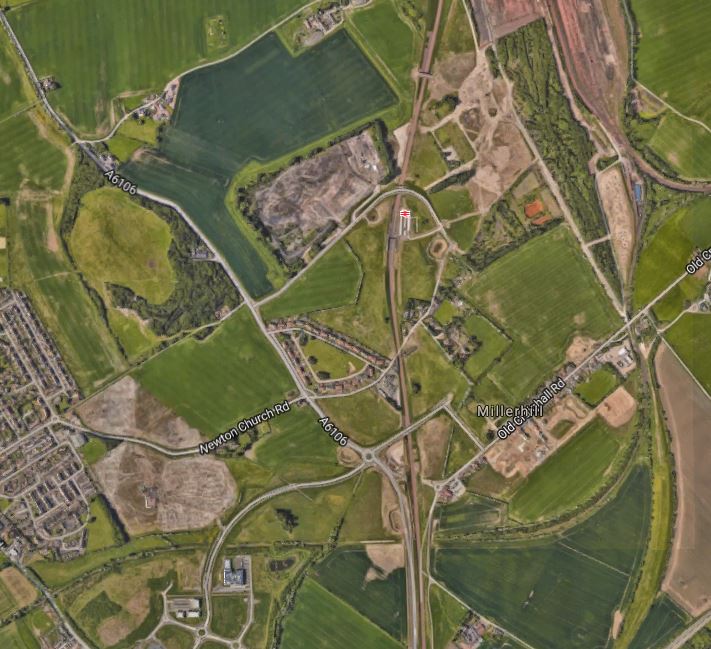
Note the disused track of the Edinburgh, Loanhead and Roslin Railway crossing the Borders Railway at right-angles and then curving Northwards to the freight yard at Millerhill.
Trains could go via Millerhill, to join the Borders Railway South of Newcraighall station, but surely, it would be better if the branch to Penicuik, joined the Borders Railway South of Shawfair station.
This would allow trains to and from Penicuik to pass at Shawfair station.
As trains to and from Tweedbank station seem to call between
- XX:08 to XX:10
- and XX 38 to XX:40
So Penicuik trains could use times of perhaps .
- XX:23 to XX:25
- and XX 53 to XX:55
Which would mean a train would have thirty minutes to go from Shawfair to and from Penicuik.
The way Shawfair station is used also means the following for the Borders Railway.
- A convenient spacing is imposed for trains to call at the single platform at Newcraighall station, as that is just four minutes towards Edinburgh.
- Effectively, the Borders Railway to Tweedbank station runs a two tph service with two widely-seperated trains South of Shawfair station at any one time.
- Two widely-separated trains, South of Shawfair station enables the use of single-platform stations at all stations except Stow and Tweedbank.
- Shawfair station is the only station with an expensive footbridge.
I also suspect that four tph is possible, with trains passing at Shawfair and Stow stations, perhaps with faster trains and improvements to the signalling.
By clever design and selective use of two-platform stations and double-track, it would appear that the engineers have designed an efficient affordable railway, that is mainly single track and has only one footbridge.
The Junction Of The Borders Railway And The Penicuik Branch
This Google Map shows where the track-bed of the Edinburgh, Loanhead and Roslin Railway passes under the Borders Railway to the South of Shawfair station.
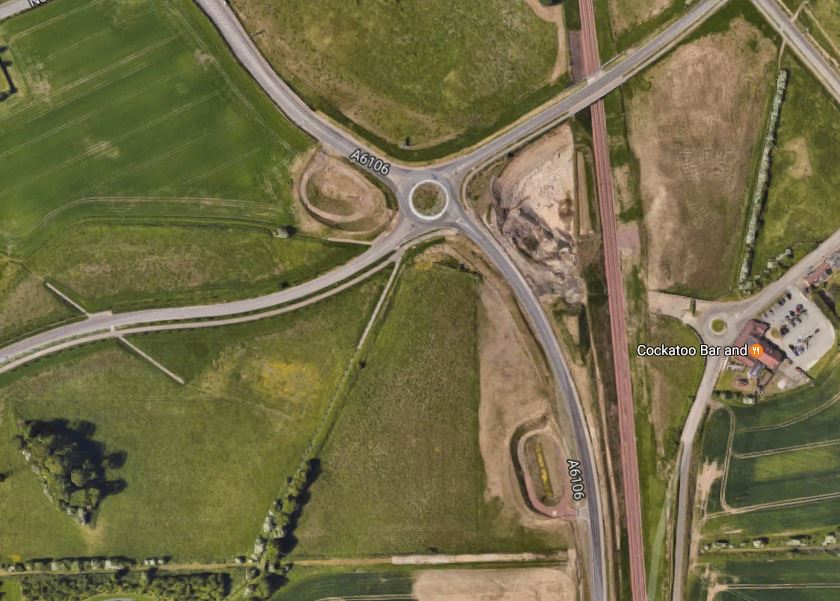
Note the old track-bed of the Edinburgh, Loanhead and Roslin Railway running East-West across the bottom of the map.
The roads in the area don’t appear to have been built with a suitable space for a chord to connect.
But even so, I suspect it would be a practical proposition for a single-track chord to be built between the Borders Railway and the Edinburgh, Loanhead and Roslin Railway.
The only difficult construction would be crossing the A6106 road to the South-East of the roundabout.
A cross-over would be needed South of Shawfair station to allow Southbound trains to access the branch to Penicuik. But as there would only be no more than four tph South of Shawfair station, this wouldn’t be a large operational problem.
Single-Track To Penicuik
Wikipedia says that the proposed Penicuik branch is ten miles in length.
Surely, if it were a single-track branch, trains could go from Shawfair to Penicuik station and return within thirty minutes.
Consider.
- It would take five minutes for the driver to change ends at Penicuik
- Two stops each way with a modern train could take a total of just five minutes.
- The train would be the only one on the branch.
- A well-designed line could have an operating speed of at least 75 mph and possibly 90 mph.
All this would mean that there would be ten minutes for each leg of the journey between Shawfair and Penicuik.
Should A Future Penicuik Branch Be Electrified?
Electrification of a future Penicuik Branch would not be difficult.
- Electrification would need to be extended from Newcraighall station.
- Electrification would be easier, if the branch were single-track with single-platform stations.
- Electrification of a new railway must be easier than electrifying an existing line.
Electrifying between Newcraighall and Penicuik may give advantages.
- There will be a fairly plentiful supply of cascaded electric trains, that could be suitable for the route.
- Electrifying may allow electric trains to access the Millerhill TMD.
- Electrifying would help in running bi-mode trains on the Borders Railway, if that were thought necessary.
- Electrifying may save a few minutes between Shawfair and Penicuik.
Obviously, electrification would allow politicians to boast about their green credentials.
The only disadvantage of electrification is that some bridges may need to be raised.
Surely, if the ten-mile branch was well-designed as mostly single-track, perhaps with electrification, and run by modern trains, two tph would be possible, even with one or more intermediate stops.
Could A Future Penicuik Branch Be Worked By Bi-Mode Trains?
A bi-mode train like a Class 319 Flex train could certainly work the route and as they have lots of power, they could probably achieve the Shawfair to Penicuik and return time of thirty minutes.
Could A Future Penicuik Branch Be Worked By Battery Trains?
As it is only ten miles between Shawfair and Penicuik, I suspect that in the future,, trains with onboard energy storage will be able to work the branch.
Single-Platform Stations
If the future Penicuik Branch could be a single-track railway, where only one train was on the branch at any one time, all stations could be built with a single-platform and no expensive footbridge, as most stations were built on the existing Borders Railway.
As five-cars seems to be becoming the new standard train length, I would build all platforms to accept five-car trains.,
A North-South Service Across Edinbugh
Peak Hour services link Tweedbank and Newcraighall beyond Edinburgh to Glenrothes with Thornton via Kirkcaldy.
There is obviously a need for a service in the Peak, but if there was a second Southern terminus at Penicuik would it be sensible that if a total of four tph were running from Newcraighall to Edinburgh, that a proportion cross the Forth.
Note that Cross-Forth services.
- Call at both Edinburgh and Haymarket stations in the City Centre.
- Have an easy interchange with the Edinburgh trams at Haymarket and Edinburgh Gatway station.
- Probably have an easier route to Edinburgh Airport.
There are certainly lots of possibilities.
Could A Future Penicuik Branch Be Worked By Tram-Trains?
The Germans would probably use tram-trains in a city the size of Edinburgh.
Compared to the tram networks in Nottingham and Birmingham, Edinburgh trams always strike me that it was a network designed without ambition and that doesn’t provide the maximum benefit to the largest number of residents and visitors.
If you look at Edinburgh Gateway station, it could have been modified to allow tram-trains like the Class 399 tram-train to come from the Airport and then go straight onto the Fife Circle Line to South Gyle, Haymarket and Edinburgh stations.
At present this line is not electrified, but doing that is probably in Scotrail’s wish-list.
Once at Edinburgh station, the tram-trains could take any of the electrified routes to North Berwick, Dunbar or perhaps Penicuik.
Passengers would finally get a proper interchange between trains on the East Coast Main Line and the Edinburgh tram.
I also think that the Germans would run tram-trains on the Fife Circle Line and its proposed extension to Leven.
Currently, the frequency of trains on the Fife Circle Line is low and tram-trains could probably give a four tph service to all stations, if electrification was put in place.
Conclusion
I believe that it would be possible to open a single-track branch to Penicuik with single-platform stations and these objectives.
- Provide a two tph service between Penicuik and Edinburgh.
- Boost the service between the Park-and-Ride at Newcraighall and Edinburgh to four tph.
- Provide an alternative Southern terminal for a North-South service across Edinburgh.
Electrification of the line might give operational advantages to Millerhill TMD, the Borders Railway and the branch itself.
The Class 319 Flex Units To Be Class 769
This is the title of a short article in the June 2017 Edition of Modern Railways.
Giving the Class 319 Flex train, its own unique class number of 769, must say that Porterbrook, Northern, Network Rail and the Department of Transport, think that the bi-mode conversion of a Class 319 train is a viable project.
The article gives some new details about the trains.
- Northern have ordered eight units, which will be delivered before the end of May 2018.
- The first unit is at Wabtec’s Brush Traction facility in Louthborough.
- Completion of the design and the first load testing is plasnned before the end of May.
- The first unit is due to be completed with driver training underway, by the end of the year.
- Northern will get a total of thirty-two Class 319 trains, which probably include the eight Class 769 trains.
- Tri-mode functionality and dynamic mode changeover on the move are being considered.
- Full production rate is a Class 769 train every two weeks.
The Class 319 Flex train has definitely moved from concept to a real train.
The article finishes by saying that Porterbrook expects further orders soon, while it is also considering transferring the concept to other roiling stock, such as the Class 455 train.
Why Convert Class 455 Trains?
The Class 319 and Class 455 trains are very similar electrical multiple units based on Mark 3 coaches.
But there are a few differences.
- The Class 455 is third-rail only, whereas the Class 319 is dual-voltage.
- The Class 455 is a 75 mph train, whereas the Class 319 is a 100 mph train.
- South West Trains’ Class 455 trains have had an extensive refurbishment and are fitted with 2+2 seating.
- South West Trains planned to upgrade the traction package of the Class 455 trains, which would include new AC traction motors and regenerative braking. This article in Rail Magazine has full details.
A Class 455 Flex train could have the following specification.
- The updated 2 x 2 seating.
- The new traction package with AC traction motors and regenerative braking.
- 75 mph operating speed on both electric and diesel.
It could be a better financial proposition for both the leasing company and the train operator.
In The Class 319 Flex Train And Third Rail Routes, I looked at various third-rail routes that could be served with a Class 319 Flex train.
Some of these routes could be served by a Class 455 Flex train, instead of the Class 319 Flex train.
The article states that Porterbrook are expecting further orders and could it be, that the company have assessed the number of bi-mode trains required and found that a large proportion of the available Class 319 trains might need to be converted.
So creating a Class 455 Flex train for use in areas with third rail electrification, might be a prudent action.
South Western Railway, will have around ninety well-maintained Class 455 trains with the refurbished interiors going spare, so there is certainly no shortage of trains to convert.
South Western Railway And Class 455 Flex Trains
South Western Railway, themselves could have some uses for the trains.
I doubt that the trains would be acceptable running long distance services from say Waterloo to Salisbury, due to being designed as short distance commuter trains and the lack of a toilet and tables.
They would be ideal for the following local services.
- Running the hourly circular service from Salisbury to Chandlers Ford via Southampton, which has sections of electrified line.
- Existing lines like the Lymington Branch.
- Reopened lines like the Fawley Branch and the Ludgershall Branch.
- Perhaps running services on the Swanage Railway.
- New services like Portsmouth Harbour to Salisbury via Southampton and Romsey.
- Services on the Heart of Wessex Line.
In some places like the Lymington Branch, they would release Class 158/159 trains to boost services on the West of England Main Line.
Merseyrail And The Class 455 Flex Trains
In the June 2017 Edition of Modern Railways, Chris Stokes talks about the problems of running services between Bidston and Wrexham Central stations on the Borderlands Line. He concludes with the following.
So the operation of the route is very tight, but it appears to work quite well.
There has been talk of using battery trains on this route in place of an expensive full electrification, which would allow Merseyrail’s new Stadler trains to run the route in the following manner.
- At least two trains per hour (tph).
- Longer trains.
- Calls at proposed new stations on the route.
In an ideal world, the service would terminate at the Northern end of the line by going round the third-rail electrified Loop Line under Liverpool City Centre.
The Class 455 train appears on a brief look to be the same size as Merseyrail’s current Class 508 trains, so it should be possible to use the Liverpool Loop.
Chris Stokes has told me two things.
- The Class 455 trains, used redundant trailer cars from Class 508 trains, that were shortened for Merseyrail, so there can’t be much difference in the size of the Class 455 and Class 507/508 trains.
- The Wrexham service used to terminate at Birkenhead North station.
So it seems a better Northern terminus could be possible.
Ideally, the Loop Line would be used, but look at this Google Map of Birkenhead North station.
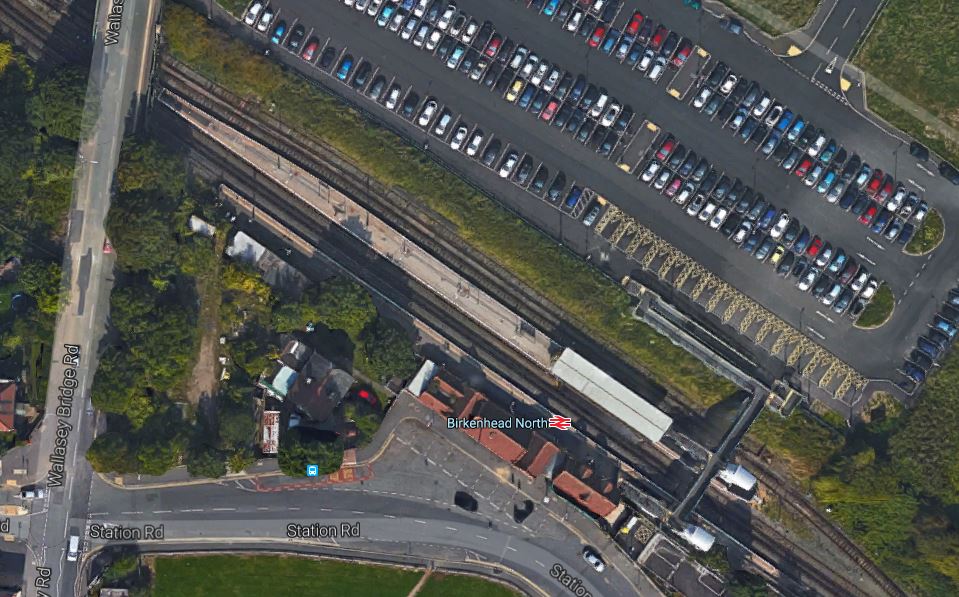
The Wikipedia entry for the station, has a section entitled Wrexham Diesel Service. This is said.
From 4 January 1971 until 2 October 1978, the diesel service on the Bidston to Wrexham line, which had previously operated from New Brighton, was diverted to Birkenhead North. These trains terminated on the centre platform which had previously been used for Liverpool-bound services, and when one of the diesel trains was present (which in that timetable was much of the time), Liverpool-bound electric services used the outer north side of the island platform instead. The diesel service was cut back to Bidston from 2 October 1978. Regular use of the outer platform at Birkenhead North thereafter ceased.
Note that the service used to be Wrexham to New Brighton, which with the replacement of a short chord and some work at New Brighton station might be another alternative, although the service wasn’t very busy.
So could a Class 455 Flex train work the route in the following manner?
- Use diesel power between Wrexham Central and Bidston stations.
- Use electric power from Bidston to Liverpool.
- Join the other Wirral Line trains and terminate in the Liverpool Loop, stopping at the four stations in Central Liverpool.
As to frequency, you could run as many trains as you want, as the Borderlands Line is double-track, with the exception of a short single track section between the two Wrexham stations.
A round trip would take nearly three hours based on current timings, which would mean the following numbers of trains would be needed.
- One tph – three trains.
- Two tph – six trains.
- Four tph – twelve trains.
As Merseyrail like to run four tph on the various branches, why not use this frequency on the Borderlands Line?
It would be a Turn-Up-And-Go service, that would benefit a large number of people.
Does the service have to terminate at Wrexham?
- Shrewsbury is only thirty-one miles from Wrexham on the Chester to Shrewsbury Line.
- Rhyl is only twenty-seven miles from Shotton on the North Wales Coast Line.
It certainly wouldn’t require any electrification or challenging engineering to open up these and other possible routes.
The Class 455 Flex train may have other uses in Liverpool.
Northern’s services in the area will probably use a few Class 319 Flex trains alongside their Class 319 trains, that already serve Liverpool Lime Street.
So where services are being extended from Merseyrail’s third-rail network, why not use some Class 319 Flex trains, as these trains have a third-rail capability from their days South of the Thames?
- There may be an engineering or operational problem with a dual-voltage Class 319 Flex train.
- The pantograph of a Class 319 Flex train might make the train too large for parts of Merseyrail’s third-rail network.
- A third-rail only Class 455 Flex train may be a better financial proposition for leasing companies and train operators.
Or it could be that Porterbrook’s response to the Class 319 Flex train has been so positive, that the alternative offered by the Class 455 Flex train is welcomed.
Merseyrail’s prime route for a bi-mode Flex train would be the Canada Dock branch.
- There is a long term aspiration to run a passenger service.
- The branch is not electrified but it could connect to Liverpool’s third-rail network at both ends and also to 25 KVAC at the Southern end.
- Numerous freight trains use the route.
- Perhaps four stations at about ten million pounds a time would need to be rebuilt.
- Liverpool Football Ground would get a station.
Class 455 Flex trains could run a Southport, Ormskirk or Kirkby to Liverpool South Parkway service tomorrow.
A Four-Car Diesel Multiple Unit
In Who Would Want An Electric Train Powered Only By Diesel?, I discussed the fact that according to the Porterbrook brochure,
A diesel-only version of Class 319 Flex is now being delivered for one operator.
Could it be, that the updated interior of the Class 455 train, is exactly what the operator wants in a diesel train?
A Class 455 Flex train would have the following characteristics, if the third-rail equipment was removed.
- Four cars.
- Diesel power only.
- 75 mph operating speed.
- A quality 2 x 2 interior.
- A train that meets all the present and future access and disabled regulations.
That sounds to me like a high-quality replacement train for which Direct Rail Services will provide you with two Class 68 locomotives and some elderly coaches, which probably don’t meet the latest regulations.
But also, the UK suburban diesel multiple unit fleet has quite a lot of two and three car trains, but very few four-car ones and you see lots of four-car trains made by coupling two two-car units together. So perhaps, some train operators, see these trains as an easy and affordable way to increase the number of four-car trains on their routes without any form of electrification.
As South Western Railway take over the South West Trains franchise on the 20th August 2017, perhaps some Class 455 trains would be available soon after, as they could replace them with new Class 707 trains.
I suspect that a Class 455 Flex train could be available early in 2018.
Conclusions
The Class 319 Flex train or more properly the Class 769 train looks to be a successful concept.
I’m also convinced that Porterbrook have decided the market is larger than they originally thought, so they are seriously looking at converting Class 455 trains, to make sure they have enough trains.
Conservative Manifesto On The Railways
The Conservative Manifesto says this on railways.
We will focus on creating extra capacity on the railways, which will ease overcrowding, bring new lines and stations, and improve existing routes – including for freight. We will increase services on our main lines and commuter routes, and launch new services to places which are poorly served or host major new housing projects.
This would seem a sensible policy and it is probably very little different to what has been done over the last fifteen years.
- Quite a few new trains have been procured.
- New rail and tram lines like the London Overground, the Borders Railway, the Manchester Metrolink, the Midland Metro and others have been opened.
- Around seventy new stations have been opened.
- Some lines have been electrified.
- Some lines have been improved and resignalled.
- Mechanisms have been developed , so that developers can help to provide stations for their new developments.
But there is one big difference.
A lot of quality trains are now being replaced by new or much better trains in the next few years.
- Virgin Trains East Coast‘s and First Great Western‘s InterCity 125s are being replaced by new Class 800 trains.
- Thameslink’s Class 319 trains are being replaced by new Class 700 trains.
- Greater Anglia‘s Class 90 locomotives and Mark 3 coaches are being replaced by new Stadler FLIRTs.
- Greater Anglia’s Class 379 trains are being replaced by new Stadler FLIRTs.
- Greater Anglia’s Class 156 trains are being replaced by new Stadler FLIRTs
- Greater Anglia’s Class 170 trains are being replaced by Stadler FLIRTs.
- Greater Anglia’s Class 321 trains are being replaced by new Class 720 trains.
- Greater Anglia’s Class 317 trains are being replaced vt new Class 720 trains.
- Greater Anglia’s Class 360 trains are being replaced by new Class 720 trains.
- London Overground‘s Class 172 trains are being replaced by new Class 710 trains.
- Various operators have Class 317 trains, which will be replaced by new trains.
- Heathrow Connect’s Class 360 trains are being replaced by new Class 345 trains.
- TransPennine Express wil be returning twenty-two Class 185 trains to the leasing company.
- TrnsPennine Express’s Class 350 trains will be replaced by new Class 397 trains.
Some of these were built this century and will have plenty of takers, whilst others despite being a lot older have already been earmarked for substantial refurbishment.
Remember that, just as our architects and builders are good at taking ruins and creating high quality dwellings, offices or commercial buildings, our engineers, designers and train building and refurbishment companies are good at taking trains of an advanced age and creating high quality trains and locomotives, as comfortable, reliable, safe and passenger, crew and operator-friendly, as new ones straight from the factory.
In What Train Is This?, I show a refurbished Great Western Railway Class 150 train. This picture shows the quality that can be achieved, by refurbishing a thirty-year-old Mark 3-based train.
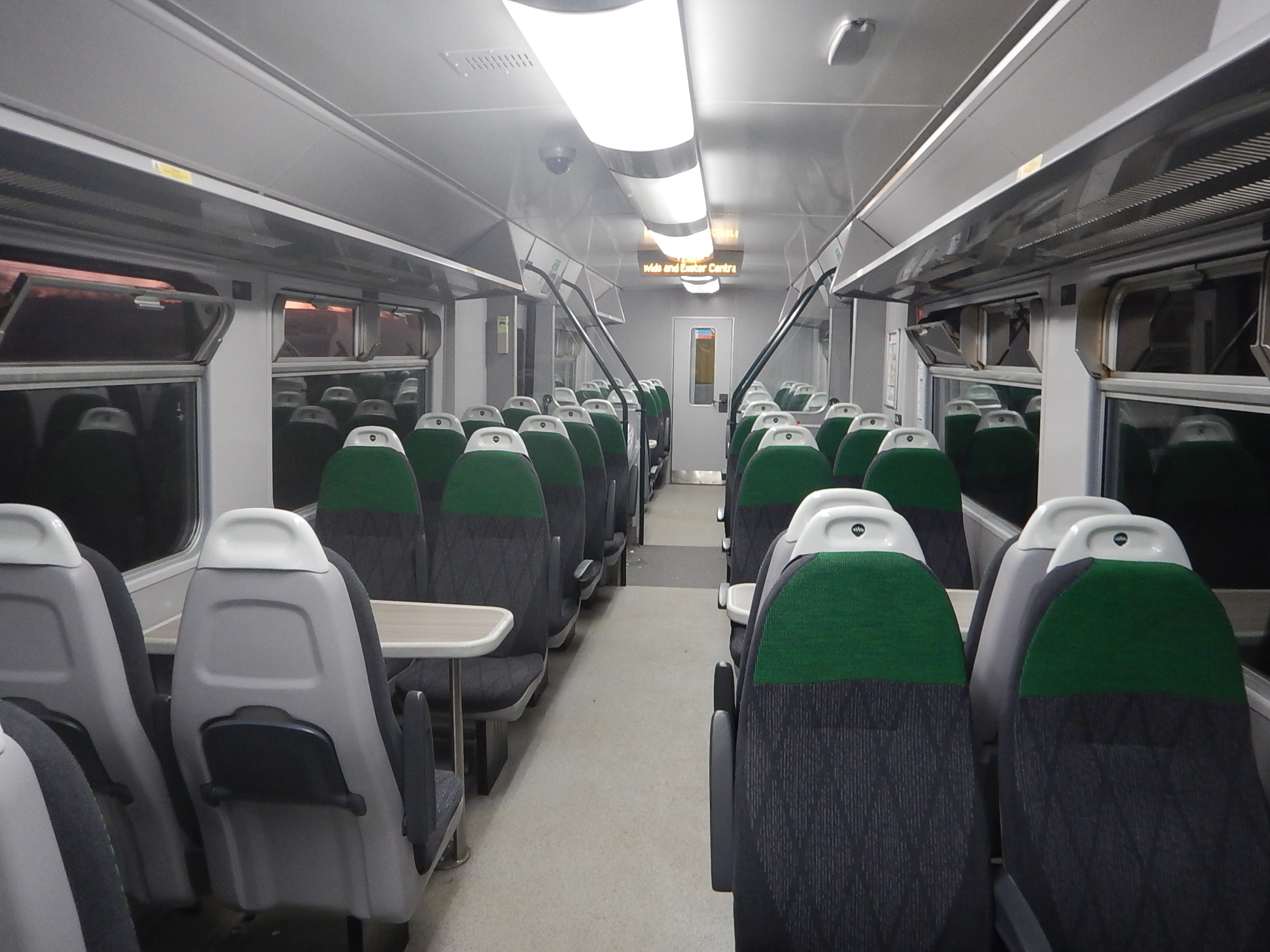
Who would complain about this superb refurbishment, which I suspect was done by Great Western Railway’s depot at Laira in Plymouth?
This table summarises what has been planned and what trains are worth saving.
- Forty of the hundred InterCity 125 sets are being converted into quality four and five carriage trains for ScotRail and Great Western Railway – Equivalent to forty four-car diesel trains.
- Some InterCity 125 sets might end up as high-speed parcel trains. Although if Scotrail and Great Western Railway prove the Pocket Rocket four-car HST to be viable, other companies may copy the concept.
- Will the 137 Class 150 trains be refurbished to the standard shown in the picture?
- The 114 Class 156 trains can be refurbished to a high standard for local routes. – Perhaps half will go to new operators.
- The twelve Class 170 trains were built in 1999 and will go to another oiperator – Probably equivalent to another six four-car diesel trains,
- The 72 Class 317 trains are in surprisingly good condition for thirty-year-old trains. They are also 100 mph units and Mark 3-based. If Network Rail were good at electrification, they would find a home. They are seventy-two four-car electric trains.
- The 86 Class 319 trains will find homes, with some converted into Class 319 Flex bi-mode trains. – Probably equivalent to another thirty four-car trains, of which some would be electric and some bi-mode.
- The Class 90 locomotives will go to freight operators.
- The 130 Mark 3 carriages will find a use, as they always do. Chiltern probably need some more.
- The 100 Class 321 trains could be refurbished and go to another operator. They are 100 four-car electric trains .Some could even be converted to bi-modes.
- The 10 Class 350 trains were built in 2013 and will go to another operator. They are 10 four-car electric trains.
- The 26 Class 360 trains were built in 2002 and will go to another operator. They are twenty-one four-car and five five-car electric trains.
- The 30 Class 379 trains were built in 2010 and will go to another operator. They are thirty four-car electric trains.
The totals in four-car trains are roughly as follows.
- Diesels and bi-mode – 100 – 50 already allocated
- Electric – 170
These totals don’t include all the plans.
What will the new owners of these franchises do?
- East Midlands
- London Midland
- Southeastern
- South West Trains
- Wales
Only South West Trains has been settled and it looks they’ll be releasing the new Class 707 trains.
Conclusion
It does look that there could be enough diesel trains.
- There could be quite a number of Sprinters, Class 170, Class 172 and Class 185 trains, which after refurbishment could be providing excellent service for perhaps another twenty years.
- The pride of lions in the room will be the shortened InterCity 125s, that Scotrail and First Great Western are creating and introducing in the next couple of years.
- Will they have cubs or be imitated, by creating rakes of four or five Mark 3 coaches, with a Class 43, Class 68 or Class 88 locomotive at each end?
- TransPennine Express have already ordered Mark 5 coaches and Class 68 locomotives to do the same thing.
- A hybrid electric/diesel/battery locomotive could be used with the coaches. Hitachi created such a beast from a Class 43 some years ago and the Germans are experimenting.
Terry Miller should be awarded a posthumous knighthood, as his amazing stop-gap design that saved British Rail forty years ago, could be about to play an encore.
If there is a problem, it is that there are a lot of electric trains.
- The more recent ones like Class 379, Class 350, Class 360 and Class 707 trains will probably find homes in places like Birmingham, Leeds, Liverpool, Manchester and Scotland.
- Surely, Class 379 trains would be ideal on shorter distance services to Manchester Airport, as they were designed for Stansted services.
- If the Class 319 Flex train is a success, expect to see more of these trains converted to 100 mph dual-voltage four-car bi-modes trains.
There is still a lot of electric trains to be allocated.
The Class 319 Flex train may be based on the forty-year-old Mark 3 coach design, but I believe it fits the specification of the train we need to expand our rail services.
- 100 mph on either 25 KVAC overhead or 750 VDC third-rail electrification.
- 90 mph on diesel.
- Four-coaches meeting all regulations laid out to the operator’s required configuration.
- Can work in eight and twelve car formations.
- Ability to go on virtually all rail lines in the UK.
- Proven reliable systems.
- In service by the end of 2017.
- Liked by the drivers
- Fits the niche below the five-car Hitachi Class 800 bi-mode.
But above all there are numerous Class 319 trains available for conversion and they are affordable.
If the concept takes off in a big way, then the engineers would just move on to the Class 321 trains.
But there will still be a lot of quality electric trains left over.
They will have to be scrapped or exported, unless Network Rail can get its electrification work into line.
Perhaps we will see limited electrification between existing electrification and major cities and junctions, with services run by bi-mode, battery or diesel trains to jump the missing electrification.
Areas where this approach might work could include.
- South Yorkshire between Leeds, Wakefield, Doncaster, Sheffield and Rotherham.
- North Yorkshire between Leeds, Skipton, Harrogate, Ripon and York.
- East Yorkshire between Doncaster, Hull, York and Scarborough.
- Blackpool, Preston, Blackburn, Clitheroe, Burnley, Colne and Hebden Bridge.
- Southport, Preston, Kirkby, Wigan and Manchester.
- Crewe, Chester, Wrexham, Shotton and the Wirral.
- Darlington, Middlesbrough and Teesside.
- Birmingham, Snow Hill and Camp Hill Lines
- Edinburgh to Dundee and the branches to Leven and St. Andrews.
Engineering is the Science of the Possible, whereas Politics is Dreaming of the Impossible.
What A Fine Mess Thameslink And The Midland Main Line Is In
This article is prompted by an article in the May 2017 Edition of Modern Railways, which is entitled Crunch Time Nearing For MML Thameslink Timetable.
The author of the report; the respected Roger Ford, explains the problems of getting a timetable that is acceptable to a number of parties.
Govia Thameslink Railway (GTR) want to do the following.
- Run 20 trains per hour (tph) through the central core of Thameslink by May 2018.
- Run 24 trains per hour (tph) through the central core of Thameslink by December 2018.
- Run eight, four and four tph respectively to Bedford, Luton and St. Albans.
East Midlands Trains (EMT) and/or their successor, want to do the following.
- Run their current diesel services.
- EMT want to run new new electric services to Kettering and Corby.
- EMT want to run 6 tph at 125 mph into St. Pancras.
And both companies will have to satisfy the politicians.
Network Rail’s original plan is described under Political Developments in the Thameslink entry in Wikipedia. This is said.
Network Rail had planned to terminate Sutton Loop Thameslink trains at Blackfriars station, rather than have them continue through central London as at present. This would increase the capacity of the central core as the Sutton Loop could only accommodate shorter trains. This upset many residents in South London and their local politicians, who saw it as a reduction in services rather than an improvement. In response to pressure, government has ordered Network Rail to reverse the decision.
It is an awful lot of trains to squeeze into the Midland Main Line.
Some improvements were planned to help with the capacity North of Bedford.
- A fourth track between Bedford and Kettering/Corby.
- !25 mph electrification.
Both these should happen, but the electrification South of Bedford will only be 100 mph capable and there is no date for its upgrade.
So it looks like we have the classic pint pot and everybody is trying to put a quart in it.
Roger points out that the knock-on delays for a late train, could be horrendous and felt all over the North, with several minute increases in journey times to Sheffield and Nottingham.
Roger does highlight a couple of solutions.
Turning Thameslink Services At Kentish Town
The first Roger Ford outlines is to turn some services from the South at Kentish Town.
- ,There is stabling capacity.
- EMT might take over some of the fast outer-suburban commuter services.
- There is a good connection to the Northern Line, which will have an increased capacity in a couple of years.
Perhaps too, a connection could be made with the Gospel Oak to Barking Line at West Hampstead Thameslink and Tufnell Park to improve connectivity.
But would the politicians accept a solution like this?
Has Thameslink Got The Wrong Length Of Trains?
If you look at some recent train orders, they seem to suggest a train and a half-train philosophy.
- GWR’s order for Class 80x trains.
- VTEC’s order for Class 80x trains.
- Greater Anglia’s order for Aventras.
- SWT’s order for Class 707 trains.
In all these orders, it would appear that two half-trains are used to create a full train, when needed. This coupling and uncoupling is done throughout the day and often on an automatic basis.
But Thameslink’s Class 700 trains only come in lengths of eight and twelve cars.
The eight-car train is needed for short platforms on the Sutton Loop Line.
But eight-car trains have disadvantages compared to say a six-car train.
- two trains can’t be joined together to make a long train.
- An eight-car train uses one of the valuable twenty-four hourly paths through the central core of Thameslink, just as a twelve-car train does.
The train length is patently inefficient.
The Sutton Loop Line could be run by using six-car trains that split and join at Streatham station.
Splitting Regional Services With A Change Of Train
This diagram from the Wikipedia entry for East Midlands Trains shows the company’s routes.
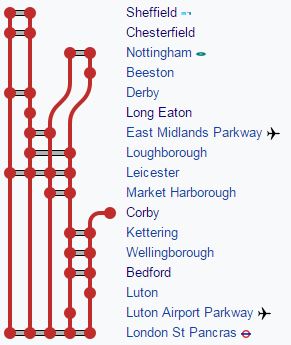
I can’t see that expecting passengers to change trains on a journey say between London and Sheffield would be welcomed by everyone.
Electrification To Leicester, Derby And Nottingham
This section is an aside, but I think that it could be the key to solving the capacity problem.
Electrification to these three cities, shouldn’t be a problem other than the usual one of Network Rail’s competence and it could be completed by 2023, which would include Sheffield.
However, there is a serious problem with electrification between Derby and Sheffield, in that the line goes through the World Heritage Site of the Derwent Valley Mills.
But there is an alternative plan, which is to electrify the Erewash Valley Line, which avoids the World Heritage Site and provides a more direct and possibly faster route between London and Sheffield.
Under Future in the Wikipedia entry for the Erewash Valley Line, this is said.
Network Rail as part of a £250 million investment in the regions railways has proposed improvements to the junctions at each end, resignalling throughout, and a new East Midlands Control Centre.[1]
As well as renewing the signalling, three junctions at Trowell, Ironville and Codnor Park will be redesigned and rebuilt. Since the existing Midland Main Line from Derby through the Derwent Valley has a number of tunnels and cuttings which are listed buildings and it is a World Heritage Area, it seems that the Erewash line is ripe for expansion. As the new signalling is rolled out, train detection is moving away from the traditional Track circuit detection of trains to Axle counting.
I hope all of the work done on the Erewash Valley Line has made sure that whenh they do electrify the line, the bridges are high enough and the signalling cables are well out of the way.
As the East Midlands Hub station for HS2 will be close to Toton TMD on the Erewash Valley Line and would open in 2032/3, it strikes me that it would be sensible to plan electrification of the Midland Main Line and HS2 together.
Bring On The Bi-Modes
Roger Ford dismisses the bi-modes in strong words.
A bi-mode doesn’t really work on the high-speed main line.
Under the wires it is a very heavy EMU, while under diesel power it is an underpowered DEMU. Just consider the roles on the MML. From London to Bedford it would need to run as a 125 mph diesel. From Bedford to Kettering the pantograph would go up for some 125 mph running. And after that it would go back to diesel. So why bother with the electric traction?
I would agree with that, but the Class 80x bi-modes may have other characteristics, that could get the timetable out of trouble.
The current hourly timetable out of St. Pancras is as follows.
- XX:00 – Corby, stopping at Luton, Bedford, Wellingborough and Kettering.
- XX:15 – Nottingham, stopping at Market Harborough, Leicester and East Midlands Parkway
- XX:26 – Sheffield, stopping at Leicester, Loughborough, East Midlands Parkway, Long Eaton, Derby, Chesterfield
- XX:29 – Nottingham, stopping at Luton Airport Parkway, Bedford, Wellingborough, Kettering, Market Harborough, Leicester, Loughborough, Beeston
- XX:58 – Sheffield, stopping at Leicester, Derby, Chesterfield
When Bedford to Corby is electrified, there will be another path.
Note that all the paths except those to Corby go through Leicester.
Currently the services are run by a mixture of 27 x Class 222 trains of 4, 5 and 7 cars and 12 x InterCity 125s of a 2×8 formation.
I said that the Class 80x trains may have other characteristics, that could get the timetable out of trouble.
One is that, two closely-related Class 395 trains can automatically couple and uncouple in under a minute, so I suspect that the Class 80x trains will have the same capability.
So supposing a pair of Class 80x trains ran from St. Pancras to either Bedford, Kettering or Leicester, where they would divide, with each train going to a separate destination.
This would mean that six paths would give twelve services to each of three destinations, Corby, Nottingham and Sheffield via Derby and Chesterfield.
EMT could balance the number of trains with their passenger statistics and could extend services from Corby, Nottingham and Sheffield, as they felt appropriate.
Modern trains would also be able to execute stops quicker than the current Class 222 trains and Inter\City125s.
So could extra stops be introduced South of Bedford to enable Thameslink services to be simplified and thinned out?
Conclusion
These may be consequences.
- Four tph might be able to call at Luton Airport Parkway and East Midlands Parkway.
- Sheffield and Nottingham might get marginally slower services, but they could get four tph.
- All EMT might stop at Bedford, to enable Thameslink services to Bedford to be reduced from 8 tph to 4 tph.
- Two tph between Sheffield and London might use the Erewash Valley Line and stop at Alfreton and Ilkeston.
There’s an optimal solution in there somewhere.
Hybrid Trains In The Former East Germany
In my travels from Göttingen, most of the local trains were diesel multiple units as local lines like the South Harz Railway are not electrified. On the other hand, the main lines through Göttingen, are all electrified.
In September 2016, I wrote German Trains With Batteries, which indicated a project in Germany to create hybrid trans, based at technical universities in Chemnitz and Dresden.
As some of the journeys I took in diesel trains, were under electrification, it would certainly appear that the German’s approach is sensible.
There would also appear to be lots of lines without electrification and diesel passenger services all over the area.
- Annaberg-Buchholz–Flöha Railway
- Bautzen–Bad Schandau Railway
- Chemnitz–Adorf Railway
- Flöha Valley Railway
- Gera Süd–Weischlitz Railway
- Glauchau–Wurzen Railway
- Heidenau–Kurort Altenberg Railway
- Herlasgrün–Oelsnitz Railway
- Karlovy Vary–Johanngeorgenstadt Railway
- Löbau–Zittau Railway
- Mid-Germany Railway
- Vejprty–Annaberg-Buchholz Railway
- Zwickau–Schwarzenberg Railway
If the universities can come up with an economic and practical solution, there are certainly a lot of places to use these hybrid trains.
I think it is interesting to compare the German approach with that of Porterbrook/Northern with their development of the Class 319 Flex train.
- The Germans are starting with a diesel Desiro Classic, whereas the British are starting with an electric Class 319 train.
- Batteries are an important part of the German solution, but may not be part of the British one.
- The German trains are nowhere near as old as the thirty-years-old British ones.
But the objectives of the two projects are to improve passenger services without doing a lot of expensive electrification.
Electrification At Rotherham
These pictures show some of the electrification gantries around Rotherham Central station.
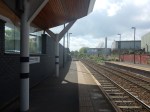
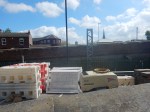
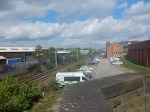
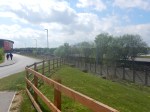
The overhead gantries would appear to be Network Rail’s standard for 25 KVAC, rather than the lighter-weight structures used on the Sheffield Supertram for their 1500 VDC.
So are Network Rail future-proofing the gantries for later conversion to 25 KVAC or are they being wired to that voltage, so that the tram-trains can be tested on the 25 KVAC as well?
The latter would be prudent, so that the problems and strengths of dual-voltage 25 KVAC/1500 VDC tram-trains can be assessed.
However, as I returned to Sheffield later, it appeared that the line connecting Rotherham and Sheffield had both heavy-weight and light-weight gantries in place.
Could there be a last minute change of project scope to include 25 KVAC running in the Sheffield tram-train trial, which also explains the timing of the rebuilding of the College Road Bridge?
This is said under Future in the Wikipedia entry for the Sheffield Supertram.
A tram-train extension to Rotherham is currently under construction and is scheduled to open in 2018, with a fleet of seven Vossloh Citylink Class 399 tram-trains in a UK first. This will involve trams operating on Network Rail’s Dearne Valley Line from Meadowhall Interchange to Rotherham station with a short extension to Rotherham Parkgate Shopping Centre. The proposed station will be a combined tram stop and railway station.[10] It is also planned that Rotherham Parkgate will be the hub for longer distance inter regional services,[11] while Central station will be the hub for local, Yorkshire based services. To cater for the tram train services, Rotherham Central will have a third platform built. It is thought that constructing the station will cost around £14 million (£53 million including the railway service to Leeds) and deliver economic benefits worth over £100 million. A study has concluded that it is not worth expanding Rotherham Central railway station because it would cost £161 million to expand the station but only deliver benefits worth £76 million. This is why constructing a new station is considered more viable.
That explains a lot, especially as it is a big change from what was being said perhaps a year ago.
There is an article in the Yorkshire Post, which is entitled Rotherham could get new rail station, which gives a lot more detail.
- Parkgate station could cost up to £53.2 million
- Parkgate would be the inter-regional station.
- Central would be more local
- Rotherham should have one train per hour (tph) to Leeds and Manchester, three tph to Doncaster and six tph to Sheffield.
As I came through the Rotherham Parkgate area on my train between Leeds and Rotherham earlier, I didn’t see any evidence of station construction.
I think that Network Rail by putting up gsntries that can accept 25 KVAC electrification have made sure that they can fit any future plans.
So long as they can get some sort of wiring along the route and a reversing facility somewhere in the Rotherham area, I can see tram-trains running next year.
If Parkgate station is built, then provided any tracks are in the right place, this shouldn’t be a problem.
But the interesting idea could be to use Class 319 Flex trains on the route to Leeds via the Wakefield Line. The gaps in the electrification would be initially covered by the trains onboard diesel power.
As electrification is installed, they would eventually be able to do Rotherham Central to Leeds under electric power.
Whilst, Network Rail were electrifying the tram-train route, would it not be prudent to put up the wires to Meadowhall Interchange station or even Sheffield station?
The other way they could also electrify the short Swinton to Doncaster Line, which would allow electric trains from London to reach Rotherham Parkgate, Meadowhall and Sheffield stations.
I can certainly see something like the following services through Rotherham when Parkgate station is open.
- 1 tph Sheffield to Leeds calling at Parkgate and Central
- 1 tph Doncaster to Manchester and Manchester Airport calling at Parkgate and Sheffield
- 2 tph Doncaster to Sheffield calling at Parkgate and Central
Add in three tram-trains per hour between Sheffield Cathedral and Parkway via Central and the required frequencies are achieved.
It will be interesting to see what finally happens.
Extra Services To Southport On Merseyrail’s Northern Line
Local interests have ambitions to connect Ormskirk and Southport stations, as is detailed in Wikipedia under Future Developments in the Wikipedia entry for Ormskirk station.
There have been calls from local authorities and the local rail user group to reopen both curves at Burscough to allow the reinstatement of through trains from here to Southport, as well as to reinstate through services between Preston & Liverpool via Ormskirk and to rebuild & reopen the Skelmersdale branch.[7] Merseytravel’s 2014 ‘Liverpool City Region Long Term Rail Strategy’ does not back plans for an Ormskirk to Skelmersdale route (instead proposing that the link be provided from the Kirkby to Wigan Wallgate line), though it does suggest that a new bi-level interchange at Burscough Bridge could be built to provide improved interchange facilities between the Ormskirk branch and the Wigan to Southport line in addition to reopening the curves and extending electrification through to Preston & Southport.
, To connect the two stations would mean doing at least the following.
- Reinstate the South Burscough Curve as a single track
- The South Burscough Curve would have bi-directional signalling and third rail electrification.
- Remodel Ormskirk station.
This picture shows what remains of the second platform at Ormskirk station.
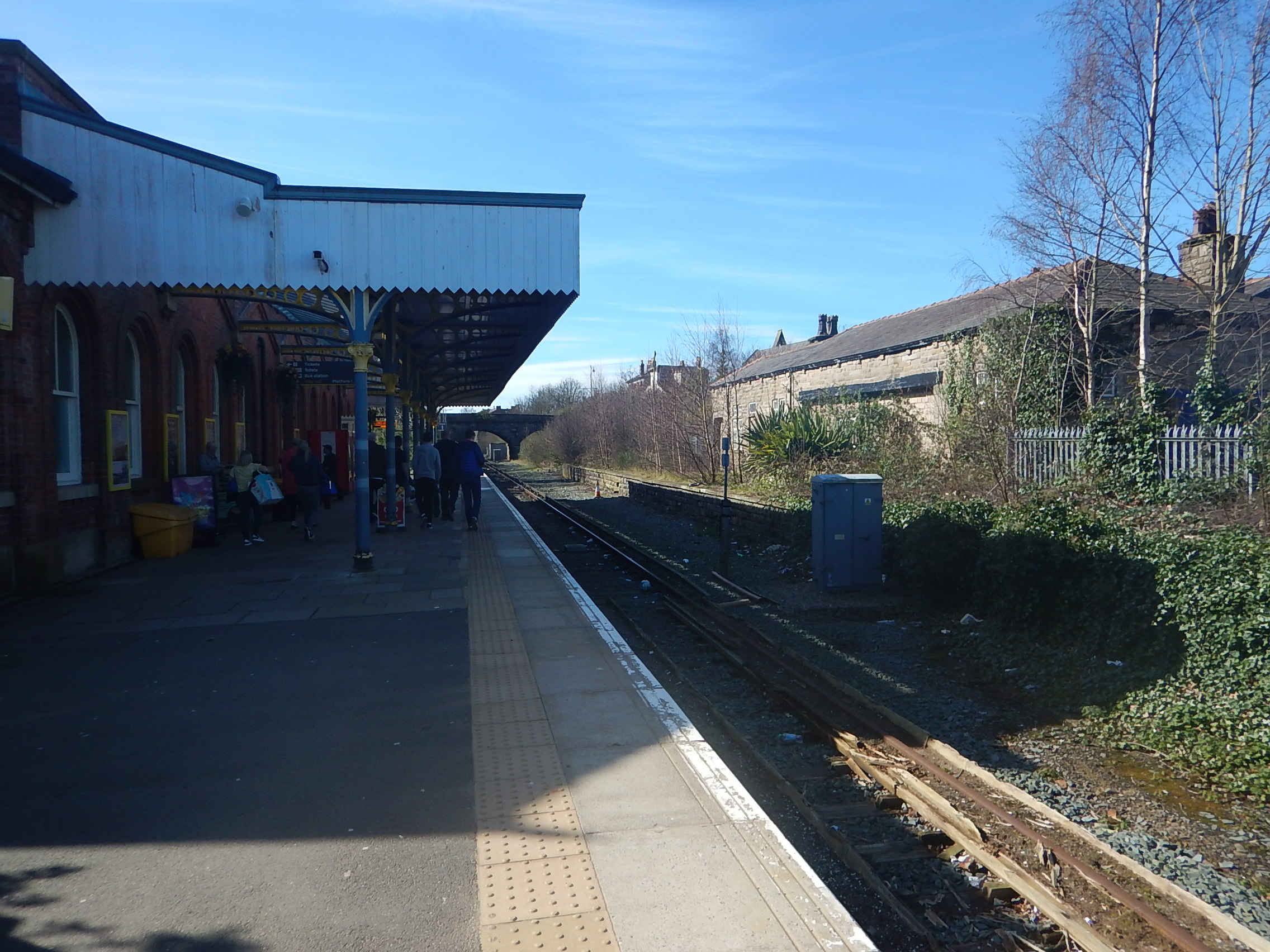
The second platform could probably be reinstated reasonably easily, but I wonder if a clever station designer and train scheduler could organise Liverpool, Preston and Southport services around a single long platform?
The current layout could be actually considered to be two platforms, as one end serves Liverpool trains and other Preston trains.
So in this explanation, I’ll refer to them as the Liverpool Platform and the Preston Platform.
- The Liverpool platform would be long enough to take two new Stadler trains.
- The Preston platform would be long enough for the longest train likely to work an Ormskirk to Preston service.
- An electrified passing loop starting from between the two platforms and extending towards Burcough Junction station would be installed.
Consider.
- Trains arriving and returning to Liverpool would operate as they do now using the Liverpool platform.
- Trains arriving and returning to Preston would operate as they do now using the Preston platform, but stop within the passing loop.
- Passengers changing between Liverpool and Preston services would change trains as they do now, by walking along the platform.
- Liverpool to Southport and Liverpool to Preston services would use the Liverpool platform and would either go through the Preston platform or use the passing loop as appropriate.
Two parallel platform stations are so nineteenth century!
These modifications between Ormskirk and Southport would improve train services in the following ways.
- Create more capacity between Liverpool and Southport.
- Allow travellers to go between Southport and the Ormskirk Branch of the Northern Line , without going via Sandhills station.
- Allow access to Manchester services at Burscough Bridge station
- Add direct Liverpool services to those to Manchester and Southport to all the new housing that seems to be under construction around the Southport to Manchester Line.
- Enable the construction of one or more new stations, like Kew Gardens in Southport, which is close to the hospital.
You can certainly understand why Merseyrail appears to be keen.
There are lots of ways to organise services.
I suspect one of the most efficient ways will be to run the trains in a loop going to and starting from Hunts Croos and going to Liverpool Central via Liverpool Central, Southport, Burscough Bridge, Burscough Junction and Ormskirk. Four trains per hour (tph) would go in one direction and four tph in the other.
Timing with the current trains are as follows.
- Hunts Cross to Southport – 64 minutes
- Southport to Burscough Bridge – 22 minutes
- Burscough Bridge to Ormskirk – 9 minutes – estimated
- Ormskirk to Liverpool Central – 34 minutes
- Kirkby to Liverpool Central – 18 minutes.
These timings are not the easiest to put together to make a four tph schedule.
As an example, if you want a current Class 508 train to go from Hunts Cross to Southport and back again, it will take 128 minutes plus whatever it takes to turn the train at each end. Allowing eleven minutes at each end gives a time of two and a half hours, which means ten trains are needed for a full four tph.
Ormskirk to Liverpool central will also need trains. If they could do Liverpool Central to Ormskirk and back in under an hour, that would need four tph..
The new Stadler trains have been designed to do the journey nine minutes quicker, which means that if the turnrounds are a bit quicker, it could be possible to do the round trip in two hours, which would mean only eight trains would be needed for a full four tph.
Ormskirk to Liverpool central will also need trains. If they could do Liverpool Central to Ormskirk and back in under an hour, that would need four tph..
If you look at the full loop with the current trains, this takes 258 minutes plus perhaps 30 minutes for the two reverses at Southport and the one at Liverpool Central. So we get a time of probably three hours and a requirement of 12 trains to run 4 tph to both Ormskirk and Southport and provide a four tph service between the two current termini.
As the current services need ten trains for Hunts Cross-Southport and four for Liverpool Central-Ormskirk, the loop saves two trains.
With the new Stadler trains, I suspect they could do the loop diagram in under two hours, which would mean just eight trains for a full four tph.
Thus, extra services can be provided between Ormskirk and Southport with a requirement of four less trains than running the lines individually.
Services to Southport and Ormskirk from Liverpool would be as follows.
- Southport to Hunts Cross via Formby – 4 tph
- Southport to Liverpool Central via Ormskirk – 4 tph
But the big difference is most stations on the Northern Line are served by four tph from Hunts Cross and Southport and all the other stations need a single change and a wait of a few minutes.
To operate the loop service, it would need Ormskirk to Southport to be fully electrified.
Southport To Manchester
You then have the situation if a Class 319 Flex train were to work Southport to Manchester, that it would work as follows.
- Southport to Burscough Bridge – using third-rail electrification when installed.
- Burscough Bridge to Bolton – using diesel power.
- Bolton to Manchester – using overhead electrification.
Southport would become an all electric station.
To get a full electric service to Manchester, it would only be necessary to electrify between Manchester and Burscough Bridge, where the chsngeover would take place.
I have followed this line in my helicopter and there are only three small bridges and a level crossing between Burscough Bridge and Wigan Wallgate stations.
So I suspect electrifying from Wigan to Burscough Bridge could be an easier electrification than most.
Conclusions
I have come to the following main conclusion.
Combining Southport and Ormskirk services in a loop via a reinstated South Burscough Curve, means the following.
- Southport gets eight trains per hour (tph) to and from Liverpool.
- Ormskirk gets four tph to and from Liverpool.
- All stations on the Northern Line get four direct or single-change tph from Hunts Cross, Southport and Liverpool Central.
- Ormskirk to Southport and all intermediate stations get 4 tph in both directions.
- The service can be run by less trains than needed for independent operation to Southport and Otmskirk.
Southport to Ormskirk needs third-rail electrification.
There were a some subsidiary conclusions.
- Ormskirk station can be based on a single platform with a passing loop, which could allow Liverpool-Preston services.
- Ormskirk station could still run the current Ormskirk to Preston service.
- The third-rail electrification between Southport and Burscough Bridge stations could be used by Class 319 Flex trains working services between Southport and Manchester.
- Southport could become an all electric station.
I suspect that others could do much better.
Thoughts And Facts About Class 319 Flex Trains From Manchester And Blackburn Into The Hills
On Thursday and Friday last week, I spent two days in the Premier Inn at Blackburn and explored the rail lines around the town with journeys all over the area that should by now have been fully electrified.
Class 319 Flex Trains
The main reasons to go was to see some Friends In The North and to see Ipswich play at Barnsley, but I also wanted to explore some of the hilly routes in Lancashire.
Porterbrook in their brochure for the Class 319 Flex trains says that the objective for the train is that it can run from Manchester Piccadilly to Buxton on the Buxton Line, under the power that is available, which is electrification only as far as Hazel Grove station.
The Routes With Hills
There are three routes from Manchester and Blackburn that climb into the hills.
- The Ribble Valley Line to Blackburn via Bromley Cross and then on to Clitheroe and Hellifield stations.
- The East Lancashire Line Line to Colne station
- The Buxton Line to Buxton station.
The lines are not for low-powered trains and the current Class 150 or Class 156 trains struggled on the three climbs I did.
- Hazel Grove to Buxton in the afternoon.
- Blackburn to Clitheroe early in the morning.
- Bolton to Blackburn, crush-loaded in the rush hour.
Someone told me, that leaf fall can be a problem in the Autumn.
In no particular, these are my thoughts and some facts from other sources and my observations.
Blackburn Depot
A conductor told me that Northern Rail will be creating a depot and basing train crew at Blackburn.
This article in the Lancashire Telegraph is entitled Multi-million pound train depot set for Blackburn.
This is said.
Blackburn is to get a new multi-million pound train depot as the latest stage of East Lancashire’s rail revolution.
The stabling, maintenance and cleaning centre will include an office block and new connection to the existing Bolton junction where the tracks to Preston and Darwen divide.
If as I believe the Class 319 Flex trains could serve Clitheroe/Hellifield and Colne, then it could be an ideal location. Especially, if the Clitheroe/Hellifield and Buxton services were run back-to-back across Manchester.
Double Track Most Of The Way
The three lines have the following track layouts.
- The Ribble Valley Line has a large proportion of double track, which stretches to Hellifield.
- The Buxton Line is double-track.
- The East Lancashire Line is single-track from Rose Grove station to Colne station.
So hopefully, if two trains per hour (tph) were to be run on these three branches, passing would be possible.
Hellifield
Hellifield station is where the Ribble Valley Line connects to the Settle-Carlisle Line.
A conductor told me that he’d heard that Northern would like to serve Hellifield more regularly.
Since I first wrote this, I’ve heard that the tracki at Hellifield has been recently replaced and is in good condition.
Housing And Other Property Development
As I travelled along the lines to Clitheroe and Buxton, there was a lot of housing development along the line, at places like Clitheroe, Hazel Grove, Whalley to name just three.
The crowded trains I used in the Peak to Blackburn are going to carry even more passengers and the need for capacity with power on these lines will increase.
Tourism Issues
Buxton, Clitheroe Colne and Hellifield all have reasons for tourists and especially those that enjoy visiting the hills.
I have no figures to back it up, but I suspect leisure passengers often go loaded with children in buggies, bicycles and heavy rucksacks and cases. They certainly do in the Summer on the trains of East Anglia and that is flat.
Add in the weather forecast and the effects of new trains and at times, there could be a large increase in leisure and tourism-related travel.
If the trains connected the Settle and Carlisle Line at Hellifield to Blackburn, Manchester and perhaps Buxton, this would surely open up a tourist train route, that Doctor Beeching wouldn’t have thought was the least bit feasible.
Future Train Frequencies
Train frequencies to Manchester could possibly grow to the following.
- Blackburn – 2 tph to Manchester Piccadilly
- Blackburn – 2 tph to Manchester Victoria
- Buxton – 2 tph
- Clitheroe – 2 tph
- Hazel Grove – 4 tph
In addition, the intersecting route from Blackpool South to Colne via Preston and Blackburn, could be running 2 tph.
I do suspect though, that 1 tph to and from Hellifield will be enough. But who knows? I could just be as wrong as Beeching.
The lines probably have a Peak problem, that is fairly unusual in the UK, but probably is common in countries with real mountains like Austria, Japan and Switzerland. One direction of Peak travel is downhill, but the other is up a very steep railway.
On train frequencies, this is said in the Wikipedia entry for the Ribble Valley Line.
A six-week engineering blockade saw the existing passing loop there extended by 1 mile (1.6 km) at each end and signalling improvements made to add capacity on the line and allow for service frequencies between Bolton & Blackburn to be doubled to two trains per hour each way throughout the day from December 2017.
Could this be why, Porterbrook are planning to deliver four refurbished Class 319 Flex trains by the end of 2017, according to their brochure?
Some powerful extra trains will probably be needed to achieve the objective of 2 tph to Blackburn and four Class 319 Flex will help.
Future Train Capacity
I did two journeys in the Peak to Blackburn; in the first I took the slower service via Todmorden and Burnley in a two-car train and in the second, I took the direct route via Bromley Cross, in a four-car formation.
The second was the most crowded, but it was Friday. It also struggled up the hill from Bolton to Blackburn.
Northern’s decision to go for a four-car Class 319 Flex train which could be used on some of these routes, is understandable.
Blackburn To Huddersfield
I travelled to Huddersfield station from Manchester Victoria and didn’t see any signs of electrification on this important route.
Returning to Blackburn from Huddersfield, my train was a direct service which travelled via Manchester Victoria, Bolton and Bromley Cross.
This would be an ideal service to run using a Class 319 Flex train, until Network Rail get their act together and electrify Manchester Victoria to Huddersfield. Even if they only get the wires as far as Stalybridge, the Class 319 Flex would be an enormous improvement compared to the asthmatic Class 156, that struggled with its full load of passengers to Blackburn.
The Calder Valley Line
The Calder Valley Line goes through very picturesque countryside between Preston and Leeds.
I think that full electrification of this line could never happen.
- The line has large numbers of stone and brick viaducts and bridges, which would be very expensive to modify for electrification.
- The station at Hebden Bridge is Grade II Listed.
- There is electrification between Leeds and Bradford, which could probably be extended as far as Halifax.
- Preston is fully electrified and affordable electrification to Blackburn or perhaps Rose Grove or Burnley Manchester Road stations should be possible.
- Electrification to Rose Grove would mean that the service between Blackpool South and Colne could be run using electricity between Rose Grove and Kirkham and Wesham stations.
But the biggest problem would be the opposition to overhead gantries in the hills.
The distances are revealing.
- Burnley to Halifax is just over twenty miles
- Blackburn to Halifax is just over thirty miles.
If Halifax to Bradford wasn’t electrified then that adds another ten miles.
All distances would be within range of a modern bi-mode train, including a Class 319 Flex.
Other Destinations
From Hazel Grove, it is possible for diesel trains to access the Hope Valley Line towards Sheffield.
There must be stations on this line that are possible destinations for a Class 319 Flex train.
Chester and Windermere have also been mentioned as future destinations for the train.
Electrification
Electrification has been painfully slow in the North-West, as it has in most places in the UK.
It looks like that by the end of 2017, Manchester to Preston via Bolton and the Blackpool Branch to Blackpool North station will be electrified.
The advantage of the Class 319 Flex is that it can use this electrified set of lines to run services to stations like Barrow, Blackburn, Blackpool South, Burnley, Chester, Hebden Bridge, Sellafield and Windermere, that are off the electrified network in conjunction with the Class 319 trains.
The Need For A Train To Climb The Hills
From this brief analysis and my observations, it would seem that Northern need a few four-car trains with adequate power to get up the hills at a speed, that enables an efficient timetable. As some of the routes from Manchester Piccadilly and Victoria are electrified, the ideal train would need the capability to use the wires.
If ever, there was a series of routes that need a bi-mode train, then it is these routes.
The Class 319 Flex And The CAF Civity
The Class 319 Flex has according to the brochure I’ve seen been designed to run from Manchester to Buxton with a full load of passengers in the Peak or perhaps after a City-United Derby.
But Northern have ordered new CAF Civity trains in the following versions.
- 25 two-car Class 195 diesel trains
- 30 three-car Class 195 diesel trains
- 31 three-car Class 331 electric trains
- 12 four-car Class 331 electric trains.
This is said in the Wikipedia entry for the Class 331 trains.
In early 2016 it was confirmed that Spanish rolling stock manufacturer CAF would construct the new electric powered trains which are planned to operate in West Yorkshire to replace Class 321 and Class 322 trains and work alongside the current fleet of Class 333 units. The four-car Class 331 units will be deployed on electrified services from Manchester Piccadilly to replace the Class 323 units which are due to return to Porterbrook at the end of their current lease in 2018.
So it would appear that the Class 319 trains will continue to operate for a few years yet! Hopefully with better seats, wi-fi and a few other smaller improvements.
I think that Northern have decided that until the Class 195 trains arrive that the Class 319 Flex trains are the best short-term solution. But given the overcrowding on the routes will the future three-car trains have enough capacity?
So I suspect, if Northern go the CAF Civity route, I feel that Northern will acquire some longer diesel trains or even some dual-power Civitys.
But at least running Class 319 Flex trains on the route will effectively produce the specification for these hilly routes.
Class 319 Flex Trains Could Be In Service By December 2017
I have just seen a an early copy of Porterbrook’s brochure for their new Class 319 Flex train.
On the summary page, the following is said.
4 units in service by December 2017
On the North-West Electrification page of the Network Rail web site, these electrification milestones are given.
- December 2017 – Preston to Manchester and Manchester Victoria to Stalybridge
- Early 2018 – Preston to Blackpool
It would appear that the delivery of the trains and the availability of electrified lines are not a bad fit.
I estimate that three Class 319 Flex trains will be needed to provide an hourly service to Blackpool from either Liverpool or Manchester, before Preston to Blackpool is electrified.
But once Blackpool to Preston is electrified, Blackpool, Liverpool, Manchester and Preston would be linked by standard Class 319 trains, releasing the Class 319 Flex trains to develop other routes from the core electrified network.
- Barrow-in-Furness – Electrified to Carnforth
- Buxton – Electrified to Hazel Grove
- Huddersfield – Electrified to Stalybridge
- Kirkby – Electrified to Bolton
- Southport – Electrified to Bolton
- Windermere – Electrified to Oxenholme Lake District
Places like Blackburn, Burnley, Clitheroe and even Hebden Bridge and Todmorden could be reached from the electrification at Bolton, Manchester or Preston.
The electrified network will be grown, by the selective addition of electrification and/or trains.
Where Is Moorside?
Moorside is the name given to NuGen‘s new nuclear power complex in Cumbria.
I was drawn to write this post, by this article in Construction News, which is entitled Network Rail and Moorside nuclear power plant developer Nugen are putting together a business case for rail investment in Cumbria that could be worth as much as £400m.
four hundred million pounds could buy a lot of rail infrastructure.
But where exactly is Moorside?
This map was taken from the Our Site page on the NuGen web site, showsthe Moorside site outlined in red.
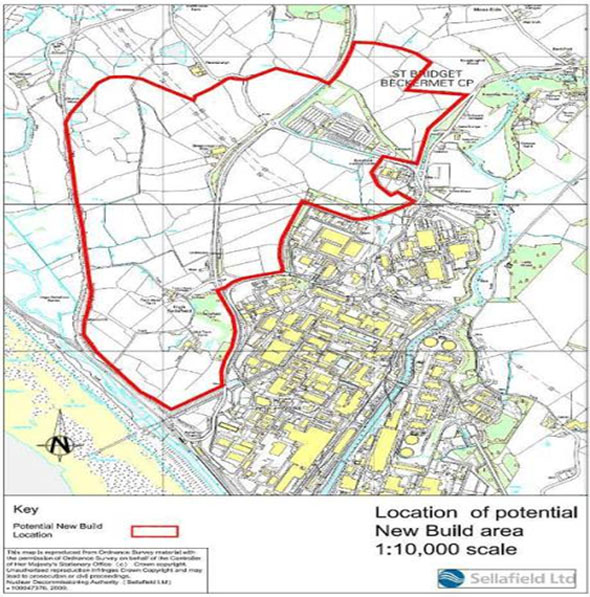
Note the development with the yellow-shaded areas to the South-East of the red-lined area. This is Sellafield.
And this is a Google Map of the coast around the nuclear reprocessing complex.
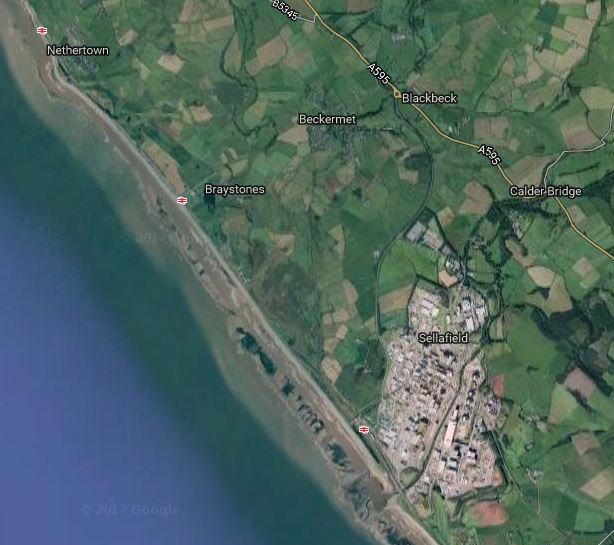
Note the railway stations along the coast. Sellafield station is by the nuclear complex, with Braystones and Nethertown to the North.
All three stations are on the Cumbrian Coast Line, which in addition to the passenger service, is used to transport freight, including nuclear waste to and from Sellafield.
Overlaying the NuGen map on the Coogle Map shows that Moorside will be to the North-West of Sellafield.
The Cumbrian Coast Line and the related Furness Line curve around Cumbria from Carlisle to Carnforth via Workington, Whitehaven, Sellafield and Barrow-in-Furness.
- The line is mainly double track, but with sections of single-track.
- The line is not electrified.
- Most of the trains are elderly diesels.
- The train service is vaguely hourly, but patchy in places.
The nuclear power complex is a ten billion pound project and will require large amounts of heavy equipment and construction materials to be transported the site. Also on a daily basis, large numbers of engineers and construction workers wilol need to get to one of the largest construction sites in the North of England.
Is Network Rail’s £400 million proposed vdevelopment, a reconstruction of the Cumbrian Coast and Furness Lines to the following standard.
- Double track.
- Electrification
- 100 mph line speed where possible.
- Build a new station at Moorside and any other places, where they are needed.
- Step-free stations
- At least two trains per hour in both directions.
- Full wi-fi and 4G on all trains and in stations.
Upgraded to a high standard, it might do more than help construction at Moorside and Sellafield and those that work in the two complexes.
- It might increase quality tourism.
- It could be a diversion route for the West Coast Main Line.
- It might make a London service to Barrow-in-Firness via HS2 a possibility.
Network Rail’s project could do a lot more than service the twin nuclear sites.
I explored the Cumbrian Coast Line in April 2015.
 The Anonymous Widower