UK Government Sets 8-Hour Minimum For LDES Cap-And-Floor Sheme
The title of this post, is the sa,e as that of this article on Energy Storage News.
This is the sub-heading.
The UK government has published a Technical Decision Document confirming crucial aspects of its long duration electricity storage (LDES) cap-and-floor scheme, which includes increasing the minimum duration required from six hours to eight
These paragraphs give full details.
The document, released by regulator Ofgem on 11 March, details the final overarching rules and requirements for the scheme as well as how it will be implemented, though significant detail still remains to be worked out.
The scheme will provide a cap-and-floor revenue protection for 20-25 years that will allow all capital costs to be recoverable, and is effectively a subsidy for LDES projects that may not be commercially viable without it. Most energy storage projects being deployed in the UK today are lithium-ion battery energy storage systems (BESS) of somewhere between 1-hour and 3-hour in duration (very occasionally higher).
One of the most significant new details of the scheme is that, following industry feedback, the minimum duration for projects to qualify has been increased from six hours to eight hours of continuous rated power.
The ‘continuous rated power’ aspect prevents shorter duration projects from bidding in a smaller section of their MW capacity in order to act like an 8-hour system.
Another interesting detail pointed out by several commentators is that the cap is a ‘soft’ one, meaning it will allow extra revenue to be shared between developers and consumers. Exact details on the ratio are yet to be determined.
As a Graduate Control Engineer from Liverpool University in the 1960s, I hope that the move from a six to eight hours minimum duration is feasible.
I wasn’t dealing with power systems, but with multi-vessel chemical plants.
These are my thoughts.
The biggest project, I was dealing with a few years later in the 1970s, was the modeling of all the the reservoirs and pipelines by the Water Resoures Board.
As the supply side of the water industry hasn’t had too many issues with the volume of water supplied, I feel that the main modelers must have done a reasonable job.
Six To Eight Hours Of Continuous Operation
The article says this about uprating from six to eight hours of continuous operations.
All the systems that have been proposed for cap-and-floor operation, seem to have some form of physical storage.
- Energy Dome appears to have tents of carbon dioxide.
- Energy Vault uses stacks of heavy weights.
- Form Energy has tanks of rust.
- Gravitricity has huge weights in disued mine shafts.
- Highview Power has large tanks of liquid air.
- Pumped storage hydro has two lakes, that hold water.
- Rheenergise has two large tanks, of a water-based slurry.
So to go from six to eight hours will hopefully just need some more storage.
Highview Power appears to use similar gas tanks to those used to store natural gas or hydrogen.
This image clipped from Highview’s web site, shows large tanks for liquified gas storage.
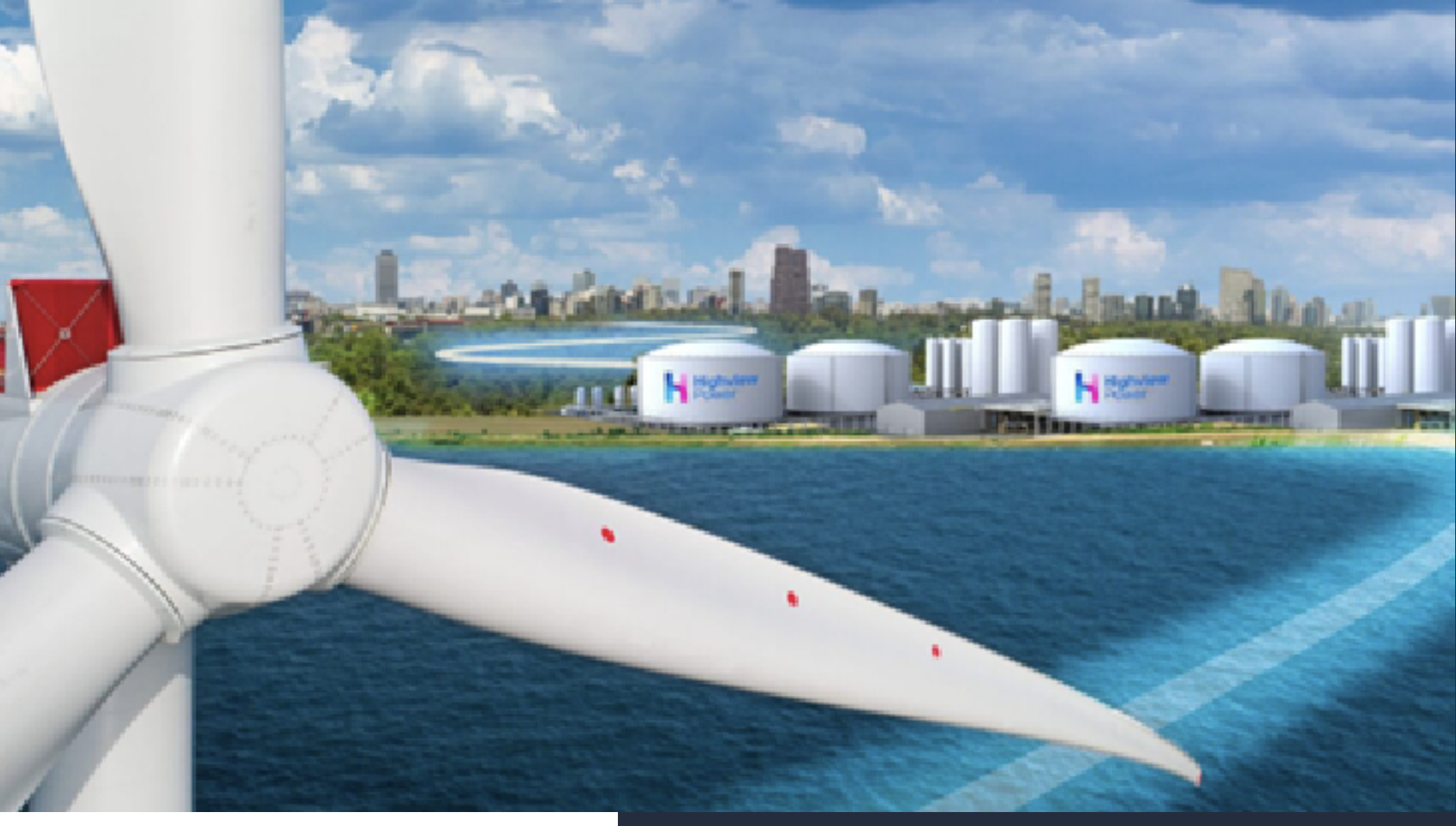
With tanks like these, which can hold GW-equivalents of liquid air, Highview could be building batteries with storage to rival the smaller pumped storage hydroelectric power stations. They are already talking of 200 MW/2.5 GWh systems, which would have a 12.5 hour continuous rating and would probably need two to three tanks.
Coire Glas Pumped Storage
I’ll use Coire Glas pumped storage hydro electric power station as an example.
As currently planned SSE’s Cioire Glas pumped storage hydroelectric power station is 1.5 GW/30 GWh, so it has a a 20 hour continuous rating.
In The UK’s Pumped Storage Hydroelectricity, I gave a rough estimate of the pumped storage hydroelectricity systems in operation or planed as nearly 11 GW/224GWh.
The Soft Cap
The article says this about a soft cap.
Another interesting detail pointed out by several commentators is that the cap is a ‘soft’ one, meaning it will allow extra revenue to be shared between developers and consumers. Exact details on the ratio are yet to be determined.
I seem to remember that when I was modeling a larger multi-vessel chemical plant at ICI, I was using sharing between vessels, to get the system to operate on a PACE-231R analog computer.
So I suspect a soft cap is possible.
Diversifying A US$200 billion Market: The Alternatives To Li-ion Batteries For Grid-Scale Energy Storage
The title of this post, is the same as that of this article on Energy Storage News.
This is the introductory paragraph.
The global need for grid-scale energy storage will rise rapidly in the coming years as the transition away from fossil fuels accelerates. Energy storage can help meet the need for reliability and resilience on the grid, but lithium-ion is not the only option, writes Oliver Warren of climate and ESG-focused investment bank and advisory group DAI Magister.
Oliver starts by saying we need to ramp up capacity.
According to the International Energy Agency (IEA), to decarbonise electricity globally the world’s energy storage capacity must increase by a factor of 40x+ by 2030, reaching a total of 700 GW, or around 25% of global electricity usage (23,000TWh per annum). For comparison, this would be like swelling the size of the UK’s land to that of the USA.
Similar to how “nobody ever gets fired for buying IBM”, lithium-ion holds a similar place in grid scale electrical storage today.
And just as IBM did in the last decades of the last century, the builders of lithium-ion will fight back.
He then lists the problems of grid-scale lithium-ion batteries.
- Shortage of cobalt.
- Toxic and polluting extraction of some much needed metals and rare earths from unstable countries.
- Lack of capacity to load follow.
- Limited lifespan.
He does suggest vehicle-to-grid can provide 7TWh of storage by 2030, but it has similar problems to lithium-ion grid scale batteries.
Finally, he covers these what he considers several viable methods of energy storage in detail.
He introduces them with this paragraph.
No single killer application or technology exists to get the job done. Diversification is key with success dependent on the wide-scale adoption of multiple grid-scale energy storage solutions.
- Energy Dome – Italy – Stylish Use of CO2
- Augwind Energy – Israel – Stores Energy As Compressed Air Underground
- Cheesecake Energy – UK – Stores Energy As Heat And Compressed Air
- Highview Power – UK – Stores Energy As Liquefied Air
- Ocean Grazer – Netherlands – Ocean Battery
- RheEnergise – UK – High Density Hydro
- Lumenion – Germany/Japan – Stores Energy As Heat
- Energy Vault – Switzerland – Raising And Lowering Of Weights
Note.
- All systems are environmentally-friendly and use readily-available materials like air, water, sea-water, steel and concrete for their systems.
- The most exotic materials used are probably in the control computers.
- Some systems use readily-available proven turbo-machinery.
- Most systems appear to be scalable.
- All systems would appear to have a working life measured in decades.
- I would expect that most well-educated teenagers could understand how these systems worked.
Only Augwind Energy and Lumenion are new to me.
He finally sums up the economics and the market potential.
Our ability to expand energy storage capacity is one of the most pressing issues that will determine whether this defining ‘transitional’ decade is a success. But we’ll need to invest wisely into the right technologies that get the greatest bang for the buck (in terms of GWh capacity and return on capital) given the limited lifespan of Li-Ion and the decarbonisation of the grid.
At a current capital cost of US$2,000 per kW quoted by the US National Renewable Energy Laboratory (NREL) for 6-hour Li-ion battery storage, the 700GW of capacity needed by 2030 equates to around a US$1.5 trillion market over the coming decade, making it worth nearly US$200 billion a year.
The Energy Storage News article is a comprehensive must read for anyone, who is considering purchasing or investing in energy storage.
I have some further thoughts.
From My Experience Would I Add Any Other Systems?
I would add the following.
- Form Energy, because its iron-air battery is well-backed financially.
- Gravitricity, because it can use disused mine shafts to store energy and the world has lots of those.
- STORE Consortium, because its 3D-printed concrete hemispheres, that store energy using pressurised sea-water can be placed within a wind farm.
I also suspect that someone will come up with an energy storage system based on tidal range.
Finance
When we started Metier Management Systems, finance to breakout from the first initial sales was a problem. We solved the problem with good financial planning and an innovative bank manager who believed us all the way.
David, was a rogue, but he was a rogue on the side of the angels. Long after Metier, he even came to my fiftieth birthday party.
David would have found a way to fund any of these systems, as they tick all the boxes of demonstrated, environmentally-friendly, safe and understandable. They are also likely to be bought by companies, governments and organisations with a high net value, a very respectable reputation and/or large amounts of money.
I also think, that just as we did with the original Artemis project management system, some of these systems can be leased to the operators.
Second-Use Of Systems
Several of these systems could be moved on to a new location, if say they were supporting an industry that failed.
That would surely help the financing of systems.
Gravity—Yes, Gravity—Is the Next Frontier for Batteries
The title of this post, is the same as that of this article on Popular Mechanics.
This is the first paragraph.
When the sun isn’t shining and the wind isn’t howling, suspended weights can step in to generate power.
The article goes on to explain Energy Vault and Gravitricity.
It is certainly an endorsement of the technique from one of America’s popular magazines.
Gravity, The Ultimate In Energy Storage
This is a must read article on explica.co.
It talks about three methods of storing energy using gravity.
Gravitricity
Gravitricity is under development in Edinburgh
Energy Vault
An image explaining the principle of Energy Vault is also shown.
The Energy Vault web site has some impressive video.
They could be a company to watch. Especially, when they have a battery working, where it can be viewed in action, as it will look like a gigantic many-armed robotic child, playing with thirty-five tonne concrete bricks.
Vázquez Figueroa
This writer from the Canaries has come up with an interesting idea, which combines an energy storage system with water desalination. This is his website. Unfortunately for me, it’s in Spanish only.
This is explica.co’s description of the idea.
Figueroa’s idea is conceptually very simple. Pumping water from the sea to an elevated reservoir, using renewable energy for the process when it is not in demand. Then, in a total win-win, the writer proposes to release that water into a vacuum (as in a traditional hydroelectric power station) which would move a turbine generating electricity. But also, and here’s the genius, that salty water could fall on a semi-permeable membrane, so that it desalinated. Clean electricity and fresh water for the same price. Who gives more?
It certainly sounds feasible.
It sounds to me, though it could be paired with another idea, I read about a couple of years ago.
- A reservoir would be built on a high place close to the sea.
- Pumps driven by the waves would pump seawater into the reservoir.
- When electricity is needed, water is released from the reservoir through turbines.
- There would be no reason, why the water discharged from the turbines couldn’t be desalinated.
Never underestimate the power of innovation. Especially, when it is fuelled by convivial company and appropriate beers!
Companies Have New Take On Old Energy Storage Tech
The title of this post, is the same as that of this article on Hackaday.
This is the introductory paragraph.
According to Spectrum, several companies are poised to make a splash storing energy with gravity. That sounds fancy and high tech at first, but is it, really? Sure, we usually think of energy storage as some sort of battery, but there are many energy storage systems that use water falling, for example, which is almost what this new technology is all about. Almost, since instead of water these new systems move around multi-ton blocks.
The article gives a review of Energy Vault, Gravitricity and another company called Gravity Power.
This is the article’s take on Gravity Power.
The scale of the weights is hard to imagine. Another company, Gravity Power, claims they could deliver 400 megawatts for 16 hours using an 8 million metric ton piston. There’s no word on how long it takes to bring that piston back to the charged position after the 16 hours, though. A Boeing 757-200, for example, weighs about 100 tons when loaded with fuel and passengers. So imagine 80,000 giant airplanes melted down. It makes Energy Vault’s 35-ton weights seem much more reasonable.
Looking at the Gravity Power web site, their technology is described on this page, where this is the first paragraph.
The GPM (Gravity Power Module) uses a very large piston that is suspended in a deep, water-filled shaft, with sliding seals to prevent leakage around the piston and a return pipe connecting to a pump-turbine at ground level. The piston is comprised of reinforced rock and in some cases concrete for low cost. The shaft is filled with water once, at the start of operations, but is then sealed and no additional water is required.
This graphic from the page explains the technology.
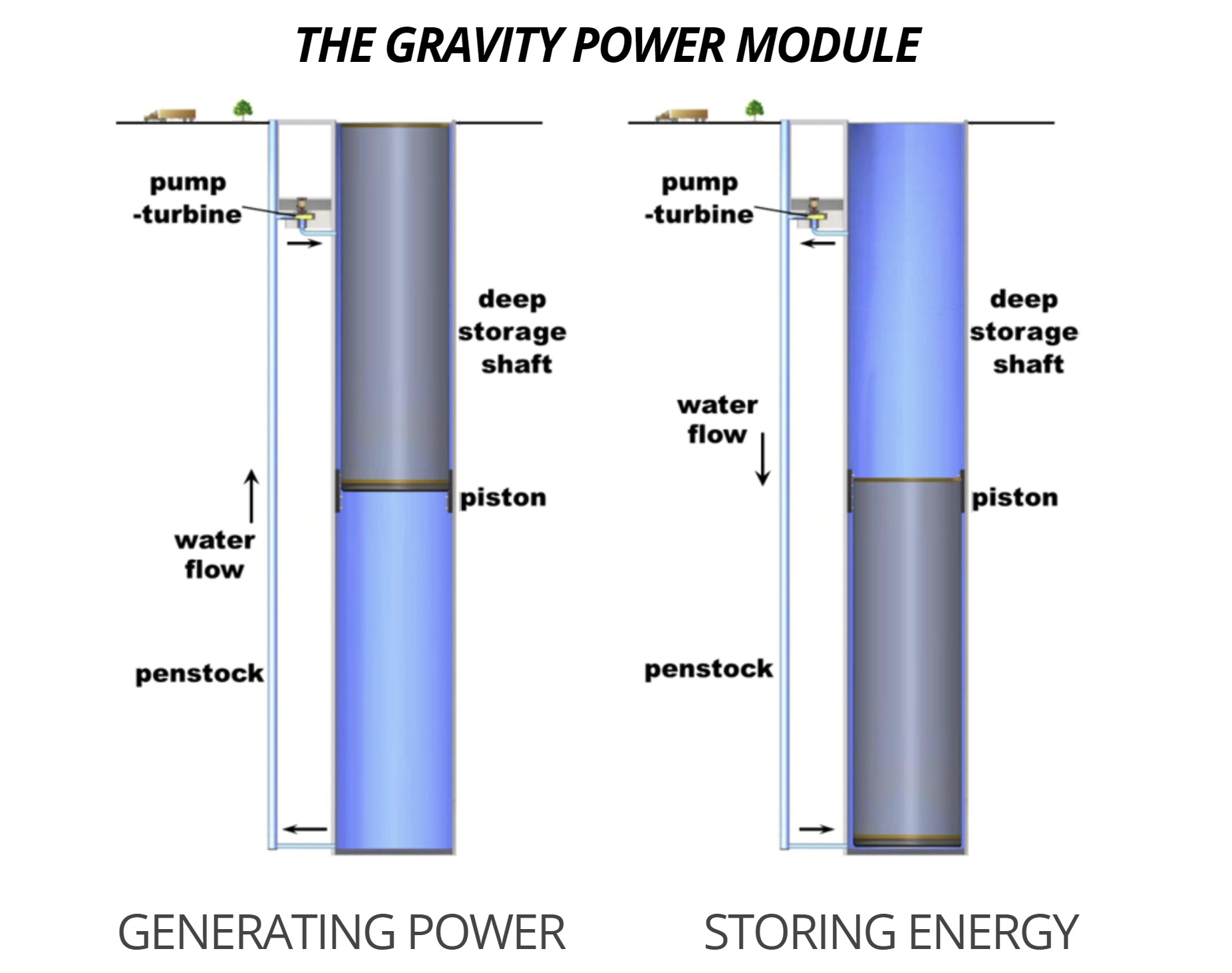
My worry would be water leakage past the piston.
This does sound like an idea from William Armstrong, who was responsible for many things including the hydraulic accumulator.

The picture shows the hydraulic accumulator at Limehouse in London.
I visited the Limehouse Accumulator during Open House in 2012 and wrote about it in Open House – The Limehouse Hydraulic Accumulator.
Prowling for Solutions To Unleash Renewable Energy
The title of this post, is the same as this article on Toolbox.
It is a good summary of the best methods of storing renewable energy without using chemical batteries.
Gravitricity, Energy Vault and Highview Power are all mentioned.
This last paragraph, explains some of the philosophy behind Vermont looking seriously at Highview Power.
Vermont may well be tempted by liquid air energy storage because of its flexibility — simply requiring a two-acre site anywhere. One possible location could be near an abandoned power station. That’s a beautiful solution because the transmission lines that once transported the electricity from the plant are built and ready to use in the renewable era.
Note that a two-acre site is slightly smaller than a football pitch.
It is rather elegant to replace a coal- or gas-fired power-station with an environmentally-friendly energy storage system on the same site, which effectively does the same job of providing energy.
The article doesn’t mention employment, but surely many of the existing workforce can be easily retrained for the new technology.
Energy Vault Receives $110 Million From SoftBank For Gravity-Assisted Power Storage
The title of this post is the same as that of this article on Forbes.
Energy Vault is a company, that is developing gravity-assisted power storage.
You don’t invest £110million in a company, even if you are as rich as Softbank, unless you are certain, that you’ll get a return!
So I suspect Energy Vault may have a working system for storing energy
Read the article and see what your think! It also links to a video.
This is an interesting quote from the company.
We knew we needed to be around three to four cents levelized cost per kWh ($30 – $40 per MWh) to add to PV or wind in order to be competitive below fossil. This took a lot of innovation.
I shall be following the company.
 The Anonymous Widower