Getting Ready For The Flat Pack Station
Custom House station on Crossrail has been described as the flat-pack station, like in this article in the Standard. Here’s the first paragraph.
A £35 million “flatpack” station for Crossrail is being built hundreds of miles from London in a first for the rail industry.
The new station for Custom House is taking shape in a factory near Sheffield, pictured left, before being transported to London for assembly in 2015.
The question has to be asked, if they will be bringing the station to London by train.


The pictures show the state of the site, with lots of work going on.
If we can buy flat pack furniture from IKEA and their ilk, why can’t Crossrail use similar suppliers?
Phyllis And Ada To Be Buried Alive
This headline from a magazine, seems like something consistent with Halloween.
But it’s not!
The headline actually is from the Crossrail update on the back page of this month’s Modern Railways. It tells how, the two tunnelling machines; Ada and Phyllis, will be left in the ground rather than recovered. The two machines are named after Ada Lovelace and Phyllis Pearsall respectively.
This does seem to be a pity, especially, as they cost ten million pounds each, but getting some of them out will be a very difficult, dangerous and expensive job. I also suspect that there isn’t much of a second-hand market for specialist tunnelling machines, which generally seem to be built for a particular set of conditions and sizes. Crossrail are actually using two different types of machine for their project. There’s more about the tunnelling here.
Speeding Past The Hitchin Flyover
The Hitchin Flyover, is compared to HS2, a fairly miniscule piece of railway infrastructure.


According to this article, it will cost £47 million and save 30,000 minutes a year in train schedules.
I have this feeling, that engineers know of similar schemes, that would benefit UK railways all over the country. But most of them aren’t very sexy for politicians.
Will We Get HSW Before HS2?
In this post about the BBC’s knocking of HS2, I jokingly referred to the Great Western Main Line as HSW, for High Speed West or High Speed Wales.
But is it that far from the truth?
A high speed railway is defined as one where speeds of 200 kph or 125 mph are possible. The fastest lines run at 320 kph or 200 mph.
So what speed can we expect to see on the Great Western Main Line, after it is fully modernised in 2017?
Currently the fastest trains in the UK are the Class 373 ( 300 kph) used by Eurostar, the Class 390 ( 225 kph) used by Virgin and the InterCity 225 (225 kph) used by East Coast. The latter two trains are restricted to 200 kph, due to signalling restrictions on their lines and because they have to mix it with slower trains.
It is also interesting to note that the Class 395, which bring the high speed Kent commuter services into St. Pancras run at 225 kph.
The new trains for the electrified Great Western Main Line are based on the Class 395 and are called Class 800 and Class 801. These have a design speed of 225 kph, but will be limited to 200 kph on traditional lines.
But Brunel built the Great Western for speed and a lot of the route it is pretty straight and much has four tracks. It is also going to be resignalled to the highest European standards with in-cab signalling. The latter is necessary to go above 200 kph. So it shouldn’t be one of the most difficult tasks to make much of the line capable of 225 kph or even more.
The only real problem on the line is the Severn Tunnel. But as Crossrail has shown, we have some of the best tunnel engineers in the world. So just as the Swiss dealt with their railway bottleneck of the Simplon Tunnel, all we need to do to improve the Severn Tunnel is give the best engineers their head and let them solve the problems, whilst the politicians sit around and watch and wait. After all it’s only a baby compared to the massive twin bores of the Simplon.
As an aside here, I do wonder if one of the most affordable solutions might be to use a modern tunnel boring machine to create a new tunnel alongside the current one.
Conclusion
So I believe that even if it still goes slower on opening, trains to Bristol and Wales will be doing 225 kph before the end of this decade.
If that isn’t a high speed railway like HS1, I don’t know what is?
But whatever we call it, it’ll be here several years before HS2!
I think we need to call for three cheers for Brunel, who got the route right in the first place.
Do They Use These Doors In Pyramids?
I saw this door opening method in several places in Italy.
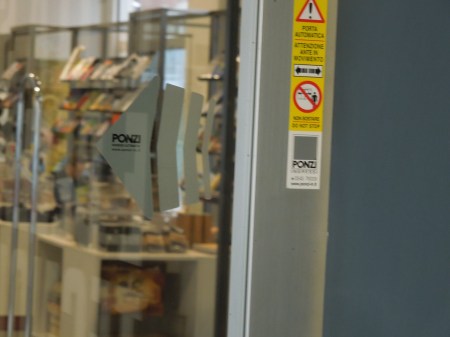
Do They Use These Doors In Pyramids?
They seemed to work well, so they could be described as a good Ponzi system.
This web site explains all about the company.
And this one explains about Ponzi schemes.
It’s Not A New Train
This may look like a new train, but it’s just a well refurbished one!







The story of the refurbishment of these Class 455 trains is detailed here in Wikipedia. It includes this comment.
This refurbishment was so comprehensive that many passengers thought the refurbished units were new trains.
But refurbishment of trains is something we do well in this country. And there are lots of similar trains built like these Class 455, running all over the UK. Some like the Class 317 are already being earmarked for full refurbishment and upgrading.
So don’t despair that the old rattletraps on your line are beyond improvement. Some designer or engineer has ideas for your trains. Whether they will get done is up to the Treasury, which is not a real bastion of hard core engineering and design.
The First Shoots Of Electrification
Huyton lies on the original route of the Liverpool and Manchester Railway and you pass through Rainhill, where the trials were synonymous with the Stephenson’s Rocket, on your way to Manchester. As you travel you notice the pylons for the electrification of the line by the trackside.




It reminds me of watching as a child, as the pylons started to be added to the Great Eastern Main Line electrification was extended to Chelmsford and Colchester in the 1950s and 1960s.
There is one big difference. The modern pylons are much stronger than those of the past. Hopefully, these will cure some of the overhead wiring problems encountered on some of the lines electrified in the last century.
Going Underground
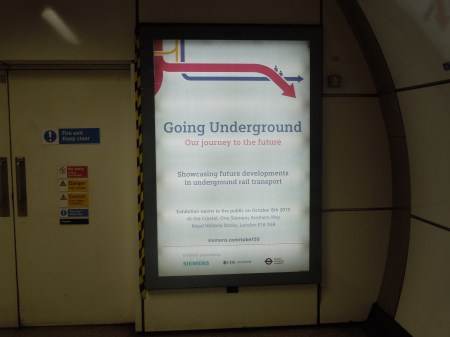
I saw this poster on the Undergound.
Going Underground
I think it will be worth seeing, as a glimpse into the future.
An Investigation Into The Stability Of Peer-To-Peer Lending Systems
For some time, I’ve thought that peer-to-peer lending systems, and Zopa which I know best, in particular, are a very interesting proposition mathematically. I did muse on this question some time ago in Stability in Financial Systems.
My education is at Liverpool University, where I got a B. Eng degree in Electronics in 1968. I had specialised in Control Engineering and my undergraduate thesis was all about mathematical modelling.
Most of my career since has been about large business, monetary and planning computing.
But one thing that must be born in mind, is that after I sold Metier in 1985, I formed a finance company in partnership with a friend. We still talk so it must be a good relationship.
In the years I had a stake in that company, I modelled the cash flows for obvious reasons of watching risk, just as I do with my funds invested in Zopa now.
The company taught me a lot about the finance industry and it was partly for that reason, that I invested my savings in Zopa nearly six years ago. And I’ve not regretted it one bit!
As I said in Stability in Financial Systems last year, I have a feeling that Zopa is a stable system. I also think they have used this stability to their own advantage, to create their Safeguard offers.
Obviously, a full investigation would be of value to see how, if Zopa my proposition concerning the system is correct.
You would just right down the various cash flows and see how the various scenarios will affect the company.
Can We Delay Fracking?
Or any other new means of energy creation for that matter?
There has just been a very heated debate about fracking on BBC Radio 5 Live and the amount of hot air produced could power the whole of Sussex without doubt.
Most of the arguments on both sides were fact-free and full of emotion, with accusations of lying and wrong facts from both sides.
The most significant energy news of the day is this story from the Guardian. It says that domestic energy use has dropped by a quarter since 2005.
More work in this field could actually delay the crunch, when we need to build lots of new power stations, be they powered by whatever.
That delay is the time to use to research every method of obtaining energy fully.
The trouble is this would probably give engineers and scientists enough time, to find a solution that ended all the arguments, so a lot of protesters and believers in uneconomic technologies would be kicked soundly into the long grass.
If I’d had a pound for every scientifically incorrect argument about energy I’d heard, I’d be a very rich man.

