We’ve Now Got Some Information On The Sewer!
I went to the View Tube on Monday and saw this sign outside.
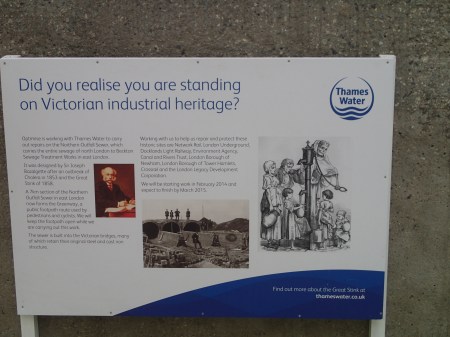
We’ve Now got Some Information On The Sewer!
It’s only one sign, but I suppose it’s a start.
But we need more boards like this on all big buildings, projects, stations and bridges to inspire the next generation.
Using The Power Of Water
We’ve seen enough rain this winter and it has caused a lot of damage at places like Dawlish. This story from the BBC, shows how to make working safe at Dawlish, the Devon Fire Brigade is using water to bring down an unsafe landslip. Here’s the first bit.
Fire crews are pumping sea water on to the cliff at Dawlish to bring down 350,000 tonnes of potentially unstable rock and soil in a controlled landslip.
Network Rail called in firefighters to prevent a “catastrophic” collapse that could have posed a risk to workers repairing the main Devon railway line.
What I find interesting, is that lots of people are against hydraulic fracking or fracking, which on a grand and more open scale, Network Rail are doing at Dawlish.
Is This Sense For Somerset?
It would appear that the report commissioned by the government is going to recommend a barrage of the River Parrett downstream from Bridgwater, according to reports like this one on the BBC.
Over forty years ago, my modelling software Speed was used by the now-superseded Water Resources Board to model water flows in river basins. I’m sure that these days, scientists and engineers could do much better, but then a scientifically correct solution often ignores powerful interests like farmers, the RSPB and politicians, who know a cause to get themselves re-elected.
The only thing I will predict with certainly, is that there will be a large argument over what is to be done.
They should do what Network Rail seem to doing at Dawlish. And that appears to be getting the job done as quick as possible using every possible method. The BBC is now stating that the line will open on April the 4th. So it would appear that the engineers are winning!
My one time neighbour in Suffolk, a past Colonel in an Engineering Regiment in the British Army, said that in case of war, you burn all Rule Books. He did say, that you keep the Instruction Manuals.
It’s certainly a war our there against the floods!
Rebuilding For The Future
In Modern Railways this month, there are a series of articles about how old engines and trains are being rebuilt or used to make up for a shortage of new motive power.
Class 73
The refurbishment and the fitting of new modern diesel engines to some of the 1960s-built Class 73 locomotives is described. One aim is to give them another 10-20 years of life.
Class 37
The Class 37 is a few years older than the Class 73 and also may be getting new engines to prolong their lives.
Class 365
There is also a report on the refurbishment of the Class 365 electric multiple units. Wikipedia says this.
Starting from January 2014, the first trains in the fleet will undergo a refurbishment by Bombardier Transportation at their Ilford site, some of which will be completed on a two-part basis with a second stage starting from the summer of 2014. The first unit to be put back into service is 365 517, which began operations on the 16th of January 2014.[8] The initial refurbishment comprises new seat upholstery, new flooring, interior and exterior repaint and an engineering overhaul to maintain reliability. The second stage of upgrades will bring the units in line with the latest disability regulations by installing two wheelchair bays, new external door buttons and vestibule grab handles, a new wheelchair-accessible toilet, a new fully automated passenger information system with audio and visual announcements, and a call-for-aid in the wheelchair and toilet areas. This will be retrofitted to units that have already undergone refurbishment prior to the start of works.
That looks pretty comprehensive.
Class 20 And Western Champion
This is probably the strangest use of old locomotives and describes how the 1950s-designed Class 20 and the Class 52 called Western Champion.
The Class 20 probably took part in the most outrageous train movement, ever done in or from the United Kingdom. Three Class 20s took a train of a eight thousand tonnes of aid to Pristina in Kosovo. It’s described in detail here.
Old Trains As New
This article describes how the Class 321 electric multiple units are being as the article says re-imagined. A demonstrator has been built.
All of this emphasises that rebuilding trains is something that we’re good at.
The Connection Between The First Tanks And The Classic Routemaster Bus
At first glance, it would appear that there would be little connection between Little Willie, which was one of the prototypes leading to the first tanks of the Great War and the classic Routemaster bus of the 1950s.
But I’ve just read this article on the BBC’s web site about how the tanks were developed in Lincoln. The article talks about the two designers.
The work needed more than technical experience, it needed two very particular men – William Tritton and Lieutenant Walter Wilson.
“Tritton was a brilliant engineer,” says Mr Pullen. “And he was a brilliant leader. He got things done.
“He turned Foster’s around with new ideas and new markets.
“Couple him with Walter Wilson, who was also a good engineer but a genius with things like gearboxes, and they made a brilliant partnership.”
It goes on to describe how they locked themselves in a hotel room and scribbled designs on envelopes and fag packets.
And the rest as they say is history!
Walter Wilson went on to form a company called Self-Changing Gears, that developed pre-selector gearboxes. I never drove a vehicle with one of these gearboxes, but I’ve sat just behind the driver on many a London Transport RT-bus and watched the driver select the gear and then hit the gear change pedal to engage it. The use of this type of transmission, was to make the effort of the constant stopping and starting easier on the driver.
Routemasters , it would appear had a fully-automatic version of the transmission, linking them back to the original tanks.
British And French Engineers Can Work Together
In the Sunday Times today, they are talking about a £4billion project to import electricity into the UK from Iceland, It is called Icelink and it would appear to have the backing of both the UK and Iceland governments. There’s more about it in this article in Utility Week.
So it got me thinking about undersea electricity connections around the world. There is a list of them here. And there is forty-four of them
Perhaps the best known is the connection between Kent and France, which is called the HVDC Cross Channel. It is actually the second one and it has been running for nearly thirty years. A section in Wikipedia describes its significance.
Since the commissioning of the 2,000 MW DC link in the 1980s, the bulk of power flow through the link has been from France to Britain. However, France imports energy as needed during the summer to meet demand, or when there is low availability of nuclear or hydroelectric power.
As of 2005 imports of electricity from France have historically accounted for about 5% of electricity available in the UK. Imports through the interconnector have generally been around the highest possible level, given the capacity of the link. In 2006, 97.5% of the energy transfers have been made from France to UK, supplying the equivalent of 3 million English homes. The link availability is around 98%, which is among the best rates in the world. The continued size and duration of this flow is open to some doubt, given the growth in demand in continental Europe for clean electricity, and increasing electricity demand within France.
So it would appear it’s been successful and proves that we can work with the French on an engineering project.
It strikes me that we need to connect all of our power systems together in Western Europe. The UK is being connected to Ireland, Iceland and Norway and the Netherlands, Belgium and Germany are getting in on the act.
What you won’t find from reading about the cables, but you will in some newspaper articles, is that Norway will have the ability to store electricity in a pumped storage system in the future.
So when the wind is blowing and we have too much electricity, the Norwegians will pump water from a low to a high lake and when we want it back, the water will be released through a turbine. It’s like putting your KWh in a bank!
The High Speed Train Got Through
I’ve just found this clip of video on the BBC’s web site.
It just shows the sort of conditions that these trains of the 1970s can withstand. It also shows why they will never electrify this line between Exeter and Plymouth.
This other video shows the work going on to repair the line. Note the wall of shipping containers filled with ballast to give protection to the workings and properties by the railway line. But even these have been breached, as is reported here on ITV.
It’s all extreme engineering at its most way out. Hopefully the engineers will win, but it should lead to better techniques for the next set of problems.
My IKEA Furniture Now Has Some Brass Knobs!
My house has a theme of dark black-brown steel beams fitted together with brass fittings.
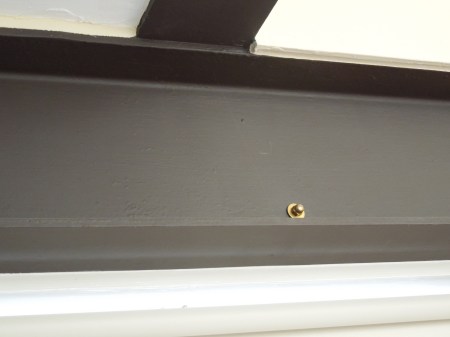
Dark Steel And Brass Bolts
When I bought the house, it still had Jerry’s gold-painted steel bolts, which I have replaced with real brass ones. Even if some might be just be real bolts glued into Jerry’s crude holes.
So when I bought some of IKEA’s Expedit boxes, which are just the right colour for the beams, I was disappointed that they only come with natural aluminium knobs.
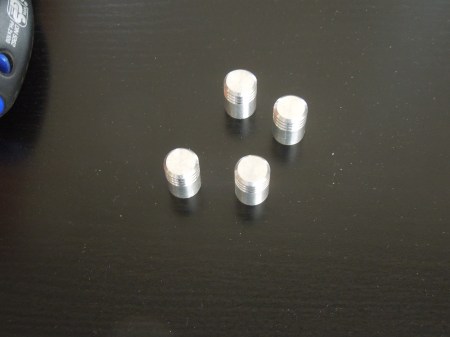
IKEA’s Aluminium Knobs
So it was off to Birmingham by train to visit Honeyglen Anodising in Sparkbrook to see what they could do. I’ve now got the trial batch and here’s one in place.

Expedit With Brass Knobs
I’ve now got to get all the others together and send them off to Birmingham. I am getting them in a pretty standard brass colour, but there are more details here of the colours available.
The Engineer Who Fixed His Own Heart
This story from the BBC’s web site is almost beyond belief, but it is totally true. Here’s the intro.
As an engineer, Tal Golesworthy is no stranger to taking things apart, figuring out what the trouble is and putting them back together with the problem solved.
But for more than 30 years, he lived with a life-threatening issue that was less easy to fix.
That is, until he took an idea from the garden, combined it with some basic procedures borrowed from the aeronautical industry and came up with a “beautifully simple” solution to treat his own heart condition.
He then managed to convince surgeons to put it into him.
That was nine years ago, and he’s still here!
Perhaps we need to train doctors more in simple engineering techniques.
Keyhole Surgery For Gas Mains
I like this story from the Standard, as it shows how good design and clever technology can make the solving of everyday problems, quicker and easier. Here’s the first paragraph.
A £1m robot will today complete work repairing gas mains in London without having to dig a single hole in the street in a UK first that it is claimed will save thousands of hours of disruption to motorists.
It may have cost a lot, but how much did it save?

