Is This A Simple And Affordable Solution To Providing Step-Free Access At Essex Road Station?
The access to and from the platforms at Essex Road station, is not the best.
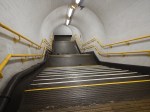
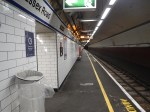
There is a set of tunnels beneath the two platforms.
- The tunnels are connected to the surface, by a pair of large lifts and an emergency spiral staircase.
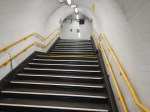
- The tunnels are connected to the platforms by two wide sets of stairs.
- One set of stairs is for passengers leaving the station and the others are for those arriving.
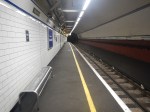
This set of pictures shows some of stations underground features.




It looks to be a difficult station to make step-free.
- The platforms are narrow.
- There is very little space in the station building to add more lifts direct to the platform.
- I’m not sure,but the rail tunnels might be under the Canonbury Road, which runs outside the station.
Unless its possible to use the Greenford solution.
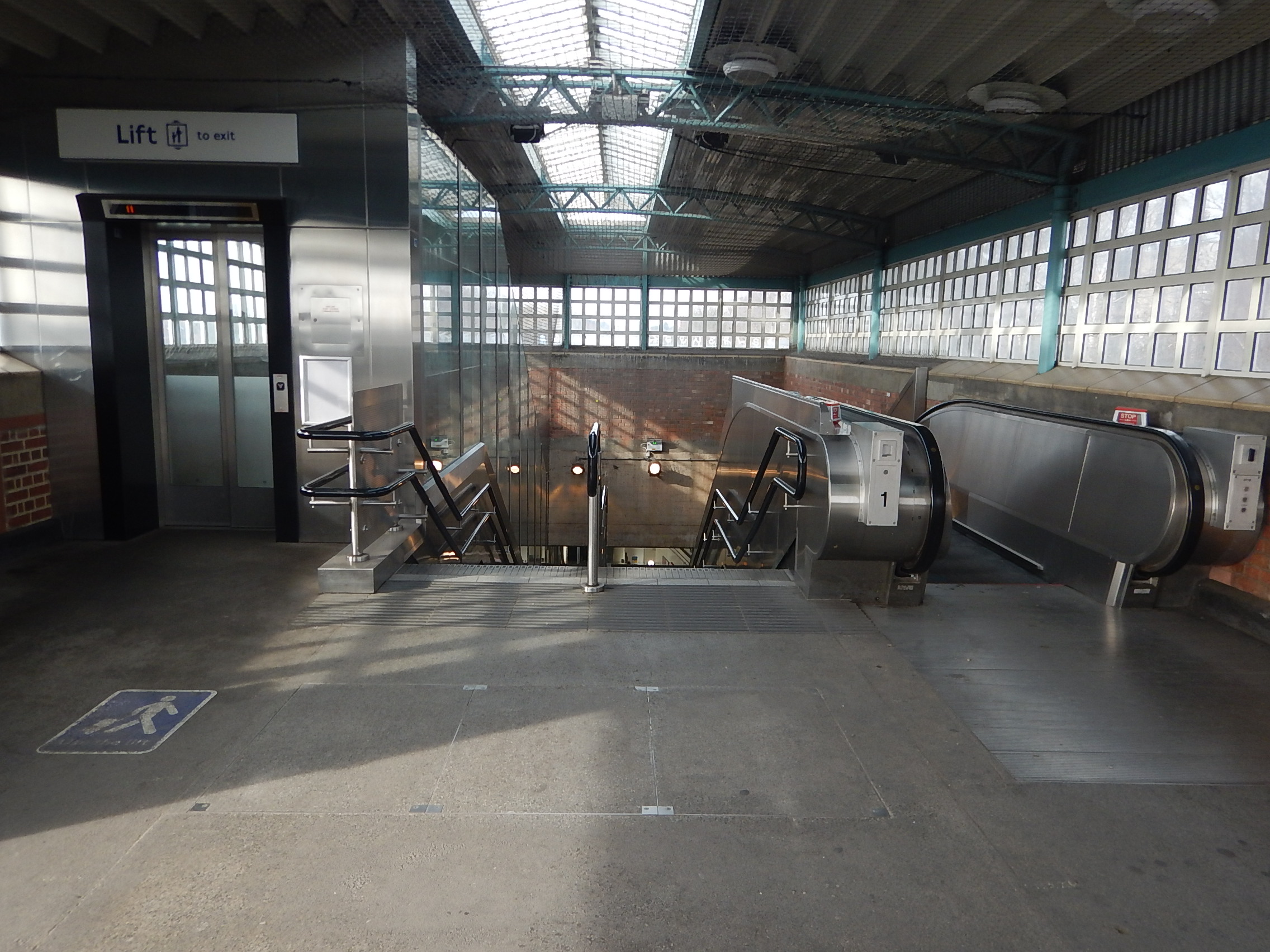
This picture shows the inclined lift/stairs and escalator installation at Greenford station.
Note.
- The inclined lift has a capacity of about 4-6 people in normal times.
- The staircase is double, with a handrail up the middle.
- The escalator is permanently set to up.
It should be noted that Greenford station has two Central Line platforms and one National Rail platforms.
Could this type of installation be used at Essex Road station?
I will look at a few points and issues.
Station Usage
It should be said, that despite the different natures of the station, we are not comparing apples with oranges, as to get between the street and platforms at both stations, passengers have to use the stairs at Essex Road station or the multi-mode installation at Greenford station.
Entries and exits to Essex Road station over the last four years are as follows.
- 2016-17 – 811,000
- 2017-18 – 861,000
- 2018-19 – 857,000
- 2019-20 – 768,000
The average is 824,000
National Rail entries and exits to Greenford station over the last four years are as follows.
- 2016-17 – 230,000
- 2017-18 – 151,000
- 2018-19 – 153,000
- 2019-20 – 170,000
The average is 176,000
Central Line entries and exits to Greenford station over the last four years are as follows.
- 2015 – 4,720,000
- 2016 – 4,810,000
- 2017 – 4,680,000
- 2018 – 4,250,000
The average is 4,615,000
The total for Greenford station is 4,791,000 or nearly six times as much as Essex Road station.
In fact, the difference is bigger than that as Essex Road station could have a pair of installations, so the capacity of each of the Essex Road installations, would only need to be a twelfth of that of the Greenford installation.
The Simplest Installation
The simplest installation would surely be to fit an inclined lift at the side of one of the existing staircases.
The staircase would probably be halved in width, but quite frankly they are not safe for anybody encumbered with a pushchair or a heavy suitcase.
There would also need to improvements to the routes between the main lifts and the inclined lift.
London’s Single Escalators
London has several single escalators.
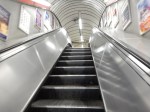

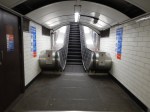
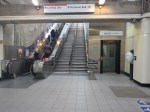
Three pictures are from Moorgate and the other one is at Greenford.
Could Pairs Of An Inclined Lift And An Escalator Be Fitted In At Essex Road Station?
It would be tight to fit a pair in one staircase, but I’m sure it would be possible. Especially, if the shaft could be widened a bit.
If they could be made to fit, then a simple program of works could be applied.
- Close one staircase and use the other staircase for both entry and exit. As there is a cross-tunnel, passengers would be able to walk between the lifts and the platforms, by walking about an extra thirty metres or so.
- The closed tunnel would then be gutted and an inclined lift and escalator would be fitted and tested.
- Once complete and tested, it would be opened to passengers.
- The station would now be entrance-only or exit-only, whilst the second lift and escalator were fitted and tested.
Being entrance-only or exit-only would not be the greatest problem, as the 271 bus parallels the rail route between Highbury & Islington and Moorgate stations.
Could An Inclined Lift And A Pair Of Escalators Be Fitted?
In this installation, one shaft would be fitted with a pair of escalators and the other with an inclined lift.
A similar program of works to that I laid out previously would be applied.
Conclusion
Essex Road station could be made step-free.
Because of the bus routes in the area and the 271 in particular, it wouldn’t cause the greatest of inconveniences to close the station for some time.
The Bakerloo Line Connection At Paddington Station
I use the Bakerloo Line to get to and from Paddington station for various reasons, and find myself in the narrow two-way passage between the Underground station entrance in the middle of the Paddington station and the top of the escalators to the Bakerloo Line.
These pictures show the route towards the Bakerloo Line.
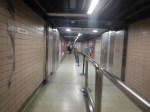


It strikes me that a certain amount of reorganisation is needed.
- In the narrow two-way passage signs tell people to keep left.
- On the escalators, the escalators are run on a keep right basis.
So everybody has to cross over in the area at the top of the escalators.
I’m sure, it could be better organised.
It should be noted that another pedestrian tunnel is being built to connect the Bakerloo Line to Crossrail.
I wrote about the Paddington Bakerloo Line Link in Paddington Is Operational Again!
The Steps At Dalston Junction Station
Dalston Junction is a four-platform station and these are the only stairs at the station.

I think the design is excellent.
- They serve all four platforms, so you can’t go the wrong way!
- They are very wide, so have a high capacity.
- There are effectively four handrails for those like me, who want or need to hold on.
- Fit travellers who can lift their case, can use the stairs.
- There is a landing half-way up.
- The stairs are well-lit.
- in 2017-2018, the stairs handled nearly six million passengers.
- The small number of interchange passengers don’t need to use the stairs and walk between platforms on the level.
- The steps are Transport for London’s typical low-slip design.
- At the bottom of the staircase, there is a wide landing area with two train information displays and a 20-30 metre walks to the four platforms.
- At the top of the staircase there is a wide lobby, with the wide gate-line in front of passengers coming up the stairs.
- There is usually, a member of the station staff watching the passenger flows and answering any questions.
But above all there is a single lift about ten-twenty metres from the stairs, so avoiding the stairs is easy and obvious.
I have seen few stairs in stations as well-designed as these.
A few more general observations.
Wide Stairs With A Double Rail In the Middle
This design of stairs is being increasingly seen in London and around Europe.
In Stairs And A Lift At Cannon Street Station, I show a similar installation.
But there are loads like this monstrosity at Bethnal Green station in Before Overground – Stairs Not Fit For Purpose.
How many stations could be improved by widening the staircase?
Probably quite a few, but many staircases are constrained within solid walls.
Handrails
Transport for London generally use round and easy-to-grip handrails.
These are the best I’ve seen, which are on the Amsterdam Metro.

Some on British Rail-era stations are big and square and must be difficult for those with small or frail hands.
An Obvious Lift
At Dalston Junction, the lift is obvious as you approach the stairs.
But in some stations, the lifts are at the other end of the platform.
The Greenford Solution
These pictures show the solution at Greenford station.


Note.
- There is an up-escalator.
- A staircase,which is as wide as possible.
- There are three handrails with a low rail for those who prefer it.
- There is an inclined lift, which saves space.
I think we’ll see more step-free installations of this style.
Safety
I won’t comment on safety, as I don’t want to bring bad luck to the installations.
Conclusion
All those designing staircases and lift systems for stations, should be made to visit Dalston Junction and Greenford stations in the Peak.
Good Design On The Amsterdam Metro
Sometimes, it’s good design that catches my eye as I roam around.
These pictures are from the Amsterdam Metro.





Most of the escalators I saw in The Netherlands had traffic lights and I like that. Stations in the UK don’t seem to have a policy about which side is up or down. Some shops also deliberately make their escalatoprs complicated, so you take a detour round the shop.
I would like to see a law, that all escalators (and ticket gates) had much better lights to show their direction of operation.
The wooden handrail must be the only one I’ve seen in a new station or building. Transport for London repairs old ones, but doesn’t seem to install new ones.
The New Escalators At Limehouse Station
Limehouse station now has a smart pair of escalators on the Westbound platform.
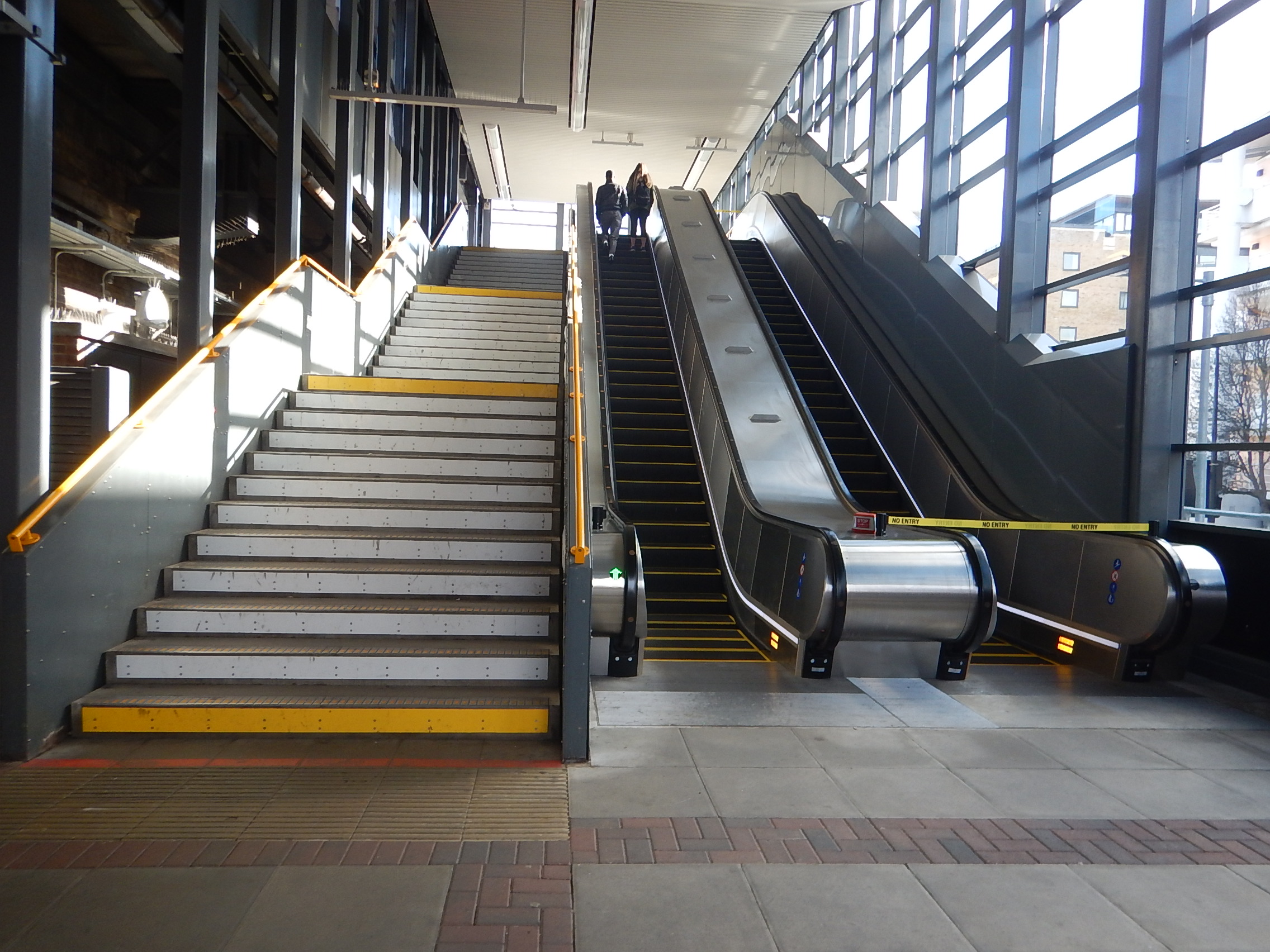
Are escalators going to be added to the Eastbound platform and the c2c platforms?
Do Escalators Attract Passengers?
These are passenger figures from 2016 in millions on the London Underground’s Victoria Line
- Walthamstow Central – 22.77
- Blackhorse Road – 8.45
- Tottenham Hale – 13.21
- Seven Sisters – 19.61
- Finsbury Park – 32.74
- Highbury & Islington – 20.22
- Warren Street – 20.35
- Pimlico – 11.49
- Vauxhall – 32.23
- Stockwell – 11.42
- Brixton – 33.46
Note.
- I have left out the very busy stations which are major interchanges like Kings Cross St. Pancras, Euston, Oxford Circus, Green Park and Victoria.
- Perhaps the figures for Finsbury Park, Stockwell and Warren Street, should be divided by two, as these stations have two lines.
- Most stations have connections to National Rail services.
Brixton and Vauxhall only have indirect connections to National Rail, but they have a higher number of passengers compared to say Finsbury Park, Highbury & Islington and Walthamstow Central, which all have direct connections.
But these two stations have three escalators.
Seven Sisters seems to attract more passengers, than Tottenham Hale.
But then it is double-ended!
So does more escalators at a station increase the number of passengers using the station?
It is also worth looking at single line stations with no connection to National Rail stations on both sides of the Euston Rpad.
Again the figures are for 2016 in millions.
- Angel – 20.10 – Three escalators
- Archway – 9.94 – Escalators
- Chalk Farm – 5.61 – Lifts
- Covent Garden – 17,19 – Lifts
- Euston Square – 14.40 – Stairs and a lift to one platform
- Goodge Street – 8.46 – Lifts
- Great Portland Street – 9.86 – Stairs
- Mornington Crescent – 5.04 – Lifts
- Regent’s Park 3.35 – Lifts
- Russell Square – 12.36 – Lifts
Note.
- Angel and Archway have been rebuilt to replace lifts with escalators and they show higher usage.
- I’d love to have before and after figures for these two stations.
This is only a crude analysis, but I’m certain it shows that stations with escalators have higher passenger numbers.
It could also be, that London Transport, knew where the passengers would go and built stations they felt would be busy accordingly.
They certainly put a lot of escalators on the Northern extension of the Piccadilly Line.
These are 2016 for the stations.
- Cockfosters – 2.04 – Stairs
- Oakwood – 2.88 – Stairs and Lift
- Southgate – 5.65 – Escalators
- Arnos Grove – 4.65 – Stairs
- Bounds Green – 6.62 – Escalators
- Wood Green – 13.20 – Escalators
- Turnpike Lane – 10.98 – Escalators
- Manor House – 9.12 – Escalators
Note.
- I think it can be said, that this section of the Piccadilly Line did very well to get the access right.
- The catchment areas of the five Northernmost stations overlap and many travellers will use different stations depending on how they feel.
- Southgate attracts more passengers than the two adjoining stations.
- Wood Green and Turnpike Lane are the busiest stations as they connect to the shops at Wood Green and lots of buses.
- Only Cockfosters has car parking.
I think at the end of the line, the escalators draw passengers.
Escalators And The Disabled, Elderly, Buggy Pushers and Suitcase Draggers
There’s also no doubt, that a large proportion of the many passengers in these categories can handle an escalator, even if they have problems with stairs.
Conclusion
My crude data isn’t good enough to draw a firm conclusion, but I suspect Transport for London know the answer.
If escalators do attract passengers, surely transport operators should install more of them.
 The Anonymous Widower