A Freight Shuttle For Liverpool Street Station Planned
Edition 889 of Rail Magazine has an article which is entitled London Gateway-Liverpool Street Freight Trial Planned.
Rail Operations Group are planning to run a freight shuttle between London Gateway and Liverpool Street station.
Trains will be Class 769 bi-mode trains.
- The trains will be fitted with roller doors, roller cages and strengthened floors.
- Three aervices will leave Thames Gateway at 0029, 1208 and 1856.
- They will return from Liverpool Street at 0242, 1421 and 2100.
- Services will use Platforms 9 and 10 in Liverpool Street station.
It seems a very detailed plan.
A few of my thoughts.
Journey Time
I would estimate that a time of about 45 minutes to an hour would be possible.
Use Of Platforms 9 and 10
These two platforms are generally used for the London and Norwich expresses via Colchester and Ipswich, but it appears that only one service is timed to arrive in times when the station is really busy.
Platform 10 is near to the old Cab Road and so there is good vehicle access from the back of the station.
Final Delivery
The article says that trucks would be used for the final deliveries, with battery vehicles planned for the future.
Would There Be Sufficient Capacity For Trucks In The Cab Road?
A Class 769 train has four twenty metre long cars, so capacity will be equivalent of four small-to-medium supermarket delivery articulated trucks.
You wouldn’t get artics into the Cab Road, but would you get enough small trucks in to pick up a complete train-load?
- At night or in the evening, this would surely be possible!
- However, in the afternoon, it would surely be too busy, for more than a couple of delivery vans.
I’m sure Karl Watts has a well-laid plan.
What Is The Role Of UPS In This Freight Service?
In the Wikipedia entry for London Gateway, this is said.
Development of the Logistics Park has followed the initial stages of development of the port. UPS is developing a 32,000 square metre package sorting facility on the site – one of the American firm’s largest ever infrastructure investments outside of the USA. Since March 2017,
UPS wouldn’t build a facility the size of thirty two football pitches and then send out a series of trucks to their biggest market in the City of London , only for the packets to get stuck in the traffic.
I suspect that packets will be sorted into small easily-managed loads for delivery by electric vans, cargo bicycles or Shank’s Pony, from Liverpool Street station.
And Could Lidl Be In On The Act?
The Wikipedia entry for London Gateway also says this.
German grocery retailer Lidl has been operating out of the DP World London Gateway Logistics Centre, the first warehouse to be developed on the site.
This article in the Guardian is entitled Lidl In The Middle: Chain To Open First Store In Central London. This is said.
Lidl is to launch its first store in central London as it opens 40 new shops across the capital in the next five years.
Could Lidl be thinking of using such the proposed service to supply Central London stores?
- Last mile delivery could be by electric vehicles.
- Catching the 0029 train from London Gateway could be ideal.
- Goods could be on the shelves by early in the morning.
I think that this could offer interesting possibilities.
Supermarket deliveries were also one of the cargoes proposed in the LaMiLo project that I talked about in The LaMiLo Project.
Why Use Bi-Mode Trains?
Consider.
- Virtually all of the route is electrified, except for the last mile or so into the London Gateway.
- It would be possible to electrify those last few miles and use electric trains.
- Electric trains like unmodified Class 319 trains could be used for the service.
But cranes, containers and 25 KVAC overhead wires are a possible disaster waiting to happen, as a crane driver once told me!
When Will The Service Start?
The article says that the service could start in April or May.
Could There Be Other Services?
This is the last paragraph of the article.
Watts mentioned that other routes were a possibility for the business, suggesting that routes from the West Midlands to the Scottish Central Belt and the West Midlands to the West Country have been investigated. No dates have yet been given for any such trials.
I would also think, that there could be opportunities for moving high-value or perishable cargoes into major city centre stations in the middle of the night.
Suitable stations could be.
- Birmingham New Street
- Bristol
- Edinburgh
- Glasgow
- Leeds
- Liverpool Lime Street
- Manchester Piccadilly
I am not being anti-Geordie, but Newcsastle might be a difficult station to unload cargoes from trains onto trucks!
Conclusion
If seems to me that Rail Operations Group are being innovative with trains.
Poetic Return For The Night Train In The Era Of ECommerce
The title of this post is the same as that of a half-page article on Page 34 of the Business Section of today’s copy pf The Times.

As you can see The Times gave it the full treatment with stills from the classic documentary film; The Night Mail, which has a verse commentary written by W. H. Auden.
It’s an idea from the seemingly irrepressible Karl Watts, who is Chief Executive of Rail Operations (UK) Limited.
He plans to start test operations with two Class 769 trains leased from Porterbrook.
I wrote about this concept two years ago, in The Go-Anywhere Express Parcel And Pallet Carrier (HSPT).
The Go-Anywhere Express Parcel And Pallet Carrier (HSPT)
In the June 2017 Edition of Modern Railways there is an article entitled Freight, Not All Doom And Gloom, which talks about high-value parcel carriers. The article says this.
Think about all those 1980s units that are soon to be made redundant, especially the ones with wide doorways. You could forklift in pallets and move them by hand trolley inside the vehicle (forklift tines would not fit an HST’s doors).
A Class 150 parcels unit, anyone?
There are other reasons for not using a High Speed Train.
- ScotRail and Great Western Railway have better uses for the trains moving passengers around in style.
- Their 125 mph capability and large windows might come in handy for heritage tourism.
- They are diesel trains and some might not like to hear them thundering through the countryside in the middle of the night.
As to the Class 150 train, it has a few disadvantages.
- It is only two-cars.
- It has a 75 mph operating speed.
- It is diesel-powered, which probably means regular refuelling.
But also like all Mark 3-based stock it scrubs up well as I wrote in What Train Is This?
I would refurbish the whole fleet and use them on short branch lines to provide a quality service, where a two or four-car train was all that was needed.
So what would be the specification of an ideal Go-Anywhere Express Parcel and Pallet Carrier?
I was going to call it a GAEPPC in this post, but that’s rather a mouthful, so I’ll call it a High Speed Parcel Train or High Speed Pallet Train, which in recognition of its more famous big brother will be called a HSPT.
For the specification, it might be a good idea to start with the Class 325 train. This is the first paragraph of the train’s Wikipedia entry.
The British Rail Class 325 is a 4-car dual-voltage 25 kV alternating current (AC) or 750 V direct current (DC) electric multiple unit (EMU) train used for postal train services. While the Class 325 bears a resemblance to the Networker series of DMUs and EMUs, they are based on the Class 319 EMU. The Class 325 was British Rail’s newest unit to take over parcels workings on electrified lines.
The requirement might have changed since the 1990s, but the basic specification would be similar.
- Four-cars
- 100 mph operating speed.
- 25 KVAC overhead or 750 VDC third rail operation.
- The ability to run as four-, eight- and twelve-car trains.
- It would be available in a range of colours and not just red!
In addition, it would need wide doors for pallets.
It would also be nice, if the HSPT could run on lines without electrification.
Look at this picture of a Class 321 train.
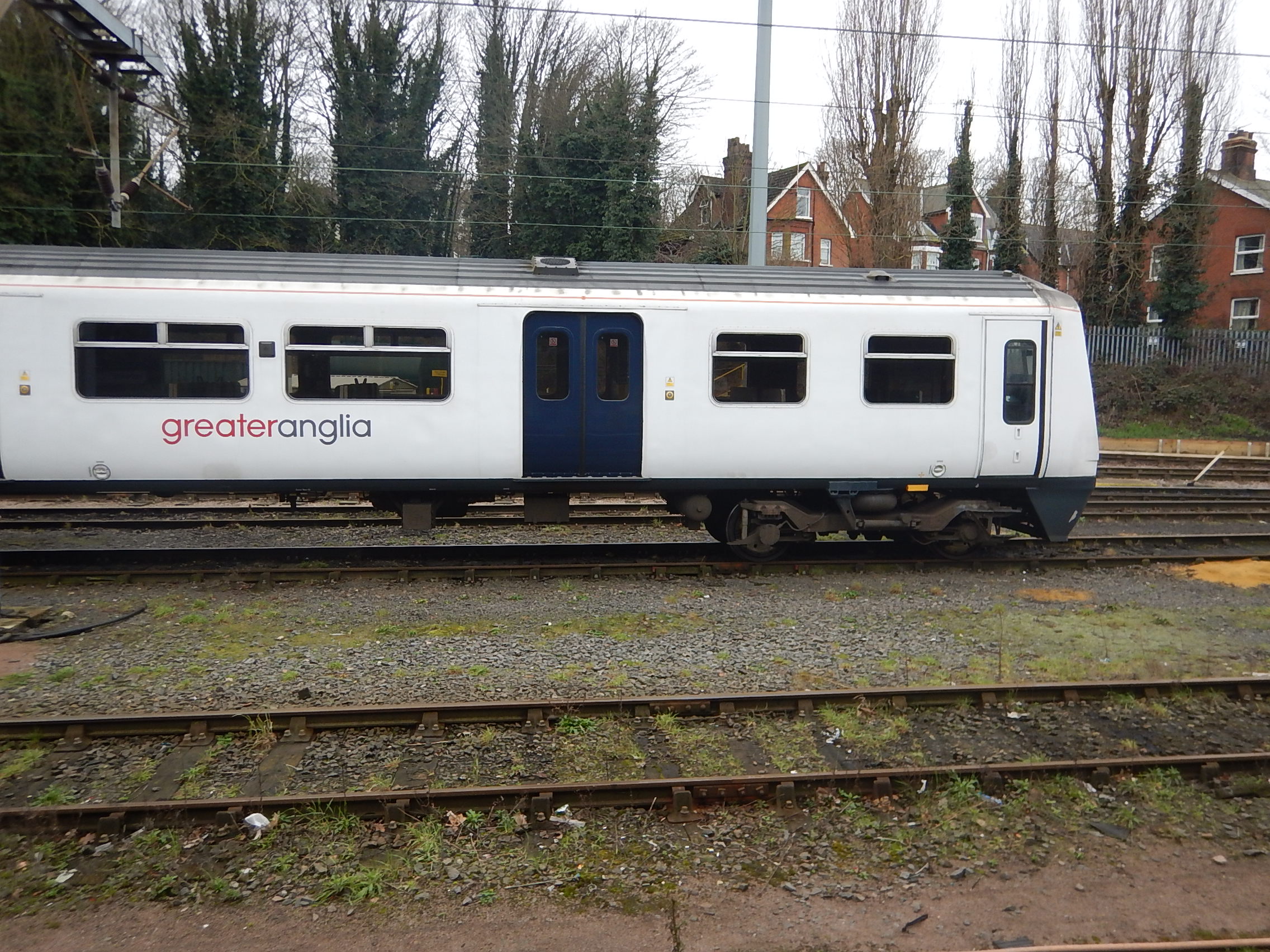
Would a standard size 1200 x 1000 pallet go through this door?
This morning, I measured the door on a Class 378 train and it was about 1700 mm. wide. So yes!
Once inside the systems used in cargo aircraft could be used to arrange the pallets.
Consider, these facts about Class 321 trains.
- They are four-car electric multiple units, that can also run as eight and twelve car units.
- They can operate at 100 mph.
- They are dual voltage units, if required.
- There are 117 of the trains, of which over a hundred will be released by Greater Anglia and will need a new caring owner.
- The interior may be wide enough to put two standard pallets side-by-side.
- They are based on Mark 3 steel carriages, so are built to take punishment.
In Could There Be A Class 321 Flex Train?, I speculated as to whether these trains could be fitted with underfloor diesel engines as in the Class 319 Flex train. After the news reports in the June 2017 Edition of Modern railways, which I reported on in The Class 319 Flex Units To Be Class 769, I’m now convinced that converting other types of train like Class 455 and Class 321 trains is feasible and that the train refurbishing companies are going to be extremely busy.
I have a feeling that Class 319 trains will not be converted to HSPTs, as they seem to be very much in demand to carry more valuable cargo – Namely fare-paying passengers!
But fit diesel engines under a Class 321 train and I think it would make a HSPT, that could travel on nearly every mile of the UK rail network and quite a few miles on heritage railways too!
A Freight Terminal For An HSPT
As the Class 321 train has been designed for passengers, it lines up reasonably well with most of the station platforms in the UK.
So at its simplest a freight terminal for a HSPT could just be a station platform, where a fork lift truck could lift pallets in and out.The freight handling facilities would be designed appropriately.
Supermarket Deliveries
I also think, that if a HSPT were available, it could attract the attention of the big supermarket groups.
In The LaMiLo Project, I described how goods were brought into Euston station in the middle of the night for onward delivery.
If it cuts costs, the supermarket groups will use this method to get goods from their central warehouses to perhaps the centres of our largest cities.
Get the design right and I suspect the supermarkets’ large delivery trolley will just roll between the train and the last-mile truck, which ideally would be a zero-emission vehicle.
In some of the larger out-of-town superstores, the train could even stop alongside the store and goods and trolleys could be wheeled in and out.
This Google Map shows Morrisons at Ipswich.
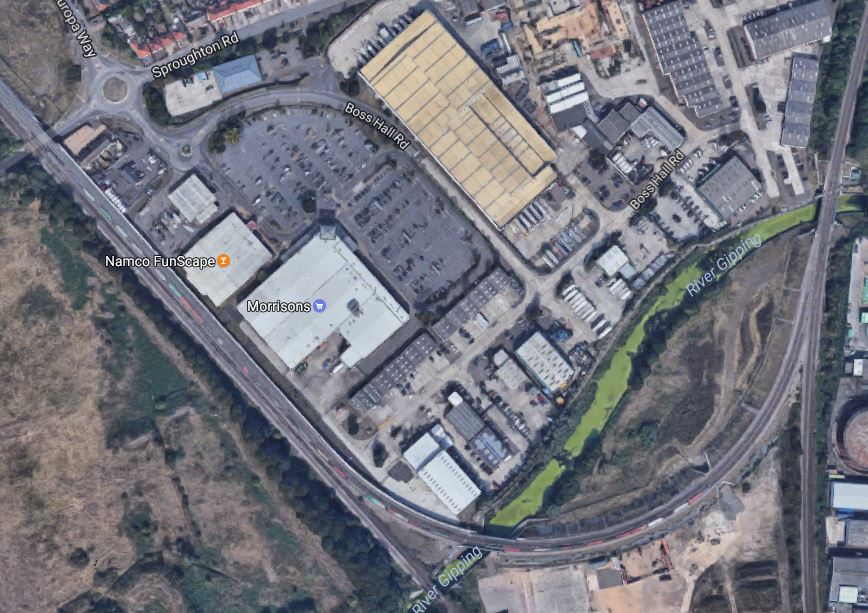
The store lies alongside the Great Eastern Main Line.
Surely, the ultimate would be if the goods were to be transported on the trains in driverless electric trolleys, which when the doors were opened, automatically came out of the trains and into the store.
Supermarket groups like to emphasise their green credentials.
Surely, doing daily deliveries to major stores by train, wouldn’t annoy anybody. |Except perhaps Donald Trump, but he’s an aberration on the upward march of scientifically-correct living.
Just-In-Time Deliveries
To take Toyota as an example, in the UK, cars are built near Derby, and the engines are built near Shotton in North Wales.
Reasons for the two separate sites are probably down to availability of the right workforce and Government subsidy.
I’m not sure, but I suspect currently in Toyota’s case, engines are moved across the country by truck, but if there was a HSPT, with a capacity of around a hundred and fifty standard pallets would manufacturing companies use them to move goods from one factory to another?
It should be said in Toyota’s case the rail lines at both Derby and Shotton are not electrified, but if the train could run on its own diesel power, it wouldn’t matter.
Refrigerated Deliveries
There probably wouldn’t be much demand now, but in the future bringing Scottish meat and seafood to London might make a refrigerated HSPT viable.
Deliveries To And From Remote Parts Of The UK
It is very difficult to get freight between certain parts of the UK and say Birmingham, London and the South-Eastern half of England.
Perishable products from Cornwall are now sent to London in the large space in the locomotives of the High Speed Trains. Plymouth, which is in Devon, to London takes nearly four hours and I suspect that a HSPT could do it in perhaps an hour longer.
But it would go between specialist terminals at both ends of the journey, so it would be a much easier service to use for both sender and receiver.
Another article in the same June 2017 Edition of Modern Railways is entitled Caithness Sleeper Plan Set Out.
This is said in the article.
Another possibility would be to convey freight on the sleeper trains with HiTrans suggesting the ability to carry four 40-foot and two 20-foot boxes on twin wagons could provide welcome products and parcels northwards and locally-produced food southwards.
A disadvantage of this idea would be that passengers would be required to vacate sleeping berths immediately on arrival at Edinburgh, so that containers could continue to a freight terminal.
The HSPT would go direct to a suitable terminal. In remote places like Caithness, this would probably be the local station, which had been suitably modified, so that fork lift trucks could move pallets into and out of the train.
One-Off Deliveries
Provided a load can be put on a pallet, the train can move it, if there is a fork lift available at both ends of the route.
It would be wrong to speculate what sort of one-off deliveries are performed, as some will be truly unusual.
Disaster Relief
On the worldwide scale we don’t get serious natural disasters in the UK, but every year there are storms, floods, bridge collapses and other emergencies, where it is necessary to get supplies quickly to places that are difficult to reach by road, but easy by rail. If the supplies were to be put on pallets and loaded onto a HSPT, it might be easier to get them to where they are needed for unloading using a fork lift or even by hand.
International Deliveries
I am sure that Class 319 and Class 321 trains can be made compatible with Continental railway networks. In fact two Class 319 trains, were the first to pass through the Channel Tunnel.
Post-Brexit will we see high value cargoes transported by the trainload, as this would surely simplify the paperwork?
What value of Scotch whisky could you get in a four-car train?
Expect Amazon to be first in the queue for International Deliveries!
Imagine a corgo aircraft coming into the UK, at either Doncaster Sheffield or Manston Airports, with cargo containers or pallets for all over the UK, that were designed for quick loading onto an HSPT.
Conclusion
There is definitely a market for a HSPT.
If it does come about, it will be yet another tribute to the magnificent Mark 3 design!
The Return Of Red Star Parcels
In the 1970s, I used to use Red Star Parcels regularly. As there was no Internet, if I wanted to send a software update of Artemis to London, I’d go into Ipswich, pay a fee to register the parcel with Red Star and they’d put it on the next train to Liverpool Street. I’d phone the train time through and someone in London would pop over to Liverpool Street station and collect it.
C and other lawyers in her Chambers, also used the service to get briefs between London, Colchester, Ipswich and Norwich.
The service worked very well and there is nothing to match it today, except for paying for a courier with a high-speed bike or car.
Perhaps, the best story about Red Star was one that appeared in the Sunday Times.
Parents had bought one of the first Andrews Maclaren baby buggies for their child, but the frame had broken at the back, a day before they were going on holiday. A call to the firm in Derby, told them to Red Star the buggy to Derby station, which they duly did. A few hours later, they were phoned by the company to say that the buggy would arrive in London on the 19:00 train.
The story was true, but you wonder how much was spin on the part of Andrews Maclaren and British Rail.
Network Rail are trying to make their assets sweat. I did see a report a couple of years ago, where Colas Rail and TNT were experimenting with bringing freight trains into Euston for deliveries to shops like Sainsburys and Ryman using electric and low carbon delivery trucks.
A company called InterCity RailFreight is now starting a service using high-speed passenger trains. This is said on their web-site.
We have proven that using passenger trains works – for everything from ultra-time-critical tissue samples delivered to testing laboratories, to fresh seafood carried from fishing boats into the kitchens of top London restaurants.
Not only is our service fast, frequent and reliable – it is cheaper and greener
It sounds very much like the reincarnation of Red Star Parcels.
They are helped by some of the rolling stock that work the services. The InterCity 125s have a generous amount of space in the power car for luggage and some of the driving van trailers used to Norwich can take a copious amount of goods, but what attracted me to the service was this article in Rail Magazine, which is entitled Plans submitted to modify Mk 3s as freight vehicles.
Mark 3 coaches don’t seem to know, when the time is right, to make a dignified exit to the scrapyard.
They would certainly make very good high-speed freight cars for high value goods. We might even see some complete InterCity 125s converted to freight to bring sea food from the far South West or England and the far North of Scotland to places, where they will be consumed.
Could we also see Royal Mail using them as long distance mail and parcel carriers?
 The Anonymous Widower