With Federal Funding Windfall, X-energy Advances Small Nuclear Reactor
The title of this post, is the same as this article on Canary Media.
This is the sub-heading.
The Amazon-backed firm is aiming to build up to 144 of its novel Xe-100 reactors as the U.S. government seeks to revitalize an industry beset by rising costs
These three initial paragraphs add more detail.
The federal government has thrown its weight into reviving America’s long-stagnant nuclear industry, and X-energy’s first-of-a-kind reactor project is among the biggest beneficiaries so far.
The U.S. Department of Energy last month said it would award $1 billion to X-energy, an Amazon-backed advanced nuclear startup working to bring four novel 80-megawatt electric reactors online at a Dow Chemical facility in Seadrift, Texas, in the early 2030s.
The award nearly doubles the federal government’s commitment to X-energy, following a $1.2 billion investment in early 2021. Both tranches were structured as 50-50 cost-sharing agreements under the DOE’s Advanced Reactor Demonstration Program, launched in 2020 to commercialize next-generation nuclear technologies.
Note.
- It looks like X-energy are well-funded.
- It also looks like they have received funding under two different presidents.
- I like Dow’s concept of using nuclear to power a chemical complex, which needs both lots of electricity and heat.
- If they build 144 reactors, this will be twelve of the 12-pack power station, that they have said they will build at Hartlepool and I wrote about in Hartlepool Nuclear Reactor Moves To UK Regulatory Assessment.
The next phase would appear to be up to the regulators.
The article on Canary Media is well worth giving a full read.
These are some important highlights.
Dow Seem Enthusiastic And Would Be An Ideal First Customer
In any large project the first customer is always important.
- Dow seem to fit the part well.
- I also suspect, that as Dow turned over around $40 billion in fiscal year 2025, they know what they want.
Even in nuclear power, the customer is generally right.
Has X-energy Found Any Customers For The Xe-100?
I asked Google AI, this question and received this answer.
Yes, X-energy has secured major commercial customers and strategic partners for the Xe-100 reactor.
Key Customers and Partners
Dow: Partnering to deploy an Xe-100 four-pack plant at the Seadrift chemicals manufacturing site in Texas to provide low-carbon heat and power.
Amazon: Bankrolling and collaborating on up to 12 Xe-100 units via Energy Northwest in Washington state, alongside broader clean energy scaling for AI infrastructure.
Centrica: Partnering in the UK to deploy a potential fleet of up to 6 GW (10 to 20 reactors), targeting the Hartlepool site.
Energy Northwest: A Washington public power utility working collaboratively on project deployment frameworks.
Note.
When, the four partners, of which I was one, started to develop the Artemis project management system, the salesman of the four, did a survey of who might buy.
A proportion of these became valuable clients.
As X-energy also has a world-class engineering partner from Japan and Korea, I feel that they have done their preparation thoroughly.
Where Is The TRISO Fuel To Be Made?
According to the Canary Media article, it will be made near Oak Ridge National Laboratory in Tennessee.
- This could be handy for support.
- It could ease recruiting some of the staff with the right experience.
- There may also be useful sub-contractors in the area, with the right experience and certification.
The location is an excellent one.
Has Centrica Been Recruited Because They Are British?
According to its Wikipedia entry, the Dragon reactor, which used TRISO fuel, was generally considered extremely successful.
So by inviting Centrica to be involved, will X-energy be able to get access to the British files concerning the details of the Dragon reactor?
Their interpretation may be the difference between success and failure of the project.
I wouldn’t be surprised that there is a very trustworthy and knowledgeable network of very elderly British nuclear engineers, who enjoy meeting in pubs, with only the best real ales.
Centrica, X-energy Advance Nuclear Plans As UK Regulators To Begin Design Review For Xe-100
The title of this post, is the same as that of this press release from Centrica.
This is the sub-heading.
On the one-year anniversary of the Centrica X-energy partnership being signed, the UK Government has directed regulators to accept the X-energy Xe-100 Advanced Modular reactor into the Generic Design Assessment, marking a significant step toward UK commercial licensing.
Under their partnership, the companies intend to deploy up to 6 GW of new nuclear capacity in the UK (10-20 Xe-100 power stations depending on size of each installation)
These first two paragraphs add some details.
Centrica and X‑Energy, Inc., a leading developer of advanced nuclear reactors and fuel technology, today announced that X‑energy’s Xe‑100 Generation IV advanced Small Modular Reactor (“SMR”) has been accepted into the United Kingdom’s Generic Design Assessment (“GDA”) process.
GDA acceptance formally triggers the process of assessing the design’s acceptability for deployment and operation ahead of the technical and environmental evaluations required for site‑specific licensing and permitting. The assessment is expected to take approximately three years and will be administered by the UK Office for Nuclear Regulation (“ONR”), the Environment Agency (EA), and Natural Resources Wales
To learn more, I asked Google AI for what it knows on the Xe-100 reactor and I received this.
The Xe-100 is an advanced Generation IV high-temperature gas-cooled pebble-bed small modular nuclear reactor developed by the American company X-energy.
Key Specifications & Design
Power Output: Generates about 80 megawatts of electricity (MWe) or 200 MW thermal per unit, and can be scaled up into a four-pack configuration yielding 320 MW.
Cooling System: Uses inert helium gas instead of water to remove heat from the core, reaching operating temperatures above 750°C.
Fuel Type: Runs on proprietary TRISO-X fuel pebbles, where each billiard-ball-sized pebble contains roughly 18,000 microscopic TRISO fuel particles that act as individual containment vessels.
Note.
- 320 MW may seem small, but you have to remember Sizewell A was two 210 MW Magnox reactors and it operated for forty years.
- I like the choice of helium for a coolant. Especially, as the gas is widely used for cooling superconducting magnets, so there must be plenty of expertise.
- Helium is also present in the atmosphere at 5.2 parts per million.
- I also like the concept of the fuel pebbles.
These are some of my questions.
Where Was TRISO Fuel Developed?
The Wikipedia entry for TRISO Fuel has a History section, which starts with this paragraph.
Coated-particle ceramic fuels were initially developed in the United Kingdom as part of the Dragon reactor project. During the development of the Dragon reactor, its designers became concerned by the need to purge gaseous fission products from the reactor core and their potential migration to other parts of the reactor This concern led to the choice of coated-particle fuel, where the fuel would be formed from small particles of uranium then coated with pyrolytic carbon. The inclusion of silicon carbide as a diffusion barrier was first suggested by D. T. Livey in 1961, in order to better retain fission products.
Note.
- The United States and Germany made contributions to the development of TRISO fuel.
- the first commercial reactor to use TRISO, was the 330 MWe Fort Saint Vrain Nuclear Power Plant
- The experimental High Temperature Test Reactor in Japan, constructed in 1998, uses prismatic UO2 TRISO fuel.
- Japan has the only TRISO-fueled reactor in commercial operation.
- Oak Ridge National Laboratory in the United States, developed the process used to make TRISO fuel.
The Wikipedia entry for the Dragon reactor is worth a read.
These are the first two paragraphs of its Wikipedia entry.
Dragon was an experimental high temperature gas-cooled reactor at Winfrith in Dorset, England, operated by the United Kingdom Atomic Energy Authority (UKAEA). Its purpose was to test fuel and materials for the European High Temperature Reactor programme, which was exploring the use of tristructural-isotropic (TRISO) fuel and gas cooling for future high-efficiency reactor designs. The project was built and managed as an Organisation for Economic Co-operation and Development/Nuclear Energy Agency international project. In total, 13 countries were involved in its design and operation during the project lifetime.
Originally conceived as a small research reactor, during the design phase it grew larger. The choice of helium coolant was made after a long debate within the UKAEA between proponents of helium and carbon dioxide, with helium ultimately selected. Groundbreaking occurred in 1960. It operated from 1965 to 1976, and is generally considered extremely successful.
Who Are The Technology Partners Of X-energy?
I had to ask Google AI this question and received this reply.
X-energy works with major technology, industrial, and energy partners to develop and deploy its advanced small modular nuclear reactors (SMRs) and TRISO-based fuel technology.
Key Technology and Strategic Partners
Amazon and AWS: A primary investor (through the Climate Pledge Fund) and customer, Amazon collaborates with X-energy on scaling nuclear energy for data centers and AI infrastructure. X-energy, Amazon Web Services (AWS), NVIDIA, and Idaho National Laboratory are founding members of Project Prometheus to apply AI to advanced nuclear deployment.
NVIDIA: A founding partner in Project Prometheus alongside AWS and Idaho National Laboratory, helping integrate AI accelerators and tools into nuclear design and operations.
Doosan Enerbility & Korea Hydro & Nuclear Power (KHNP): South Korean industrial partners collaborating to support multi-gigawatt deployments of Xe-100 reactors and manufacture key components.
Energy Northwest: A utility partner working on X-energy’s first-of-a-kind project development in Washington state.
Dow Inc.: Partnered with X-energy to deploy an initial four-unit Xe-100 plant at Dow’s Seadrift chemical manufacturing site in Texas.
Centrica: Partnered through a Joint Development Agreement to deploy Advanced Modular Reactors and pursue up to 6 gigawatts of new nuclear capacity in the United Kingdom.
IHI Corporation: Partnered to expand U.S.-Japan supply chain collaboration and commercial-scale manufacturing for reactor components.
Oak Ridge National Laboratory: Collaborates with X-energy’s fuel subsidiary, TRISO-X, on advanced nuclear fuel research.
Note.
- There are companies and organisations here from Korea, Japan, the US and the UK.
- Do Amazon and Centrica see an Xe-100 reactor as a reliable way of powering a data centre without a grid connection?
- The Korean and Japanese companies would be ideal to ensure the quality of reactor and other key compoonents.
- Chemical manufacturing sites use a lot of electricity and Dow’s contribution could define a widespread use of the Xe-100.
- Oak Ridge have been a client of mine in the past and like AWRE in England, I would trust their nuclear technology.
I also believe that if you put these companies in a joint venture, you’ll get out more ideas than you expect.
Who Are The Financial Partners Of X-energy?
I had to ask Google AI this question and received this reply.
Amazon & Climate Pledge Fund: Led major funding rounds (including a $500 million investment in 2024 and ongoing backing) and holds a significant stake in the company.
Jane Street: Led X-energy’s oversubscribed $700 million Series D financing round.
Ares Management: Provided financial backing and funds across multiple investment rounds alongside special purpose acquisition sponsorships.
Emerson Collective: Participated as a key venture capital backer across multiple funding rounds.
NGP Energy Capital Management: Contributed significant capital through multiple financing stages.
Segra Capital Management: Acted as an ongoing financial participant in major capital raises.
Other Investors: Includes ARK Invest, Point72, Galvanize, Ken Griffin (Citadel founder), XTX Ventures, Reaves Asset Management, and the University of Michigan.
Note that like the technology, the finance comes from a wide variety of sources.
This all sounds like a good positive start.
Will Centrica, X-energy Be Going For A Multi-Country Design Review For Xe-100?
There are four major countries with extensive nuclear power experience, with stakes in the Xe-100; Japan, Korea, the US and the UK.
There is also Oak Ridge in the US, which appears to be supplying the concept of the fuel.
If this group can’t convince the regulators in these four countries, that they have a safe and viable project, then they shouldn’t be in business.
Conclusion
It’s now mainly up to the regulators.
Unfortunately, you get stories with titles like this article on the BBC, which have a title of Green Party Leader Criticises Nuclear Reactor Plan.
UK’s Largest Solar Plant Cleve Hill Supplying Full Power To The Grid
The title of this post, is the same as that of this article on the Solar Power Portal.
This is the sub-heading.
Quinbrook Infrastructure Partners has completed construction and started commercial operations of the 373MW Cleve Hill Solar Park, now the largest operational in the UK.
Note.
- According to Quinbrook, during the commissioning phase in May, electricity exports from Cleve Hill peaked at a level equivalent to 0.7% of the UK’s national power demand.
- Construction of the 373 MW solar project began in 2023, and Quinbrook said construction is now underway on a 150 MW co-located battery energy storage system (BESS).
- The gas-fired power stations at Coolkeeragh, Corby, Enfield, Great Yarmouth and Shoreham are all around 410-420 MW for comparison.
- On completion of the BESS, Cleve Hill will go from the largest solar plant in the UK to the largest co-located solar plus storage project constructed in the UK.
- The solar and storage plant was the first solar power project to be consented as a nationally significant infrastructure project (NSIP) and is supported by the largest solar + BESS project financing undertaken in the UK.
This Google Map shows the location of the solar farm with respect to Faversham.
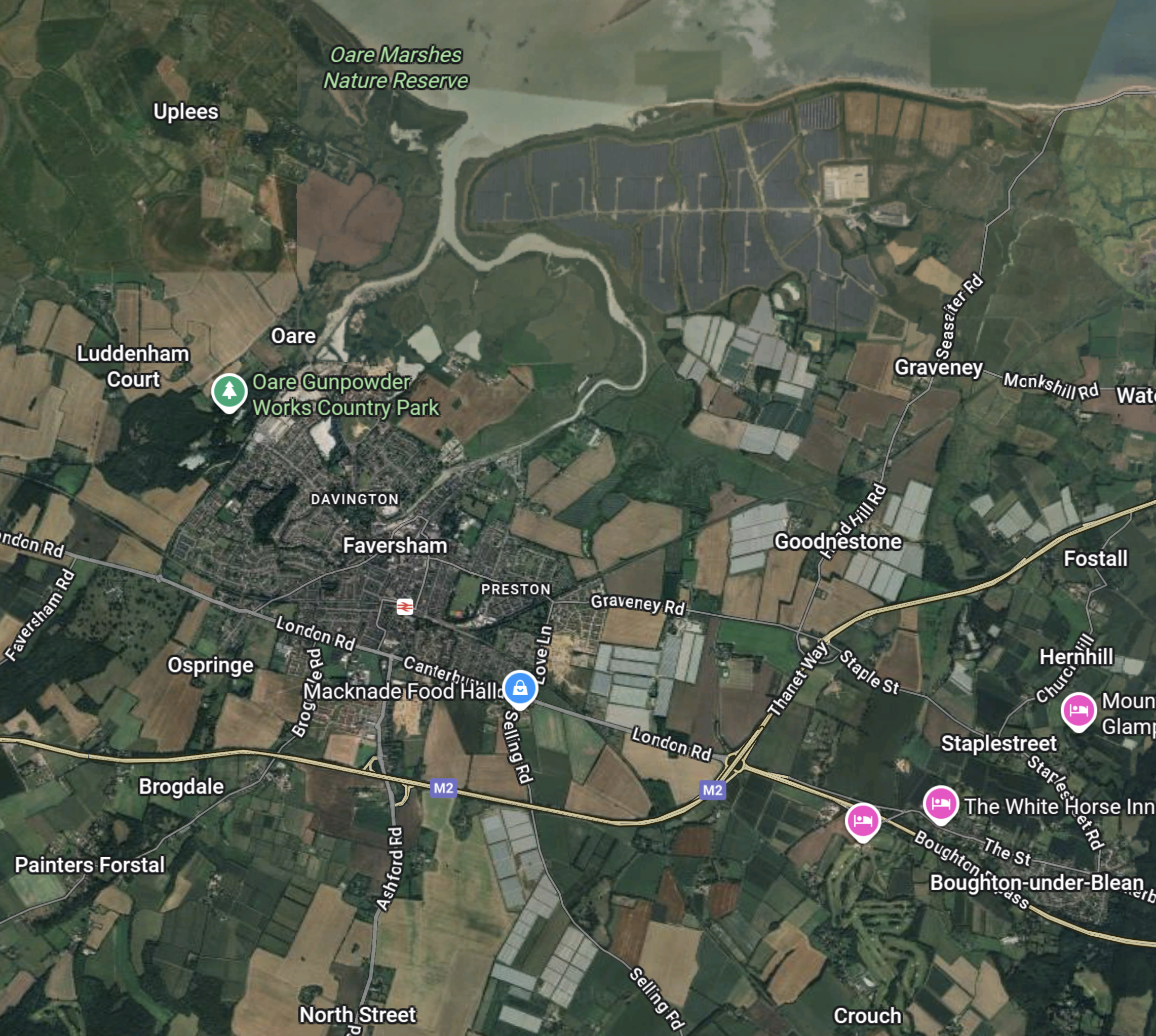
Note.
The town of Faversham to the left of the middle of the map.
Faversham station has the usual railway station logo.
The North Kent coast is at the top of the map.
Cleve Hill Solar Park is on the coast to the East of the River Swale.
This second Google Map shows a close up of the solar farm.
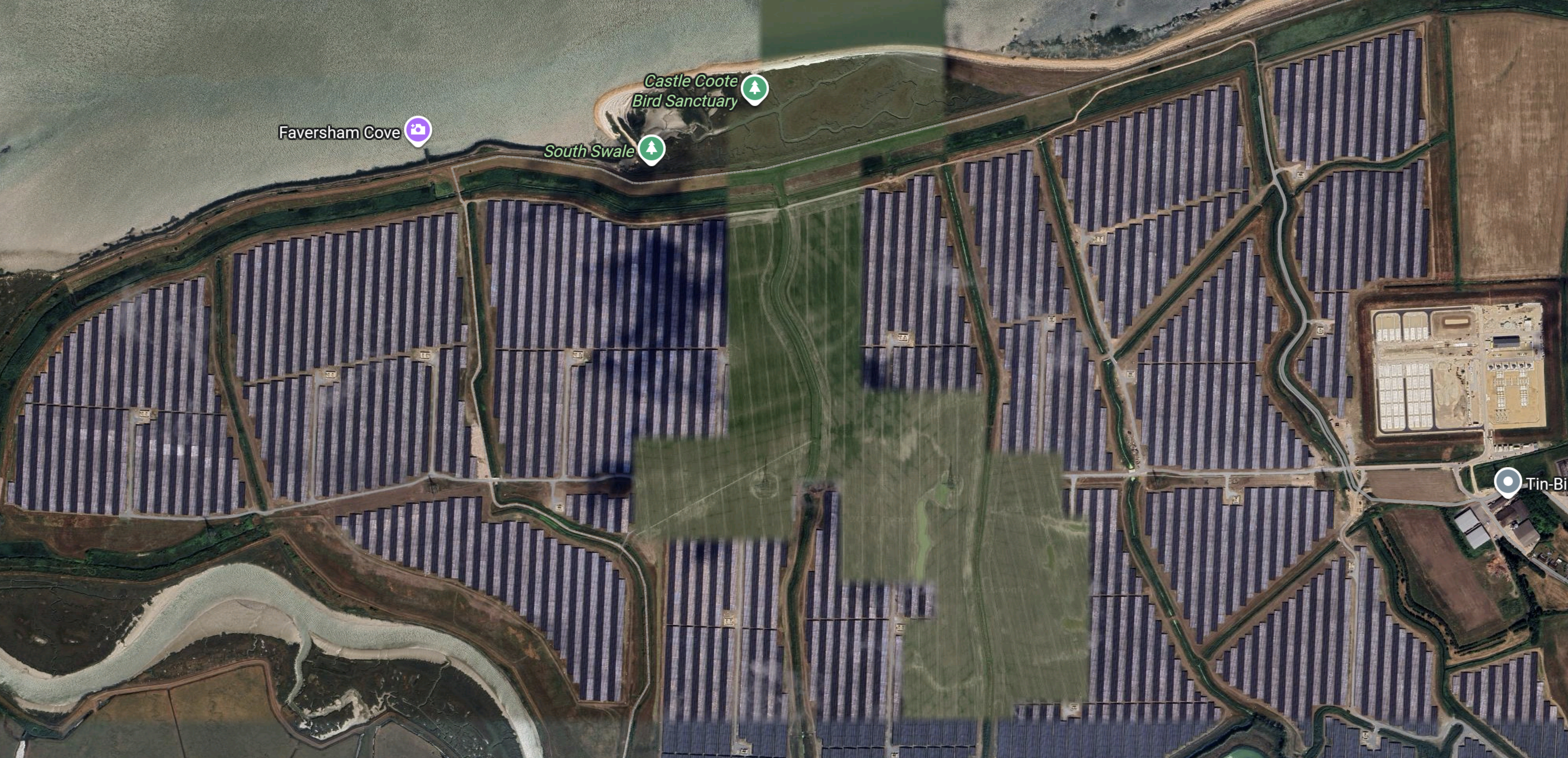
Note.
- The large number of solar panels.
- The North Kent coast is at the top of the map.
- The River Swale in the South-West corner of the map.
- It appears that Cleve Hill substation is at the right edge of the map.
- The boxes at the left of the substation appear to be the batteries.
- The 630 MW London Array wind farm, which has been operational since 2013, also connects to the grid at Cleeve Hill substation.
- When completed, the London Array was the largest offshore wind farm in the world.
As a Control Engineer, I do like these Battery+Solar+Wind power stations, as they probably provide at least a reliable 500 MW electricity supply.
Could A System Like Cleeve Hill Solar Park Replace A 410 MW Gas-Fired Power Station?
The three elements of Cleeve Hill are as follows.
- Solar Farm – 373 MW
- BESS – 150 MW
- Wind Farm – 630 MW
That is a total of only 1,153 MW, which means a capacity factor of only 35.6 % would be needed.
How Much Power Does A Large Solar Roof Generate?
Some people don’t like solar panels on farmland, so how much energy do solar panels on a warehouse roof generate?
This Google Map shows Amazon’s warehouse at Tilbury.
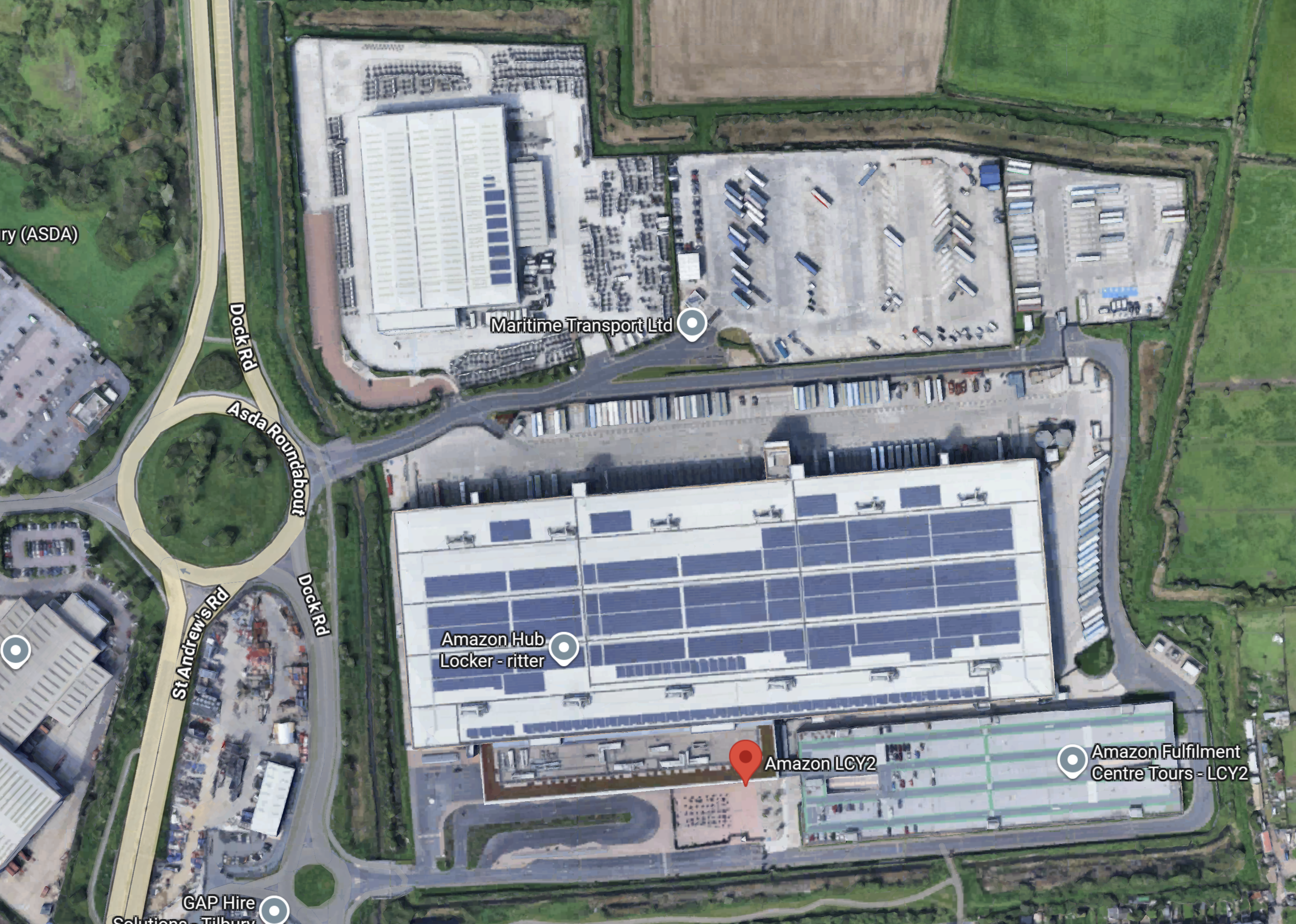
I asked Google AI to tell me about Amazon’s solar roof at Tilbury and it said this.
Amazon’s solar roof at the Tilbury fulfillment center is the largest rooftop solar installation at any Amazon site in Europe, featuring 11,500 panels across the two-million-square-foot roof. Unveiled in 2020, it is part of Amazon’s larger goal to power its operations with 100% renewable energy by 2025 and reduce its emissions, contributing to its Climate Pledge to be net-zero carbon by 2040.
It generates 3.4 MW, which is less that one percent of Cleeve Hill Solar Park.
Bidders Circle ‘Elvis Airport’ A Decade After The SNP Bought It For £1
The title of this post, is the same as that of this article in The Times.
This is the sub-heading.
Prestwick has cost taxpayers millions since it was nationalised by the SNP in 2013. A consortium plans a bid, but can the Nats let go of Sturgeon-era stateism?
These are the first two paragraphs.
It was always going to be difficult keeping a lid on the arrival of Elvis Presley at a US military base in Prestwick, Ayrshire. “Where am I?” he asked as he stepped off the plane and into the biting wind that whipped off the Firth of Clyde.
March 3, 1960 was a momentous day for the screaming youngsters who engulfed the American singer as he set foot on British soil for the first and only time. For Presley, it was his last stop on his return from Germany after two years of military service. For Prestwick, it meant being immortalised in British trivia for its brief flirtation with The King.
But now it appears that a consortium has a plan for the airport and has made a bid.
These are my thoughts.
Prestwick Airport
Prestwick Airport, which is 32 miles SouthWest of Glasgow, is an airport that has seen busier times.
This OpenRailwayMap shows the Airport.

Note.
- The airport has two runways at right angles.
- The longer runway is 3,000 metres long.
- The red line is the electrified Ayrshire Coast Line, which runs between Glasgow Central and Ayr.
- There is a station at the airport.
- The black line going across the map is an unelectrified railway line, which eventually leads to the West Coast Main Line.
The airport does have four very useful assets.
- A very long runway capable of handling the largest and heaviest aircraft.
- A railway station.
- Plenty of space.
- The airport has plenty of available landing and take-off slots.
I also suspect that a rail connection could be developed to the West Coast Main Line.
Prestwick As A Cargo Airport
Someone commenting in The Times, suggested that Prestwick could become a cargo airport.
- The main runway could accommodate the largest and heaviest cargo aircraft.
- There is space for stands for large aircraft and warehouses.
- A rail link to the electrified West Coast Main Line could be built.
The airport could have a very high capacity.
A Rail Connection To The West Coast Main Line
This could be very beneficial for air-cargo at Prestwick.
- It would be less than ninety miles to the West Coast Main Line.
- It is only single-track as British Rail removed the second track.
- Cargo Services could be run all over the UK mainland.
- There could even be an airport service from Carlisle.
A zero-carbon rail service for freight, passengers and staff from both Glasgow and Carlisle would enhance the green credentials of the airport.
Where Would Planes Fly?
It looks like a modern freighter aircraft like a Boeing 747-8F could fly at maximum weight to nearly all the USA.
But because Prestwick Airport is further North, It does possibly have a wider range of airports, it can reach.
What Is The Closest Airport In North America?
The two airports on Newfoundland; Gander and St. John’s are probably the two closest being about 2,000 miles from Prestwick.
- Both airports have long runways.
- I suspect a rail terminal could be arranged at the airport to take cargo through the Chunnel to Europe.
- Could USAF Galaxies even be used to bring over American tanks and guns for Ukraine? The range of a Galaxy at maximum weight is 2,600 miles.
- They could be delivered by rail to Ukraine.
I suspect there will be times, where the shorter routes could be useful.
Could Cargo Change Planes At Prestwick?
On some routes like perhaps New York and India, might it be more efficient to change planes at Prestwick.
Could Cargo Planes Refuel At Prestwick?
Planes can only fly so far and is Prestwick in the right place to refuel a long flight?
Prestwick Could Be A Viable Cargo Airport For North America?
I am convinced that Prestwick and North American could be a viable air cargo route.
Zero-Carbon Air Cargo
In the next few years, Scotland will have much more electricity, than it needs, due to all the wind farms in the seas around the country and much of the spare electricity could be converted into hydrogen.
So does a cargo operator plan to run zero-carbon aircraft powered by hydrogen between North America and Prestwick?
- Remember it’s only 2,000 miles between St. John’s or Gander and Prestwick.
- The ideal aircraft to convert to hydrogen, must surely be an Airbus A 380, as there’s a lot of space in the fuselage for a hydrogen tank.
- Cargo could be brought to Prestwick in zero-carbon trains from all over the UK.
Amazon might like the idea of zero-carbon parcels across the pond!
Could An Airbus A380 Be Converted To Hydrogen?
This article on Simple Flying is entitled Airbus Plans A380 Hydrogen Flights In 2026 After Successful Power On Of ZEROe Engine.
The header picture shows a visualisation of an Airbus A 380, with a fifth engine with a propeller mounted on the top of the fuselage. The A 380 will be testing this electric engine, so that it can be fitted in the ZEROe Turboprop sometime around 2030.
This is a visualisation of the ZEROe Turboprop.

Note,
- The hydrogen tank will probably be behind the passenger compartment.
- The A 380, that will be testing the engine is no ordinary A 380. It is the very first and Airbus use it as a flying laboratory for new technology.
- I wouldn’t bet against one of its next jobs, is to test turbofan engines running on hydrogen.
I wouldn’t be surprised that in a few years, Airbus demonstrate an A 380 flying between Europe and North America on hydrogen.
A Zero-Carbon Air Bridge Between Europe And North America
Or does Westjet fancy a zero-carbon shuttle service, which would appeal to the Gretas of this world?
It has been rumoured, that the possible buyers of Prestwick are linked to Westjet.
As soon, as someone announces, a flight like this across the Atlantic, I’ll be signing up!
If the worse should happen, which I think would be unlikely, it would surely be a less painful death, than that of my wife’s from a rare cancer.
Conclusion
There are certainly, possibilities at Prestwick.
Amazon Books Over Half Of Moray West Offshore Wind Capacity To Power UK Operations
The title of this post, is the same as that of this article on offshoreWIND.biz.
This is the sub-heading.
Amazon has signed a corporate power purchase agreement (CPPA) for a total of 473 MW of Moray West offshore wind farm’s generation capacity to help power its operations when the project becomes operational later this year.
These are the first two paragraphs.
The technology giant signed the CPPA with ENGIE, which owns the Moray West project through Ocean Winds, the 50-50 joint venture between ENGIE and EDP Renewables.
The 473 MW Amazon secured through the agreement is enough to power the equivalent of more than 650,000 UK homes annually and is more than half of the total installed capacity of the 882 MW Moray West offshore wind farm.
Note.
- In Google Buys Scottish Offshore Wind Power, I talked about how Google had signed a Corporate Power Purchase Agreement to buy 100 MW from the Moray West offshore wind farm.
- This would mean that there’s still 305 MW of capacity to allocate.
- I would assume you wouldn’t sell hundred percent of capacity to give yourself leeway.
But what do you do, if your wind farm isn’t producing the 573 MW you need to satisfy the CPPAs you’ve sold? I suspect you have to buy it on the market.
If And When Do Amazon Think About Batteries?
My twenty-five-year-old self could have developed methods to calculate the answer to that question, as it would have been a simple calculation for the analogue computer, that I was using at the time; a PACE-231-R.

They really were magnificent machines.
Ecojet: Dale Vince Launches An Aviation Revolution
The title of this post is the same as that as this news story from Ecotricity.
This is the sub-heading.
The world’s first electric airline powered by renewable energy
These three paragraphs outline the project.
Ecotricity founder, Dale Vince, has announced the launch of Ecojet, the world’s first Electric Airline, powered by renewable energy. The move marks the beginning of an aviation revolution by making net-zero, emission-free air travel possible for the first time.
Ecojet’s fleet will comprise conventional planes retrofitted with hydrogen-electric powertrains. Once converted, the aircraft will operate with the same power output as before, but with a one-hundred percent reduction in CO2 emissions.
The decision to repurpose old planes rather than build new models from scratch will save 90,000 tonnes of carbon per year. The only byproduct will be water, which can be captured and released into the lower atmosphere to avoid the harmful effects of contrails.
These ae my thoughts.
The Aircraft
The news story contains pictures of two aircraft; a de Havilland Canada Twin Otter and a 737 or A320 variant.
- It also says that hydrogen-electric powertrains will be used.
- ZeroAvia in partnership with Cranfield Aerospace are developing such a powertrain and I suspect they could have one certified by 2025.
This would be used in the Twin Otter.
But what about 737 or A320 variant?
Airbus are already proposing the ZEROe Turbofan, which appears to be based on an improved A320 neo.
But the image on the news story looks more like a Boeing 737 from the wing-tips.
This article on the IET web site, which is entitled Airbus And Boeing To Embrace Hydrogen From Mid-2030s, indicates that it will be the mid-2030s before hydrogen twinjets of this size are in service.
This paragraph from the news story indicates his philosophy about the aircraft.
Short-term, to secure routes and a license from the Civil Aviation Authority, Ecojet will initially launch using conventionally fuelled planes. Ecojet will launch with two different sizes of turboprop aircraft (a 19-seat aircraft and a 70-seat aircraft). These aircraft will be retrofitted with the hydrogen-electric powertrains as they become approved for service by the CAA – the first retrofits will take place in 2025, one year after the commencement of flights.
Note.
- The news story clearly states that two types of aircraft will be used; a 19-seat turboprop and 70-seat turboprop.
- So the second picture of a Boeing 737 had nothing to do with the news story.
- They will be retrofitted with hydrogen-electric powertrains, when they have been certified.
- Flights are planned to start next year.
It looks a very canny philosophy, as Ecojet will be able to prove the route with aircraft running on traditional fuels or sustainable aviation fuel (SAF) and only switch to hydrogen, when the hydrogen-electric powertrains are proven, certified and installed, and the hydrogen infrastructure is in place.
The Smaller Aircraft
The first picture in the news story is of a de Havilland Canada Twin Otter.
- This aircraft accommodates 19-20 passengers.
- It has two turboprop engines.
- Production started in 1966 and it is still ongoing.
- Nearly a thousand have been built, so plenty of nearly-new examples will be available for refurbishment and conversion.
- Loganair operate three aircraft in Scotland.
It looks fairly certain, that Ecojet’s 19-seat aircraft will be a Twin Otter.
The Larger Aircraft
Possibilities would include these aircraft.
- ATR-72 – 72 seats
- de Havilland Canada Dash 8 – > 50 seats
Note.
- Both aircraft are still in production.
- In ZeroAvia To Bring Zero-Emissions Flight To Sweden, I talk about how ZeroAvia have sold their hydrogen-electric powertrains to Swedish ATR-72 operator; Braathens and are targeting Dash 8 operators.
- In Universal Hydrogen Successfully Completes First Flight Of Hydrogen Regional Airliner, I talk about Universal Hydrogen’s successful progress in selling hydrogen-electric powertrains for ATR-72s and Dash 8s. The first flight of their system was in an ATR-72.
It looks to me, that Dale Vince has a choice of two 70-seat aircraft and hydrogen-electric powertrains from two manufacturers; ZeroAvia and Universal Hydrogen.
In Monte To Purchase 100 FC Aircraft Drives From ZeroAvia, I talk about how Monte Aircraft Leasing have done a deal with ZeroAvia to lease ZeroAvia’s hydrogen-electric powertrains to regional airlines.
Has Dale Vince done a deal with Monte Aircraft Leasing for his aircraft?
- Monte Aircraft Leasing and ZeroAvia would get an eco-celebrity customer, who could even be the launch customer.
- Ecojet’s aircraft would all have similar ZeroAvia hydrogen-electric powertrains, although the size might be different.
- Dale Vince would only be sharing the risk, if the technology was a dog.
- De Havilland Canada and/or ATR will see how the passengers like zero-carbon flight.
There is also, one of aviation’s most powerful companies close to the deal, as Airbus own half of ATR.
Airbus are developing the hydrogen-powered ZEROe Turboprop, which is shown in this Airbus image.
Note.
- It looks very much like an improved ATR-72.
- It has more extreme propellers and probably better aerodynamics.
- Airbus might like to persuade Ecojet to use ATR-72s as their 70-seat airliner.
- Information from an operator of hydrogen-powered airliners would be very valuable to Airbus.
I wouldn’t be surprised to see Ecojet lease some nearly new ATR-72s.
Would Airbus Fit ZeroAvia Hydrogen-Electric Powertrains In The ZEROe Turboprop?
This page on the Airbus website is entitled ZEROe.
In a section, which is entitled Hydrogen Propulsion To Power Future Aircraft, this is said.
All three ZEROe concepts are hybrid-hydrogen aircraft. They are powered by hydrogen combustion through modified gas turbine engines. Liquid hydrogen is used as fuel for combustion with oxygen.
In addition, hydrogen fuel cells create electrical power that complements the gas turbine, resulting in a highly efficient hybrid-electric propulsion system. All of these technologies are complementary, and the benefits are additive.
In 2022, we launched our ZEROe demonstrator with the aim to test hydrogen combustion technology on an A380 multimodal platform. Through future ground and flight testing, we expect to achieve a mature technology readiness level for a hydrogen-combustion propulsion system by 2025.
Note.
- Airbus state they are using modified gas turbine engines.
- Airbus also talk about using fuel cells to create electrical power that complements the gas turbines.
- Could the hydrogen fuel cells be used to power the aircraft’s systems, like avionics, control systems, air-conditioning and the hydrogen system for the main engine?
- This concept of effectively a hydrogen auxiliary power unit, might be a more efficient way of using the hydrogen, which either gives longer range or a smaller fuel tank.
- In The ZEROe Demonstrator Has Arrived, I talk about the ZEROe Demonstrator, which is a modified Airbus A 380.
Did the adding of hydrogen fuel cells to the ZEROe aircraft, lead to the concept of a hydrogen-powered auxiliary power unit, that I talked about in Airbus To Trial In-flight Auxiliary Power Entirely Generated By Hydrogen?
It looks to me, that Airbus have developed their own simple concept of powering the aircraft.
I doubt they will need ZeroAvia’s technology.
But.
- Aircraft manufacturers like Airbus generally fit the best and most suited engines they can find in their aircraft.
- The Wikipedia entry for ZeroAvia says that the prototype hydrogen-electric powertrain is in the cabin, consisting of two fuel cells and a lithium-ion battery for peak power.
- ZeroAvia have powerful shareholders like Amazon, Bill Gates and Royal Dutch Shell.
- ZeroAvia have also received grants from the UK Government.
I wouldn’t be surprised to learn, that Airbus have taken a long hard look at ZeroAvia’s technology.
After all, ZeroAvia could probably build a hydrogen fuel cell power pack, that would meet Airbus’s needs for a hydrogen-powered auxiliary power unit.
Remember too, that many fleets of aircraft have been updated with new engines for decades and I don’t think Airbus would mind ZeroAvia giving a new zero-carbon lease of life to the hundreds of ATR-72s in service around the world.
Surely, a successful hydrogen-powered ATR-72 is only going to create more interest in airlines buying ZEROe Turboprops.
All the converted aircraft will still need support from ATR.
Both the converted and new aircraft will need hydrogen refuelling services, so could the two aircraft use a common standard.
Airbus and ZeroAvia would appear to have several common interests.
Ecojet’s Core Route
This is a paragraph from the news story on the Ecotricity web site.
Dale has partnered with experienced pilot Brent Smith and a team of aviation specialists to set up Ecojet. Flights across the UK will commence in early 2024, starting with the Edinburgh to Southampton route, and expanding to mainland Europe shortly after, with long-haul flights planned for the future.
Note.
- The ATR-72 has a range of 949 miles, which is more than adequate for Southampton and Edinburgh, which is just over 350 miles.
- Diagonal journeys in the UK are often the most passenger-unfriendly by rail and tend to use diesel trains.
- Southampton Airport has good road and rail connections, with the terminal less than a minute from the station.
- Edinburgh Airport has good road and tram connections, with rail connections needing a short journey on the tram.
- Southampton Airport has flights to the Channel Islands, Ireland and Schiphol.
- Edinburgh Airport has a comprehensive service from major airlines and low-cost carriers, and several flights to destinations in the North of Scotland and on the Islands.
I think that it is a well-chosen core route for their 70-seat aircraft.
Which Routes Will Ecojet Fly With The Twin Otters?
Consider.
- My Scottish friends tell me that flying to the Scottish Islands, like the Hebrides, Orkney and Shetland is expensive.
- The growth of the Scottish wind power industry will mean, that more capacity is needed to serve the North of Scotland and the Islands.
- Tourism to the North of Scotland and the Islands is on the up.
- There will not be a shortage of green electricity to produce green hydrogen.
- The North of Scotland isn’t short of airports.
- The Twin Otter has a surprisingly long range on aviation fuel and I suspect, that a hydrogen version would be designed to have a similar range.
- The longest flight needed would probably be Edinburgh and Sumburgh, which is about 280 miles, which should be well within the range of a Twin Otter.
- I suspect that hydrogen refuelling could be easily provided at enough airports, to support hydrogen-powered airliners.
- I am sure, that the Twin Otters could be used on a network of zero-carbon flights from Edinburgh to the North of Scotland and the Islands.
- A zero-carbon airline would help Scotland’s net-zero ambitions.
There is certainly a need for another airline to connect Edinburgh to the North of Scotland and the Islands and the infrastructure could be upgraded to support a hydrogen-based zero-carbon airline.
Could Ecojet build a similar network at Southampton, that served the Channel Islands, Southern Ireland and Northern France?
Conclusion
There’s a lot more to this venture, than there appears at first sight.
O wish Vince and his partners well, but as a coeliac, I’ll skip the food.
Mercedes-Benz, Amazon, Frankfurt Airport, Lidl & Kaufland, Vodafone – Giants In Germany Lining Up To Buy Offshore Wind Power
The title of this post, is the same as that of this article on offshoreWIND.biz.
This is the sub-heading.
With the latest news about Lidl and Kaufland entering a long-term offshore wind power offtake contract, and Mercedes-Benz announcing the same shortly prior to that, the list of big names signing up to buy offshore wind-generated electricity in Germany keeps growing. What lies behind this are both the companies’ ambitious decarbonisation strategies and the country’s approach to tendering.
Rhe whole article can be read after signing up for a free trial.
Amazon Finances First-Ever Commercial-Scale Seaweed Farm Located Between Offshore Wind Turbines
The title of this post, is the same as that of this article on offshoreWIND.biz.
This is the sub-heading.
Multinational technology company Amazon is funding the world’s first commercial-scale seaweed farm located between offshore wind turbines
This paragraph details the project.
The North Sea Farm 1 will be located in a wind farm off the coast of the Netherlands, designed to test and improve methods of seaweed farming, while researching the potential of seaweed to sequester carbon.
Seaweed is all the rage at the moment, since Notpla won Prince William’s Earthshot Prize, with their packaging made from seaweed.
It sounds to me, that as Amazon probably create more need for packaging, than any company in the world, there could be an almighty coming together, which will create a lot of environmentally-friendly ideas.
A London Mongrel Gets Ready For Christmas
I constantly, refer to myself as a London Mongrel, as my father did.
This extract from a previous post, explains why I do.
On the other hand, I’m a London Mongrel of German Jewish and French Huguenot roots, with quarters of stubborn Devonian and solid Northants yeoman stock thrown in. A large proportion of my ancestors are also real East Enders and of course my father was a genuine Cockney.
The older I get, the more I think, the Devonian genes of my Dalston-born maternal grandmother are asserting themselves.
I was going to my son’s house for Christmas Dinner, but we felt last night, that it was best to call it off, as although, what we had planned would have been within the rules, it would be better not to take any chances.
Yesterday, there was an article in The Times about how Michelin-starred chefs were doing Christmas meals in a box for home warming through!
So last night, I bought one for sixty-one pounds from Roasted by Jack and Scott.
I’ve already got the beer in, as this picture shows.
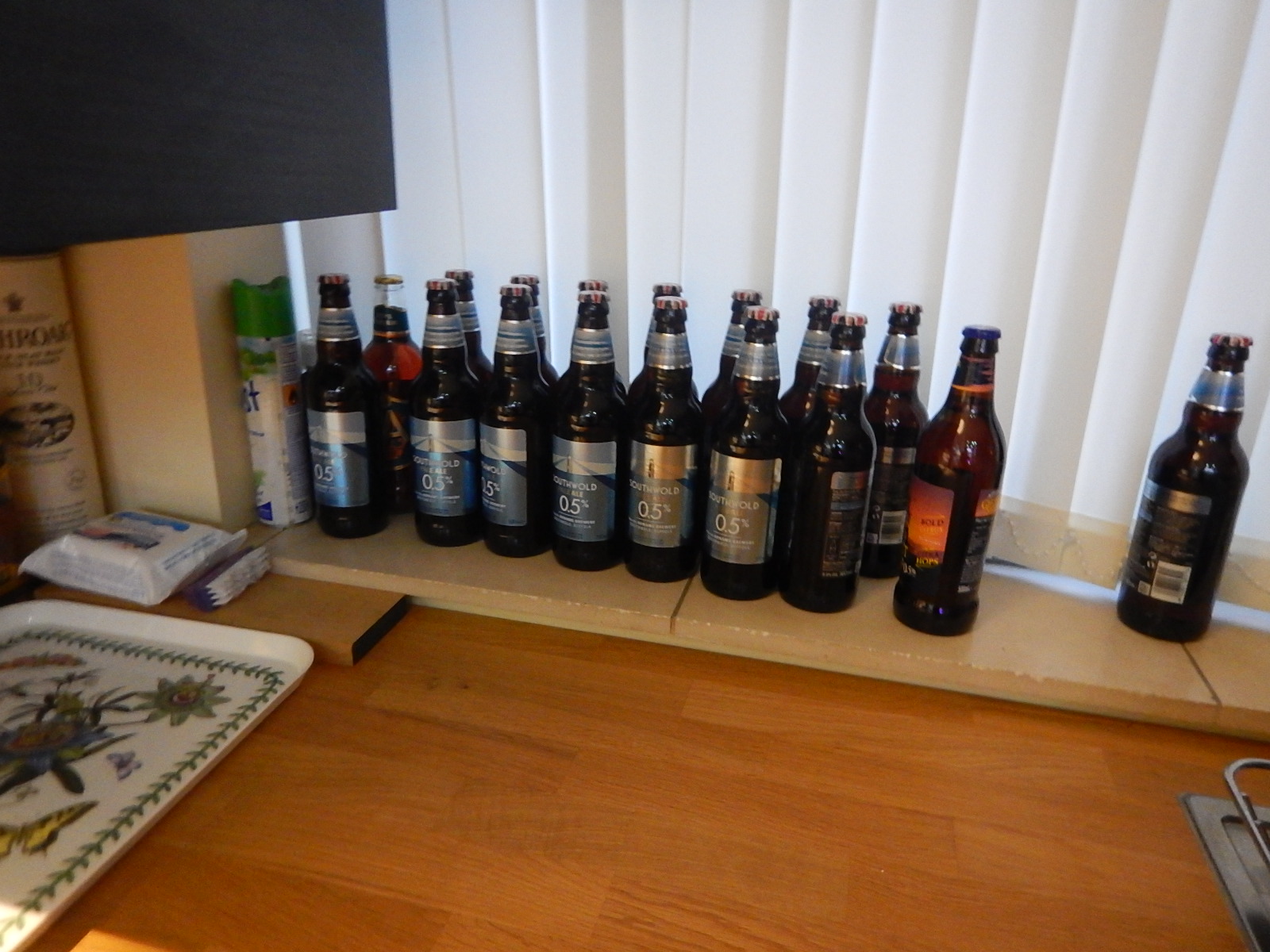
But then it’s all gluten-free, low-alcohol beer from Adnams, that tastes just like the halves from the same brewery, that my father used to buy for me sixty years ago.
My father didn’t want me to be the alcoholic his father was, so he introduced me to beer in social settings at an early age and now at seventy-three, I can honestly say, that, there are few times in my past, where I’ve got really drunk. So thank you, Dad!
But then my father was unconventional and didn’t follow the rules.
A year or so ago, I was reminded of a story about my father by someone I was at school with at Minchenden.
My father had ordered a new Vanden Plas Princess 1100 from a garage near the school. So one morning over breakfast, he asked the seventeen-year-old me, if I wouldn’t mind picking up the car after school and bring it home.
So after school, I picked up the car and took it home.
I can’t remember, if I gave any of my school-mates a lift. But I may have done!
Football
The one problem, I have is not being able to watch Premier League football on television, except on Match of the Day.
The Premier League have sold the Christmas rights to Amazon, which is a company, I don’t do business with!
Anyway, as the pictures come by broadband, I doubt I’d be able to watch it, as my broadband is crap.
BT told my MP, it’s because I’m too close to the exchange!
Conclusion
I’ll be OK. But then like my father, my sons and my granddaughter, we all seem happy in our own company.
I am also lucky in being coeliac on a gluten-free diet!
The more I research my health, the more I’m convinced that my genes have given me a strong immune system and that is protecting me from the covids.
But then, self-isolating by habit is not a bad trait in these terrible times.

