Sunrise On A Eurostar to Paris
I took these pictures as the Eurostar sped to Paris through the countryside.








So try to book a ticket in a window seat on the left hand side of the train.
In fact always book on that side if you want the sun as coming home you’ll get the sunset.
Would Reorganising Cross-Channel Freight Cut Illegal Migration?
People can argue about the advantages and disadvantages of migration into the UK.
But in my view one of the reasons for the high level of illegal immigration into the UK, is that it is a rich source of income for criminal gangs and probably money lenders in countries like Syria, Ethiopia and Somalia, which transport these migrants to the French ports. Never underestimate the role of money-lenders in these sort of enterprises!
Once in the ports, they probably only have one reliable way to get into the UK and that is to sneak or be welcomed aboard a truck. I have only heard very occasionally of an illegal immigrant trying to get into the UK in someone’s car.
So could we reorganise cross-channel freight to cut illegal migration?
It would be a good exercise to analyse truck movements through the Channel Tunnel and see how many could be replaced by a direct rail container transfer. It could be argued that jumping on to a train going at over a hundred kilometres per hour is not easy and this alone would cut the number who try to enter the UK illegally.
Could we also run the truck-shuttles from a dedicated truck terminal at a remote location perhaps fifty kilometres from the tunnel itself? I’ve heard drivers complain of bad facilities and not being able to stop before the tunnel, so this could be a lot better for the drivers. I’m sure the French have a really isolated spot close to the autoroutes. If someone thought about this sort of terminal, it could be made into a very secure and comfortable facility.
Obviously, we’d need a similar facility on the UK side! Manston?
What Is The French For Knackered?
According to The Times, the French PM said “We have six months to save France, or we’re knackered”
Google translate gives the answer – crevé
What Do The French Do For Commuter Trains?
The French equivalent to the Class 345 for Crossrail, also has a version built by Bombardier called the Z 50000 Francilien.
What probably shows more of this train is this excellent YouTube video.
Looking at the video and comparing the images with say travelling in a familiar Class 378 on the Overground, you notice several differences.
The biggest difference is that the French train is wider and taller in cross-section than the British train. This is due to the much more generous Continental loading gauge, which the designers of the train have used to their advantage.
Another big difference is getting into and out of the trains. On the Class 378 and probably the Class 345, it’s just a simple step across, but on the French train, an extra step emerges from the train and it’s a double step into the train. How would the French train cope with platform edge doors, like those that will be installed on Crossrail? I ask this question as European safety legislation insists on these in all stations in tunnels.
A Market Named After The Queen
I find it somewhat unusual that the French have named a market after the Queen, as is reported here on the BBC. The French have also brought the Wikipedia entry for the market in line.
We rarely name places after famous people these days, although it did happen in the past. And if we do, it is unlikely to be after a foreign monarch or politician. Prince Charles for example has a cinema in London and a hospital in Merthyr Tydfil, but where is General de Gaulle Square?
In France though there are lots of places named after Kennedy, Churchill and Roosevelt.
There is a list here of everything named after the Queen. On a quick look Canada seems to honoured her more than we have.
I suspect that the Queen wasn’t that bothered one way or the other about the renaming of the market, but she probably accepted the honour with grace.
Could This Happen In The UK?
This article on the BBC web site is about how the French have ordered 2,000 new trains that are too wide for the platforms.
The French train operator SNCF has discovered that 2,000 new trains it ordered at a cost of 15bn euros ($20.5bn; £12.1bn) are too wide for many regional platforms.
But could it happen here?
The front cover of the February 2014 edition of Modern Railways has a headline of Mind the Gap. Inside it describes how at some London Underground stations there is a problem of large gaps between trains and station platforms with the new S Stock.
But the London Underground problem is for a different reason. As the lines get upgraded and new trains are delivered, London Underground is endeavouring to get the platform-train interface to help passengers and especially those with accessibility problems. And they have some curved platforms that make this difficult and will need rebuilding.
Regularly on the Overground, I see a wheelchair-bound passenger push themselves effortlessly into and out of the Class 378 trains, where the interface is easy. As the Overground platforms are lengthened for the new trains, any small gap problems are probably being addressed.
On the Continent except on Metros, there is usually a step-up into the train, which with heavy cases or a baby in a buggy is a slower process.
I wonder how long it is before some anti-Europe and anti-metrication politician or dinosaur, blames the EU and/or metrication for this French problem.
After all, the French are only probably doing what London Underground are and adjusting the platforms to their shiny new trains.
But are the new French trains solving the problem of access?
I can’t find any detailed descriptions of the trains or even their class, so I can’t answer that one.
This train-platform problem will happen more in the future, as many train platforms in the developed world were designed in the steam era and have been updated over the years. I suspect we’ll probably find some newish stations may have to be rebuilt for the next generation.
So we will see more of approach taken by the French and London of ordering a train, that you want for passenger needs and then adjusting those stations that don’t fit the new trains.
After all you would prefer to have the same type of train for all your lines like London Overground has done with the Class 378 rather than have a special version for some stations. If you look at the Class 378 as a go-anywhere train on the Overground, it has a dual-voltage and selective door opening capabilities to cope with lines without overhead electrification and short platforms.
I suspect that the French problems are worse as it’s a much larger number of trains and stations and there are politicians with axes to grind.
From Madrid To London
As the hotel at Chamartin didn’t have a restaurant and there wasn’t any tea or coffee making facilities in the room, I went for an explore at about four and found the station opened at 04:30.
So as I didn’t have any soap or shampoo with me and my luxurious four-star hotel didn’t provide any, I went back to the station as soon as it opened, after a breakfast of an EatNakd bar.
As I was hungry, in the most strange of hotels, I decided that the best thing to do, was take a train to Barcelona, then a TGV to Paris, followed by a Eurostar home.
At least the train companies seem to have systems that men you can get a keenly priced ticket from a machine without an ego or communication problem.
I found out by a roundabout way, that contrary to my informant from Spanish Railways at the airport, there were no trains to Barcelona from Chamartin, but one left at 05:50 from Atocha.
So it was a taxi to Atocha station at a cost of twenty euros, which I could have done the previous night for nothing on my ticket from the airport. Talk about the airport information guy, being a Spaniard in the Works.
To add insult to injury, there were several hotels in the area of Atocha, one of which was a brand I trust!
I bought the ticket to Barcelona with ease for €59 and after going through a full airline style security check, I just made the AVE high speed train to Barcelona. It was a Siemens train and like it seems all of their products had been designed without litter bins, although it did have an ash tray. The latter was unneeded as the train was non-smoking. I did get a reasonable drink in the buffet, but of course nothing to eat was gluten-free.
The change of train at VBarcelona was pretty quick, but I did need to buy another ticket from the ticket office, rather than an intelligent machine. I also had to go through security again to get back on the platform, where I arrived to get the TGV Duplex to Paris. Just 25 mins after arriving at 08:55, I was on my way to Paris. There are four trains a day for Paris and I paid a full fare of €170. Seat61.com has a full description of the journey.
This railway line up the Spanish and French coasts to the Rhone valley, is one of the best train rides in Europe. I didn’t chose to be on the top deck of the train, but that is where I was allocated a seat.
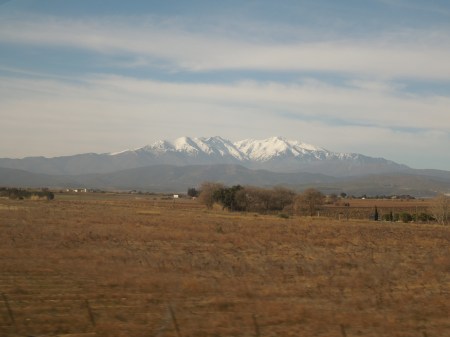
The Pyrenees
This picture shows the snow-capped mountains just before Perpignan and this shows the Etang de Thau before Sete.
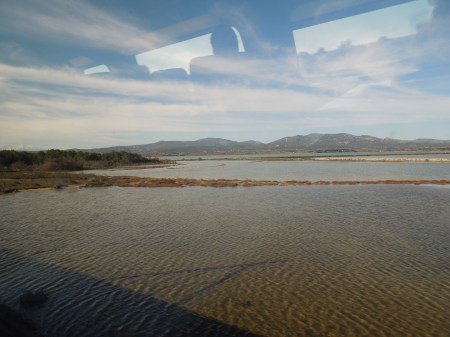
Etang de Thau
They don’t show in the picture, but there were lots of greater flamingoes in the lakes. I never realised that these birds were so common in France, until a holiday in the area in about 1975.
Once in Paris at 15:53, I didn’t hang about but just jumped on the RER at Gare de Lyon for Paris Nord and the Eurostar. An hour and twenty minutes after arriving in Paris, I was leaving.
I finally arrived in London at 18:30 or just thirteen hours forty minutes after leaving Madrid.
This journey will get quicker, as for quite a way along the south coast of France, the trains don’t run on high speed lines. I can’t find any references to the distances on the journey, although Madrid to Barcelona and Paris to London are given as 621 and 495 kilometres respectively. Map Crow gives the Barcelona to Paris distance at 831 kilometres. I know this isn’t accurate and is probably a bit short, but that gives a total of 1947 kilometres, so my journey was at an average speed of 142 kmh. This compares with an average speed of 200 and 220 kmh on the first and last legs from Madrid to Barcelona and Paris to London respectively.
If the centre section was capable of an end-to-end average of 200 kmh, then a time from Madrid to London of under ten hours should be possible, especially if it was one train all the way.
The Last Word On Hollande
I picked this paragraph up from The Times.
Christine Boutin, a Roman Catholic who served as a minister under President Sarkozy, accused Mr Hollande of “treating his concubine like a Kleenex”.
It would appear that he’s running out of powerful women to take to bed. One wag also said last week, that he looked like a middle-aged provincial dentist.
i know the French expect different things from their politicians, but there can’t be many countries where Hollande’s behaviour would be tolerated without redicule.
Hollande Gets On His Motorbike
Traditionally in the UK, there is a joke about infidelity and men getting on a bicycle.
But French presidents do it differently and use a motorbike driven by a chauffeur., according to this article on the BBC web site. Here’s the relevant bit.
The pictures purportedly show the pair arriving separately. Mr Hollande, wearing a helmet, is on a motorbike driven by a chauffeur.
It looks like it’s one law for the leaders and one law for the plebs.
I wonder what is the French colloquialism for “Beware the scorned woman!” or in Hollande’s case “Beware the scorned women!”
Logging In In France
On my recent trip to Bilbao and back, I spent three days in France and on the two mornings in Biarritz, I checked some of my Internet accounts, from a computer in the hotel’s Business Centre.
My major accounts have a system of logins and passwords that are stored in my Mark One brain, which means it is a system that is unbreakable without my being present. Nothing is written down, on or in anything I carry.
However, France with its bizarre keyboard layout, made some of the logins difficult. For instance to login to many accounts, you need to type an e-mail address, but that is not easy, as typing the @ sign is not a simple shift, but a control-alt keystroke.
Sometimes, France can get very annoying in the simplest of things, by going its own sweet way.
 The Anonymous Widower