Project Managers Having Fun In The East
A lot of people moan that London and the South East get all of the rail infrastructure investment, but next time you travel up and down the country from Edinburgh or Newcastle to London, moaning why the A1 is such an inferior road or your train seems always to be held up, then you should perhaps be pleased that things might be getting a bit better due to one of the largest rail projects in the UK, that will be commissioned later this year.
The Great Northern and Great Eastern Joint Railway (GNGE) It ran from Doncaster to Cambridge via Lincoln, Sleaford and Spalding a dozen or so miles to the east of the East Coast Main line. It was built primarily as a freight line to get coal from Yorkshire to East Anglia.
Some southern parts of the line and the by-pass around Lincoln have been closed, but the rest of the line was used by passenger trains although gauge limitations meant that moving large freight trains was difficult.
One of the problems of the East Coast Main line is the number of freight trains that need to use the line. Between Peterborough and Doncaster, a lot of the line doesn’t have four tracks, so the fast express passenger trains have to mix it with much slower freight trains, which need to be passed.
This problem could have been solved by just four-tracking the main line, but Network Rail found that it would be cheaper to enable the GNGE to take all the freight traffic.
So a £230m project was started to upgrade the GNGE and provide the line with new track and signalling. As a by-product of the work tens of level crossings on the route will be eliminated.
This may seem a lot of money for essentially creating a freight by-pass from Peterborough to Doncaster, but according to this article in Rail Engineer it is a major project. Here’s what they say about the scope.
The first thing that strikes is the surprising scale of the scheme – some £330 million pounds is being spent on a stretch of railway which does not come across as particularly high profile. The changing pattern of freight has seen the route drop below the horizon and it is the resurgence in the last few years that has brought awareness of its potential to support, and help capacity, on the main East Coast route south of Doncaster. That scale can be summed up as 86 miles of route between Werrington and Doncaster and the renewal of 27% of the track and 53% of the point ends.
On top of the trackwork itself there are 49 underbridges, 19 overbridges and 82 culverts to be dealt with. There is even a tunnel where there is a 66 metre track-lowering job.
By comparison, the Borders Railway south from Edinburgh is a 50 km stretch of reopened railway from Edinburgh to Tweedbank and is budgeted to cost £348m. It should open in 2015.
The completion of the updated GNGE line later this year, should have some major benefits.
As many of the freight trains will be removed from the East Coast Main line between Peterborough and Doncaster, this will mean that passenger trains on the line will have more paths and will be less likely to be slowed. So this should mean more and faster trains up and down from London to Leeds, Newcastle and Edinburgh.
The ease of getting freight trains between Peterborough and Doncaster should mean that more traffic from Felixstowe and London Gateway to the North will be able to go by rail.
In the longer term, will it mean that more passenger services are run from Peterborough to Lincoln and from Lincoln to Doncaster?
The only problem I can see, is that all these freight trains trundling through the level crossing at Lincoln are going to create a lot of congestion. I discussed this infamous crossing in this post. A new footbridge has been approved which could help, but this level crossing really needs to be bypassed and closed.
Innovations In Diesel Locomotives
All across Europe there is a shortage of locomotives to pull both freight and passenger trains. In some ways this may well be good news, as it could be said that the economies of some countries are at last picking up.
In the UK, there have been orders for the new Class 68 to pull both freight and passenger trains and for some more of the ubiquitous Class 66. As the latter class doesn’t meet the current emission standards, the order for the Class 66 will probably be the last for the type. In my view that is a good thing, as I’ve talked to drivers and although the engines are reliable, the working environment could be better. They also aren’t popular with some residents, who live near busy freight routes, as they aren’t the quietest.
So in the UK, we’ve seen a scraping around for motive power, and this partly explains, why some elderly engines, like the Class 20, I saw a couple of days ago, are still working.
But we have also ordered some new Class 88, which are an electric engine, with an on-board diesel engine, so are capable of going all over the network. So for say Felixstowe to Manchester via the routes through London, could be done without changing the engine en route.
I also found another interesting idea on the web yesterday. This article in Global Rail News describes the delivery of a new TRAXX locomotive in Germany. What is unique about the TRAXX P160 DE is that instead of one large diesel engine, it has four smaller ones. So the power can be adjusted to the load, therefore using less fuel and creating much less noise.
This technique has been used on some diesel multiple units like the Class 185 used by Trans Pennine. On their hilly routes, some parts need more power than others, so these trains have an eco-mode.
Over the next few years, we will see a lot more serious developments with respect to more power, better fuel economy and less noise.
Conclusions On The Dudding Hill Line
Except for taking a trip in the cab of one of the freight trains on the line, I think I’ve had a pretty good view of the length of the The Dudding Hill Line from Cricklewood to Acton.
The line gives the impression of being well-built and well-maintained and probably except for the bridge-cum-tunnel at Craven Park would not be in the difficult and expensive category to open up to a loading gauge suitable for containerised freight trains and electrify, especially if you judge it against this post, which discusses the problems of electrification.
So I stick with my conclusion that the line should be electrified.
The main reason would of course be for the freight, but it of course opens up the possibilities for passenger services. How about?
Brighton-Gatwick-St.Pancras-Heathrow.
Southampton-Reading-Heathrow-Luton-Sheffield-Newcastle.
The list is pretty endless and depends very much on what passengers want and what an operator is prepared to try.
But did I get any answers to any of the other questions I had in this post?
1. I have found no information on how to get from the North London Line to the Midland Main Line. So it would appear that it will be a difficult rail journey from London Gateway to the new Radlett Freight Distribution Centre, unless you unload the containers onto trucks. One or other of the two ends of the journey is in the wrong place.
2. I looked at the Acton area of the North London Line and its proximity to North Acton station and came to the conclusion, it might not be a good idea, as it has the Brixton problem with one line on a high bridge and the other in a cutting. It looks like politicians are trying to design a railway.
I’ll leave the other questions, as most aren’t concerned with the Dudding Hill Line.
My last conclusion is a bit of a cop-out! Because of the lack of a sensible connection between the Midland Main Line and the North London Line, is holding back full utilisation of the Dudding Hill Line.
As the more I investigated the Dudding Hill Line, the more it hit me, that we need a line around North East London.
Come back Palace Gates Line, all is forgiven!
Was It A Mistake To Close The Palace Gates Line?
I must be one of the few people still alive, who regularly watched trains trundle up and down the Palace Gates Line between Palace Gates and Seven Sisters stations. I’ll admit that I didn’t see many trains, as I sat in my father’s office in Station Road Wood Green on a pile of ledgers in the early 1950s. Admittedly, most trains were just a single coach pushed or pulled by an ancient tank engine, but they kept this then five-year-old amused. Some psychologists might argue, it created my life-long fascination with trains.
But think what could be happening now to East Coast Main Line freight trains travelling to or from London Gateway or the Channel Tunnel, if the line hadn’t been closed and dismantled? The Palace Gates Line was linked to the Hertford Loop, so would it be that the line was used to get freight trains through North East London?
If nothing, it shows how those in charge of the railways in the 1960s were very bad at predicting what the railways would be like fifty years on.
But now Alexandra Palace is being proposed as one of the northern terminii of Crossrail 2, with the line being in tunnel from there to Seven Sisters and then on to my local stations at Dalston Junction and the Angel.
It would not probably be the most difficult of projects to add a junction at Seven Sisters, that allowed trains using the Crossrail 2 tunnel, to have access to the Gospel Oak to Barking line.
Such access would allow freight trains to travel under North East London. But I doubt that Transport for London would want freight trains running through their tunnels. But with platform edge doors, at any intermediate stations, would this still be the problem it is now? I wonder if anybody has put a tunnel under a city big enough to take freight trains and shared the line with the city’s local passenger trains or metro? I can’t find one in Wikipedia.
But if freight can’t use the Crossrail 2 tunnels, what about a third tunnel on the same alignment?
This is probably very fanciful, but we do need some way of getting freight through East London to the railway lines to the North. One alternative would be to make the M25 five or six lanes each way!
Closing the Palace Gates Line just removed an option and closing it today if it still existed, would probably not be contemplated.
Searching For The Dudding Hill Line – Willesden And Park Royal
I took the Overground to Willesden Junction and walked down Old Oak Lane towards Acton.
According to the map, it appeared that the Dudding Hill Line crossed the Grand Union Canal somewhere to the west of the road. So I went for a look.
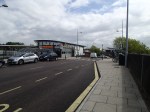
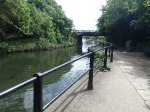

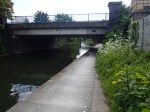
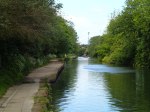
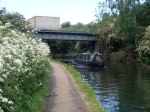
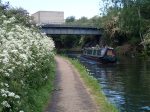
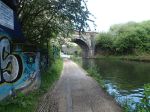
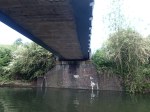
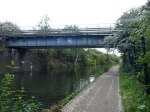

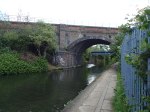
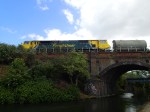
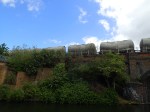
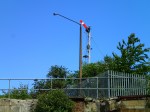
As the pictures show, I found the line where it crosses the canal on a massive brick bridge. The blue bridge beside it would appear to be curve enabling trains to come down the West Coast Main Line and turn south to Acton.
Thoughts About The Dudding Hill Line
A friend, who is an expert on the Dudding Hill line or DHL has just e-mailed me after reading my post about Old Oak Common. He says that one of the conditions of the planning permission given for the Radlett Freight Terminal, is that the DHL is opened up, so it can take container traffic. There is a problem at the bridge-cum-tunnel at Harlesden.
I have traced the DHL on the map from where it starts at Cricklewood to past Old Oak Common and on to Acton.
Significantly, its northern end is by Brent Cross Shopping Centre, which is being expanded to form part of the new Brent Cross Cricklewood town centre, for which it is proposed to add a new railway station.
So the line effectively runs between two of London’s biggest and most-needed housing and commercial developments at Brent Cross and Old Oak Common.
I would suspect that there are opportunities for new stations at several places like Neasden and Harlesden.
This whole area of London is rapidly building up a set of questions about public transport that must be answered.
1. How do freight trains from London Gateway and Felixstowe come along the North London line and reach the Radlett Freight Terminal? It’s not clear if it is possible for trains to switch to the Midland Main line in the area of West Hampstead. If not, then that is a possible new piece of infrastructure, that would allow the movements between the ports and Radlett.
2. It has been proposed to put a station at North Acton on the North London line to link with the Central line. Surely, if Old Oak Common is to be built on the Overground, then the interchange to the Underground, would probably be incorporated in that station.
3. Should the Gospel Oak to Barking service be extended past Gospel Oak? As in a few years, this service will be run by new electric trains, which will probably be the Overground’s Class 378, to terminate these services at either Old Oak Common, Clapham Junction or Richmond, would surely make the running of a more frequent service on the GOB easier.
4. If passenger services are to be run on the DHL, then surely this line must be electrified, as this would allow the Overground to run a unified fleet. It would also enable trains to proceed up the Midland Main line, if that was thought to be a worthwhile thing to do. It would also allow freight trains from the west and eventually Southampton to run to Radlett and the north, without a chanmge of motive power en route.
5. If the DHL is electrified then it would probably be using overhead wires, as it effectively links two lines so equipped. So should the short section of the North London line to the west of Acton Central be changed to overhead wires rather than third rail? It would make for a tidier railway, but as the trains are dual voltage, there is no urgency to re-electrify!
The planners in the London Overground part of Transport for London, must be enjoying themselves playing with the best train set in London.
The more I think about all this, especially after seeing how Hackney has responded to being Overgrounded, I come to one conclusion.
If Old Oak Common and Brent Cross stations go ahead, then the Dudding Hill Line must be electrified to take freight trains and an Overground-style passenger train service.
But then what do I know about running trains?
Enthusiasm For Class 68 And Class 88
I found this article from Rail Engineer about the new Class 68 and Class 88 locomotives that will soon be pulling freight and passenger trains on the UK rail network.
The article is enthusiastic about the two classes, but notes that the Class 68 will not meet the toughest EU pollution regulations. This is particularly appropriate given that the UK and some European countries are suffering high levels of air pollution. The Rail Engineer article says this about compliance to the new regulations.
The CAT engines meet European Stage IIIA emission standards, and can be modified to meet 2012 IIIB emission standards by replacing the exhaust silencer with a diesel particulate filter. However, because of the UK’s restricted loading gauge, this would involve considerable re-design work if it were to be applied to the Class 68.
It is important that rail locomotives are improved, as the current mainstay, the Class 66 is not liked by those who live on busy freight routes, due to its noise. I’ve also talked to drivers, who feel they have other problems too.
As an engineer, I feel that the best solution is the next generation of locomotives like the Class 88, which will be a 200 kph electric locomotive with an on-board diesel for running on non-electrified track. I wrote about the Class 88 here.
An Idea For Which Time Has Come
This article on the BBC’s web site talks about robot cargo ships.
A a control engineer, I can’t see any reason, why this will not be the norm in a few years time.
More Progress On The Bacon Factory Curve
The Bacon Factory Curve at Ipswich is progressing well.
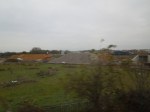
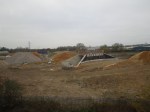
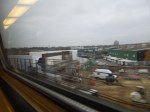
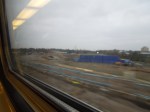
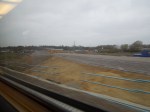
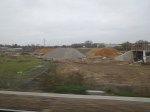


I should be going back to the dentist in the Spring, so it will be interesting to see the progress as it is slated from completion next year.
Freight Trains At Ipswich
On my trip to the dentist in Felixstowe yesterday, I changed trains at Ipswich. There was a wonderful example of the problems that the Bacon Factory Curve is designed to eliminate, as two freight trains going to and from London, passed through the station at the same time.
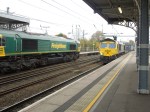

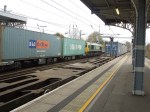


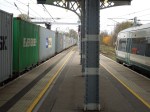
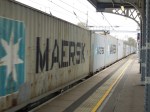

One thing that worries me, is that these trains were going through a busy station, where lots of people were waiting for trains like I was. Is this a good idea from a Health and Safety point of view?
Many of these trains, are routed by the North London and Gospel Oak to Barking lines to complete their journey.
When the curve is fully operational, they will go on a more direct route, via Stowmarket and Peterborough.
But will those who live on that line be complaining of very noisy Class 66 locomotives at all hours of the day and night?
Incidentally, as a lot less freight trains will be travelling to or from London, they should be able to use the direct line through Ipswich station, which is between the main lines used by passenger trains to stop at platforms 2 and 3. This will certainly make things less frightening and probably a lot safer.
 The Anonymous Widower