Enthusiasm For Class 68 And Class 88
I found this article from Rail Engineer about the new Class 68 and Class 88 locomotives that will soon be pulling freight and passenger trains on the UK rail network.
The article is enthusiastic about the two classes, but notes that the Class 68 will not meet the toughest EU pollution regulations. This is particularly appropriate given that the UK and some European countries are suffering high levels of air pollution. The Rail Engineer article says this about compliance to the new regulations.
The CAT engines meet European Stage IIIA emission standards, and can be modified to meet 2012 IIIB emission standards by replacing the exhaust silencer with a diesel particulate filter. However, because of the UK’s restricted loading gauge, this would involve considerable re-design work if it were to be applied to the Class 68.
It is important that rail locomotives are improved, as the current mainstay, the Class 66 is not liked by those who live on busy freight routes, due to its noise. I’ve also talked to drivers, who feel they have other problems too.
As an engineer, I feel that the best solution is the next generation of locomotives like the Class 88, which will be a 200 kph electric locomotive with an on-board diesel for running on non-electrified track. I wrote about the Class 88 here.
An Idea For Which Time Has Come
This article on the BBC’s web site talks about robot cargo ships.
A a control engineer, I can’t see any reason, why this will not be the norm in a few years time.
More Progress On The Bacon Factory Curve
The Bacon Factory Curve at Ipswich is progressing well.
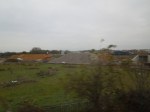
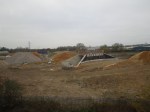
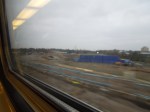
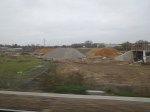


I should be going back to the dentist in the Spring, so it will be interesting to see the progress as it is slated from completion next year.
Freight Trains At Ipswich
On my trip to the dentist in Felixstowe yesterday, I changed trains at Ipswich. There was a wonderful example of the problems that the Bacon Factory Curve is designed to eliminate, as two freight trains going to and from London, passed through the station at the same time.
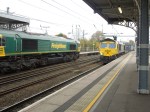

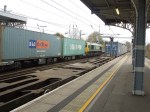


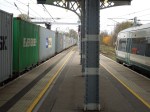
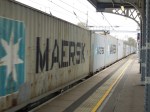

One thing that worries me, is that these trains were going through a busy station, where lots of people were waiting for trains like I was. Is this a good idea from a Health and Safety point of view?
Many of these trains, are routed by the North London and Gospel Oak to Barking lines to complete their journey.
When the curve is fully operational, they will go on a more direct route, via Stowmarket and Peterborough.
But will those who live on that line be complaining of very noisy Class 66 locomotives at all hours of the day and night?
Incidentally, as a lot less freight trains will be travelling to or from London, they should be able to use the direct line through Ipswich station, which is between the main lines used by passenger trains to stop at platforms 2 and 3. This will certainly make things less frightening and probably a lot safer.
Norwich In Ninety
I travel regularly on the Great Eastern Main Line to Ipswich and have used the line since the 1970s, when we lived just north of Ipswich.
In those years, there has been very little improvement in journey times, although the trains are newer and perhaps slightly more comfortable.
So I was interested to find this report on the Treasury’s web site. Here’s the first paragraph.
Plans for a new expert group charged with finding ways to speed up rail services to the East of England by as much as 25% have been set out by the Chancellor.
Personally, I will be pleased if the speed improvement to Norwich, is matched on my shorter journey to Ipswich.
At present Ipswich and Norwich take 67 and 110 minutes respectively on a typical train. If Norwich were to be reached in ninety minutes, then Ipswich should be a few minutes or so under the magic figure of one hour.
Given that these trains would probably interface to Crossrail at \Shenfield, Stratford and Liverpool Street, it should be possible to go from Ipswich to Heathrow in under a hundred minutes. The Norwich figure would be two hours ten minutes.
I would think that this could be one of those small improvements, that show a very high return on the money invested. At least the line is fully electrified and all of the major stations can accept long high-capacity trains.
The major problem of delays caused by freight trains going to and from Felixstowe is also being solved with the Bacon Factory Curve, so I’m hopeful that by the end of this decade, we’ll be seeing much reduced journey times to East Anglia.
Will we also be seeing more electrication in East Anglia, like Ely to Norwich and Ipswich to Peterborough? I doubt it, although the latter would really help with the movement of freight out of Felixstowe.
White Van Gentlemen
I saw this van in the Holloway Road.

White Van Gentlemen
But they are parked in the bus lane on an Arsenal match day.
The Damage To The Overground
Judging by these pictures I took, the train crash on the 15th caused quite a bit of damage.

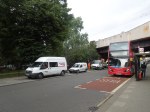

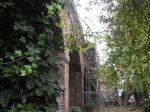


You do wonder what would have happened if the container had fallen into the park below during the day. Luckily the wall held it on the track. But it did happen at three in the morning.
Let’s hope this accident is not a foretaste of the future, when a lot more freight trains from London Gateway will be using the North London Line.
There doesn’t seem to be any news about when the line will reopen.
Fall Out From A Train Crash
On the fifteenth of October, there was a train derailment at Camden Road on the North London Line. It still hasn’t been fixed fully yet, as the train brought the overhead wiring down in a very difficult place.
It’s reported here in the Camden New Journal. Some of the comments are priceless and fairly paranoid and speculate about it being a nuclear fuel train. It was actually, a load of containers going from Birmingham to Felixstowe.
Probably the good news is that this derailment has caused great inconvenience to freight train operators and they will be thinking harder about using the direct routes via Nuneaton and Peterborough, thus avoiding sending freight trains through Central London. This will of course get easier once the Bacon Factory Curve is complete at Ipswich.
Hopefully We Won’t See This Much Longer
Whilst waiting for a train at Canonbury station today, a Class 70 diesel engine went through with a long train of intermodal freight.
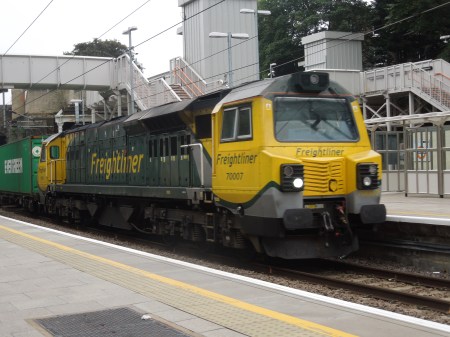
Hopefully We Won’t See This Much Longer
They are noisy beasts and hopefully, they will be replaced by more environmentally friendly electric locomotives soon. Note the overhead wires used by most trains on this line.
An order has been placed for Vossloh Eurolite engines, which are effectively electric locomotives, with the ability to work off the electrified network, using an on-board diesel engine. They will be called Class 88, when they are delivered.
There’s more about the Class 88 order here.
The Class 88 increasingly looks like a very good design to solve one of big problems of freight on UK railways; the need to use diesel engines on most trains, as there is not a large enough continuous electrified system.
If we take a simple example of a freight train from Felixstowe to Manchester via London, which at present needs a diesel engine to Ipswich and then an electric one for the rest of the journey, this could be Class 88-hauled all the way.
I think we could see a lot of Class 88s and similar engines in the future.
It won’t just be on freight, as the engine has a top speed of 200 kph, when working passenger trains. Could they be used on difficult services like Euston to Holyhead, where much of the route past Crewe is not electrified?
Surprisingly, the electro-disel concept is not new, as the old Class 73, which dates from the 1960s, was also an electric engine with an onboard diesel, designed for the third rail lines south of London.
Some of the original 49 engines are still in use.
Does this show that you can’t keep a good idea down?

