Use Of A Bi-Mode Class 755 Train On The Sudbury Branch Line
I took these pictures today on a visit to the Sudbury Branch Line in Suffolk.
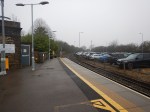
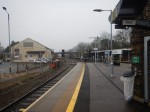
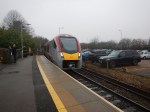
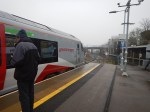
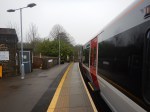
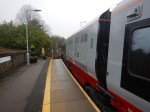
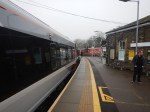
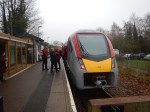

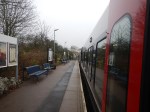
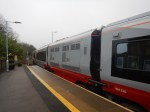
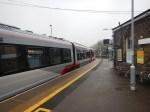
The two stations shown are Marks Tey, where the branch joins the Great Eastern Main Line and Sudbury, which is the Western terminus of the branch.
Both stations have short platforms.
To simplify this description, I will identify the four cars of the Class 755 train as follows.
- Driver East Car – Driver car with passengers on the Marks Tey end of the train.
- Passenger Car – The passenger car, which also has the bike space and the Universal Access Toilet.
- PowerPack – The smaller car that powers the train.
- Driver West Car – Driver car with passengers on the Sudbury end of the train.
This Google Map shows Marks Tey station.
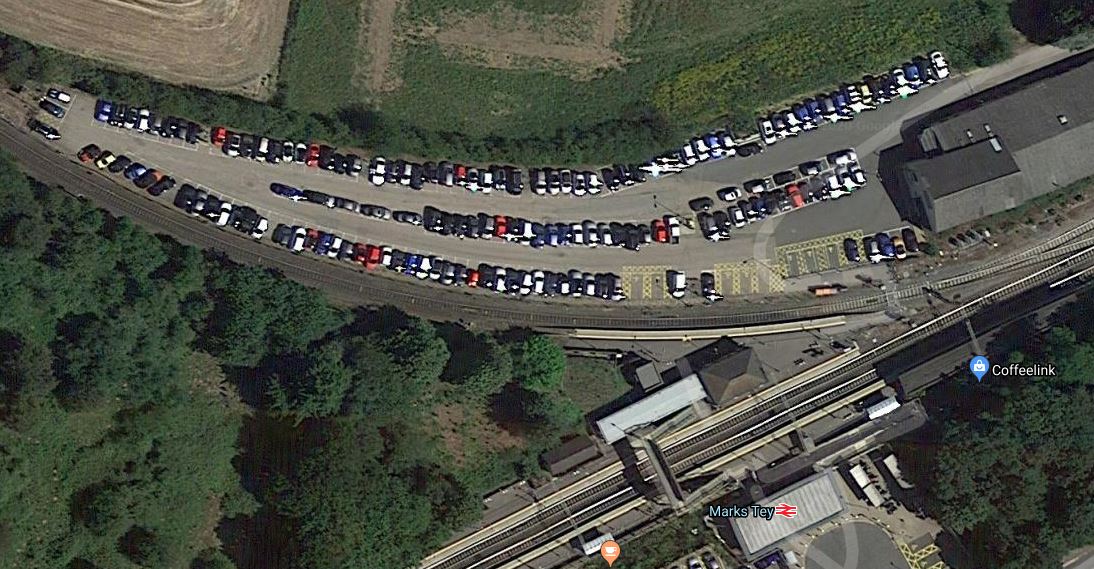
The short and gently curving, Sudbury Branch Line platform is on the North side of the station.
To make it easy for passengers to get in and out of the train, Greater Anglia seem to have devised a cunning plan.
- The Class 755 trains run with the end with the Driver East and Passenger Cars are towards Marks Tey and Colchester stations.
- The driver stops the train in the station, so that the two passenger cars, are in the same place as a two-car diesel multiple unit, like a Class 156 train, would be.
- The two pairs of wide double doors and the level step-free access, encourage passengers to enter the train.
- Interestingly, the PowerPack Car of the train is at the narrowest part of the platform and is this deliberate to encourage passengers to enter through the doors facing them on the platform.
- The Driver West Car doesn’t come into the platform.
- At busy times, when the Driver West Car will need to be used, passengers will walk through the PowerPack Car.
- Bicycles can be wheeled between the platform and the space in the Passenger Car.
The method of operation has avoided any expensive lengthening of the short and curvy platform.
This second Google Map shows Sudbury station.

At least the single platform is straight.
A similar procedure is used at Sudbury station to that at Marks Tey.
- The driver stops the train in the station, so that the Driver West and Passenger Cars either side of the PowerPack Car are in the station.
- Passengers have two sets of doors and level access to get into and out of the train.
- Bicycles can be wheeled between the platform and the space in the Passenger Car.
- There is no direct access to the Driver West Car at the Marks Tey end of the train, but passengers can walk through the train.
Lengthening of the platform is not necessary.
Important Routes With Few Passengers
Suppose you have a route that at certain times of the day needs a three-car train, but at other times two-cars or even only one car.
I can think of the case of a large industrial site like a nuclear facility or power station, that has lots of passengers, when people are going to and from work and students are going to and from school and college, but at other times of the day, passenger numbers are low.
The conductor indicated to me, that the design of the train allows the doors on the PowerPack to be locked, thus restricting movement.
This could save operating costs if thought out properly.
Wheelchair Passengers To And From Sudbury
The conductor indicated that this was a problem for some directions.
- London to Sudbury is just a walk or push between platforms.
- Sudbury to Ipswich and Norwich is just a walk or push between platforms.
- Sudbury to London is take a train to Colchester from Marks Tey and use the lifts to change direction for London.
- Ipswich and Norwich to Sudbury is take a train to Witham and use the lifts to change direction for Marks Tey.
The local MP is Pritti Patel and she has been pushing hard for a step-free bridge with lifts, which would solve the problem.
Sudbury And Colchester Town
Greater Anglia have proposed that the Sudbury service be extended to Colchester Town station.
There may be problems running on the busy Great Eastern Main Line between Marks Tey and Colchester, but at least there appears to be a freight loop just to the North of Marks Tey, on the London-bound track.
Some things would help.
- Redesign of the junction to allow a faster turnout.
- The extra power of the Class 755 trains.
- Electrification of Platform 3 at Marks Tey station.
- Full digital in-cab signalling on the Great Eastern Main Line.
It might even be worthwhile putting in a simple flyover for Sudbury-bound trains.
Could Battery Power Be Used On The Sudbury Branch Line?
Class 755 trains have been designed, so that diesel engines in the ~PowerPack Car can be replaced with batteries, which can be charged from electrification.
If and when a suitable battery module is developed, then it could just be slotted in.
Some form of charging would be needed and the proposal to change the service into s Sudbury and Colchester Town service, would allow the trains to be charged on the main line.
The German Solution
I can’t help feeling that the Germans or the Welsh would use a different solution.
In Could There Be A Tram-Train Between Ipswich And Felixstowe?, I discuss the East-West Rail Link’s idea of running tram-trains between Ipswich and Felixstowe.
- It would have a frequency of four trains per hour.
- It would probably start in the forecourt of Ipswich station.
- It could either go to Felixstowe station or perhaps through the High Street and down to the Sea Front.
- It would go via Portman Road, Ipswich Town Centre, Ipswich Hospital, before joining the Felixstowe Branch Line to the East of the town.
The reason for this proposal, is to get more freight trains into the Port of Felixstowe.
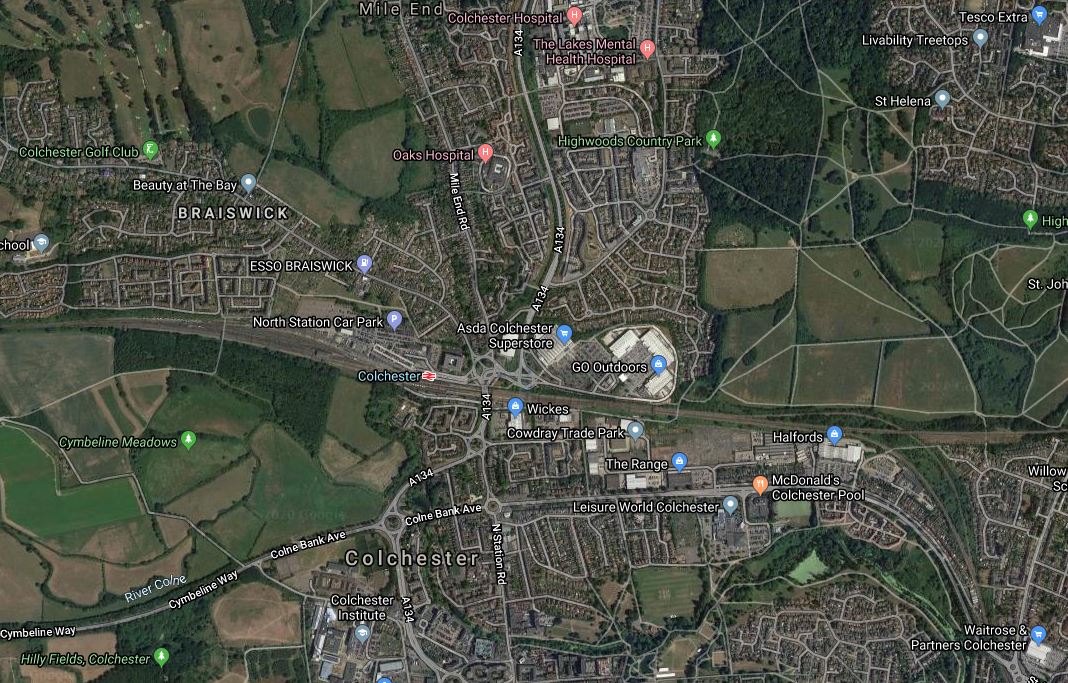
Now look at this Google Map of North Colchester.
Note.
- Colchester station in the middle of the map on the Great Eastern Main Line, which runs East-West.
- A junction to the East of the station, where the lines from Colchester Town, Clacton and Walton join the Great Eastern Main Line.
- Colchester Hospital at the top of the map.
Without doubt,, the Germans would create a tram-train network based on Colchester station.
- Sudbury and Marks Tey could be served in the West, by perhaps building a third track alongside the Great Eastern Main Line
- Marks Tey and Sudbury would be on battery power.
- Colchester Hospital and perhaps the football ground and a Park-and-Ride could be served in the North, by adding tracks to the junction East of Colchester.
- Colchester Town could be served in the South, using the existing tracks.
The network would certainly connect a lot of important places to the main station.
- It would improve access to Colchester Hospital.
- It would solve the step-free problem at Marks Tey.
- It could open up much needed new housing developments.
With 100 mph tram-trains or trains able to work as trams, it could reach places using the various routes in the area, like Clacton, Harwich and Walton.
Stadler have already designed 100 mph diesel trains, that work in Zwickau in Germany, alongside and share tracks with the city’s trams.
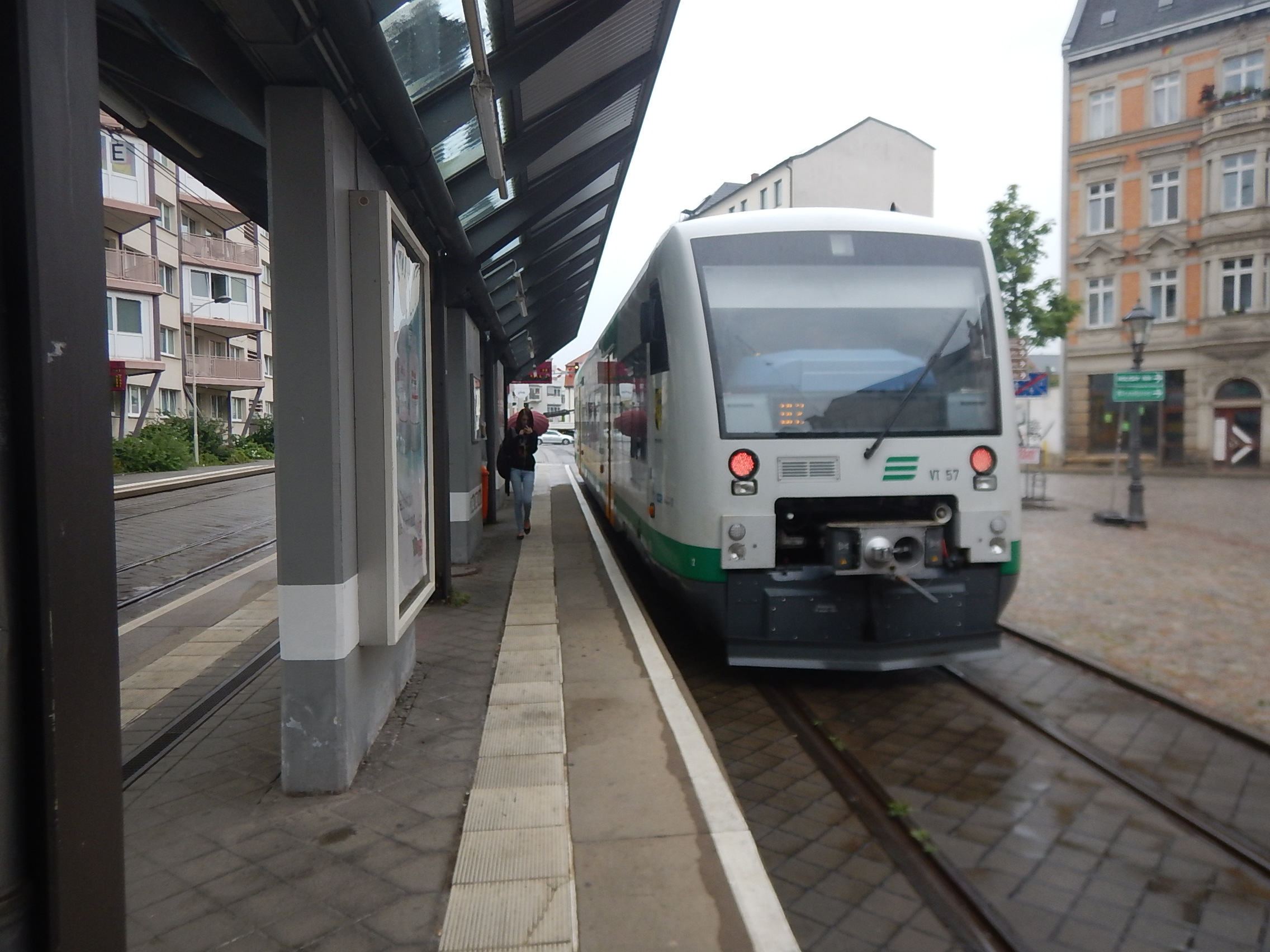
It seems that if you have a specification, Stadler will make it.
Conclusion
Greater Anglia are going to have fun with these trains.
Their level access is liked by passengers.
The short car length, allows the trains to call in curvy platforms.
My First Ride In A Class 745 Train
I took these pictures as I took a ride in a new Class 745 train between Liverpool Street and Colchester.

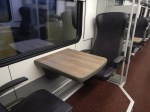
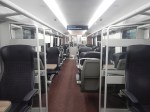



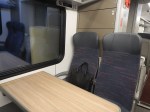
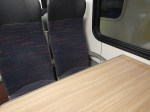
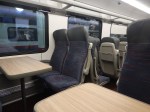
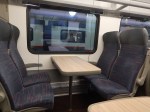
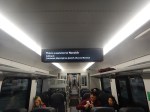
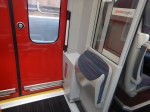
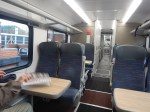
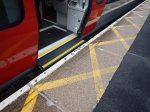
These are my thoughts on various subjects.
Seating
I found no problem with the seats in Second Class, although there have been reports, that they are harder than those of the Mark 3 coaches.
I came back from Colchester in one of British Rail’s finest products and prefer the new train.
Note that in both cases I had a seat with a proper table, so I was comparing like with like.
In the Class 745 train, I was sitting in one of the higher seats over a bogie and I like this position with its better view, which I have also used in the smaller bi-mode Class 755 trains, that are used for local services in Norfolk and Suffolk.
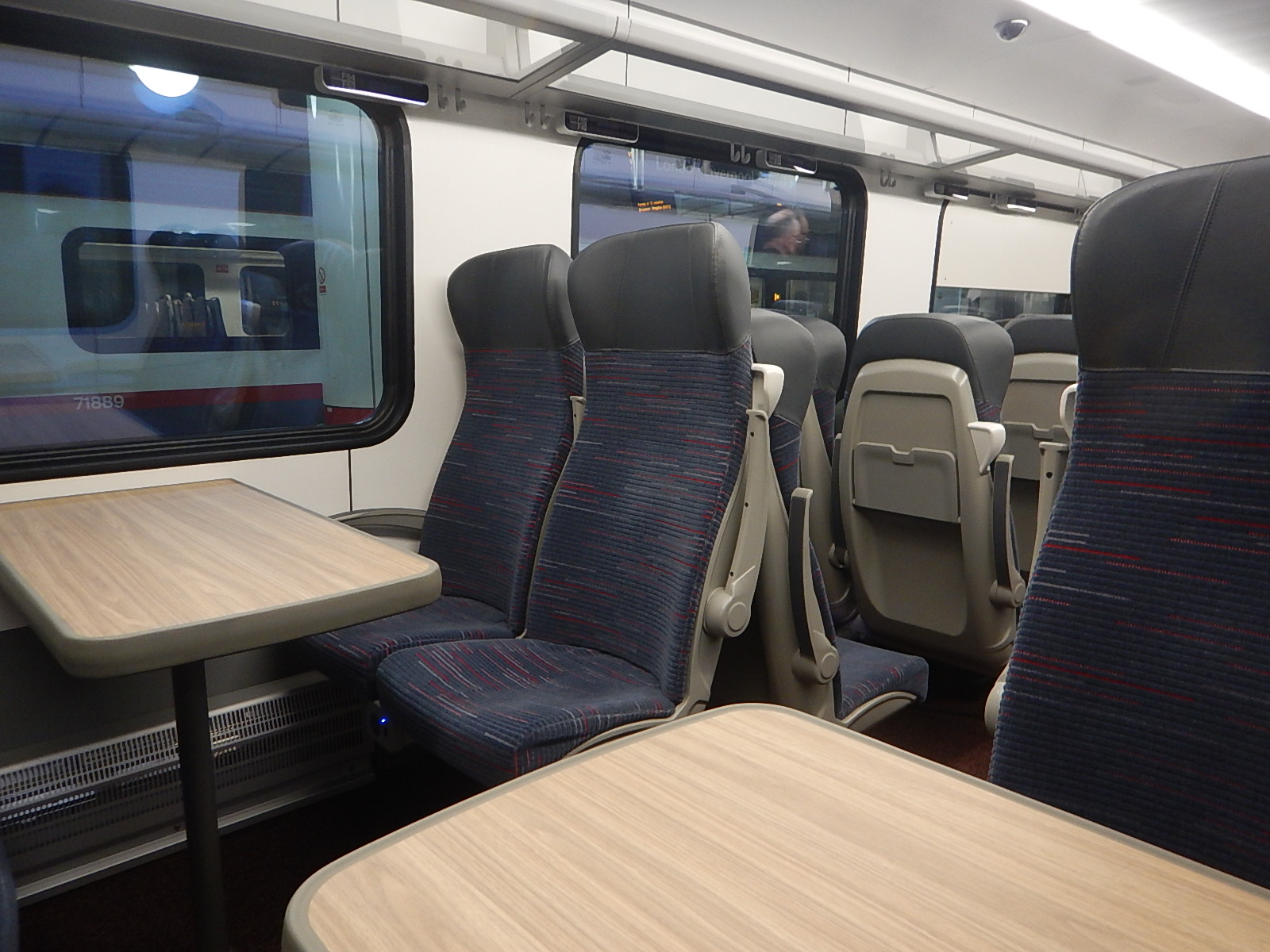
These higher seats, which are in groups of four are a good design solution to maintaining the level floor in the train over the bogies and with their large windows, I feel they would be ideal for families.
You are also slightly isolated from the rest of the train, so could be ideal for a group of people wanting to have a slightly confidential meeting on the train.
Do you get some of the advantages of a compartment, without any of the inconvenience for train operators and passengers?
This article on Rail Magazine is entitled First Pictures: Greater Anglia Reveals Interior Of New Intercity Fleet.
This paragraph describes the seating.
The ‘745/0s’ feature 752 seats (672 in Standard Class and 80 in First Class) compared to the 614 on existing nine-car sets (528 in Standard and 86 in First Class), while they retain the 2+2 seating in Standard Class and 2+1 in First Class. There is space for 245 standing passengers.
Greater Anglia claims there is the maximum padding allowed under stricter fire regulations.
First Class Seats
First Class looks spacious and the seat was better, as I stole a quick try, as I walked through.
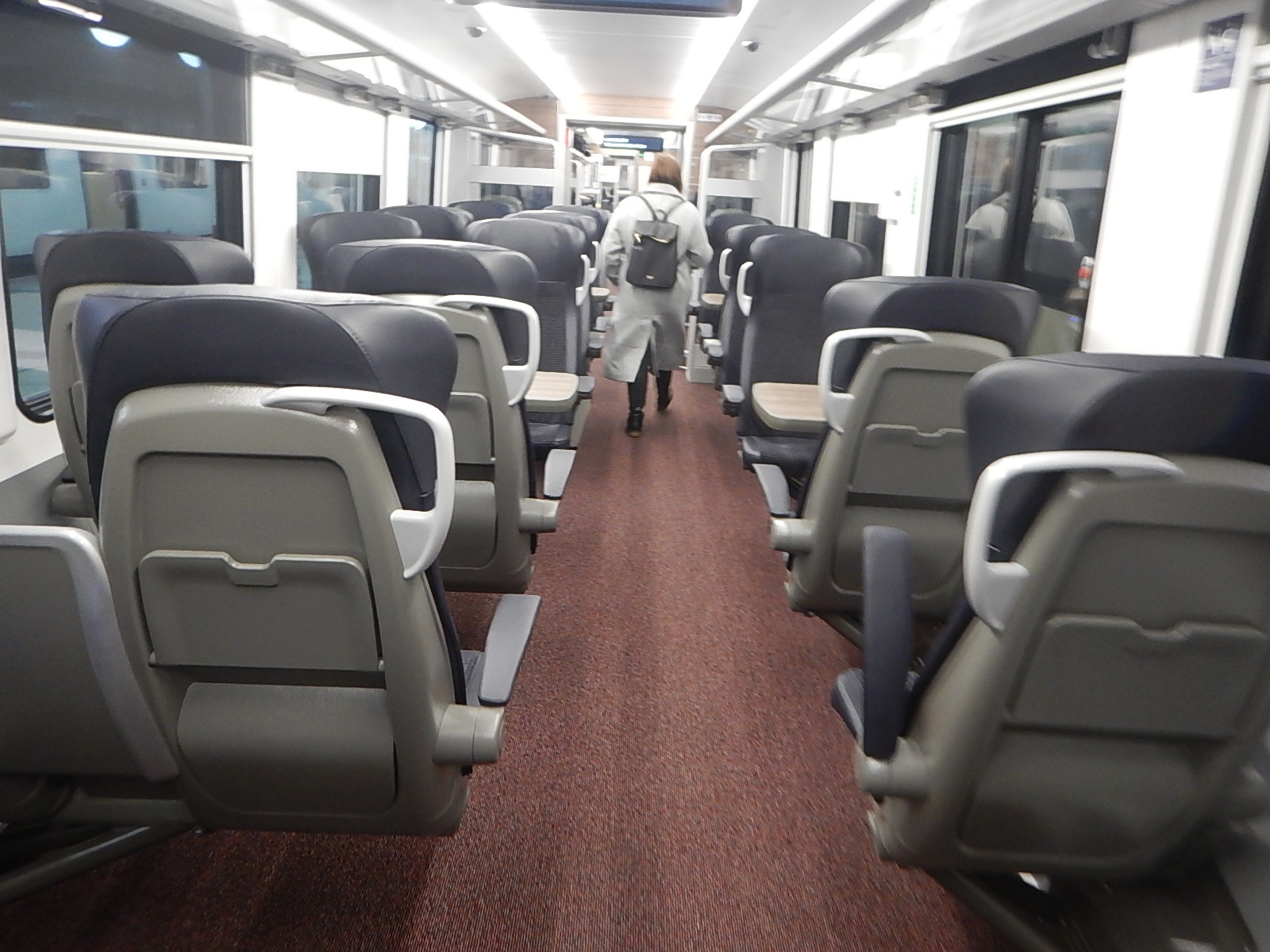
If Greater Anglia continue Weekend First, I shall pay the extra if Ipswich lose on the way home.
Tables
In First Class all seats have proper tables and in Standard Class, there are more proper tables than in the Mark 3 coaches.
I didn’t check, but it appears most airline seats in Standard Class have a seat back table. As the Mark 3 coaches are well-provided with seat back tables, there would be protests, if the new trains aren’t the same.
I actually counted the number of four-place tables in Standard class and found their were forty-three pairs of tables on either side of the aisle.
As each table has four seats, this means that 344 seats in Standard Class have a full size table.
This means that just over half of Standard Class seats have a full size table.
In the old Mark 3 rakes of coaches, there are five Standard Class coaches, which each have seventy-four seats, which gives a total of 370 seats.
I feel that at most times of the day, nearly all Standard Class passengers will get a seat with a full-size table.
Greater Anglia seem to be giving passengers on their premium service a lot more space.
The Buffet
I only passed through the buffet, when the train was in Liverpool Street station and it was closed.
So I didn’t get to see the food and drink offering.
The buffet is placed between First and Standard Class, which is where it should be.
Walk-Through Train
The Class 745 train is the UK’s first walk-through express train, with a nearly level floor from end to end.

You can even walk through the equipment sections in the middle of the train, where the two halves join.
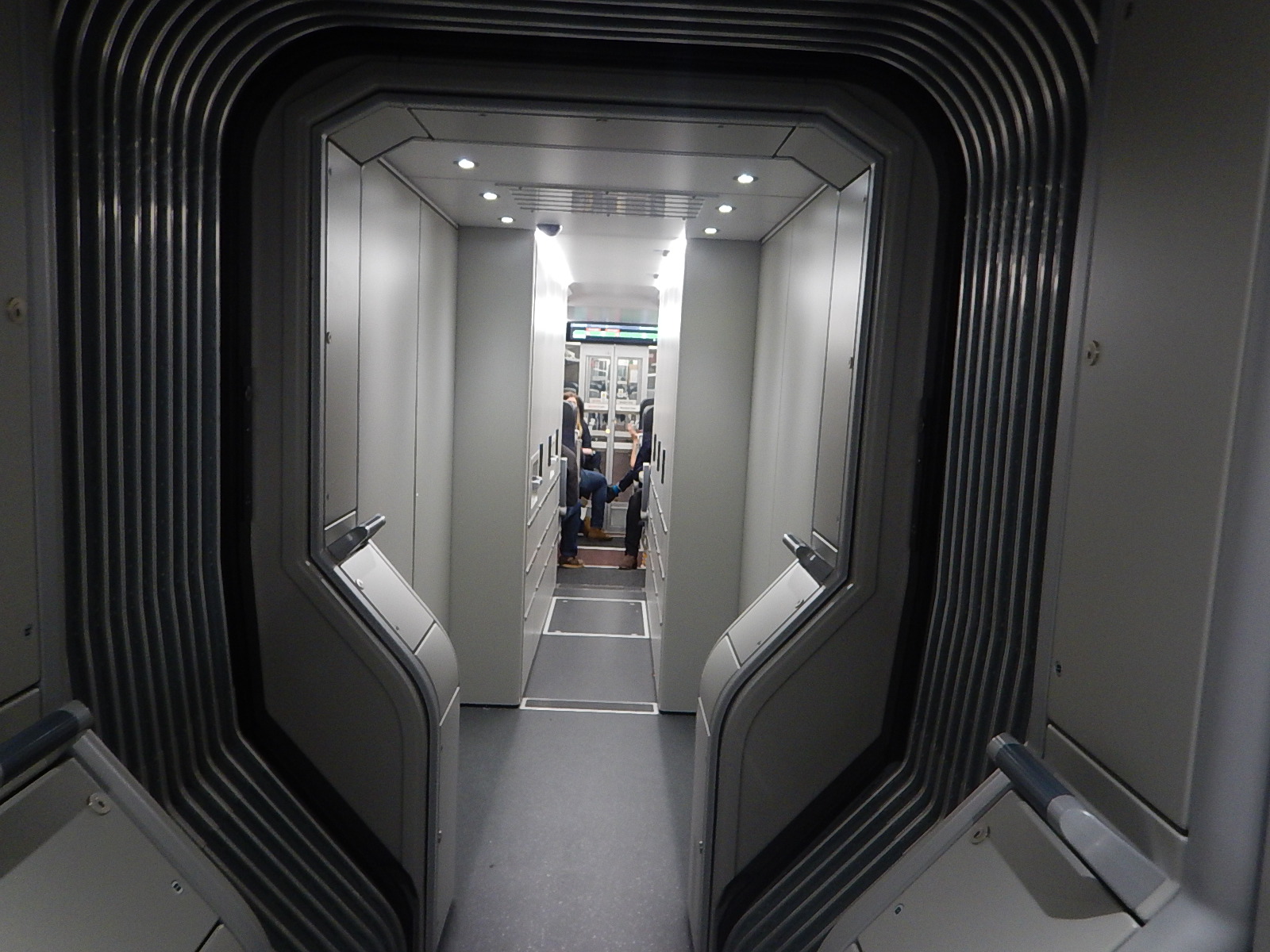
At very nearly 237 metres long, it is over thirty metres longer than Crossrail’s Class 345 trains, so the Class 745 trains must be the UK’s longest walk-through trains.
Note that a twelve-car Class 321 train is just over 239 metres long, with a twelve-car Class 360 train at 244 metres.
But these trains are not walk-through.
Catering Trolley
One benefit of the level walk-through floor, is that it must be easier for staff to push the catering trolley through the train.
As, it came through on both trips, it looks like Greater Anglia are doing the right thing with catering in both First and Standard Class.
However, I did meet a steward, who wasn’t looking forward to pushing a trolley all that way!
Ride Quality
I had no complaints, although not everyone likes sitting on top of the bogie, as it can be choppy.
It should be noted that like the bi-modes, the train has yaw dampers between carriages.
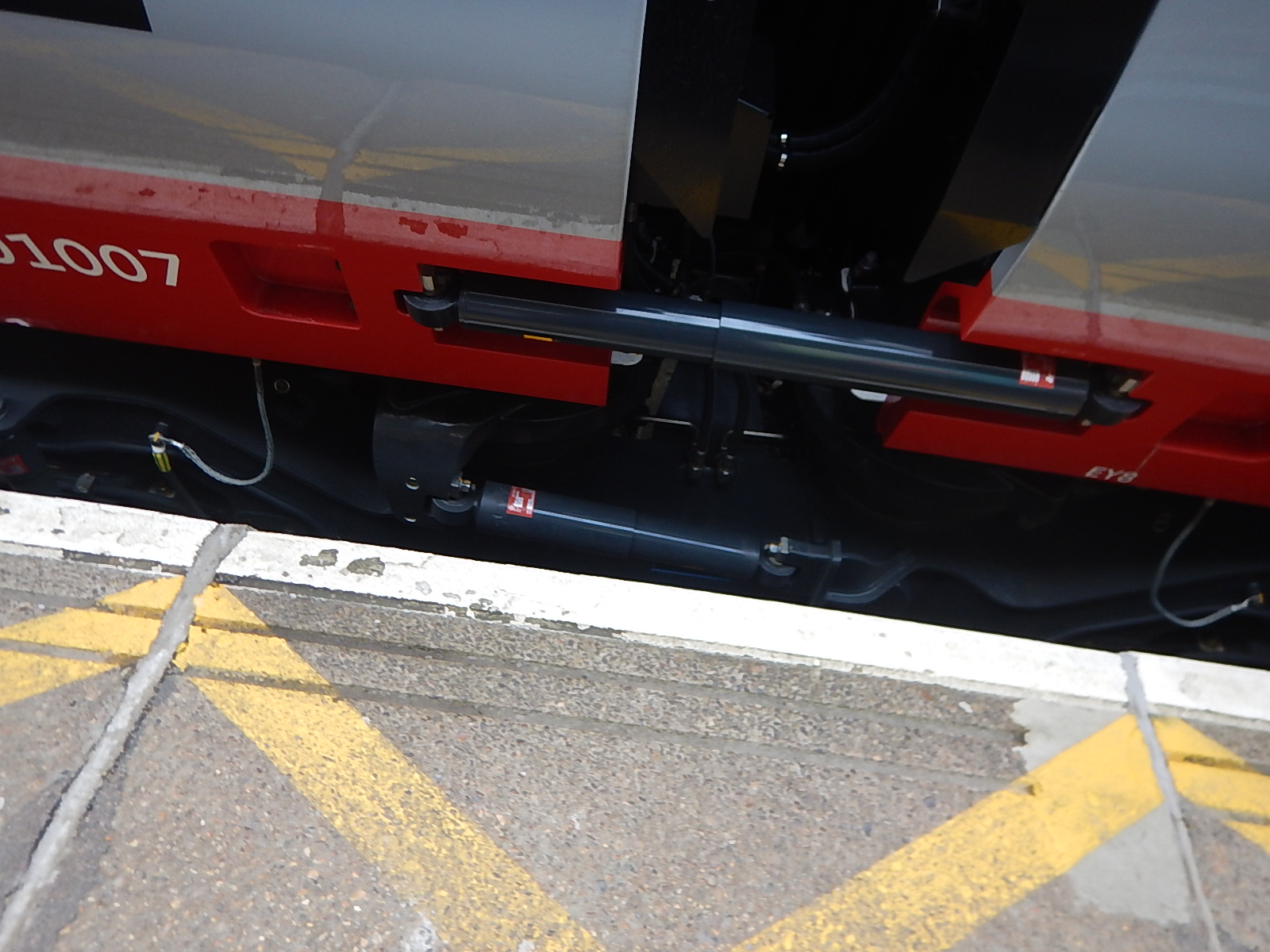
Note the second one lower down! That is not engineering by accountants!
Does these improve the ride? I didn’t ask Greater Anglia to take them off and have another trip!
Step-Free Access
One of my gripes with many trains is the large step to get in or out of the train.
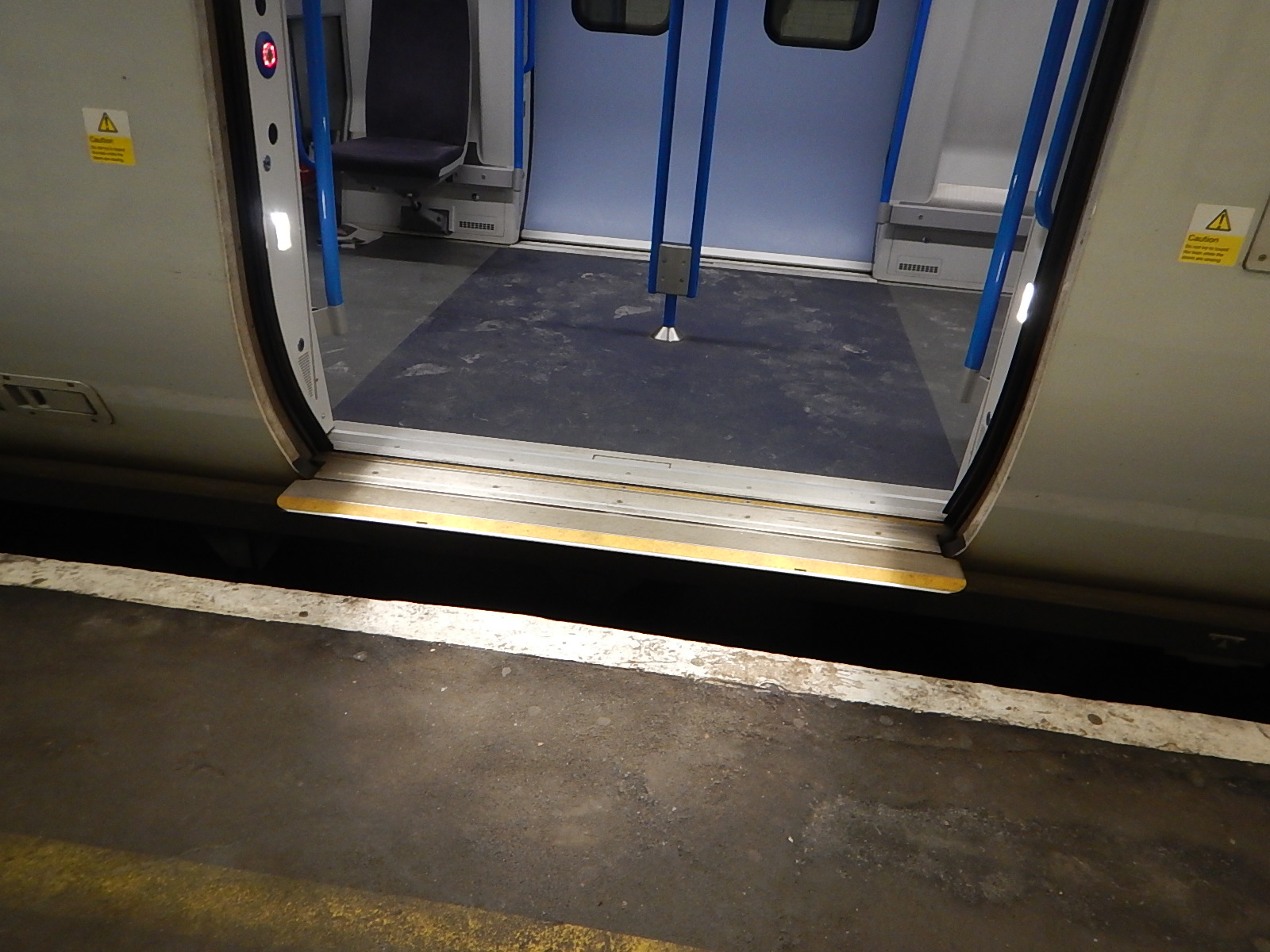
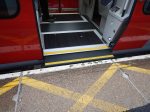
Compare this picture, which shows a Class 717 train at Moorgate station, with this second picture of the step on a Class 745 train at Colchester.
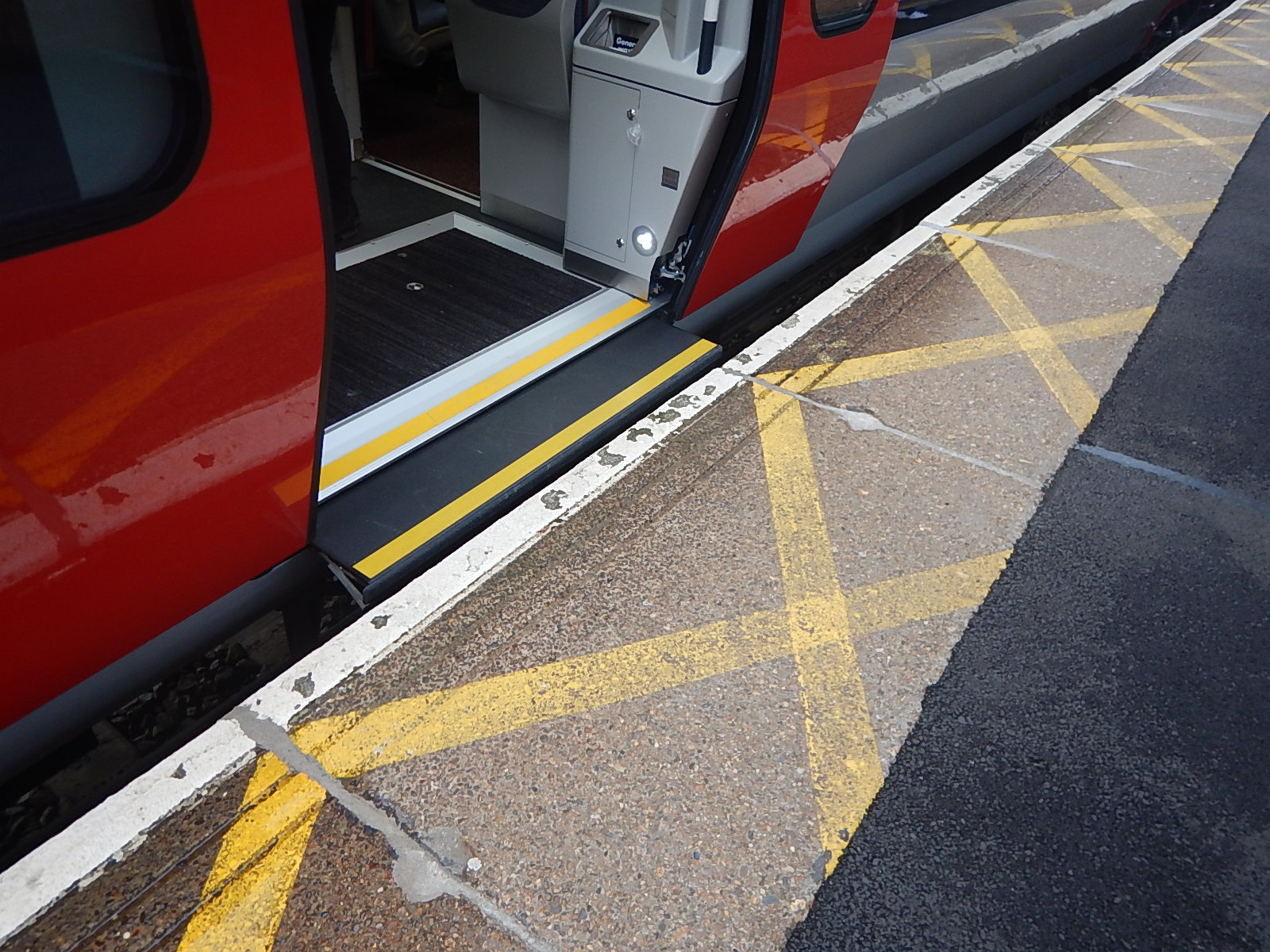
Note too, the wide-double door, which is much more like that of a high-capacity commuter train, than an express designed for two-hour journeys.
I appreciate these touches, as I could have been in a wheel-chair after my stroke.
But the Devil thought I’d be a troublemaker, so she gave me a second chance and threw me back!
A Driver’s View
Sitting opposite was a Greater Anglia driver having his first trip on a Class 745 train.
He was training to change from Class 321 trains to the bi-mode Class 755 trains and seemed genuinely enthusiastic to get driving his new charges.
But he said the best feature of both fleets of new trains from a driver’s point of view in the acceleration and he showed me an impressive video, which compared the acceleration of the old and new trains.
This acceleration will save a few minutes,
He was also very interested in hydrogen power, so I told him about my adventures in the North of the Netherlands.
Performance
When Norwich-in-Ninety services started in May 2019, I wrote Norwich-In-Ninety Is A Lot More Than Passengers Think!.
I described a ride from Norwich to London in ninety minutes in the Mark 3 coaches hauled by a Class 90 locomotive, where for much of the route, we were cruising at the route’s maximum speed of 100 mph.
Today, the Class 745 train was at 100 mph for long periods and appeared to be running easily.
But then a Class 745 train, has a power output of 5,200 kW compared with the 3,730 kW of a Class 90 locomotive. The new train may have twenty-three percent more seats, but it also has nearly forty percent more power.
This is certainly one reason for the acceleration, shown in the driver’s video.
Various fast trains can be compared.
- Pendelino Class 390/0 – 125 mph – 9 cars – 469 seats – 5,100 kW
- Pendelino Class 390/1 – 125 mph – 11 cars – 589 seats – 5,950 kW
- Class 745 – 100 mph – 12 cars – 747 seats – 5,200 kW
- Class 755 – 100 mph – 4 cars – 229 seats – 2,600 kW
- Class 801 – 125 mph – 9 cars – 611 seats – 4,000 kW
- InterCity 125 – 125 mph – 8 cars – 514 seats – 3,400 kW
- InterCity 225 – 125 mph – 9 cars – 535 seats – 4,700 kW
Note.
- Except for their 100 mph, the Class 745 fit well into the table.
- They have more seats than any other trains in the table.
- They have more power than a Class 801, an InterCity 225 and the short Pendelinos.
- The bi-mode Class 755 trains are no wimps either.
Both the Class 745 and Class 755 trains really are high-powered Swiss rockets.
Could they go faster?
There are 120 mph Flirts running in Norway, but the maximum speed on the Great Eastern Main Line is only 100 mph, so they couldn’t run any faster there.
But a senior Greater Anglia driver told me, that the bi-mode Class 755 trains have been designed for 125 mph.
As an engineer, this is not unexpected, as Europe has a plethora of rail lines with a 200 kph or 125 mph operating speed, that have branches that extend to sizeable towns and cities that need an improved rail service.
In the UK, think of LNER’s recently introduced services to Lincoln and Harrogate, where there is a 125 mph electric dash on the East Coast Main Line and a diesel trundle to the destination.
As the two classes of Greater Anglia trains and the Norwegian Flirts seem to use the same running gear, is there lucking in that body a cheetah wanting to be unleashed.
If so, the Hitachi trains have a serious rival!
But could the Class 745 trains go faster on the Great Eastern Main Line?
For periods yesterday, the Speedview app on my phone, was showing a steady 100 mph. But the route to Colchester is crowded with 100 mph commuter trains, which probably preclude faster running.
But get North of Ipswich and in a few months, the only non-Flirt traffic, will be the freight trains to and from Felixstowe, which use the Great Eastern Main Line on the fifteen miles between Ipswich and Haughley Junction.
The Northern section of the Great Eastern Main Line has two major bottlenecks.
- Haughley Junction, which needs remodelling to handle the large numbers of freight trains.
- Trowse swing bridge and its single track, which needs replacing with a proper bridge and a double track.
Both projects are under development by Network Rail.
However, between the two bottlenecks, the track was built for Victorian high speed. and is reasonably straight across flat country, with one station and a few level crossings.
Currently, the Norwich-in-Ninety trains can achieve the following.
- Norwich and Haughley Junction, which is 32 miles, in around 26 minutes at an average speed of 73 mph.
- Norwich and Ipswich station, which is 46 miles, in around 35 minutes at an average speed of 79 mph.
Note there is a stop at Diss, where the Class 745 trains might save a few seconds because of their level access and fast acceleration.
Whilst the two major projects at Trowse and Haughley Junction are carried out, will Network Rail improve the track between Ipswich and Norwich to allow faster running.
Being able to average 100 mph between Norwich and Ipswich would knock several minutes off the journey time.
Conclusion
Hitachi have a serious competitor.
Northern Welcome New Link Between East And West Yorkshire
The title of this post is the same as that of this article on Rail Technology News.
This is the introductory paragraph.
Rail Operator, Northern Railway, is celebrating the improved links between East and West Yorkshire today (Dec 19) following the introduction of a new service on the network, providing a direct service between Halifax and Hull.
The tone may be a bit self-congratulatory by Northern, but it is to me a very necessary service.
- The trains run hourly.
- Looking at today’s early morning Saturday service, it appears to have doubled the frequency to and from Leeds.
- Families and friends are more spread out these days..
- Events like football matches and concerts bring in supporters and attendees from a lot further, than when the rail services were carved in stone.
I shall be very interested to see the figures for ridership on this new service..
The Suffolk Experience
Over the last few years, Suffolk’s cross-county service between Ipswich and Cambridge has gone from an hourly single-car Class 153 train through two and three-car Class 170 trains to the proposed four-car Class 755 trains.
Greater Anglia may be having trouble introducing the Class 755 train, but the proposed capacity increase is there. They are also proposing to double the frequency on the Eastern section of the route.
Nationwide
Hopefully, we’ll see more improvements in services on routes like these all over the country. Certainly, Northern and Greater Anglia have been increased threir train fleets to provide more services.
I would also like to see a nationwide capacity standard for routes like these between cities and large towns.
Greater Anglia’s New Stansted Service To And From Norwich
Stansted Airport railway station now has the following rail services.
- Four trains per hour (tph) Stansted Express services to and from Liverpool Street station.
- One tph to and from Cambridge.
- One tph to and from Birmongham New Street
- One tph to and from Norwich, which started on December 15th, 2019.
This morning I wen to the station to use the new service to Cambridge.


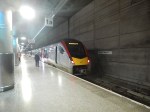
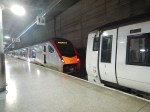
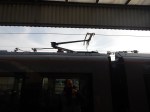
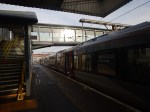

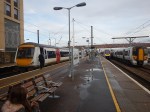
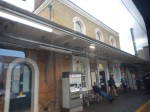
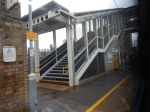
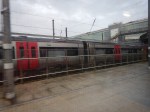
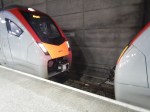

Note.
- Platform 1 at Stansted Airport, is used to handle two trains.
- The Class 755 trains appeared to be using overhead 25 KVAC.
- The Cambridge-Ipswich and Norwich-Stansted services appear to offer interchange possibilities at Cambridge could be developed in the future.
- It appeared that a new Class 755 train had failed and was parked in Platform 1a at Stansted.
The service certainly seemed to be attracting more than a handle of passengers.
These are a few extra thoughts.
Whittlesford Parkway Station
Whittlesford Parkway station has a Holiday Inn hotel and a large car park, as this Google Map shows.
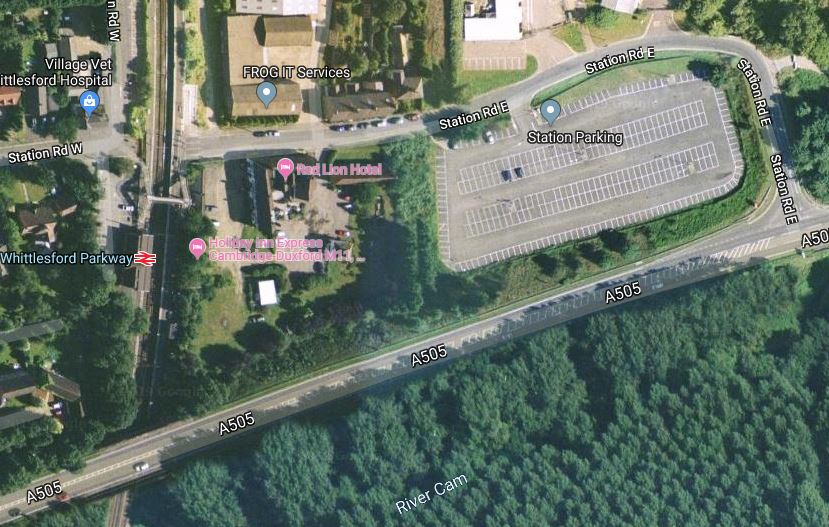
When I lived in the area, I used to use it as a station for travelling to and from London.
Consider.
- Whittlesford Parkway to Stansted Airport takes twenty-six minutes by train.
- There are two tph to and from Stansted Airport.
- Given the station’s convenient position on the road network and the good train service to Stansted Airport, I suspect some Airport users will use the station as an alternative place to park.
- It will certainly make a sensible drop off point for Stansted passengers and workers.
In my view, the only improvement needed, is a step-free bridge.
Audley End Station
Audley |End station is another station that is served by trains going between Stansted Airport and Cambridge and Norwich.
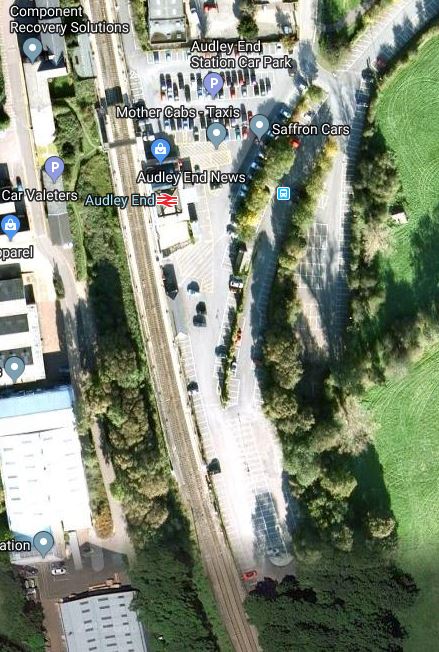
As the map shows, car parking is not as extensive.
Commuting From Audley End And Whittlesford Parkway To Norwich
C, my late wife was a barrister, who regularly drove to Norwich for a day in Court.
If there had been a train service between Whittlesford and Norwich, she might have used it.
But it does appear, that early morning services start from Cambridge.
Early And Late Trains Between Norwich and Stansted Airport
It appears to me, that that the timetable between Norwich and Stansted Airport may not start ealy enough and perhaps run late enough, given the hours that flights arrive and depart at the Airport.
Conclusion
This is going to be a worthwhile service, but I don’t think it is fully developed yet.
Could Suffolk Have It’s Own Version Of London’s Freedom Pass?
London has a travel pass for certain groups of passengers, like the elderly and the disabled called a Freedom Pass.
This is the introduction forthe Freedom Pass from Wikipedia.
Freedom Pass is a concessionary travel scheme, which began in 1973, to provide free travel to residents of Greater London, England, who are aged 60 and over (eligibility age increasing by phases to 66 by 2020) or who have a disability. The scheme is funded by local authorities and coordinated by London Councils. Originally the pass was a paper ticket, but since 2004 it has been encoded on to a contactless smartcard compatible with Oyster card readers.
I have a Freedom Pass, as I am seventy-two and it really gives me freedom, as my eyesight isn’t good enough for me to drive.
Other parts of the UK like Manchester and Newcastle have similar schemes that allow a degree of free travel on local trains, trams and light rail systems.
But generally English counties like Suffolk don’t have such a scheme.
East Anglia’s Rail Revolution
All of Greater Anglia’s trains are being replaced with new Stadler Class 745 and Class 755 trains.
In InterCity Quality For Rural Routes, I said this.
Greater Anglia are purchasing a fleet of 38 trains with a total of 138 carriages to replace 27 trains with a total of 58 carriages.
- This is a forty percent increase in the number of trains.
- This is nearly two and a half times as many carriages.
- The average number of carriages per train is raised from 2.1 to 3.6.
That is a massive increase in train capacity.
I don’t believe that Greater Anglia will park these trains in a siding, but use them to increase frequencies.
Greater Anglia are having signalling problems introducing the new trains, but we have already seen the following in Suffolk.
Four-car Class 755 trains running from Ipswich to Cambridge, Felixstowe and Lowestoft.
As the frequency is still the same and train length has increased from one, two and three cars, this is almost a doubling of capacity.
The UK’s Contactless Ticketing Revolution
London started wide-scale contactless tickerting and in places, it is applied to rural routes like Iver and Reading on TfL Rail’s new Western branch, where frequencies are more Suffolk, than Central London.
I believe in the next few years, the average passenger going between say Newmarket and Ipswich in Suffolk, will touch-in at Newmarket with their credit card and touch-out at Ipswich, just as passengers do now, millions of times all over London, every day of the year.
London’s Freedom Pass looks to the readers in London, as just a different credit card, so it is able to allow passengers through.
I believe that once Suffolk goes contactless with ticketing, then it will be possible to overlay a Suffolk Free Travel Pass on the system.
What Lines Would Be Allowed To Be Used By Passengers With A Suffolk Free Travel Pass?
These are routes that are wholly or partly in Suffolk.
Ipswich And Cambridge
The Ipswich and Cambridge Line currently has one train per hour (tph) and is wholly in Suffolk, except for a short section at the Cambridge end of the route.
Would a Suffolk Travel Pass allow travel to Cambridge?
I suspect that both Cambridgeshire and Suffolk would have reasons for a compromise , as both counties could benefit from visiting Travel Pass holders.
I would include Ipswich and Cambridge in a Suffolk Free Travel Pass.
Ipswich And Diss
The section of the Great Eastern Main Line, between Ipswich and Diss, currently has two tph and is wholly in Suffolk, except for a short stretch at Diss, which is just over the border in Norfolk.
I would include Ipswich and Diss in a Suffolk Free Travel Pass.
Ipswich And Felixstowe
The Felixstowe Branch Line currently has one tph and is wholly in Suffolk.
But this route is planned to be upgraded as I wrote in Could There Be A Tram-Train Between Ipswich And Felixstowe?.
- Tram-trains would start at Ipswich station and run to \felixstowe.
- Tram-trains could start on the forecourt of Ipswich station and could run through the streets of Ipswich, via Portman Road, the Town Centre, Christchurch Park, Ipswich Hospital, the proposed new housing at Westerfield and Ransome’s Retail Park before joining the Felixstowe Branch, in the area, where it crosses the A14.
- It could even do more street running in Felixstowe to connect to the Town Centre and the Sea Front.
- Frequency would be four tph.
Removing the passenger service from the rail lines between Derby Road and Ipswich stations, would allow more freight trains to run through the area.
I would include Ipswich and Felixstowe in a Suffolk Free Travel Pass.
Ipswich and Lowestoft
The East Suffolk Line currently has one tph and is wholly in Suffolk.
I believe that this line could be developed by adding a second hourly service to Aldeburgh.
I would include Ipswich and Lowestoft in a Suffolk Free Travel Pass.
Colchester And Peterborough
The current service runs between Ipswich and Peterborough, and is a service of one train per two hours.
Greater Anglia plan to do the folloeing.
- Increase the frequency to one tph.
- Extend the route to run between Colchester and Peterborough.
- It will terminate in a bay platform at Colchester.
The route will be mainly in Suffolk, with thends in Cambridgeshire and Essex.
- Passengers for the North and Scotland will change at Peterborough.
- Passengers for London will change at Colchester, Ipswich, Cambridge and Peterborough.
- Passengers for Stansted Airport, Hertfordshire and West Essex will change at Cambridge.
- Passengers for Sudbury will change at Colchester.
This route will become a very important connecting service.
Because of this connectivity, I would include Colchester and Peterborough in a Suffolk Free Travel Pass.
Colchester Town And Sudbury
The Gainsborough Line currently has one tph and is an isolated line that is half in Suffolk and half in Essex.
I would include Colchester Town and Sudbury in a Suffolk Free Travel Pass.
How Would It Be Funded?
Wikipedia says this sabot the funding of London’s Freedom Pass.
The cost of providing the travel concession is negotiated between London Councils and the local transport operator Transport for London. It is funded through a mixture of national grant and council tax.
Although a similar process could be used for a county like Suffolk, other elements are present, that have effects on use and revenue.
Only One Train Operator
There is only one train operator involved; Greater Anglia.
This must make planning and operation easier.
Greater Anglia Should Benefit From Passengers Travelling Further
Will passengers use their passes to get to Ipswich and Peterborough to travel further?
If they do, then Greater vAnglia won’t be bothering.
Greater Anglia may be able to fill the twelve-car Clsass 745 trains in the Peaks, but filling them in the Off Peak will be more difficult.
Would a Suffolk Free Travel Pass attract passengers to the trains?
Modal Change
This is a big imponderable in any calculation.
If you live near a station, would you be more likely to use the train to go to work, shopping or a meal in Ipswich, Bury St. Edmunds or Cambridge, if the train was free?
Only partly, but if the car parking was expensive or always full, that would be a deterrent.
People plan travel against a large range of parameters and cost is one of them.
Would a Suffolk Free Travel Pass take pressure off the roads.
Trips To The Coast
There are only two rail-connected coastal towns in Suffolk; Felixstowe and Lowestoft.
Travel on a sunny day between Ipswich and Felixstowe and the train can be packed with passengers going for a stroll along the sea front.
With more capacity, this usev will increase and especially amongst those who would be eligible for a Suffolk Free Travel Pass.
Carbon Emissions
People are starting to take notice of carbon emissions.
But they’re not buying electric cars, as they worry about the range.
So taking the train is a sop to the pressure of their conscience or that of their children.
Stansted Airport
There are two tph between Cambridge and Stansted Airport.
Travelling from say East Suffolk to the sun, could start with a train to the nearest airport using a train at Cambridge.
East-West Suffolk Travel
Suffolk is not the largest county in England, but East West travel by road can take longer than the train.
Greater Anglia are planning two East-West services at a frequency of one tph.
- Colchester and Peterborough via Ipswich, Needham Market, Stowmarket, Bury St. Edmunds and Ely.
- Ipswich and Cambridge viaNeedham Market, Stowmarket, Bury St. Edmunds and Newmarket.
Note that Ipswich and Bury St. Edmunds stations will have a frequency of two tph.
The East-West Railway, currently being built between Oxford and Cambridge is proposing more improvements for Suffolk.
- A new hourly Manningtree and Oxford service, via Ipswich, Needham Market, Stowmarket, Bury St. Edmunds, Newmarket and Cambridge.
- A new A14 Parkway station, where the Cambridge and Peterborough routes divide to the North of Newmarket.
- Tram-trains at a frequency of four tph between Ipswich and Felixstowe.
Note that Ipswich and A14 Parkway stations willl have a frequency of three tph.
I also think that operationally, there could be another improvement.
Ipswich station has a limited number of platforms and expanding it will be difficult.
But I believe that operations could be eased, if the Ipswich and Cambridge and Ipswich and Lowestoft services were to be combined into a single cross-Suffolk Cambridge and Lowestoft service, with a reverse at Ipswich.
These routes between Cambridge and Suffolk will spread the Cambridge effect across the county and in return Suffolk will provide the housing and other resources that Cambridge needs.
People Will Be Working Longer
We are going through an employment revolution for those past retirement age for various reasons.
- Economic necessity.
- Some people l;Ike and/or need the camaraderie of working.
- Some people have much-needed skills.
- Some business owners and self-employed prefer working to retirement.
- Flexible and part-time working is expanding.
A Suffolk Free Travel Pass would be used by a lot of those who are still working and paying Income Tax.
Healthcare
I have no figures, but I suspect in London, Freedom Pass holders are bigger users of the NHS and hospitals.
Healthcare in East Anglia is changing, with increasing dependence on the three largest hospitals at Cambridge, Ipswich and Norwich.
This means that going to hospital for a check-up often means a fifty mile drive and a long hassle over the limited parking.
Published plans mean that Cambridge and Ipswich hospitals will be rail-connected at each end of Suffolk.
Would it be easier to use the train from many parts of Suffolk?
It should also be noted, that those with health problems, that need regular hospital visits in London, are issued with a Freedom Pass for travel, as it’s cheaper than sending a car.
Any county bringing in a free travel scheme would surely use it to help those needing to go to hospital regularly.
Greater Anglia’s new trains are all step-free, as this picture shows.
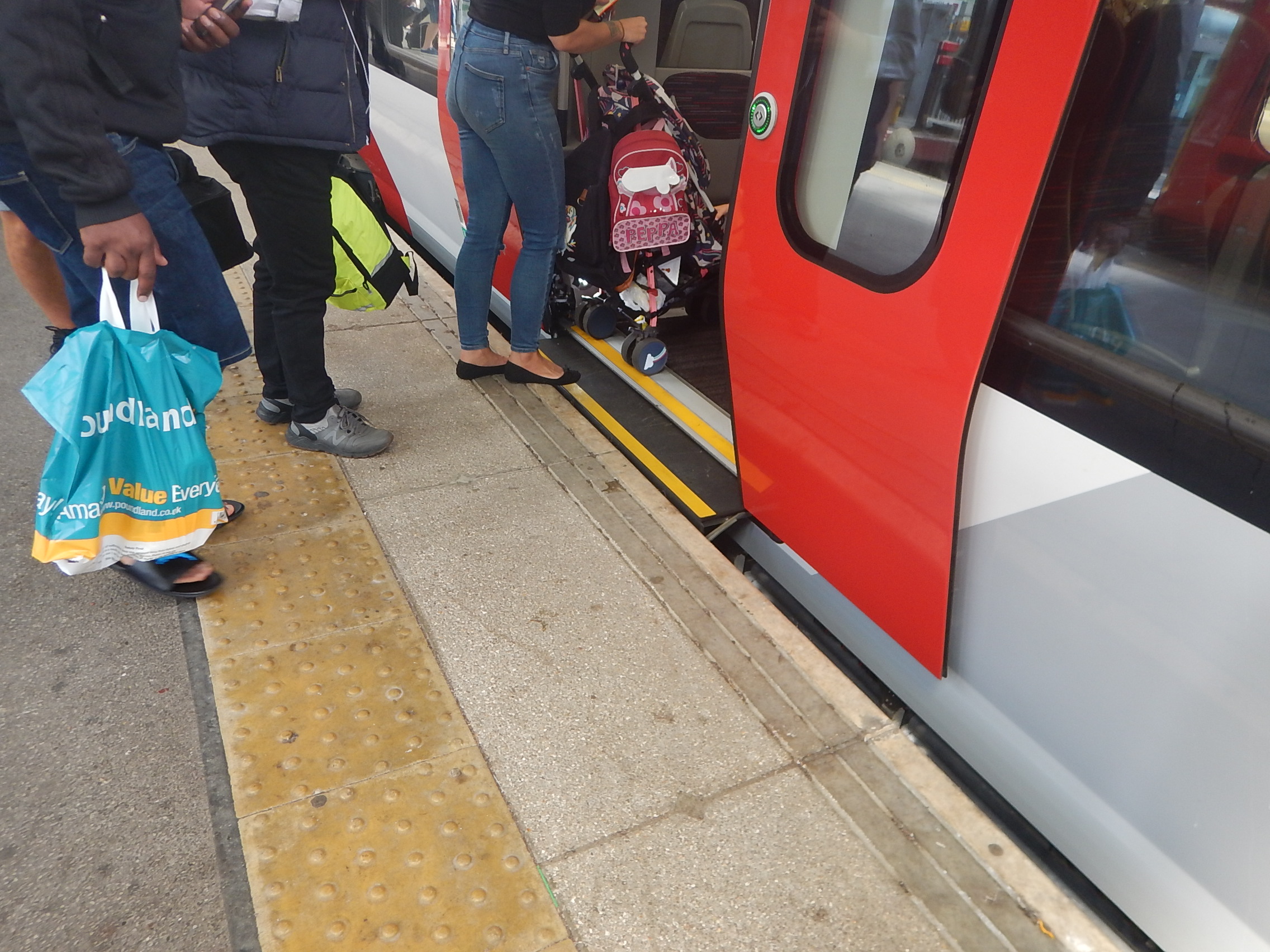
I believe that good rail-connected hospitals can improve the efficiency of the NHS.
Summing Up Funding
All of these developments across Suffolk will see a large increase in Suffolk’s economic activity and the consequent tax take from Council Tax and Business Rates.
I believe that Suffolk could probably afford to fund their share of a Suffolk Free Travel Pass.
Given the reduction in carbon emissions, that would probably occur, surely Government would contribute a share.
As Greater Anglia would surely benefit from onward journeys to and from London, they can probably afford to do a good deal for free travel in Suffolk. After all, they’ve already built in the capacity to their business model.
Restrictions On Use
There may need to be restrictions on use, like some routes apply in London.
For instance, using trains to and from London to perhaps travel between Ipswich and Stowmarket, may be restricted in the Peak.
It will all depend on Greater Anglia’s capacity.
Would It Work For A Group Of Counties?
I don’t see why not!
Perhaps instead of Cambridgeshire, orfolk and Suffolk, all having their own Free Travel Passes, would an East Anglian one work better?
Conclusion
If London can have a Freedom Pass, then why not Suffolk? Or other English and Welsh counties for that matter?
I have rambled through several ideas and possibilities.
But I believe that Suffolk with the powerhouse of Cambridge in the |West can see an improvement in economic activity, can go a long way to funding a Suffolk Free Travel Pass.
This in turn could generate further economic activity and the tax revenue that would be generated to pay for the scheme.
Suffolk though is lucky in that it aslready has the rail network and Greater Anglia have purchased enough trains. Only a hanful of extra stations and some branch line reopenings would be needed.
I shall return regularly to this post.
Would It Have Been Better To Scrap HSTs, Abandon Class 769 Trains And Use Stadler Bi-Mode Flirts Instead?
I have ridden for several hours in Greater Anglia'[s new Class 755 trains and they seem to make good trains for scenic rural lines.
From December 16th, we’ll be seeing them work between Stansted and Norwich, which will show their mettle as true bi-modes working a partially-electrified route.
By mid-next year they will be working the following partially-electrified routes.
- Liverpool Street and Lowestoft
- Colchester and Peterborough
- Norwich and Stansted
- Ipswich and Cambridge
- Sudbury and Colchester Town
I think that about forty percent of these routes are electrified and they also include a lot of 100 mph lines.
ScotRail
These Greater Anglia routes are not unlike some of the ScotRail Inter7City routes, which are to be run by shorterned four- and five-car HSTs.
Both trains have been late because of training and other issues, but delivery of the HSTs seems to have got stuck round various remanufacturing problems at Wabtec.
Would ScotRail have done better to follow their sister company Greater Anglia and buy some Class 755 trains to their specification?
Consider the advantages of the Inter7City over the Class 755 train.
- Nostalgia
- Well-known engineering
- Comfortable
They could have been obtained at an affordable price.
But they do come with disadvantages.
- Forty years old
- Two big diesel engines
- They are rather dark and dingy inside.
The Class 755 trains also have the following advantages.
- They would help to remove diesel power from Edinburgh, Glasgow Queen Street and Stirling stations.
- They have large picture windows ideal for looking at lakes and mountains.
- Some seats are raised for a better view.
- They are genuine 100 mph trains, which could be uprated to 125 mph, so would be ideal for incursions on the fast routes to England.
- They’re probably ready to fit ERTMS.
- They come in various lengths.
- They are able to be modified for battery-electric operation.
- I suspect hydrogen operation will be possible in the future.
But the biggest advantage is that they could extend Scotland’s electric network by using the bi-mode capability.
Think.
- Fife Circle
- Borders Railway
- West Kilbride
- Perth
- West Highland Line
I think Scotland could really get to love these trains.
Great Western Railway
I could see a case for running shortened HSTs in the far South West, where GWR call them Castles, mainly on nostalgia and tourism grounds, but Class 755 trains would surely be better running the following partially-electrified services.
- Henley and Paddington
- Oxford and Gatwick via Reading
- Oxford and Paddington
- Cardiff and Taunton
- Cardiff and Portsmouth Harbour
Often, they would be replacing Class 156 or Class 769 trains.
- Some would need to be fitted with third-rail equipment.
- The Gatwick services could be given an airport interior.
- I suspect a 125 mph capability is available.
- The Class 769 trains seem to be late in arriving.
I have no doubt in my mind, that the new Stadler trains are much better than the refurbished British Rail trains.
Transport For Wales
Transport for Wales have ordered a selection of bi-mode and tri-mode Flirts.
They must have good reasons for buying a selection of trains, rather than buying more Flirts.
Probably cost!
All these routes could be run using bi-mode Flirts
- Cardiff and Holyhead
- Birmingham International and Holyhead
- Manchester Airport and Llandudno
- Crewe and Chester
- Chester and Liverpool Lime Street
- Milford Haven and Manchester Piccadilly
- Birmingham International and Aberystwyth via Shrewsbury
- Birmingham International and Pwllheli via Shrewsbury
- Heart of Wales Line
- Conwy Valley Line
Some of these routes are partially electrified and use lines with a 125 mph operating speed.
Answering The Question In The Title
I very much feel that bi-mode Flirts would be better trains than shortened HSTs and Class 769 trains.
- They are new trains.
- They can use electrification, where it is present.
- The appear to be capable of uprating to 125 mph.
- They have good viewing for scenic routes because of large windows and some raised seats.
- They are comfortable with a good ride.
- They are able to be modified for battery-electric operation.
- I suspect hydrogen operation will be possible in the future.
I suspect their one downside is cost.
Conclusion
Bi-mode and tri-mode Flirts and other similar trains will proliferate and within ten years we’ll have seen the last of pure diesel trains in the UK.
I suspect that most of the shortened HSTs will have gone by 2030.
Are There Seat Reservation Systems On Class 755 Trains?
Greater Anglia’s Class 755 trains may have been ordered mainly for local routes in Norfolk and Suffolk, but they are also going to work some long routes.
- Colchester and Peterborough – 79 milrs
- London Liverpool Street and Lowestoft – 118 miles
- London Liverpool Street and Norwich 114 miles
- Stansted Airport and Norwich – 92 miles
- London Liverpool Street and Norwich via Cambridge 134 miles
These distances are ones, where passengers like to have a reserved seat and you can certainly get reservations on London and Norwich services.
Look at this picture of the window in a Class 755 train.
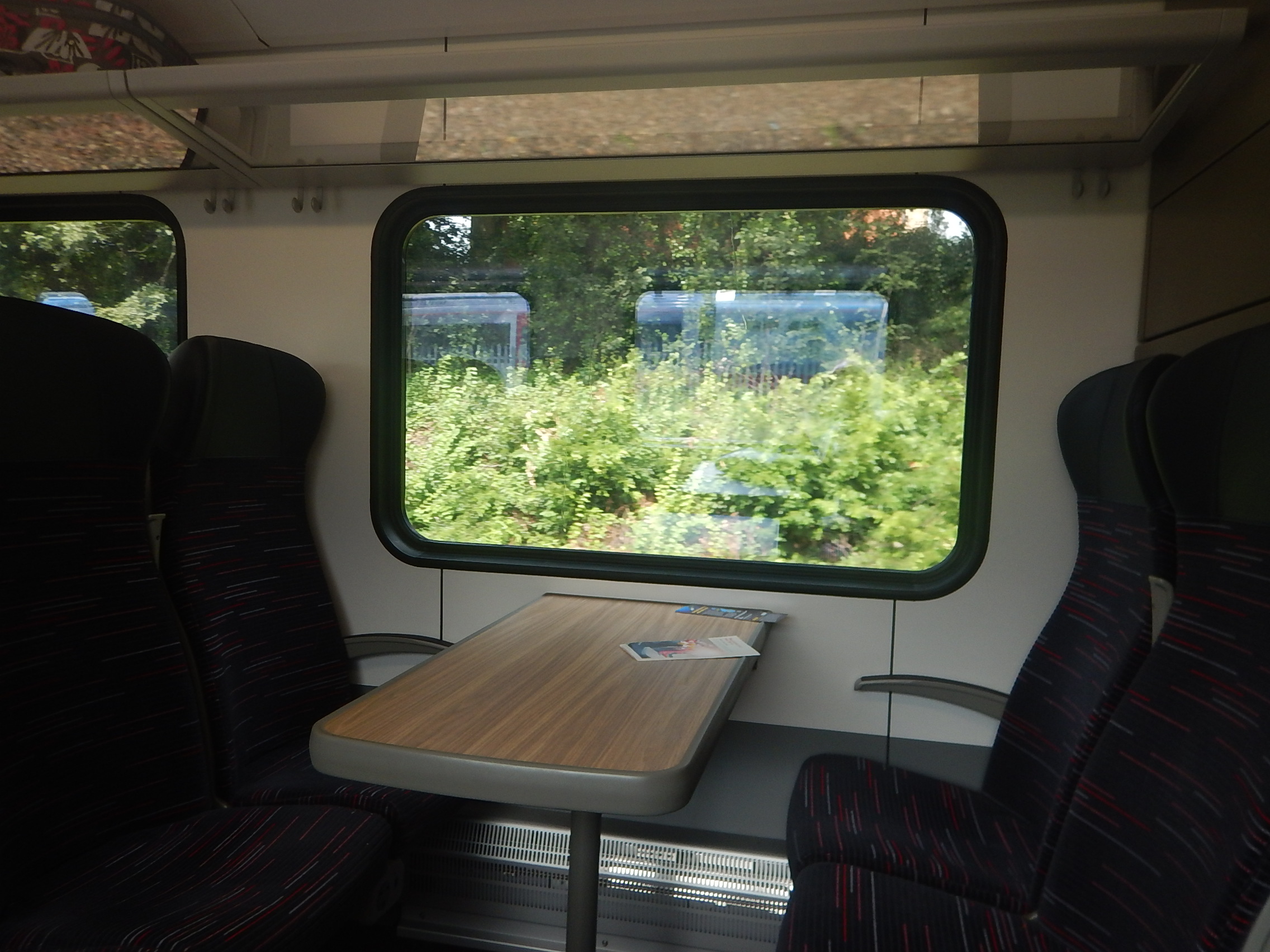
There would appear to be no reservation displays.
Perhaps, they haven’t been fitted yet?
But, it these trains ever run London and Norwich services, via Cambridge because of a weather or power supply emergency, they will need a reservation system.
Can Greater Anglia Run Four-Car Class 755 Trains On Most Services?
Greater Anglia will eventually have the following fleet of Class 755 trains.
- 14 x three-car
- 24 x four-car
Note that only four-car trains are in service.
How Many Trains Are Needed For Each Route?
A rough calculation gives theses trains for various routes.
- Colchester and Peterborough – four trains
- Ipswich and Cambridge – four stains
- Ipswich and Felixstowe – one train
- Ipswich and Lowestoft – three trains
- Norwich and Great Yarmouth/Lowestoft – two trains
- Norwich and Sheringham – two trains
- Norwich and Stansted Airport – four trains
- Sudbury and Colchester Town – two trains
This makes a total of only twenty-two trains. And Greater Anglia have a fleet of twenty-four!
I have seen it written that the Sudbury and Colchester Town service will be run using three-car trains.
Trains North Of Ipswich And Cambridge
Sp it looks like all trains North of Ipswich and Cambridge can be four-car trains, as there are enough trains.
It also gives operational advantages for services to Norwich.
- I took a train from Cambridge to Norwich and noticed, that after unloading passengers at Norwich, it picked up a load more for Cromer and Sheringham and reversed out of the station.
- Norwich services to Great Yarmouth and Lowestoft weave a pattern between the City and the coast all day.
- A spare can be based at Norwich Thorpe Depot, in case a train fails.
- I assume that one Class 755 train can act as a Thunderbird or rescue locomotive for a stalled train.
Ipswich station could see a major sort-out.
- Only three services to and from Cambridge, Felixstowe and Lowestoft, will terminate and go North at the station.
- Will eventually all these services turnback in the bay platform 1?
- Through services going South from Norwich and Lowestoft would use Platfoirm 2
- The new Peterborough and Colchester service will use Platform 2, when going South.
- All Northbound through services would use Platform 3.
- Terminating services from London will use Platform 4.
It looks like Greater Anglia’s proposed timetable simplifies operation at Ipswich and means no new building there.
I suggested that the three services from Cambridge, Felixstowe and Lowestoft all terminate in Platform 1.
- Platform 1 can handle a four-car Class 755 train.
- Three trains per hour (tph) could easily be accommodated in one platform.
- There is space around the platform to improve the passenger experience.
There may be the possibility to use the trains more efficiently.
- Ipswich and Lowestoft currently takes 91 minutes
- Ipswich and Cambridge currently takes 81 minutes
The Class 755 trains will shave a few minutes off these times, but they will still result in a long wait at terminals.
Combining the two services with a reverse at Ipswich might be advantageous.
- Greater Anglia could need less trains for the service.
- Passengers would have extra route choices.
There are some interesting possibilities.
Where Will The Three-Car Trains Be Used?
I believe and I have tried to show the possibilities, that Greater Anglia will use four-car trains efficiently on all their core routes, with the exception of Sudbury and Colchester Town, where three-car trains will be used.
So where will the other three-car trains be used?
New Services
Greater Anglia, Network Rail and politicians have talked about the following new services.
- A direct service between Lowestoft and Great Yarmouth via Reedham.
- Reinstatement of the March and Wisbech service.
- Partial reopening of the Aldeburgh Branch if Sizewell C is built.
In recent years Greater Anglia, Network Rail and others have used the Mid Norfolk Railway, which is a heritage railway for various purposes.
- Storing rail maintenance equipment.
- Moving light tanks for the Army by train.
- Training emergency services.
- Rail enthusiasts tours, including one in an HST,
- Storing trains for Greater Anglia. This was a £3.25million. deal.
I feel that because of the train storage deal, Greater Anglia will explore the possibility of a local Norwich service to Dereham, which is a town of just under 19,000 people with no National Rail connection..
- It could be a joint venture between Greater Anglia and the Mid Norfolk Railway.
- Norwich and Dereham would take under thirty minutes.
- Services could use the Mid-Norkfolk Railway’s stations at Wymondham Abbey, Kimberley Park, Thuxton, Yaxham and Dereham as appropriate.
- Felixstowe, a similar sized town to Dereham attracts 200,000 passengers per year.
The service could be a nice little earner for both companies.
Capacity Increases
With new trains on all Greater Anglia’s services, I suspect that Greater Anglia believe they will see a substantial increase in passengers.
- There will be a large increase in train capacity.
- Services should be faster.
- Services will be more frequent.
But some services will need more capacity.
So will we see pairs of three-car trains working on some services, where a four-car train is not big enough?
Sub-Leasing To Other Companies
It does seem that either Greater Anglia is going to have a large expansion of services or they have acquired too many trains.
Unless of course, they hope to make some of the Class 755 trains available to other companies.
Conclusion
In answer to the title of this post, the answer is yes!
But Greater Anglia must have expansion plans using their three-car Class 755 trains.
Class 755 Trains Are Now Running Between Ipswich And Cambridge
According to this article on the East Anglia Daily Times, the new Stadler Class 755 trains are now running between Ipswich and Cambridge stations.
The article also makes these points.
- The Class 153 trains will be retired at the end of this week.
- More Class 755 trains wll come into service in the coming weeks.
There is a software problem that restricts full operation, which should be fixed in a couple of weeks, which is described like this.
A new piece of software is due to be installed within a few weeks – but until then passengers heading east from Elmswell and west from Kennett are being taken by bus to the next station.
Both Elmswell and Kennett are simpler stations, with short platforms.
This Google Map shows Elmswell station.
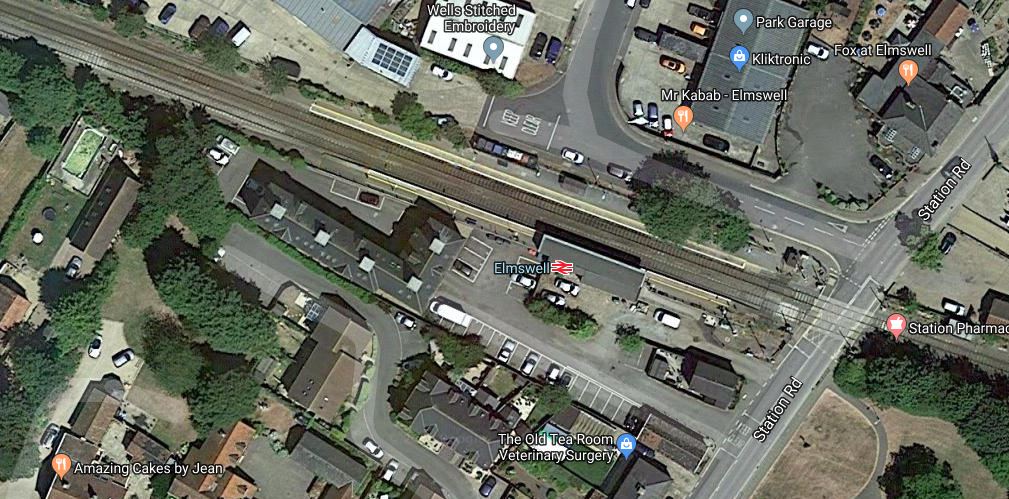
And this Google Map shows Kennett station.

I wonder, if with these stations, selective door opening is needed the on one platform and the layout doesn’t fit the original software.
When you write software to work in a large number of situations, it’s difficult to make sure you cover everything.
Greater Anglian’s solution of a bus to get around the problem is not an ideal solution, but it should work, until the software is fixed.
A First Close-Up View Of A Class 745 Train
I was standaing on Stowmarket station and this Class 745 train came through.





These twelve section trains will replace stakes of Mark 3 coaches, sandwiched between a Class 90 locomtives and driving van trailers.
Note.
- When I first saw the train, I thought it was a Class 755 train., as they look so similar. So I had to read the plate between the trains to check.
- Unlike most UK trains the number on the cab is not a full number and just the last three digits.
- If you look at the top of the train, it appears that the energy bus appears to be along the middle of the roof.
- Like most modern trains, they were quiet. Does this suggest efficient aerodynamics.
It bcertainly appears that Stadler have a selectio of sections, that can be connected together to create the trains.
 The Anonymous Widower