Does Brexit Mean We Need More Runways?
I ask this question, as after I wrote Changing Sides, I’ve had some thoughtful comments.
In 2015, there were seven airports that handled over ten million passengers.
- London Heathrow – 74,985,748
- London Gatwick – 40,269,087
- Manchester – 23,136,047
- London Stansted – 22,519,178
- London Luton – 12,263,505
- Edinburgh – 11,114,587
- Birmingham – 10,187,122
In addition, there are airports like Bristol, Cardiff, East Midlands, Glasgow, Leeds-Bradford, Liverpool and Newcastle, that can take a significant portion of regional traffic.
I can add these comments.
- Manchester is taking traffic from other airports in the North and Scotland.
- In a decade or so, a very high speed rail link could enable Liverpool to provide extra runway capacity for Manchester.
- Birmingham will be on HS2 within a decade.
- Manchester will get HS2 within two decades.
- Six of the top seven airports are getting improved rail links.
- Glasgow is just off the list in eighth, but does Scotland need two airports in the Central Belt?
- Cardiff is not the busiest airport and was in fact 20th.
The Airports Commission said we need another runway in the South East, but will Brexit change matters?
I have this feeling that, Brexit could mean that we actually see more air-routes opening up.
Consider.
- The British will always love their holidays in the sun.
- The UK will always be a destination for tourists and a low pound courtesy of Brexit will help.
- If the regions of the UK get more independence from London, they’ll probably look to attract more visitors.
- On past form, the City of London will survive Brexit, just as it did the Great Fire and the Blitz.
- Brexit could be an excuse for building more runway capacity.
- People love setting up airlines to lose their fortune and those of others.
- Infrastructure like railways and trams will make some airports, easier and more affordable to use.
- Travellers will get more savvy.
On the other hand, the low-cost airlines seem to be saying that traffic to and from the UK will be a lot lower and they are moving aircraft out of the UK.
I have no idea what will actually happen, but we may see some surprising things. I said this earlier.
In a decade or so, a very high speed rail link could enable Liverpool to provide extra runway capacity for Manchester.
Consider.
- The Shanghai Maglev Train has a top speed of over 400 kmh and a length of 30 km.
- Liverpool and Manchester airports are 50 km. apart.
- Liverpool Airport is alongside the Mersey.
Even if this doesn’t happen, we’ll certainly see many airports expand and be easier to use.
The debate on where the South-East gets extra runway capacity has been enlivened by Gatwick saying that if Heathrow is chosen, then they’ll build a second runway anyway.
Consider.
- Building a new runway at Heathrow will need extensive works to the M25
- Gatwick has the space for a second runway and has already shown possible runway, terminal and rail railway station designs.
- Gatwick is already a well-connected rail-hub.
- Both airports will be connected to Farringdon by modern high-capacity rail links.
- Cameron promised no third runway at Heathrow and his election still defines the make-up of Parliament.
- Most Londoners don’t like Heathrow.
- Heathrow probably couldn’t build a third runway, if Gatwick got the Government’s blessing.
We could see the Government give Heathrow their blessing, but Gatwick builds a new runway as well.
Surely two world-class airports for London, would show that a post-Brexit Britain was open for business.
I think many London residents like me, living away from Heathrow, would accept an enlargement at both airports.
You can envisage these scenarios.
Heathrow Gets A Third Runway And A Sixth Terminal
If this was the decision, the following would or could happen.
- The opposition would be vocal and possibly violent.
- Every legal experts in the field would keep the Courts going for decades.
- The moving of the M25 would paralyse the traffic to the West of London for at least a decade. Remember Terminal 5!
- All of the hassle would frighten investors away from a post-Brexit UK
Gatwick would build a second runway anyway.
Heathrow Hub
Heathrow Hub is the independent proposal shortlisted by the Airports Commission. Wikipedia describes it like this.
Heathrow Hub proposes extending both of the existing runways up to a total length of about 7,000 metres and dividing them into four so that they each provide two, full length, runways, allowing simultaneous take-offs and landings. The aim is to complete the construction within five years and with 100% private funds.
Available capacity would be doubled while keeping a percentage of the slots unused in order to alter noise levels. In addition, early morning flights could land much further west along the extended runways so reducing the noise footprint for a large area of west London.[5] Other noise mitigation techniques include using two-stage approaches, and steeper, curved climb-outs.
The Heathrow Hub concept includes a new multimodal air, rail and road interchange located approximately two miles north of Heathrow’s Terminal 5 to accommodate passenger growth. This includes a new terminal, a new railway station connecting Heathrow to the West Coast Mainline and Crossrail and direct access to the M25 motorway.
This image from the Heathrow Hub web site shows the layout with just the Northern runway extended.
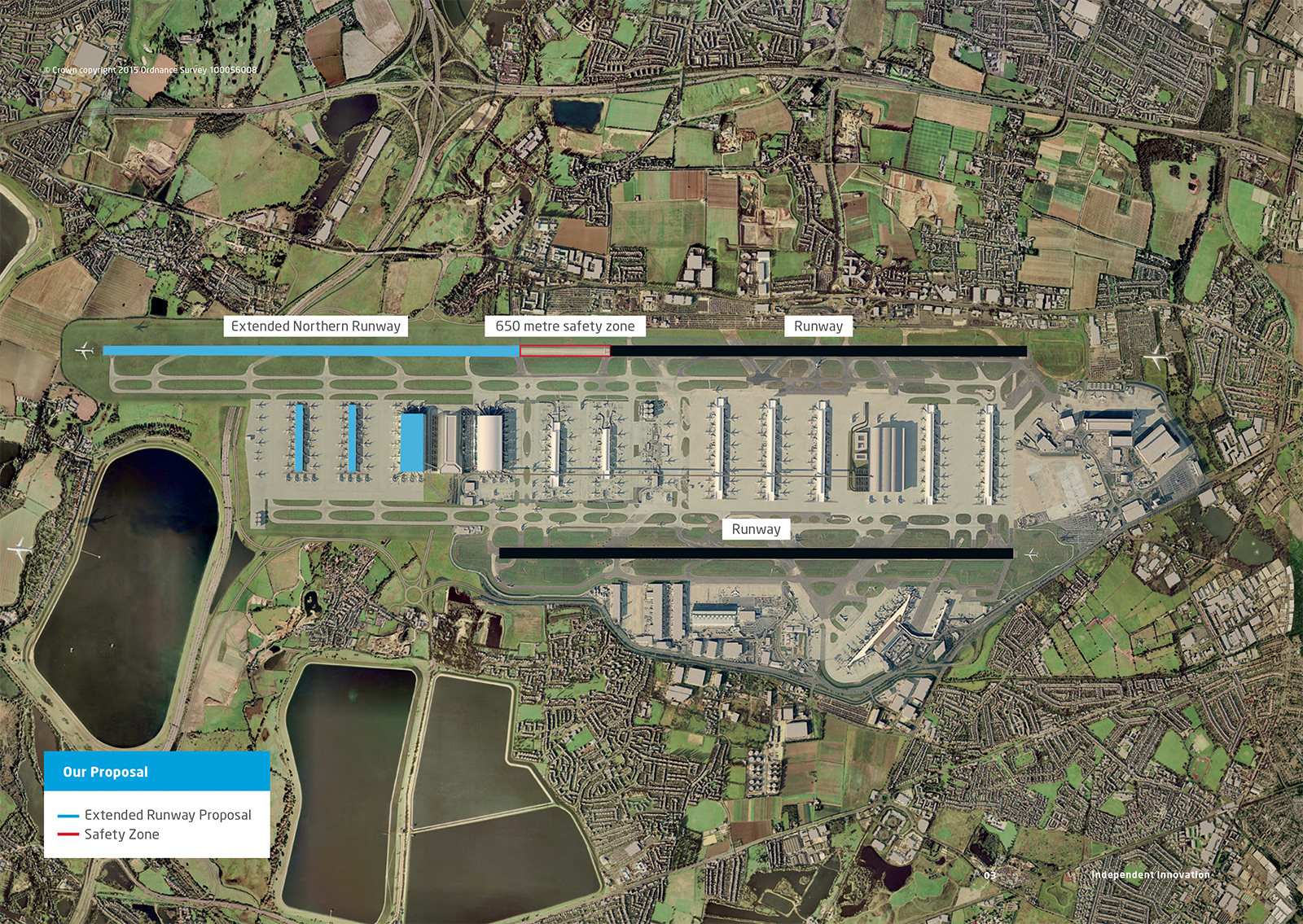
Heathrow Hub Runway Proposal
Note.
- The M25 would just needed to be put in a tunnel, as has been done at Schipol.
- The Southern runway could be expanded later to provide even more runway capacity.
- As aircraft will get smarter and be able to fly more precise paths, more noise will be kept within the larger airport boundary.
With my project management hat on, I believe that the building of the rNorthern Runway extension, a new terminal and all the connecting infrastructure could be built without disrupting the operation of the current Airport.
Heathrow Hub is the joker in the pack and it could be the surprise choice.
But I doubt it.
- The opposition would still be vocal and possibly violent.
- Every legal experts in the field would keep the Courts going for decades.
- Heathrow Airport wouldn’t like it, as they didn’t think of it.
Although, in a post-Brexit world, it could make sense.
Gatwick Gets A Second Runway
In some ways this is the option with the least amount of hassle.
- The opposition at Gatwick would be much less, than choosing Heathrow.
- There would be no traffic disruprion at Heathrow.
But Heathrow would probably fight the decision in the Courts.
I also think, that Heathrow will never give up on expansion, as there is just too much investment in the airport.
Both Airports Get An Extra Runway
This could be the Judgement of Theresa!
- Heathrow would extend the Northern runway, as detailed in the Heathrow Hub proposal, with perhaps another rail-connected terminal between the runways.
- Gatwick builds a second runway and appropriate terminals.
Consider.
- The current two-airport strategy works for London.
- Heathrow and Gatwick will soon have much-improved rail connections with an interchange in Central London.
- Both rail journeys to Central London will be around thirty minutes.
- Both runways could be built without disrupting the existing airports.
- Once the M25 is covered, Heathrow can extend the runway and gets the space for more terminals.
- Few properties would be demolished at either Heathrow and Gatwick.
- Those living around Heathrow would suffer less noise.
- A second runway fits Gatwick’s plans.
- Airlines can choose their best location as capacity increases.
- At least two runways at both airports, surely increases safety.
But the reason, I like this option best, is that it future-proofs, the airports in the South-East for a very long time.
It also creates true competition between the two airports and that can only be to the benefit of the airlines and their passengers.
This article in the Independent is entitled If Gatwick and Heathrow both build extra runways, it could mean the UK becomes future-proofed.
Add future-proofing to my list.
Conclusion
I said we should be prepared for surprises about airports.
I stand by that!
Sadiq Khan Backs Gatwick
This article on the BBC is entitled Sadiq Khan urges swift decision on Gatwick expansion.
Doesn’t most of those living and/or working in london and the South East?
This is said in the article.
London Mayor Sadiq Khan has urged Theresa May to make a quick decision on airport expansion in the South East.
Mr Khan said the new Prime Minister should make the final decision on whether a new runway should be built at Gatwick or Heathrow a top priority.
This decision has been kicked further into the long grass for years, ever since Harold Wilson cancelled Maplin Airport in 1971.
With Brexit on the near hotizon, what better way to say the UK and London is open for business, than by deciding on the next runway in the South East.
I don’t believe Heathrow should build another runway for the following reasons.
- Building another runway would cause endless problems as the M25 is diverted., if what happened when it was diverted for Terminal 5 is anything to go by.
- Gatwick will have better rail connections.
- Heathrow has annoyed a lot of influential and powerful people and organisations in West London.
- The site is too small, even after demolishing the odd village.
- I don’t believe they’ll solve the pollution problem.
- I don’t like approaching the airport over Central London.
- It is the more expensive option.
You can probably say similar things for Gatwick.
But at least Gatwick’s owners don’t seem to be as greedy and uncooperative as those at Heathrow.
At least Gatwick’s plans seem well advanced, as this visualisation shows.
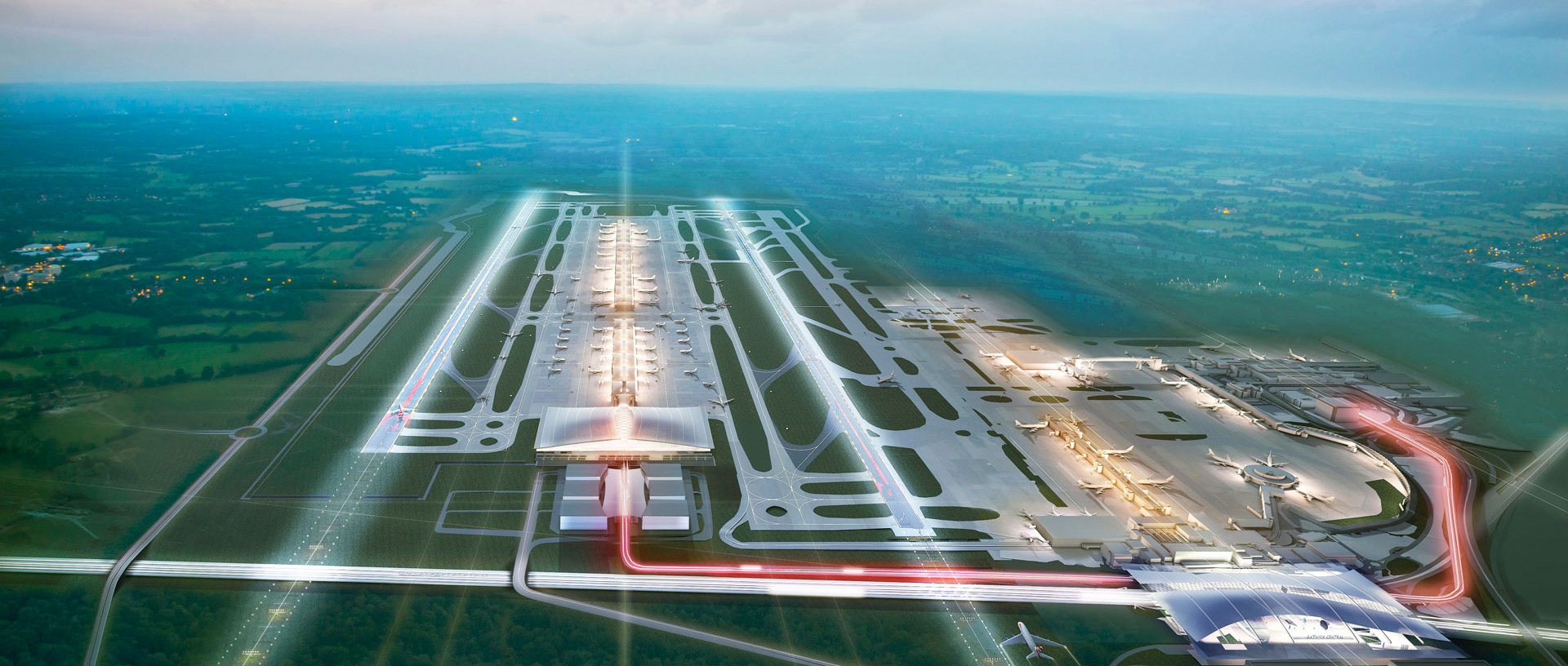
Gatwick With Two Runways
This appears to me to be a good efficient design.
- The new runway is on the left.
- It looks like the secondary North runway, used when the current main runway is under msaintenance, is still in place.
- Between the two runways is a massive new terminal.
- Note the station in the bottom right corner, with the Brighton Main Line going across.
- The red line is a shuttle, that takes passengers between the current North and Main terminals, the new terminal and the train station.
- Little demolition seems to have taken place.
But in some ways, where the runway is built is irrelevant, if Crossrail and the improved Thameslink work as they say on their tins.
These two high-capacity railways will give Heathrow and Gatwick a shared terminal called London, that unfortunately for them, they will share with Stansted, Luton, HS2 and Eurostar.
I feel though, that because of Brexit, we’ll see a decision before the end of the year and possibly in the next few weeks.
British governments have fiddled for far too long!
The Windsor Link Railway Gets Public Approval
This article in the Windsor Express reveals the results of the consultation of a railway to connect the town’s two railway stations.
Surprisingly in my view, 64% of the public approved of the project.
I am dubious, that this project will ever get built, as it is too radical and Network Rail have their own plans for more railways into Heathrow.
But if I was Lord Adonis, I’d recommend building the line, as I think it gives tremendous possibilities for business, tourism and leisure in the Thames Valley.
Gatwick Express Embrace Contactless Ticketing
I took this screen capture this page on from the Gatwick Express web site.
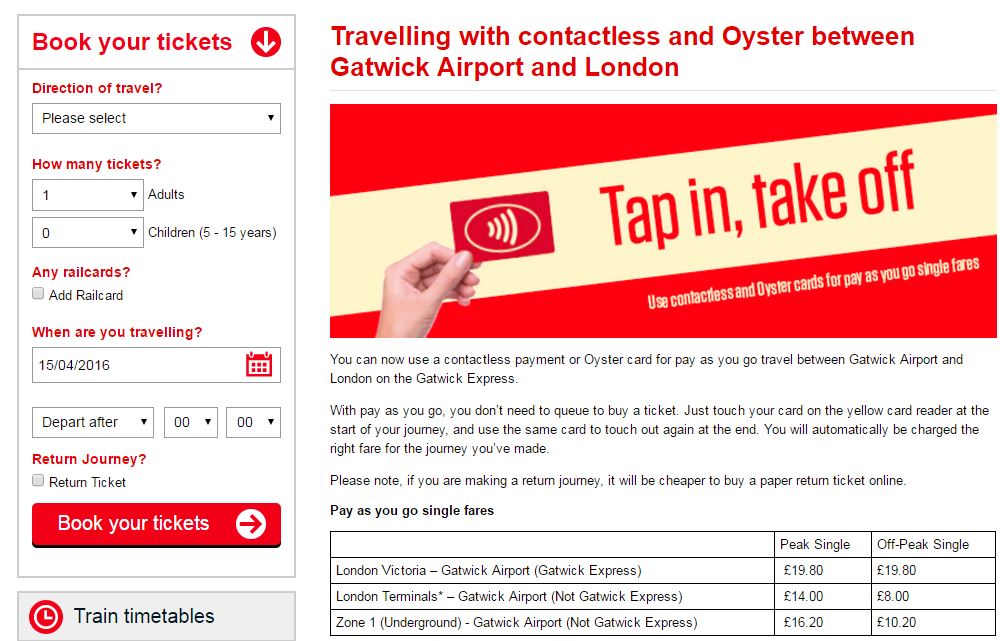
It does seem they are embracing contactless ticketing to Gatwick. They do add this caveat.
Please note, if you are making a return journey, it will be cheaper to buy a paper return ticket online.
From here in the wilds of Dalston, I shall probably never use Gatwick Express, except to catch an early flight, when I would take one of two night buses; N38 and N73 or a mini-cab to Victoria.
I will probably use Thameslink from London Bridge or use the East London Line to get to Croydon.
I will certainly use a contactless bank card for the last leg to Gatwick, as it is not in Freedom Pass territory. As contactless costs just three pounds between East Croydon and Gatwick, I wouldn’t put it past the Airport to allow Freedom Passes to Gatwick, if Heathrow don’t allow them on Crossrail to the there.
There’s a war out there and the two main protagonists; Helpful Gatwick and Greedy Heathrow are laying out their policies.
Heathrow Expansion Under Legal Threat
Heathrow Airport will look back on March 2016, as very much a mense horribilis.
After the cracks in the Class 332 trains, which led to to all sorts of problems with Heathrow Express, the airport can’t be pleased with this story on the BBC web site, entitled Heathrow third runway: Councils in legal threat over plan. This is said.
Four Tory councils have threatened to sue the government if plans for a third runway at Heathrow Airport go ahead.
Solicitors acting for Wandsworth, Hillingdon, Richmond and Windsor and Maidenhead councils have written to the prime minister saying expansion would be “irrational or otherwise unlawful”.
What is surprising about this story, is that only four councils are mentioned.
But the Councils involved, are the closest ones to the Airport and the ones likely to get the most complaints from residents. The Airport is actually in Hillingdon.
Given that the current Mayor of London and nearly all candidates for the Mayoral Election in May, are against the third runway, I would have thought a few other councils could jump on the bandwagon. And not just Tory ones!
Is there a Council in London and the South East that actually wants Heathrow to have a third runway?
According to Wikipedia, Slough is in favour.
In The Rise Of Gatwick Airport, I said this.
I am coming more to the conclusion, that despite the report of the Airports Commission, Heathrow Airport will never have a third runway, but Gatwick may get a second one, as they can start to plan, for when the deal to not build a second runway with Sussex County Council, runs out in 2019.
I think as time goes on, it will be even more unlikely that Heathrow will get another runway.
Heathrow’s only hope is that after this year’s elections and the Brexit vote, David Cameron decides to allow the runway, as it won’t affect him in 2020.
How Will Crossrail Fit Into Heathrow?
With all the unnecessary arguments going on about Crossrail and access to Heathrow Airport, that I wrote about in Heathrow Express And Crossrail, I thought it would be an idea to look at the layout of the rail lines at the airport. This rail map from carto.metro.free.fr, shows the lines as they are now.

Heathrow Rail Lines
Look at the Crossrail web site page for Heathrow and this is said.
Crossrail will provide four trains per hour in each direction between central London and Heathrow Airport (Terminals 2 & 3 and Terminal 4), replacing the two trains per hour Heathrow Connect. Crossrail services to and from the airport will call at local stations into central London.
To match the train service with passenger demand at particular stations, and to achieve shorter journey times for longer distance passengers, trains will not usually call at all stations.
The Heathrow Express will continue to operate as prior to the construction of Crossrail but we will replace the Heathrow Connect overground service with a more frequent service that stops at other stations on the way to Paddington.
So it would appear that Crossrail will use the two platforms at the Terminal Four station, as a terminus. Is that enough platforms?
Passengers for Terminal Five will have to change trains at Heathrow Central station.
It’s certainly not the best way to design a railway.
In a real world where passengers come first, Heathrow Express would be confined to history and two Crossrail trains per hour would go to each of Terminal Four and Terminal Five.
As I write this post, this article on Global Rail News has just been published. It has a title of Heathrow Express fleet out of service for “foreseeable future”.
So perhaps the trains are imposing a solution to the problem and leaving the paths open for a sensible Crossrail-only solution.
Many would pay serious money to be a fly on the wall at the meeting between Heathrow Airport, Transport for London, the Mayor of London, the Office of Rail Regulation and perhaps a couple of heavyweight government ministers, when the solution to Crossrail’s access to Heathrow is sorted.
The Piccadilly Line And Heathrow
I’ve just looked at the map again and it prompted me to look at the Piccadilly Line At Heathrow.
Note how the Piccadilly Line starts from Hatton Cross station calls at the single platform Terminal Four station and then curves in a single-track loop before it arrives at the station for Terminals 1, 2 and 3.
This must be the simplest way to create a the end of an Underground line, if you can just keep digging.
A few years earlier, a similar tunnel was dug in Liverpool to link the Wirral Line to the city centre, when Merseyrail was created.
Both tunnels are single unidirectional lines running clockwise.
A similar layout could be used to take the Victoria Line to Herne Hill, as I wrote about in Will The Victoria Line Go To Herne Hill?
The Piccadilly Line And Heathrow After Crossrail
Some might question if it is still necessary to have the Piccadilly Line run to Heathrow after Crossrail has been built.
But consider the following.
- The upgrade of the Piccadilly Line with new signalling and new trains, will bring an increase in capacity and faster times from Central London to the Airport.
- For large numbers of people living along the route of the Piccadilly Line or just one change away from it, it will still be the easiest way to get to Heathrow.
- The Piccadilly Line will be the only line other than Heathrow Express, that serves all five terminals.
- There will certainly be contactless ticketing to Heathrow, if you use the Piccadilly Line.
- If politics stop the use of Freedom Passes to Heathrow on Crossrail, it will probably be available on the Piccadilly Line.
I also think, that there is scope for sorting out the western ends of the Piccadilly Line to improve connectivity in the area.
Slough Borough Council have already proposed extending the Piccadilly Line from Terminal 5 to Slough.
If you look at the route of the Piccadilly Line westward from South Kensington station, the line seems to cross several important rail lines without any interchange.
As an example this is the area centred on the old Earls Court Exhibition Centre, which is now being developed as housing.
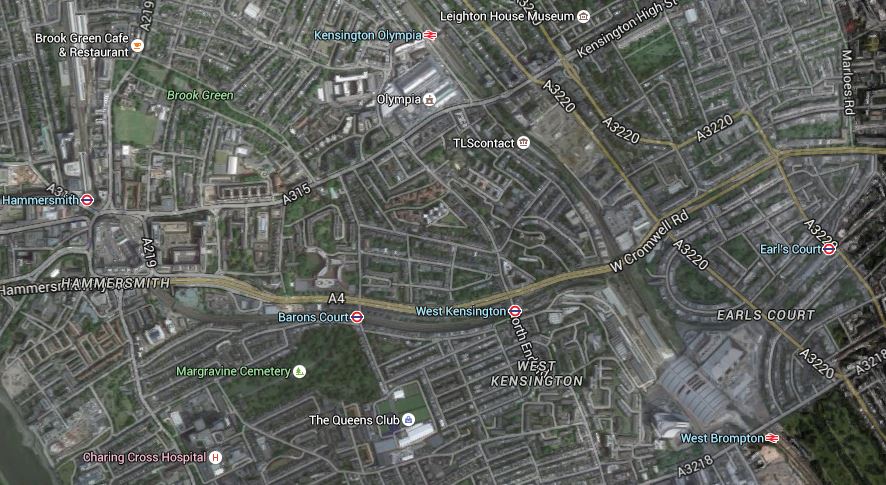
Around Earl’s Court
I think there’s scope for a better station at Earl’s Court on the Piccadilly Line, that connects with the West London Line.
Unless of course, the development is so upmarket, the residents wouldn’t be seen dead in trains. But developers have told me that in London, good stations improve marketability.
An improved station here would give good connections between Heathrow and South London and especially to Clapham Junction and East Croydon stations.
Other possibilities would be to connect the Piccadilly Line to the North London Line and a reinstated Brentford Branch.
I can’t believe that if Transport for London spend millions on new signalling and trains on the line, that they won’t do some other improvements.
Heathrow Express In Trouble
I have used it occasionally, but I don’t use Heathrow Express much, as it is very overpriced and terminates in London at the difficult-to-access Paddington station.
So to go to and from Heathrow, I usually use the Piccadilly Line. Cramped and slow it might be, but when going, I can take a bus to the convenient Manor House station, get a seat and read all the way to the airport for free.
Coming back from the airport, depending on the time, I use a variety of routes. The last time, I swapped to the District and then used the East London Line to get to my nearest station at Dalston Junction and two stops on a frequent bus home.
This report on the BBC web site is entitled ‘Crack’ in train forces Heathrow Express to replace stock and tells how the Cl;ass 332 trains have been withdrawn for checks.
They’ve probably developed the crack due to the overweight passengers with their overweight luggage, who are on expenses, so they can afford Heathrow Express.
So what have Heathrow Express done to get round the problem of no trains?
They’ve taken the Class 360 trains used on Heathrow Connect, thus removing the only affordable way for a lot of passengers and airport workers to get to Heathrow, unless they use the 140 bus.
I’ve just looked at how you get from Hayes and Harlington station to Heathrow this morning and the National Rail Journey Planner, is telling everybody to get a train into Paddington and then get Heathrow Express.
Taxi and mini-cab drivers must be laughing all the way to the bank.
It all goes to show how the Heathrow Express/Connect service is good and expensive when it’s working, but totally useless when there is a problem.
It could be thought that Crossrail will solve the problem.
At present there are four Heathrow Express and two Heathrow Connect services an hour between Paddington and the Airport. I think that Crossrail will still provide four much larger trains an hour to Paddington and additionally another four trains through London to Shenfield or Abbey Wood.
That could be a tripling of capacity between Heathrow and Central London. And unless it is convenient for you, you don’t have to change to the Underground, a bus or a taxi at Paddington.
I shall take a direct train between Whitechapel and Heathrow, if I need to get to the airport.
But will I be able to?
This article in Rail Magazine is entitled ORR consults on Heathrow Spur access charges and reports on the ongoing row between Heathrow and everybody else, about letting Crossrail trains use the spur into Heathrow Airport.
Consider the following.
- Heathrow desperately wants to build a third runway, which is opposed by nearly all Londoners.
- UK taxpayers are paying for the upgrading of the link between the Heathrow Spur and the Great Western Main Line.
- Crossrail will bring a massive increase in capacity to the airport.
- Heathrow Express only serves Paddington, which ironically is on Crossrail.
- Londoners generally don’t like Heathrow and rarely use Heathrow Express.
- Gatwick is getting two affordable world-class links into London.
- Boris Johnson has said that Freedom Pass holders will be able to use Crossrail to the Airport for free.
On top of all that, the current disruption to rail services has occurred at just the right time, when the ORR are calling Heathrow to act in the best interest of travellers to the airport.
I’m sure another rail company will welcome the chance to use Heathrow Express’s Class 332 trains, even with a few cracks, when the service is closed in a few years time.
The Rise Of Gatwick Airport
I used to hate Gatwick Airport, but now on my short flights to Europe, I often find myself using the Sussex airport, as it is usually an easier train ride, than Heathrow or Stansted.
The South East’s Next Runway
I am coming more to the conclusion, that despite the report of the Airports Commission, Heathrow Airport will never have a third runway, but Gatwick may get a second one, as they can start to plan, for when the deal to not build a second runway with Sussex County Council, runs out in 2019.
- No serious candidate for London Mayor would win an election if they proposed a third runway at Heathrow.
- Heathrow is surrounded by housing, whereas Gatwick is surrounded by more much open countryside.
- The protests over another runway at Heathrow would be enormous.
- In a few years time, Gatwick will have the better rail links and fifteen million people will live within an hour’s train journey of the Airport.
But the main reason is that building a second runway at Gatwick will be a lot easier. Just look at this Google Map of Gatwick Airport.
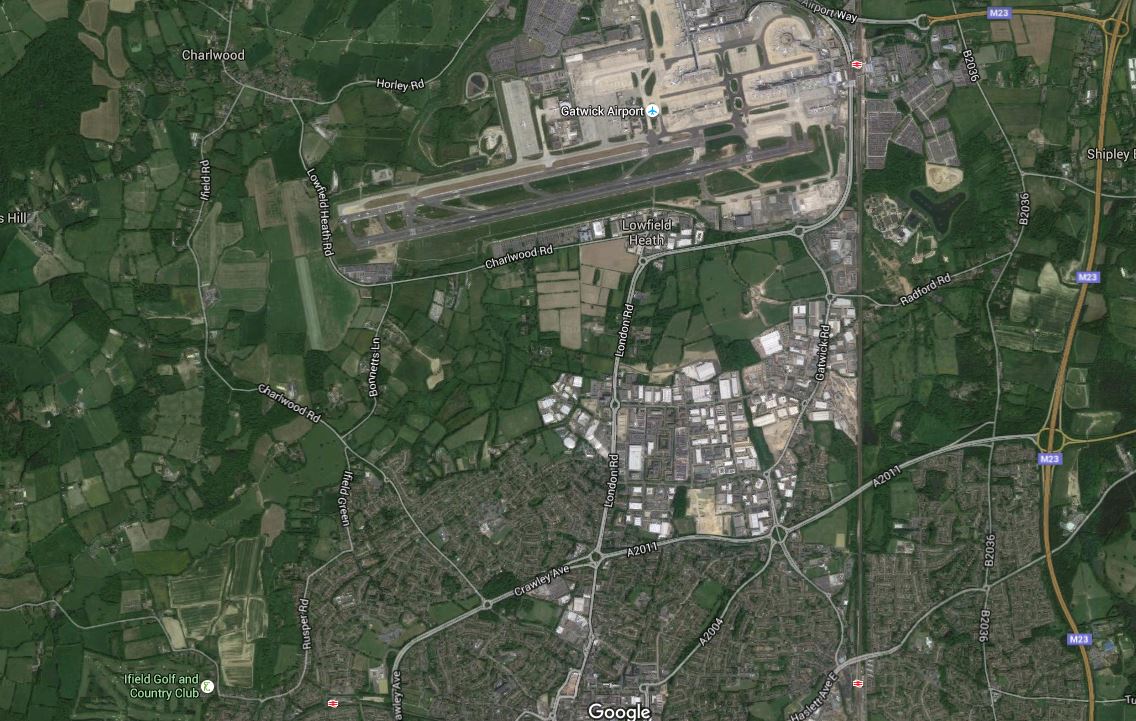
Gatwick Airport
Note the following about the map and the expansion of Gatwick Airport.
- The second runway will be built to the South of the existing runway.
- There doesn’t appear to be much housing in the area of the proposed new runway.
- The M23 Motorway and the Brighton Main Line run North-South to the East of the Airport.
- A third terminal would be built near to the existing railway line.
- Note in the map, that in addition to the single runway, the taxiway can be used as a runway, if say the runway is under repair or blocked.
The second runway would increase the capacity of the Airport to over 80 million passengers a year.
I’ve always believed that Gatwick could also build a North-South runway over the M23. This was proposed in the 1980s by pilots and with the capability of aircraft increasing all the time, I don’t rule it out at some time in the future.
The Biggest Airport Terminal In The World
I have argued in the past, that when Crossrail and Thameslink are completed, then the following airports and international rail stations will be connected together.
- Heathrow Airport
- Gatwick Airport
- Stansted Airport
- Luton Airport
- St. Pancras International station
- Ebbsfleet International station
There will also be an easy link to HS2 for the North and Scotland.
As passengers will be increasingly savvy, in many cases they will organise their travel to what is best for them and not the travel agents, airlines and the airports.
I believe that London will sell itself, as a place to break that long journey, just as Singapore and Dubai have done for years.
As the North of England, Scotland and Wales always say, London always wins!
But then London is the capital of the world!
Rail Links To Heathrow Airport
Crossrail should give Heathrow Airport a world-class link to Central London, if they can sort out Crossrail’s access problems to the airport, that I wrote about in Heathrow Express And Crossrail.
The over-priced joke that is Heathrow Express will be on borrowed time once Crossrail opens in 2019.
But there will still be problems with rail access to Heathrow Airport.
- Terminal 5 will not be connected to Crossrail.
- Changing terminals at Heathrow is a chore.
- Heathrow Express only takes passengers to and from Paddington.
- There is no direct rail access to Reading for the West.
- For some parts of London, the Piccadilly Line will still be the best way to go to and from the Airport.
- Access to Continental rail services from Heathrow will be difficult.
You would never describe Heathrow as fully integrated into the the UK’s rail network.
Heathrow will of course argue, that links to Central London are excellent and that those continuing their journey will just change terminals and be on their way.
Obviously, improvements will come, but nothing important for passengers will happen, until Heathrow puts passengers first and drops it’s arrogant attitude, which thinks it is London’s only airport.
Rail Links To Stansted Airport
Stansted Airport has the Stansted Express from Liverpool Street, which runs about four times an hour.
I believe in the next few years, the following will happen.
- Crossrail will arrive at Liverpool Street in 2019, giving one-change journeys to and from Heathrow.
- The West Anglia Main Line will be four-tracked, allowing faster Stansted Express services.
- An improved rail service will be provided to the increasingly important rail hub at Cambridge.
- An extra Stansted Express service will run to Stratford via the new Lea Bridge station.
- Stansted Express will probably get new air passenger-friendly trains.
But the biggest improvement of rail services to Stansted Airport will come, when and if Crossrail 2 is built, as this will make travel to the airport from all over London a lot easier, with just a single change at Tottenham Hale or Broxbourne.
I also wouldn’t be surprised to see some Crossrail 2 trains extended to Stansted. After all, the tracks exist and if the airport said to Transport for London, here’s a few million from our petty cash to run Crossrail 2 to Stansted, I’m sure TfL would oblige!
This would give Stansted Airport one-change services to Gatwick, Heathrow and Luton airports, Continental Rail Services and HS2.
Rail Links To Luton Airport
Luton Airport has its own Thameslink station at Luton Airport Parkway.
But also it has plans to expand, as is reported in this article in the Daily Mail, entitled Luton Airport reveals plans for direct rail line that would cut train journey from central London to just 20 minutes.
I think that Luton Airport could use something like Class 387/2 trains, as used on Gatwick Express with an IPEMU capability, so that they could use a branch line without any electrification to underneath the airport terminal.
Rail Links To Gatwick Airport
I found this article in TravelWeekly, which is entitled Gatwick outlines plans for a train departure to London every three minutes.
It gives a very good summary of the train services that will run to Gatwick after Thameslink is completed.
The planned hourly timetable would see:
• Four dedicated Gatwick Express trains to Victoria
• Six trains to Victoria – originating from East and West Coastway, Horsham/Littlehampton, and Three Bridges/Haywards Heath
• Four trains to Bedford via London Bridge – originating from Gatwick and Brighton
• Two trains to Cambridge via London Bridge – originating from Brighton
• Two trains to Peterborough via London Bridge – originating from Horsham
• Two trains to London Bridge – originating from Littlehampton/West Coastway, and Haywards Heath/Three Bridges.
That is a total of twenty trains to and from London and beyond and most of the South Coast from Southampton to Hastings.
How many better rail-connected airports are there anywhere in the world?
The article also quotes Guy Stephenson, the Airport’s Chief Commercial Officer as saying.
The new high frequency service that will serve Gatwick will transform rail journeys for our passengers, with capacity doubling and a train to London every three minutes.
Crucially, the new trains will be much more reliable and will be stacked with amenities suited to the needs of air travellers. Combined with robust new track and signalling systems, Gatwick’s passengers will experience a really pleasant and dependable service.
Overall, the improvements to Gatwick’s rail service means that 15 million people will be brought within 60 minutes of Gatwick by rail – the best reach of any UK airport,
Reading the article, you might think that Thameslink should be called Gatwicklink!
According to this Press Release on the Gatwick Airport web site, Gatwick Airport are going to spend £120.5million on updating the rail station. This is an architect’s impression of the new station.

I also think that Gatwick could extend their Gatwick Express services.
I think we can also see development of Airport services to and from Gatwick Airport station based on the following existing services.
- Reading via the North Downs Line.
- Tonbridge and Ashford International via the Redhill to Tonbridge Line.
Will we be seeing a second Gatwick Express route from Ashford or Ebbsfleet to Reading via Gatwick Airport?
Consider.
- It would inevitably get known as the M25-on-rails.
- It gives a large number of passengers a way to get to Gatwick and Continental Rail Services without going through Central London.
- It could serve Heathrow, if they got their act together.
- Surprisingly, I think this route will be quicker to go between Reading and Gatwick, than using Crossrail and Thameslink with a change at Farringdon.
- The trains for such a service could be the same as the new Class 387/2 Gatwick Expresses, but with an IPEMU capability.
But it wouldn’t be just an Airport service, as I suspect that given adequate parking at stations, it would become a valuable cross-country route linking the rail hubs of Ebbsfleet, Gatwick and Reading. After all, North of London, the East West Rail Link is being created from Reading to Cambridge via Oxford, Milton Keynes and Bedford.
Southern also run a service from Milton Keynes to South Croydon via the West London Line. In the future this service will serve Old Oak Common station on Crossrail, HS2, the West Coast Main Line and the North London Line.
So will this service be extended from South Croydon to Gatwick and become a third Gatwick Express service?
These two additional Gatwick Express services would greatly increase or ease the airport’s links across the wider South East and to HS2 services out of Euston.
The only problem, is the overcrowding on the Brighton Main Line.
Conclusion
Gatwick will become the best rail-connected airport in the UK and will get a second runway!
Is A Rail War Starting To London’s Airports?
The following sections sum up the rail services to the various London airports.
London City Airport
London City Airport may only be small, but some people use it a lot. I never have, but that’s not for dint of trying. It’s just that if I include all the factors, by which I choose a flight, it hasn’t come out top yet!
London City Airport is only on the Docklands Light Railway, but when Crossrail is open and Bank station has been fully upgraded in 2021, it will be a relatively easy airport through which to travel.
Crossrail passes very close to the Airport and passive provision has been made for a Silvertown station that could be connected to the Airport. At present, the Docklands Light Railway provides enough capacity.
Eurostar
Eurostar is the cuckoo in the nest and should be included, as it will offer rail services to a couple of European Airports.
By the early 2020s, there will be new direct or single-change services to France, Germany, The Netherlands and Switzerland.
I also suspect that one of the first extensions of Crossrail will serve Ebbsfleet International station, so it will give a lot more passengers easy access to European services.
Gatwick Airport
This year the rail links to Gatwick Airport are getting a major upgrade.
- The current unsuitable Class 442 trains used on Gatwick Express, are being replaced with new Class 287/2 trains, designed for the route.
- The current mixture of Thameslink Class 319 and Class 387 trains are being replaced with new higher capacity walk-through Class 700 trains.
- Gatwick Airport station was redeveloped with new buildings and two extra platforms under two years ago.
- Gatwick Airport has now been brought into London’s Oyster and contactless ticketing area. This report in Rail Technology Magazine gives more details.
And increasingly, as the next few years roll on, various developments will or could happen.
- Thameslink and particularly London Bridge station will have greater capacity.
- Thameslink will add many direct trains to new destinations like Cambridge, Stevenage and Peterborough.
- Thameslink and other developments, will mean that nearly all stations East of the Midland Main Line, will have access to Gatwick Airport through with only a single change at a convenient interchange like Bedford, Cambridge, Farringdon, Finsbury Park, Luton, Peterborough or Stevenage.
- The dreadful links to the Thameslink platforms at St. Pancras, from some other lines at Kings Cross and St. Pancras will be improved.
- An IPEMU variant of the Class 387 Gatwick Express could easily reach Reading on an hourly-basis, to give single-change access between Gatwick Airport and Wales and the West.
- The East Coastway and West Coastway routes could be extended to Ashford and Bournemouth respectively, improved with more and faster trains and a better interchange to Gatwick services at Brighton.
But I believe that what would transform train services to Gatwick, is when the whole of the area from Weymouth and Reading in the west to Ramsgate in the East becomes part of London’s Oyster and contactless bank card ticketing area.
Heathrow Airport
Heathrow Airport will have to wait until December 2019 before it gets any more capacity to Central London, in the shape of Crossrail.
Until then, it will have to make do with the current services.
- The very crowded and slow Piccadilly Line.
- The infrequent Heathrow Connect.
- The overpriced and much unloved Heathrow Express.
But there are serious problems.
- The rail lines into the airport are designed to maximise revenue for Heathrow, rather than the convenience of passengers.
- Crossrail hasn’t been designed to serve Terminal 5 directly. How daft is that?
- Links to the West are atrocious and rely on going into London and out again. Gatwick has better links to Reading!
- As I wrote in Heathrow Express And Crossrail, Heathrow and TfL are still arguing about access for Crossrail into Heathrow.
- Boris has indicated that Freedom Passes will be allowed on Crossrail to Heathrow.
- Heathrow Express will be killed by Crossrail, if Heathrow allows it to serve the airport.
- Gatwick, Luton and Stansted Airports will become part of London’s Oyster and contactless bank card ticketing area. Will Heathrow?
- Improved rail links and services at Gatwick, Luton and Stansted Airports will make these airports more attractive for a lot of passengers than Heathrow.
On top of all this, Heathrow needs Crossrail to give the Airport connectivity to large parts of the South East, the West Coast Main Line and HS2.
I think all candidates for the next London Mayor, will be playing the anti-Heathrow card frequently and with immense relish.
In the end Heathrow will have to accept the following.
- The closure of Heathrow Express.
- Full access of Crossrail directly to all terminals, at an agreed price with TfL.
- Oyster and contactless bank card ticketing.
- A rail link from the West, under probably Network Rail, Great Western and TfL control.
If they don’t like it, then I’m sure Gatwick, Luton and Stansted Airports will take up the slack.
Luton Airport
Luton Airport is in some ways the joker in the pack, but also it has plans to expand, as is reported in this article in the Daily Mail, entitled Luton Airport reveals plans for direct rail line that would cut train journey from central London to just 20 minutes.
In Will Bombardier Develop The Ultimate Airport Train, I discussed Luton Airport in detail and came to the conclusion that if Bombardier Class 387/2 trains as used on the Gatwick Express were fitted with an IPEMU capability, they could easily use terminal platforms without electrification in a tunnel under the Airport.
Whether they will or not, I don’t know, but there is scope for very affordable solutions to providing a fast rail link into Central London.
Luton Airport is closer than Gatwick is to Central London, so I would expect that Oyster and contactless bank card ticketing, would not be a problem.
Southend Airport
Southend Airport is the newest of London’s airports. I know it well from my days as a pilot and occasionally use it on trips to the Netherlands on easyJet.
Operationally for airlines, Southend Airport’s location, close to the Essex Coast is ideal, as it is away from other airports and pilots can get planes in to and out of the airport without too much delay. Also, flights coming in from the East have an uncluttered approach, over the sea and marshland. I once came in to the airport on a flight from Schipol and was on the train from Southend Airport station to Central London, within an hour of boarding the flight in The Netherlands.
I can understand why the Roskill Commission recommended that London’s new airport should be built on Maplin Sands.
This airline-friendly location could drive growth at the airport, especially if the airport keeps its reputation for fast passenger handling.
The Airport talks about handling two million passengers by 2020 and I can’t feel that this is unreasonable.
What could help passenger growth is that there is plenty of scope for making rail trips to Southend Airport easier, especially for Southend’s typical traveller with just hand-baggage and perhaps a wheeled case.
At present Southend Airport and Southend Victoria have three services to and from Liverpool Street per hour, which stop at all stations between Shenfield and Southend Victoria and then just Stratford and Liverpool Street. This is a recent upgrade, as Wikipedia says one train stops at all stations.
Journey times are as follows.
- Liverpool Street – 64 minutes – Just four minutes longer than Stansted.
- Stratford – 57 minutes
- Shenfield – 27 minutes
Capacity isn’t a problem as all stations can take eight-car trains.
The airport station is very close to the terminal and is fully step-free. Incoming passengers from the London direction, don’t even have to cross the railway to get to the terminal.
Crossrail and the new East Anglia franchise will certainly have effects, some of which have already happened.
- Between Shenfield and London there will be at least eight high-capacity Crossrail trains per hour.
- Will Crossrail run on a twenty-four hour basis?
- Shenfield will have Oyster and contactless card ticketing. Will this go all the way to Southend Victoria?
- Shenfield will be Freedom Pass territory.
- Will Norwich-in-Ninety improvements mean that times between Shenfield and London are reduced?
- Will more of the longer distance services to East Anglia, stop at Shenfield for interchange with Crossrail?
I suspect that the answer to the two last questions, will be yes. This improved connectivity and reduced journey time, would mean that a lot of places in East London, Essex and East Suffolk, would be just one change at Shenfield away from Southend Airport.
I wouldn’t be surprised to see some upmarket trains between Southend Victoria and Liverpool Street, with a four trains per hour frequency. Partly, this will be driven by the airport, but also by the competition for passengers between the two companies running services to Southend.
Stansted Airport
Stansted Airport is currently served by the adequate but slow Stansted Express.
Stansted Airport is owned and operated by the ambitious Manchester Airports Group and I can’t see them sitting idly by, whilst Gatwick and Luton expand into their market. After all, they have resources that other airports in the South East lack; space and spare capacity on the current runway.
The rail links need improvement and these will or could happen in the next few years.
- The West Anglia Main Line will be developed and given four tracks between at least Broxbourne and Lea Bridge stations, with higher speed limits.
- There will be a higher frequency for Stansted Express trains into Liverpool Street.
- Stansted Express will serve Stratford several times an hour.
- Stansted Airport station will gain a second tunnel and platform.
- There will be an improved service between Stansted and Cambridge.
- Stansted Airport will become part of London’s Oyster and contactless bank card ticketing area.
The service between Cambridge and Stansted is a truly inadequate, single train per hour to and from Birmingham via Peterborough and Leicester.
I believe that when the new East Anglian franchise is awarded, the route north from Stansted will see the greatest improvement. Note that Thameslink will have four trains per hour to Cambridge going through London of which two will go all the way to Gatwick Airport and Brighton.
I wouldn’t be surprised to see two half-hourly services added to the airport.
- Stansted Airport to Peterborough via Cambridge, Cambridge North and Ely.
- Stansted Airport to Norwich via Cambridge, Cambridge North and Ely.
Even if the current Birmingham service was cut back, this would still give four trains per hour between Stansted Airport and one of its most important catchment areas.
Note how Cambridge North station, which serves the North of the City and the Cambridge Science Park, will be given good rail links.
In Better East-West Train Services Across Suffolk, I wrote about a radical idea of Network Rail to create a much improved service between Peterborough and Ipswich, based on a rebuilt Newmarket station.
But who knows, what will actually happen? I don’t!
But whatever happens to the North of Stansted Airport, the rail links to the airport will be much improved by 2020 or so.
Road Improvements
Road improvements will not be numerous, but one new road will effect the use of airports.
If a new Lower Thames Crossing is built, it could make driving to Gatwick, Stansted and Southend Airports easier and some travellers will shun Heathrow.
On the other hand, if it wasn’t built, it might favour other airports.
Conclusion
All of London’s six airports, except probably London City will be seeing large investments in rail infrastructure, stations and trains in the near future.
Heathrow won’t like it, but I think the political consequences for the major parties of a new runway at Heathrow will make it unlikely that Heathrow gets another runway.
But given the rail infrastructure, I suspect that the other airports will take up the increased traffic for several years.
Gatwick, Luton and Stanstead will get very much improved services and I think Southend could become a Luton in the East.
As passengers will get increasingly savvy as to the routes they use, it will be very difficult to predict how the transport pattern to London’s Airports, will look say in 2025.
I’ll finish by listing some ideas I’ve read over the years.
- The Windsor Link Railway to connect Heathrow to the Great Western Main Line via Windsor.
- A Heathrow Hub station at Iver linked to Heathrow.
- Reopening the line from Bishops Stortford to Braintree via Stansted Airport and Dunmow.
- Extending the Chingford Branch past Chingford to Stansted Airport.
- Creating a Southend Metro to connect the two main Southend stations to Southend Airport.
- Extending some Crossrail trains to Southend Victoria.
There’ll be others and some might even be built.
 The Anonymous Widower