Does The NHS Need Physician Associates?
There have been reports about using these in the NHS over the last few days. One article in the Independent is entitled, NHS patients to be seen by doctors on the cheap. It starts with.
Patients will increasingly be seen by “physician associates” rather than doctors under Government plans despite fears they are “doctors on the cheap”, according to a report.
I have seen a lot of doctors and hospitals over the last ten years, what with the death of my wife and son to cancer and my stroke. What is different now, to what I remember of the NHS in the 1960s and 1970s, is that nurses now play a larger role.
Does anybody bother?
Some might, but I’ve never heard anybody complain, that the nurse did a job, that a doctor might have not delegated forty years ago.
So when it comes to physician associates, I have an open mind.
Or I did until I read the letters page of The Times today, where four serious letters from eminent medical professionals were very much supportive of physician associates.
Now I’ve changed my open mind to one that is totally in favour!
Centralised Stroke Care Is Good For You
I had what some doctors have described as a serious stroke, although I think it might not have been that severe, although it did leave me with damaged eyesight.
I had the stroke in Hong Kong and within about an hour, I was in hospital receiving the special clot busting drug.
But if I’d had that stroke in London, I would have probably had that drug in the ambulance and I would have been in hospital within thirty minutes.
In common with Manchester, London has centralised stroke care in what are called hyperacute stroke units or HASUs. And according to research published in the BMJ, they work well and save lives and money for the NHS. Read all about the system in the Guardian. The article finishes like this.
So what’s stopping this system from being rolled out in other metropolitan areas? It’s a question that Morris’s collaborators are seeking to answer, by studying the potential barriers and facilitators of country-wide stroke unit reconfiguration. Morris himself wants to look at the cost-effectiveness of the exercise: does the improvement in care and reduction in hospital (and hospice) stays make the reconfiguration worthwhile?
There are a few hundred people alive today who would undoubtedly answer “yes”.
My life may not have been saved by a HASU, but I did have similar care.
Admittedly, not every hospital could have a HASU, but most metropolitan areas could and should.
If you take where I used to live near Cambridge, and you draw a thirty-minute ambulance ride area around Addenbrookes hospital, you would enclose about 300,000 people. So it is not just the large metropolitan areas that would benefit.
Everyone possible, should be within range of a HASU.
The Other Side Of Healthcare
According to reports like this, the new boss of the NHS is going to create more smaller community hospitals. Here’s the first few paragraphs
Smaller community hospitals should play a bigger role especially in the care of older patients, the new head of the NHS in England has said.
In an interview in the Daily Telegraph, Simon Stevens signalled a marked change in policy by calling for a shift away from big centralised hospitals.
The health service chief executive said there needed to be new models of care built around smaller local hospitals.
I think there is something, which is just as important, that he doesn’t seem to mention.
That is that all hospitals should be easy to access from most of their catchment area.
When I lived in Suffolk, the only way to get to the excellent local hospital at Addenbrooke’s in Cambridge, was either by a private car or taxi. It certainly couldn’t be done by public transport.
Where I live now, I only have to walk round the corner about fifty metres and every ten or fifteen minutes, there is a 30 bus direct to University College Hospital. The other local hospitals; Royal London, Barts and Homerton are also easy by public transport. I could even get the 30 bus to Harley Street for a private consultation.
But not everybody is so lucky and many hospitals are downright difficult or even impossible to access by public transport. Two hospitals in Suffolk; Ipswich and Bury \St. Edmunds come to mind.
Fixing this problem, will not only help patients, but make it easier for visitors without their own private transport to get to the hospitals.
Hopefully good public transport to hospitals, may also ease parking problems for staff and visitors and hopefully cut down the number of patients who miss their appointments.
My Letter In The Times Yesterday
I had a letter in The Times yesterday about BBC Radio, under the headline of Let’s Hear It
Amid the debates about the BBC’s licence fee some are questioning the value of the BBC’s radio stations …
Sir, Four years ago I was in hospital in Hong Kong after a serious stroke. Luckily, I had a laptop with me and I was able to listen to BBC radio
online.
BBC radio aided my recovery and certainly allowed me to keep my sanity. Those who would like to see the abolition of BBC radio should try six weeks in a hospital where the television and most of the staff are all in a foreign tongue.
I might add, that I now think that most patients in hospital should be allowed a computer or smart phone to fix their mind. Subject of course to it not conflicting with their treatment.
How Many Times Do You Go To A & E In A Year?
This story on the BBC’s web site has done a bit of research and here’s the first part.
Some patients are going to A&E units in the UK more than 50 times a year, a BBC investigation shows.
Data from 183 sites obtained under the Freedom of Information Act revealed nearly 12,000 people made more than 10 visits to the same unit in 2012-13.
A small number of those – just over 150 – attended more than 50 times.
I wonder why they needed a Freedom of Information request to get all this information. This sort of information should be shown on the NHS web site, suitably anonimised.
I didn’t go in 2011. but I went once in 2012 and 2013. Last year’s visit was when I damaged my hand and it just wouldn’t stop bleeding.
Surely, if the NHS had a decent joined-up computer system, they could deal with their serial patients better. I am joined up to UCLH, where I went for my hand, as I had been an in-patient and that got me through the hospital a lot quicker.
Do People Prefer A Terrible Local Hospital?
This article from the Express and Star illustrates the problems of reforming local health services.
The problems that existed at Stafford Hospital have been well documented. This report from the BBC is typical of many I’ve seen.
One of the problems with hospitals with bad reputations either in the media or amongst medical professionals, is that no staff will move there, as they want to protect their professional reputation. There is a story about this from the Stoke Sentinel.
But those that want to keep Stafford Hospital going, have no right to use some of the abuse they have against Julie Bailey, who fought valiantly to expose the scandal of poor healthcare at the hospital. It’s probably lucky for Ms. Bailey, that she appears to be white. I suppose that is lucky for her abusers, as otherwise some of the language used would have probably involved a reference to the police.
The Good And The Bad Of A & E
The saga of my hand is hopefully now finished.
But it does illustrate the good and the bad of A & E in the NHS.
The damage happened near to my surgery and the nurse patched it up. She also checked my tetanus and found it was up to date.
But possibly because of my Warfarin, the blood started to seep around the plaster and in the end, when I started dripping blood all over a Victoria line train, I got out at Warren Street station and I went to A & E at University College Hospital. They did a stronger patch but even that fell apart, probably because I type too much and the damage was on the point of the knuckle.
So it was back to the surgery and then on to Boots, where I bought a large traditional plaster to put over the lot, and some white cotton gloves to protect the whole package.
I still have a scab on the back of the hand and now because of the success of the hospital bandage, I wear a wrist support to take the pressure off my wrist and the knuckle.
The treatment, I got was generally good and quick, as who would complain at forty minutes in A & E for a minor injury.
But as I live alone and couldn’t patch it up myself with one good hand, it needed trips to get medical help.
So are we seeing more people going to A & E because so many of us now live alone? And is A & E geared up for it?
But the real problem that A & E has, is the lack of a joined up database with my GP. The nurse at the surgery checked my tetanus status, which I thought was good, but of course, I couldn’t remember the date. The nurse in the hospital asked and I told her it was good. but she had no means of checking.
Incidentally, one thing that saved time in A & E was that I’d been an in-patient at the hospital and I was already registered.
Those who object to a large joined up NHS patient database, are probably the people, who complain loudest at the wait in A & E.
But how much time and effort would it save?
My Poor Hand
This morning, I cut my hand accidentally, as I walked the Regent’s Canal. How I don’t know, but despite timely repairs by the nurse at my surgery nearby, the wound refused to stop bleeding and I had to go to A & E at University College Hospital.

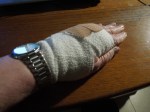
The nurse at UCLH, who bandaged my hand, put the bleeding down to the interaction between Warfarin and the other drugs I am taking.
The strange thing is that I can now type easier and get the Shift and Control keys right.
The Hospital Test
As I travel around the country, I like to apply the hospital test to all of the places I visit.
Imagine, that a friend or relative has been taken ill or had an accident and is in the local hospital!
By going to the local main station or airport, can you get to that hospital easily using information available there?
Some hospitals are easy to do the last link, but for others, the information is sadly lacking.
I’ve just looked up Barnet Hospital, where both my in-laws died. I did find the nearest station and bus information on the web site, but it wasn’t on a front page link, as it seemed to assume most will drive. On the Transport for London web site, I did find a spider map for the buses to and from the hospital. But not in every case, will I have such good local knowledge!
Incidentally, it seems that most London hospitals have their own spider maps showing all buses around the hospital. The only one I can’t find is one for University College Hospital.
How does your local hospital stack up?
Remember a high proportion of visitors will not be in the first flush of youth and many will have mobility and eyesight problems.
Not One Of My Problems!
This story about treatment for varicose veins shows how a lot of medical treatments are going to get more hi-tech. This is the first bit.
People with varicose veins should be offered laser or heat treatment, say new guidelines for England and Wales.
The National Institute for Health and Care Excellence (NICE) says, in most cases, surgery should be a last resort.
Both my parents had bad varicose veins, with my mother’s being particularly bad. She had them operated on at the old Highlands Hospital in Winchmore Hill in the mid-1950s. The strange thing about that operation was that the surgeon was an Indian lady, who did her ward rounds in a sari. I don’t think, I actually saw the surgeon, as eleven-year-old children weren’t allowed to visit their parents in hospital in those days, but my father would recall if her surgery was as as good as her looks, then my mother would be fine.
It’s strange, but you don’t seem to see the awful varicose veins you did fifty years ago!
I certainly don’t seem to have inherited them from my parents!
 The Anonymous Widower