Rail Engineer On Hydrogen Trains
This article on Rail Engineer is entitled Hydrail Comes Of Age.
It is a serious look at hydrogen-powered trains.
This is typical information-packed paragraph.
Instead of diesel engines, the iLint has underframe-mounted traction motors driven by a traction inverter. Also mounted on the underframe is a lithium-ion battery pack supplied by Akasol and an auxiliary converter to power the train’s systems. On the roof is a Hydrogenics HD200-AT power pack which packages six HyPMTM HD30 fuel cells, with common manifolds and controls, and X-STORE hydrogen tanks supplied by Hexagon xperion which store 89kg of hydrogen on each car at 350 bar. These lightweight tanks have a polymer inner liner, covered with carbon fibres soaked in resin and wrapped in fibreglass.
They have interesting things to say about the trains and the production and delivery of the hydrogen, which can be what they call green hydrogen produced by electricity generated by wind power.
This is said about supplying the hydrogen.
It takes 15 minutes to refuel the iLint, which holds 178kg of hydrogen supplied at a pressure 350 bar. It consumes this at the rate of 0.3kg per kilometre. Thus, Lower Saxony’s fleet of 14 trains, covering, say, 600 kilometres a day, will require 2.5 tonnes of hydrogen per day. If this was produced by electrolysis, a wind farm of 10MW generating capacity would be required to power the required electrolysis plant with suitable back up. This, and sufficient hydrogen storage, will be required to ensure resilience of supply.
These are the concluding paragraphs.
With all these benefits, a long-term future in which all DMUs have been replaced by HMUs is a realistic goal. However, the replacement, or retrofitting, of 3,000 DMUs and the provision of the required hydrogen infrastructure would be a costly investment taking many years.
Germany has already taken its first steps towards this goal.
For myself, I am not sceptical about the technology that creates electricity from pure hydrogen, but I think there are design issues with hydrogen-powered trains in the UK.
The German trains, which are built by Alsthom and should start test runs in 2018, take advantage of the space above the train in the loading gauge to place the tanks for the hydrogen.
Our smaller loading gauge would probably preclude this and the tanks might need to take up some of the passenger space.
But in my view, we have another much more serious problem.
Over the last twenty years, a large number of high quality trains like electric Desiros, Electrostars and Junipers, and diesel Turbostars have been delivered and are still running on the UK network.
It could be that these trains couldn’t be converted to hydrogen, without perhaps devoting a carriage to the hydrogen tank, the electricity generator and the battery needed to support the hydrogen power.
It is for this reason, that I believe that if we use hydrogen power, it should be used with traditional electrification and virtually unmodified trains.
A Typical Modern Electric Train
Well! Perhaps not yet, but my view of what a typical electric multiple unit, will look like in ten years is as follows.
- Ability to work with 25 KVAC overhead or 750 VDC third-rail electrification or onboard battery power.
- Ability to switch power source automatically.
- Batteries would handle regenerative braking.
- Energy-efficient train design.
- Good aerodynamics.
- Most axles would be powered for fast acceleration and smooth braking.
- Efficient interior design to maximise passenger numbers that can be carried in comfort.
- A sophisticated computer with route and weather profiles, passenger numbers would optimise the train.
The battery would be sized, such that it gave a range, that was appropriate to the route.
In an article in the October 2017 Edition of Modern Railways, which is entitled Celling England By The Pound, Ian Walmsley says this in relation to trains running on the Uckfield Branch.
A modern EMU needs between 3 and 5 kWh per vehicle mile for this sort of service.
As I’m talking about a train that has taken energy efficiency to the ultimate, I think it would be reasonable to assume that 3 kWh per vehicle mile is attainable.
As I believe that most axles would be powered, I feel that it would be electrically efficient for a battery to be fitted into each car.
Suppose we had a five-car train with a 30 kWh battery in each car.
This would give a total installed battery capacity of 150 kWh. Divide by five and three and this gives a useful emergency range of ten miles.
These facts put the battery size into perspective.
- , 30 kWh is the size of the larger battery available for a Nissan Leaf.
- A New Routemaster bus has a battery of 75 kWh.
Where will improved battery technology take us in the next decade?
Use Of Hydrogen Power With 750 VDC Third-Rail Electrification
This extract from the Wikipedia entry for third-rail, explains the working of third-rail electrification.
The trains have metal contact blocks called shoes (or contact shoes or pickup shoes) which make contact with the conductor rail. The traction current is returned to the generating station through the running rails. The conductor rail is usually made of high conductivity steel, and the running rails are electrically connected using wire bonds or other devices, to minimize resistance in the electric circuit. Contact shoes can be positioned below, above, or beside the third rail, depending on the type of third rail used; these third rails are referred to as bottom-contact, top-contact, or side-contact, respectively.
If a line is powered by third-rail electrification, it needs to be fed with power every two miles or so, due to the losses incurred in electricity passing along the steel conductor rail.
I suspect that Network Rail and our world-leading rail manufacturers have done as much as they can to reduce electrical losses.
Or have they? Wikipedia says this.
One method for reducing current losses (and thus increase the spacing of feeder/sub stations, a major cost in third rail electrification) is to use a composite conductor rail of a hybrid aluminium/steel design. The aluminium is a better conductor of electricity, and a running face of stainless steel gives better wear.
Suppose instead of having continuous third-rail electrification, lengths of electrification with the following characteristic were to be installed.
- Hybrid aluminium/steel rails.
- Power is supplied at the middle.
- Power is only supplied when a train is in contact with the rail.
All trains would need to have batteries to run between electrified sections.
The length and frequency of the electrified sections would vary.
- If a section was centred on a station, then the length must be such, that a train accelerating away can use third-rail power to get to operating speed.
- Sections could be installed on uphill parts of the line.
- On long level sections of line without junctions, the electrified sections could be more widely spaced.
- Battery power could be used to take trains through complicated junctions and crossovers, to cut costs and the difficulties of electrification.
- Electrified section woulds generally be placed , where power was easy to provide.
So where does hydrogen-power come in?
Obtaining the power for the track will not always be easy, so some form of distributed power will be needed.
- A small solar farm could be used.
- A couple of wind turbines might be appropriate.
- In some places, small-scale hydro-electric power could even be used.
Hydrogen power and especially green hydrogen power could be a viable alternative.
- It would comprise a hydrogen tank, an electricity generator and a battery to store energy.
- The tank could be buried for safety reasons.
- The installation would be placed at trackside to allow easy replenishment by tanker-train.
- It could also be used in conjunction with intermittent solar and wind power.
The tanker-train would have these characteristics.
- It could be a converted electrical multiple unit like a four-car Class 319 train.
- Both 750 VDC and 25 KVAC operating capability would be retained.
- One car would have a large hydrogen tank.
- A hydrogen-powered electricity generator would be fitted to allow running on non-electrified lines and give a go-anywhere capability.
- A battery would probably be needed, to handle discontinuous electrification efficiently.
- It might even have facilities for a workshop, so checks could be performed on the trackside power system
Modern digital signalling, which is being installed across the UK, may will certainly have a part to play in the operation of the trackside power systems.
The position of all trains will be accurately known, so the trackside power system would switch itself on, as the train approached, if it was a train that could use the power.
Use Of Hydrogen Power With 25 KVAC Overhead |Electrification
The big difference between installation of 25 KVAC overhead electrification and 750 VDC third-rail electrification, is that the the overhead installation is more complicated.
- Installing the piling for the gantries seems to have a tremendous propensity to go wrong.
- Documentation of what lies around tracks installed in the Victorian Age can be scant.
- The Victorians used to like digging tunnels.
- Bridges and other structures need to be raised to give clearance for the overhead wires.
- There are also those, who don’t like the visual impact of overhead electrification.
On the plus side though, getting power to 25 KVAC overhead electrification often needs just a connection at one or both ends.
The electrification in the Crossrail tunnel for instance, is only fed with electricity from the ends.
So how could hydrogen help with overhead electrification?
Electrifying some routes like those through the Pennines are challenging to say the least.
- Long tunnels are common.
- There are stations like Hebden Bridge in remote locations, that are Listed Victorian gems.
- There are also those, who object to the wires and gantries.
- Some areas have severe weather in the winter that is capable of bringing down the wires.
In some ways, the Government’s decision not to electrify, but use bi-mode trains is not only a cost-saving one, but a prudent one too.
Bi-mode trains across the Pennines would have the advantage, that they could use short lengths of electrification to avoid the use of environmentally-unfriendly diesel.
I have read and lost an article, where Greater Anglia have said, that they would take advantage of short lengths of electrification with their new Class 755 trains.
Electrifying Tunnels
If there is one place, where Network Rail have not had any electrification problems, it is in tunnels, where Crossrail and the Severn Tunnel have been electrified without any major problems being reported.
Tunnels could be developed as islands of electrification, that allow the next generation of trains to run on electricity and charge their batteries.
But they would need to have a reliable power source.
As with third-rail electrification, wind and solar power, backed by hydrogen could be a reliable source of power.
Electrifying Stations With Third Rail
It should be noted, that the current generation of new trains like Aventra, Desiro Cities and Hitachi’s A-trains can all work on both 25 KVAC overhead or 750 VDC third-rail systems, when the appropriate methods of current collection are fitted.
Network Rail have shown recently over Christmas, where they installed several short lengths of new third-rail electrification South of London, that installing third-rail electrification, is not a challenging process, provided you can find the power.
If the power supply to the third-rail is intelligent and is only switched on, when a train is on top, the railway will be no more a safety risk, than a route run by diesel.
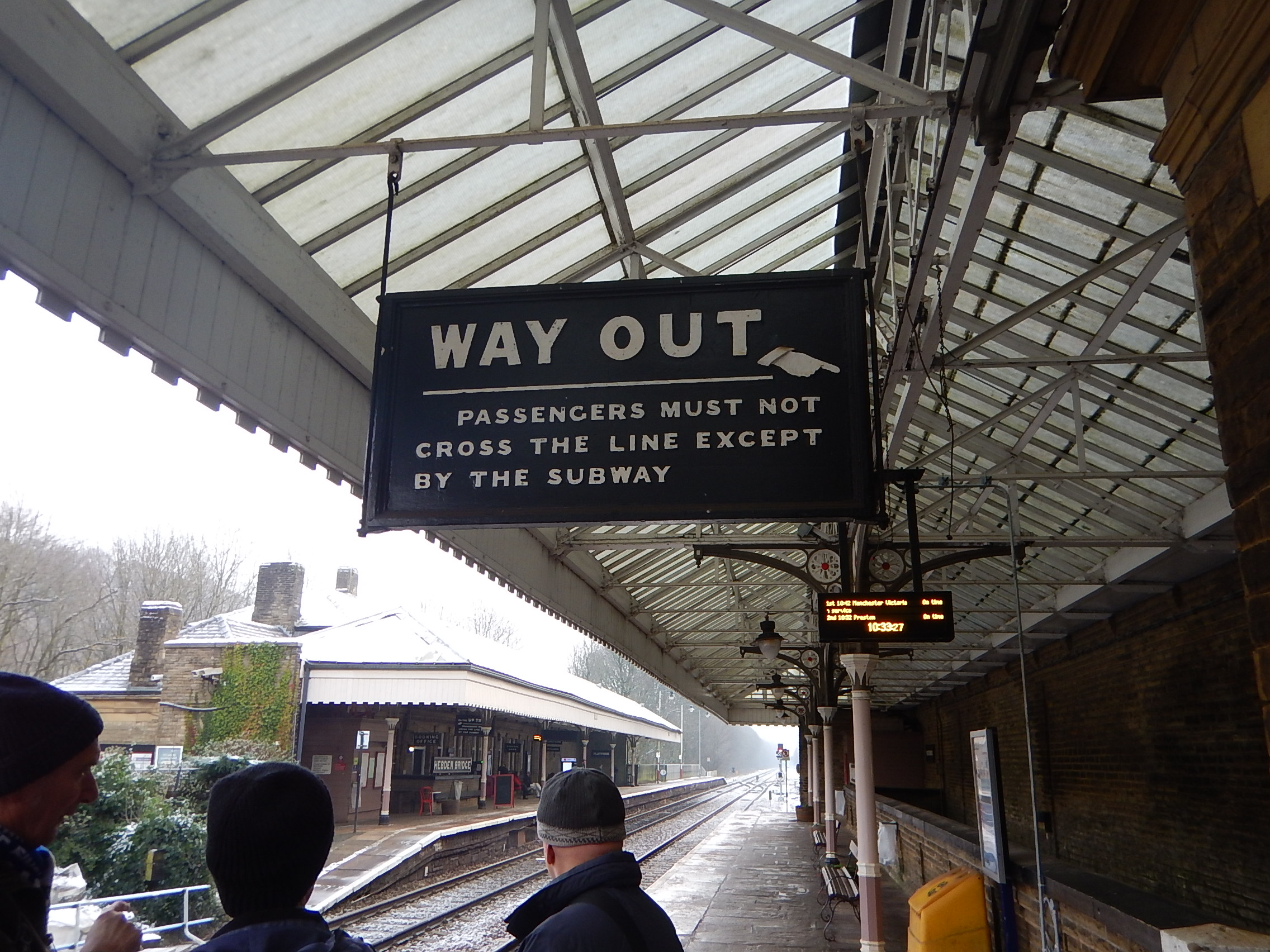
The picture shows the Grade II Listed Hebden Bridge station.
Third-rail electrification with an independent reliable power supply could be a way of speeding hybrid trains on their way.
Power Supply In Remote Places
Communications are essential to the modern railway.
Trains and train operators need to be able to have good radio connections to signalling and control systems.
Passengers want to access wi-fi and 4G mobile phone networks.
More base stations for communication networks will be needed in remote locations.
Wind, solar and hydrogen will all play their part.
I believe in the future, that remote routes in places like Wales, Scotland and parts of England, will see increasing numbers of trains and consequently passengers., many of whom will be walking in the countryside.
Could this lead to upgrading of remote stations and the need for reliable independent power supplies?
Conclusion
I am very much coming to the conclusion, that because of the small UK loading gauge, hydrogen-powered trains would only have limited applications in the UK. Unless the train manufacturers come up with a really special design.
But using hydrogen as an environmentally-friendly power source for UK railways to power electrification, perhaps in combination with wind and solar is a definite possibility!
.
Siemens Joins The Hydrogen-Powered Train Club
This article on Global Rail News is entitled Siemens Working On Fuel Cell-Powered Mireo Train.
Siemens Mobility’s Mireo is their next-generation electric multiple unit.
This description is from Wikipedia.
The railcars have an articulated design and aluminium carbodies, with 26 metres (85 ft) cab cars on each end of a trainset and 19 metres (62 ft) passenger cars between them, with trainsets between two and seven cars long. The use of aluminium, combined with new control systems, is intended to reduce energy use by up to 25%. compared to previous Siemens EMUs. The railcars can reach a top speed of up to 160 kilometres per hour (99 mph)
The first units were ordered in February 2017 by DB Regio, which ordered 24 three-car trainsets with a passenger capacity of 220 for service on its routes in the Rhine valley in southwestern Germany.
This train has a lot in common with other offerings from the major train manufacturers.
- Light weight
- Articulated design.
- Sophisticated control systems.
- Low energy use.
Is it a case of engineering minds thinking alike?
The Global Rail New article says this about the hydrogen-powered trains.
Siemens is partnering up with Canadian manufacturer Ballard Power Systems to develop a fuel cell engine for its new Mireo train platform.
The two companies have signed a Development Agreement to produce a 200 kilowatt fuel cell engine to power a Mireo multiple unit.
The first fuel cell-powered Mireo could be running by 2021, Siemens and Ballard have announced.
There is a page on the Ballard web site, which lists their fuel cell engines called FCVeloCity.
- FCVeloCity-MD – 30 kW
- FCVeloCity-HD – 60kW, 85kW, 100kW
- FCVeloCity-XD – 200 kW
I would assume that as there is no product sheet for the XD, that the 200 kW unit is still in development.
The first application would appear to be the Siemens Mireo.
Is Two Hundred Kilowatt Enough Power?
Bombardier’s four-car Class 387 train, is a typical electric muiltiple unit, that has been built in the last few years.
It has an installed power of 1.68 megawatts or 420 kW per car.
Porterbrook’s brochure says this about the two diesel engines in their Class 769 train, which is a bi-mode conversion of a Class 319 train.
The engine is a MAN D2876 LUE631 engine which generates 390 kW at 1800 rpm, giving an acceptable power output.
So that works out at 195 kW per car.
Both these trains have similar performance to the Siemens Mireo.
- The trains will be substantially heavier than the Mireo.
- The trains will do a lot of acceleration under electrification.
The 200 kW of the Mireo, isn’t much compared with the current generation of train.
As with the Alstom Coradio iLint, that I wrote about in Is Hydrogen A Viable Fuel For Rail Applications?, I suspect the Mireo has the following features.
- Use of batteries to store energy.
- Regenerative braking will use the batteries.
- Selective use of electrification to drive the train directly.
- Intelligent control systems to select appropriate power.
Given that the light weight will also help in the energy-expensive process of electrification, the intelligent control system is probably the key to making this train possible.
Will The Train Have One Or Two Hydrogen Power Units?
Wikipedia says this about the layout of the train.
The railcars have an articulated design and aluminium carbodies, with 26 metres (85 ft) cab cars on each end of a trainset and 19 metres (62 ft) passenger cars between them, with trainsets between two and seven cars long.
The trend these days in modern trains, is to fit large numbers of axles with traction motors for fast acceleration and smooth regenerative braking. As an Electrical Engineer, I believe that the most efficient electrical layout, would be for any car with motors to have some form of energy storage.
Have Siemens designed the train to use two identical cab cars?
- These are longer to meet higher crash-protection standards.
- Any diesel or hydrogen generator would be in these cars.
- Energy storage would be provided.
Two cab cars with generators would have 400 kW, which would be more likely to be an acceptable power level.
Would the intermediate passenger cars be powered or just trailer cars?
I very much believe that the ideal intermediate cars should be powered and have a battery for regenerative braking.
Will Other Companies Join The Hydrogen Club?
Alstom, who are merging their train business with Siemens have announced orders for the Coradia iLint, so they are obviously a full-paid up member.
Bombardier have said nothing, but like Ballard, they are a Canadian company.
The key though, is that modern intelligent train control systems, which are used by all train manufacturers, have been designed to do the following.
- Select appropriate power from electrification, battery or an on-board diesel generator.
- Deploy pantograph and third-rail shoe as required.
- Drive the train in an efficient manner.
Just swap the diesel generator for a hydrogen one.
Having a light weight, energy efficient train design will also help.
Conclusion
Expect hydrogen-powered trains from most manufacturers.
The First Hydrogen Trains Have Been Ordered
This article on Global Rail News is entitled Alstom Confirms Orders For Its Hydrogen-Powered Coradia iLint.
There is also this Press Release on the Alstom web site, which gives a lot more details.
Given that this is a real order worth millions of euros, I think we can assume that another practical motive power source for trains has arrived.
One interesting point is that the deal involves the Linde Group, who are the world’s largest industrial gas company.
Could Bombardier Build A Hydrogen-Powered Aventra?
In Is A Bi-Mode Aventra A Silly Idea?, I looked at putting a diesel power-pack in a Class 720 train, which are Aventras, that have been ordered by Greater Anglia. I said this.
Where Would You Put The Power Pack On An Aventra?
Although space has been left in one of the pair of power cars for energy storage, as was stated in the Global Rail News article, I will assume it is probably not large enough for both energy storage and a power pack.
So perhaps one solution would be to fit a well-designed power pack in the third of the middle cars, which would then be connected to the power bus to drive the train and charge the battery.
This is all rather similar to the Porterbrook-inspired and Derby-designed Class 769 train, where redundant Class 319 trains are being converted to bi-modes.
I also suggested that a hydrogen power-pack could be used.
After writing Is Hydrogen A Viable Fuel For Rail Applications?, I feel that a similar hydrogen power pack from Ballard could be used.
Is Hydrogen A Viable Fuel For Rail Applications?
Perhaps a good place to start is this article on Global Rail News, which is entitled In depth: What you need to know about Alstom’s hydrogen-powered Coradia iLint.
The article starts with this summary of where we are at present.
The global rail industry’s major players are competing to establish an affordable and green alternative to diesel.
Electric traction has been rolled out extensively but electrification can be very expensive – as the UK has learned – and a large part of Europe’s network remains unelectrified. In countries where the provision of electric services is patchy, bi-mode trains are a popular alternative.
I certainly believe that all trains should be powered by electricity, but then we have had diesel-electric locomotives in regular use pn the UK network since the 1950s.
The article mentions two alternatives to diesel.
Bombardier’s modified Class 379 train, which is now called an IPEMU, which I rode in public service in early 2015 is mentioned. I found this train impressive, as I reported in Is The Battery Electric Multiple Unit (BEMU) A Big Innovation In Train Design?. This was my conclusion.
Who’d have thought that such a rather unusual concept of a battery electric multiple unit would have so many possibilities.
I think I’ve seen the future and it just might work!
I still agree with that conclusion.
The second alternative has just arrived in the shape of the Alstom Coradia iLint, which is powered by hydrogen and just emits little more than steam and condensed water.
The Coradia LINT is a family of one and two car diesel trains.
Wikipedia has a section on the Coradia iLint and this is said.
The Coradia iLint is a version of the Coradia Lint 54 powered by a hydrogen fuel cell.[6] Announced at InnoTrans 2016, the new model will be the world’s first production hydrogen-powered trainset. The Coradia iLint will be able to reach 140 kilometres per hour (87 mph) and travel 600–800 kilometres (370–500 mi) on a full tank of hydrogen. The first Coradia iLint is expected to enter service in December 2017 on the Buxtehude-Bremervörde-Bremerhaven-Cuxhaven line in Lower Saxony, Germany. It will be assembled at Alstom’s Salzgitter plant. It began rolling tests at 80km/h in March 2017.
That sounds impressive.
The Global Rail News article gives a bit more detail, including the following.
- The train has no need for overhead catenary.
- The train has lithium-ion batteries to store generated energy.
- The train has a intelligent energy management system.
- Alstom propose to use wind energy to generate hydrogen in the future.
It also includes this promotional video for the Caradio iLint.
Some points from the video.
- The train has similar performance to comparable regional trains. Do they mean the Lint 54 on which it is based?
- The train captures regenerative braking energy.
- The train has been developed in co-operation with a Canadian company! Do they mean Ballard?
So what are my views about trains hydrogen power?
Hydrogen Power In Road Transport
London bus route RV1 has been run by hydrogen-powered buses since 2010.
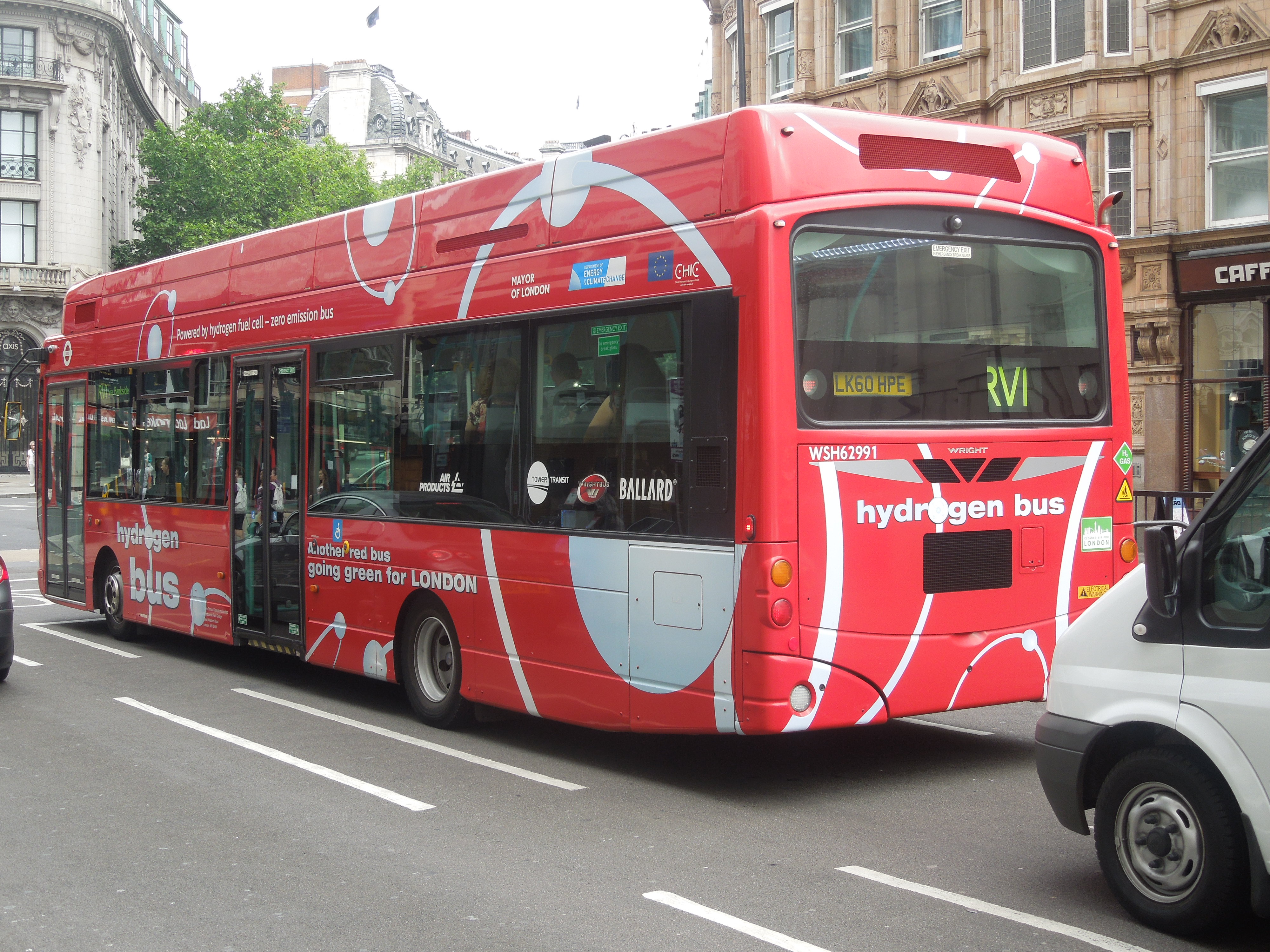
Note Ballard on the side of the bus!
There are also a number of hydrogen-powered cars including the Honda Clarity.
The latest Clarity has these characteristics.
- 4-door saloon.
- 366 mile range.
- 130 kW electric motor.
That seems very reasonable. But the car is only available in California, costs a lot and refuelling points are not everywhere.
The competition for the Honda and other hydrogen-powered cars is the electric car powered by batteries, where charging is getting much faster and easier and the price is getting more competitive.
I think that on the current technology, you’d have to be a very special individual to invest in a hydrogen fuel-cell car.
But use of hydrogen on a city-centre bus is more suitable.
- Pollution is often a problem in city-centres.
- Politicians like to show off their green credentials.
- Buses run fixed routes.
- Bus working schedules can be arranged, such that after a number of trips, they can return to a nearby garage for refuelling.
According to this fuel-cell bus entry in Wikipedia, there have been several trials with varying degrees of success.
My view is that with the current technology, there may be a niche market for hydrogen fuel-cell buses in city centres and environmentally-sensitive areas on defined routes, but that practically and economically, hydrogen fuel-cell cars are a non-starter.
There will be, improvements in current technology in the following areas.
- Vehicle design will result in lighter-weight vehicles and better aerodtnamics.
- Charging systems for electric vehicles will get more numerous and innovative.
- Batteries or energy storage systems will get smaller, lighter and will hold more energy.
Although these developments will also help hydrogen fuel-cell vehicles like buses, they will also help battery-powered vehicles a lot more.
So I would not be surprised to see hydrogen fuel-cell buses not being very successful.
The Advantage Of Rail Over Road
You can’t disagree with the laws of physics, although you can use them to advantage.
Rolling resistance is well described in Wikipedia. This statement starts the third paragraph.
Any coasting wheeled vehicle will gradually slow down due to rolling resistance including that of the bearings, but a train car with steel wheels running on steel rails will roll farther than a bus of the same mass with rubber tires running on tarmac. Factors that contribute to rolling resistance are the (amount of deformation of the wheels, the deformation of the roadbed surface, and movement below the surface. Additional contributing factors include wheel diameter, speed, load on wheel, surface adhesion, sliding, and relative micro-sliding between the surfaces of contact.
Also, as a tram or train system has control of the design of both the vehicle and the rail, it is much easier to reduce the rolling resistance and improve the efficiency of a rail-based system.
One factor; wheel load, is very important. Increasing the load on steel wheels running on steel rails can actually reduce the rolling resistance. So this means that a rail vehicle can better handle heavy components like perhaps a diesel engine, transformer, battery or hydrogen fuel-cell and tanks.
Hydrogen Power In Rail Transport
As Alstom appear to have shown, hydrogen fuel-cells would appear to be able to power a train at 140 kph. Although, there are no reports, that they have actually done it yet! But there has been an order!
The Coradia iLint
I will attempt to answer a few questions about this train.
How Much Power Will The Train Need?
The train is based on a Lint 54.
This document on the Alstom web site, is the brochure for the Coradia Lint.
This is said about the Lint 54.
Ideal for regional or suburban service: The two-car diesel multiple unit with four entrances per side combines all the advantages of its smaller brothers while offering space for up to 170 seats. The vehicle measures 54 m in length. Thanks to its powerful engines, the Lint 54 reaches a maximum speed of up to 140 km/h. With its three powerpacks, the vehicle has a performance of about 1 MW.
Does the iLint have a similar power of about 1 MW?
Could Ballard Power The Train?
If Ballard are Alstom’s Canadian partner could they power the train?
Searching the Ballard web site, I found a product called FCveloCity-HD, for which this document is the data sheet.
The data sheet shows that a 100 kW version is available.
I also found this press release on the Ballard web site, which is entitled Ballard Signs LOI to Power First-Ever Fuel Cell Tram-Buses With Van Hool in Pau, France.
The press release says that 100 kW versions of the FCveloCity-HD, designated FCveloCity-HD100, are used on the tram-buses.
All these applications lead me to believe that Ballard could meet the requirements of enough power for the train.
The video appears to show, that the fuel-cell charges the battery, which then drives the train.
This is not surprising, as most diesel-powered hybrid buses work the same way.
How Big Is The Fuel-Cell?
A Ballard FCveloCity-HD100 is 1200 x 869 x 506 mm. in size and it weighs 285 Kg.
The hydrogen tanks are probably bigger.
Would The Fuel-Cell Provide Enough Power For The Train?
Not on its own it wouldn’t, but adding in the lithium-ion battery and intelligent power management and I believe it would.
- The fuel-cell would generate a constant 100 kW assuming it’s a FCveloCity-HD100.
- The generated electricity would either power the train or be stored in the battery.
- The battery would handle the regenerative braking.
- Air-conditioning and other hotel functions for the train would probably be powered from the battery
The intelligent power management system would take the driver’s instructions and sort out how the various parts of the system operated.
- Moving away from a station with a full train would mean that the train used fuel-cell and battery power to accelerate up to line speed.
- Stopping at a station and the regenerative energy from braking would be stored in the battery.
- Running at 140 kph would need an appropriate power input to combat wind and rolling resistance.
- Any excess energy from the fuel-cell would go into the battery.
- Whilst waiting in a station, the fuel-cell would charge the battery, if it was necessary.
That looks to be very efficient.
How Big Would The Lithium-Ion Battery Need To Be?
I don’t know, but given the appropriate figures, I could calculate it. So Alstom have probably calculated the optimum battery size, based on the routes the train will serve.
Is The Coradia iLint A Battery Train With A Hydrogen-Powered Battery Charger?
I think it is!
But then many hybrid buses are battery buses with a diesel-powered charger.
In Arriva London Engineering Assists In Trial To Turn Older Diesel Engine Powered Buses Green, I wrote about a diesel-hybrid bus, that with the use of geo-fencing, turns itself into a battery bus in sensitive or low-emission areas.
How Would The Train Be Refuelled With Hydrogen?
The video shows a maintenance depot, where the train is topped up with hydrogen, probably after a day’s or a shift’s work.
The first iLint trains have been ordered for the Bremerhaven area, which is on the North Sea coast. So will the depot make its own hydrogen by electrolysis using local onshore or offshore wind power?
Some of that wind power could be used to charge the battery overnight in the depot.
It’s an excellent green concept.
What About The Hindenberg?
But then the very explosive use of hydrogen in the Space Shuttle External Tank never gave any trouble.
Does Alstom Have Any Plans For The UK?
This article on the Engineer web site is entitled Alstom Eyes Liverpool Hydrogen Train Trials.
It would appear to be a good chjoice for the following reasons.
Location
Alstom’s UK base is at Widnes, which is in the South-East of the Liverpool City Region.
Test Partner
Merseyrail have shown in recent years, that they can think out of the box, about using trains and would be a very able partner.
Test Route
The article suggests that Liverpool to Chester via the Halton Curve could be the test route.
- The route is partly electrified from Runcorn to Liverpool.
- The route passes close to Alstom’s base.
- The section without electrification from Runcorn to Chester is probably about twenty miles long, which is a good test, but not a very difficult one.
There would also be good opportunities for publicity and photographs.
Availability Of Hydrogen
Hydrogen is available locally from the various petro-chemical industries along the Mersey.
Incidentally, I used to work in a chlorine plant at Runcorn, where brine was split into hydrogen and chlorine by electrolysis. There were hydrogen tankers going everywhere! Does the industry still exist?
Where’s The Train?
Are Alstom going to build a new train as the Coradia iLint is not built for the British network? Or are they going to modify an existing train, they manufactured a few years ago?
Conclusion
Hydrogen would appear to be a viable fuel for rail applications.
UK Rolling Stock Strategy: Diesel, Bi-mode and Fuel Cell-Powered Trains
The title of this post is the same as that on an article in Global Rail News.
I will not repeat myself here, but I laid down my thoughts in The Intelligent Multi-Mode Train And Affordable Electrification.
In that post, I said that an Intelligent Multi-Mode Train would have these characteristics.
- Electric drive with regenerative braking.
- Diesel or hydrogen power-pack.
- Onboard energy storage to handle the energy generated by braking.
- 25 KVAC and/or 750 VDC operation.
- Automatic pantograph and third-rail shoe deployment.
- Automatic power source selection.
- The train would be designed for low energy use.
- Driver assistance system, so the train was driven safely, economically and to the timetable.
Note the amount of automation to ease the workload for the driver and run the train efficiently.
After discussing affordable electrification, I came to the following conclusion.
There are a very large number of techniques that can enable a multi-mode train to roam freely over large parts of the UK.
It is also a team effort, with every design element of the train, track, signalling and stations contributing to an efficient low-energy train, that is not too heavy.
Is A Bi-Mode Aventra A Silly Idea?
In How Long Will It Take Bombardier To Fulfil Their Aventra Orders?, when discussing the new West Midlands Trains franchise, that has recently been awarded, I said this about the proposed eighty new carriages for the Snow Hill Lines.
As it is unlikely that the Snow Hill Lines will be electrified in the near future, could we be seeing an Aventra bi-mode for the Snow Hill Lines?
So is the bi-mode Aventra a silly idea?
The Five-Car Aventra
It looks like the formation of a five car Aventra like a Class 720 train is something like DMSLW+MS+MS1+PMS+DMSL
The codes are as follows.
- D – Driving
- L – Lavatory
- M – Motor
- S – Standard Class
- W – Wheelchair
So this means the following.
- All cars are motored for fast acceleration and smooth regenerative braking.
- As all cars are motored, there must be a heavy-duty electrical power bus running the length of the train.
- Both driving cars have a toilet.
- The wheelchair area and the fully-accessible toilet are probably together in one driving car.
- The pantograph is on one of the middle three cars.
It should also be noted that the Aventra has a slightly unusual and innovative electrical layout.
This article in Global Rail News from 2011, which is entitled Bombardier’s AVENTRA – A new era in train performance, gives some details of the Aventra’s electrical systems. This is said.
AVENTRA can run on both 25kV AC and 750V DC power – the high-efficiency transformers being another area where a heavier component was chosen because, in the long term, it’s cheaper to run. Pairs of cars will run off a common power bus with a converter on one car powering both. The other car can be fitted with power storage devices such as super-capacitors or Lithium-ion batteries if required.
This was published six years ago, so I suspect Bombardier have refined the concept
It would appear that this could be the reason, why in the document I found MS1 was used for one of the intermediate cars, as this is the car with space for the energy storage.
Do Aventras Have Batteries For Regenerative Braking?
Until I get a definitive statement from Bombardier, that they don’t, I will believe that they do for the following reasons.
- In Do Class 800/801/802 Trains Use Batteries For Regenerative Braking?, I said I would be very surprised if the answer to this question is No!
- In Class 345 Trains And Regenerative Braking, I showed that there were no giveaway electric fires on the roof to handle regenerative braking.
- Batteries would be the ideal way to drag a Class 345 train to safety in case of complete electrical failure in the Crossrail tunnel.
- The Germans, the Japanese, the Swiss and probably the Basques are experimenting with batteries to handle regenerative braking.
- Hybrid vehicles like cars and buses do it all the time.
But the main reason, is that as an Electrical Engineer, I believe it to be stupid and seriously bad design to not use some form of energy storage to handle the energy produced by regenerative braking.
Energy Storage In A Bi-Mode Train
If you look at the five-car Class 720 train, all axles are motored. This will give fast acceleration and smooth regenerative braking, which is just what both train operators and passengers want.
If a bi-mode train had energy storage, if say its speed was checked by a yellow signal, it would be able to regain line speed using the energy stored when it slowed down. So passengers wouldn’t have to endure the vibration of the diesel engine and the jerks as it started.
No competent engineer would ever design a modern bi-mode train without energy storage.
Where Would You Put The Power Pack On An Aventra?
Although space has been left in one of the pair of power cars for energy storage, as was stated in the Global Rail News article, I will assume it is probably not large enough for both energy storage and a power pack.
So perhaps one solution would be to fit a well-designed power pack in the third of the middle cars, which would then be connected to the power bus to drive the train and charge the battery.
This is all rather similar to the Porterbrook-inspired and Derby-designed Class 769 train, where redundant Class 319 trains are being converted to bi-modes.
Diesel Or Hydrogen Power Pack
Diesel will certainly work well, but London and other cities have hydrogen-powered buses.
The picture is from 2013, so the technology has probably moved on. This Fuel Cell Bus section in Wikipedia gives the up-to-date picture.
Automatic Power Source Selection
Effectively, the ideal bi-mode train will be a tri-mode and will have the following power sources.
- Traditional electrification.
- On board diesel or hydrogen power.
- Energy storage, charged from the electrification or from regenerative braking.
The power source would be chosen automatically to minimise the use of both diesel/hydrogen power and electric power from the electrification.
Modern trains like an Aventra can raise and lower the pantograph automatically, so they can do this to make best use of what electrification exists to both power the train and charge the energy storage.
Techniques like these will be used to minimise the use of the diesel or hydrogen power pack.
Intermittent And Selective Electrification
On lines like the Snow Hill Lines sections could be electrified, where the engineering is easy and affordable, to with time reduce the use of unfriendly diesel or expensive hydrogen.
Strangely, one of the first places to electrify, might be the tunnels, as after the electrification of the Severn Tunnel, our engineers can probably electrify any railway tunnel.
I also don’t see why third rail electrification can’t be used in places like on top of viaducts and in well-designed station installations.
The 125 mph Bi-Mode Aventra
This article on Christian Wolmar’s web site is entitled Bombardier’s Survival Was The Right Kind Of Politics. This is said.
Bombardier is not resting on its laurels. Interestingly, the company has been watching the problems over electrification and the fact that more of Hitachi’s new trains will now be bi-mode because the wires have not been put up in time. McKeon has a team looking at whether Bombardier will go into the bi-mode market: ‘The Hitachi bi-mode trains can only go 110 mph when using diesel. Based on Aventra designs, we could build one that went 125 mph. This would help Network Rail as it would not have to electrify everywhere.’ He cites East Midlands, CrossCountry and Wales as potential users of this technology.
So Bombardier don’t think it is silly. Especially, the statement that Bombardier could build an Aventra that could do 125 mph running on diesel.
Applying, what we know about the power in the bi-mode Class 800 and Class 769 trains, which have three and two diesel power-packs respectively, I suspect that to create a five-car Aventra, that is capable of 125 mph on diesel, would need the following.
- At least three diesel power-packs.
- Regenerative braking using onboard energy storage.
- Automatic pantograph deployment.
- Automatic power source selection.
The light weight of the Aventra would be a big help.
It is my belief that energy storage is key, for the following reasons.
- Stored energy from braking at a station from 125 mph, would be used to get the train back to operating speed, without using a large amount of diesel power.
- Braking and acceleration back to operating speed, perhaps after being slowed by another train, might not need the diesel engines to be started.
- Starting a journey with an optimum amount of power in the battery might make getting to operating speed easier.
It would be a rough engineering challenge, but one I believe is possible.
Consider the routes mentioned.
East Midlands
Consider.
- 125 mph running would certainly be needed on this route.
- Battery power could be used to boost the trains to 125 mph.
- Electrification will be available between St. Pancras and Kettering.
- Electrification might be impossible between Derby and Sheffield because the Derwent Valley is a World Heritage Site.
Some form of charging might be needed at Derby, Nottingham and Sheffield.
A bi-mode train would be ideal for Norwich to Liverpool, although there’s not a great deal of electrification.
Cross Country
CrossCountry use several electrified lines on their various routes..
- York to Edinburgh
- Birmingham New Street to Manchester Piccadilly
- Bournemouth to Basingstoke
- Stansted Airport to Ely
Note that parts of some of these routes allow125 mph and Bournemouth to asingstoke is electrified using third-rail.
A dual voltage, 125 mph bi-mode train would probably fit CrossCountry’s routes well.
Wales
Except for the South Wales Main Line, there’s little electrification in Wales, but a 125 mph bi-mode train could be used on the following several partially-electrified routes.
- Carmarthen to Manchester Piccadilly.
- Holyhead to Manchester Piccadilly
- Holyhead to Liverpool via the Halton Curve.
- Birmingham to Shrewsbury.
- Swansea to Newport
Currently most of these services are served by 100 mph Class 175 trains. If nothing else, they would probably be more spacious, faster and fuel-efficient.
Conclusion
A five-car Aventra bi-mode is definitely not a silly idea.
It would be a sophisticated train with the following characteristics.
- Electric drive
- Regenerative braking.
- 25 KVAC overhead and 750 VDC third rail capability.
- Automatic pantograph deployment.
- Onboard energy storage.
- Automatic power source selection.
- Diesel or hydrogen power-pack
- 125 mph capability.
The first four are probably already in service in the Class 345 train.
.
Why Not Hydrogen-Powered Trains?
I regularly use the London bus route RV1 which runs along the South Bank between Tower Gateway and Covent Garden.
This article on the Rail Engineer web site is entitled And now Hydrogen Power – Alstom’s new fuel cell powered train.
The article is worth reading and gives a good review of what might be possible with a hydrogen-powered train.
I have a couple of reservations about hydrogen-powered vehicles.
- In the late 1960s, I worked at ICI Plastics. The Division had had a serious accident with a polythene plant a couple of years previously and there was a distinct lack of enthusiasm for highly-compressed flasmmable gases, that I share to this day.
- I also feel that, if the technology is so good, why aren’t all city buses and taxis hydrogen-powered?
Hydrogen could be the fuel of the future, but we’re possibly nowhere near its time.
This is an extract from the article.
The efficiency of the system relies on the storage of energy in the lithium-ion batteries. Fuel cells tend to work at their best if they are run continuously at reasonably constant performance. The battery stores energy from the fuel cell when not needed for traction and from regenerative braking when the train’s motors turn kinetic energy into electrical energy. In short, the batteries store the energy not immediately required, in order to supply it later, as needed.
So wouldn’t it be better to have a decent charging system for the batteries?
- Overhead electric
- Protected third rail electric
- Small diesel engine.
A system appropriate to the location could be used.
 The Anonymous Widower