The Battery Trains Are Coming
Every month seems to bring more information about trains where batteries are an important part of the propulsion system of the train.
So what are the various manufacturers offering?
Alstom
Alstom’s Coradia iLint train is hydrogen powered and as this video shows, batteries are an important part of the design of the train, which can probably be considered a hydrogen/battery hybrid train.
As I wrote in Germany Approves Alstom’s Hydrogen Train For Passenger Service, these trains will be entering service in late summer in Germany.
In the UK, Alstom are to convert some of the hundred-plus fleet of Class 321 trains, to running on hydrogen power.
I set out my thoughts on this in Thoughts On A Hydrogen-Powered Class 321 Train.
These were my conclusions.
- The Class 321 train will make a good hydrogen-powered train.
- Alstom would not have looked at converting a thirty-year-old train to hydrogen power, if they thought it would be less than good.
- British Rail’s design of a 750 VDC bus makes a lot of the engineering easier and enables the train to be tailored for world-wide markets, with different electrification systems and voltages.
- Having two different hydrogen-powered trains will give Alstom a better place in an emerging market.
I suspect in a few years time, if these two hydrogen projects are successful, Alstom will design and manufacture, a whole family of hydrogen-powered trains, with different gauges, capacities and operating speeds.
Bombardier
Unlike Alstom, who seem to be telling the world what they are doing with hybrid hydrogen/battery trains, Bombardier are playing their cards close to their chest.
In early 2015, I rode on Bombardier’s Class 379 Battery-Electric Multiple Unit demonstrator between Manningtree and Harwich.
It destroyed my scepticism about battery-electric trains.
Since then, the following has happened.
Class 345 Trains Have Entered Service
Class 345 trains have entered service on Crossrail routes to the East and West of London.
Until denied by Bombardier, I believe that these trains from Bombardier’s new Aventra family use batteries for the following purposes.
- Storing and reuseing the energy generated by regenerative braking.
- Providing an emergency power source, should the main electricity supply fail.
- Allowing depots and stabling sidings without electrification.
The trains should also make Crossrail and the other routes on which they run, more electrically efficient.
Five More Fleets Of Aventras
Bombardier have sold five more fleets of Aventras.
Could electrical efficiency because of clever use of batteries be a reason?
A 125 Mph Bi-Mode Aventra With Batteries Has Been Launched
This article in Rail Magazine is entitled Bombardier Bi-Mode Aventra Could Feature Battery Power.
A few points from the article.
- Development has already started.
- Battery power could be used for Last-Mile applications.
- The bi-mode would have a maximum speed of 125 mph under both electric and diesel power.
- The trains will be built at Derby.
- Bombardier’s spokesman said that the ambience will be better, than other bi-modes.
- Export of trains is a possibility.
In Mathematics Of A Bi-Mode Aventra With Batteries, I analyse the train in detail.
This was my conclusion.
I am rapidly coming to the conclusion, that a 125 mph bi-mode train is a practical proposition.
- It would need a controllable hydrogen or diesel power-pack, that could deliver up to 200 kW
- Only one power-pack would be needed for a five-car train.
- For a five-car train, a battery capacity of 300 kWh would probably be sufficient.
From my past professional experience, I know that a computer model can be built, that would show the best onboard generator and battery sizes, and possibly a better operating strategy, for both individual routes and train operating companies.
Obviously, Bombardier have better data and more sophisticated calculations than I do.
My calculation might be wrong, but it’s in the right area.
Voyager Battery Upgrade
This use of batteries by Bombardier was a total surprise.
In the July 2018 Edition of Modern Railways, there is an article entitled Bi-Mode Aventra Details Revealed.
A lot of the article takes the form of reporting an interview with Des McKeon, who is Bombardier’s Commercial |Director and Global Head of Regional and Intercity.
This is a paragraph.
He also confirmed Bombardier is examining the option of fitting batteries to Voyager DEMUs for use in stations.
I discuss what Bombardier might be doing in Have Bombardier Got A Cunning Plan For Voyagers?.
I feel the simplest use for batteries on these trains would be to store the energy generated by regenerative braking in batteries, from where it would be used for the train’s hotel power!
This would reduce the need for the engines to be running in stations.
Conclusion
I think Bombardier have been thinking very hard about how you design a train with batteries.
CAF
CAF have fitted several of their trams with batteries and this system will be used on the Midland Metro, to create new routes without catenary.
But they only seem to have an on-off order for trains fitted with batteries for Auckland.in New Zealand.
The order seems to be on hold.
Given that CAF, have a reputation for research and development and they have used batteries in trams, I can’t believe that they are not looking seriously at how to use batteries in their train designs.
Hitachi
On page 79 of the January 2018 Edition of Modern Railways, Nick Hughes, who is the Sales Director of Hitachi Rail Europe outlines how the manufacturer is embracing the development of battery technology.
He is remarkably open.
I wrote Hitachi’s Thoughts On Battery Trains, after reading what he said.
Hitachi certainly have working battery trains in Japan and use batteries on Class 800 trains to capture the energy generated by regenerative braking. On these trains, it appears to be used for hotel power.
Siemens
Siemens have now merged with Alstom and they are also developing a hydrogen-powered train.
I wrote about this train in Siemens Joins The Hydrogen-Powered Train Club.
As with Alstom, I suspect this train will be using batteries.
Siemens have also won the order for the New Tube For London.
I wrote about this in Thoughts On The New Tube For London.
In the Future Upgrades section of the Wikipedia entry for the Piccadilly Line, this is said.
Siemens publicised an outline design featuring air-conditioning and battery power to enable the train to run on to the next station if third and fourth rail power were lost. It would have a lower floor and 11% higher passenger capacity than the present tube stock. There would be a weight saving of 30 tonnes, and the trains would be 17% more energy-efficient with air-conditioning included, or 30% more energy-efficient without it
I would suspect, the batteries are also used to handle the energy from regenerative braking
Stadler
Stadler have developed a bi-mode Flirt, which has been ordered by Greater Anglia as the Class 755 train.
They have now sold a diesel/electric/battery tri-mode to KeolisAmey Wales, which from the visualisations look like the trains are closely related to the Class 755 trains.
Stadler are also delivering Class 777 trains to Merseyrail. Wikipedia says this.
In May 2018, it was announced the sixth Class 777 unit to be delivered will be fitted with batteries for a trial.
So it looks like two major fleets of trains for the UK from Stadler will have batteries.
There is also the Stadler Wink, which has been sold to Arriva Nederland.
Wikipedia says this about the design.
It has an aluminium carbody that can be customized in length by the customer, and can be powered by either diesel or electric powertrains with supplemental on board batteries. Arriva units will be delivered with Deutz diesel engines and batteries charged by regenerative braking; the engines are planned to be replaced by additional batteries once electrification is installed over part of their route.
Stadler seem to be putting a lot of effort into batteries.
Vivarail
Vivarail’s Class 230 train started as a diesel-electric and they have now sold a battery version to KeolisAmey Wales, which should be in service in May 2019.
Conclusion
All train manufacturers seem to be applying battery technology to their trains.
The main purpose seems to be to recycle the energy generated by regenerative braking.
Some trains like Alstom’s hydrogen trains, Bombardier’s Aventras and Stadler’s tri-mode Flirt, use the energy for traction, whilst others like Hitachi’s Class 800 trins, use the energy for hotel power.
If a researcher or company comes up with a better battery, they will certainly get a return for their efforts in the rail industry.
Thoughts On A Hydrogen-Powered Class 321 Train
A hundred and seventeen Class 321 trains were built around 1990 and a hundred and four, which are currently in service with Greater Anglia, are due to be replaced by new Class 720 trains.
Alstom and the trains owners; the Eversholt Rail Group, plan to convert some of these trains to hydrogen power.
The Class 321 Train
The basic characteristics of these trains are as follows.
- They have a 100 mph operating speed.
- They are built for operation on 25 KVAC overhead electrification.
- The closely-related Class 456 trains can run on 750 VDC third-rail electrification.
- They have a formation of DTCO+TSO+MSO+DTSO.
- Note that only the third car is powered.
- Thirty of the trains have been refurbished in the Renatus project, which includes an upgraded interior and a new traction package, which includes regenerative braking.
This picture shows on of the driving trailers of a Class 321 train.
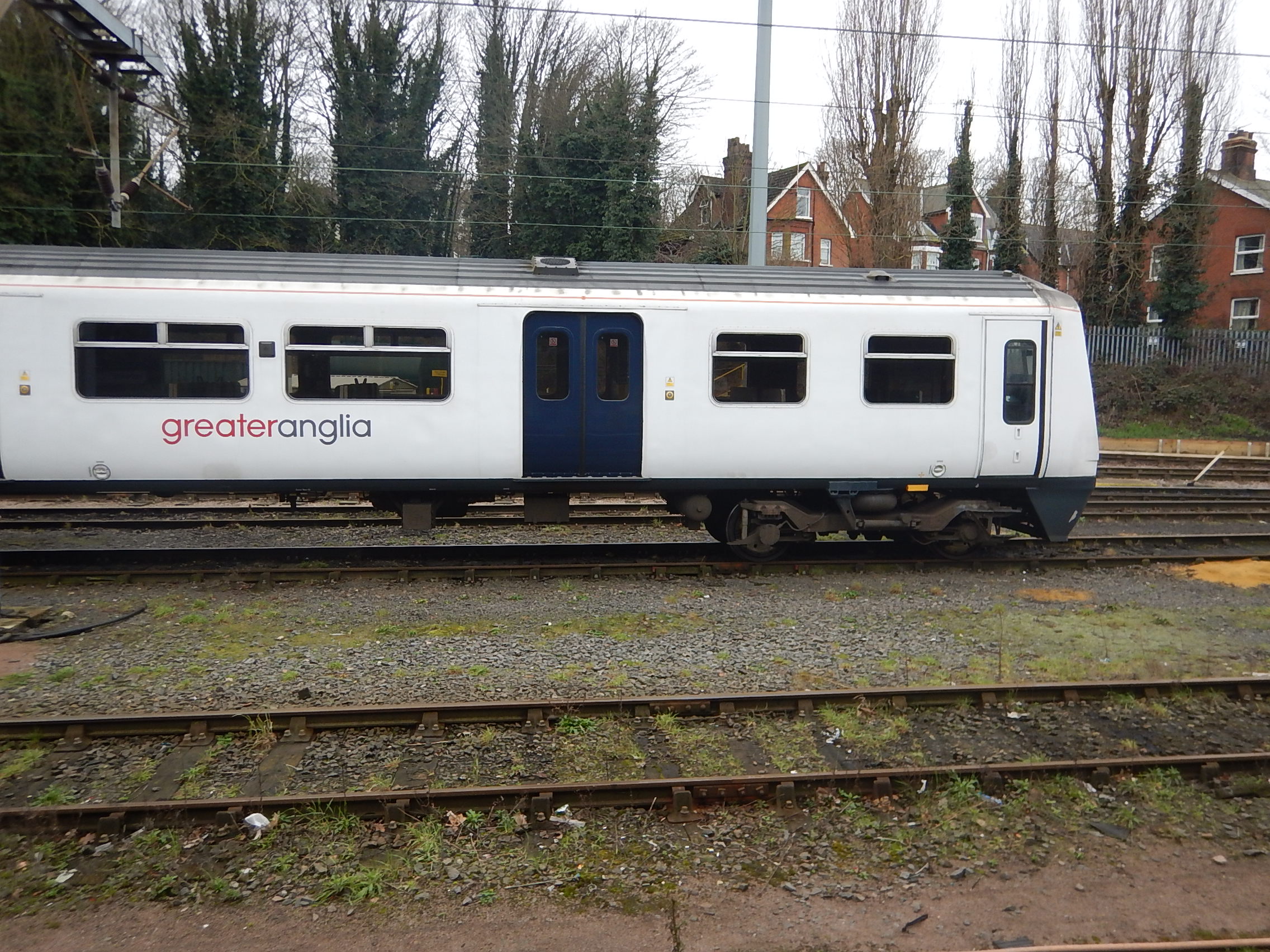
Note the large amount of space underneath.
If the Class 321 train has a problem, when converted to a modern efficient train, it is that the front end of the train has the aerodynamics of a large brick outhouse.
The Electrical System Of A Class 321 Train
I don’t know the electrical system of a Class 321 train, but I do know that of the Class 319 trains, which were built a couple of years earlier in the same factory at York These trains have a 750 VDC bus from one end of the train to the other.
As Class 321 and Class 319 trains have a similar train formation and a common Mark 3 heritage, I suspect that the electrical systems are the same and both have this 750 VDC bus.
Regenerative Braking
Regenerative braking is an important part of any modern train, as it saves energy.
Normally, the energy generated as a train stops, is returned through the electrification to power other nearby trains.
But with a hydrogen-powered train, that may not be connected to the electrification, the energy has to be stored on the train to avoid being wasted.
The Alstom Coradia iLint Train
Alstom have developed a hydrogen-powered version of the Coradia Lint train, which they call an iLint.
This promotional video shows how Alsthom’s hydrogen-powered Coradia iLint works.
<span class=”embed-youtube”></span>
Summarising, Alstom’s video the Coradia iLint works in the following way.
- The hydrogen fuel cell turns hydrogen gas into electricity.
- The electricity is used to power the train or is stored in a lithium-ion battery.
- The computer on the train monitors the system and controls it in an intelligent manner.
I wouldn’t be surprised to find out the system works in the same way as a serial hybrid vehicle like a New Routemaster bus.
- The power source; hydrogen fuel cell in the train or small diesel generator in the New Routemaster, charges the battery directly.
- The power source shuts down automatically, when the charge in the battery reaches a certain high level.
- The power source starts up automatically, when the charge in the battery reaches a certain low level.
- The battery moves the vehicle using one or more electric traction motors.
- The battery powers all the other systems in the vehicle.
- When the vehicle brakes, the traction motors generate electricity, which is stored in the battery.
The great advantage of this system is its simplicity, as the vehicle is effectively powered from a single source; the battery.
There is also an independently-controlled charging system for the battery.
A Possible Layout For A Hydrogen Powered Class 321 Train
Hydrogen powered trains need the following components.
- Hydrogen tank.
- Fuel cell to convert hydrogen to electricity.
- Battery to store energy from both the fuel cell and regenerative braking.
- Intelligent control system to control everything.
Positioning the last item shouldn’t be a problem, but could the other three larger components be placed under the train?
There’s certainly plenty of space under the two driving cars.
The battery would be connected to the following.
- The 750 VDC bus to power the train.
- The regenerative braking system.
- The hydrogen fuel cell.
The train’s computer would control the systems intelligently.
Powering The Class 321 Train From Electrification
Class 321 trains were designed as electric trains and I’m certain they could be made to run on 25 KVAC overhead or 750 VDC third rail electrification.
The electrically similar Class 319 trains are being converted into bi-mode Class 769 trains, so I wouldn’t be surprised to see the hydrogen-powered Class 321 trains being able to use electrification directly.
The Battery Size
How large would a battery need to be to store energy from both the fuel cell and regenerative braking?
I will start by calculating the kinetic energy of a Class 321 train, as the battery must be able to store all the energy generated by regenerative braking, when the train stops in a station from an operating speed of up to 100 mph.
- A Class 321 train weighs 137.9 tonnes
- A train can accommodate a total of about 320 seated and standing passengers.
- With bags, buggies and the other things passengers bring on, let’s assume an average passenger weight of 90 kg, which gives an extra 28.8 tonnes.
- I will assume a total weight of ten tonnes for the battery, hydrogen fuel cell and hydrogen tank
- So I will assume that an in service Class 321 train weighs 176.7 tonnes.
Calculating the kinetic energy of the train for various speeds gives.
- 50 mph – 12.3 kWh
- 75 mph – 28 kWh
- 90 mph – 40 kWh
- 100 mph – 49 kWh
Note that speed increases the kinetic energy much more than weight. This is because kinetic energy is proportional to the square of the speed and only proportional to the weight.
Even if the extra equipment weighed twenty tonnes, the kinetic energy at 100 mph only increases to 51.8 kWh.
As the battery will have to store this energy after a stop from 100 mph, I suspect that the battery will have a capacity somewhere between 50 and 100 kWh.
A Bombardier Primove 50 kWh battery, which is built to power trams and trains, has the following characteristics.
- A weight of under a tonne.
- Dimensions of under two x one x half metres.
- The height is the smallest dimension, which must help installation under the train floor or on the roof.
I conclude that Alstom won’t have any problems designing a battery with sufficient capacity, that can be fitted under the floor of a Class 321 train.
The Train Will Need An Intelligent Computer System
The hydrogen-powered Class 321 train could have up to four methods of charging the battery.
- From 25 KVAC overhead electrification
- From 750 VDC third rail electrification
- From the hydrogen fuel cell.
- From regenerative braking.
The computer would try to ensure the following.
- There was always spare capacity in the battery to accept the energy from regenerative braking.
- Trains stop in a station with a full battery.
- Hydrogen consumption is minimised.
The computer might even be programmed with the route and use GPS or digital signalling to optimise the train to that route.
It’s all very basic Control Engineering.
Alstom’s Marketing Philosophy
Watch Alstom’s video embedded in this post and they stress the environmental credentials of hydrogen power and particularly the Cordadia iLint.
They also show a caption which states that 195 states have made a commitment to zero carbon emissions.
That could be a very big market
The Coradia iLint will probably be a good train, but I suspect it may have a few problems satisfying a large market.
- It is only two cars.
- The current design can’t work on overhead electric power.
- It is based on a Lint 54, which has only 160 seats.
- Operating speed is 140 kph.
- They are new trains and manufacturing may be expensive.
On the other hand, Class 321 trains have the following characteristics.
- They are four car trains.
- The trains can work from 25 KVAC overhead electrification.
- The trains are built to a smaller loading gauge than the iLint.
- I suspect that they could be easily converted to other overhead and third-rail electrification voltages.
- Each train has 309 seats.
- Operating speed is 160 kph.
- They are existing trains and manufacturing may be more affordable.
It should also be said, that there is a massive amount of knowledge accumulated in the UK over thirty and more years, about how to refurbish, modify and update Mark 3-based rolling stock.
Once the concept of a hydrogen-powered Class 321 train is proven and certified, Alstom would probably be able to produce four-car hydrogen-powered trains at a fair rate, as they become available from Greater Anglia.
Conclusion
I have come to the following conclusions.
- The Class 321 train will make a good hydrogen-powered train.
- Alstom would not have looked at converting a thirty-year-old train to hydrogen power, if they thought it would be less than good.
- British Rail’s design of a 750 VDC bus makes a lot of the engineering easier and enables the train to be tailored for world-wide markets, with different electrification systems and voltages.
- Having two different trains will give Alstom better coverage of an emerging market.
I suspect in a few years time, if the hydrogen project is successful, Alstom will design and manufacture, a whole family of hydrogen-powered trains, with different gauges, capacities and operating speeds.
Retrofitted Hydrogen Fuel Cell EMU Concept Presented
The title of this post is the same as that of this article on Global Rail News, that was published in April 2014.
This is the first two paragraphs.
The possibility of retro-fitting diesel multiple units (DMUs) to run on hydrogen fuel cell technology has been put to the test as part of an RSSB and Network Rail-funded innovation research programme.
Fuel Cell Systems, which has worked alongside the University of Birmingham and Hitachi Rail Europe, says the six-month study has demonstrated the feasibility of installing hydrogen fuel cell technology on DMUs as an alternative to electrification.
It strikes me that some serious people are involved in this project.
The report on the project was published in June 2016 and it is stored here on the University pf Birmingham web site.
The Hydrogen Train Of The Future Is A Lot Like The Train Of Today
The title of this post, is the same as that of this article on engardget.
It is an article worth reading ass it gives details of the philosophy of the guy behind the concept; Dr. Jörg Nikutta.
Hydrogen Trains Herald New Steam Age
The title of this post is the same as that of an article on nearly half of Page 4 of today’s Sunday Times.
When I saw the article with its large graphic showing the working of a hydrogen train, the train seemed rather familiar.
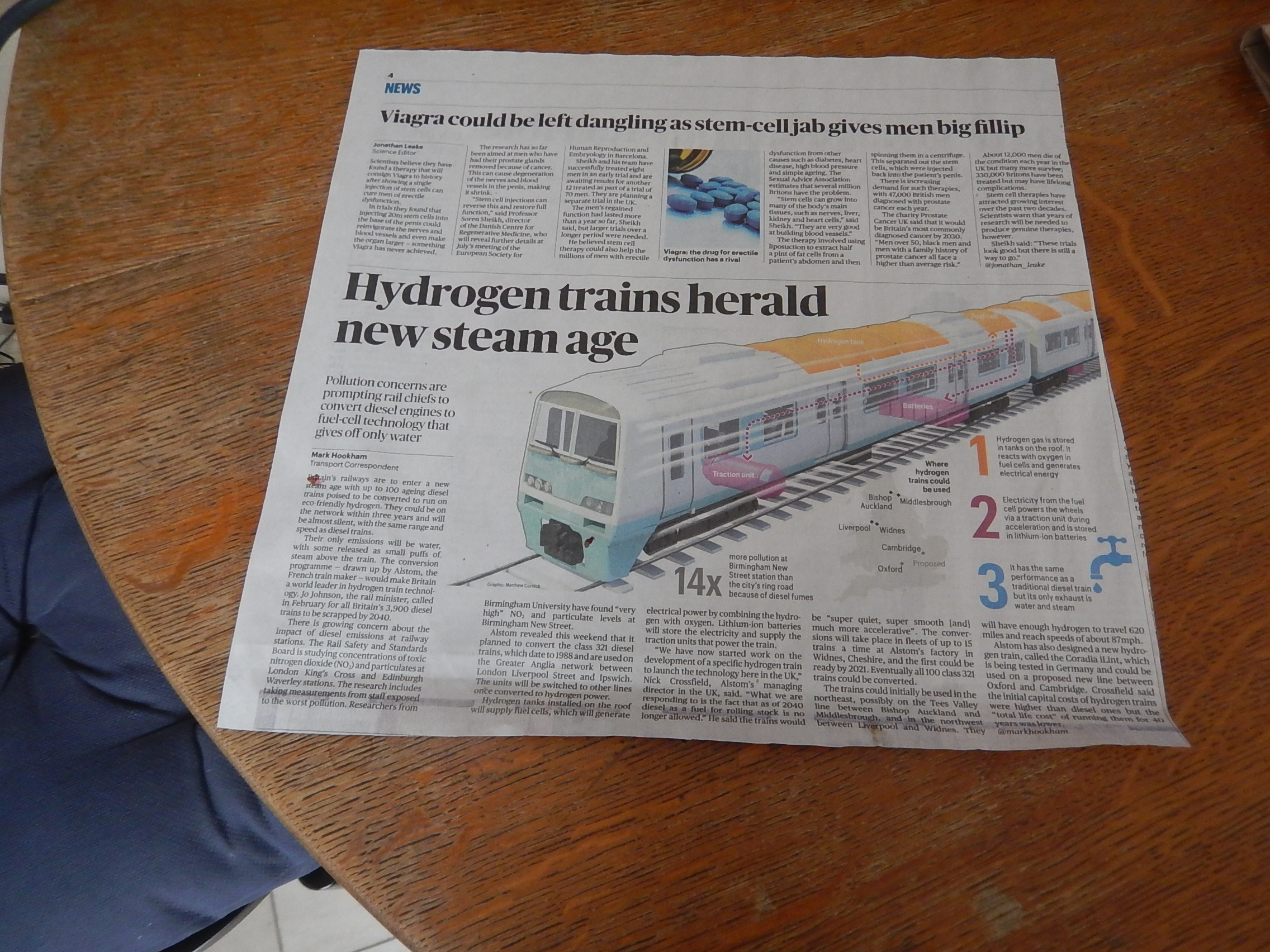
The leaning back front of the train with its two windows and the corrugated roof looked like a Class 321 train.
The large orange area on the roof is the hydrogen tank and the smaller one is the hydrogen fuel cell.
This is a paragraph from the article.
Alstom revealed this weekend that it planned to convert the Class 321 diesel trains, which date to 1988 and are used on the Greater Anglia network between London Liverpool Street and Ipswich. The units will be switched to other lines once converted to hydrogen power.
I suspect Mark Hookham, who wrote the article, has already been told by ninety percent of the train enthusiasts in this country, that Class 321 trains are electric multiple units.
This picture shows the first car of a Class 321 train in the sidings at Ipswich.
Note all the space, under the train, which would be an ideal place for the batteries and traction control, that are shown in that position, in pink, in the Sunday Times graphic.
But there are other reasons, why Class 321 trains may be ideal to convert to hydrogen power.
- Although they are thirty years old, they are a modern train, which meet all the latest regulations.
- They have a 100 mph operating speed on electricity.
- They operate on 25 KVAC overhead electrification.
- There are a hundred and seventeen four-car trains.
- Greater Anglia will be replacing over a hundred Class 321 trains, with new Class 720 trains in the next two years.
- A number of Greater Anglia’s trains have been upgraded to Class 321 Renatus. These trains are a substantial upgrade over the standard train..
- Greater Anglia’s trains appear to be in good condition.
- Designs have been tested to upgrade the traction motors and drive systems of the trains.
But most importantly, the trains are based on the Mark 3 coach, which gives the following advantages.
- An excellent ride and superb brakes.
- Bodies with a legendary strength and toughness.
- There is a vast amount of knowledge in the UK rail industry, that enables the trains to be kept at peak performance.
I doubt, that you could find a better fleet of a hundred trains to convert to hydrogen power anywhere in the world.
The article says or indicates the following.
- Hydrogen tanks will be mounted on the roof.
- An Alstom spokesman is quoted as saying. “We have now started work on the development of a specific hydrogen train to launch the technology here in the UK.”
- He also said that the trains would be super quiet, super smooth and much more accelerative. I assume that is compared to diesel.
- Conversion will take place in fleets of up to 15 trains a time at Alstom’s factory in Widnes.
- The first train could be ready by 2021.
- Eventually, all Class 321 trains could be converted.
- Initial routes could be on the Tees Valley Line and between Liverpool and Widnes.
- Range on a tank of hydrogen will be 620 miles.
- Top speed would be about 87 mph.
The article finishes with a quote from Alstom’s spokesman. “The initial capital costs of hydrogen trains were higher than diesel ones, but the “total life cost” of running them for 40 years was lower.”
I have my thoughts on various things said and not said in the article.
Alstom’s Widnes Factory
Alstom’s Widnes factory has just upgraded, Virgin Trains, fleet of Class 390 trains, so it does seem capable of handling heavy work on a number of trains at one time.
Train Certification
All trains have to be certified, as to being safe and compatible to run on the UK rail network.
Converting an existing train, must make this process a lot easier, especially as many of the hydrogen components and batteries have been used on trains in the EU.
The Proposed Routes
The routes named in the article are in the North East and North West of England, where hydrogen could be readily available from the petrochemical works, so fuelling the trains may not be a problem.
Power Supply
Class 321 trains were only built to work on lines with 25 KVAC overhead wires, but I suspect the parts exist to enable them to run on 750 VDC third-rail lines, if needed.
INEOS
INEOS is a very large multi-national petrochemical company, with a multi-billion pound turnover, which is sixty percent owned by Jim Ratcliffe, who has just been named the UK’s richest man.
So why would a company like that be involved in hydrogen-powered trains?
This news item from Reuters, is entitled AFC In Hydrogen Power Generation Deal With INEOS.
This is the first two paragraphs.
British budget fuel cell maker AFC Energy has signed a deal with British petrochemicals company INEOS to produce electricity using the hydrogen given off in chlorine manufacturing.
AFC said the project with INEOS ChlorVinyls would use surplus hydrogen from the chemical firm’s Runcorn facility in north-west England to supplement the plant’s energy needs.
I used to know the Runcorn plant well, when I worked there for ICI in the 1960s.
The hydrogen was produced when brine was electrolysed to produce chlorine.
So does Jim Ratcliffe, who is a qualified Chemical Engineer, see an opportunity to sell the by-product as train fuel to his neighbour; Alstom, on the other side of the Mersey?
Obviously, I don’t know what Jim Ratcliffe and INEOS are thinking.
But consider.
- The Sunday Times article says that the North West and the North East of England are two promising areas for hydrogen-powered trains.
- INEOS has large petrochemical plants on the Mersey and Teeside.
- I wonder how many plants owned by INEOS around the world have a surplus of hydrogen.
- Alstom would probably like to sell hydrogen-powered trains everywhere.
- A well-respected chemical engineer, once told me, that the only things that should go out of an integrated petrochemical plant is product that someone pays for, air and water.
As the other place in the UK, where INEOS have a large petrochemical plant is Grangemouth in Central Scotland, I wonder, if we’ll see hydrogen-powered trains North of the Border.
Availability of Hydrogen
This article on Process Engineering, which is entitled INEOS project reduces energy bill by £3m, starts with these three paragraphs.
INEOS Chlor is one of the major chlor-alkali and chlorine derivative producers in Europe. Its Runcorn site in north west England has two large chlorine plants: the original J Unit that uses a mercury cell electrolysis process route, and the more recently opened Genesis Membrane Chlorine Plant (MCP).
Continuous improvement of the manufacturing processes has taken the Runcorn site to a ’best in class’ cost base and environmental performance, and as part of this improvement programme the company wanted to minimise vented hydrogen and maximise the value of this resource at both plants.
Without a significant change in market demand for hydrogen, it was not possible to increase sales to existing customers. The only alternative was to increase the amount used as fuel to power on-site boilers, thereby reducing costs for purchased natural gas.
Burning the hydrogen in on-site boilers.obviously helps to reduce the energy bill, but surely, if the hydrogen could be sold to a local customer, that could be more profitable.
You certainly want to minimise the vented hydrogen!
A few days ago I wrote The Liverpool Manchester Hydrogen Clusters Project, which is a project to create a hydrogen network in the Liverpool Manchester area.
Surplus hydrogen from Runcorn and other placed would be piped around the area to augment the natural gas supply.
This network could supply Alstom’s new hydrogen-powered trains and INEOS have a new market for their surplus hydrogen.
I don’t know the petrochemical industry in the North East, but there are a lot of petrochemical plants and some are owned by INEOS.
Is there a surplus of hydrogen, that could profitably sold as fuel for Alstom’s hydrogen-powered trains. I don’t know!
And then there’s Grangemouth in Scotland! My Scottish agent in the Borderlands, used to work at the INEOS plant in Grangemouth and that had a hydrogen surplus.
Even, if we can’t pipe hydrogen to the various depots for the trains around the country, surely it can be transported by rail!
I think that we may be short of some things in this country, but hydrogen might not be one of them.
Given that Alstom have moved so quickly to start planning conversion of the Class 321 trains, they have probably identified sources of enough hydrogen to power the fleet, even if all are converted, as they hinted at in the Sunday Times article.
Eversholt Rail Group’s Involvement
All the trains are leased from the Eversholt Rail Group, who would probably like to see their assets continue to earn the best return possible.
A few days ago, I wrote Eversholt Joins Very Light Rail Consortium.
These two projects may be at both ends of the rail industry, but I believe, they show the willingness of Eversholt to invest in innovation, rather than allow an asset to drift towards the scrapyard.
The Class 321 Renatus
This page on their web site describes the Class 321 Renatus, which was an upgrade developed by Eversholt in conjunction with Greater Anglia, to improve the trains, whilst waiting for Greater Anglia’s new fleet to be delivered.
These are the listed improvements.
- New air-conditioning and heating systems.
- New, safer seating throughout
- Larger vestibules for improved boarding and alighting
- Wi-Fi enabled for passengers and operator
- Improved space allocation for buggies, bicycles and luggage
- Passenger power sockets throughout
- New, energy efficient lighting
- One PRM compliant toilet and a second controlled emission toilet on each unit
- Complete renewal and remodelling of all interior surfaces.
It would be a better interior than most British Rail-era trains.
Comparison With The Class 769 Train
The proposed hydrogen-powered Class 321 train, will inevitably be compared with Porterbrook‘s Class 769 train, which is a bi-mode upgrade of the Class 319 train.
Looking at operating speed on electricity and alternative fuel we find.
- Both trains can operate at 100 mph on lines with 25 KVAC overhead electrification.
- The Class 769 train can also operate at 100 mph on lines with 750 VDC third-rail electrification.
- According to the Sunday Times article, the Class 321 Hydrogen train can operate at about 87 mph on hydrogen.
- According to this article in Rail Magazine, the Class 769 train can operate at 91-92 mph on diesel.
So in terms of operating speed, the trains are more of less comparable, but emissions will be better with the hydrogen-powered train.
When it comes to interiors, as both trains are Mark 3-based, designed around the same time, train operating companies will have what their budget allows.
In the end the choice will come down to cost, which will surely be higher for the Class 321 Hydrogen, as this will require more expensive modifications and additional infrastructure for refuelling the train.
Could Any Other Trains Be Converted?
There are various other classes of electric multiple unit based on the Mark 3 coach.
I think there could be good reasons to only convert trains with the following characteristics.
- Four-cars or more.
- 100 mph capability
- Perhaps fifty or more trains to convert.
These rules would leave us with only the seventy-two Class 317 trains, many of which have been refurbished and are in very good condition.
Conclusion
I’m drawn to the conclusion, that Alstom and Eversholt are serious about producing hydrogen-powered trains for the UK.
I also think, they’ve identified enough hydrogen to power the whole fleet, if it’s converted.
Tendering Begins For German Hydrogen Train Order
The title of this post is the same as that of this article in the International Railway Journal.
This is the first paragraph.
Rhine-Main Vehicle Management (Fahma), a subsidiary of Rhine-Main Transport Authority (RMV), published a tender notice in the Official Journal of the European Union on April 20 for a contract to supply a fleet of hydrogen fuel cell multiple units for regional services on non-electrified lines in the Taunus area of Hessen.
But then the Germans seem to be much easier to use gases of various types to solve problems, than other countries.
I’ve spoken about hydrogen trains to people in Germany and the UK and the Germans are more enthusiastic, whereas the Brits just question hydrogen’s ability to catch fire.
Perhaps, Gemans teach chemistry better?
Who knows? But the orders for hydrogen trains keep coming.
Routes For Bombardier’s 125 Mph Bi-Mode Aventra
This article in Rail Magazine, is entitled Bombardier Bi-Mode Aventra To Feature Battery Power.
A few points from the article.
- Development has already started.
- Battery power could be used for Last-Mile applications.
- The bi-mode would have a maximum speed of 125 mph under both electric and diesel power.
- The trains will be built at Derby.
- Bombardier’s spokesman said that the ambience will be better, than other bi-modes.
- Export of trains is a possibility.
Bombardier’s spokesman also said, that they have offered the train to three new franchises. East Midlands, West Coast Partnership and CrossCountry.
These are my thoughts on these franchises.
Bi-Mode And Pure Electric
I’m pretty certain that if you want to create a 125 mph bi-mode train, you start with a 125 mph electric train, if you want a high degree of commonality between the two trains.
Hitachi have a whole family of Class 800 trains, each of which has a different specification for the diesel power. Even the pure-electric Class 801 trains, has one diesel engine for emergencies.
An electric train with batteries could be very efficient, if the batteries were used to handle regenerative braking and boost the trains, where more power is required.
East Midlands
It is no surprise that Bombardier are talking to the groups, that are bidding to become the new franchise holder for the East Nidlands, when it is awarded in April 2019.
They wouldn’t want to see another company’s product roaring past the factory.
The proposed bi-mode Aventra will probably have been designed very much with the Midland Main Line in mind.
- The Midland Main Line will be electrified from St. Pancras to Kettering and Corby.
- Will the fast lines be electrified to Glendon Junction, where the Corby Branch joins the Midland Main Line?
- The route between St. Pancras and Glendon Junction is being upgraded to four tracks, with as much 125 mph running as possible.
- The non-stop nature of Midland Main Line services South of Kettering could be significant.
- North of Kettering, there is currently no electrification.
- The development of Toton station for HS2 is being accelerated and there could be an island of electrification here, by the mid-2020s.
- If HS2 shares the Midland Main Line corridor between Toton and Sheffield, this section could be electrified by the late-2020s.
Over the next decade, there will be more electrification and a greater proportion of the route, where 125 mph running will be possible.
There has been a bit of controversy, that the number of stops the franchise will make at Bedford and Luton is being reduced after May this year.
The reason given is that it will enable faster services to Derby, Nottingham and Sheffield.
North To Derby, Nottingham and Sheffield
Consider a bi-mode train with batteries going North.
- Between St. Pancras and Kettering, it will be at 125 mph for as long as possible.
- The train will also ensure that at Kettering, it has the batteries brim full, sfter charging from the electrification.
- After a stop at Kettering station, if the electrification reached to Glendon Junction, the acceleration would all be electrically-powered.
- Whether it stopped at Kettering or not, the train would pass Glendon Junction at line speed with full batteries.
It’s almost as if the electrification is being used as a catapult to speed the train North.
South From Derby, Nottingham and Sheffield
Being as electrically efficient coming South would be a lot more difficult.
- I suspect that train batteries will be charged at Derby, Nottingham and Sheffield, so they start their journey South with full batteries.
- Using a full battery and assistance from the onboard generator, trains would be accelerated away from the terminii.
- The trains computer would select automatically, whether to use battery or onboard generator power and would harvest all the power from regenerative braking.
- At each stop on the journey, energy would be lost, as regenerative braking systems do not are only between seventy and ninety percent efficient.
- Once at Glendon Junction, the train would raise the pantograph and switch to getting power from the overhead wires.
It’s all about a well-programmed computer on the train, which knows the route, the timetable and battery state so it can switch power sources appropriately.
Electrification
On the other hand, electrification around Toton could make everything easier and more efficient.
With electrification, every little helps.
- Modern trains can raise and lower pantographs, quickly and automatically.
- Faster journeys.
- Lower carbon emissions.
- Less noise and vibration from diesel generators.
Everyone’s a winner.
Oakham To Kettering
The Oakham-Kettering Line to Corby station is being electrified, double-tracked and I suspect speed limits will be raised.
Speed limits are also being raised and track improvements are being done, South of Glendon Junction.
Currently, services take seventy minutes. With the 125 mph Aventras on the route, they will not need to use the onboard generator, but surely the journey time could be reduced to under an hour, which would attract passengers and need less trains to run a two trains per hour (tph) service.
The Oakham Problem
Oakham station is in the middle of the town, as this Google Map shows.

The Department for transport would like to see more services to the town and the next station of Melton Mowbray.
But the line through the station is busy with freight trains and there is a level crossing in the middle of the town.
125 mph bi-mode trains, won’t help with the problem of Oakham.
Joining And Splitting Of Trains
There is also the possibility of joining and splitting trains.
Hitachi’s Class 800 trains can do this and I’m sure bi-mode Aventras will be able to do this automatically.
There is only four platforms available for trains on the Midland Main Line at St. Pancras and regularly two trains occupy one platform.
The ability to run a pair of bi-mode trains, that joined and split could be a great asset.
Liverpool To Norwich
This long route is an important one for those, who live near its stations. It is usually served by one or two Class 158 trains, which are often very crowded.
The route is partially electrified.
- Liverpool to Hunts Cross
- Manchester Oxford Road to Stockport
- Grantham to Peterborough
- Around Ely
- Around Norwich
So there should be plenty of places to raise the pantograph and charge the batteries.
It is a typical long-distance route for the UK and I’m sure it would benefit from 125 mph bi-mode Aventras.
West Coast Partnership
Bids for the West Coast Partnership, which will run services on the West Coast Main Line and HS2, will be submitted by July 2018. The winning bidder will be announced in May 2019 and take over services two months later.
A modern 125 mph bi-mode would be an ideal replacement for the current twenty Class 221 trains, that work on the West Coast Main Line.
These Class 221 trains are.
- Diesel powered.
- Five-cars long.
- Built in 2001-2002 by Bombardier.
- 125 mph capable.
- Some services are run by splitting and joining trains.
But most importantly, most services are run substantially under wires.
New 125 mph bi-mode trains would certainly improve services.
- Several of the current services operated by Class 221 trains, would become electric ones.
- How much faster would they be able to run a service between London Euston and Holyhead?
- They would also be able to run new services to places like Barrow. Blackburn and Huddersfield.
- Five cars could be a convenient train size for the operator.
But above all, they would offer a better passenger experience, with less noise and vibration from the diesel engines.
The longest section of running using onboard power of a bi-mode Aventra will be along the North Wales Coast Line to Holyhead.
- The line has an 90 mph operating speed.
- The line is 85 miles long.
- The gradients won’t be too challenging, as the line runs along the coast.
- Services stop up to half-a-dozen times on the route.
- From London to Crewe is electrified.
- The section between Crewe and Chester may be electrified.
It looks to be an ideal route for a 125 mph bi-mode Aventra.
As the route appears to not be as challenging as the Midland Main Line, could this route, be the ideal test route for a hydrogen fuel-cell powered Aventra.
West Coast Partnership may well have plans to use 125 mph bi-mode trains as feeder services for HS2’s hubs at Birmingham and Crewe.
I could certainly see West Coast Partnership ordering a mixed fleet of 125 mph Aventras, some of which would be bi-modes and some pure electric.
CrossCountry
CrossCountry has a diverse portfolio of routes, which have every characteristic possible.
- Some are lines with a 125 mph operating speed.
- Some are electrified with 25 KVAC overhead wires.
- Some are electrified with 750 VDC third-rail.
- Some are not electrified.
A bi-mode train with these characteristics would fit well.
- 125 mph capability on both electric and diesel power.
- Battery power for short branch lines.
- Modern passenger facilities.
- Five-cars.
- Ability to work in pairs.
They could actually go for a homogeneous fleet, if they felt so inclined.
That would be a substantial fleet of upwards of fifty five-car trains.
The new CrossCountry franchise will be awarded in August 2019 and start in December 2019.
Other Routes
If the 125 bi-mode Aventra with batteries is built, there could be other routes.
Borders Railway
Why would you run a 125 mph bi-mode Aventra on the 90 mph Borders Railway?
- The Borders Railway will be extended to Carlisle, which will mean, that both ends will be electrified for a few miles.
- This will mean that bi-mode trains with batteries could charge their batteries at both ends of the line.
- If traffic increases, extra cars can be added.
- The trains would be able to use the West Coast Main Line to link the Lake District to Edinburgh.
- They could be given a tourism-friendly interior, to go with the large windows common to all Aventras.
The trains would help to develop tourism in the South of Scotland and the North of England.
East West Rail
The East West Rail between Oxford and Cambridge is going to built without electrification.
- But that doesn’t mean that it should be built with an operating speed in the region of 90 mph!
- The legendary InterCity 125s have been running on lines without electrification at 125 mph since the late 1970s, so it isn’t an unknown practice.
So if the line were to be built for high speed across some of the flattest parts of England, why not unleash the 125 mph bi-mode Aventras?
They could serve Ipswich, Norwich and Yarmouth in the East using their onboard generators.
They could serve Bournemouth, Bristol, Reading and Southampton, if the trains had a dual-voltage capability.
They could use electrification at Bedford, Bletchley, Cambridge and Reading to charge the batteries.
Settle-Carlisle Line
Surely, if the 125 mph bi-mode Aventras are suitable for the Borders Railway, then it should be able to work the Settle-Carlisle Line.
- Both ends of the line are electrified, so batteries could be charged.
- The line needs more and better services.
But the main reason, is that there will be a high-class scenic route between Edinburgh and Leeds.
I estimate that a London to Edinburgh service via Leeds, Settle, Carlisle and the Borders Railway would take six and a half hours, using a 125 mph bi-mode Aventra.
Some tourists love that sort of trip.
Waterloo To Exeter
The West of England Line has the following characteristics.
- It runs between Basingstoke and Exeter.
- It is a hundred and twenty miles long.
- It has a 90 mph operating speed.
- The line is not electrified.
- It is connected to the electrified South Western Main Line to Waterloo.
- The route is electrified between Waterloo and Basingstoke.
- Direct trains take three hours twenty-three minutes between Waterloo and Exeter, with fourteen stops between Basingstoke and Exeter.
- The trains used on the route are twenty-five year-old Class 159 trains.
Would a 125 mph bi-mode Aventra improve the passenger service between Waterloo and Exeter?
- The Aventras are built for fast dwell times at stations, so there could be time saving with all those stops.
- The Aventras could use the third-rail electrification between Waterloo and Basingstoke.
- There may be places, where the operating speed can be increased and the faster Aventras would take advantage.
- The trains could have a passenger-friendly interior and features designed for the route.
The real benefits for South Western Railway and their passengers would come, if the trains could do Waterloo to Exeter in three hours.
Routes For A Pure-Electric Version
There are several routes in the UK, where the following apply.
- Some long-distance trains are run by 125 mph trains.
- The route is fully- or substantially-electrified.
- A proportion of the route allows 125 mph running.
- Sections of the route is only double-track.
Routes satisfying the criteria include.
- The West Coast Main Line
- The East Coast Main Line
- The Great Western Main Line
- The Midland Main Line
On these routes, I believe it would be advantageous, if all passenger trains were capable of operating at 125 mph.
This is cause if all trains were running at 125 mph, they could be more closely spaced, thus increasing capacity.
Digital signalling would probably be needed.
There are several train services,, that use the electrified 125 mph sections of these routes.
Birmingham/Liverpool/Manchester To Edinburgh/Glasgow
TransPennine Express, are replacing their current Siemens 110 mph Class 350 trains on this service, with new CAF 125 mph Class 397 trains.
Euston To The West Midlands, Liverpool And Preston
West Midland Trains are replacing some of their current Siemens 110 mph Class 350 trains with new Aventras.
Information is scarce at the moment, but could some of these new Aventras be 125 mph units for working on the West Coast Main Line?
Leeds/York To Edinbugh
TransPennine Express run trains on this route.
St. Panvras To Corby
The Corby Branch is being upgraded.
- Double-track
- 125 mph running
- Electrification
The section of the Midland Main Line between St. Pancras and Glendon Junction is also being upgraded to allow as much 125 mph running as possible.
If 125 mph bi-mode trains are to be used from St. Pancras to Derby, Nottingham and Sheffield, then surely, it would be logical to use a pure-electric version of the train between St. Pancras and Corby?
Various documents and web pages say, that the St. Pancras to Corby services are going to be worked by 110 mph Class 387 trains. Surely, faster 125 mph trains, which had been designed for the route would be better for passengers and the train operating company.
From my experience of scheduling, the section of the Midland Main Line between St. Pancras and Bedford, must be a nightmare to timetable successfully.
- There are two train operating companies using the route, who go a hundred miles in different directions.
- The Class 700 trains used by Thameslink are only 100 mph trains, so probably can’t use the fast lines too often, as if they do, they’ll delay the expresses..
- Regular passengers object to any change in stopping patterns or journey times.
- Passengers liked to get on express services at Bedford, but they now don’t stop.
- Passengers don’t like the Class 700 trains.
- Luton Airport wants more services.
My experience, says that something radical must be done.
Consider.
- Plans are for two tph between St. Pancras and Corby.
- How many passengers would complain if they ended up in the St. Pancras Thameslink platforms, rather than the high-level ones? They’re both equally badly connected to the Underground, buses and taxis.
- There will be four tph between Bedford and London all day on Thameslink, with an extra four tph in the Peak.
- Some or all of these services will call at both Luton and Gatwick Airports.
- Looking at the two semi-fast services. which both run at tw trph, they seem to stop virtually everywhere.
I think it would be possible for the two tph St. Pancras to Corby services to become express services between Corby, Gatwick Airport and Brighton.
- The services would only stop at Kettering, Bedford, Luton, Luton Airport Parkway, St. Albans, West Hampstead Thameslink, St. Pancras Thameslink, Farringdon, City Thameslink, Blackfriars, London Bridge and East Croydon.
- The services would use the 125 mph fast lines North of St. Pancras, as much as possible.
- Corby services would always call at St. Pancras Thameslink.
- The trains would be designed for both Airport services and long-distance commuting.
- The trains would be maximum length.
Obviously, this is my rough idea, but something like it might satisfy the stakeholders, more than what is proposed.
I think there are also other services, which are fully electrified, which could be upgraded, so that they would be suitable for or need 125 mph electric trains.
Kings Cross To King’s Lynn
I wrote about this route in Call For ETCS On King’s Lynn Route.
Portsmouth Direct Line
Under Topography Of The Line in the Wikipedia enter for the Portsmouth Direct Line, this is said.
The central part of the route, from Guildford to Havant, runs through relatively thinly populated country. The line was designed on the “undulating principle”; that is, successive relatively steep gradients were accepted to reduce construction cost. In the days of steam operation this made the route difficult for enginemen.
But with.
- A second man in the cab, in the shape of the train’s computer, juggling the power.
- Regenerative braking to the batteries saving energy for reuse when needed.
- Bags of grunt from the traction motors.
The pure electric version of the 125 mph Aventra might just have the beating of the topography.
South Western Railway plan to introduce an older train from Litchurch Lane in Derby on this route, in the shape of the last of the Mark 3s, the Class 442 train or the Wessex Electrics, which were built in the 1980s.
It will be interesting to see how a 125 mph pure electric Aventra compares to something made in the same works, thirty years earlier.
Waterloo To Southampton, Bournemouth and Weymouth
The South Western Main Line goes to Southampton Central, Bournemouth and Weymouth.
- It is a 100 mph line
- It is fully-electrified.
Would a 125 mph pure-electric Aventra be able to put the hammer down?
I’m sure Network Rail can improve the line to a maximum safe line-speed.
Conclusion
If Bombardier build a 125 mph bi-mode Aventra with batteries, there is a large market. Especially, if there is a sibling, which is pure electric.
Mathematics Of A Bi-Mode Aventra With Batteries
This article in Rail Magazine, is entitled Bombardier Bi-Mode Aventra To Feature Battery Power.
A few points from the article.
- Development has already started.
- Battery power could be used for Last-Mile applications.
- The bi-mode would have a maximum speed of 125 mph under both electric and diesel power.
- The trains will be built at Derby.
- Bombardier’s spokesman said that the ambience will be better, than other bi-modes.
- Export of trains is a possibility.
It’s an interesting specification.
Diesel Or Hydrogen Power?
Could the better ambience be, because the train doesn’t use noisy and polluting diesel power, but clean hydrogen?
It’s a possibility, especially as Bombardier are Canadian, as are Ballard, who produce hydrogen fuel-cells with output between 100-200 kW.
Ballard’s fuel cells power some of London’s hydrogen buses.
The New Routemaster hybrid bus is powered by a 138 kW Cummins ISBe diesel engine and uses a 75 kWh lithium-ion battery, with the bus being driven by an electric motor.
If you sit in the back of one of these buses, you can sometimes hear the engine stop and start.
In the following calculations, I’m going to assume that the bi-mode |Aventra with batteries has a power source, that can provide up to 200 kW, in a fully-controlled manner
Ballard can do this power output with hydrogen and I’m sure that to do it with a diesel engine and alternator is not the most difficult problem in the world.
The Mathematics
Let’s look at the mathematics!
I’ll assume the following.
- The train is five cars, with say four motored cars.
- The empty train weighs close to 180 tonnes.
- There are 430 passengers, with an average weight of 80 Kg each.
- This gives a total train weight of 214.4 tonnes.
- The train is travelling at 200 kph or 125 mph.
- A diesel or hydrogen power pack is available that can provide a controllable 200 kW electricity supply.
These figures mean that the kinetic energy of the train is 91.9 kWh. This was calculated using Omni’s Kinetic Energy Calculator.
My preferred battery arrangement would be to put a battery in each motored car of the train, to reduce electrical loses and distribute the weight. Let’s assume four of the five cars have a New Routemaster-sized battery of 55 kWh.
So the total onboard storage of the train could easily be around 200 kWh, which should be more than enough to accommodate the energy generated , when braking from full speed..
I wonder if the operation of a bi-mode with batteries would be something like this.
- The batteries would power everything on the train, including traction, the driver’s systems and the passenger facilities, just as the single battery does on New Routemaster and other hybrid buses.
- The optimum energy level in the batteries would be calculated by the train’s computer, according to route, passenger load and the expected amount of energy that would be recovered by regenerative braking.
- The batteries would be charged when required by the power pack.
- A 200 kW power pack would take twenty-seven minutes to put 91.9 kWh in the batteries.
- In the cruise the power pack would run as required to keep the batteries charged to the optimum level and the train at line speed.
- If the train had to slow down, regenerative braking would be used and the electricity would be stored in the batteries.
- When the train stops at a station, the energy created by regenerative braking is stored in the batteries on the train.
- I suspect that the train’s computer will have managed energy, so that when the train stops, the batteries are as full as possible.
- When moving away from a stop, the train would use the stored battery power and any energy used would be topped up by the power pack.
The crucial operation would be stopping at a station.
- I’ll assume the example train is cruising at 125 mph with an energy of 91.9 kWh.
- The train’s batteries have been charged by the onboard generator, on the run from the previous station.
- But the batteries won’t be completely full, as the train’s computer will have deliberately left spare capacity to accept the expected energy from regenerated braking at the next station.
- At an appropriate distance from the station, the train will start to brake.
- The energy of the train will be transferred to the train’s batteries, by the regenerative braking system.
- If the computer has been well-programmed, the train will now be sitting in the station with fully-charged batteries.
- When the train moves off and accelerates to line speed, the train will use power from the batteries.
- As the battery power level drops, the onboard generator will start up and replace the energy used.
This sequence of operations or something like it will be repeated at each station.
One complication, is that regenerative braking is not one hundred percent efficient, so up to thirty percent can be lost in the braking process. In our example 125mph train, this could be 27.6 kWh.
With an onboard source capable of supplying 200 kW, this would mean the generator would have to run for about eight and a half minutes to replenish the lost power. As most legs on the proposed routes of these trains, are longer than that, there shouldn’t be too much of a problem.
If it sounds complicated, it’s my bad explanation.
This promotional video shows how Alstom’s hydrogen-powered Coradia iLint works.
It looks to me, that Bombardier’s proposed 125 mph bi-mode Aventra will work in a similar way, with respect to the batteries and the computer.
But, Bombardier Only Said Diesel!
The Rail Magazine article didn’t mention hydrogen and said that the train would be able to run at 125 mph on both diesel and electric power.
I have done the calculations assuming that there is a fully-controllable 200 kW power source, which could be diesel or hydrogen based.
British Rail’s Class 150 train from 1984, has two 215 kW Cummns diesel engines, so could a five-car bi-mode train, really be powered by a single modern engine of this size?
The mathematics say yes!
A typical engine would probably weigh about 500 Kg and surely because of its size and power output, it would be much easier to insulate passengers and staff from the noise and vibration.
Conclusion
I am rapidly coming to the conclusion, that a 125 mph bi-mode train is a practical proposition.
- It would need a controllable hydrogen or diesel power-pack, that could deliver up to 200 kW
- Only one power-pack would be needed for a five-car train.
- For a five-car train, a battery capacity of 300 kWh would probably be sufficient.
From my past professional experience, I know that a computer model can be built, that would show the best onboard generator and battery sizes, and possibly a better operating strategy, for both individual routes and train operating companies.
Obviously, Bombardier have better data and more sophisticated calculations than I do.
D-Train Order For Marston Vale Confirmed
The title of this post, is the same as the title of an article in the April 2018 Edition of Modern Railways.
It gives a few more details on the order from West Midlands Trains for three Class 230 trains to provide the service on the Marston Vale Line.
- The trains will be in operation in December 2018
- Two trains will operate the daily service.
- The trains will be diesel-powered.
When the trains come into operation, extra early morning and late-night services will be added from Monday to Saturday.
Battery Prototype
The article also gives more details of the battery prototype.
- The train has four battery rafts, each with a capacity of 106 kWh
- Range is up to fifty miles with a ten minute charge at each end of the journey.
- Range will increase as battery technology improves.
- The train is charged using a patented automatic charging point.
- The batteries will have a seven-year lifespan, backed by a full warranty.
- Battery rafts would appear to be interchangeable with the diesel generators.
- Hydrogen power will be used within the next few years.
The specification seems comprehensive and it would appear there is a high degree of innovative automation and well-thought-out electrical engineering.
Train Energy Consumption
The train has the following characteristics.
- Two cars
- 424 kWh of battery capacity.
- 50 mile range
This gives a consumption 4.24 kWh/per car/per mile.
In an article in the October 2017 Edition of Modern Railways, which is entitled Celling England By The Pound, Ian Walmsley says this in relation to trains running on the Uckfield Branch, which is probably not much more taxing than the Marston Vale Line.
A modern EMU needs between 3 and 5 kWh per vehicle mile for this sort of service.
I am surprised that the Class 230 train lies in the 3-5 kWh range, but then I’m not sure of the weights of the two trains.
I estimate two-car units to weigh as follows.
- Class 230 train plus batteries – Around 50 tonnes.
- Electrostar – Around 90 tonnes
- Aventra – Around 80 tonnes
I shall get some better figures, when I actually see the trains, as the weight is on the side.
The Pop-Up Train
The article talks of the concept of a low-cost pop-up train as a solution for a regional or commuter train.
Export To America?
This pop-up train could be designed to be used to demonstrate rail services in America.
Henry Posner, who is promoting the train in America is quoted as saying cities could use the train to test possible services with passengers on board ‘for less than the cost of a consultant’s study into a possible service’.
These demonstrations will be on freight lines, where for reasons of safety, the passengers trains would run during the day and freight trains at night.
Is America ready for an invasion of remanufactured forty-year-old London Underground D78 Stock trains?
Is Hydrogen The Answer?
This excellent article on Rail Engineer, is a very good analysis of using hydrogen to power trains.
It is also crammed full of facts!

