The East-Facing Bay Platforms At Reading Station
This picture shows the east-facing bay platforms at Reading station.
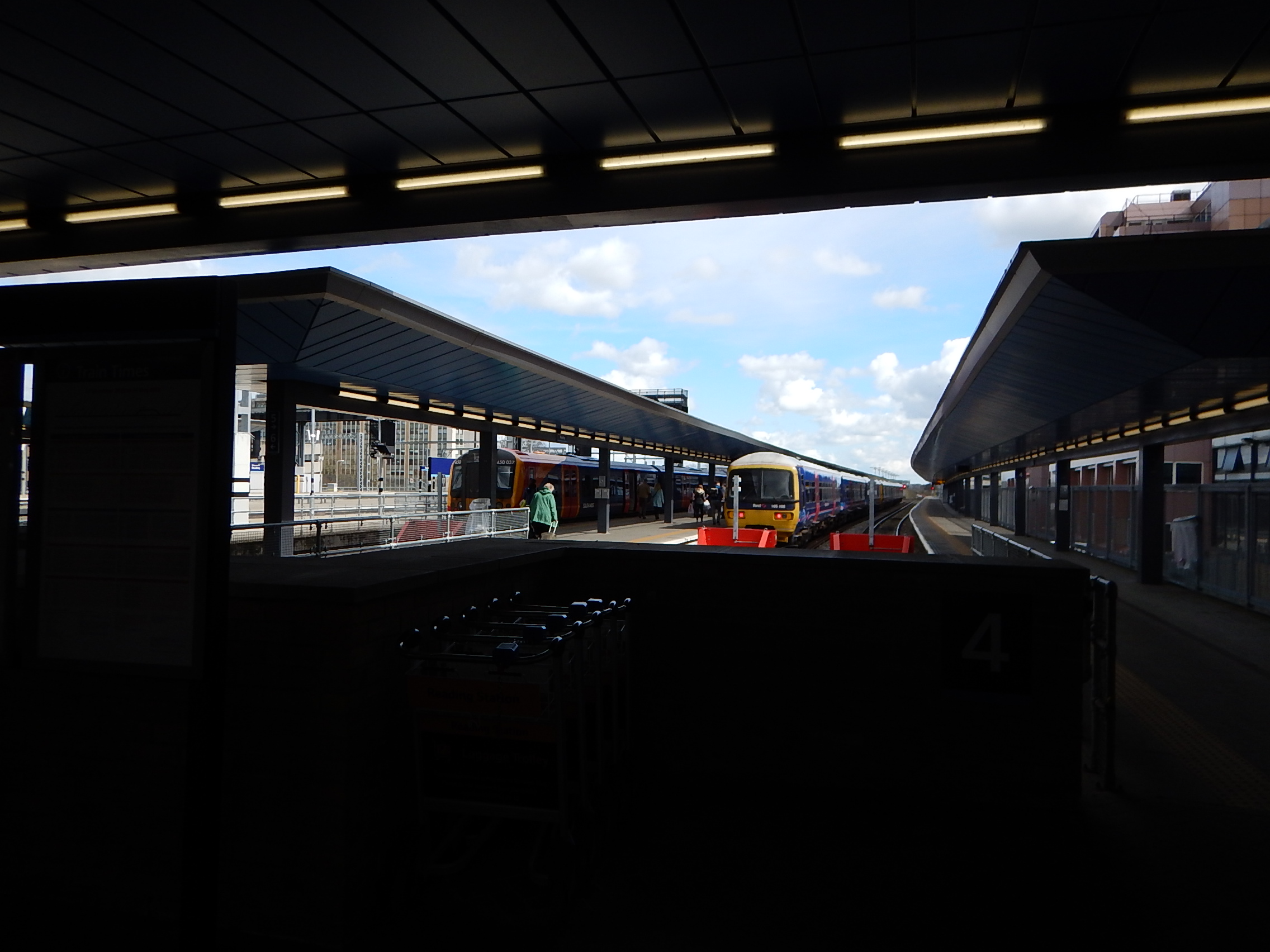
Bay Platforms 4, 5 and 6 At Reading Station
Note that they are numbered 4, 5 and 6 from the right. The train on Platform 5 is a Great Western Railway service for Gatwick Airport via Guildford. with a South West Trains service for Waterloo on Platform 6.
Gatwick Via The North Downs Line
Trains go to Gatwick using the North Downs Line, which is a double-track line effectively in five sections.
- Reading to Wokingham – electrified
- Wokingham to North Camp – not electrified
- North Camp to Shalford Junction – electrified
- Shalford Junction to Reigate – not electrified
- Reigate to Redhill and Gatwick – electrified.
According to Wikipedia, there needs to be work at Redhill and Gatwick Airport stations, but I believe that is underway.
Wikipedia also states that the line has an operative speed of 70 mph. The journey currently takes 76 minutes.
Once Crossrail and Thameslink are fully open, it would surely be quicker to change at Farringdon.
- The fastest journey between Farringdon and Gatwick Airport is now 54 minutes.
- The Crossrail route calculator says that Reading to Farringdon will take 57 minutes.
So that means that at 111 minutes, surprisingly the London route is thirty five minutes slower and needs a change of train.
Note these further points about the North Downs route.
- A well-driven electric train like a 110 mph Class 387 train might even be able to do the journey a few minutes quicker than the current 76 minutes, if the line were to be electrified.
- It is my belief, that the current piecemeal nature of the third-rail electrification would enable a Class 387 IPEMU to run between Reading and Gatwick Airport, using the batteries as required.
- I don’t think the batteries would need charging at the end of the journey, as both ends of the route are electrified.
- The line has ten level crossings, which must speed the trains, if some were removed.
- There must be other track improvements.
- Class 387 trains have also been fitted with an Airport Express interior for Gatwick Express.
- Can an Airport Express be battery-powered? Engineers like me, would say yes, but Marketing Departments would be sceptical.
I believe that ultimately a Class 387 train or an IPEMU with a similar performance could do Reading to Gatwick Airport in an hour, without further electrification.
The West-Facing Bay Platforms At Reading Station
Reading station has three west-facing bay platforms, numbered 1, 2 and 3.
They are used as follows.
- Platforms 1 and 2 for local services to Basingstoke, Newbury and Bedwyn.
- Platform 3 for Cross Country reversing trains.
Whilst I was at Reading yesterday, a Cross Country train reversed in a higher numbered platform.
These are some pictures of the bay platforms.
The View From Above
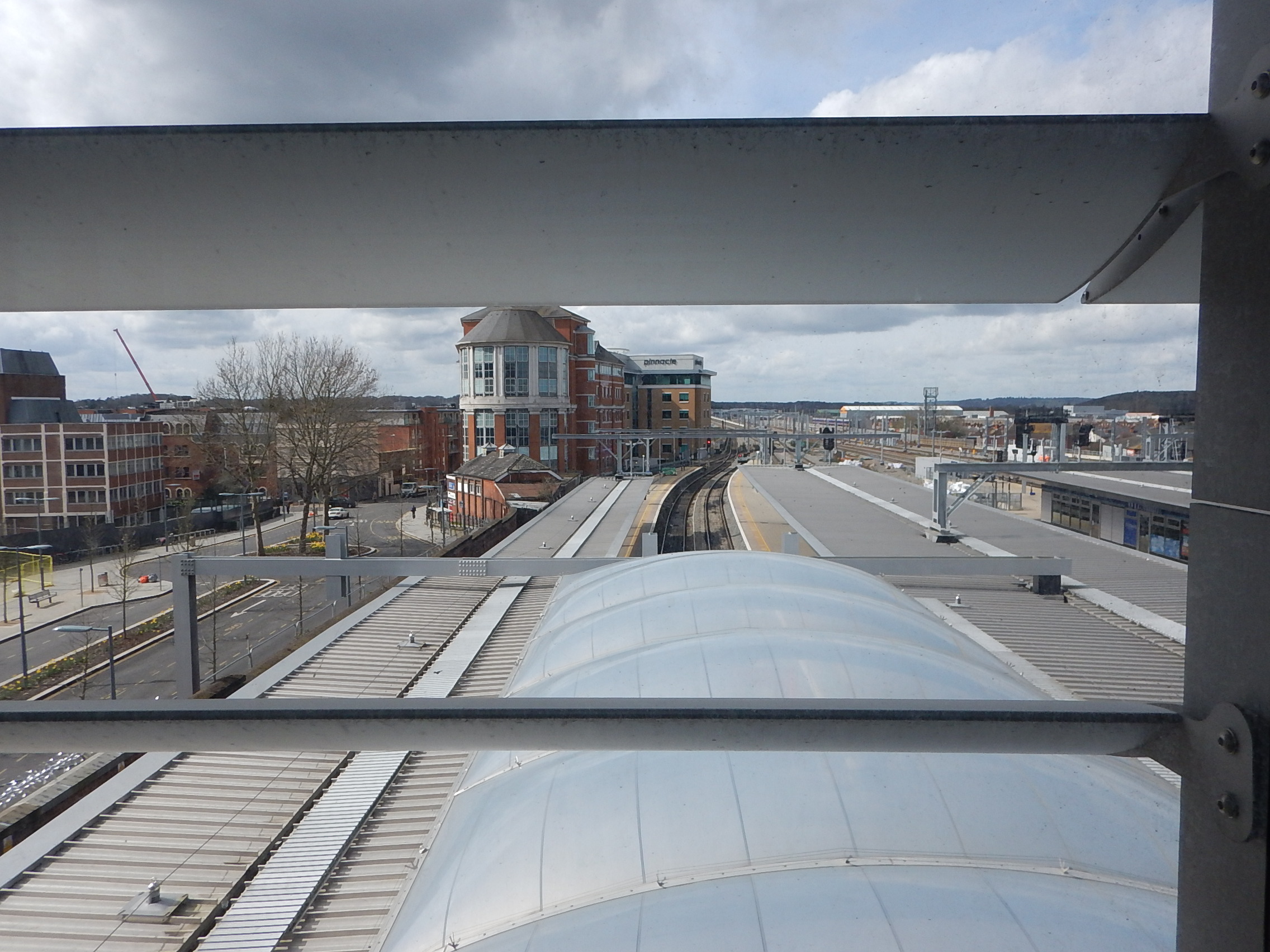
The Layout Of Bay Platforms 1, 2 and 3 At Reading Station
Note that the electrification gantries are in place across the three tracks.
The Platforms From Ground Level
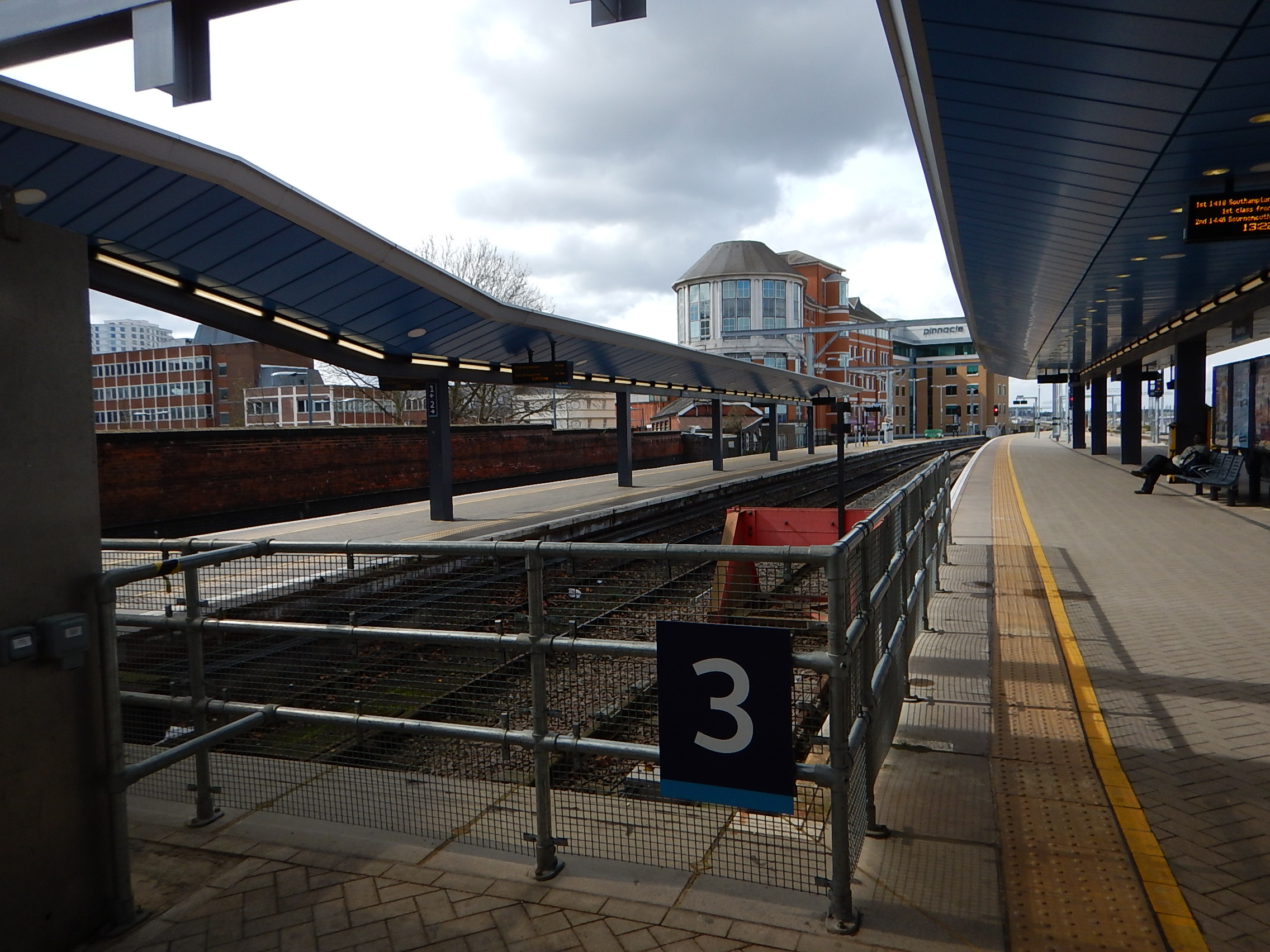
Platforms 1, 2 and 3 At Reading Station
Note how good the access is to the platforms. To the right of Platform 3, is platform 7, which is used for Down trains for the Berks and Hants route and for reversing Cross Country services.
So passengers arriving on a Cross Country train from say Manchester to Bournemouth or Newcastle to Southampton train on Platform 7 have these choices if they need to change trains.
- They could walk across from their train to a local service from platforms 1, 2 or 3.
- They could walk to the other end of the platform and get a local train from the east-facing platforms 4, 5 or 6.
- They could use lifts or escalators to cross the massive bridge to get a train on the Great Western Main Line to London or the West.
- They could also walk across to local services or in future, Crossrail to London.
And of course, they could walk out of the nearby station entrance and get a bus, taxi or their own transport.
Is there a station in the UK, where changing trains comes with so less hassle?
Ready For The Electrification
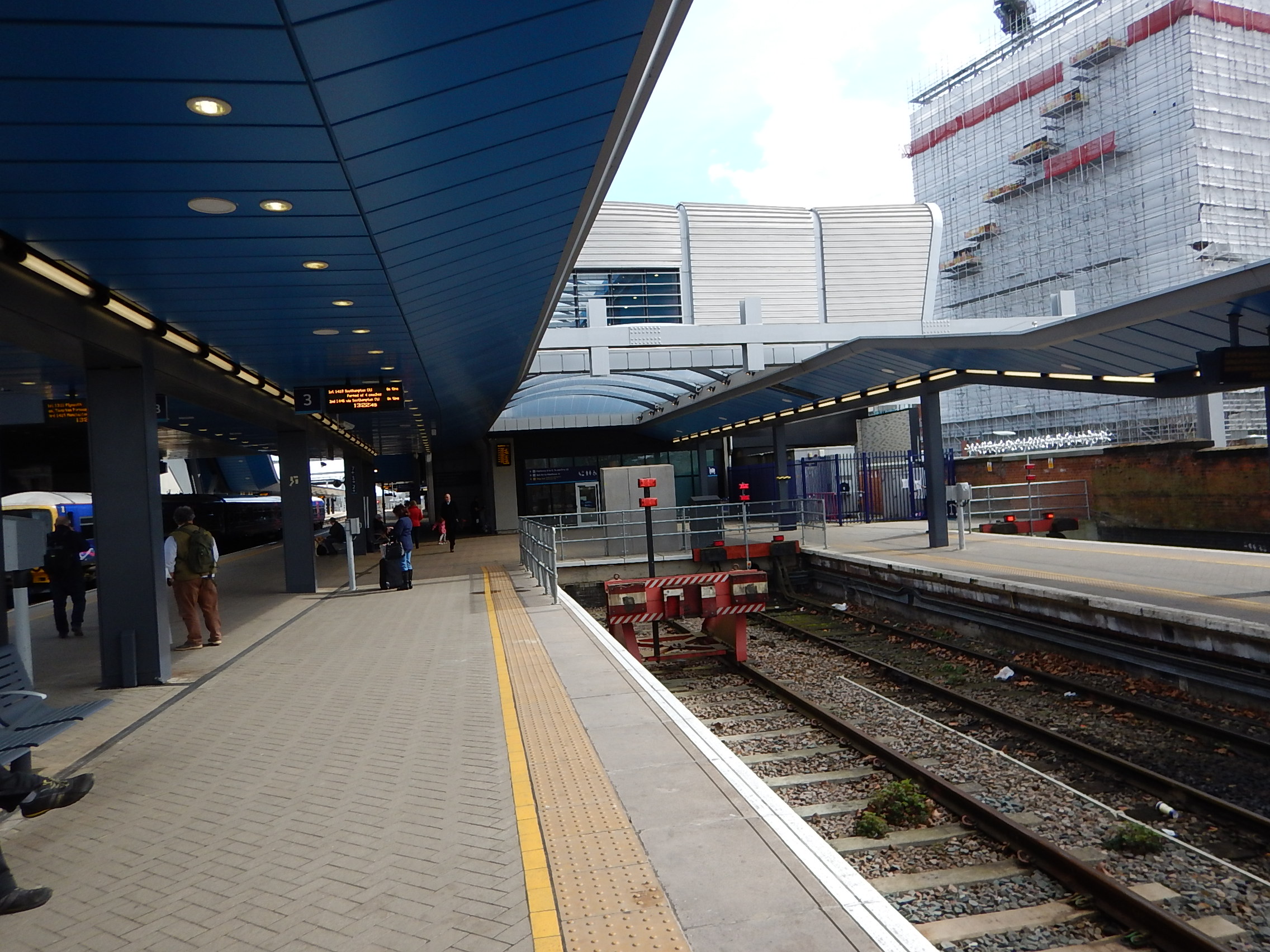
Looking Back At The Buffer End Of The Bay Platforms 1, 2 And 3 At Reading Station
Note that the gantries seem to have been designed into the station and are ready for the wires, with a nice secure steel plate to which to bolt them.
I can’t see the Heritage Taliban arguing about this design of catenery.
The Length Of The Platforms
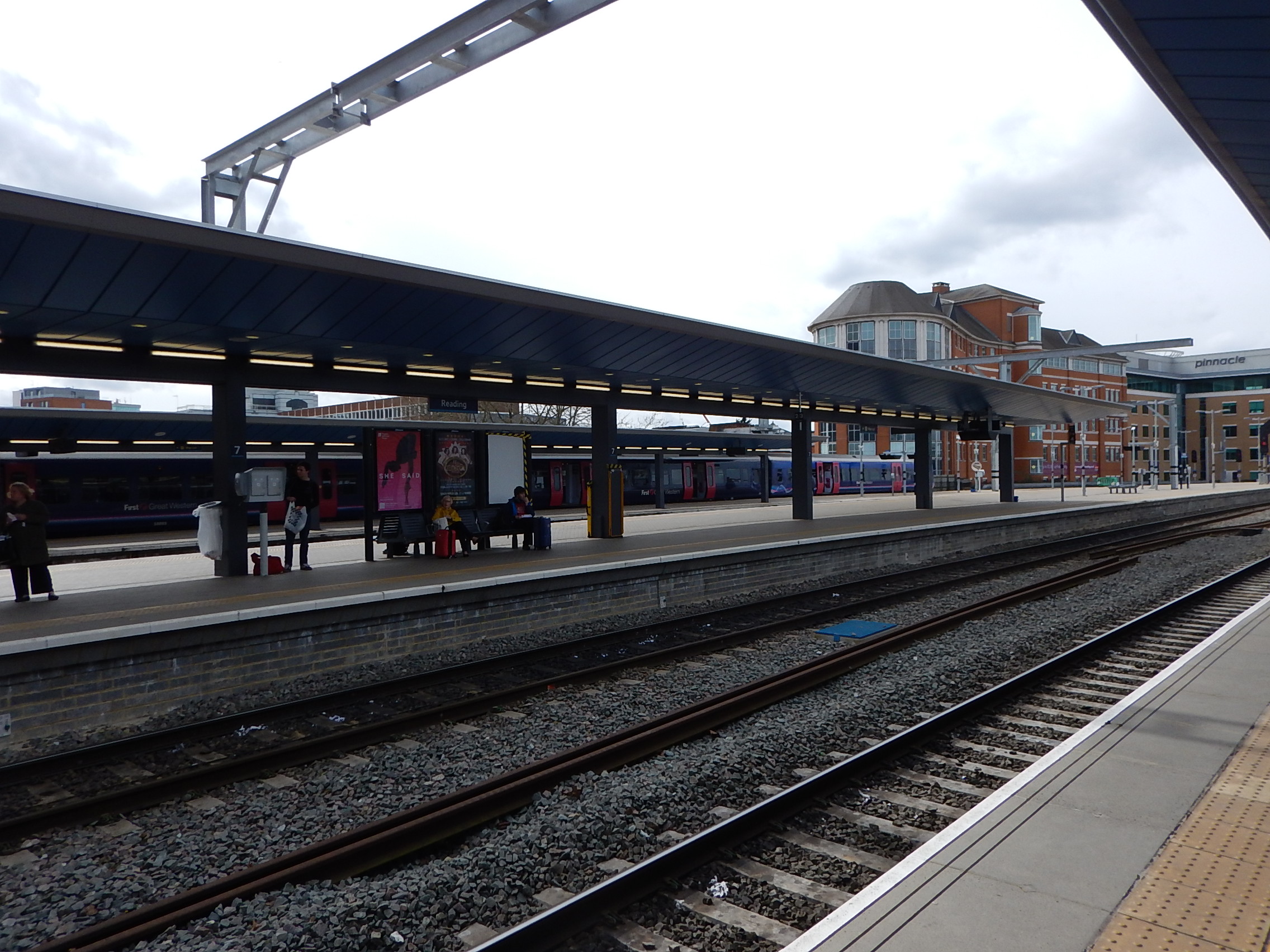
Platform Length Of The Bay Platforms 1, 2 And 3 At Reading Station
Note the three-car diesel multiple unit in the platform. I haven’t measured the platform, but I think they are long enough for a five car Class 800 train.
Future Use Of The Bay Platforms
At I said earlier the three platforms are used for local services to Basingstoke, Newbury and Bedwyn and reversing Cross Country trains., but there are two major purposes for which the bay platforms might be used.
The Test Track for Class 800 Trains
When the electric track between Didcot and Reading has been energised, it will be used as a test track for the new Class 800 trains. This article from the Witney Gazette gives more details.
The first three trains are due to be shipped to the UK early next year to begin an extensive test programme, which will include high-speed running on the line between Didcot and Reading once the installation of overhead electric power cables is completed later next year.
Roger Ford in the April 2016 Edition of Modern Railways said this.
Energisation for test running is now scheduled for September this year.
So will one of the bay platforms be used to reverse the train?
I’ve no idea! But the showman in me, would certainly do it, just for the publicity it would generate!
On a serious side, tests could also be performed on the train/platform/passenger interfaces.
Charging Platforms for IPEMUs
Great Western Railway would probably want to get their Class 387 trains into revenue service as soon as possible.
In the September 2015 edition of Modern Railways, there is an article entitled Class 387s Could Be Battery Powered. This is said.
Delivery as IPEMUs would allow EMUs to make use of as much wiring as is available (and batteries beyond) while electrification pushes ahead under the delayed scheme, and in the longer term would allow units to run on sections not yet authorised for electrification, such as Newbury to Bedwyn. The use of IPEMUs might also hasten the cascade of Class 16x units to the west of the franchise.
To run IPEMUs from Reading to Bedwyn or Basingstoke, would need them to be charged.
These bay platforms would be ideal for charging the trains and would mean that Basingstoke, Bedwyn and Newbury would get electric shuttles to Reading.
Conclusion
The team that designed Reading station, deserve a few gold stars.
Strings Of Class 171 Trains On Test
I took these photographs of four or possibly six of Southern Class 171 trains running in a long formation, just south of South Croydon station
These were probably the units from Scotrail, which are going to be working Southern’s diesel-operated services.
- London Bridge to Uckfield on the Oxted Line
- Hastings to Ashford on the Marshlink Line.
To use these Class 171 trains was the original plan, but I do wonder if these routes will be run using Class 387 IPEMUs.
On the other hand, their may be more important uses for the Class 387 trains, as I wrote about in Are The TOCs Arguing Over The Class 387 Trains?
Or the IPEMUs might not be ready yet?
Who knows?
But whatever happens, someone is going to get a string of Class 171 trains in Southern livery.
The Uckfield Branch Is Almost Ready For Longer Trains
These are some of the pictures, that I took on the Uckfield Branch of the Oxted Line.


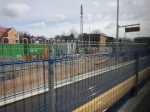
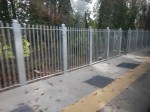


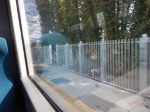

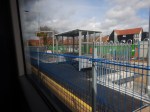





I can’t believe that they’ve spent all this money, just to run an eight, ten or twelve car train formed by formations of Class 171 trains.
Increased Services To Uckfield
On my trip, the line seemed exceedingly busy for one with just a single service an hour. When coming back North, I was passed by a Class 171 train going South, somewhere South of Ashurst station, which prompted me to take the picture of the passing loop.
So it would seem that my observations, ehich also included the sight of a long string of Class 171 trains at South Croydon, could point to Southern testing or training drivers on the line, to see if they can operate a more frequent service to Uckfield. After all, if the service were to be every half-hour to Uckfield, logic says, this would generate more business. They’ve certainly got the capacity at Uckfield with a new station with a long twelve-car platform and a large car park, which is now free to all users at weekends.
There is also an electrified two trains an hour service from East Grinstead to Victoria, which calls at Oxted station. There is probably scope, if you get the service pattern right, to get a two trains per hour service from both Oxted Line termini that serves London Bridge, Victoria and Farringdon for Crossrail, either direct or with one very easy change.
An Uckfield To Oxted Shuttle
Could Southern be planning to link a two train per hour service from Oxted to Uckfield, with the East Grinstead trains, to effectively give passengers on the Uckfield Branch, a two train per hour service to London? Perhaps, they will be using an Oxted to Uckfield shuttle to fill in the gaps between the London trains, as I suspect there aren’t the paths available for all Uckfield trains to go to a London terminus.
There would just be an easy interchange at Oxted or East Croydon.
Timings could be adjusted so that.
- A Southbound Victoria to East Grinstead service would allow cross platform interchange to the Oxted to Uckfield shuttle.
- The Northbound East Grinstead to Victoria service would call at Oxted a couple of minutes after the shuttle arrived.
As Southern know the traffic numbers and passenger behaviour, I’m sure they’ll get the timings right.
The Bay Platform Puzzle At Oxted Station
On Sundays, the service on the Uckfield Branch is just a diesel shuttle between Oxted and Uckfield, with a same platform interchange to the East Grinstead to Victoria service at Hurst Green station.
So why have Network Rail electrified the bay platform at Oxted Station?
There are three possible reasons.
- Network Rail are just future-proofing the Uckfield Branch, so that if it is electrified, they can still run the Sunday shuttle.
- The East Grinstead branch is very busy at times and an East Grinstead to Oxted shuttle could be used to give passengers access to the less busy Uckfield services.
- There is the possibility, that the Oxted branch will be served by an IPEMU in the future. This platform is being prepared, so it can charge the train’s on-board energy storage.
With respect to reason three, Oxted to Uckfield would also be a very good test track for IPEMUs and driver training, especially as there is only one passenger train an hour in both directions.
Hopefully, the reason will become clearer when the May 2016 timetable changes are announced. Although, nothing is known at present!
Trains To Work The Uckfield Branch
In my view there are only two trains that could work the line.
- Class 171 trains in an appropriate formation and as I wrote in Strings Of Class 171 Trains On Test, they certainly have acquired enough of these trains.
- Electrostar trains with an IPEMU capability.
I’d always assumed that Electrostar IPEMUs would be based on Class 387 trains, as Southern run them on Thameslink and Gatwick Express. Porterbrook have also ordered twenty from Bombardier.
But after writing Are The TOCs Arguing Over The Class 387 Trains?, and getting a tip-off (Thank you! John!) , I took a look at the closely related Class 377 trains and wrote Will Southern Fit On-board Energy Storage To Class 377 Trains?
The Class 377 train is an interesting possibility for conversion to an IPEMU for use by Southern.
- Bombardier has said that it could convert other recently-built Electrostars to IPEMUs
- The trains have regenerative braking, but it is not always used according to this article on railway-technical.com.
- Southern have over two hundred Class 377 trains in various sub-types with three, four and five car sets.
- Class 377 trains already work the East Grinstead Branch of the Oxted Line.
Because of the issue of the wasting of regenerative braking energy, there could be a financial case to convert some or all of Southern’s Class 377 trains to IPEMUs, whether they are used as such or not!
A mixture of the diesels and IPEMUs would also be an alternative.
I’ll now look in detail at the three alternatives. For this analysis, I’m assuming that Southern will want to improve the service with these objectives.
- At least two trains per hour from Uckfield to Oxted.
- Passengers can travel to and from both London Bridge and Victoria from both branches of the Oxted Line, with an easy change.
- Longer trains to Uckfield.
- Improved numbers of passengers using the trains between the Oxted Line and London.
I’m certain, that Southern could also have the long term objective of becoming an electric train only company, with all the positive operational and marketing benefits that that will give them.
They may also want to show that there is a demand for more capacity from the area to London, so that they can push for a reopening of the Wealden Line to Lewes.
Class 171 Trains To Uckfield
This solution works, as it has been running for years and given that Southern will soon have more trains, twelve car platforms, improved stations and car parking on the branch, it is an option they could implement for the May 2016 timetable change.
Electrostar IPEMUs To Uckfield
There are two ways this could be done.
Electrostar IPEMUs could work the whole line from London Bridge to Uckfield, charging their batteries on the London Bridge to Oxted section of the route. This would mean that the change to access Victoria would not always be a simple one at Oxted. It could involve a platform change at East Croydon.
I think a better alternative would be for Electrostar IPEMUs to work the current hourly London Bridge to Uckfield service and use another Electrostar IPEMU to work a shuttle between Oxted and Uckfield to fill in the half-hours and provide two trains per hour. It would charge the batteries in the bay platform at Oxted. This would not need another path between Oxted and London Bridge.
There are issues that must be settled before Electrostar IPEMUs can run to Uckfield.
- The technology has been shown to work on a four-car Electrostar, but will it work on a two or three train formation?
- How do you recover a failed Electrostar IPEMU from the Uckfield Branch? Southern wouldn’t want one incident to ruin everything!
- Will IPEMUs be created from Class 387 trains or Class 377 trains? The latter trains already work the East Grinstead Branch.
Because of the problems with the availability of Class 387 trains, I suspect Class 377 trains could be converted.
But whatever train is used, there would be tremendous kudos for the company that ran the first successful battery trains in the UK.
A Mixture Of Class 171 And Electrostar IPEMUs To Uckfield
One of the problems of running an intensive train service, is what do you do when a train fails? Sod’s Law also states, it will always fail at the worst time, in the most difficult place on the network.
In other words, an IPEMU will one day, fail with a flat battery or some other IPEMU fault at Uckfield station. Another train or a Thunderbird locomotive will have to go in and pull the train out.
To facilitate this, all trains run by Southern have the same Dellner couplings. Wikipedia says this about the couplings, when highlighting the difference between Class 170 and Class 171 trains.
The Class 171 Turbostar is a type of diesel multiple unit (DMU) train built by Bombardier Transportation (previously ADtranz) at its Litchurch Lane Works in Derby, England, which is identical to the Class 170, except for the replacement of the BSI (Bergische Stahl Industrie) coupler with a Dellner coupling. This provision was made to allow emergency joining with Class 377 DC third-rail electric units.
Remember that some of Southern’s Class 171 trains have been converted from Scotrail’s Class 170 trains.
As a Class 377 train is an Electrostar train, it would appear that a Class 171 train could easily rescue a stalled Electrostar IPEMU or vice-versa.
So could a conservative and safety-first approach, see an hourly London Bridge to Uckfield service worked by Class 171 trains, with a shuttle from Uckfield to Oxted run by a Electrostar IPEMU?
The East Grinstead Branch
The East Grinstead Branch of the Oxted Line has a two trains per hour service to Victoria worked by Class 377 trains.
Would there be any benefits on running Class 377 trains with an IPEMU capability on this line?
- If identical trains worked the Uckfield Branch, there must surely be operational advantages and benefits in the training of drivers and other staff.
- If the Oxted line is one of those with a poor power system, then there would be cost savings on electricity.
It would not appear that there are other connections, that can use the IPEMU capabilities of the trains, except fantasy ones, like running down the Bluebell Line to Sheffield Park.
Conclusion
I believe we could see an improved service to Uckfield with the May 2016 timetable change.
I think that the service will still be run initially by Class 171 diesel multiple units, but that when they are available, Electrostar IPEMUs could be tried out on the Uckfield Branch possibly as a shuttle between Oxted and Uckfield.
As passenger numbers increase and IPEMU reliability and acceptance is proven, I suspect that this line could be one of the first in the UK to be run solely by IPEMUs.
Electrification At Didcot Parkway – 29th March 2016
On the 25th of March, I wrote Electrifying Didcot Parkway, after I passed through Didcot Parkway station on the way to Oxford.
Yesterday, as I passed through on the way to Bath, I took this picture of the forest of masts at the station.

A Forest Of Masts At Didcot Parkway
It does appear to me, that more have gone up over Easter, but because WordPress doesn’t let me look at galleries, I can’t be sure.
I also took this picture looking towards Oxford.
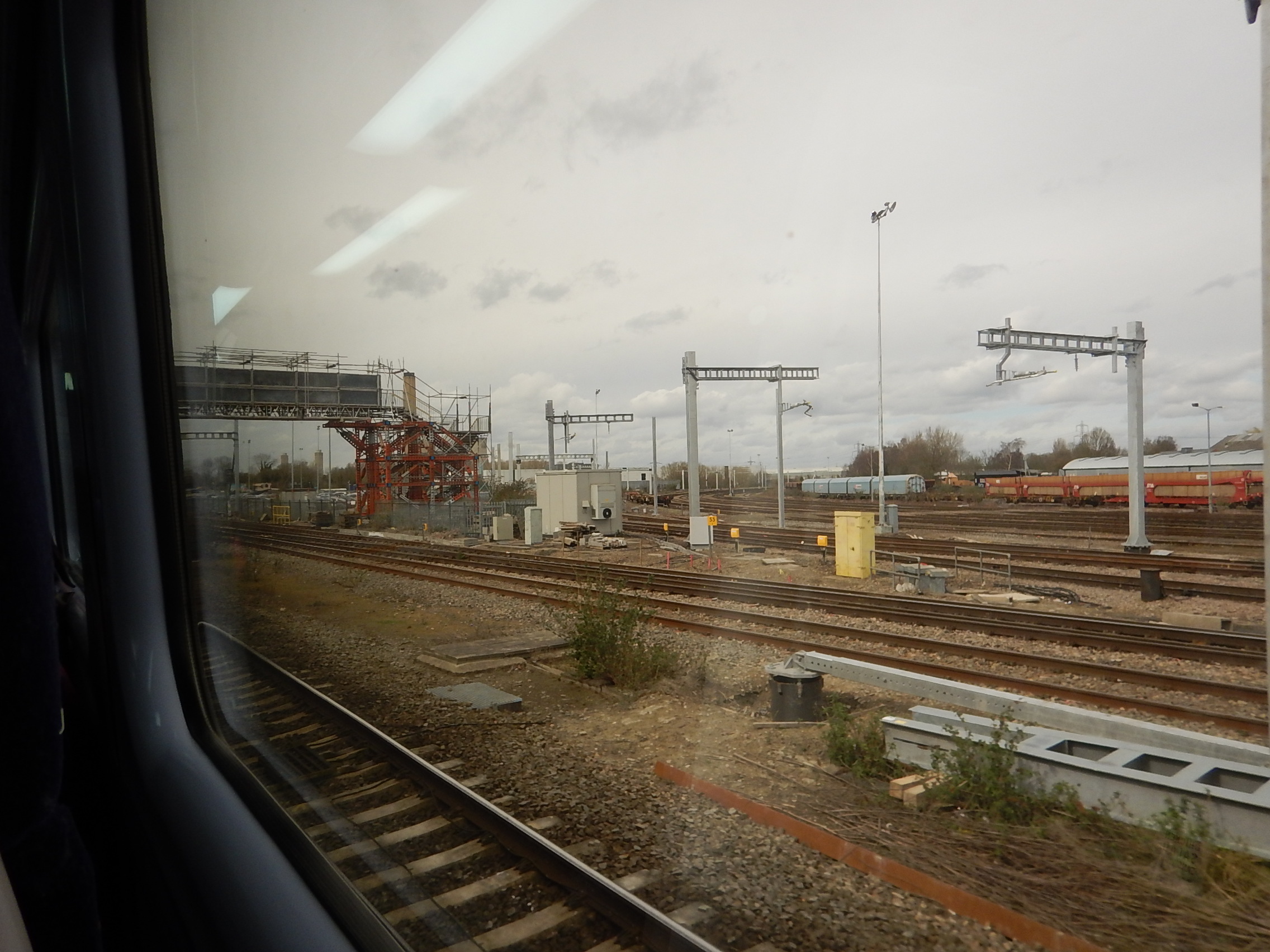
Masts Marching Towards Oxford
It would appear that the electrification is going to go at least as far as Didcot North Junction, where the West Curve from the direction of Swindon joins the Cherwell Valley Line. This schematic was clipped from Wikipedia.
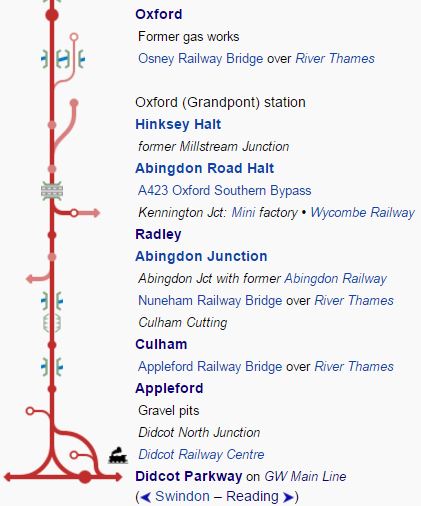
Didcot To Oxford On The Cherwell Valley Line
And this is a Google Map of the same area.
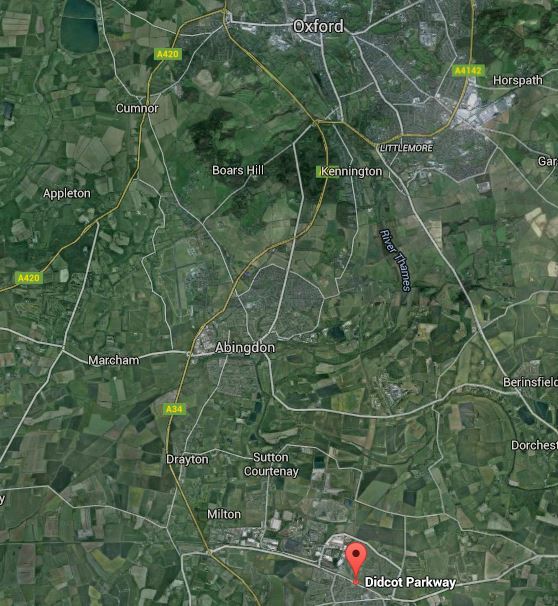
Didcot To Oxford
I estimate that from Didcot North Junction to Oxford station is about ten or twelve miles.
This would mean that if an IPEMU could reach Didcot Parkway station using overhead electrification, it could undoubtedly reach Oxford and then get back to Didcot.
Between Reading and Didcot, it would appear that the wires are going up.
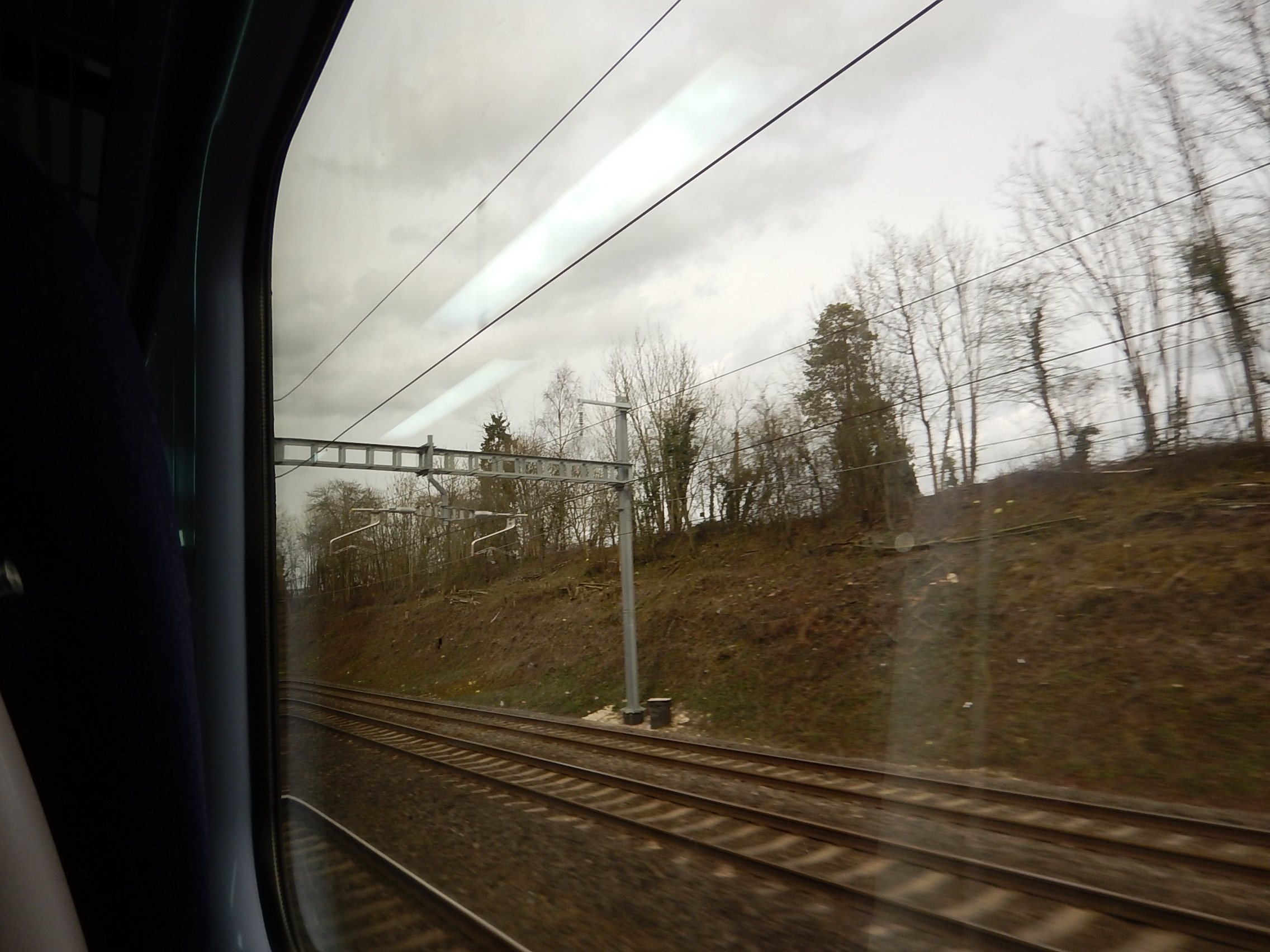
Wires Between Reading And Didcot
This picture shows the wires over the two slow or relief lines.
How Long Would An IPEMU Take From St. Leonard’s To St. Pancras International?
If an IPEMU is going to be used between St. Leonard’s and St. Pancras International station, there are two possibilities.
- A 110 mph IPEMU based on existing Class 387 trains.
- A 125 mph IPEMU based on a purpose-built Aventra. Ian Walmsley stated in the April 2016 Edition of Modern Railways that a 125 mph Aventra is possible.
This compares with the 143 mph and 100 mph speeds of a Class 395 train on high speed and classic lines respectively.
For this estimate, I will make the following assumptions.
- St. Leonards takes four minutes longer than Hastings.
- The baseline time from St. Pancras to Ashford is 38 minutes in a Class 395 train.
- Times on the high speed section are in proportion to the train speed.
- The baseline time from St. Leonard’s to Ashford is 46 minutes in a Class 171 train.
- All trains on the unelectrified section are limited to 100 mph.
Times From St.Leonards to Ashford
The Class 171 train takes 46 minutes, but it is only a benchmark, as few would go to Ashford and then get on a Class 395 train on High Speed 1.
The Class 395 train and the IPEMUs would be quicker as they would save a couple of minutes at each of the typical five stops, because of their faster acceleration.
Two minutes a stop would save ten minutes.
Times From Ashford to St. Pancras
Doing a simple calculation based on train speed gives the following times.
- Class 395 train – 38 minutes
- Class 387 IPEMU – 48 minutes
- Aventra IPEMU – 43 minutes.
Times from St. Leonards to St. Pancras
Adding the two times together gives.
- Class 395 train – 74 minutes
- Class 387 IPEMU – 84 minutes
- Aventra IPEMU – 79 minutes.
With Hastings it will be four minutes less.
In Wikipedia, there is a section called Future for the entry for the Marshlink Line. This is said.
The line is strategically important, as electrification and junction improvements would mean that High Speed 1 trains could travel directly from St Pancras International to Hastings. Amber Rudd, Member of Parliament for Hastings, has campaigned for electrification works to start by 2017. The aim is to reduce times to London from Hastings to 68 minutes, and from Rye to under an hour. This would require remodelling Ashford International station so the existing Marshlink line could connect to HS1, installing power systems, and adding a passing loop at Rye, all in addition to requiring new trains.
I think that the aim of 68 minutes from London to Hastings is a modest one, but as my crude estimate was only six minutes longer, I think the 68 minutes is totally attainable, especially as my times from St. Leonards to Ashford are just based on current timings and taking off a couple of minutes for each stop.
But if the Marshlink Line could be significantly improved, then time reductions of several minutes could well be achieved.
How Would IPEMUs Fit With The East West Rail Link?
I feel very much, that IPEMUs or battery trains are very much going to be a part of the UK rail network in the next few years.
When I was writing Are The TOCs Arguing Over The Class 387 Trains?, I kept coming across the Oxford end of the East West Rail Link, so I got to thinking how IPEMUs would fit in with the line.
Will the Line Be Electrified?
The Government certainly thinks so, as Wikipedia reports.
The Secretary of State for Transport, the Rt. Hon Justine Greening MP, today announced that the Western section of East West Rail (EWR) will be part of the government’s strategy for rail transport, confirming not only funding for the project but also for electrification of the Oxford to Bedford part of the route. EWR will provide an electric link between the electrified Great Western, West Coast and Midland main lines. This further investment in the project upgrades it to form a key part of the new ‘Electric Spine’ passenger and freight route between the South Coast, the East Midlands and Yorkshire
But I’m not sure.
- Will freight operators pay out for new electric locomotives or will they stick with their old noisy and smelly Class 66 locomotives? I’m afraid most will stick with what they’ve got!
- The new Class 88 electro-diesel locomotive will be delivered this year and what effects will they have on locomotive procurement?
- One of the major intersecting lines is Chiltern, which is not electrified. Will the Chiltern Line be electrified to make things easier? It could be! But I doubt it!
- After the fuss about the aesthetics of the electrification on the Great Western Main Line, that I wrote about in Aesthetic Problems With Overhead Wires On The Great Western, I have a feeling the natives might object.
- When they see the total bill for the Great Western Electrification, will the Government have second thoughts about electrification?
I think the line will eventually be electrified, but it may not be built with electrification, just as the first section between Bicester Village and Oxford Parkway stations was.
It would be built however, so that it would be easy to electrify in future.
- All over-bridges would have sufficient clearance for overhead wires.
- Space would be left for overhead gantries and other essential electrification equipment.
- Piles for gantries might even be put in.
- Everything would be properly documented.
Too many railway lines in the past were just built and assumed no improvements would ever be made.
Connection To Existing Electification
One of the most expensive items in an electrification scheme can be connecting the new wires to a suitable electricity supply.
This is why Crossrail and the Great Western Electrification share a sub-station to the West of London.
The East West Rail Link crosses a succession of lines at its Western End from Oxford to Bedford. In order from the West they are.
Only the Chiltern Main Line will not be electrified, when the Oxford to Bedford part of the link opens.
The route from Bedford to Ipswich and Norwich is not fully defined yet, but it is likely it will cross these electrified lines.
So the link, isn’t short of connectivity to electrified lines, which will help with full electrification.
The Route
This map from the East West Rail Link web site shows the route.
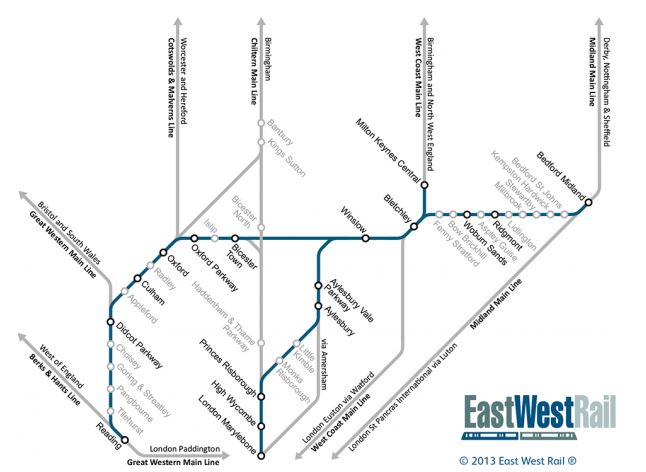
East West Rail Link
Starting from the West stations are.
- Reading on the Great Western
- Tilehurst on the Great Western
- Pangbourne on the Great Western
- Goring and Streatley on the Great Western
- Cholsey on the Great Western
- Didcot Parkway on the Great Western
- Appleford on the Cherwell Valley Line
- Culham on the Cherwell Valley Line
- Radley on the Cherwell Valley Line
- Oxford on the Cherwell Valley Line
- Oxford Parkway
- Islip
- Bicester Village
- Winslow
- Bletchley on the West Coast Main Line
- Milton Keynes Central on the West Coast Main Line
- Fenny Stratford on the Marston Vale Line
- Bow Brickhill on the Marston Vale Line
- Woburn Sands on the Marston Vale Line
- Apsley Guise on the Marston Vale Line
- Ridgmont on the Marston Vale Line
- Lidlington on the Marston Vale Line
- Millbrook on the Marston Vale Line
- Stewartby on the Marston Vale Line
- Kempston Hardwick on the Marston Vale Line
- Bedford St. Johns on the Marston Vale Line
- Bedford on the Midland Main Line
It’s quite a few stations, many of which are simple affairs in rural locations.
IPEMUs And The East West Rail Link
Proposed services when they start in 2019 will include.
- Bedford – Oxford – Reading
- Milton Keynes – Oxford – Reading
- Milton Keynes – Aylesbury – Marylebone
The first two services could be easily run by IPEMUs, but the third might need other arrangements.
According to the latest Great Western electrification schedule Oxford is not scheduled to be electrified until June 2019, so as I believe that Oxford will be reached by IPEMUs until that date, I suspect that we’ll see IPEMUs on the line, as they will be able to easily bridge the fifty mile electrification gap between Didcot on the Great Western and Bletchley on the West Coast Main Line, charging their batteries at both ends of the route.
The London to Aylesbury Line is thirty-nine miles of which sixteen miles are owned by the London Underground. Could it be if the line between Aylesbury and Winsford were to be electrified and some form of third-rail power was made available on the sixteen miles of the London Underground, that IPEMUs could work the services between Marylebone and Milton Keynes?
If they can’t, then it will be more diesels from Chiltern. But Chiltern’s ambitious nature, says they would prefer some form of electric train.
If the lines were eventually to be fully electrified, the IPEMUs would still have a valuable part to play as their self-contained regenerative braking would mean that the power supply wouldn’t have to be able to accept a return current, which lowers the cost of electrification.
Conclusions
IPEMUs will have to play some part in providing services on the East West Rail Link, because of the late running of the Great Western electrification.
Also with some selective electrification, Chiltern could use them for a service between Marylebone and Milton Keynes.
As these trains can provide a service on the whole line using existing electrification, the electrification of the East West Rail Link should be enabled but delayed to allow wires to be put up in more important places.
Are The TOCs Arguing Over The Class 387 Trains?
The April 2015 Edition of Modern Railways has an article entitled Operators Vying For Class 387s.
Before discussing the article, I’ll describe the trains involved.
Class 387 Trains
At present there are twenty-nine new four-car Class 387 trains running Thameslink services for Govia Thameslink Railway (GTR).
- These are dual-voltage 175 kph (110 mph) versions of Electrostars.
- They can run on probably most of the electrified routes in the UK.
- They are about to be replaced by brand-new Siemens Class 700 trains, as these are delivered.
- They are closely related to the Class 379 trains, which were used for the IPEMU prototype in early 2015.
As they become available, they are supposed to go to the Great Western Railway (GWR).
But GWR only have the working electrification from Paddington to Hayes and Harlington station on which to run the trains. As I showed in Hayes and Harlington Station – 28th February 2016, work is progressing at the station and an extended bay platform is being created.
The finish of platform works at the station, will mean a service can be started between Paddington and Hayes and Harlington.
- It will replace the main-line portion of the service between Paddington and Greenford, which is soon to be discontinued.
- It can be used by GWR for driver training.
- Class 387 trains working in GWR livery will be good publicity.
But I can’t see this service needing more than a couple of Class 387 trains.
This picture shows the colour scheme of a Class 387 train, currently working on Thameslink.

The colour of those doors looks suspiciously like GWR green to me! So perhaps the transfer of operator would not require anything more than downloading new software for the passenger information screens and changing the adverts and notices.
In addition to the current twenty-nine trains on Thameslink, Bombardier have three further orders for Class 387 trains.
- Twenty-seven four-car Class 387/2 trains are being delivered for Gatwick Express.
- Eight four-car trains for GWR.
- Twenty four-car trains have been ordered by Porterbrook.
Bombardier are reported to be on the verge of finishing the Gatwick Express order and starting manufacture of more Class 387/1 trains.
Class 442 Trains
The Class 442 trains, which are being replaced on Gatwick Express by Class 387/2 trains are not the most loved trains in the UK’s train fleet.
It is very likely that despite being the fastest third-rail trains in the world, that they will go to the scrapyard as they are replaced.
The only reason some might be retained on Gatwick Express, is so that some Class 387/2 trains could work Thameslink to release a few of the Class 387 trains for other operators.
Class 700 Trains
The Class 700 trains, being built in Germany by Siemens, are replacing the last Class 319 trains and the new Class 387 trains on Thameslink.
So introduction of these trains is important to release Class 387 trains for other operators.
But these trains are only due to be introduced on the 16th April 2016 and there are inevitable questions.
- What is the introduction into service schedule?
- As with all new trains or car, bus or truck for that matter, will there be any teething problems?
- Will they replace the Class 319 or 387 trains first?
- Will the passengers like them?
The last question is the most important and expect lots of moaning about the lack of free wi-fi!
Class 360 Trains
The Class 360 trains, used on Heathrow Connect, have a peripheral role in the argument, as c2c were trying to sublease two of these trains to sort out their capacity problems.
But the well-documented problems of Heathrow Express, have probably meant that these trains are no longer available.
Summarising The Article
The first paragraph of the Modern Railways article entitled Operators Vying For Class 387s, says that several operators are vying for the Class 387/1 trains currently working on Thameslink.
To summarise.
- c2c, who are big Electrostar operators, are still looking for trains after failing to procure Class 360 trains.
- GWR is anxious to get 387s to start driver training.
- GTR wants to retain them, as there is problems with the new Class 700 trains.
- GWR have apparently suggested that GTR retain the Class 442 trains and use the new Class 387/2 Gatwick Expresses on Thameslink.
- GWR wants to start services to Maindenhead earlier than thought.
It looks like there’s a serious argument going on.
The final paragraph offers a solution.
It could be that the quest to find additional short term capacity at c2c may be solved by early delivery of the next batch of 387s, construction of which is to begin shortly at Bombardier’s Derby factory.
Perhaps, building some of Porterbrook’s trains before those destined for GWR, where they have nowhere to run, could happen!
Bombardier are probably being a bit bullish, as after all one of the reasons for the problems would appear to be the new Class 700 trains from Siemens.
Adding An IPEMU Capabilty To Class 387 Trains
Could it also be, that until this argument is settled, we will not be seeing any Class 387 trains converted into IPEMUs?
I believe that a proportion of trains with on-board energy storage could help some of our electrification problems.
Bombardier have stated that all their new Aventra trains will be wired to accept on-board energy storage if the operator desires it be added. This article in Global Rail News gives full details.
In the meantime, the only train that is available that can be given an IPEMU capability is the Class 387 train.
Electric Services To Maidenhead And Reading
The article says this about electrification to Maidenhead.
Whilst the completion date for wiring to Maidenhead is shown in the re-plan of Network Rail’s Enhancements Programme by Sir Peter Hendy as being June 2017, Modern Railways understands that work is ahead of the new schedule and this section may be completed by the end of 2016.
As electrification to Reading is Crossrail’s problem, this might help too, as different structures are being used.
In Rumours Of Battery Trains, I discussed an article in the September 2015 Edition of Modern Railways entitled Class 387s Could Be Battery Powered, which said that GWR’s eight additional Class 387 trains could be battery powered. This was said in Modern Railways.
Delivery as IPEMUs would allow EMUs to make use of as much wiring as is available (and batteries beyond) while electrification pushes ahead under the delayed scheme, and in the longer term would allow units to run on sections not yet authorised for electrification, such as Newbury to Bedwyn. The use of IPEMUs might also hasten the cascade of Class 16x units to the west of the franchise.
But thinking about electrification to Maidenhead in a practical manner, would a train operator want Maidenhead as the terminus of a new electric service.
Remember that the Class 387 trains are required to increase capacity and bring a whole new level of electric traction and modern comfort to services from Paddington to Bedwyn, Newbury, Oxford, Reading and other places in the Thames Valley, so having to change from your old diesel train to a new electric one at Maidenhead is something that will bring out the worst out of passengers.
If you look at train times between Maidenhead and Paddington, some services take up to thirty-six minutes, but the fastest scheduled journey I can find is probably by an InterCity 125 in nineteen. So you can understand, why GWR would like 110 mph Class 387 trains on the route. They could probably do the journey in a few minutes over twenty.
With Chiltern starting an Oxford to Marylebone in December 2016, GWR are probably preparing to lose a lot of their Oxford business. I know which service I’d choose.
But the Class 387 IPEMU would offer a viable alternative.
- Hayes and Harlington station is fully electrified to Paddington and is just under eleven miles from Paddington.
- Reading station is not electrified and is thirty-six miles from Paddington.
- A Class 387 IPEMU has a range of upwards of fifty miles on batteries.
The Class 387 IPEMU would seem to have been designed to handle Paddington to Reading. But I suspect that electric services will not be offered until the wires reach Maidenhead.
So when will GWR be offering an electric local service between Paddington and Reading?
- Trains would use overhead power to the end of the wires and batteries beyond.
- Enough Class 387 trains will have to be converted to IPEMUs
- Enough platforms at Paddington would have be able to accept electric trains.
Could this be why GWR appear to be so keen to take deliveries of Class 387 trains?
From Reading diesel shuttles would work the lines to Bedwyn and Oxford.
So how does this fit in with Modern Railways assertion, that electrification to Maidenhead will be complete before the end of the year?
If GWR take the IPEMU route to provide services between Paddington and Reading, it just means that the train will be less reliant on the batteries, as Maidenhead to Reading is only twelve miles.
To go to anywhere past Reading is probably difficult, as suitable places like Bedwyn, Didcot and Newbury are more than twenty-five miles from Maidenhead, which probably means the range is too much for an IPEMU, as it has to go both ways on battery power.
On the other hand, every extra mile of usable electrification would extend the reach from Paddington.
But there are three places, where Class 387 IPEMUs could operate without major additional electrification; the three branch lines.
- Henley is 11.5 miles from Maidenhead.
- Marlow is 5 miles from Maidenhead.
- Windsor is 2.5 miles from Slough.
There would probably need to be some short lengths of electrification where the branches join the main line, signalling upgrades and platform lengthening. But not electrifying the branches and using IPEMUs would probably be welcomed by Network Rail, as it would sidestep any legal challenges to the electrification on aesthetic and heritage grounds.
In the peaks there are direct services between Bourne End station on the Marlow Branch and London, which seem to take fifty-four minutes. I suspect that a Class 387 IPEMU could do the journey about twenty minutes faster, with electrification between Paddington and Maindenhead.
Onward To Oxford
Electrification to Maidenhead would not give advantages in providing electric services from Reading to Bedwyn, Newbury and Oxford. It’s just too far for a train powered by batteries.
Commercial common sense, would indicate that with Chiltern scheduled to serve Oxford station in December 2016, if there was one destination, where new electric trains must go, it is Oxford.
And by the end of 2016!
It sounds like an impossible dream!
Roger Ford in an article in the April 2016 Edition of Modern Railways, which is entitled GWEP Target Dates And Costs, says this about testing the Class 800 trains.
GWEP’s 16-mile ‘test track’is between Reading and Didcot; It was originally due to have been energised in September last year.
Energisation for test running is now scheduled for September this year.
He also indicated, and I can confirm it, that substantial amounts of the overhead structures have been installed. So I think we can assume that by September, the test track will probably be working.
As an aside here, I wonder if the test track will electrify and use one of the west-facing bay platforms at Reading station.
If we assume that the test track provides a fully-functioning electrified route between Reading and Didcot, it could surely be used by Class 387 IPEMUs to get to Didcot.
- They would use overhead electrification from Paddington to Maidenhead or the end of the wires.
- They would go to Reading on battery power.
- Reading to Didcot would be using the overhead wires put up for the test track.
- Batteries would be charged on both electrified sections.
Oxford is less than twenty miles from Didcot, so reaching Oxford with an electric service is possible before December 2016.
Onward To Bedwyn
Bedwyn is forty-two miles from Maidenhead and thirty from Reading, so it would appear to be another impossible dream, even if there was electrification all the way to Maidenhead from Paddington.
I do think that unless the Great Western Main Line is electrified to Maidenhead, that getting Class 387 IPEMUs to Bedwyn is impossible.
But there are three possibilities to get to Bedwyn from Paddington, if Maidenhead is electrified.
- A bigger battery to give a longer range.
- As the train stops at Reading, it could stop in an electrified platform and charge the battery.
- Electrifying the junction and a short length of the Reading to Taunton Line, perhaps as far as Reading West station.
I’m sure Bombardier, Network Rail and GWR are working on a solution.
It should also be noted that there are two west facing bay platforms used for services to Basingstoke, Bedwyn and Newbury. These could be electrified and Bedwyn could be served by a shuttle.
Onward To Basingstoke
Another possibility would be to use the Class 387 IPEMUs to provide a service along the Reading to Basingstoke Line, which is currently run using diesel multiple units.
It could be charged at Reading by electrifying the two west-facing bay platforms or even at Basingstoke using third-rail electrification in the bay platform.
Conclusion
I believe that all the Thames Valley services out of Paddington could be run by a fleet of Class 387 trains, some or all of which would be IPEMUs, It would be necessary to do the following.
- Electrify between Airport Junction and Maidenhead.
- Allow the use of the test track between Reading and Didcot by Class 387 services travelling past Didcot.
- Electrify selected platforms at Reading station.
The new trains would provide an increase in capacity, faster services and possibly extra routes.
I also believe that it would be possible to serve Oxford using Class 387 IPEMUs by the end of the year. This might persuade passengers not to desert to Chiltern.
Does this all explain GWR’s reluctance to lose the Class 387 trains, that have been earmarked for transfer from Thameslink?
But with other train companies looking jealously at the GWR’s Class 387 trains, it’s no wonder there’s an argument.
More On Class 345 Trains
In an article in this month’s Modern Railways, which is entitled 345 Counting On It, Ian Walmsley gives more details of the new Class 345 trains for Crossrail.
Ian uses phrases like.
Let’s get this out of the way first before I start enthusing (and I will) – personally I don’t like the interior colours.
Now I will go into full enthusing mode,
The bogies are the FLEXX Eco Bogie B5000-derivative inside-frame design similar to that on the Meridian (probably the only good thing about Meridians in my view)
The bodyshell is brilliant, and I say this as a passenger and an engineer.
The train is a fine piece of work.
He finishes by saying that he thinks the train will be a success for Bombardier.
Ian also throws in a few clues as to where Aventras might end up.
The 125 mph Aventra
Apparently, 125 mph Aventras are a possibility.So we could see High Speed Trains with similar performance to an InterCity 125, based on a train originally designed for commuters across London.
The High Speed Train With Batteries
One thing that Ian doesn’t mention about the Class 345 trains is whether they will be fitted with onboard energy storage. But he does say this.
Most braking will be done electrically, regenerating power to the grid.
So the answer is probably no! But it should be noted that Bombardier have told me that all Aventras are wired to accept onboard energy storage.
This raises the interesting possibility of the High Speed Train running on batteries.
I think that this could be a surprisingly large market.
Think of the routes which consist of two types of line.
- A high speed electrified line, which permits trains to travel at 100-125 mph.
- A secondary or branch line without electrification, that is up to about forty or fifty miles long.
On a quick look, I can think of these routes.
- London Liverpool Street – Ipswich – Lowestoft
- London Liverpool Street -Norwich – Yarmouth
- London Kings Cross – Bradford
- London Kings Cross – Harrogate
- London Kings Cross – Huddersfield
- London Kings Cross – Hull
- London Kings Cross – Lincoln
- London Kings Cross – Perth
- London Kings Cross – Sheffield
- London Kings Cross – Sunderland
- London St. Pancras – Hastings – Eastbourne – Brighton
- London Euston – Blackpool
- London Euston – Chester
- London Euston – Huddersfield
- London Euston – Shrewsbury
- London Waterloo – Exeter
I am assuming that electrification is at 2016 mileage.
As electrification increases more and more routes will be possible using a High Speed Train with batteries to extend the route away from the main line.
Merseyrail
Ian mentions Merseyrail as another target.
They would appear to be a good match to Merseyrail’s specification, that I wrote about in Is Liverpool Planning To Invade Manchester By Train?
- Merseyrail are looking to buy energy-efficient trains.
- Merseyrail stated in Modern Railways that they were seriously interested in having IPEMUs.
- Merseyrail want to expend their network and routes to Preston, Manchester via Kirkby, Chester via the Halton Curve and Wrexham via the Borderlands Line are very IPEMU-friendly routes.
- Merseyrail needs trains that are certified for working in tunnels.
- Merseyrail needs trains that can work on both third-rail and overhead electrification, which the dual-voltage Class 710/2 Aventra trains for the London Overground can do.
- Ian feels the train’s low weight could be enough to avoid sub-station upgrades.
In addition, the modular nature of the Aventra design means that Merseyrail could have a mixture of train lengths and voltages to optimise their procurement and operating costs.
East Midlands Trains
Ian says this about using Aventras for East Midland trains electrics.
As a 125 mph unit it would cope well with Corby commuters and the ‘Master Cutler’ crowd. – It is all about the interior.
I think there are other factors, that could be useful, if some or all of the trains were an IPEMU variant.
- I think Corby could be reached from St. Pancras by an IPEMU using the existing electrification.
- Running on batteries through the Derwent Valley World Heritage Site, might avoid tricky negotiations with the heritage lobby.
- Services could be extended past the current terminals of Nottingham and Sheffield.
Using Aventra IPEMUs would enable a whole new method of railway electrification.
Starting from Bedford, the electrification would be performed northward and as each section was completed, the Aventras could reach twenty or thirty miles further.
So electric train services would arrive at a town earlier than by using traditional methods.
Europe
Ian finishes the article with.
With the new design, Bombardier can take them all on. I think we will see this product platform around for many years, capitalising on the succes of Electrostar, and who knows, maybe even exporting to Europe? 345 – count on it.
If Bombardier have the right product, why not?
Along The Marshlink Line
After writing Will We See IPEMUS in Hastings?, I thought it would be a good idea to see, if there were any other reasons, why running longer IPEMUs on the Marshlink Line would be a good idea.
So I took a Class 395 train from St. Pancras International station to Ashford International station along High Speed One.
From Ashford International, I took the Marshlink Link to Hastings station, in one of the services run by Southern using Class 171 trains.
These are my observations from the trip.
Class 171 Trains
These are two-car modern diesel multiple units with a top speed of 160 kph and they can be coupled together to make longer trains.
They are totally adequate for the current service between Ashford International and Brighton via Hastings, Bexhill, Eastbourne and Lewes.
Class 387 Trains With An IPEMU Capability
I believe that if battery trains or IPEMUs are used to provide an electric service on the Marshlink Line, that only Class 387 trains can be delivered in a reasonable timescale.
- The Class 387 train is a cousin of the Class 379 train, which was used to create the demonstrator.
- The Class 387 train is a four-car 175 kph train, that can be run in 4, 8 or 12 car formations.
- The capability of the train on battery power, would be more than adequate to go between Ashford International and Hastings.
- There are over twenty Class 387 trains in service, that will start to be replaced this year with new Class 700 trains.
- Another twenty trains are on order for Porterbrook.
- Because of the late delivery of the Great Western electrification, quite a few trains have no home to go to.
- Southern are very familiar with Class 387 trains.
The main thing that would need to be done, would be to add an appropriate battery pack to the number of trains needed for a Brighton to Ashford or St. Pancras service.
As a battery pack was designed over a year ago, I’m sure Bombardier have this under control.
This article in Rail Technology Magazine, talks about how Bombardier are doing extensive tests on battery systems in Mannheim.
Ashford International Station
This Google Map shows the various lines through Ashford International station.
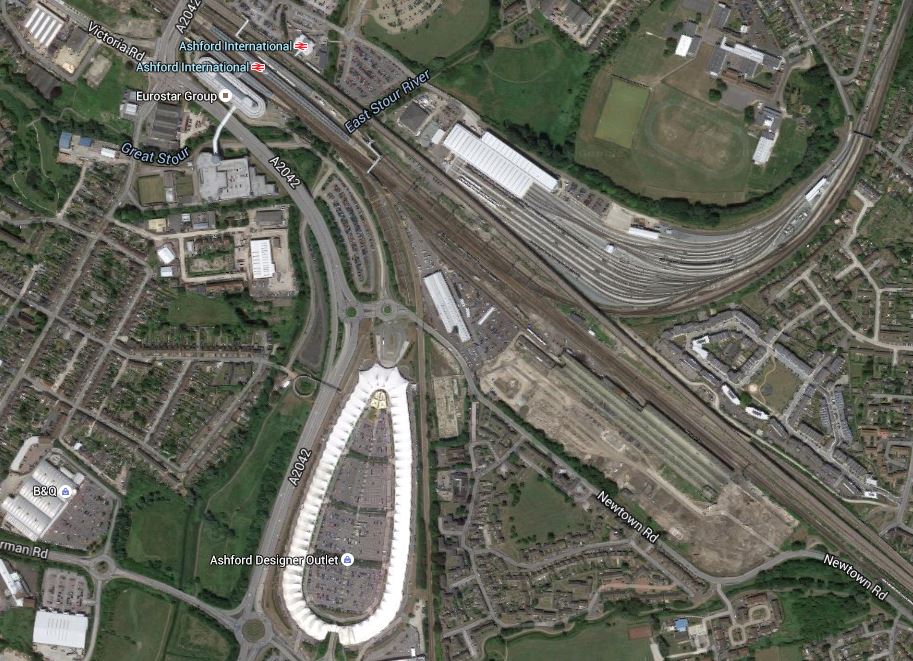
Lines Around Ashford International Station
Note.
- High Speed One goes through the station calling at the long island platforms 3 and 4, or on the flyover, as appropriate.
- The Ashford to Ramsgate Line goes off to the North East.
- The Marshlink Line goes south alongside the white teardrop, which is the Ashford Designer Outlet.
There are three alternatives for Marshlink Line trains.
- Currently, trains from the Marshlink Line terminate in Platform 1. This could continue.
- Trains could go to and from London on High Speed 1
- Trains could go to and from London on classic lines.
I suppose there could be a mixture of all three.
I don’t know if it is possible to run trains between High Speed One and the Marshlink Line, but I can’t believe that it would be impossible to arrange, as Network Rail have mentioned Hastings to St. Pancras services via High Speed One in some of their reports.
Ham Street Station
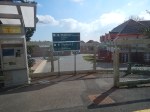
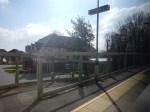
Ham Street station is a simple affair on a double-track section, with two staggered platforms.
I took these pictures of the station.


This is a Google Map of the station.
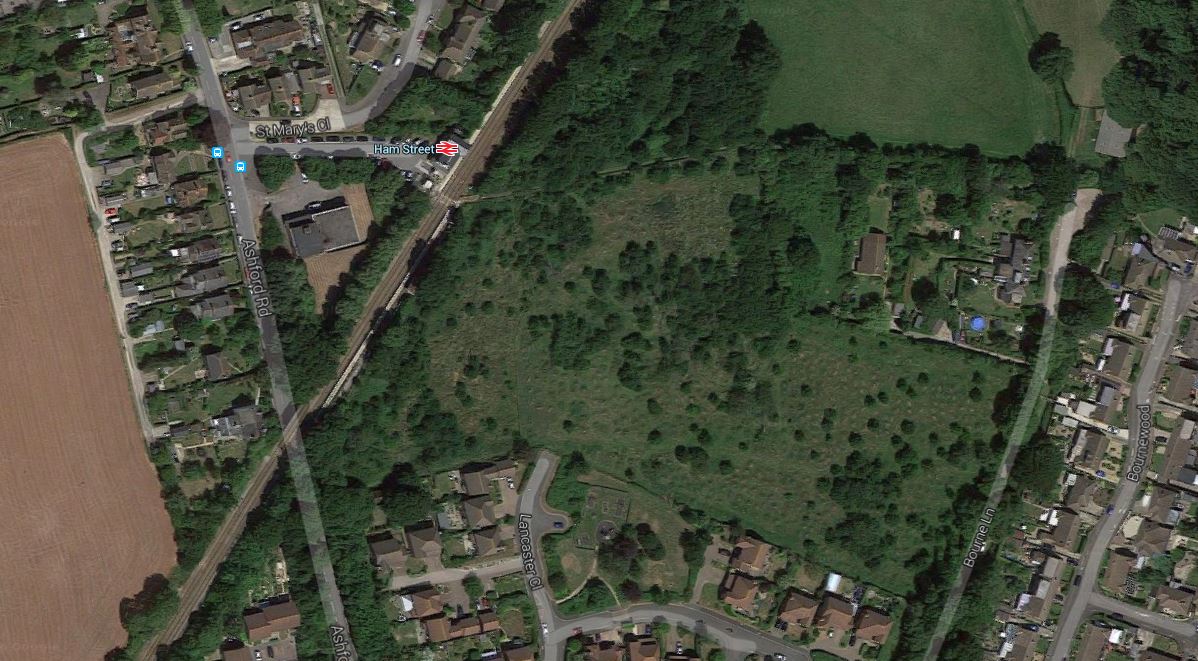
Ham Street Station
it would appear that quite a few houses have been built recently.
The station doesn’t appear to be of the same quality as the houses.
Appledore Station
This Google Map shows the Appledore station.
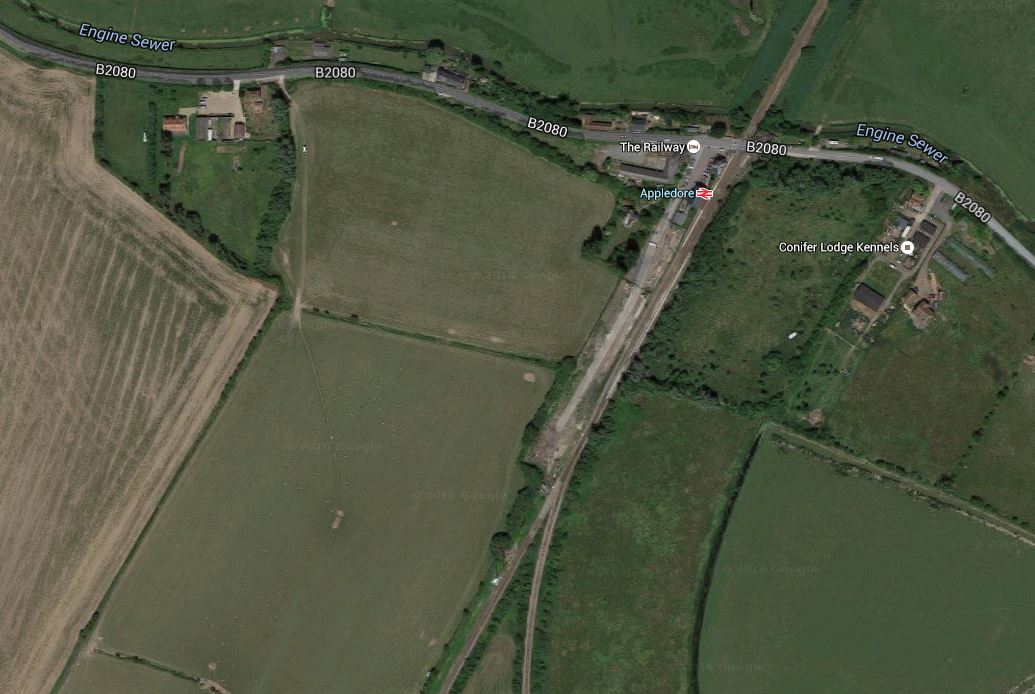
Appledore Station
It is simple affair, with very few houses locally.
- Appledore itself is two miles away.
- It has two staggered platforms.
- There is a level crossing.
- There is no footbridge.
South of the station the line becomes single-track and the Dungeness Branch goes off to Dungeness and Lydd.
Dungeness
A proportion of the freight traffic on the Marshlink Line serves the Dungeness Nuclear Power Station using the Dungeness Branch.
The Google Map shows the area of Dungeness.
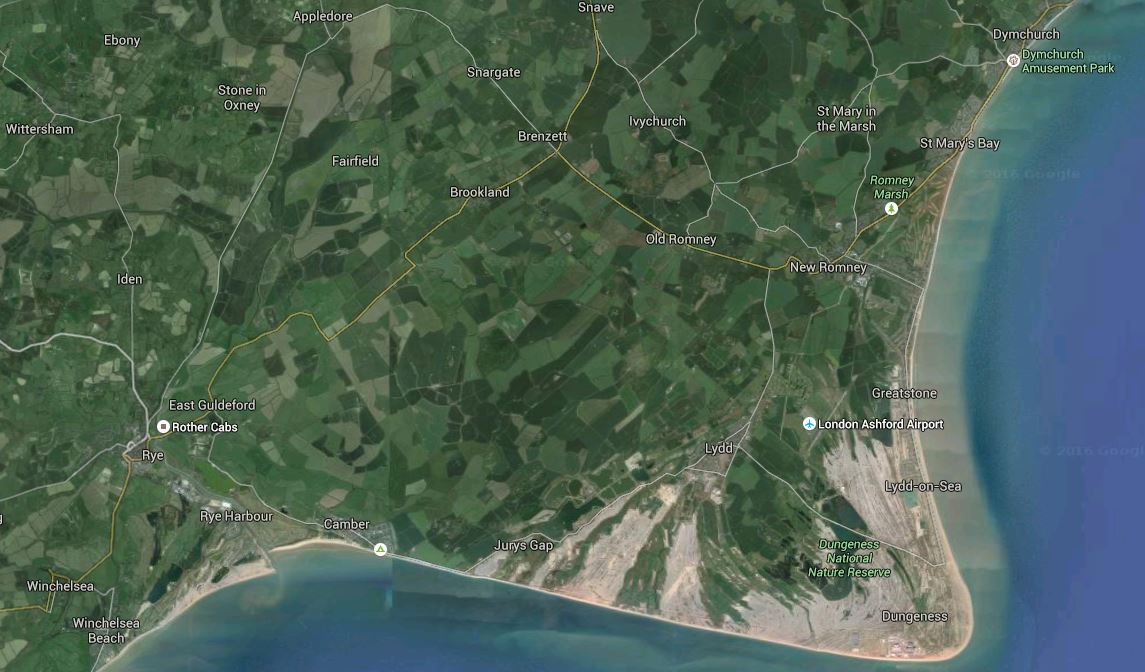
Dungeness
At one time, the line had several stations including one at Dungeness.
Other than the power station, there is just a few houses, Lydd Airport, a nature reserve and a few tourist attractions like the iconic Romney Hythe and Dymchurch Railway.
The only other things that could effect the area, is a possible building of Dungeness C Nuclear Power Station and other energy related developments, like a cross-Channel energy link or support for wind turbines.
So to say that the Dungeness Branch will never be developed with a passenger train service, is a bit like saying human beings will never set foot on Mars.
I’ve never been down to Dungeness, although C flew to Beauvais near Paris in the 1960s from the Airport using an airline called Skyways (?).
Rye Station
Rye station is the only substantial station on the unelectrified part of the Marshlink Line.
This Google Map shows the station.
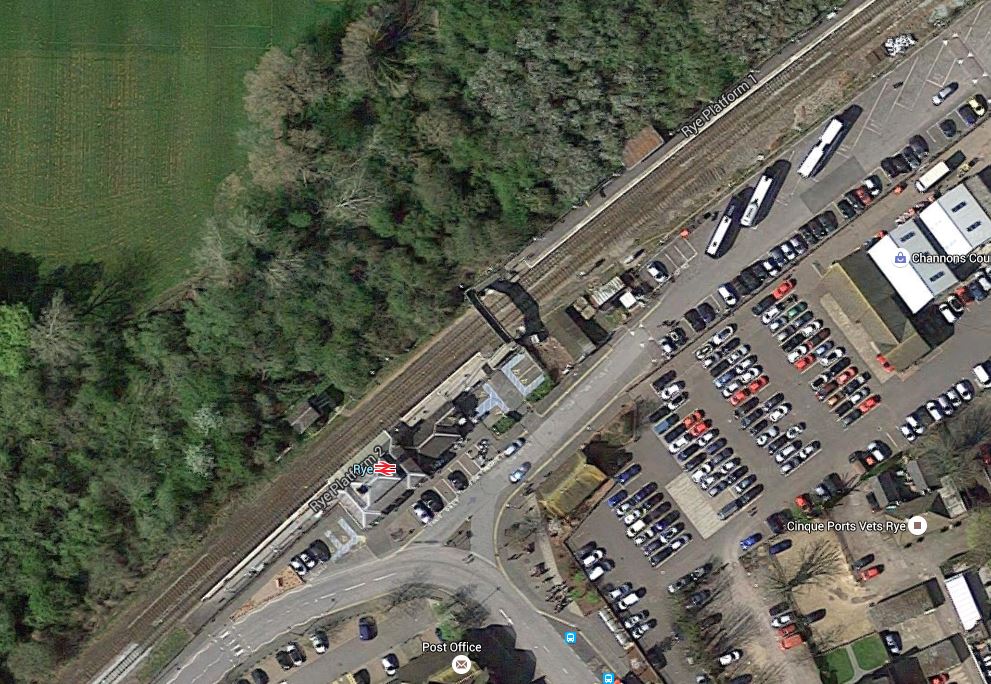
I visited Rye in 2015 and wrote Lunch At Rye, where I found it a charming little town, lacking in information.
The station has a passing loop, a footbridge and a booking office, and it probably would need little work for longer trains.
However, there was evidence of general tidying up and the relaying of track.
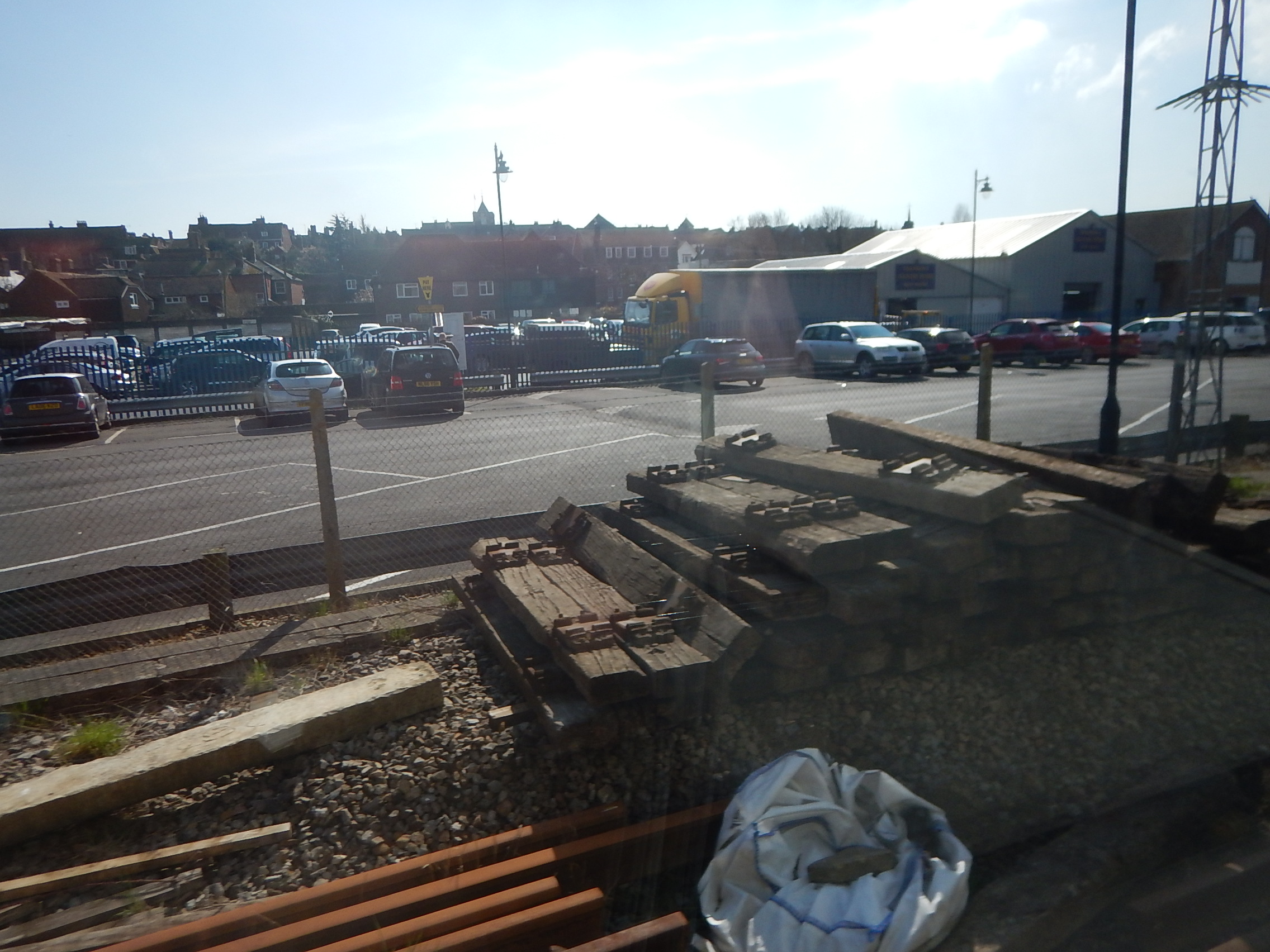
Evidence Of Work At Rye
In fact, this was virtually the only work, that I saw anywhere on the Marshlink Line.
Winchelsea, Doleham And Three Oaks Stations.
Of these three stations, we only stopped at Winchelsea station.
Except for well-maintained single platform, there is not much there.
Doleham and Three Oaks stations are also fairly basic, with Three Oaks only able to handle a single carriage.
From Ore To Hastings
Ore station is the next station after Three Oaks and it is fully electrified from the station all the way to Eastbourne and Brighton.
An Article In Rye News
This article in Rye News is entitled More give than take on Marshlink, was written by Stuart Harland who is chairman of the Marsh Link Action Group.
It gives a summary of the work needed to allow Class 395 trains to Bexhill.
As we know from the Network Rail presentation to MLAG last year, the physical issues to be resolved are:
- electrification of the Marshlink line
- signalling at Bexhill;
- remodelling of the track layout at Ashford;
- the dualling/ passing loop at Rye
- the two level crossings at East Guldeford where input is awaited from the Highways Agency to remove the need for two level crossings on the A259
All of this needs funding, as do the additional Javelin units built by Hitachi.
So how does using Class 387 trains with an IPEMU capability affect this list.
- Electrification of the Marshlink Line would not be needed.
- The signalling at Bexhill, can already handle eight-car Electrostars, like the Class 387 train, so I would assume modifications would be simpler, if at all.
- The remodelling of the track layout at Ashford would only need to connect Platforms 1 and 2 to High Speed One.
- The passing loop at Rye seems capable of accepting two four-car Class 171 Turbostar trains, which are closely related to Class 387 Electrostar trains.
- The level crossing problems would remain, but the speeds could be kept to those used now.
- New trains would not need to be purchased from Hitachi.
In addition, there would need to be work done to make sure that all stations and signalling on the Marshlink Line could accept the length of train, that Southern want to run between |St. Pancras and Hastings.
Conclusion
Class 387 IPEMUs could easily provide service on the Marshlink Line and the cost of the work would be very much reduced compared to using Class 395 Javelin trains, with the biggest expense probably being adding the battery packs to the Class 387 trains.
 The Anonymous Widower