The Aerosol Tales
When I left Liverpool University in 1968, I was very familiar with the use of products distributed in aerosol cans.
- I had used aerosol shaving cream, although about that time, I acquired my beard.
- I certainly used aerosol deodorant, as did most in the 1960s.
- Aerosol paints were common for covering scuffs and scratches in your car.
- Aerosols were often used to apply sun protection.
- Aerosols containing cream or a non-dairy alternative for culinary use were not unknown.
- Aweosol lubricants were starting to appear.
Although, I went to work for the chemical giant; ICI, at that time, I had no idea how an aerosol and its can worked.
As ICI at the time, ICI were major manufacturers of aerosol propellants, I quickly learned how they worked.
The Wikipedia entry for Aerosol Spray Dispenser gives a lot of history about aerosol cans and their propellants.
The Wikipedia entry for Propellant has this paragraph describing propellants of the last century.
Chlorofluorocarbons (CFCs) were once often used as propellants, but since the Montreal Protocol came into force in 1989, they have been replaced in nearly every country due to the negative effects CFCs have on Earth’s ozone layer. The most common replacements of CFCs are mixtures of volatile hydrocarbons, typically propane, n-butane and isobutane. Dimethyl ether (DME) and methyl ethyl ether are also used. All these have the disadvantage of being flammable. Nitrous oxide and carbon dioxide are also used as propellants to deliver foodstuffs (for example, whipped cream and cooking spray). Medicinal aerosols such as asthma inhalers use hydrofluoroalkanes (HFA): either HFA 134a (1,1,1,2,-tetrafluoroethane) or HFA 227 (1,1,1,2,3,3,3-heptafluoropropane) or combinations of the two. More recently, liquid hydrofluoroolefin (HFO) propellants have become more widely adopted in aerosol systems due to their relatively low vapor pressure, low global warming potential (GWP), and nonflammability.
Note that the whole range of these chemicals, effect the ozone layer.
Rocksavage Works
ICI’s Rocksavage Works, was an integrated chemical plant by the Mersey,.
- It made all types of CFCs for aerosols and other purposes.
- It also made the fire suppressant and extinguisher; Bromochlorodifluoromethane or BCF.
- Alongside BCF, it made the anaesthetic Halothane or as ICI called it Fluothane.
- The plant was a poisonous place with all those bromine, chlorine and fluorine compounds.
- Despite this, the plant had a remarkable safety record.
I had the pleasure of working at the plant and it was where, I had most of my excellent Health and Safety training, from the amazing site foreman; Charlie Akers.
Some of the wisdom he distributed has proved invaluable in aiding my stroke recovery.
I suspect that since the signing of the Montreal Protocol, the plant has changed greatly or has even been closed.
All that appears to be left is the 800 MW gas-fired Rocksavage power station and a Facebook page.
Aerosol Baked Beans
In those days, I worked most of the time in a lab at Runcorn Heath.
One of the labs near to where I generally worked, in the large research complex, was a lab, where new aerosol products were developed and tested.
One of the standard jokes about that lab, was that they were working on aerosol baked beans. They said, they would develop the product, even of they had to eject them from the can one at a time.
Gift Time
One afternoon, the boss of the aerosol development lab came through with a tray of goodies.
On the tray, which was much like a cinema usherette’s ice cream tray of the sixties was a whole host of partly-labeled aerosol cans. Only clues to what the product might be were written on the outside in felt-tip pen.
I grabbed two, one of which was marked something like lubricating oil and the other was just marked hand cream, which I of course gave to my new wife; C.
We were married for nearly forty years and often, when she bought hand cream, she would remark, that it wasn’t of the same standard as the little can I brought home from work.
It appears to me, that one of the world’s top cosmetic companies and ICI were trying to create the world’s best and probably most expensive hand creams.
DMW
Fast-forward nearly twenty years and I was approached by Lloyds Bank about two individuals, who had developed an aerosol valve, that instead of using CFCs or other ozone-depleting chemicals.
- By the exploitation of the nether end of fluid dynamics, the propellant of the aerosol was nothing more harmless than pure nitrogen.
- I formed a company called DMW with the two inventors.
- John Gummer, who at the time was my MP and Environment Minister, knew of the aerosol valve and he took the details to Montreal.
So did a device developed in Suffolk help push through the Montreal Protocol?
Osbourne Reynolds
I also wonder, if we had some supernatural help. At the time, I lived in the family home of Osbourne Reynolds.
- He did a lot of the early work on fluid dynamics.
- He was the first UK Professor of Engineering.
- He was professor of Engineering at Manchester University for nearly forty years.
- The Reynolds number is named after him.
- Remarkably, students are sill taught on the equipment Reynolds designed.
- Reynolds was certainly one of our great Victorian scientists.
This Wikipedia entry gives more details of his remarkable life and work.
After Montreal the aerosol valve was sold to Johnson & Johnson.
DMW continued to develop other products and we had one, who no-one had any idea about how it worked.
So I discussed it with the Reynolds’s expert at Manchester University and he said he had no idea either.
But he was absolutely certain, that Reynolds would have known.
East Kent Maternity Deaths: Babies Might Have Survived With Better Care
The title of this post, is the same as that of this article on the BBC.
This is the first paragraph.
Up to 45 babies might have survived if they had received better care at East Kent NHS Hospitals Trust, a damning independent review has found.
As a father of three, who has experienced the death of both his wife and youngest son, I know that this is a tragedy for too many families.
But episodes like these seem to come along regularly in the NHS. We have had two cases, where nurses were murdering babies, the notorious Harold Shipman and several abuse cases in mental health.
Is the monitoring of the outcome of patient treatment up to scratch?
In the 1970s, I was asked to do some programming for Bob, who was the Chief Management Accountant of Lloyds Bank and before that he had been Chief Accountant of Vickers. Bob had very definite ideas about how to ascertain the performance of various divisions and departments in a company or organisation.
He taught me a lot as we applied his ideas to check out the performance of various branches in the Bank. A lot of his experience was incorporated into Artemis and other programs I have written.
One of the things we did with bank branches was to plot groups of branches in simple scatter diagrams, so that those with problems stood out.
Does the government do similar things with hospitals and GP surgeries?
I even went as far as to suggest that my software Daisy could be used to find rogue practitioners like Harold Shipman. I was thanked for my submission to the report, but was not told my ideas were mentioned in the report.
Conclusion
I believe that more babies might have survived in Kent, if a statistician had been comparing results between hospital trusts and actively looking for problems.
I suspect the reason, there is no serious analysis, is that there is a belief in the NHS, that no-one ever makes mistakes or is evil.
Is This The Most Important Door In My Life?
In some ways this is the most important door in my life.
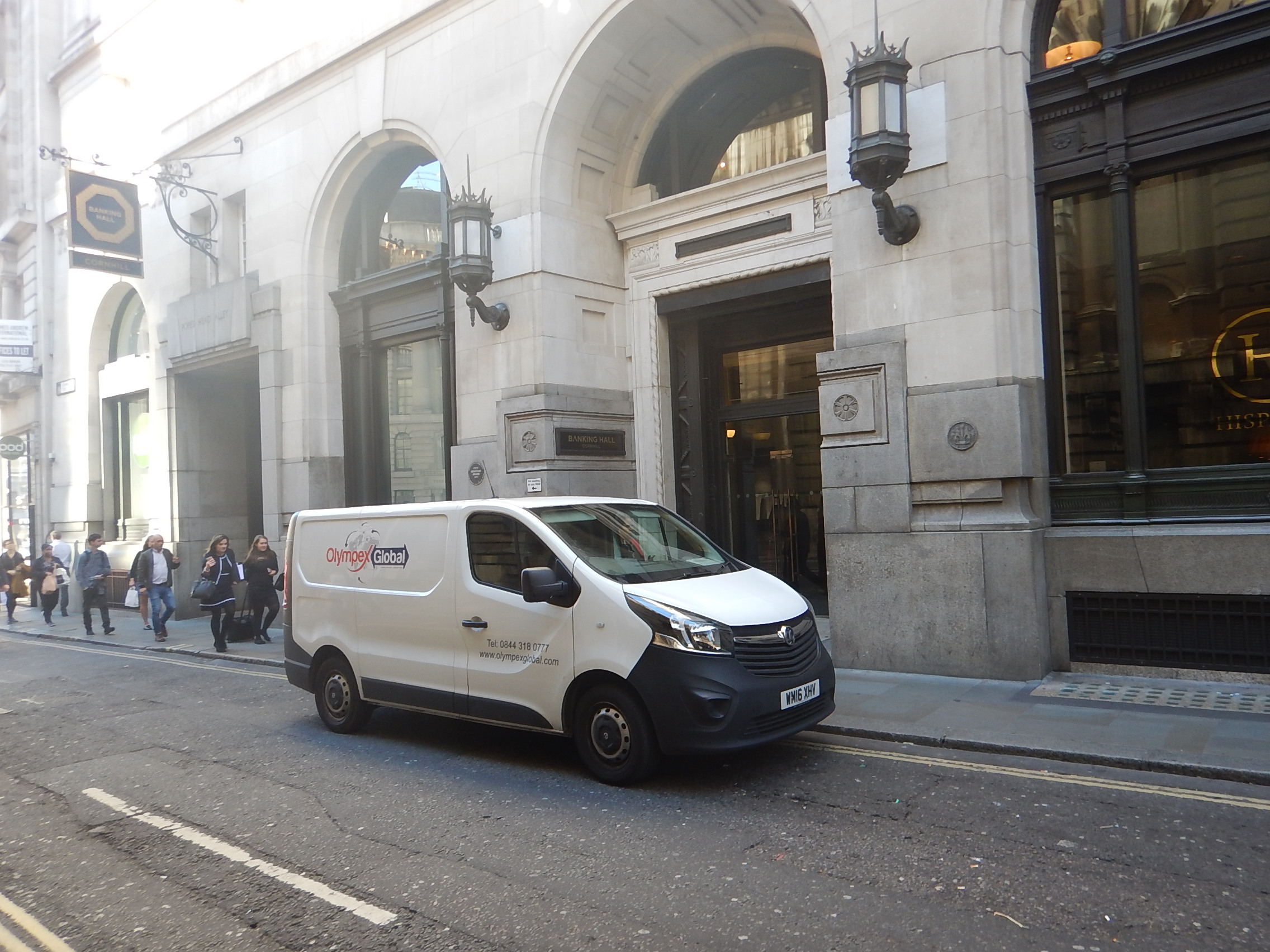
It used to lead through into the superb banking hall of Lloyds Bank.
In the early 1970s, I was doing some programming for the bank as a consultant to a company called Time Sharing Ltd.
The purpose of the software was to take the banks costs and expenses and calculate how much each of the various actions cost the Bank, by branch,area and region.
I was working for one of the Managers; Mike Spicer, who worked under the Chief Management Accountant; C. R. C. Wesson, who I later knew as Bob.
I’d never met Bob and as Mike was away, Bob phoned me up one morning and asked me to run the software, as they’d just uploaded a new batch of data.
I duly did this from home, and checked that it had run successfully after cycling to Time Sharing at Great Portland Street. They then asked, if I could take the results to the Bank on my way home to the Barbican.
I was worried that I was not dressed for visiting the Head Office of one of the UK’s big banks. I was painting our flat and wearing a pair of ice blue jeans and a short-sleeved shirt. . Luckily, I had a carrier on my bike, for the couple of inches of fan-folded green-striped print-out.
I had been told to ring the bell by the side of the door in the photograph and despite the banking hall being closed, I would be let in.
I arrived safely about six and rang the bell.
Perhaps a minute or two later, the ornate and extremely heavy door slid aside and a footman appeared, immaculately dressed in the Lloyds uniform of green tail-coat and top hat. He said. “You must be Mr. Miller!”
When I affirmed, he ushered me through and I offered him the printout. He then said, that Mr. Wesson would like to see me. I protested about my clothes, but he firmly showed me to the lift and pressed the appropriate floor. He added that Mr. Wesson would meet me at the lift.
It was the start of a very firm friendship.
Together we developed the software and produced loads of copious tables and graphs.
I learned a tremendous amount from dealing with the only innovative accountant I have ever met.
A lot of his philosophy found its way into Artemis.
One thing he told is that bankers when given a table of figures, always add them up to make sure there are no mistakes.
So I developed a technique in the Lloyds Bank software, where if money was allocated between various rows in a table, the total was always correct. If you round each row, this isn’t always the case.
I used this technique in the aggregation of resources and costs in Artemis.
Sadly, Bob died of I think cancer, a few years later!
I owe him a great debt!
Artemis Lives
I was listening to Wake Up To Money on BBC Radio 5 this morning and they interviewed someone from a company called Artemis Optical.
On their home page, their mission statement is.
Improve Vision: to be the Photonics industry’s most advanced manufacturer.
Their about page, says this.
Owned equally by the executive directors, Artemis, a world renowned company
employs 30+ talented staff, with an enviable history of 60 years in the design and
application of high precision, technically differentiated optical thin film coatings.
It sounds so very familiar.
In the interview, their spokesman disclosed that they banked with Lloyds, as did Metier!
And where did our bank manager come from? Plymouth, where Artemis; the company is based.
Very different industries, but same philosophy, same ambition, same bank and same name!
 The Anonymous Widower