SSE And Gilkes Energy Submit Plans For Pumped Hydro Storage Project
The title of this post, is the same of this article in Solar Power Portal.
This is the sub-heading.
SSE Renewables and Gilkes energy have submitted a planning consent application to Scottish Ministers for a proposed Pumped Storage Hydro (PSH) project.
These two paragraphs add more detail.
The Fearna PSH project is proposed as a 50:50 joint venture project between SSE and Gilkes Energy, with Gilkes Energy leading the development under a developer services agreement with SSE Renewables. The scheme will have an installed capacity of 1.8GW and a stored capacity of up to 36GWh, providing 20 hours of storage. If approved, the project would be the largest pumped hydro scheme in the UK.
The proposed site is located around 25km from Invergarry in the Scottish Highlands and adjoins SSE Renewables’ existing Loch Quoich reservoir, which forms part of the Great Glen hydro scheme. The development will include the construction of tunnels and a new power station that will connect the existing Loch Quoich reservoir to an upper reservoir at Loch Fearna.
This Google Map shows the location of Invergarry and Loch Quoich.

Note.
Loch Quoich is the dolphin-shaped loch at the West of the image.
Invergarry is indicated by the red dot at the East of the image.
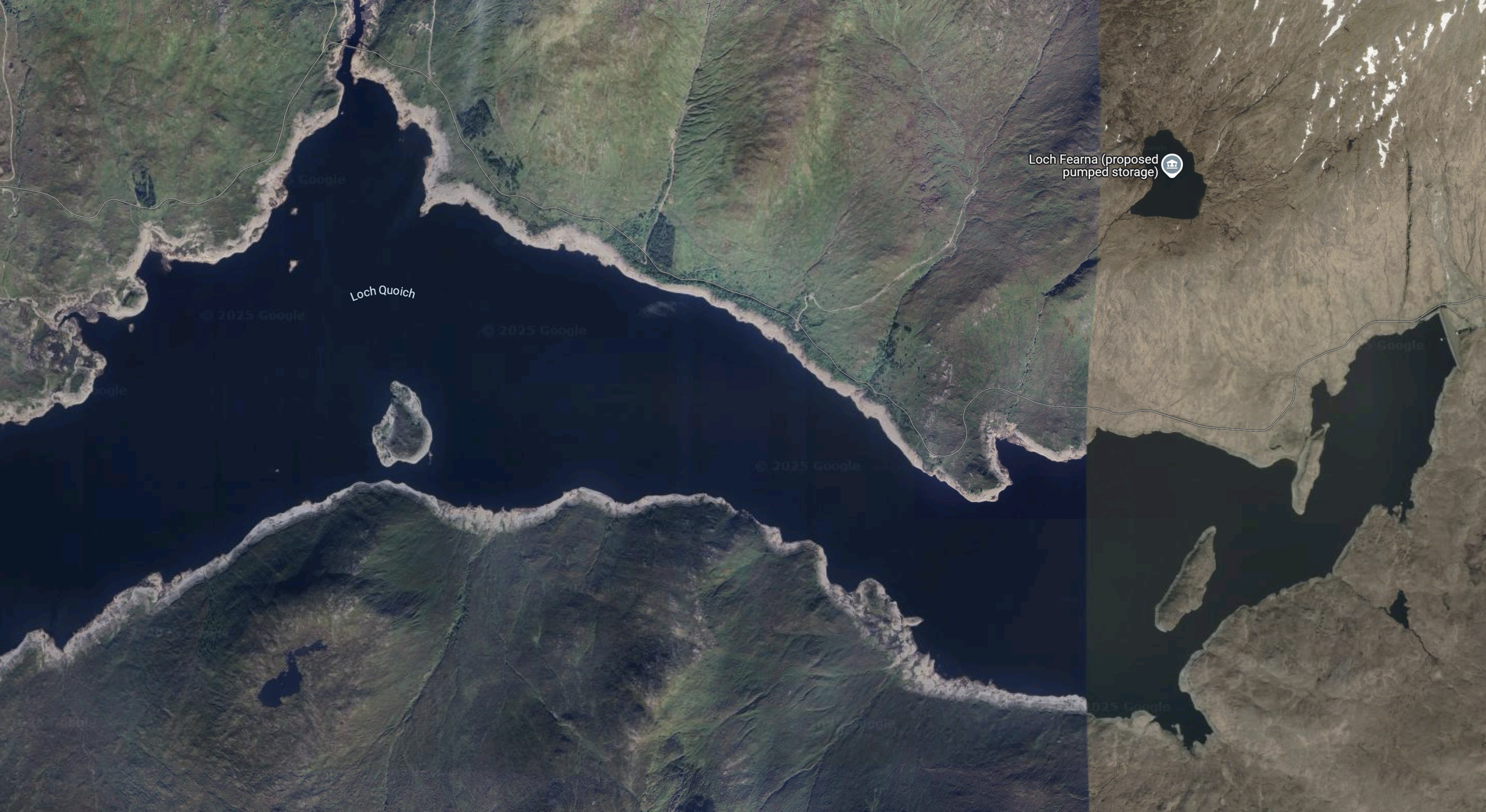
This second Google Map shows the location of Loch Fearna to the North-East of Loch Quoich.
These are my thoughts.
It Will Be A Large Scheme
With an installed capacity of 1.8GW and a stored capacity of up to 36GWh, providing 20 hours of storage, this is not a small scheme.
Wikipedia’s Description Of Loch Quoich
This is the first two paragraphs of the Wikipedia entry for Loch Quoich.
Loch Quoich (Scottish Gaelic: Loch Chuaich) is a loch and reservoir situated west of Loch Garry approximately 40 km northwest of Fort William, Lochaber, Scotland. The name means “loch of the quaich”. In 1896, it was listed as six miles long and three-quarters of a mile in width, belonging to Mrs. Ellice of Glenquoich, within the parish of Kilmonivaig.
Both lochs form part of the Glen Garry hydroelectricity project commissioned by the North of Scotland Hydro-Electric Board in the 1950s.
So is the Loch Fearna scheme, a massive repurposing of the existing Glen Garry hydroelectricity project?
I wrote about this before in Repurposing The Great Glen Hydro-Electric Scheme?
This map from the SSE Renewables web site shows the layout of the dams and power stations between Loch Quoich and Invergarry..
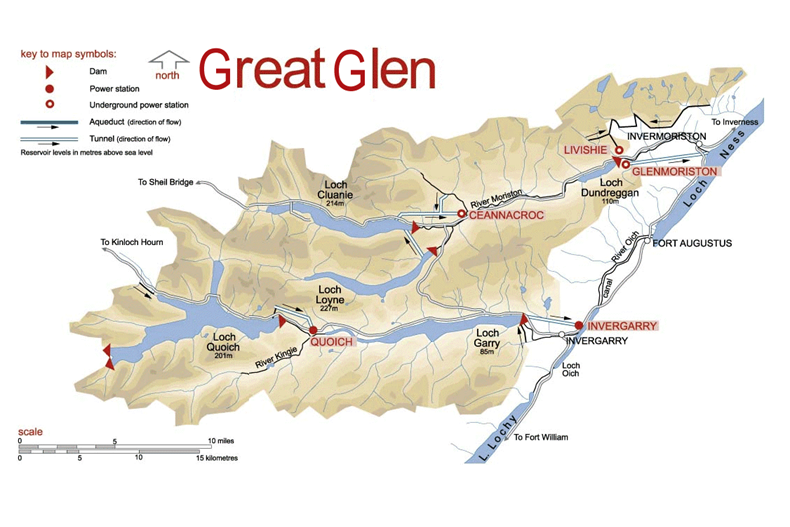
The sizes of the power stations in the scheme are as follows.
- Ceannacroc – 20 MW
- Livishie – 15 MW
- Glenmoriston- 37 MW
- Quoich – 18 MW
- Invergarry – 20 MW
- Mucomir – 1.7 MW
This gives a total power of 112.7 MW.
112.7 MW to 1.8 GW (1800 MW) is a colossal increase in power.
It should be noted that 1.8 GW is half the power of Hinckley Point C nuclear power station.
Pumped Storage Hydro In The Highlands – Is Anywhere Still Off Limits?
The title of this post, is the same as that of this article on UK Climbing.
This is the sub-heading.
Are the enormous Earba and Fearna hydro projects merely the thin end of an ever bigger wedge? Thanks to a relaxed developer-friendly planning regime, is anywhere in Highland Scotland now safe from energy projects designed to feed an insatiable demand down south? In pursuit of clean power, do we risk permitting huge and irreparable harm across our remaining wild habitats and scenic land? And if so, what (and who) is it all really in aid of? It’s not too late to shed light on the murky world of Highland mega-energy, says Jane Meek, but time is running out for our mountain heritage.
These are the first three paragraphs.
In case you haven’t heard, Earba is the codename for a massive pumped storage hydro scheme to be hosted by Ardverikie Estate of Monarch of the Glen fame on behalf of Gilkes Energy, a Lakes-based engineering firm hitherto better known as a developer of small-scale run-of-river hydro schemes on Scottish burns and rivers. Some of these may be familiar to you: they include Pattack on Ardverikie Estate, Ben Glas on Glen Falloch Estate near Crianlarich, and Neaty Burn in Glen Strathfarrar, to name just three.
Gilkes Energy has now moved up into the big league of pumped storage hydro (PSH). Visit their homepage to admire a brief slide show of projects past, present and in planning. It’s glossy professional stuff, just what you’d expect from the self-styled “leading independent developer” of conventional hydro and PSH in the UK.
The aerial shots are particularly fine but… hang on a minute… isn’t that Loch a’ Bhealaich Leamhain down there, gleaming like a pearl in the high pass between Munros Beinn a’ Chlachair and Mullach Coire an Iubhair (Geal Charn as was)? And … oh dear, isn’t that Loch Fearna, the glittering shelf lochan below Spidean Mialach, immortalised in countless photographs by walkers crossing the col between Spidean and neighbouring Gleouraich? From the slopes above Fearna, the views across Loch Quoich to Gairich and beyond are simply stunning. After watching the slide show, you may feel simply stunned.
The author of the article makes a statement and asks a question.
It’s industrialisation on a vast scale. Are these truly the right schemes in the right places?
The author may have a point, but environmentalists will argue that saving the planet is more important and that pumped storage hydroelectricity is one of the technologies, that will help us do that!
SSE And Gilkes Energy Announce Joint Plans To Progress Loch Fearna Pumped Storage Hydro Project
The title of this post, is the same as that of this press release from SSE Renewables.
These five paragraphs from the press release outline the scheme.
SSE has announced plans to progress a new pumped storage hydropower scheme at Loch Fearna in Scotland’s Great Glen, in a 50:50 development joint venture with a consortium led by Gilkes Energy.
The proposed co-development is located at the western end of Glengarry around 25km west of Invergarry and adjoins SSE Renewables’ existing Loch Quoich reservoir in the Great Glen hydro scheme.
SSE Renewables already operates the largest fleet of hydro-electric power and pumped storage hydro assets in Scotland. It is now progressing development plans for new pumped storage hydropower projects in the Highlands to complement its existing fleet and deliver the large-scale, long-duration electricity storage (LDES) needed as part of Britain’s future energy mix.
The Fearna Pumped Storage Hydro (PSH) project envisages the development of tunnels and a new power station connecting SSE Renewables’ existing reservoir at Loch Quoich with an upper reservoir at Loch Fearna.
Under the terms of the joint venture being announced today, Gilkes Energy will lead the project’s development under a development services agreement with SSE Renewables.
I wrote about the Great Glen hydro scheme in Repurposing The Great Glen Hydro-Electric Scheme, where I included this map, from the SSE Renewables web site shows the layout of the dams and power stations.
The sizes of the power stations in the scheme are as follows.
- Ceannacroc – 20 MW
- Livishie – 15 MW
- Glenmoriston- 37 MW
- Quoich – 18 MW
- Invergarry – 20 MW
- Mucomir – 1.7 MW
This gives a total power of 112.7 MW.
This five paragraph from the press release details the size of the scheme.
It is envisaged the proposed development would be up to 1.8GW in generating capacity and capable of producing around 37GWh of stored energy capacity. The project has already secured a grid connection offer totalling 1,795MW.
The 1.8 GW/37 GWh Fearna pumped hydro scheme will dwarf the Great Glen hydro scheme.
it is now seventy years since some of these hydro-electric systems were built in Scotland.
As an engineer, I wouldn’t be surprised to a see a fair amount of updating in the Highlands to upgrade Scotland’s hydro-electricity.
Price Framework Paves Way For Vast Electricity Storage Scheme
The title of this post, is the same as that of this article on The Times.
This is the sub-heading.
SSE welcomes step forward in plans to build the £1.5bn Coire Glas hydroelectric project
These two paragraphs outline the article.
Ministers have provisionally agreed to a power pricing framework that could pave the way for more pumped storage hydroelectricity projects in Britain, including a gigantic £1.5 billion scheme from SSE that is starting to take shape in the Scottish Highlands.
The Department for Energy Security and Net Zero said it intended to develop a “cap and floor” pricing mechanism that would advance the Coire Glas storage project being developed by SSE, the energy company, and could unlock further pumped storage power stations.
Coire Glas will be one of the largest renewable power projects ever built in the UK.
- It will have a power output of 1.5 GW, which is comparable with some of the large wind farms in the North Sea or four gas-fired power station or Rolls-Royce SMRs.
- It will be able to store 30 GWh of electricity and provide 1.5 GW for twenty hours.
- Coire Glas has a web site.
- Coire Glas will more than double pumped storage hydroelectric capacity in the UK.
Bath County Pumped Storage Station in Virginia, US claims to be the world’s largest battery, but Coire Glas will be able to store more electricity.
You wait decades for one of these monsters to come along in the UK and SSE also have another on the way.
- Loch Sloy hydroelectric power station is the largest conventional hydroelectric power station in the UK.
- It has an output of 152 MW.
- It opened in 1950 and was largely built by German and Italian prisoners-of-war.
SSE plan to convert Loch Sloy power station into a pumped storage hydroelectric power station.
- It will be able to store 25 GWh of electricity.
- Loch Sloy will be the upper lake.
- Loch Lomond will be the lower lake.
- The existing dam, upper lake, pipes and powerhouse will be retained.
- The developments have a web page.
The project is aimed at a commissioning date of 2028.
This paragraph explains how the ‘cap and floor’ mechanism works.
In the scheme, operators would be guaranteed a minimum level of revenue, while consumers would be protected by a price ceiling, above which surplus revenue would be returned to them.
And these two paragraphs give SSE’s reaction.
Finlay McCutcheon, 46, director of onshore Europe at SSE, said the pricing framework was welcome news. He said that a deal for Coire Glas was needed by the end of this year to secure a firm investment decision by early 2026. Planning for the project started in 2007.
“Given the time taken to reach this point, much work is now needed to ensure an effective mechanism is finalised and put in place as early as possible to enable Coire Glas to take final investment decisions and move into construction,” he said.
I believe that the negotiations between the Government and SSE will lead to a monster on Loch Lochy and another one on Loch Lomond.
Conclusion
There are also these pumped storage hydroelectric schemes under development.
- Balliemeanoch Pumped Hydro – 1.5 GW/45 GWh
- Balmacaan Pumped Hydro – 600 MW/15-20 GWh
- Corrievarkie Pumped Hydro – 1.5 GW/14.5 GWh
- Fearna Pumped Hydro – 1.8 GW/37 GWh
- Glenmuckloch Pumped Hydro – 400 MW/1.6 GWh
- Loch Earba Pumped Storage Hydro – 900MW/33 GWh
- Loch Kemp Pumped Storage Hydro – 300MW/9 GWh
- Loch Na Cargeach/Red John Pumped Storage Hydro – 450 MW/2.8 GWh
These total up to 7.4 GW/100+ GWh.
This page on the Strathclyde University web site, gives these GWh figures for the possible amounts of pumped-storage that can be added to existing schemes.
- Errochty – 16
- Glasgarnock – 23
- Luichart – 38
- Clunie – 40
- Fannich – 70
- Rannoch – 41
- Fasnakyle – 78
- Tummel – 38
- Ben Lawers – 12
- Nant – 48
- Invermoriston – 22
- Invergarry – 41
- Quoich – 27
- Sloy – 20
That is a total of 514 GWh.
Scotland will be the Saudi Arabia of energy storage.
Scotland’s 25 GWh Energy Storage Arriving By Stealth
In SSE Unveils Redevelopment Plans For Sloy Hydro-Electric Power Station, I introduced SSE Renewable’s plan to convert the UK’s largest hydro-electric power station into a pumped storage hydroelectric station, that can store 25 GWh of electricity and generate 152.5 MW of electricity.
After a public consultation in July, which unfortunately, I was unable to get to, SSE have now published a comprehensive document, which details their plans.
These are some points from the document.
- There will be no increase in the generating capacity of 152.5 MW, which is about half the size of a gas-fired power station.
- SSE designed a similar scheme for Sloy in 2009.
- Pumped storage systems need a lot of water. The Loch Sloy scheme has Loch Lomond.
- The development of pumped storage at Sloy would only require construction work to be carried out in the grounds of the existing power station.
- No permanent new works would be required at Sloy Dam or outside of the existing station boundary.
- A new above ground structure would be required which would contain a main hall with vehicular access, laydown areas, an overhead travelling crane, electrical switchgear and control systems.
- A new underground pump hall would be required to house two pumps. This would link to the intake structure and would be approximately 20m below the existing ground level.
- The existing tailrace to Loch Lomond, will be used to bring water to the pumps.
- Construction could start in 2025, with completion in 2027.
This redevelopment is a much less complex construction project, than building the original power station in the 1950s.
It also looks like the construction will not cause much disruption in the local area.
Hence my view, that this storage is arriving by stealth and won’t be noticed by those passing the power station.
After reading this SSE document, I wonder how many similar 1950s hydroelectric power stations have been upgraded to pumped storage stations in the last few years.
Also, if their Sloy scheme is successful, will SSE be looking for other hydroelectric power stations to convert to pumped storage?
This article on renews.biz is entitled Vattenfall Plans To Build 730MW Of Swedish Hydro Power, where this is a paragraph.
Vattenfall is also conducting a pilot study to investigate reinstating the Juktan power station on the Storjuktan lake adjacent to the Umeälven river in Västerbotten, to a pumped storage plant with a capacity of up to 380MW.
Note.
- Juktan power station was built as a pumped storage station and converted to a standard one.
- It has a web page.
- As the paragraph says it could be converted back!
So other companies and countries are thinking the same way!
Strathclyde University’s Prediction
This page on the Strathclyde University web site, gives these figures in GWh for the possible amounts of pumped storage that can be added to existing schemes.
- Errochty – 16
- Glasgarnock – 23
- Luichart – 38
- Clunie – 40
- Fannich – 70
- Rannoch – 41
- Fasnakyle – 78
- Tummel – 38
- Ben Lawers – 12
- Nant – 48
- Invermoriston – 22
- Invergarry – 41
- Quoich – 27
- Sloy – 20
That is a total of 514 GWh.
These figures must give SSE food for thought.
These new schemes are also being planned.
- Balliemeanoch – 1.5GW/45 GWh
- Coire Glas – 1.5 GW/30 GWh
- Corrievarkie – 600 MW/14.5 GWh
- Fearna – 1.8 GW/37 GWh
- Loch Earba – 900 MW/33 GWh
- Loch Kemp – 300 MW/9 GWh
- Loch Na Cathrach/Red John – 450 MW/2.8 GWh
These could bring the potential pumped storage in Scotland to 685.3 GWh.
Will Coire Glas Start A Pumped Storage Boom In Scotland?
This article on Renewables Now is entitled SSE Gets Tenders For Construction Of 1.5-GW Pumped Hydro Scheme.
This is the first paragraph.
SSE Renewables said on Wednesday it has received tenders for the main construction works for the Coire Glas hydro pumped storage project with a capacity of up to 1.5 GW in the Scottish Highlands.
It then lists, the companies who have tendered for the project.
SE Renewables said the ITT has drawn global interest. The tenderers shortlisted for mechanical and electrical plant scope are a partnership between ANDRITZ HYDRO GmbH and Voith Hydro GmbH & Co KG, and GE Hydro France. The parties shortlisted for the civil engineering scope include three consortia and STRABAG UK Ltd. The consortia are made up of Bechtel Ltd, Acciona Construccion SA and Webuild SpA; BAM Nuttall Ltd, Eiffage Genie Civil SA and Marti Tunnel AG; and Dragados SA and BeMo Tunnelling UK Ltd.
It is an impressive list.
The article says that construction is to start in 2024. Other sources say the pumped storage project will have a storage capacity of 30 GWh, which will make it the largest pumped storage plant in the UK.
This press release from SSE Renewables is entitled Tenders Submitted For The Coire Glas Pumped Storage Scheme.
The press release contains this quote from the Project Director for Coire Glas; Ian Innes.
Receiving the tenders on schedule from the six short-listed tenderers is another significant milestone for the Coire Glas project and we are grateful for their continued interest in the project.
We are encouraged by the content of the tenders which now provides the Coire Glas project team with several options on how construction of the project could be undertaken. It is going to take some time to carefully consider and scrutinise the tenders thoroughly and we look forward to working with the tenderers as we endeavour to make our selection decision.
It appears that not only were the tenders received from quality companies, but that they contained options and ideas that could improve the project.
Coire Glas would appear to me to be a project, that is attracting the best companies and they could be putting their best workers on the project.
These are my thoughts.
The Potential For Pumped Storage Schemes In Scotland
There are at least six schemes under development or proposed in Scotland.
- Balliemeanoch – 45 GWh
- Coire Glas – 30 GWh
- Corrievarkie – 14.5 GWh
- Loch Earba – 33 GWh
- Loch Sloy – 14 GWh
- Red John – 2.8 GWh
This page on the Strathclyde University web site, gives these figures for the possible amounts of pumped-storage that can be added to existing hydro schemes.
- Errochty – 16
- Glasgarnock – 23
- Luichart – 38
- Clunie – 40
- Fannich – 70
- Rannoch – 41
- Fasnakyle – 78
- Tummel – 38
- Ben Lawers – 12
- Nant – 48
- Invermoriston – 22
- Invergarry – 41
- Quoich – 27
- Sloy – 20
That is a total of 547 GWh or 653.3 GWh if you include the new storage, I listed above.
Scotland would appear to be land overflowing with large pumped storage possibilities and could provide the modern equivalent of milk and honey.
The Potential For Offshore Wind Power Schemes In Scotland
This is the first two paragraphs of this press release on the Crown Estate Scotland web site.
Crown Estate Scotland has today announced the outcome of its application process for ScotWind Leasing, the first Scottish offshore wind leasing round in over a decade and the first ever since the management of offshore wind rights were devolved to Scotland.
The results coming just months after Glasgow hosted the global COP26 climate conference show the huge opportunity that Scotland has to transform its energy market and move towards a net zero economy.
Some highlights are then listed.
- 17 projects have been selected out of a total of 74 applications.
- A total of just under £700m will be paid by the successful applicants in option fees and passed to the Scottish Government for public spending.
- The area of seabed covered by the 17 projects is just over 7,000km2.
- Initial indications suggest a multi-billion pound supply chain investment in Scotland
- The potential power generated will move Scotland towards net-zero.
This map shows the location of each wind farm.

Note, that the numbers are Scotwind’s lease number in their documents.
Fixed Foundation Wind Farms
These are the six fixed foundation wind farms.
- 1 – BP Alternative Energy Investments – 859 km² – 2.9 GW
- 6 – DEME – 187 km² – 1.0 GW
- 9 – Ocean Winds – 429 km² – 1.0 GW
- 13 – Offshore Wind Power – 657 km² – 2.0 GW
- 16 – Northland Power – 161 km² – 0.8 GW
- 17 – Scottish Power Renewables – 754 km² – 2.0 GW
Adding up these fixed foundation wind farms gives a capacity of 9.7 GW in 3042 km² or about 3.2 MW per km².
Floating Wind Farms
These are the ten floating wind farms.
- 2- SSE Renewables – 859 km² – 2.6 GW
- 3 – Falck Renewables Wind – 280 km² – 1.2 GW
- 4 – Shell – 860 km² – 2.0 GW
- 5 – Vattenfall – 200 km² – 0.8 GW
- 7 – DEME Concessions Wind – 200 km² – 1.0 GW
- 8 – Falck Renewables Wind – 256 km² – 1.0 GW
- 10 – Falck Renewables Wind – 134 km² – 0.5 GW
- 11 – Scottish Power Renewables – 684 km² – 3.0 GW
- 12 – BayWa r.e. UK – 330 km² – 1.0 GW
- 14 – Northland Power – 390 km² – 1.5 GW
Adding up the floating wind farms gives a capacity of 14.6 GW in 4193 km² or about 3.5 MW per km².
Mixed Wind Farms
This is the single wind farm, that has mixed foundations.
15 – Magnora – 103 km² – 0.5 GW
This wind farm appears to be using floating wind turbines.
These wind farms total up to 24.8 GW
I would expect that this is only a phase in the development of Scottish wind power, which will grow substantially over the next decade.
As I write this the UK is generating a total of 26.2 GW of electricity.
Backing Up The Wind Power
This wind power, which could grow up to well over 50 GW in Scotland alone.
But what do you do, when there is no wind?
Energy will need to come from batteries, which in Scotland’s case could be over 500 GWh of pumped storage.
Europe’s Powerhouse
It is not an unreasonable prediction, that we will continue to expand our wind farms to supply Europe with thousands of GWh of electricity and/or millions of tonnes of green hydrogen.
Conclusion
It is likely that we’ll see an upward increase of wind power in Scotland closely matched by a similar increase in pumped storage.
It is no wonder that the world’s largest and most experienced contractors were so keen to get the first big contract in Scotland’s new pumped storage boom.
They know a good thing, when they see it and after their experience with the Scotland’s oil boom in the last century, I doubt they are delaying their return.
Scotland’s Energy Storage
I have been using the web sites of Drax Group, SSE Renewables and ILI Group, and this page from Strathclyde University to look at various hydro-electric schemes to store energy using the tried-and-tested method of pumped hydro.
I have analysed these schemes.
Affric/Beauly
The scheme is now owned by SSE Renewables and has a page on their web site, which introduces the scheme like this.
Situated about 16 kilometres to the west of Inverness, Beauly is the gateway to the Affric/Beauly hydro electric scheme.
Currently, it generates a maximum power of 100.3 MW.
My analysis in Repurposing The Affric/Beauly Hydro-Electric Scheme, showed the following.
- Research from Strathclyde University, says that the Affric/Beauly scheme could support 78 GWh of pumped storage in one scheme at Fasnakyle.
- Adding pumped storage facilities to the Affric/Beauly hydro-electric scheme, with a capacity of upwards of a conservative 50 GWh, should be possible.
Generating capacity and system operation could be improved by replacing some or all of the 1950s and 1960s turbines with modern units and using modern control systems.
The Affric/Beauly hydro-electric scheme could be augmented by upwards of 50 GWh of storage.
Balliemeanoch
This new scheme is being developed by the ILI Group.
From what is published in the press. it appears to be a giant 1.5 GW/45 GWh project.
In Thoughts On The Balliemeanoch Pumped-Hydro Scheme, I analyse the plan.
The Balliemeanoch hydro-electric scheme could add 45 GWh of storage.
Balmacaan
This new scheme is being developed by SSE Renewables.
My searches in A Possible Balmacaan Pumped Storage System, showed the following.
It has a 600 MW generating capacity and I suspect would have about 15-20 GWh of storage.
The Balmacaan hydro-electric scheme could conservatively add upwards of 15 GWh of storage.
Breadalbane
The scheme is now owned by SSE Renewables and has a page on their web site, which introduces the scheme like this.
The Breadalbane scheme is set in the mountainous region around Loch Lyon, Loch Tay and Loch Earn in Perthshire.
Currently, it generates a maximum power of 168.4 MW.
My analysis in Repurposing The Breadalbane Hydro-Electric Scheme, showed the following.
- Research from Strathclyde University, says that the Breadalbane scheme could support 12 GWh of pumped storage in one scheme at Ben Lawers.
- I believe a similar scheme could be built South of Loch Tay to add a similar amount of pumped storage capacity.
As with the Beauly/Affric scheme, generating capacity and system operation could be improved by replacing some or all of the 1950s and 1960s turbines with modern units and using modern control systems.
The Breadalbane hydro-electric scheme could be augmented by upwards of 12 GWh of storage.
Coire Glass
This new scheme is being developed by SSE Renewables and the project has its own web site, which introduces the scheme like this.
Coire Glas is a hydro pumped storage scheme with a potential capacity of up to 1500MW. Coire Glas is an excellent pumped storage site with a large lower reservoir (Loch Lochy) and a significant elevation of more than 500m between the lower and the new upper reservoir site over a relatively short distance.
It is planned to generate a maximum power of up to 1.5 GW for twenty hours, which indicates an energy storage capacity of 30 GWh.
In SSE Renewables Launches 1.5GW Coire Glas Construction Tender, I talk about the current status of the project.
The Coire Glas hydro-electric scheme could add 30 GWh of storage.
Conon
The scheme is now owned by SSE Renewables and has a page on their web site, which introduces the scheme like this.
The Conon scheme lies within the northwest Highlands, broadly between Inverness and Ullapool. Electricity generation started here when the Ross-shire Electricity Supply Company built the small Falls of Conon hydro electric power station in the 1920s.
Currently, it generates a maximum power of 107.2 MW.
My analysis in Repurposing The Conon Hydro-Electric Scheme, showed the following.
- Research from Strathclyde University, says that the Conon scheme could support up to 131 GWh of pumped storage.
- Adding pumped storage facilities to the Conon hydro-electric scheme, with a capacity of upwards of a conservative 30-40 GWh, should be possible.
As with other schemes, generating capacity and system operation could be improved by replacing some or all of the 1950s turbines with modern units and using modern control systems.
The Conon hydro-electric scheme could be augmented by upwards of 30 GWh of storage.
Corrievarkie
This new scheme is being developed by the ILI Group.
From the planning application it appears to be a 600 MW/14.5 GWh project.
In Corrievarkie Pumped Storage Hydro Project, I analyse the plan.
The Corrievarkie hydro-electric scheme could add 14.5 GWh of storage.
Cruachan
Cruachan is a pumped-storage power station, that is owned by Drax, which have a comprehensive web site for the power station.
- It has an output of 440 MW.
- It has an energy storage capacity of 7.1 GWh
- It can can reach full generating capacity in less than 30 seconds.
In Drax’s Plans For Cruachan, I analyse Drax’s plans, which they call Cruachan 2.
- It will be a 600 MW power station.
- It will be to the East of the current power station.
- More than a million tonnes of rock would be excavated to build the power station.
The existing upper reservoir, which can hold 2.4 billion gallons of water, has the capacity to serve both power stations.
These was my conclusions.
It looks like very good engineering to me.
- There is a good chance, that on most nights, the reservoir will be filled using wind energy
- The maximum output of the Cruachan power station has been more than tripled from 323 to 1010 MW.
- There has been no increase in the size of the Cruachan reservoir.
Scotland will now have a GW-sized hydro-electric power station.
It will not be very much smaller than Sizewell B nuclear station.
Foyers
The scheme is now owned by SSE Renewables and has a page on their web site, which introduces the scheme like this.
The current Foyers Power Station operates quite differently to conventional hydro electric power stations. Foyers hydro scheme consists of one pumped hydro power station and one hydro power station and one major dam..
Currently, it generates a maximum power of 305 MW.
My research and analysis in The Development Of The Foyers Pumped Storage Scheme, showed the following.
- Foyers is a modern pumped-hydro scheme with a capacity of 10 GWh.
- The updating of the original 1896 hydro-power station to a modern pumped-storage system in 1974 is a superb example of hydro-power engineering.
The development of Foyers power station is an example, that shows what can be done in other hydro-electric schemes around Scotland and the rest of the world.
Galloway
Galloway is a hydroelectric scheme, that is owned by Drax, which have a comprehensive web site for their two hydroelectric schemes in Scotland; Galloway and Lanark.
- Galloway has a total output of 109 MW.
- It has six power stations at Drumjohn, Kendoon, Carsfad, Earlstoun, Glenlee and Tongland.
- There is no energy storage
- It is what is known as a run-of-the-river scheme.
The scheme opened in the 1930s.
Glendoe
The scheme is now owned by SSE Renewables and has a page on their web site, which introduces the scheme like this.
In 2009, the first major hydro electric power station to be built in Scotland for almost 30 years, Glendoe on the eastern shore of Loch Ness, began generating electricity.
Currently, it generates a maximum power of 106.5 MW.
My analysis in Glendoe Hydro Power Station, led me to conclude, that engineers will look at this scheme built in the early years of this century to convert it to a pumped storage facility. It might even have been designed for conversion to a pumped storage station, as it was built after the successful conversion of Foyers power station. Comparing the size of the upper lake to Foyers and other schemes, I would estimate it could easily provide in excess of 15 GWh of storage.
The Glendoe hydro-electric scheme could be augmented by upwards of 15 GWh of storage.
Glenmuckloch
This is a small scheme promoted by Buccleuch, that generates 4 MW and stores 1.6 GWh in a disused opencast coal mine.
My analysis in The Glenmuckloch Pumped Storage Scheme, led me to this conclusion.
This project appears to have stalled, but I do like the idea of using a disused mine to store energy and the engineering behind the project.
I will ignore it in my conclusions of this post.
Great Glen
The scheme is now owned by SSE Renewables and has a page on their web site, which introduces the scheme like this.
The Great Glen runs for more than 100 kilometres from Inverness in the northeast, to Fort William in the southwest, following a geological fault line that divides north and south Scotland.
Currently, it generates a maximum power of 112.7 MW.
My analysis in Repurposing The Great Glen Hydro-Electric Scheme, showed the following.
- Research from Strathclyde University, says that the Great Glen scheme could support up to 90 GWh of pumped storage.
- Adding pumped storage facilities to the Great Glen hydro-electric scheme, with a capacity of upwards of a conservative 30 GWh, should be possible.
As with other schemes, generating capacity and system operation could be improved by replacing some or all of the 1950s and 1960s turbines with modern units and using modern control systems.
The Great Glen hydro-electric scheme could be augmented by upwards of 30 GWh of storage.
Lanark
Lanark is a hydroelectric scheme, that is owned by Drax, which have a comprehensive web site for their two hydroelectric schemes in Scotland; Galloway and Lanark.
- Lanark has a total output of 17 MW.
- It has two power stations at Bonnington and Stonebyres.
- There is no energy storage
- It is what is known as a run-of-the-river scheme.
The scheme opened in the 1920s.
Red John
This new scheme is being developed by ILI Group and the project has its own web site, which introduces the scheme like this.
Between 2007 and 2015, the total installed capacity of renewables electricity in Scotland has more than doubled. Due to its intermittent nature, the rise in renewable generation has resulted in increased demand for flexible capacity to help meet energy balancing requirements for the national grid system.
Pumped storage hydro is considered by the Directors to be the most developed and largest capacity form of grid energy storage that currently exists. This can help reduce renewable energy curtailment and therefore promote grid stability.
The web site says this about the project.
- The scheme has an output of 450 MW.
- The storage capacity is 2.8 GWh.
- The scheme has planning consent.
- The project is budgeted to cost £550 million.
- The construction program indicates that the scheme will be completed by the end of 2025.
It also has very detailed maps.
I wrote about the project in Red John Pumped Storage Hydro Project, where I came to these conclusions.
- This scheme has the output of a large gas-fired power station for just over six hours.
- The finances must add up, as no-one would back a scheme like this if they didn’t get an adequate return on their money.
It may only be a small scheme, that is a quarter of the size of the existing nearby Foyers pumped-storage scheme, but as it is shovel-ready, we should start digging.
The Red John hydro-electric scheme would add 2.8 GWh of storage.
Shin
The scheme is now owned by SSE Renewables and has a page on their web site, which introduces the scheme like this.
Shin is Scotland’s most northerly hydro electric scheme. It utilises water from a 650 square kilometre catchment area in Sutherland, including Loch Shin, and water from the River Cassley and River Brora.
Currently, it generates a maximum power of 32.1 MW.
My analysis in Shin Hydro Power Scheme, showed the following.
- I would be very surprised if any pumped storage were to be added to this scheme.
- This 1950s scheme has been partially updated.
Perhaps some more updating would be worthwhile.
Sloy/Awe
The scheme is now owned by SSE Renewables and has a page on their web site, which introduces the scheme like this.
With the exception of Cruachan Power Station which was commissioned in 1965, major work on the Sloy/Awe scheme was completed by 1963, the year the Beatles had their first No 1 hit with From Me To You – and a world away from the immediate post-war austerity being experienced when Sloy Power Station was commissioned just 14 years earlier.
Currently, it generates a maximum power of 261.9 MW.
My analysis in Repurposing The Sloy/Awe Hydro-Electric Scheme, showed the following.
- Research from Strathclyde University, says that the Sloy/Awe scheme could support up to 68 GWh of pumped storage.
- Adding pumped storage facilities to the Sloy/Awe hydro-electric scheme, with a capacity of upwards of a conservative 40 GWh, should be possible.
As with other schemes, generating capacity and system operation could be improved by replacing some or all of the 1930s and 1950s turbines with modern units and using modern control systems.
The Sloy/Awe hydro-electric scheme could be augmented by upwards of 40 GWh of storage.
Tummel Valley
The scheme is now owned by SSE Renewables and has a page on their web site, which introduces the scheme like this.
The Tummel scheme stretches from Dalwhinnie, famous for its whisky distillery, in the north, to the remote Rannoch Station in the west, and the highly-popular tourist town of Pitlochry in the east.
Currently, it generates a maximum power of 309.2 MW.
My analysis in Repurposing The Tummel Hydro-Electric Scheme, showed the following.
- Research from Strathclyde University, says that the Tummel Valley scheme could support up to 135 GWh of pumped storage.
- Adding pumped storage facilities to the Tummel Valley hydro-electric scheme, with a capacity of upwards of a conservative 40-60 GWh, should be possible.
As with other schemes, generating capacity and system operation could be improved by replacing some or all of the 1930s and 1950s turbines with modern units and using modern control systems.
The Tummel Valley hydro-electric scheme could be augmented by upwards of 40 GWh of storage.
A Simple Summary
These are deliberately conservative figures from my analysis.
- Affric/Beauly – 50 GWh
- Balliemeanoch – 45 GWh
- Balmacaan – 15 GWh
- Breadalbane – 12 GWh
- Coire Glas – 30 GWh
- Conon – 30 GWh
- Corrievarkie – 14.5 GWh
- Glendoe – 15 GWh
- Great Glen – 30 GWh
- Red John – 2.8 GWh
- Sloy/Awe – 40 GWh
- Tummel Valley – 40 GWh
Note.
- With new storage like Balliemeanoch, Balmacaan, Coire Glas, Corrievarkie and Red John, I am using published figures where they are available.
- With figures from existing schemes,I am being deliberately very conservative.
That is a total of 324.3 GWh with 107.3 GWh down to new storage
Strathclyde University’s Prediction
This page on the Strathclyde University web site, gives these figures for the possible amounts of pumped-storage that can be added to existing schemes.
- Errochty – 16
- Glasgarnock – 23
- Luichart – 38
- Clunie – 40
- Fannich – 70
- Rannoch – 41
- Fasnakyle – 78
- Tummel – 38
- Ben Lawers – 12
- Nant – 48
- Invermoriston – 22
- Invergarry – 41
- Quoich – 27
- Sloy – 20
That is a total of 514 GWh or 621.3 GWh if you include new storage.
Conclusion
Scotland and the UK, has been left a superb legacy for the future by the pioneering work of Scottish engineers and the North of Scotland Hydroelectric Board.
Most of these assets are now in the hands of two groups; Scottish and Southern Energy (SSE) and Drax Group.
Having seen several of the schemes detailed in this post, in the last few weeks, on Michael Portillo’s; Great Coastal Railway Journeys, it does seem that both groups are looking after their assets.
SSE and Drax also seem to be doing their best to publicise the success of one of the UK’s high-value, but low-profile engineering assets.
I believe that we should do a survey that would identify the following.
- What needs to be done to allow each aqueduct, dam, power station and tunnel to continue to function until a given date in the future.
- Which of the individual schemes can be updated to larger schemes or pumped storage systems.
We would then be able to device a long term plan to create a world-class hydro-electric power scheme for Scotland.
Scotland should be able to provide upwards of 400 GWh of pumped-storage.
This article on Current News is entitled Up To 24GW Of Long Duration Storage Needed For 2035 Net Zero Electricity System – Aurora.
These are the first three paragraphs.
Deploying large quantities of long duration electricity storage (LDES) could reduce system costs and reliance on gas, but greater policy support is needed to enable this, Aurora Energy Research has found.
In a new report, Aurora detailed how up to 24GW of LDES – defined as that with a duration of four hours or above – could be needed to effectively manage the intermittency of renewable generation in line with goals of operating a net zero electricity system by 2035. This is equivalent to eight times the current installed capacity.
Additionally, introducing large quantities of LDES in the UK could reduce system costs by £1.13 billion a year in 2035, cutting household bills by £26 – a hot topic with energy bills on the rise as a result of high wholesale power prices.
The report also says that long duration storage could cut carbon emissions by ten million tonnes of carbon dioxide per year.
It appears to me, Scotland can provide more than enough energy storage for the UK and the Island of Ireland, even if the seas around the British Isles were almost completed covered by wind turbines.
In addition, to the works in Scotland to update the various hydroelectric schemes, there would need to be more interconnectors around the UK and probably to close countries like Belgium, Denmark, France, Germany, the Netherlands and Norway.
There could even be an interconnector between Iceland and Scotland, so Iceland’s abundance of zero-carbon electricity could be exported to Europe.
Repurposing The Great Glen Hydro-Electric Scheme
The Great Glen hydro-electric scheme was built in the 1950s and early 1960s, by the North of Scotland Hydroelectric Board.
- The scheme is now owned by SSE Renewables and has a page on their web site.
- There are six individual power stations; Ceannacroc, Livishie, Glenmoriston, Quoich, Invergarry and Mucomir.
- There are five dams; Cluanie, Loyne, Dundreggan, Quoich and Invergarry.
This map from the SSE Renewables web site shows the layout of the dams and power stations.
The sizes of the power stations in the scheme are as follows.
- Ceannacroc – 20 MW
- Livishie – 15 MW
- Glenmoriston- 37 MW
- Quoich – 18 MW
- Invergarry – 20 MW
- Mucomir – 1.7 MW
This gives a total power of 112.7 MW.
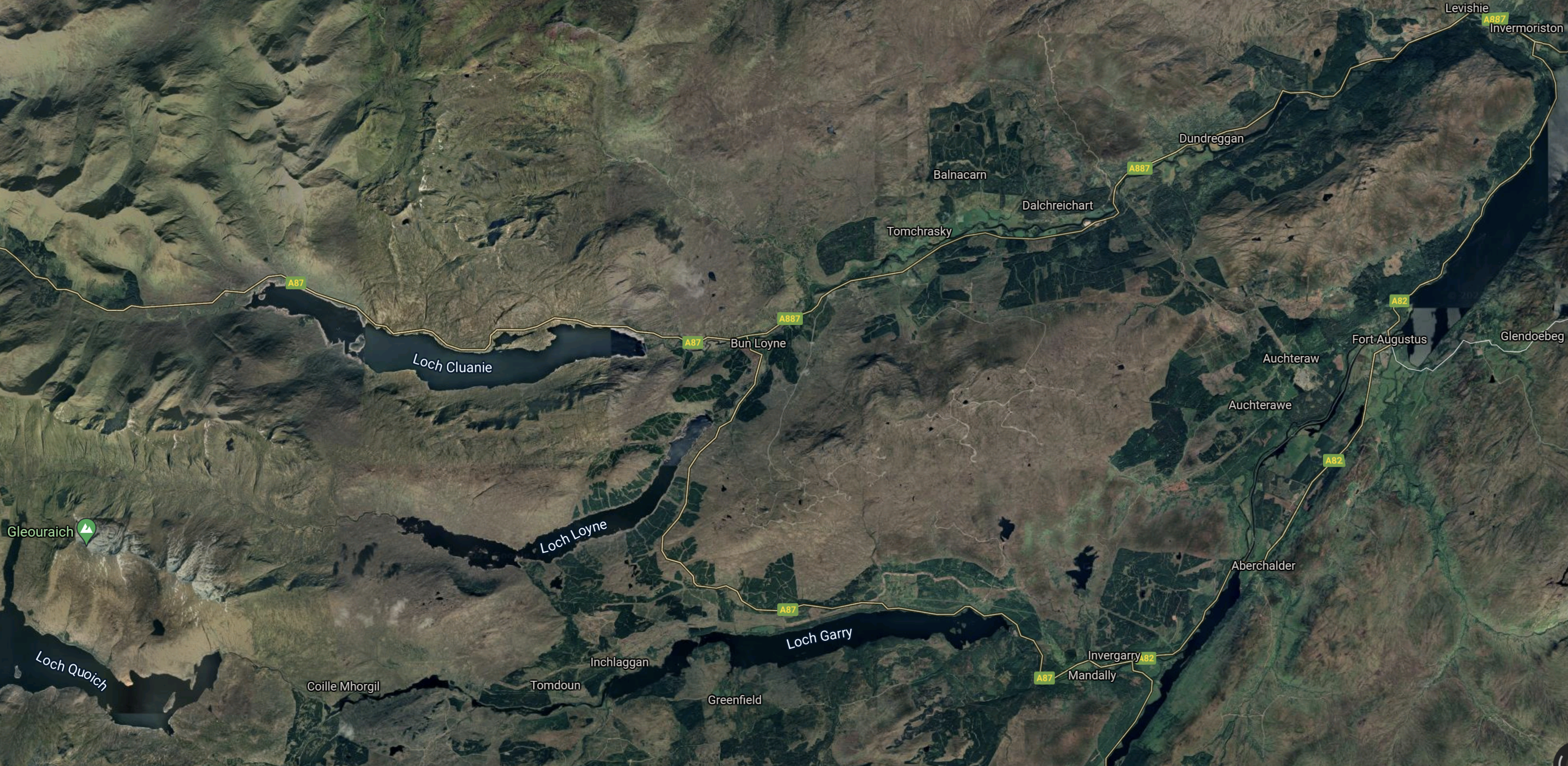
This Google Map shows the same area as the SSE Renewables Map.
Note.
- Loch Quoich is in the South-West corner.
- To the East of Loch Quoich is Loch Garry and to the North-East is Loch Loyne.
- Loch Cluanie is to the North.
- Invermoriston is in the North-East corner.
The scheme also includes three underground power stations and several miles of tunnels.
Strathclyde University And Pumped Storage Power For Scotland
This page on the Strathclyde University gives a list of the pumped storage potential for Scottish hydrogen-electric dams and power stations.
These figures are given for the dams and lochs in the Great Glen scheme.
- Invergarry – 22 GWh
- Glenmoriston- 41 GWh
- Quoich – 27 GWh
It would appear that based on research from Strathclyde University, that the Great Glen scheme could support up to 90 GWh of pumped storage.
Water Flows In The Great Glen Scheme
Looking at the SSE Renewables map of the Great Glen scheme, water flows appear to be as follows.
- Loch Quoich to Loch Garry via Quoich power station.
- Loch Garry to Loch Oich via Invergarry power station.
- Loch Loyne to Loch Dundreggan via River Moriston.
- Loch Cluanie to Loch Dundreggan via Ceannacroc power station and River Moriston.
- Loch Dundreggan to Loch Ness via Glenmoriston power station.
All the water eventually flows into the sea at Inverness.
Refurbishing And Repurposing The Great Glen Scheme
Perhaps as the power stations are now over fifty years old, one simple way to increase the generating capacity of the Great Glen scheme, might be to selectively replace the turbines, with modern turbines, that can generate electricity more efficiently.
I suspect that SSE Renewables have an ongoing program of improvements and replacements for all of their hydro-electric stations in Scotland. Some turbines at Sloy power station have already been replaced with larger ones.
Adding Pumped Storage To The Great Glen Scheme
I would assume that the water to pump uphill at night or when there is a surplus of electricity will come from Loch Oich or Loch Ness.
Some power stations like Glenmoriston and Invergarry might be updated to both generate electricity or pump water up hill, as is required.
Conclusion
There would appear to be up to three schemes, that could each add around 30 GWh of pumped storage.
One advantage is that the waters of Loch Ness can be used for the lower reservoir.
 The Anonymous Widower