A Bank Holiday To Look Forward To
C and myself, used to hate Bank Holidays and had some miserable ones.
I can remember, where we thought we’d go with the dogs to Holkham Beach, after a marvellous sunny day on the Sundasy.
However, it was foggy and after she’d sat in her bikini for about twenty minutes, expecting it to lift, as the BBC had promised, we drove home again.
This year though, according to this page on the Network Rail web site, which is entitled One month to go until new London Bridge station concourse partially opens, Londoners will be treated to a first glimpse of what could be the railways of the London’s next great station; London Bridge. In the Wikipedia entry for the station, there is this poem by John Davidson.
Inside the station, everything’s so old,
So inconvenient, of such manifold
Perplexity, and, as a mole might see,
So strictly what a station shouldn’t be,
That no idea minifies its crude
And yet elaborate ineptitude.
A dump described in six lines.
This is said on the Network Rail web page.
Bank Holiday Monday (29 August) will be the first time passengers from the region will be able to use the massive new station concourse, which is being created underneath the existing railway as part of Network Rail’s Railway Upgrade Plan to provide a bigger, better, more reliable railway for passengers and businesses.
This picture looks a bit different to how I visualise one of London’s grottiest station, from a few years ago.
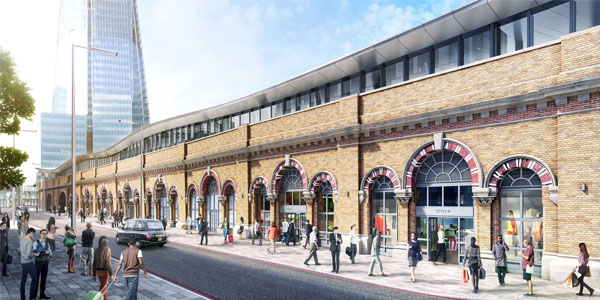
A Network Rail Visualisation Of London Bridge Station
It looks like London Bridge might turn out to a station with both a fur coat and knickers, unlike the dreadful St. Pancras, which only has the coat.
Sadly John Davison died in 1909, so he won’t be available to write a suitable new poem.
A South London Metro
Some of my recent posts including.
- An Improved South London Line Is Proposed
- A New Station For Battersea
- The Lines At Battersea Power Station On the Way Into Victoria
- A Tunnel Under Brixton
Are leading me to the conclusion that it would be possible to create a South London Metro, that worked under similar principles to the East London Line.
The East London Line
If anybody doesn’t believe that the East London Line is one of the best creations on the world’s railways in recent years, then they should go and read something else now.
Consider.
- There is a core section between Dalston Junction and Surrey Quays stations, where sixteen trains per hour (tph) shuttle passengers under the river in modern trains.
- In Increased Frequencies On The East London Line, I indicated that TfL are planning to increase this frequency to 20 tph.
- At the Northern end four dedicated platforms at two different termini; Dalston Junction and Highbury and Islington give passengers choices of onward routes.
- At the Southern end, there are four separate termini; Clapham Junction, Crystal Palace, New Cross and West Croydon.
- Three of the southern termini have excellent onward connections and if the Tramlink is sorted at West Croydon, then that would be improved.
- The line has excellent connections to the Victoria and Jubilee Lines of the Underground and other rail lines.
It has been a marvellous success.
The North London Line
The North London Line is not as radical in its design as the East London Line, as it effectively just a a simple line across North London, that carries up to eight trains per hour and a lot of freight.
It has been successful, but not as successful as the East London Line.
The Future Of The Overground In North And East London
The success of removing, third-rate trains on the North and East London Lines is now being repeated on the Gospel Oak to Barking Line, where two-car diesel trains are being replaced with four-car electric ones.
But this is only the start, as other plans are being put together in North London.
- Will electrification be completed in North London by wiring the Dudding Hill Line?
- New stations like Brent Cross Thameslink, Old Oak Common and Angel Road are being created to support development.
- In the Walthamstow area, new curves will improve services on the Chingford Branch.
- Chiltern Railways have plans for a Chiltern Metro to West Ruislip station.
- The Metropolitan Line is being extended to Watford Junction.
- Thameslink will integrate and expand the suburban services out of Kings Cross and St. Pancras.
But to use the well-known phase – “You ain’t seen nothing yet!”
South London In The Slow Lane
South London is very second-rate compared to the North with respect to railways.
My mother always told me to never go South of the River, as I’d get lost.
Look at the historic radial routes out of East, North and West London termini like Euston, Fenchurch Street, Kings Cross, Liverpool Street, Marylebone, Paddington and St. Pancras and the lines have a simple structure that the average child of ten could understand. The Underground also follows a simple structure.
But if you look at trains South of the River, there is not even any logic as to which terminus you use to get your train, with the exception perhaps of Waterloo. Only South London’s crazy rules would mean that going to East Kent would be from the most western Southern terminus at Victoria.
It is mainly down to the fact that much of the rail network South of the River were developed by companies, whose idea of co-operation was stopping the other companies from expanding.
My mother was so very right!
There are problems galore of inadequate infrastructure.
- Some stations are in desperate need of more platforms.
- Lines often cross each other in flat junctions, which severely limit capacity.
- Many of the lines have heavy peak-hour use from commuters and infrequent services in the off-peak.
- Any electrification is non-standard third-rail.
- The main lines don’t have enough capacity.
- Commuters are also often very vocal opponents of even the smallest change.
Even new lines like the Channel Tunnel Rail Link at Ebbsfleet International and Crossrail at Abbey Wood are only partly integrated into the existing network and don’t share a station.
The engineers are doing their best with innovative schemes like the Bermondsey Dive-Under, but the railways in South London need a whole new philosophy to meet the challenges of the twenty-first century.
North London may have a long list of projects in the pipeline, but after the upgrading of Thameslink and the Northern Line Extension to Battersea, South London’s future plan is very thin.
In some ways Crossrail 2 sums up the South. North London will be affected by this line’s construction, but all of the protests are from Chelsea, which can probably be ignored, and South London.
The Centre For London Proposals
In the June 2016 Edition of Modern Railways, there was an article entitled Turning South London Orange, which is a radical set of proposals from an organisation called the Centre for London, with the aim of improving rail services in South London.
This is a summary of their proposals, as they affect the lines across South London from Victoria to Peckham Rye, Herne Hill and Surrey Quays.
- A tunnel should be built from Battersea to South of Herne Hill under Brixton to remove fast services from Victoria to Kent from the area.
- The four-track South London Line should be reconfigured so that London Overground services use the Northern rather than the Southern pair of tracks.
- A new station is built at Battersea linking the Northern Line Extension to the South London Line.
One of the consequences of this, is that it would be possible to create three modern step-free stations at Wandsworth Road, Clapham High Street and Brixton, with the latter two connected to the Northern and Victoria Lines of the Underground using escalators and/or lifts.
A South London Metro
So what would a South London Metro look like?
I will assume the following.
- The fast line tunnel under Brixton is built.
- The South London Line is reconfigured to put the London Overground service on the Northern pair of tracks.
- A new interchange station is built at Battersea.
In the next few sections, I will look at the various parts of the South London Metro.
The Brixton Tunnel
Although not actually part of the South London Metro, the Brixton Tunnel must be built before the Metro can be created, as it removes all the fast Chatham Main Line services between Victoria and Kent, from the lines across South London.
Trains will use a tunnel between Battersea and South of Herne Hill.
So what Southeastern Mainline services, that serve Victoria could use the tunnel?
- 1 tph to Ramsgate via Chatham with a first stop at Bromley South.
- 1 tph to Dover via Chatham with a first stop at Bromley South.
- 1 tph to Dover via Chatham with a first stop at Orpington and a second at Bromley South.
- 1 tph to Canterbury West via Maidstone East with a first stop at Bromley South.
- 1 tph to Ashford International via Maidstone East with a first stop at Bromley South.
There are another nine trains per day running in the peak.
The question has to be asked, if extra services can be provided through a fast tunnel, as the current number of trains might even be within the capacity of a single-track tunnel.
But I suspect that for redundancy and safety reasons that the five-kilometre tunnel would probably be built as double track or a twin-bore tunnel.
At present non-stop services take sixteen minutes between Victoria and Bromley South stations, which is a distance of 20.4 kilometres, which gives a start-to-stop average speed of about 75 kph. At that speed the trains would take around four minutes to pass through the tunnel. So even if the Class 375 trains, that generally work the line went through at full speed of 160 kph, not much would be saved on the journey.
But given the transit time through the tunnel of four minutes or less and the generally low number of trains through the tunnel, I suspect that a single-track tunnel is under serious consideration.
But I would future-proof the line by providing a double-track tunnel.
As Bombardier have said, that the Class 375 trains could be retro-fitted with on-board energy storage, I suspect too that the tunnel could even be left without electrification, as an electrically-dead tunnel must be safer in the unlikely event of a train needing to be evacuated. Evacuation will probably be through the side doors of the trains onto a walkway, as is proposed for Crossrail.
I think that the developments in infrastructure creation and the powering of trains in the last few years could enable a very radical and affordable approach to building this tunnel.
I think there’s a chance we’ll see this five kilometre tunnel bored as a single bore, with either one or two tracks, but no electrification.
Remember that the Severn Tunnel, which is the longest main line rail tunnel in the UK and was built by the Victorians, is seven kilometres long.
London’s latest tunnel which is the Lee Tunnel for sewage is just under seven kilometres long, seven metres in diameter and at a depth of over seventy-five metres under East London. It is probably big enough for a third-rail electrified double-track railway. According to Wikipedia, the Lee Tunnel cost an estimated £635 million.
As we’re moving towards a Golden Age of Tunnelling, I think we’ll be seeing more tunnels proposed.
The Core Section
I would define the core section of the South London Metro as between Wandsworth Road and Peckham Rye stations, so it would also include the following intermediate stations.
- Clapham High Street
- Brixton
- Denmark Hill
If fast services from Victoria to Kent are in a tunnel under Brixton and Herne Hill, the Centre for London Report says that it would be possible for London Overground services to use the Northern pair of tracks rather than the Southern ones. Freight, empty stock movements and other non-stopping services would continue to use the Southern tracks.
At present there are just four tph each way on the Overground along the current line, but as the East London Line core is currently handling sixteen tph, I would think it possible, subject to some reorganisation of the tracks at the two ends of the core section, that all Metro and Overground services could share the Northern tracks and platforms.
Similar sharing has been done successfully between New Cross Gate and Norwood Junction on the Overground, since the East London Line was extended to West Croydon in 2010. On that existing route, the fast trains have their own separate tracks out of the way, just as under the Centre for London proposals, fast trains between Victoria and Kent will be separated in a tunnel under Brixton.
As to the ultimate capacity of the core section, who knows? Figures of 24 tph have been quoted as possible for the East London Line, but twenty through the core will do well for several years.
I suspect that as the only trains on the Northern pair of tracks through South London will be slow Overground/Metro trains, that any routing problems could be solved by simple flat junctions, of which there are many already.
So how would this affect the stations on the core section?
- Wandsworth Road would have two new Northern platforms. As the lines split for Victoria and Clapham Junction just after the station, would each pair of lines and platforms be for appropriate destinations?
- Clapham High Street would have two new Northern platforms for Metro/Overground services. As the Northern platforms are closer to Clapham North station, it might be sensible to create an escalator connection between the two stations and not generally use the Southern platforms.
- East Brixton is a station, that has been discussed for rebuilding.
- Brixton would have reopened Northern platforms for Metro/Overground services. Services via Herne Hill would still use the current platforms and as no trains on the high-level lines over the station would stop, providing step-free access between the Victoria Line and Metro/Overground services would be much easier.
- Many believe that Loughborough Junction station should be connected to the Overground. If Metro/Overground services are moved to the Northern tracks as they go over Loughborough Junction station, I believe that step-free connection between new Metro/Overground platforms and Loughborough Junction is now possible.
- Denmark Hill station would need some reorganisation, but it is already step-free.
- Peckham Rye station would need some reorganisation and it is on the list of being made step-free.
The list of projects to create a core section of the South London Metro would include.
- Build the Brixton Tunnel
- Add the extra platforms and station infrastructure at Wandsworth Road station.
- Add the extra platforms and station infrastructure at Clapham High Street station.
- Create an escalator/lift connection between Clapham High Street and the Northern Line at Clapham North station.
- Reopen the Northern platforms at Brixton station.
- Create an escalator/lift connection between the low-level platforms at Brixton with the Victoria Line.
- Add two high-level platforms at Loughborough Junction station on the Metro/Overground lines.
- Make Loughbrough Junction station fully step-free.
- Make various changes to the tracks, so that all required routes are possible.
There would obviously be other small projects, but I can’t see anything major except for the building of the Brixton Tunnel, that would be needed to create a sixteen train-per-hour route from Victoria across South London.
All projects and that includes the Brixton Tunnel could be carried out without large disruption of the existing train services, which in my view is a tribute to the Centre for London proposals.
I think that without any further major infrastructure after the Brixton Tunnel has been built, and some other smaller projects that are already being planned, the core section of the South London Metro could be a run of step-free stations interchanging with the Northern and Victoria Lines, Thameslink and other services out of Victoria and London Bridge.
Reversal Stations
I also wonder if any of the core stations could be created with an island platform, so that passengers can reverse direction without going up and down stairs. This can already be done at Queens Road Peckham station if say you are on a Dalston Junction to Clapham Junction train and want to go to South Bermondsey or London Bridge.
Never underestimate passengers’ ability to duck and dive!
Connectivity just encourages passengers to take more outrageous, faster and convenient routes.
The Western Termini
At present there are two western termini for the services along the South London Line; Victoria and Clapham Junction and Victoria.
There is probably not enough platforms, if it is desired to run sixteen tph or more through the core, as is done on the East London Line.
Clapham Junction As A Western Terminus
At present 4 tph run to Clapham Junction and as I wrote in Increased Frequencies On The East London Line, this will be increased to 6 tph in 2019.
I suspect that despite the rather unusual platform arrangements at Clapham Junction, which I call The Clapham Kiss, that 6 tph can be handled at the station.
So I think it will be very much Carry On Clapham!
Victoria As A Western Terminus
At present, the following services serve Victoria along the South London Line.
- 4 tph to Orpington, which turn off at Brixton.
- 2 tph to Dartford via Bexleyheath, which turn off at Peckham Rye.
Combined with the 6 tph from Clapham Junction, between Wandsworth Road and Brixton, there are 12 tph.
Given that Victoria is crowded and needs more platforms, would it be possible to handle the South London Metro from a dedicated platform or pair of platforms in Victoria?
Assigned platforms at Dalston Junction certainly helps passengers, as you know where your train to the various destinations will call.
- Through Platform 1 for Highbury and Islington
- Bay Platform 2 for New Cross
- Bay Platform 3 for Clapham Junction
- Through Platform 4 for Crystal Palace and West Croydon
This is certainly what is happening today as I write.
I think it would be a great advantage if you went to a particular platform or pair of platforms to pick up the South London Metro.
This mini sub-station concept is used at.
- Cheshunt for the Lea Valley Lines
- Clapham Junction for the East London Line.
- Crystal Palace for the East London Line.
- Liverpool Street for the Lea Valley Lines.
- Richmond for the North London Line.
- Stratford for the North London Line.
Usually, you just look for the orange!
Battersea As A Western Terminus
Given that Victoria is crowded and probably needs more platforms, an alternative terminus is probably needed.
Just as when Dalston Junction was rebuilt for the East London Line, two bay platforms were incorporated, could the same thing be done at the new Battersea station?
Certainly, the system works well at Dalston Junction, so why wouldn’t a similar arrangement work at Batttersea?
- Passengers needing to get to Victoria on a train terminating at Battersea would just walk across the platform and wait a couple of minutes for the train to Victoria.
- Passengers from Victoria on a train going to a wrong destination would only have to go to Wandsworth Road to get a train to any destination, including those served from Clapham Junction.
It is a system, where to do any journey you either do it direct, or with a single same-platform change.
Old Oak Common As A Western Terminus
Because of the capacity problems and the unusual layout at Clapham Junction station, it might also be possible to use somewhere on the West London Line as a Western terminus.
Old Oak Common station with its connections to the West Coast Main Line, HS2, Crossrail and the North London Line would be an obvious choice.
The Eastern Termini
At present services from Victoria and Clapham Junction, go although the South London Line to the following destinations.
- Dalston Junction – 4 tph from Clapham Junction – 6 tph from 2019
- Dartford – 2 tph from Victoria via Bexleyheath
- Orpington – 4 tph from Victoria
Even with Dartford services raised to 4 tph, that is probably still below the capacity of the core section of the line.
Dalston Junction As An Eastern Terminus
I would assume that the current Dalston Junction to Clapham Junction service will continue.
Currently there are 4 tph, but this will go to 6 tph in 2019 as I wrote about in Increased Frequencies On The East London Line.
As TfL’s predictions in the document I found for 2016 and 2017 have already happened, I would think the 6 tph is likely, if the new Class 710 trains are delivered to boost the fleet.
With the increase in service frequency, London Overground Syndrome means that the passengers using the service will increase.
Dartford As An Eastern Terminus
At present, 2 tph go between Victoria and Dartford via Bexleyheath.
But is Dartford, the best terminal in the area for the South London Metro?
Consider.
- A Crossrail extension to Gravesend has been safeguarded, which goes through Dartford.
- Crossrail surely should connect directly to HS2.
- If Crossrail served Dartford, some of the other services would be simplified.
- Dartford will probably come under TfL control.
I wouldn’t be surprised to see 4 tph service along a South London Metro to a Dartford station, where Crossrail calls to give a direct link to HS2 at Ebbsfleet International.
London Bridge As An Eastern Terminus
As London Bridge station used to be linked along the South London Line to Victoria, this important station must be added.
Especially, as there were a lot of passengers, who objected to losing the direct service along the South London Line between London Bridge and Victoria.
On the East London Line, there is a short 4 tph service between Dalston Junction and New Cross which is used as a short direct service through the core, perhaps to boost train frequencies there.
So could a service with a similar frequency be run on the South London Line between Victoria and London Bridge? It could call at.
- South Bermondsey
- Queen’s Road Peckham
- Peckham Rye
- Denmark Hill
- Loughborough Junction
- Brixton
- Clapham High Street
- Wandsworth Road
- Battersea
It would have step-free connections to the Northern and Victoria Lines and Thameslink, if the appropriate stations were upgraded.
Orpington As An Eastern Terminus
I think that Orpington has the greatest potential as a terminal.
This map from carto.metro.free.fr shows the route from Kent House station via Beckenham Junction and Bromley South to Orpington.
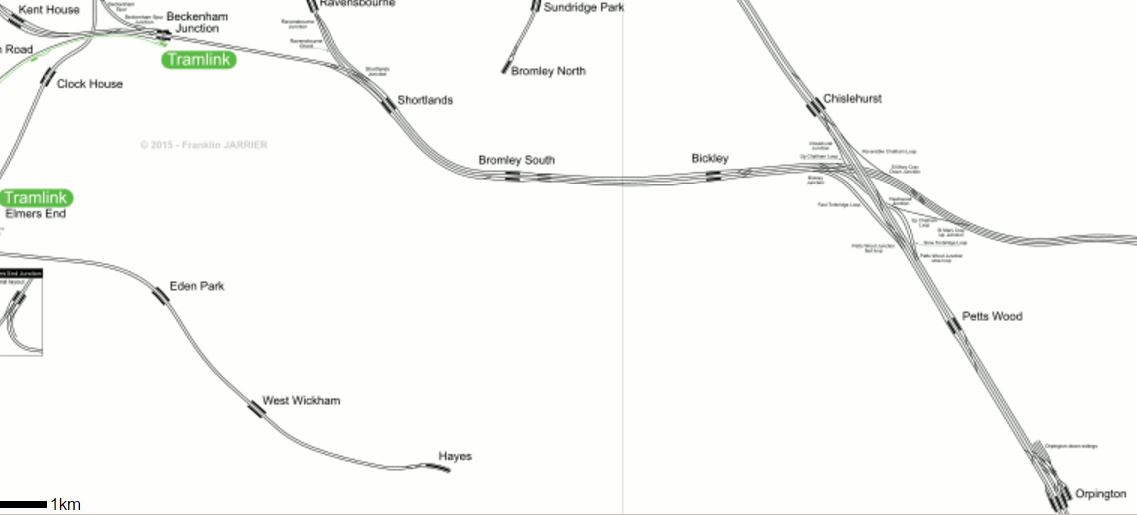
From Kent House Via BromleySouth To Orpington
It has very good connectivity.
- Beckenham Junction connects to the Tramlink.
- Bromley South connects to Thameslink, the Chatham Main Line and the Maidstone East Line.
- Orpington connects to the South Eastern Main Line and the Hastings Line.
Because of all this connectivity, Bromley and Orpington might be able to provide enough passengers for more than four trains per hour going to Victoria and/or Battersea.
Remember there will still be the five fast trains per hour through the Brixton Tunnel in addition to the stopping ones of the Metro.
Bellingham As An Eastern Terminus
When the Overground took over the line, there was some discussion about a service between Victoria and Bellingham.
So could Bellingham station be a terminus?
This Google Map shows the area around Bellingham station.
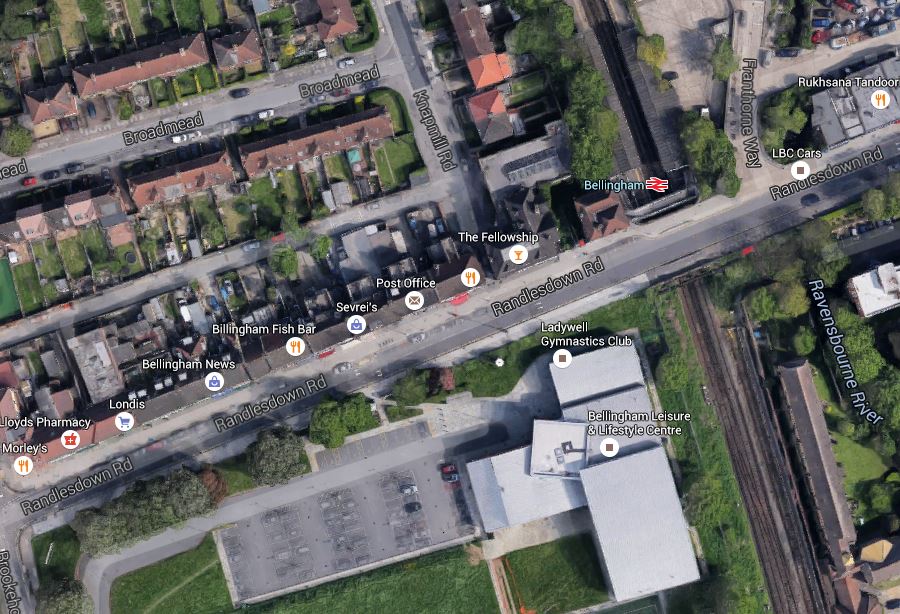
Bellingham Station
There doesn’t seem to be much of importance in the area, except the leisure centre.
In addition.
- The station doesn’t seem to have a suitable bay platform, but there may be space to build one.
- The station would provide a link to Thameslink.
- It only handles a couple of trains an hour most of the day, so perhaps the terminating of trains was to be slipped in the large gaps.
Perhaps it was all to stimulate development in the area.
An HS1 to HS2 Link
If Old Oak Common is chosen as a Western Terminus with a 4 tph service down the West London Line and the core route of the South London Metro, what would be a suitable terminal in the East?
Given what I said about Dartford as an Eastern terminus, surely a four tph service across South London linking HS1 and HS2 must enter into the route planners’ thinking.
As Crossrail does the business linking HS1 and HS2 for North and Central London, a South London Metro could be configured to do a similar job for a whole swath of South and West London.
A Brockley Interchange
The Centre for London report proposes a new pair of platforms on the South London Line between Nunhead and Lewisham stations, providing interchange with the existing Brockley station.
I gave my views on Brockley station in A Report On The Bakerloo Line Extension, which I now repeat in an edited form.
This Google Map shows Brockley station.
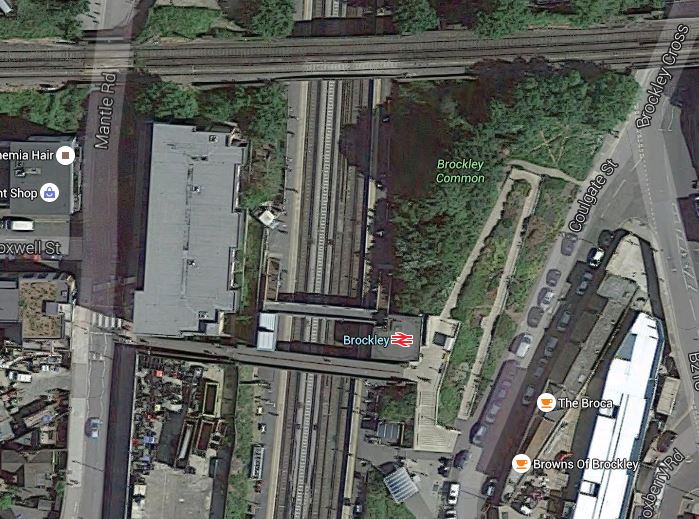
The Bexleyheath Line between Nunhead and Lewisham stations crosses the East London Line and Brockley station at a high level.
I wrote A Four-Poster Station about connecting these two lines.
It would appear that Transport for London have advanced this project from one word in their 2050 Infrastructure Plan to a proposal.
If the South London Metro included the services to Dartford via Bexleyheath, then this interchange at Brockley station might make some passengers journeys a lot easier.
A Penge Interchange
The Centre for London report proposes an interchange between Penge East station on the Chatham Main Line with Penge West station on the East London Line.
This Google Map shows the lines and the two Penge stations.
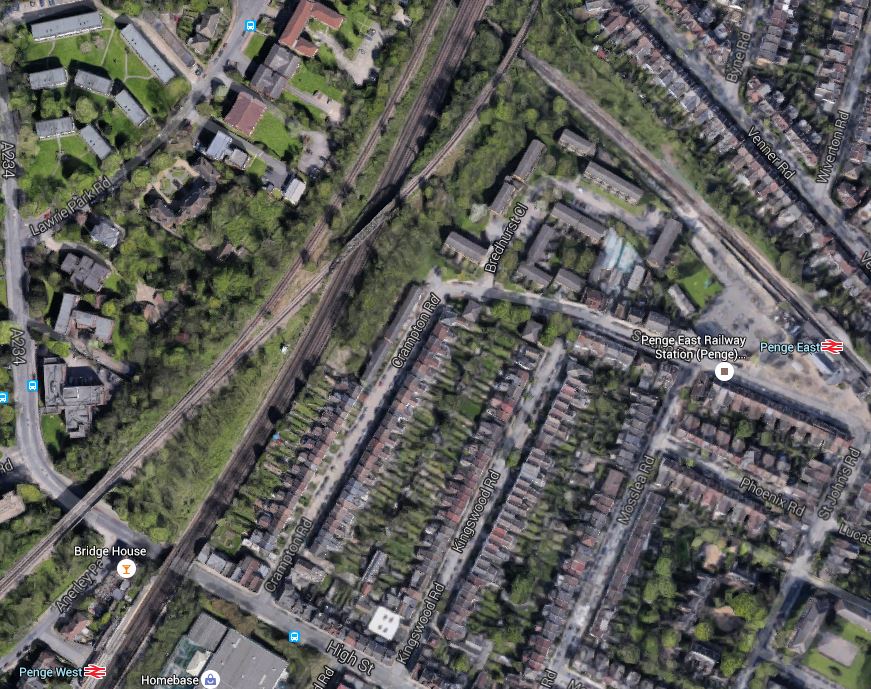
Penge Stations
The report suggests that it would be possible to reduce the walking distance between the two stations from 650 to 400 metres and there might be potential to move Penge West station to the North of the High Street.
As the walking appears substantially to be flat, I wonder if a section of travelator would be possible!
I recently walked from East to West station and took these pictures.

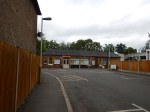
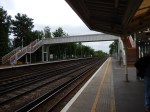

One of the station staff said that they need step-ladders to access the Crystal Palace line, that runs over the top.
The walk incidentally took me fifteen minutes, so if it decreases from 650 to 400 metres, by moving the station North of the High Street that should reduce the time to under ten minutes.
Will a travelator be added.
As with the extra platforms at Brockley station, this interchange has the potential to ease some passengers journeys.
My Proposed Schedule
I will give my view of the trains on a South London Metro.
- 6 tph between Dalston Junction and Clapham Junction.
- 4 tph between Dartford and Old Oak Common.
- 4 tph between Victoria/Battersea and London Bridge
- 6 tph between Victoria/Battersea and Orpington
This gives a total of 20 tph, which would be the same as the East London Line will be in 2019.
The Rolling Stock
Due to platform restrictions on the East London Line, I would envisage that the trains between Dalston Junction and Clapham Junction will probably still be the same five-car Class 378 trains.
The trains on the other destinations can probably be anything suitable and would include Class 375, Class 377 or even some new Class 710 trains.
But as there is no platform restrictions to the other destinations, the trains could probably be any desired formation between four and twelve cars.
Any new platforms would of course be built to accept twelve-car trains.
Getting To Heathrow
At the present time, getting to Heathrow can be a bit of a problem from some places in South London.
But after Crossrail and Old Oak Common station are opened, it would just be a matter of getting one of a 4 tph South London Metro train to Old Oak Common and changing for Crossrail.
It may of course be easier to use one of the other possible routes to Crossrail.
- Take the Northern Line to Tottenham Court Road from Battersea or Clapham North.
- Take Thameslink to Tottenham Court Road.
- Go via Whitechapel.
We’ll all develop our favourite routes.
Getting To Gatwick
At the present time, Thameslink haven’t published their full route yet, but anybody on the South London Metro should be able to do one of the following.
- Go to Clapham Junction and get a direct train.
- Go to Victoria and get Gatwick Express.
- Go to London Bridge and get Thameslink.
Unfortunately, it looks like I might lose my option of going to New Cross Gate and getting a direct train.
Conclusion
A South London Metro running 16 tph or more between Wandsworth Road and Peckham Rye stations, with multiple termini at either end, must be a feasible and affordable possibility, if the following is done.
- The Brixton Tunnel is built to give fast Victoria to Kent services a by-pass.
- The Overground/Metro services are moved to the Northern pair of tracks on the South London Line.
- Various station and track improvements are carried out.
It looks to me, that this project could transform South London and improve the lot of people like me, who live on the East London Line.
Works Around The Bermondsey Dive-Under
I took these pictures as I came into London Bridge on a train from Caterham.

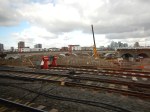
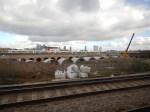
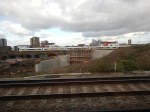

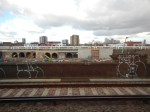


It would appear the Bermondsey Dive-Under is coming together.
From Cannon Street To London Bridge
I took this journey after the Christmas reorganisation of services through London Bridge station.


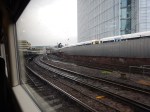


It’s all coming on.
The next big date is August, when a bit more of London Bridge station opens.
From Charing Cross To London Bridge
I took these pictures on a trip from Charing Cross station to past London Bridge station.




The train used the new viaduct over Borough Market.
The Spacious New Platforms At London Bridge Station
These pictures show some of the rebuilt terminal platforms, at London Bridge station.
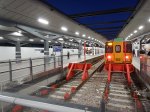


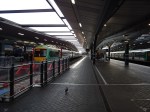

Space is much better than the London Bridge station, that I remember from before the rebuilding started.
Even the Class 455 trains, built in the 1980s, but refurbished since, doesn’t seem to show its true age.
The Problems At London Bridge
There have been lots of problems in the evening peak at London Bridge and the Thameslink Program has issued this apology.
On this page on the Thameslink Program web site, this is said.
From 5 January 2015, for three years until January 2018, no Bedford to Brighton Thameslink trains will call at London Bridge station. A reduced service will run between Brighton and London Bridge in the off-peak and a very limited service will run in the peak.
Effectively, whilst London Bridge is rebuilt, these trains will not go through the station.
One of the solutions being applied to the current trouble is to reduce the number of trains between London Bridge and West Croydon in the evening peak times.
So you need another route to get the passengers home to West Croydon. The obvious one is to avoid London Bridge entirely and take the Jubilee Line to Canada Water or the District/Metropolitan Line to Whitechapel, where from both stations you get an Overground train to West Croydon.
But the problem with this is the lack of capacity on the East London Line. This is being cured by delivering a fifth carriage for the Class 378 trains. But not many seem to have turned up yet. I’ve only seen one 5-car train twice and I travel on the line regularly.
With my project management hat on, it strikes me that the capacity upgrade on the London Overground and particularly the East London Line should have been completed before the major interim changes and capacity reductions at London Bridge. In fact according to this Transport for London document, the East London Line should have been running five car services by December 2014.
So what has delayed the arrival of the fifth carriages?
Could it be that the delivery of the new Class 387 for Thameslink jumped the queue for building by Bombardier in front of the fifth carriages for the Class 378?
How Thameslink Sorts Out London’s Trains
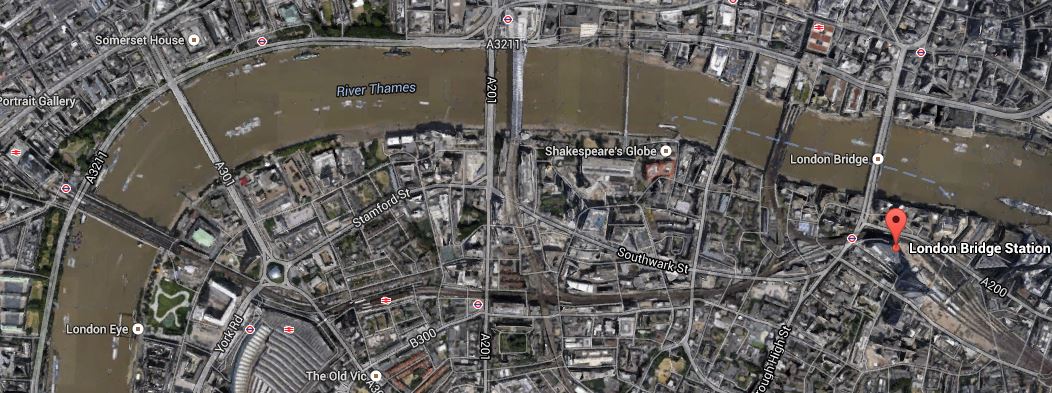
After taking the pictures of the new viaduct at London Bridge yesterday, I thought it would be good to post a map, which showed how it all fits together.
Stations Along The Thames
The picture shows most of the stations along the river that serve the South. And of course the North if they’re connected to Thameslink.
The main stations from left to right (west to east) follow.
Charing Cross is at the far left of the image, where it sits at the end of the Hungerford bridge, by which all trains enter and leave the station. The station is marked by the red British Rail double-arrow symbol, with the London Underground roundel showing the related Embankment tube station.
Waterloo is opposite Charing Cross at the other side of the Thames, although there is no direct rail connection between the stations.
Waterloo East is to the east of Waterloo and this station does have a rail connection to both Charing Cross and London Bridge.
This picture shows the position of the three stations and the rail lines to a larger scale.

Charing Cross, Waterloo and Waterloo East Stations
Note the rail lines going across Hungerford Bridge between Charing Cross and Waterloo East. I’ve never been to Waterloo East or even stopped at it on a train, but you can walk between the two Waterloo stations.
In this image the domed circular roof of the Waterloo IMAX cinema and Nelson’s Column can be clearly seen.
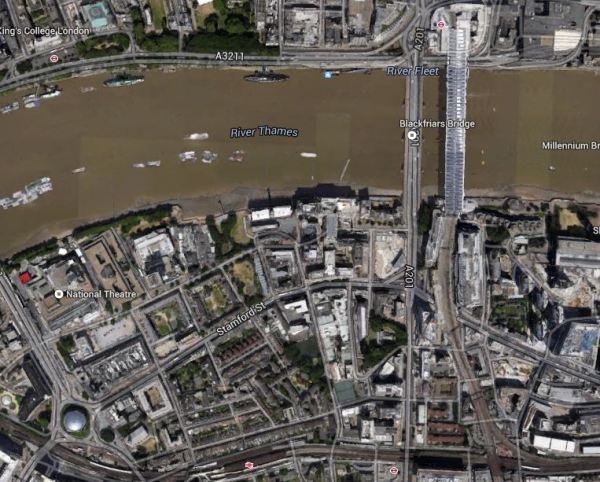
Blackfriars is the next station and its unique position across the river is shown in the middle of the main picture. It is the right one of the pair of bridges and the British Rail symbol indicates the main station entrance on the North Bank of the Rover. This picture shows its position in more detail.
Blackfriars and Thameslink
Note how the Thameslink lines from Blackfriars to the south go in two directions.
One line goes to the East for London Bridge, after joining with the lines from Charing Cross and Waterloo East, at the bottom right of the picture.
The other line goes directly South to Elephant and Castle.
The Temple area is at the top left of this picture, where there is a tube station. London’s new Garden Bridge will between here and the Southbank area, when it is built.
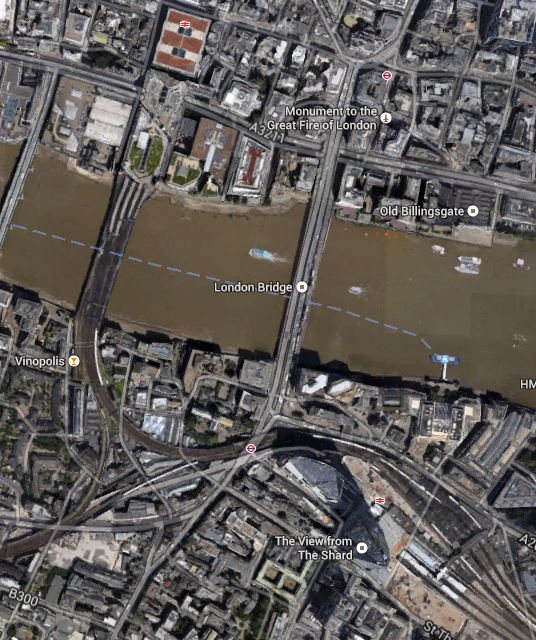
Cannon Street on the North Bank is the next station and like Charing Cross, all trains access the station by a bridge over the Thames.
Cannon Street and London Bridge
Note the triangular junction South of the Thames, that gives access to both Charing Cross and London Bridge from Cannon Street.
London Bridge station is shown in more detail in this picture.

London Bridge Detail
The detail would be a lot better, if it wasn’t for the shadow from The Shard, which is visible at the bottom right.
The pattern of the lines to and through London Bridge that will be in operation with the full Thameslink scheme is beginning to emerge.
1. The number of through platforms at London Bridge, for services on Thameslink and to/from Charing Cross and Cannon Street is being increased from six to nine.
2. The extra viaduct over Borough High Street and the Market can be seen.But it doesn’t have any tracks in this image.
3. London Bridge station itself, appears to be a big building site, with trains going through.
Incidentally, I’m not sure of the date of the Google Earth view.
The Thameslink program is vast and will add a hundred stations to the existing network. Wikipedia sums it up like this.
The Thameslink Programme, is a £6 billion project in south-east England to upgrade and expand Thameslink to provide new and longer trains between a wider range of stations to the north and to the south of London without requiring passengers to change trains in London. Work includes platform lengthening, station remodelling, new railway infrastructure, and additional rolling stock.
In this post, I have traced it south of the Thames and shown how it interfaces with the lines into Charing Cross and Cannon Street. If the architects have got the design of London Bridge station right, this alone should unlock a myriad of new routes for all those millions of Londoners and those that come into the City.
A couple of years after the new London Bridge is completed, Crossrail with its connection to Thameslink at Farringdon will open, adding even more travel possibilities.
Some months ago, I wrote a post called A Divided City.
Hopefully, the enlarged Thameslink, will help to cross the great divide of the Thames, that without which London wouldn’t even exist.
Steelwork At London Bridge
I took these pictures of the new steelwork at London Bridge station, that will carry the extra through tracks over Borough High Street and then to and from Charing Cross.
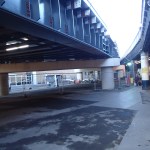
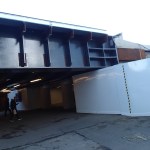
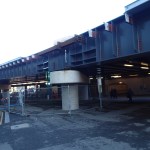
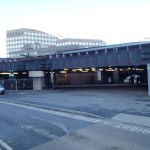
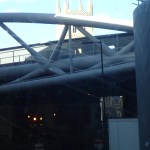

I had never used the mainline London Bridge station, until I moved to Dalston. But now, I use it regularly, as I just get a 141 bus through the City to and from the bus station by The Shard.
But don’t wait too long in the bus station, as there are sometimes down-draughts generated by the building.
Underneath The Shard
The space between Thameslink and the Shard has been tidied up a lot, as the pictures show.
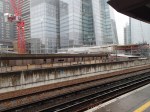
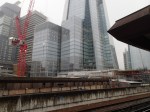
All is now ready for a start to be made on the next phase of the rebuilding of London Bridge station.
Wikipedia has a section on rebuilding the station.
This link shows the final platform layout. It’s very different to what platforms were used in the past and are now.
But hopefully, it’ll be all right on the night!
 The Anonymous Widower
