Network Rail Seem To Have Survived Christmas Without Indigestion
This article in the International Railway Journal is entitled Network Rail completes £100m of upgrades over Christmas.
It lists all the projects that were completed over Christmas,
I’m pleased that a lot of work seems to have been completed between London and Norwich, so hopefully, I’ll be seeing a more reliable rail service to Ipswich next season.
I also saw some of the fruits of the work yesterday, which I wrote about in Through The Acton Dive-Under.
So far, there have been no complaints on the news about the work, that I’ve seen.
Both Sides Of The Bermondsey Dive-Under – 26th August 2016
The Bermondsey Dive-Under is on track to be completed by Spring 2017.
This is a visualisation of the completed structure.
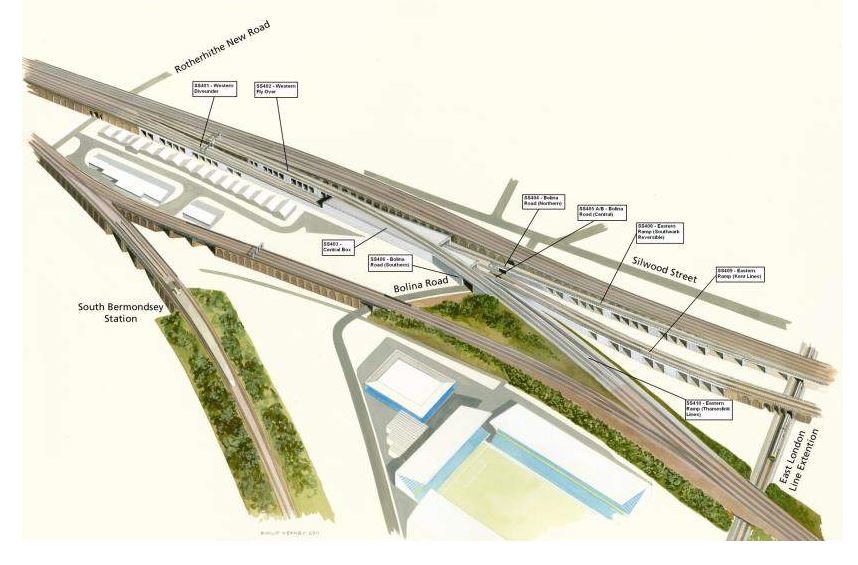
Bermondsey Dive-Under
These pictures show the dive-under from a train, running from London Bridge to Caterham on the line between the Millwall FC ground and the structure.




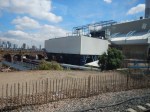
It’s now getting to look a lot like the official visualisation.
These pictures were taken from a train running into London Bridge from New Cross, on the other side of the structure.
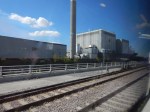
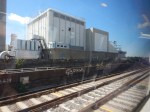
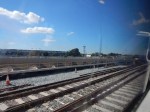


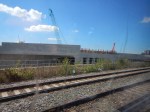
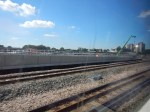
Crossrail may be the more spectacular and expensive project, but it has no intricate blend of old and new like the Bermondsey Dive-Under.
Thinking about the dive-under and when it is complete.
- Will there be walking routes through the structures and in the green spaces?
- How many extra small business units will be created underneath and around the arches?
- Will the area be integrated into the surrounding community?
Judging on other Network Rail sites, I don’t think the space will be wasted.
I do think that railway arches are a unique city resource, that can create jobs and increase economic activity and also improve the local environment.
Network Rail ought to sponsor an award for the Best New Railway Arch Business every year.
What Will Oxford Think Of This
Over the last couple of years, certain interest groups in Oxford have not been very pleased with the plans of Network Rail, Chiltern Rail and Great Western Railway to give the city an improved rail connection.
I wrote about this opposition in Network Rail’s Problem In Oxford.
So I was surprised to see this article on the BBC web site, which is entitled Oxford station design competition winners revealed. This is said.
Three competition ideas have been picked to help secure funding for a £125m revamp of Oxford railway station.
Six architects submitted designs to a contest launched in December by the city and county councils.
A proposal featuring a rooftop restaurant by firm AHR was chosen by a panel of judges and scored 70% in a public vote.
This is an image from the article of the winning design.
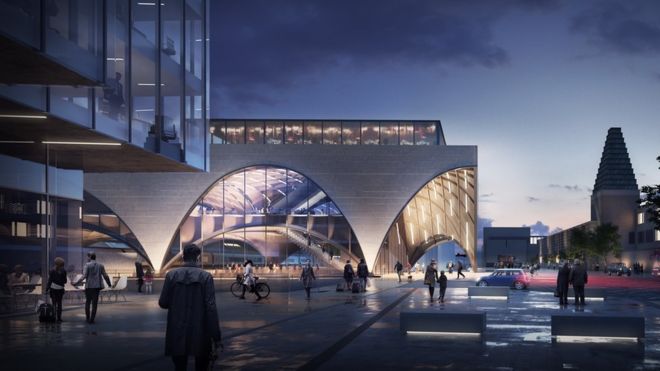
New Oxford Station Design
I agree with the panel and the general public.
But is it too good to be wasted on Oxford?
Report from Sir Peter Hendy to the Secretary of State for Transport on the Replanning of Network Rail’s Investment Programme
This report is crucial to a lot of reconstruction work continuing on railways in parts of the UK.
I’ve put the link, so I can find the report easily.
Here’s a taster of what the report contains.
This extract is entitled Case study – Aristotle Lane, Oxford and talks about the problems of closing a private level crossing in Oxford.
Network Rail planned to install a replacement footbridge over the Oxford to Banbury Line north of Oxford Station and close an adjacent private level crossing for safety reasons. People walking from a nearby car park, across some allotments to the other side of the tracks, used the level crossing. The new bridge will have a link to the allotments removing the need for people to cross the tracks.
The level crossing is not a public right of way and the rights to use it are owned by Oxford City Council. As part of the East West Rail (phase 1) improvement scheme, Chiltern Railways made an application in 2009 to close the level crossing as part of a wider project to upgrade the railway line.
Objections from allotment holders at the Public Inquiry meant that the approval was not granted. This meant that Network Rail needed to pursue a separate planning application in order to complete the work and deliver Marylebone to Oxford services.
Efforts to close the crossing and deliver the scheme continued. Meetings were held in 2012 between Network Rail, ORR and the Council to find a solution. Finally, in 2014 the principle to close this one level crossing was granted, but with the conditions that Network Rail had to fund and construct better access to the allotments, arrange a land swap so the local school could be expanded and to fund and build a new car park. All of these require further, and separate, planning permissions.
A planning application was submitted in May 2014 and approved a year later after three separate planning committee presentations. Construction of the bridge is now planned to start in January 2016 with completion in September 2016. The level crossing will then be closed seven years after the first application.
Kafka is certainly alive and well and living in Oxford.
For more information on this fiasco/farce/cock-up/vexacious litigation/waste of money (delete as appropriate!) read this article in the Oxford Mail, entitled Network Rail changes its plan for new Aristotle Lane bridge after protests.
Some of the comments are priceless.
I am very much of the opinion that all level crossings should be shut on safety grounds. If there are serious objections, then surely the railway should be closed until an agreed solution is negotiated.
Is Network Rail Only Part Of The Problem?
We like to have something simple to blame for our troubles!
I have just read this article in Rail Magazine entitled Carne opposes five-year funding cycle for big projects. This is an extract.
Network Rail Chief Executive Mark Carne told the Public Accounts Committee “there is no doubt at all in my view” that the Great Western Main Line electrification programme should have been managed in the same way as projects such as Crossrail and Thameslink.
“Personally, I think it [five-year funding cycles] is a really good way of funding ongoing operations, maintenance and renewals. But I am not sure it is a really good way of funding major investment projects,” he said.
We can look at various rail projects, that have been successfully completed without too much trouble, in the last few years.
Borders Railway
The Borders Railway seems to have been completed on time and on budget.
The only problem so far seems to be crowded trains and difficulty in finding more carriages.
So what’s new? This is only another manifestation of New Railway Syndrome.
Chords, Curves and Flyovers
Network Rail have also successfully built a few short railway lines to make the rail network and trains, easier to manage. This is a selection.
- The Allington Chord removed a bottleneck on the East Coast Main Line.
- The Hitchin Flyover removed another bottleneck on the East Coast Main Line.
- The Ipswich Chord allowed better access for freight trains to Felixstowe Docks and removed a lot of truck journeys from the roads.
- The Todmorden Curve allowed trains from Burnley to reach Manchester.
The only one with a problem was the Todmorden Curve, where Northern Rail had trouble finding trains for the new service.
Great Northern and Great Eastern Joint Railway Upgrade
The Great Northern and Great Eastern Joint Railway has been upgraded from Doncaster to Peterborough via Lincoln to act as a freight route away from the East Coast Main Line.
I talked about this upgrade in Project Managers Having Fun In The East.
This was no small project, as it involved resignalling, improving nearly a hundred miles of track and dealing with well over a hundred bridges and culverts.
It cost £330million and few people have heard of it.
But there doesn’t appear to have been any problems with the delivery of the project.
Rebuilding Birmingham New Street, Kings Cross, Manchester Victoria and Reading Stations
The rebuilding of these stations has not been trivial.
- The Birmingham New Stret rebuilding had its design and planning problems, but cost of around £500million
- The King’s Cross restoration cost £500million
- The Manchester Victroria renovation cost £55million.
- The Reading station redevelopment and some other works cost £850million
All were delivered on time, with the exception of Reading, which was delivered a year ahead of schedule.
You could add into this section, the substantial upgrades at Leeds, Newcastle and Peterborough.
Stafford Area Improvements Program
The Stafford Area Improvements Program is a £250million improvement to the West Coast Main Line.
It removes a bottleneck and allows extra trains on the line.
But few people have ever heard of it.
Summing Up Well-Managed Projects
So it would appear that Network Rail can manage some projects well and deliver them on time and on budget.
In my experience, they do seem particularly good at stations and always keep the trains running as much as possible.
If these projects have one thing in common, it is that they could all be well-defined before the project was started.
The Projects That Didn’t Go So Well
The following projects didn’t go as well as the previous ones.
Edinburgh to Glasgow Improvement Program
The Edinburgh to Glasgow Improvement Program is a £1billion program to upgrade and electrify the lines between the two largest Scottish cities.
It has had a rather chequered history and the original program has been reduced in scope.
Wikipedia says this in its entry about the project
It was reported that the project was delayed for up to three years due to the need to negotiate for the demolition of the west wing of the Millennium Hotel and works on Winchburgh Tunnel.
It has not been an easy project.
Great Western Main Line Upgrade
The Great Western Main Line Upgrade involved resignalling, electrification and a lot of track and station work on the Great Western Main Line.
To say it has been the project that keeps on wanting more time and money would not be an understatement.
This article in Rail Magazine says that the project could be two years late and cost three times as much as original estimates.
I have no insight into what has gone wrong, but there are several factors that have conspired against the project.
- Most electrification in the UK has been done in a series of phases, but on this project, they went for a faster approach, using a special train, which hasn’t worked very well.
- There have been planning problems in places like Bath, Goring and Oxford.
- The scale of the project is very large, with over a hundred bridges and tunnels to be modified.
- Politicians have changed the project several times.
It has been an unmitigated disaster.
However, I do feel that the engineers have got out the fag packets and envelopes and that they will find a way of getting this railway running under electric power. Or at least partially!
Politics is the science of spin and illusion, whereas engineering is the science of the possible.
North Western Electrification
The electrification in the North West, should have been a simple project, as the country is flat and the engineers must know the busy lines between Blackpool, Bolton, Liverpool, Manchester, Preston and Wigan like the back of their hands. It’s also a join the dots exercise with the electrification, so this should just be connected to the main line electrification at Liverpool, Manchester, Preston and Wigan.
But the benign flat lands have bitten hard, just like they bit George Stephenson.
My generation grew up with boyhood stories of George Stephenson’s problems as he crossed Chat Moss and where did his twenty-first Century successors have trouble, whilst electrifying Liverpool to Manchester? Chat Moss!
They’ve also suffered the well-publicised problems of the reconstruction of the Farnworth Tunnel and several other issues on the Manchester to Preston Line.
I think Network Rail appreciated the problems before they started and made the North West Electrification, more of a series of smaller projecs, than one large one.
The project is now on course for a two year delay, but the project now looks to be more likely to be completed.
Ordsall Chord
The Ordsall Chord is on the face of it, a simple project that should have been built years ago, to connect Manchester Victoria and Piccadilly stations and allow a large increase in number and quality of TransPennine services.
If anybody doubts the value of the Ordsall Chord, then read this article in the Manchester Evening News.
But sadly, the project has been delayed for many years, firstly by politicians and then by a veracious litigant.
I suspect that any Mayor of Manchester, would have built this important piece of railway many years ago.
Thameslink
Network Rail would probably say that the Thameslink upgrade is going well. Looking at the massive bridges and embankments, I’ll give them the benefit of the doubt.
I have added it to the list of failing projects, as there is no denying that they had their problems last Christmas, when they changed all of the routing. Network Rail received a £2million fine for their part in the chaos.
The Thameslink upgrade has been contentious and a long time coming, as it was originally approved in 2006.
I know there has been a major recession and effectively two changes of government since then, but the outcome when the project is delivered in 2018(Hopefully?), will be the same now, as was proposed a dozen years ago.
I think some major mistakes have been made.
- Network Rail were bullied by politicians to abandon their plan to terminate Wimbledon Loop services at Blackfriars, which would have taken pressure off the central tunnel.
- A protracted tendering process for mew trains, resulted in an interim fleet of Class 387 trains being delivered to fill in before the new Class 700 trains. Any sensible person would say, that Thameslink and Crossrail should have very similar trains.
- Before the major timetable change at Christmas 2014, the East London Line should have been running five-car trains and possibly more services, so make up for the reduced London Bridge services.
I would also have seen if by increasing other services, they could take the pressure off the overcrowded routes through London Bridge and on Thameslink.
In my view the project management of Thameslink has not been good. But then it is a London project managed nationally and responsible to Central Government. Crossrail on the other hand is a separate project, which is more under the control of Transport for London.
Summing Up The Bad Projects
These projects have various themes running through them.
- You could argue that the recession of 2008 and three changes of government have not done these projects any good.
- Public protest has caused delays and in the case of Thameslink unwelcome changes.
- Some of the projects don’t seem to have an independent structure that makes it easier to get things done and for the public to relate to the project. Thameslink for instance doesn’t have Crossrail’s openness.
- The time and budget constraints put on the projects by politicians have probably been a tad unrealistic.
It is my view, that the project management of these projects could have been a lot better.
I also feel, that Network Rail didn’t seem to have the strength to say No to politicians.
Is Mark Carne Right?
His first point is this.
There is no doubt at all in my view, that the Great Western Main Line electrification programme should have been managed in the same way as projects such as Crossrail and Thameslink
He is generally right on this, although I think Thameslink could learn from some of the actions of Crossrail, in the way they deal with passengers and public who are inconvenienced.
Thameslink is an information desert. If you tell people nothing and just give them hassle, you’ll reap your just rewards.
Mark Carne’s second point is this.
Personally, I think it [five-year funding cycles] is a really good way of funding ongoing operations, maintenance and renewals. But I am not sure it is a really good way of funding major investment projects.
In the 1960s and 1970s, it was a cardinal sin with large projects to mix them in with ongoing maintenance and general operation. Or it certainly was in ICI. One accountant told me that the separation , means you don’t get complicated lines of management and it controls costs better.
So it is my view that larger projects should be managed on an independent basis.
Network Rail Must Say No!
I think Network Rail can be accused of not fighting its corner against politicians and local vexatious litigants.
Hopefully Sir Peter Hendy’s Arrival at the top will help.
Projects Should Be More Like Crossrail
In some ways Crossrail is a project, that is broken in quite a few distinct smaller projects, which can be delivered in sequence.
Perhaps because of its size, it seems to have more sub-projects than say Thameslink or the Great Western Electrification.
But although some of the sub-projects are large on Crossrail, they do seem to be much smaller in scope than some of the sub-projects on the other projects.
If I look at some of the troubled projects, their structure and order is often more complicated than the much bigger Crossrail.
Both Thameslink and much of the electrification involve bring in new trains. Crossrail has the luxury of being able to introduce its new trains on the almost separate lines of the Shenfield Metro. So if the new Class 345 trains have some teething troubles, they will hopefully be very little collateral disruption to other routes.
Conclusions
Looking at this, I feel that the biggest problem is when Network Rail tries to manage large projects, especially when they are in a political or protester-rich environment.
They seem to manage better with smaller projects or one that are less politically important. But surely smaller projects are easier to give to a contractor to do the complete job.
The Crossrail structure of an independent project, seems to give a better result for large projects. In this independent structure, I suspect that the politicians and protesters still have influence, but this is direct to top management of the project, in hopefully a controlled manner.
Perhaps, all projects should be independent?
Years ago, when I worked for ICI, they used to like everyone working on a particularly project to be located closely together, if that was possible. They had found it got a better design, that was delivered faster and for less money. Communication between everybody on the project was also very good.
Is There A Pattern In The Performance Of Train Operating Companies?
I don’t care about the politics of rail nationalisation, as I just want my train to be on time and be safe, clean and comfortable.
I think this article from Rail Technology Magazine is showing a pattern of good performance.
If you read the article, it looks like two groups of train operating companies (TOCs) are doing better.
Locally controlled TOCs like London Overground, Merseyrail, ScotRail and TfL Rail, all seem to be doing well.
Two other TOCs that have a close relationship with their railway lines; C2C and Chiltern are also at the top of the pile.
I do wonder that as these two types of companies give passengers a quick and easy and often political way to complain, that they know if they muck-up they’ll be deep in e-mails, phone calls and letters, if they don’t perform.
I think this shows that we should increase areas of the country, where there are more arrangements of these types.
For instance, should short distance metro services in areas like Birmingham, Bristol, Cardiff, Glasgow, London, Manchester, Leeds, Nottingham and Newcastle, be under more direct control from the local authorities.
And also, where the operator has a virtual monopoly of track use, as does First Great Western to Bristol and the South West and Abellio Greater Anglia does in East Anglia and North Essex, should there be a more direct relation between track and train companies.
My belief is that people on the ground, be they passengers or rail staff, see problems and opportunities that are best served by a strong degree of local control or lins to those, who are providing the infrastructure.
This is well illustrated by the performance of TfL Rail on the Shenfield Metro, since being under the control of TfL Rail. The article says this.
And despite its good performance, other TOCs were close seconds, with TfL Rail raising its PPM dramatically compared to the same period last year – up by 8.5% to 96.9%. TfL also reported significantly less cancellations and lateness, from 4.9% in period 5 last year to 1.5% this year.
Previously, this line and the service was managed by Abellio, who are headquartered in Norwich.
In some ways it’s probably more about having a good management and communications structure for the train operating company, the track on which the trains run and the stations to where the trains go.
I also feel that a lot of the smaller developments in the UK rail system are locally-based projects like the reopening of branch lines and the creation of new stations, are projects that are better managed through a devolved rather than a centralised structure.
Has Sir Peter Hendy Had An Effect At Network Rail?
Sir Peter Hendy joined Network Rail in July 2015.
Is it just a coincidence, but there seems to be a lot more progress on getting the infrastructure sorted over the last couple of months?
Two stations I am following; Lea Bridge and Ilkeston seem to have finally got started.
Sir Peter may not be responsible, but just because he’s there, companies and people have decided that doing something is better than freewheeling.
Not Much Going On At Oxford Station
Oxford station is being upgraded in two ways.
A New Southern Platform
According to this section on Further Expansion in Wikipedia, a new Southern platform is to be created on the Long Stay car park to the South of the station. This is said.
The new platform was to have been brought into use during 2011.
When I last looked this morning, we are now in 2015.
Project Evergreen 3
Chiltern Railways are implementing Project Evergreen 3 to bring services from Marylebone to Oxford. Wikipedia says that this is being done at Oxford station.
The scheme also includes two new platforms at Oxford station, to be built on the site of the disused parcels depot. The new platforms would initially be five carriages in length, but provision will be made for them to be extended southwards to eight carriages.
All this should be done by 2016. This article on Modern Railways gives more details about the proposed Chiltern service.
So when I arrived at Oxford station, I expected it to be a hive of activity. These are the pictures I took.
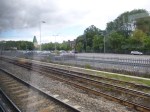
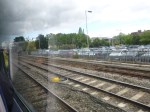

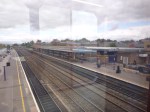
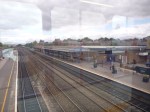
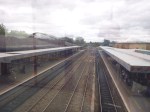

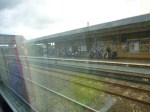
There isn’t even a man in an orange suit trying to look busy! Although the platforms were!
Perhaps this is how Oxford would like to welcome visitors? Hoping perhaps they might stay away!
I think one of the toughest jobs in the world must be a Project Manager in Network Rail. Passengers are rightly complaining that stations are cramped and need building or rebuilding and sometimes it’s impossible to get anything done for whatever reason. Then you have politicians on all sides complaining and saying it’s a total disgrace!
Hopefully Sir Peter Hendy and his new broom will go in to projects like Oxford station with all guns blazing and tell a few home truths.
I’m sure, if Oxford doesn’t want an updated station, then there are some nice projects in Birmingham, where the money would be appreciated.
 The Anonymous Widower