Could New Routemaster Buses Be Converted To Hydrogen Power?
London has a thousand New Routemaster buses.
They are generally liked by passengers and drivers, although some Labour politicians think they should be replaced, because of their association with Boris.
They were introduced in 2011, so with a refurbishment, I suspect that they could be in service for perhaps another ten years.
The big feature in the design is that they are genuine hybrid buses with a small Cummins engine halfway up the back stairs, a battery under the front stairs and electric drive with regenerative braking.
I do wonder though, that because of the electric transmission, that these buses could be converted to hydrogen-powered buses.
It could be a more affordable route to create a thousand new zero-carbon buses for the streets of London or any other city for that matter.
Given that Wrightbus, who built the New Routemasters, is now owned by a member of the Bamford family of JCB fame and the company is reported to be going down the hydrogen bus route, I would suspect that conversion to hydrogen is on somebody’s mind.
Mathematics Of A Bi-Mode Aventra With Batteries
This article in Rail Magazine, is entitled Bombardier Bi-Mode Aventra To Feature Battery Power.
A few points from the article.
- Development has already started.
- Battery power could be used for Last-Mile applications.
- The bi-mode would have a maximum speed of 125 mph under both electric and diesel power.
- The trains will be built at Derby.
- Bombardier’s spokesman said that the ambience will be better, than other bi-modes.
- Export of trains is a possibility.
It’s an interesting specification.
Diesel Or Hydrogen Power?
Could the better ambience be, because the train doesn’t use noisy and polluting diesel power, but clean hydrogen?
It’s a possibility, especially as Bombardier are Canadian, as are Ballard, who produce hydrogen fuel-cells with output between 100-200 kW.
Ballard’s fuel cells power some of London’s hydrogen buses.
The New Routemaster hybrid bus is powered by a 138 kW Cummins ISBe diesel engine and uses a 75 kWh lithium-ion battery, with the bus being driven by an electric motor.
If you sit in the back of one of these buses, you can sometimes hear the engine stop and start.
In the following calculations, I’m going to assume that the bi-mode |Aventra with batteries has a power source, that can provide up to 200 kW, in a fully-controlled manner
Ballard can do this power output with hydrogen and I’m sure that to do it with a diesel engine and alternator is not the most difficult problem in the world.
The Mathematics
Let’s look at the mathematics!
I’ll assume the following.
- The train is five cars, with say four motored cars.
- The empty train weighs close to 180 tonnes.
- There are 430 passengers, with an average weight of 80 Kg each.
- This gives a total train weight of 214.4 tonnes.
- The train is travelling at 200 kph or 125 mph.
- A diesel or hydrogen power pack is available that can provide a controllable 200 kW electricity supply.
These figures mean that the kinetic energy of the train is 91.9 kWh. This was calculated using Omni’s Kinetic Energy Calculator.
My preferred battery arrangement would be to put a battery in each motored car of the train, to reduce electrical loses and distribute the weight. Let’s assume four of the five cars have a New Routemaster-sized battery of 55 kWh.
So the total onboard storage of the train could easily be around 200 kWh, which should be more than enough to accommodate the energy generated , when braking from full speed..
I wonder if the operation of a bi-mode with batteries would be something like this.
- The batteries would power everything on the train, including traction, the driver’s systems and the passenger facilities, just as the single battery does on New Routemaster and other hybrid buses.
- The optimum energy level in the batteries would be calculated by the train’s computer, according to route, passenger load and the expected amount of energy that would be recovered by regenerative braking.
- The batteries would be charged when required by the power pack.
- A 200 kW power pack would take twenty-seven minutes to put 91.9 kWh in the batteries.
- In the cruise the power pack would run as required to keep the batteries charged to the optimum level and the train at line speed.
- If the train had to slow down, regenerative braking would be used and the electricity would be stored in the batteries.
- When the train stops at a station, the energy created by regenerative braking is stored in the batteries on the train.
- I suspect that the train’s computer will have managed energy, so that when the train stops, the batteries are as full as possible.
- When moving away from a stop, the train would use the stored battery power and any energy used would be topped up by the power pack.
The crucial operation would be stopping at a station.
- I’ll assume the example train is cruising at 125 mph with an energy of 91.9 kWh.
- The train’s batteries have been charged by the onboard generator, on the run from the previous station.
- But the batteries won’t be completely full, as the train’s computer will have deliberately left spare capacity to accept the expected energy from regenerated braking at the next station.
- At an appropriate distance from the station, the train will start to brake.
- The energy of the train will be transferred to the train’s batteries, by the regenerative braking system.
- If the computer has been well-programmed, the train will now be sitting in the station with fully-charged batteries.
- When the train moves off and accelerates to line speed, the train will use power from the batteries.
- As the battery power level drops, the onboard generator will start up and replace the energy used.
This sequence of operations or something like it will be repeated at each station.
One complication, is that regenerative braking is not one hundred percent efficient, so up to thirty percent can be lost in the braking process. In our example 125mph train, this could be 27.6 kWh.
With an onboard source capable of supplying 200 kW, this would mean the generator would have to run for about eight and a half minutes to replenish the lost power. As most legs on the proposed routes of these trains, are longer than that, there shouldn’t be too much of a problem.
If it sounds complicated, it’s my bad explanation.
This promotional video shows how Alstom’s hydrogen-powered Coradia iLint works.
It looks to me, that Bombardier’s proposed 125 mph bi-mode Aventra will work in a similar way, with respect to the batteries and the computer.
But, Bombardier Only Said Diesel!
The Rail Magazine article didn’t mention hydrogen and said that the train would be able to run at 125 mph on both diesel and electric power.
I have done the calculations assuming that there is a fully-controllable 200 kW power source, which could be diesel or hydrogen based.
British Rail’s Class 150 train from 1984, has two 215 kW Cummns diesel engines, so could a five-car bi-mode train, really be powered by a single modern engine of this size?
The mathematics say yes!
A typical engine would probably weigh about 500 Kg and surely because of its size and power output, it would be much easier to insulate passengers and staff from the noise and vibration.
Conclusion
I am rapidly coming to the conclusion, that a 125 mph bi-mode train is a practical proposition.
- It would need a controllable hydrogen or diesel power-pack, that could deliver up to 200 kW
- Only one power-pack would be needed for a five-car train.
- For a five-car train, a battery capacity of 300 kWh would probably be sufficient.
From my past professional experience, I know that a computer model can be built, that would show the best onboard generator and battery sizes, and possibly a better operating strategy, for both individual routes and train operating companies.
Obviously, Bombardier have better data and more sophisticated calculations than I do.
Calculating Kinetic And Potential Energies
I used to be able to do this and convert the units, manually and easily, but now I use web calculators.
Kinetic Energy Calculation
I use this kinetic energy calculator from omni.
Suppose you have a nine-car Crossrail Class 345 train.
- It will weigh 328.40 tonnes, according to my detective work in Weight And Dimensions Of A Class 345 Train.
- There will be 1,500 passengers at 90 Kg. each or 135 tonnes.
- So there is a total weight of 463.4 yonnes.
- The train has a maximum speed of 90 mph.
Put this in the calculator and a full train going at maximum speed has a kinetic energy of 104.184 kWh.
The lithium-ion battery in a typical hybrid bus, like a New Routemaster has a capacity of 75 kWh.
So if a full Class 345 train, were to brake from maximum speed using regenerative braking, the energy generated by the traction motors could be stored in just two bus-sized batteries.
This stored energy can then be used to restart the train or power it iin an emergency.
Out of curiosity, these figures apply to an Inter City 125.
- Locomotive weight – 2 x 70.25 tonnes
- Carriage weight – 8 x 34 tonnes.
- Train weight – 412.5 tonnes
- Passengers – appromiximately 700 = 63 tonnes
- Speed – 125 mph
This gives a kinetic energy of 206.22 kWh
And then there’s Eurostar’s original Class 373 trains.
- Weight- 752 tonnes
- Speed 300 kph
This gives a kinetic energy of 725 kWh.
If a 75 kWh battery were to be put in each of the twenty cars, this would be more than adequate to handle all the regenerative braking energy for the train.
There would probably be enough stored energy in the batteries for a train to extricate itself from the Channel Tunnel in the case of a complete power failure.
Potential Energy Calculation
I use this potential energy calcultor from omni.
Suppose you have the typical cartoon scene, where a ten tonne weight is dropped on a poor mouse from perhaps five metres.
The energy of the weight is just 0.136 kWh.
I’ve used kWhs for the answers as these are easily visualised. One kWh is the energy used by a one-bar electric fire in an hour.
Should London Allow All Doors Entry To Buses?
London is unique in the United Kingdom, in that nearly all of the buses have at least two doors.
The standard London buses have a front entrance and a middle exit, which gives the advantage of separating those getting on the bus and those getting off. In addition as the wheelchair ramp is under the middle door, loading and unloading wheelchair-bound passengers is a much less disruptive and much more efficient process.
Last football season in Reading, the bus had to be unloaded to get a wheelchair and its passenger on-board. It delayed the bus by about five minutes. Some fans were getting angry and started a chorus of “Why Are We Waiting”
In contrast in London, I saw an incident, where a passenger in a wheelchair needed to get on and the wheelchair space was full of babies in buggies. The ramp was put down, three buggies were immediately unloaded with no fuss, the wheelchair was pushed in and then two of the buggies were slotted in. The third was folded and carried on. It was all very civilised and in total contrast to the Reading incident. Effectively, the ramp and the pavement creates a very large lobby, which makes it easy for the wheelchair space to be rearranged. In my many trips on London buses, I’ve never seen a problem around the wheelchair bay.
But the biggest argument for a separate entrance and exit bus, was put to me by a bus driver and union rep, I met on a bus in Manchester. He said that because London buses separate entrance and exit, this pushed the low-life away from the driver and they don’t try and steal his money. London buses now don’t accept money and other drivers from places like Scotland and Liverpool have told me they want cashless buses as it cuts attacks on staff.
Additionally in London, we have the three-door Routemasters with an extra door at the rear. All doors have places to touch in with your contactless card, with one each side of the middle door.
Rarely do passengers get in at the two rear doors and not touch-in. If they do, they are often reminded by other passengers, with a knowing look.
Recently, I was at Kings Cross and two buses that get me near my house turned up at the same time; a two-door 476 and a three-door Routemaster running on route 73.
The 476 was in front and empty, but I took the 73, as I felt because it loads and unloads more quickly, it would get me home sooner.
It did! Perfectly illustrating the principle that more doors make a bus go faster.
There is probably an equal split of the type of the bus I can get home from the Angel and I feel that I’m not alone in choosing a New Routemaster if one is following a standard two-door bus. Baby buggy pushers also seem to wait, as it must be much easier to get in the middle door of a new Routemaster.
|As we are well-educated on how to use the buses here in Hackney, I wonder what would happen, if London’s two-door buses allowed entry through the middle door, by putting ticket readers at the door.
Having watched the behaviour of passengers on New Routemasters for quite a few years now, I think it would be worthwhile to try it as an experiment in certain areas of the capital.
We might find it increased the capacity and speed of London’s buses.
Life Just Got A Whole Lot More Complicated
Well not really, but when I come home from the Angel, I usually get a 38 bus, which goes a little bit closer to my house. But now they’ve started to Routemasterise the 73 buses.
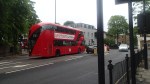

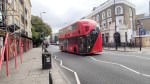
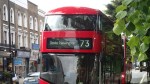
This means I can’t be sure I can distinguish the 38s, which were Routemasterised some time ago, from the thundering red herd on the Essex Road.
New Routemasters should have a top hat, as some of the old RTs of the 1950s did.
New Routemasters On Westminster Bridge
As I walked along the Albert Embankment, I took these pictures of New Routemasters crossing Westminster Bridge.
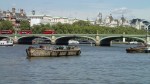

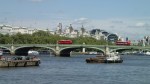
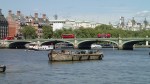
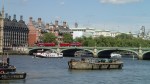
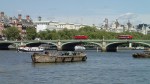
They are really becoming part of the scenery.
Also Available In Red
I took this picture on Piccadilly after leaving the Royal Academy.
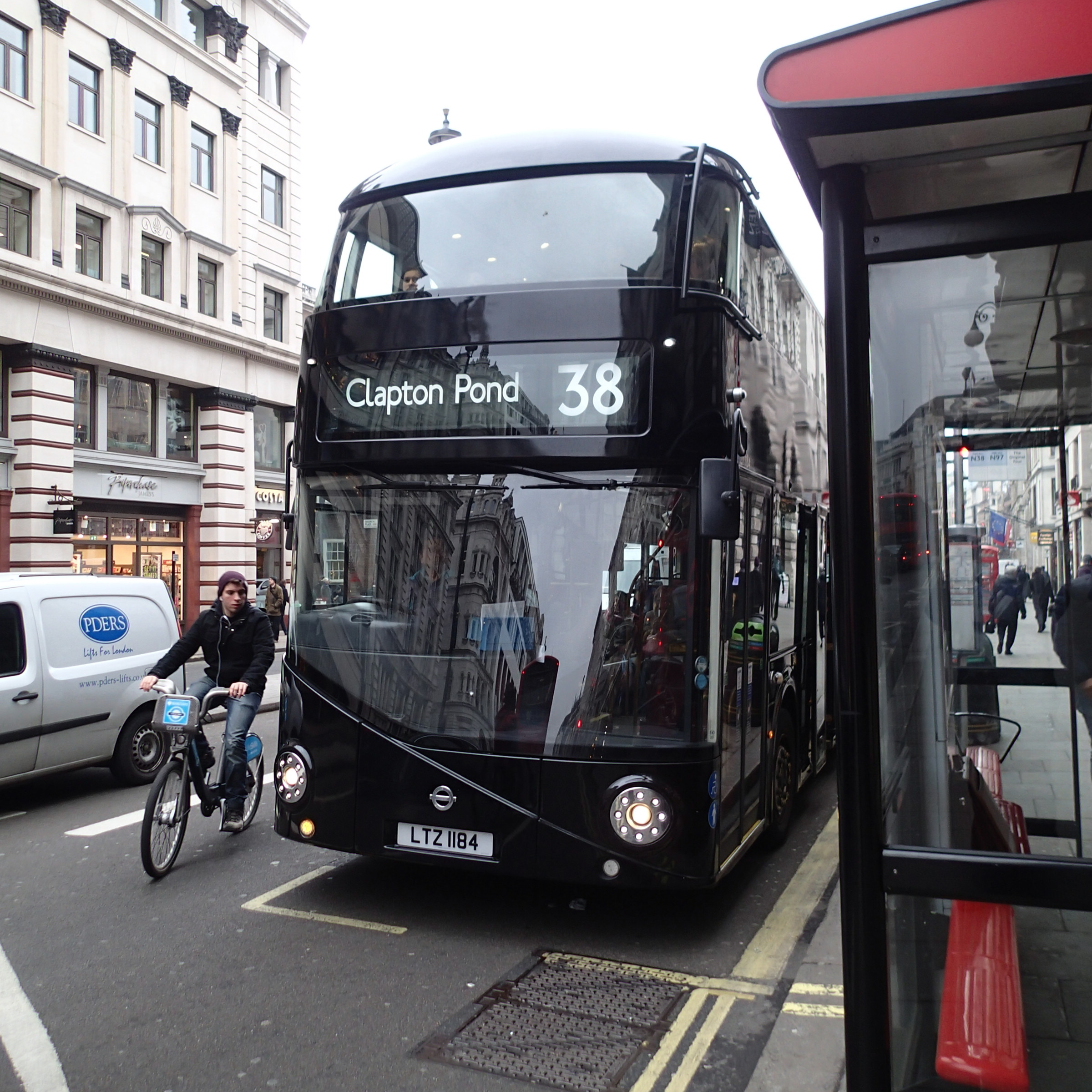
Also Available In Red
As I passed the bus, the tail-gunner recognised me and wished me well, probably because I travel on a 38 up to four times a day and usually sit downstairs.
All very uplifting!
I do wonder though, if new Routemasters do create their own little communities as they cruise around London, which all helps the city run smoothly.
Also Available In Red
I saw this New Routemaster on Bishopsgate.
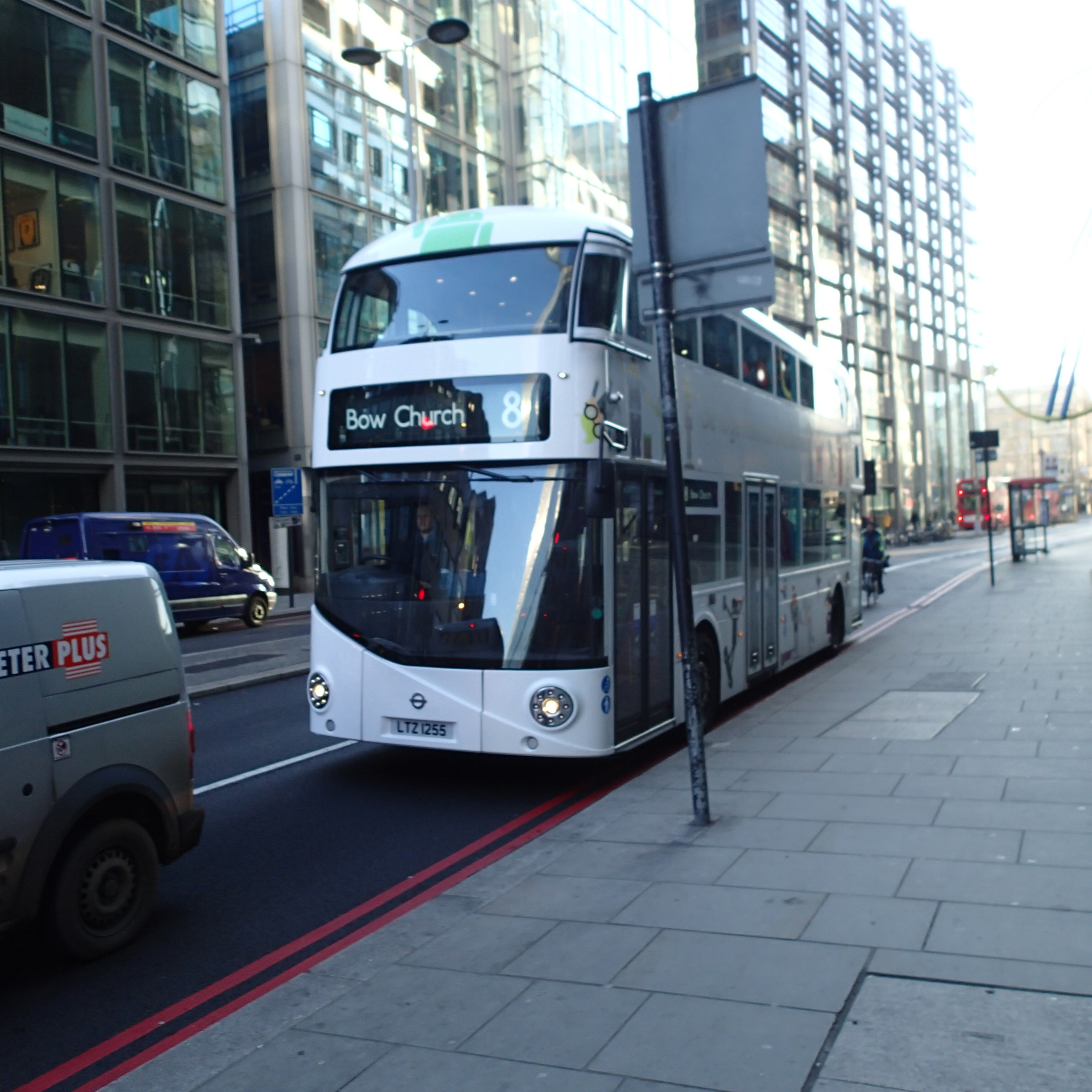
Also Available In Red
It must be a nightmare to keep clean.
A Plastic Seat On A New Routemaster
Not a standard fitting on a new Routemaster, but we were all wondering what this red plastic seat was doing on a 38 bus in this morning’s rush hour.
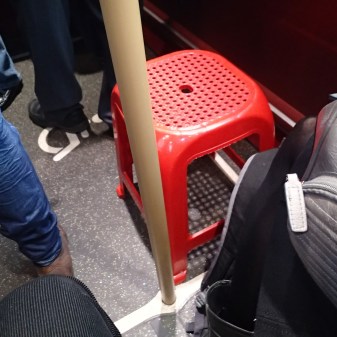
A Plastic Seat On A New Routemaster
The only thing we could think is that it’s a ruse by Transport for London to get more seats on buses.

