Wytch Farm And Horse Hill
I couldn’t resist looking at the Google Earth images of the two sites.
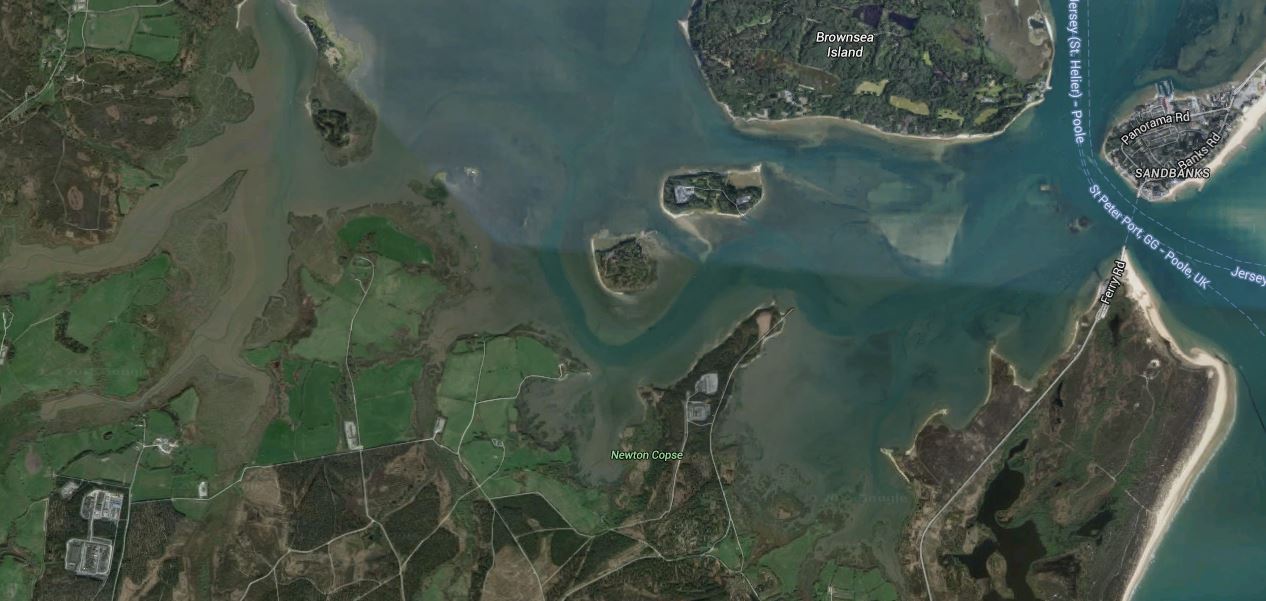
This is Wytch Farm
Wytch Farm
The processing plant for the field is the two squares in the bottom-left or south-west corner of the map and the wells fan out for upwards of 10 km. The field even goes under the upmarket area of Sandbanks, so if anybody would complain, the residents from there would.
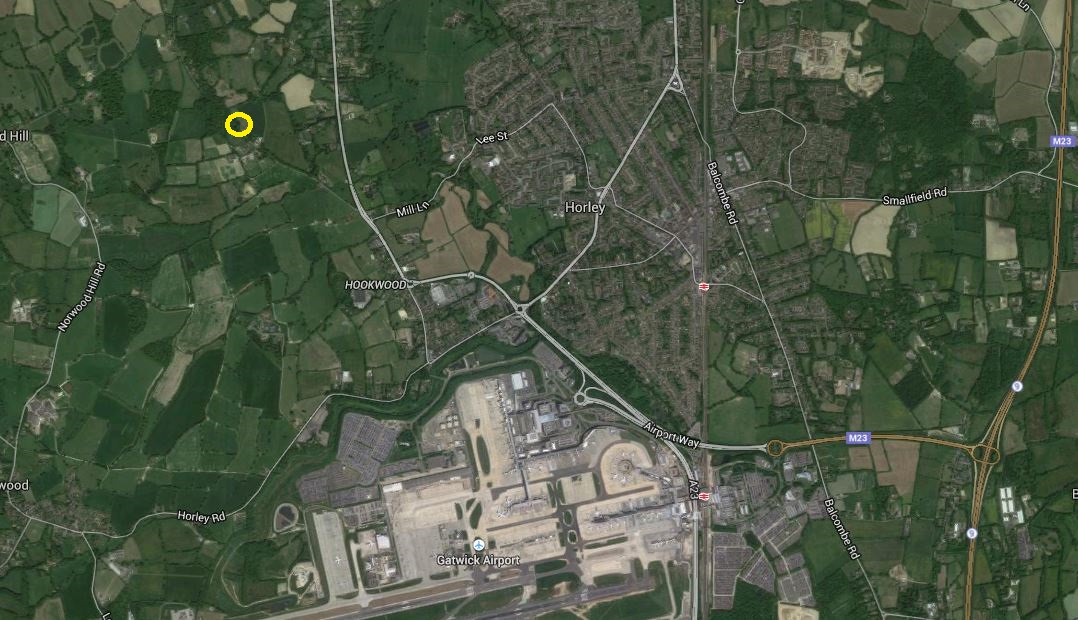
And this is the area of Horse Hill
Horse Hill
It is marked by the yellow circle. Note the sprawl of Gatwick at the bottom.
Both sites are surrounded by a lot of green field and woods, so I feel that a similar camouflage job could be done in Surrey to that done in Dorset.
Although as Wytch Farm is now forty years old, I suspect we’ll do a better job today of hiding it. It might be that directional drilling is used from a site near the railway through Gatwick, so that the processing plant could be well hidden and oil could be removed by train.
The Oil Find That Will Settle The Result Of The Election
I’ve believed for some time, that which ever party wins the election in a few weeks time should win the next election in 2020.
This belief is based on the fact, that so many large rail and other transport projects are due for completion in the later years of this decade.
The report on the BBC of the large oil find at Horse Hill in Surrey, is one of many that describe the find as of national significance. This is said in the BBC’s report.
“We think we’ve found a very significant discovery here, probably the largest [onshore in the UK] in the last 30 years, and we think it has national significance,” Stephen Sanderson, UKOG’s chief executive told the BBC.
Many will worry that developing an oil field in rural Surrey could be an environmental disaster.
A friend of mine had a lot to do with the development of the last major onshore oilfield in the UK at Wytch Farm, which is the largest onshore oil-field in Western Europe. The new field could be bigger, but all reports get their millions and billions mixed up.
Wytch Farm is not your average oilfield, as it is in the heart of rural Dorset by Corfe Castle. Wikipedia says this about the environment of the field.
Most of the field is protected by various conservation laws, including the Jurassic Coast world heritage site, Purbeck Heritage Coast and a number of sites of special scientific interest, areas of outstanding natural beauty and nature reserves (including Studland and Brownsea Island), so the gathering centre and most of the well sites are small and well screened by trees. Directional drilling has also contributed to reducing the impact on the local environment, with extended reach drilling from the Goathorn Peninsula attaining distances in excess of 10 km.
But the field would appear to have been an impeccable neighbour, more conspicuous by its absence in the media.
So I think the UK has good form in the development of oilfields in sensitive areas and there is no reason to expect that the development of Horse Hill will be any more disruptive than that at Wytch Farm.
The field’s biggest effect will be on the UK economy, if as reports are saying, production will start in a few years time, it will be producing revenues and cutting imports by the next election in 2020.
Circumstances have left the incoming government with a very large dowry.
They will have to be really stupid to lose in 2020. But then that’s normal for politicians.
Should We Embrace Fracking?
As an engineer, I have come to some conclusions about fracking.
There is certainly a lot of gas and possibly oil, buried in the ground, that can be accessed using advanced techniques like fracking in the UK.
Countries like the United States have certainly benefited from fracking with low gas prices and increased manufacturing activity.
There have been problems, as there were in Blackpool in the UK with fracking.
But are we throwing the resources of our great engineering universities, like Newcastle, Surrey, Southampton, Aberdeen, Manchester and Liverpool at the problem? I’ve left out universities that aren’t close to oil and gas reserves.
I doubt it!
Knowing engineering and engineers as I do, I suspect they could come up with better methods, that would benefit the UK and perhaps other countries, who have large difficult gas reserves and are nervous of using fracking and other methods.
So should the major oil and gas companies, be spending a few hundred millions investing in the future?
Fracking May be Good for You
There is a great deal of opposition to the use of fracking to extract gas from shale in this country.
I went to a lecture at the Royal Geograhical Society yesterday called Unconventional Gas. It was very enlightening and I can draw various conclusions from the lecture. You can find out more about the lecture here.
The first is that there is a very large amount of gas available to be extracted using fracking and a lot of it is in countries, with pretty stable regimes, like Australia, Canada and the United States.
The second is that gas prices in North America are falling fast, because of the large amounts of gas now available. I believe, that Canada has far too much gas for its own use and will soon start to export.
So it is not inconceivable, that Europe will start to import gas from North America rather than from regimes like Russia and Qatar.
Am I wrong to therefore suggest that because of fracking, we may well find that our gas prices start to drop?
I have deliberately not discussed the use of fracking in the UK and Europe.
The technologies employed are still very much under development and have been used mainly in the very underpopulated parts of the United States and Canada. The extraction is now moving towards more populous states, like Pennsylvania, and only when it is totally accepted by the inhabitants there, will it be time to use it in Europe.
In the meantime we should keep a strong watching brief, investing in resarch in the best universities, as I outlined here.
But as with many things, there are many against the technology, when it starts to be used, but now it is totally accepted. Just look at the opposition Brunel, Stephenson and others had when they started building railways!
How the Argentinians Could Solve the Falkland Islands Problem
The spat between Argentina and the UK over the Falkland Islands is a bit like a spat between two neighbours over a leylandi hedge that has got out of control, except that both sides think it more serious than a hedge. Although, my late wife was once involved in a boundary case and it was one of the nastiest she’d ever been involved in.
At the moment the Falkland Islands have one silly problem caused by the Argentinians; the lack of eggs and fresh vegetables. My mother and many women of her generation learned how to live without fresh eggs, but it was not easy. So the first thing the Argentinians should do is allow more ships carrying provisions to the islands.
Let’s face it, the whole southern part of South America is rather inhospitable. I once met an Argentinian scientist, who had been raised in Patagonia and he left for Buenos Aires as soon as he could. The only people who want to go there are people with an interest in the birds and animals, that aren’t bothered by three square meals a day, that you don’t have to hunt and constant 24-hour television.
Many of these tourists, who want to see wildlife are English-speaking, so passing them to the Falklands might not be a bad idea as building tourist accommodation in that environment is not easy.
But of course, Argentina would allow its construction companies to do the work.
There is the problem of the oil. I did think though that an agreement on how to split the profits had been signed some years ago.
But would the Falklands want the platform yards and oil refineries, with all their problems? I don’t think so, and I suspect Argentina has many suitable bays or other places to do the work. Fifty years ago, few of the experts on undersea oil production were Scots. Now there are a lot more, because of North Sea Oil. Who’s to say in fifty-years time, that a lot of these high-earning engineers won’t be from the Argentine?
So in some ways by working within the status quo, it might be better for the Argentinians.
I do sometimes wonder what would have happened to the Islands if the Argentinian junta had kept control thirty years ago.
The islands themselves might even be uninhabited, except for those animals and birds agile enough to avoid the mines.
Rocks and Climate Change: How We Can Stop Pulling the Carbon Trigger
Today, I went to another lecture at the Geological Society of London, the title of which is the title of this post.
The entertaining lecture was given by Bryan Lovell, who is Senior Research Fellow in Earth Sciences at Cambridge University. He talked about how 55 million years ago a rapid global warming effect called the Paleocene-Eocene Thermal Maximum changed the world forever and led to the creation of the first apes. Some of the proof of this is believed to be the unusual puddingstone found in places like Hertfordshire, which was created at the time. As he said the rocks tell us what happens if you don’t control global warming and that the earth can cope with it, but animals can’t.
One point he then said was that the oil industry can store safely underground the carbon dioxide captured from a coal-fired power station at a reasonable price.
He then said that although the scientific case has been established beyond doubt and even Shell accepts there is man made global warning, but we haven’t convinced ourselves of the need to act. He said that now is the time to tell the story written in the rocks – in verse, in film and in song. He was at Harvard in the 1960s and no-one got anywhere about convincing the Americans about the wrongness of the Vietnam War, until Joan Baez got involved. We need another Joan. And unfortunately someone, who could have written and performed something eloquent; Dory Previn, died on Tuesday.
Could Fracking Be The Saviour of the North?
I can remember a documentary on the BBC in probably the 1960s about how a Scottish company extracted oil from shale rock. I don’t know whether they still do. I have just found this museum to the industry and it says it closed in 1962.
According to today’s Sunday Times, there is enough shale gas in the shale deposits mostly in the north of England to last 70 years.
Now I know extracting shale gas is controversial, especially, where the process of fracking is used. There was controversy in the Blackpool are, as fracking was blamed for a couple of small earthquakes. Read about it here.
But then there was controversy, when horseless carriages first arrived on British roads and they had to be preceded by a man with a red flag.
I’m not saying there is no risk from fracking, but I do think, that with proper research fracking will be safe to use in many places in the world.
And eventually, it will be used in many places in the UK, when the problems are sorted out. After all, we mined coal for years, despite the subsidence risk nearby.
And remember that for the same amount of energy coal produces forty-percent more CO2! This is because coal is pure carbon, whereas natural gas is a mixture of Hydrogen H2 and Methane, CH4, so it produces a large proportion of water when it burns.
Hopefully, I’ll know more later in the week, when I have gone to the Geological Society of London to hear a lecture.
The other thing about shale gas in the UK, is that it is located where we need jobs; in the north of England. So it becomes a vote winner for whoever wants to play the shale gas card.
Any extraction of shale gas, should be linked to two measures.
1. A local extraction tax, that goes directly to the local authorities over the extraction. This was proposed in the seventies, by someone I knew, as a means of pursuing oil extraction in places like Surrey, which in his knowledgeable view was one of the most likely places to find oil in the UK. Imagine the fuss it would create if large quantities of oil were found under say Epsom. But if Surrey got enough money to build everything they needed, the reaction of some might be different.
2. Full insurance for any buildings damaged by extraction process.
Politicians and the press will see it as a simple black and white issue. Most will be against! I see it as a multi-coloured jigsaw, that must be based on sound technology.
I would start by setting up an well–funded Institute of Fracking, at a university that has the reputation to recruit some of the best researchers in the world. It may prove that fracking is a dead end but if it showed that it was economically viable in the UK, we would reap the benefit in spades.
I have just found this article from the American Consumer Institute. It makes a lot of interesting points. Note that the United States has a local extraction tax in some or all states and this seems to push opinion in various directions.
I think the worst thing we could do is ban fracking, with the second worst being to ignore it.
Whatever we do, because we have so much of this gas, we should set up some form of research institute.
There is also a page of expert opinion to the Qradilla report on the links between fracking and earthquakes at Blackpool.
The Balaena Lives
Not quite, but there is a lot of Balaena thinking behind Shell’s new FLNG.
So what was the design I worked upon in Cambridge for Balaena Structures all those years ago like?
The problem with offshore oil platforms is that they are very expensive and once they’ve extracted all the oil from the oilfield on which they sit, they are very difficult to take down.
In the mid-1970s, some very clever structural engineers from Cambridge University came up with a design for a reuseable platform, that could be built in a ship yard, that would normally build supertankers.
The design was simply a steel cylinder, perhaps about a hundred metres long and thirty or so in diameter. I can’t be sure of the size as it is nearly forty years ago and I have kept no records. The idea was that it would be built horizontally and then towed into position, where it would be turned through ninety degrees to sit on the ocean floor above the oilfield.
So the eventual bottom end was closed off and would have had a skirt that sat in the ocean floor and held the platform in position by a sort of gum boot principle. The other end was also closed and supported a square working deck about twenty metres high on a stem about the same length.
My part was to do the calculations on the upending, which would have been accomplished by letting sea water into the enormous tank under control.
The calculations were not that simple, but because of my dynamic simulation experience, they were well within my compass and I was able to do them on a simple time-shared computer.
I did prove that because of the vast weight of steel and the not inconsiderable weight of sea water, that the Balaena would install itself as designed. Sadly it was one of those projects that after a considerable amount of effort never came to fruition.
Some other points about the design should be noted.
- The tank could be used to store the oil extracted and this could then be pumped to a waiting tanker.
- When it needed to be moved, the tank would be emptied and at the appropriate point, the Balaena would float vertically. It could then be towed still upright to a new position.
All of this might seem rather fanciful, but I suspect that some of the ideas in the Balaena have been used successfully in the other designs.
I started talking about the Balaena, when the Deepwater Horizon blew up in the Gulf of Mexico. At the time I was lying on a bed after a serious stroke in Hong Kong. I imagined an empty Balaena ready and waiting floating horizontally in the sea within a few hundred miles of the clusters of oil platforms. It would differ from the 1970s platform design, in that the working deck would be much simpler and probably only there to control the pumping. It would also not have a complete bottom to allow the oil to enter the tank.
Could it have been towed to the site and upended over the leaking well, as a crude but effective cap? The oil would still float to the surface, but inside the tank of the Balaena, from where it could be pumped out.
The idea may still be fanciful, but I can guarantee that the structure would upend as required, just by adding sea water to the tank. I did the calculations to prove it in the early 1970s.
The Odd Physical Properties of Mixtures of Air and Water
Richard Hammond today, in his program called Engineering Connections about the Space Shuttle, showed how NASA use a wall of water droplets to protect the shuttle and the launch platform from the immense sound waves created by the rocket engines on lift off. I have seen a shuttle launch and even some miles away the noise was awesome and in some ways the most unexpected part of the event.
If I ask an averagely serious engineer or physicist to tell me the speed of sound in air and also that in water, they will give answers of 343.2 and 1497 metres per second respectvely with various conditions like dry air and pure water. So sound travels a lot faster in water than air.
So if you have a mixture of bubbles of air in water or vice-versa, a logical person would think it lies somewhere between the two.
But they would be wrong! According to this paper from 1969, by D. McWilliam and R. K. Duggins, it can be as low as 18.2 metres per second. This creates all sorts of problems and benefits. NASA’s engineers used it in one way and I invested in a company that used it to make an aerosol valve.
But it is a property that hasn’t been used to the full.
They say that oil and water do not mix.
But I have seen an experiment where bubbles of air was introduced into a mixture of water and oil and the resulting mixture was passed through a choke or restriction. A creamy liquid emerged, because the air bubbles in the restriction in trying to get into some form of steady state, mixed evetrything up.
I know that explanation isn’t very good, but who cares as the technique works.
In places like Saudi Arabia, there are large lakes of tar, that are just dumped in the desert. Perhaps by using natural gas as the gas, could this pollution be burned, whilst it is still hot?
I don’t know! But I do know that this abnormal property of mixtures of gases and liquids is not used for all the applications it can be.
 The Anonymous Widower