TfL Plans To Sell Part Of Its Tube Trains To Raise £875m For New Piccadilly Line Fleet
The title of this post is the same as this article on the International Business Times.
Why not?
London’s Underground and Overground trains are well-built and well-cared for assets, that will probably be in service for excess of forty years.
Both parties win!
- Transport for London, get a pile of cash, that can be invested in new trains.
- The leasing company get a safe investment, in which to invest pension funds and other funds looking for long term investments.
In some ways, the leasing company’s biggest risk, is that new technology comes along, which means that TfL decide to change the trains and the trains are returned to the leasing company.
So long as the terms and costs are right, I’m all for it!
Development Of Knightsbridge Station
Knightsbridge station is an important station on the Piccadilly Line.
It is unusual in that it is one of the few double-ended tube stations, with one entrance at Sloane Street by Harvey Nicholls and the other along the Brompton Road at Harrods.
I took these pictures on a Sunday morning as I walked around the station.
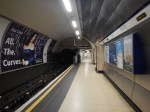

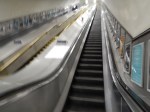
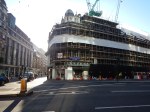

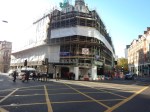

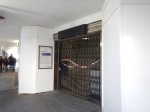
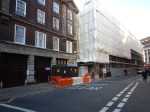







The existing building over the Sloane Street entrance is being redeveloped. Wikipedia gives these details.
The residential development of One Hyde Park opposite the station features an entrance to the station which is the diverted closed off exit. It re-opened in December 2010.
In 2017, a developer will refurbish the block above the station and close exits 3 and 4 that lead to Brompton Road and Sloane Street. When this work is complete, there will be a new entrance in Brompton Road, the two exits having been blocked permanently. The station will also feature Step Free Access available from a new entrance in Hooper’s Court, where the original station first opened, with lifts in the original lift shaft that will lead to the Piccadilly platforms.
This page on the TfL web site gives more details. This is said.
Knightsbridge Tube station will have step-free access in 2020, reached by a new entrance at Hooper’s Court.
Two new lifts will serve the Piccadilly line platforms, making the station step-free from street level to the trains.
A second new entrance will open at 15 Brompton Road in 2019, replacing the former entrance on the corner of Sloane Street and Brompton Road. The pavement on Brompton Road and Sloane Street will be widened, making more room for pedestrians.
Note that the new entrance at 15 Brompton Road will be about halfway between the corner and the LK Bennett store, which is at 39-41.
Conclusion
It looks as if Knightsbridge tube station will be very much improved.
But!
- Cutting the traffic through the area would help.
- I can’t say that I’m impressed with the new entrance to the station on the North side of Knightsbridge.
At least the entrance by Harrods, is much more in keeping with the area.
Can Between Rayners Lane And Uxbridge Stations Be Step-Free?
I took a Metropolitan Line train to Ucbridge station today and took these pictures, taken at stations between Rayners Lane and Uxbridge stations, where the line is shared between Metropolitan and Piccadilly Lines.
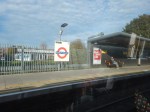
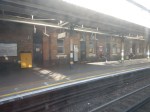
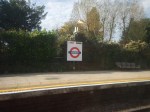
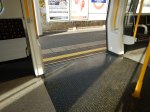
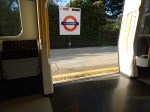
Note.
- Between platforms and Metropolitan Line trains access is generally good.
- Only Uxbridge and Hillingdon stations are fully step-free.
- There is no special provision for Piccadilly Line trains.
Making this section of line fully step-free is going to be difficult.
It may be very much step-free now for Metropolitan Line trains, but look at this picture of a Piccadilly Line train at Rayners Lane station.
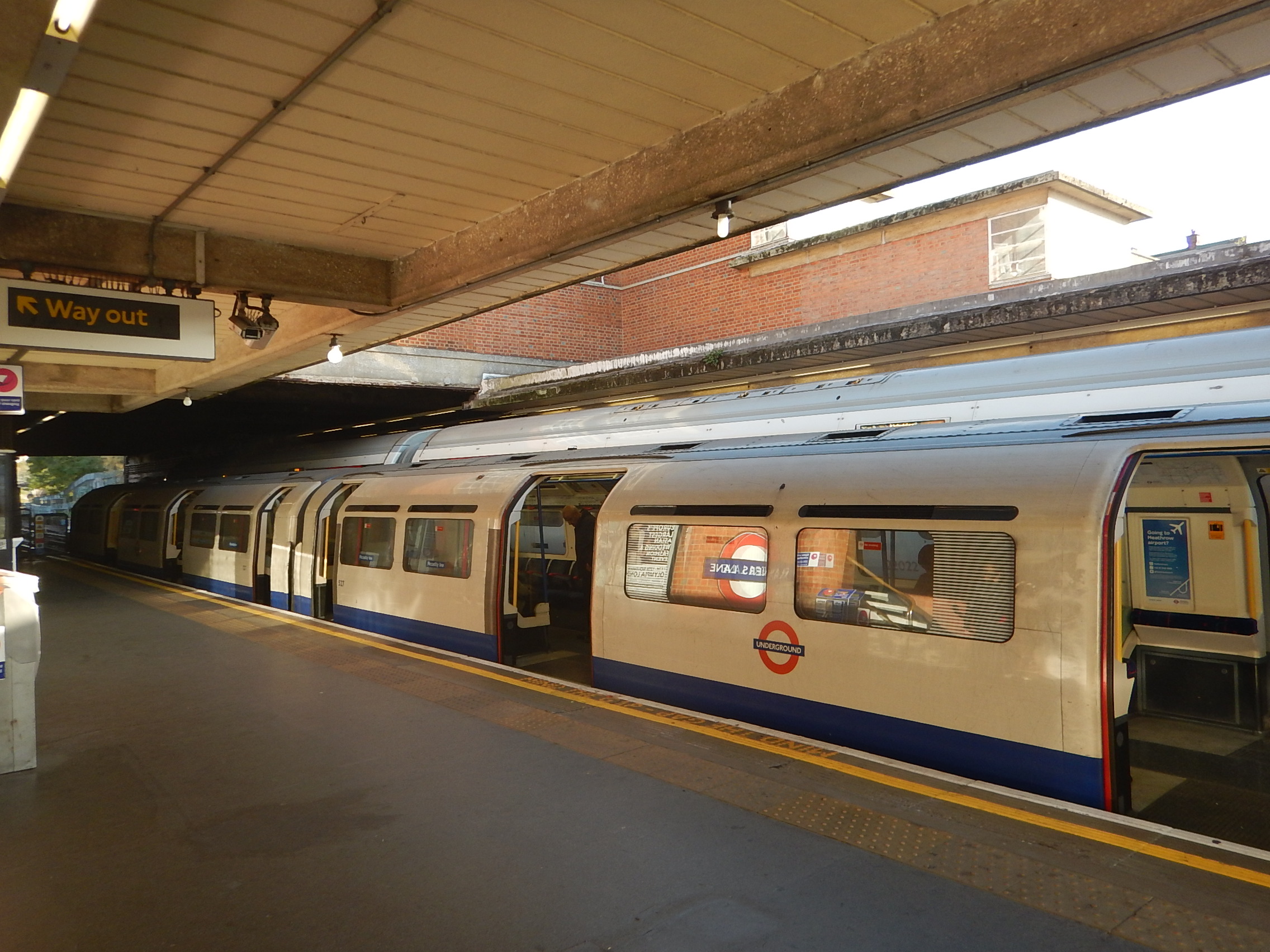
This certainly won’t meet the spirit if not the law of the the Persons of Reduced Mobility regulations.
The Platform Edge Door Issue
This article in London Reconnections is entitled Upgrading the Piccadilly: Calling Time on Mind the Gap?. It is an article that is well worth reading.
This is said about the platform train interface.
On modern transport networks once a system is designed to be UTO-capable then a mandatory requirement almost always now follows – the network or line in question should have platform-edge doors at all stations, including the above ground ones. Furthermore platform levels must be aligned with the floor level of the trains.
UTO means Unattended Train Operation.
I put London Reconnections on my list of trusted sites like The BBC, The Guardian, The Financial Times and several railway web sites, so I would rate this interpretation correct.
The new Piccadilly Line trains will certainly be built to be UTO-capable, as on past form, they will be built to last at least forty years. Could we guarantee that UTO won’t come in during their lifetime?
Note that one of the regulations associated with trains being UTO-capable, is that platform and train floors must be aligned.
This is not only good for passengers, including those in wheelchairs and buggies, and those overloaded with shopping, but it’s also good for train companies, as dwell times at stations can generally be reduced and staff don’t have to deal with cumbersome wheelchair ramps.
But, I think that these regulations mean that it is very difficult for two types of train to share the same platform.
This principle was probably obvious to the engineer, who designed the platforms at Stratford station in the 1930s, where main line services are on one side and the Central Line is on the other.
The principle certainly seems to be involved in the design of the tram-train interchange platforms at Rotherham Central station.
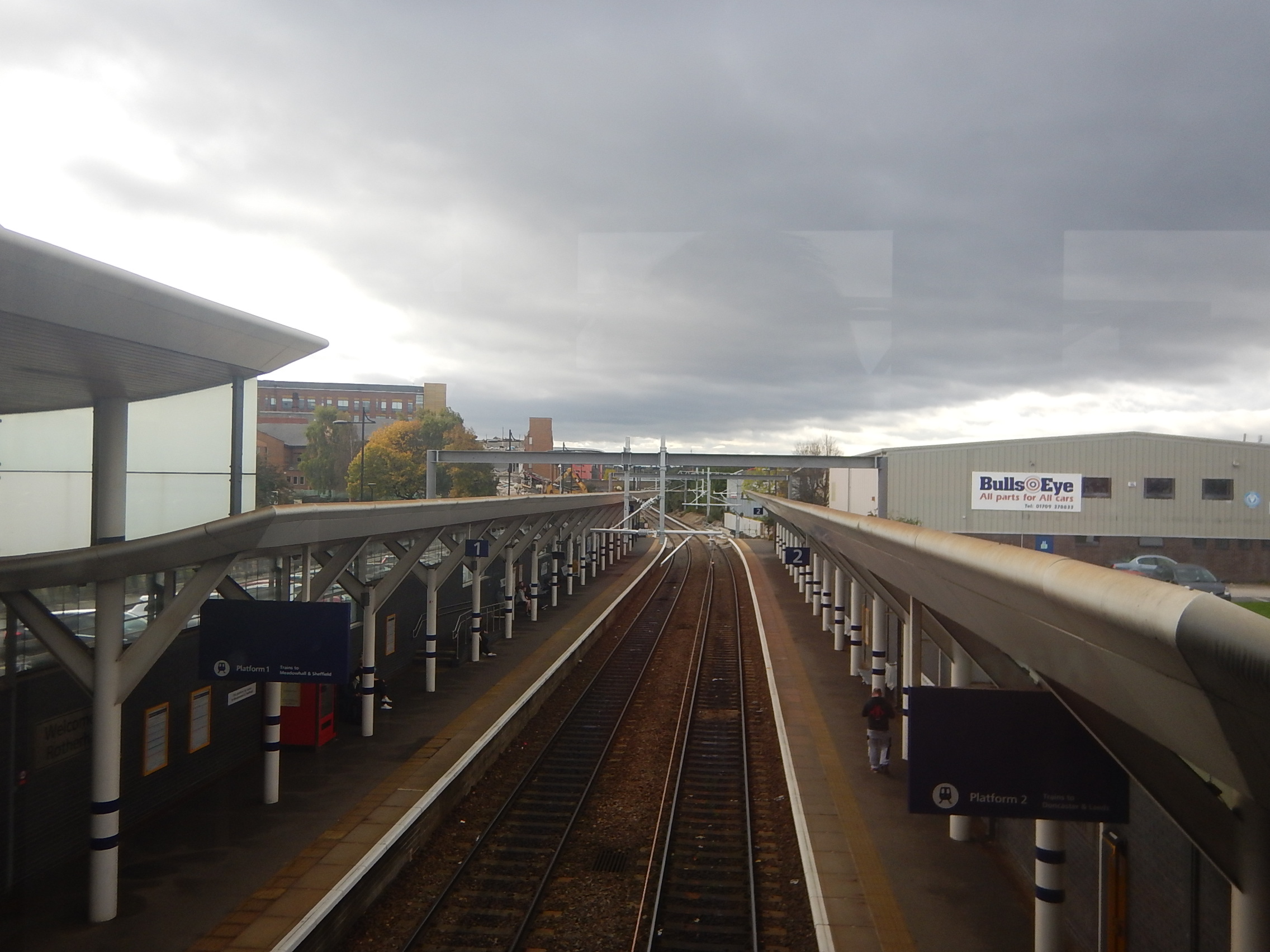
Lower level extensions are being built at the Sheffield (far) ends of the platforms, so passengers changing, will just walk along the platform.
- The longer high-level section will be able to handle the longest train likely to call, which will probably be about eight-cars.
- The shorter low-level section will be able to handle the longest tram likely to call, which will probably be a forty metre Class 399 tram-train.
It’s a simple layout, but it would mean a very long platform, if it were to be used with sub-service and deep-level Underground trains sharing a platform.
Applying The Regulations Between Rayners Lane And Uxbridge Stations
I believe these regulations will mean that only three ways to meet the regulations are possible.
- Separate tracks and platforms between Rayners Lane and Uxbridge stations.
- Extremely long bi-level platforms.
- Only one type of train serves the branch.
The first two options would probably be too expensive, but I believe that by good design and some clever reworking of the tracks at Rayners Lane station.
A Redesigned Rayners Lane Station
So could Rayners Lane station be redesigned to meet all the regulations and provide a much-improved passenger experience.
Step-Free Access
This picture shows the 1930s stairs at Rayners Lane station.
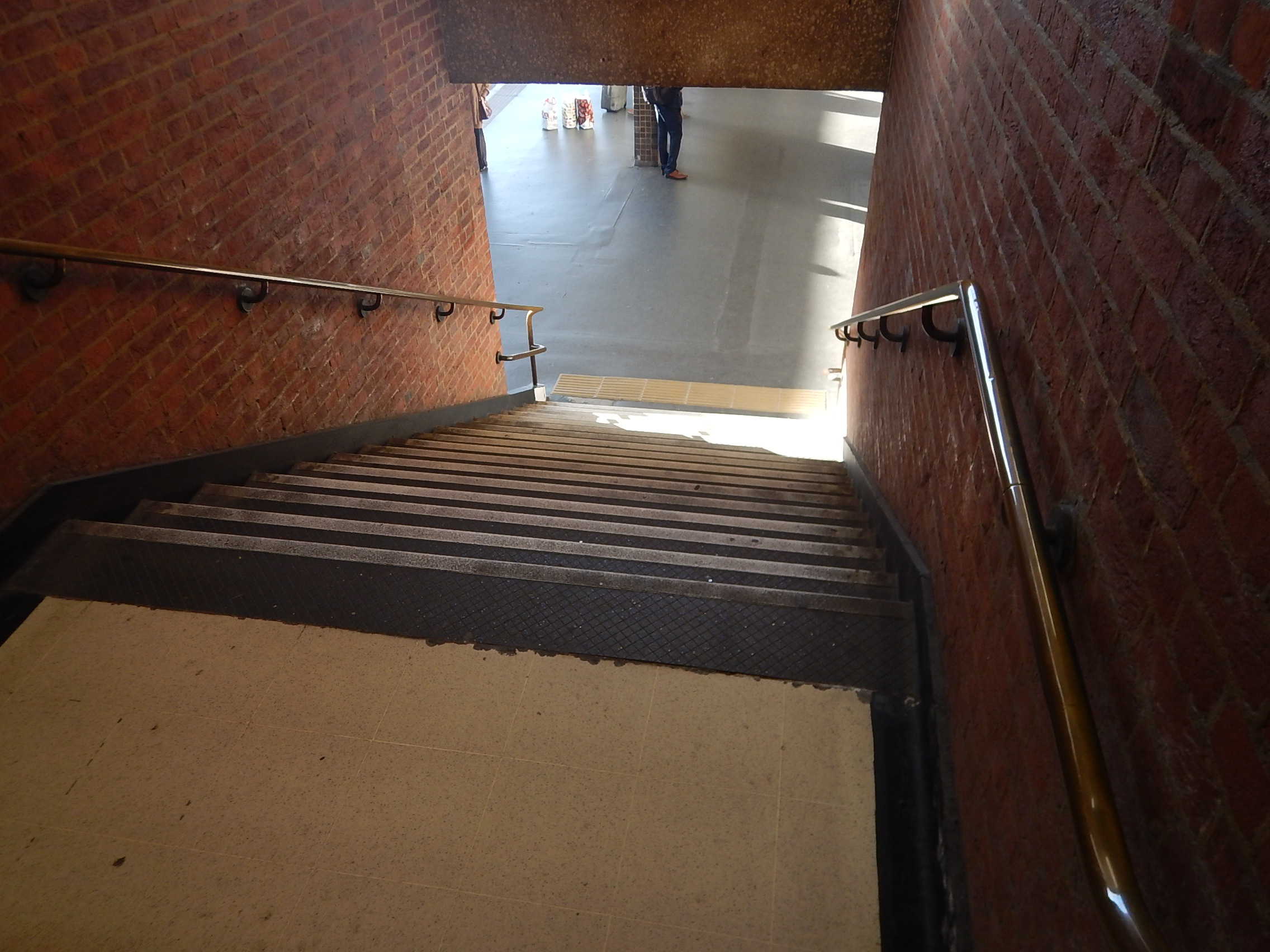
The station may be Grade II Listed, but this is not acceptable any more.
As is the platform-train interface shown in the first picture!
|Adding lifts and improving the stairs will be a major undertaking.
The Metropolitan Line Service
The Peak service is ten trains per hour (tph) in both directions, with a reduction to eight tph in the Off Peak.
Once the Four Lines Modernisation (4LM) is completed in 2023, these frequencies will be increased.
The journey between Aldgate and Uxbridge stations currently takes an hour.
This journey time is awkward from the point of scheduling the trains. The new signalling will probably reduce this to such a time, that the train could do the journey, turnround and be ready to return within an hour.
This would mean a higher frequency of trains without adding to the fleet. Although, it will probably mean that more drivers will need to be trained, which is a lot more affordable and easier, than buying new trains.
I feel that 10 tph might even be possible with the existing fleet and the new signalling.
But the new signalling will probably allow more semi-fast trains to operate, which might mean an extremely customer-friendly 12 rph were possible all day.
The Piccadilly Line Service
The Peak service is twelve trains per hour (tph) in both directions, with a reduction to six tph in the Off Peak.
Half the trains reverse at Rayners Lane station.
The journey between Kings Cross St. Pncras and Uxbridge stations currently takes an nine minutes over the hour.
The Rayners Lane To Uxbridge Service
Adding the two services together gives a Peak service of twenty-two trains per hour (tph) in both directions, with a reduction to eleven tph in the Off Peak.
Terminating The Piccadilly Line At Rayners Lane Station
There would be advantages to terminating all Piccadilly Line services at Rayners Lane station.
- All Piccadilly Line trains would go through the same procedure at Rayners Lane station
- The journey time would be reduced by fourteen minutes, which would ease train scheduling.
- There would be no knock on effects, if either line had delays.
- Signalling and train control at Rayners Lane would be simpler.
But it would need a major rebuilding of the tracks and platforms.
On the Victoria Line, thirty-six tph are handled on two platforms at Walthamstow Central and Brixton stations or eighteen tph on each platform.
So could a single platform at Rayners Lane station handle the Piccadilly Line service?
If it could, it could even be positioned between the two Metropolitan Lines, with an island platform on either side, giving cross-platform operation in both directions.
But because problems do occur, there would probably be two terminal platforms for the Piccadilly Line, as there are at the end of most Underground lines.
I think terminating Piccadilly Line services at Rayners Lane station could be made to work well and provide step-free access at all stations West of Rayners Lane station.
Terminating The Metropolitan Line At Rayners Lane Station
I don’t believe the problems of terminating the Metropolitan Line service at Rayners Lane would be any more difficult, than terminating the Piccadilly Line, but it might offer advantages, after all the stations on the line had been rebuilt to accept the new UTO-capable Piccadilly Line trains.
- This would open the possibility of running trains under UTO between Acton Town and Uxbridge stations.
- Hillingdon Borough Council have been pushing for the Central Line to be diverted from West Ruislip to Uxbridge. This would become possible.
- The frequency all the way from Acton Town to Uxbridge could easily be raised.
As with terminating Piccadilly Line services at Rayners Lane station, I think that terminating Metropolitan Line services could be used to provide step-free access at all stations West of Rayners Lane station.
Could A Piccadilly Line Service Be Run Between Uxbridge and Ealing Broadway Stations?
In Is There Going To Be More Change At Ealing Broadway Station?, I wrote about rumours of a possible plan to create a new terminus for the Piccadilly Line at Ealing Broadway station, using the route currently used by District Line trains from Ealing Common station.
I came to the following conclusion.
But overall, because it sorts out step-free access in the area, I think it is a good proposal.
I just wonder, if it would be possible for trains to run between Uxbridge and Ealing Broadway station.
This Google Map shows where the Piccadilly Line to Rayners Lane and Ucbridge and the District Line to Ealing Broadway divide , a short distance North of Ealing Common station.
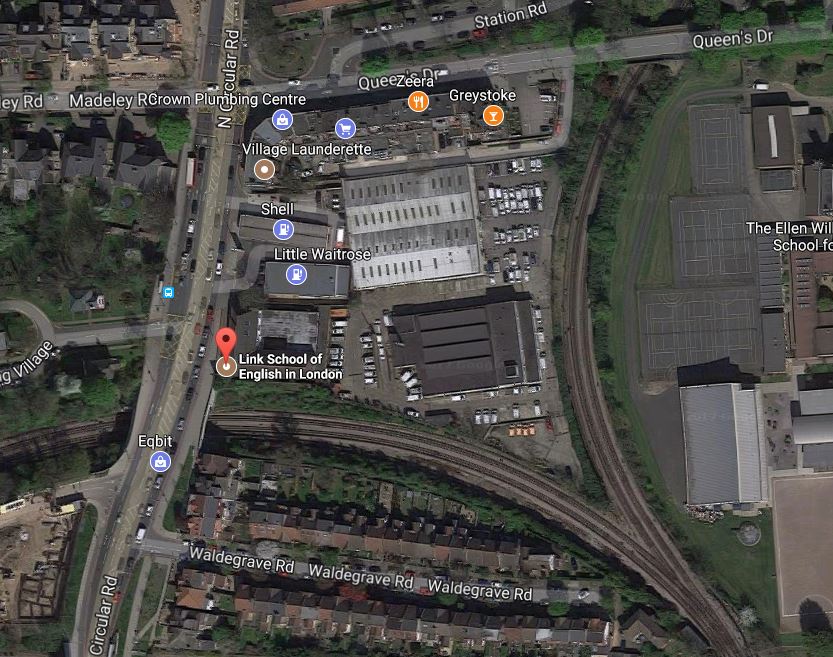
I think that creating the missing side of the triangular junction would be possible, thus allowing a service to be created between Ealing Broadway and Uxbridge stations.
- All stations would be made step-free and UTO-capable.
- Twelve tph could be run between Uxbridge and Ealing Broadway in both directions.
- Ten or welve tph would still be run between Uxbridge and Cockfosters.
- Twelve tph on both routes would mean a train every two and a half minutes between North Ealing and Uxbridge stations.
- The route would surely be ideal for running under UTO.
- A large area of Ealing, Hillington and Harrow would get a frequent link to Crossrail at Ealing Broadway.
- Extra stations could be added to the route to support development.
If the interchange at Rayners Lane were to be well designed, I doubt there would be any losers.
Could The Central Line Be Extended To Uxbridge?
In the Wikipedia entry for Uxbridge station, in the last sentence of a section called History, this is said.
The London Borough of Hillingdon announced in June 2011 that it would be lobbying Transport for London to have the Central line diverted from West Ruislip station to Uxbridge. Such a project would require a business case approved by TfL and the completion of signal upgrade work on the Metropolitan Line.
So would that be feasible?
Access To Uxbridge Station?
This map from carto.metro.free.fr shows the lines to Uxbridge and West Ruislip stations.
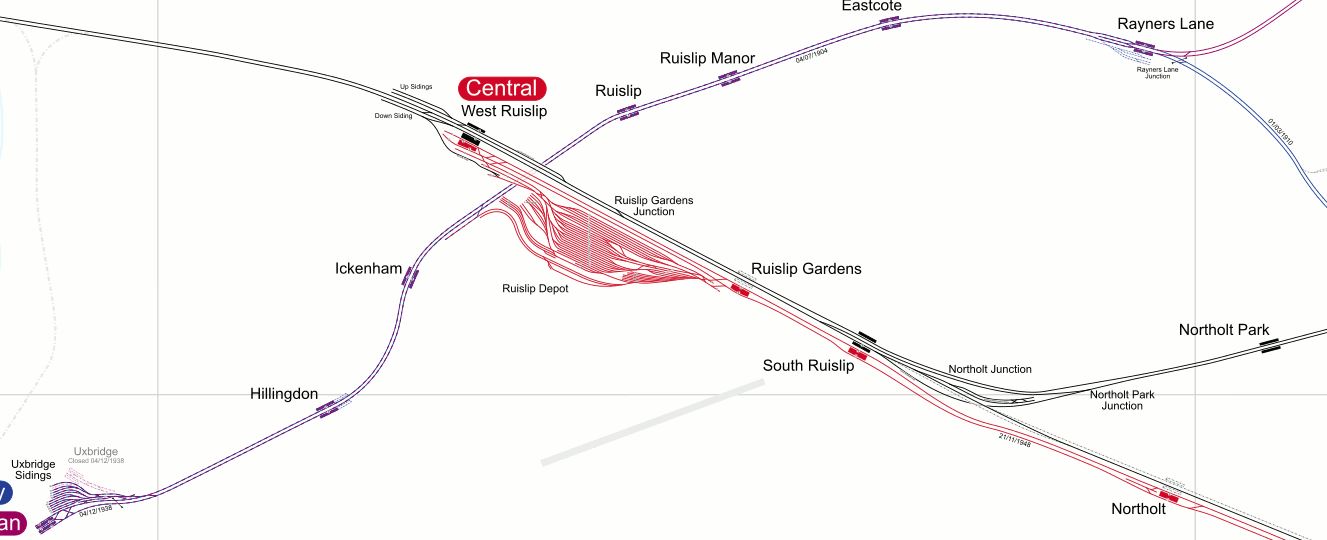
The lines in the map are as follows.
- black – Chiltern Main Line
- blue- Piccsdilly Line
- mauve – Metropolitan Line
- red – Central Line
The big red blob is the Central Line’s Ruislip Depot.
Uxbridge station is in the South-West corner.
This map from carto.metro.free.fr shows where all the lines cross at the North-West end of Ruislip Depot.
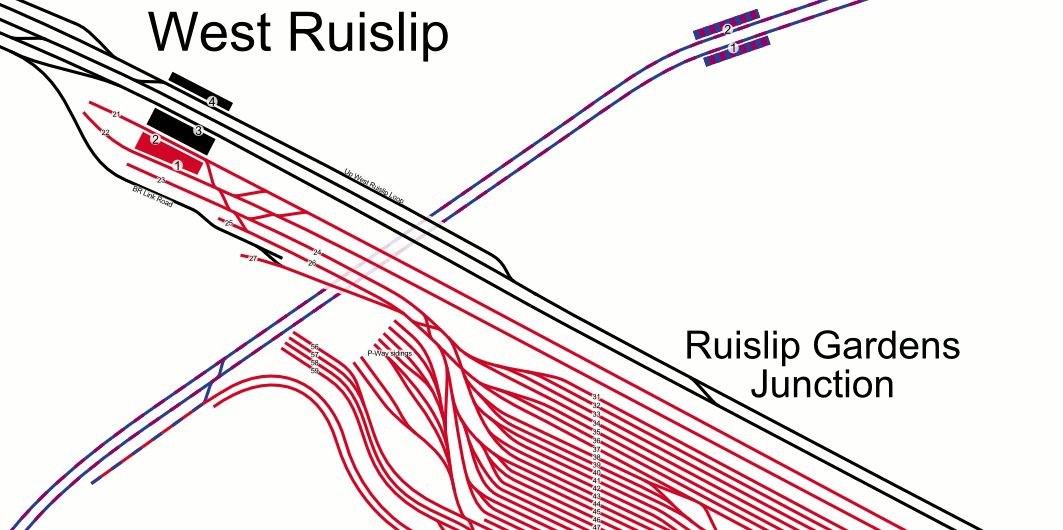
I suspect that an efficient connection can be made to allow the Central Line to go to Uxbridge instead of or as an alternative to West Ruislip station.
Note that at some point in the future, it is expected that both the Central and the Piccadilly Lines will use the same type of train. Will Ruislip depot be used for some Piccadilly Line trains, given its location close to Uxbridge station and the good connection?
Uxbridge Station
This map from carto.metro.free.fr shows Uxbridge station.
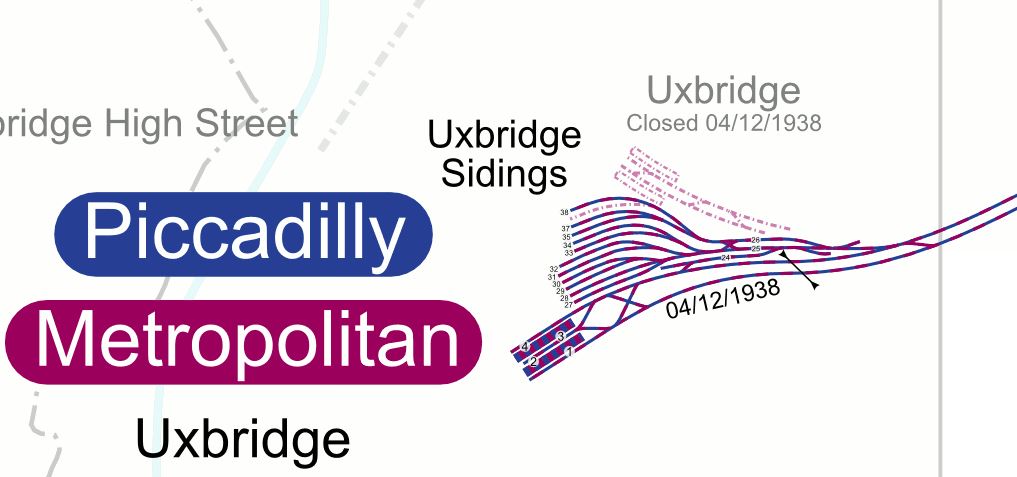
Note that Uxbridge station has three lines and four platforms.
- It would surely be much easier to handle the service, if all the trains terminating at Uxbridge were the same type.
- This would happen, if all Metropolitan Line trains terminated at Rayners Lane station.
- Two platforms could easily handle twenty-four tph for the Piccadilly Line.
- Two platforms could easily handle nine tph for the Central Line.
Uxbridge would become a very busy station.
Conclusion
There are a lot of possible improvements that can be done to the train service to Uxbridge.
Uxbridge Station
These pictures show Uxbridge station.
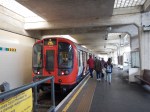


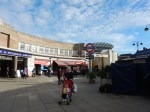
Note.
- The station was designed by Charles Holden and is Grade II Listed.
- It is in the centre of Uxbridge, which is where it should be!
- It is step-free.
- It’s got a beautiful station clock.
It is a station that has great potential for turning it into one of the London Underground’s best stations.
Rayners Lane Station
These pictures show Raynes Lane station.


Note.
- The station, like many of the period, was designed by Charles Holden and is Grade II Listed.
- The Metropolitan and Piccadilly Lines divide to the East of the station.
- There is no step-free access.
- The pictures show the step-down into a Piccadilly Line train.
I don’t think it will be easy to convert this station to full step-free access for both Metropolitan and Piccadilly Line trains.
Is There Going To Be More Change At Ealing Broadway Station?
Ealing Broadway station is being upgraded for Crossrail.
In the November 2017 Edition of Modern Railways, there is a Capital Connection supplement, which discusses London’s railways.
On Page 7 in a section about the sub-surface lines, this is said.
One possibility being discussed is that the Piccadilly should take over the District’s Ealing Broadway service. This would free up space on the South side of the inner-London circle for more City trains off the Wimbledon branch, one of the sub-surface network’s most-crowded routes.
On Page 15 in a section about the Mayor’s plans, this is said.
It is suggested Piccadilly Line services run to Ealing Broadway instead of the District Line, enabling increased frequencies on the latter’s Richmond and Wimbledon branches.
As the plan is mentioned twice, certainly the proposal is being thought about.
The Lines At Ealing Broadway Station
This map from carto.metro.free.fr shows the lines at Ealing Broadway station.
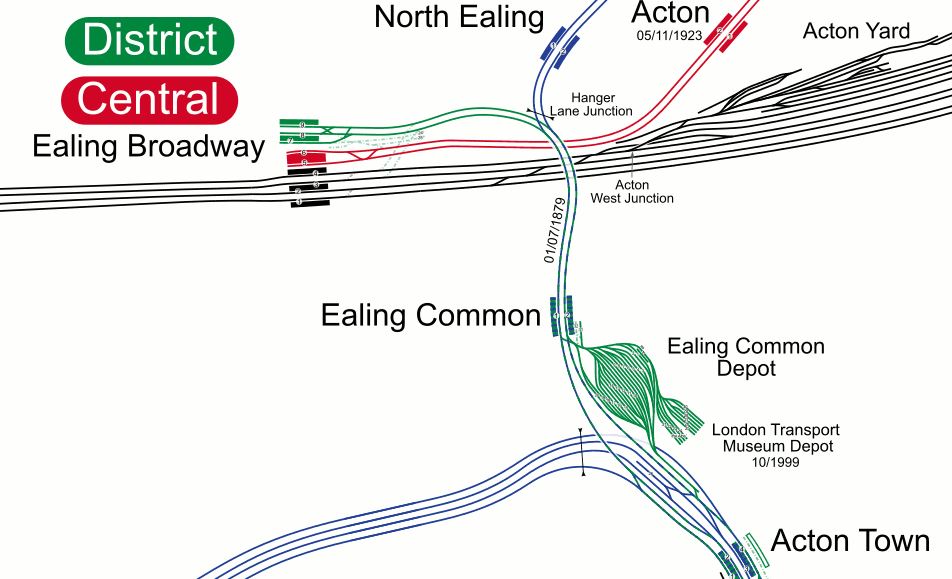
Note how the Piccadilly and District Lines share tracks from Ealing Common station, which then split with District Line trains going to Ealing Broadway station and Piccadilly Line trains going to Rayners Lane and Uxbridge stations.
If the change happened and Ealing Broadway station was only served by the Piccadilly and Central Lines of the Underground, then there might be opportunities to improve the efficiency of the Underground side of the station.
Crossrail Effects On Access To Heathrow
Crossrail will change the way a lot of passengers go to and from Heathrow Airport.
Crossrail To Heathrow
From May 2018, the service will be.
- 4 trains per hour (tph) between Paddington and Heathrow Central and Heathrow Terminal 4
After December 2019, the service will be.
- 4 tph between Abbey Wood and Heathrow Central and Heathrow Terminal 4
- 2 tph between Abbey Wood and Heathrow Central and Heathrow Terminal 5
In addition these services will serve all station including Canary Wharf, Liverpool Street, Bond Street,Paddington and Ealing Broadway.
Effect On Heathrow Express
It will be difficult to predict what will happen to Heathrow Express, but I suspect several groups of passengers will desert it.
- Passengers wanting to go anywhere East of Paddington without changing trains.
- Passengers wanting any Crossrail station.
- Passengers, who don’t like the prices of Heathrow Express.
- Passengers using Oyster or contactless cards.
- Passengers who want to ride on London’s spectacular new Crossrail.
After Old Oak Common station is opened, the numbers will further decrease.
Will Heathrow Express survive?
Effect On Piccadilly Line
The current Piccadilly Line route to the Airport will not be closed, as for many it will still be a convenient route to the Airport
- Passengers who live on the Piccadilly Line and don’t want to change trains. Think Southgate, Knightsbridge, Hammersmith and Osterley!
- Passengers to the East of Acton Town station.
- Passengers, workers and others needing to go to Hatton Cross station.
If Crossrail connected with the Piccadilly Line at say Holborn, it would be all so different.
Effect On District Line
When Crossrail opens, the District Line will become a loop from Crossrail, between Ealing Broadway and Whitechapel running along the North Bank of the Thames via Earls Court, Victoria, Charing Cross and Monument.
The step-free interchange at Ealing Broadway could become busy with passengers travelling to and from the Airport.
Effect On Piccadilly Line Overcrowding
Heathrow trains on the Piccadilly Line can get very overcrowded with so many passengers with heavy cases.
It must sometimes be very difficult to get on a Piccadilly Line train between Heathrow and South Kensington stations.
Crossrail should take the pressure from these trains, by allowing passengers to use the District Line with a change at Ealing Broadway.
Effect On My Personal Route
My personal route to the airport is to take a 141 bus to Manor House station and then get the Piccadilly Line. It takes 94 minutes.
After Crossrail fully opens, if I took the East London Line from Dalston Junction to Whitechapel and then used Crossrail, I’d take 57 minutes.
Conclusion
Crossrail will affect the way many get to Heathrow Airport.
But there are large areas of London, who still will need to change trains twice to get to the airport.
Piccadilly Line To Ealing Broadway Effects
Adding Ealing Broadway station as a fourth Western terminus to the Piccadilly Line will have effects, but not as important as the opening of Crossrail.
Some Improved Journey Times To Heathrow
Some Piccadilly Line stations will see improved journey times to Heathrow.
Hammersmith to Heathrow currently takes 37 minutes by the Piccadilly Line.
Taking a Piccadilly Line train to Ealing Broadway and then using Crossrail could save a dozen minutes.
The District Line Connection To Crossrail At Ealing Broadway Is Lost
Passengers along the District Line from Monument to Hammersmith will lose their direct access to Crossrail at Ealing Broadway.
Cross-platform access to the Piccadilly Line at Hammersmith and Turnham Green will probably be provided or improved, but it will be a second change.
Note that until the Piccafilly Line gets upgraded and new trains arrive around 2023, the District Line with new trains and the soon to be installed new signalling may well be a better passenger experience.
More Trains To Richmond
This will certainly be possible, if some Ealing Broadway trains are diverted to Richmond.
But Crossrail has another delight in its cupboard for Richmond.
Old Oak Common station is scheduled to open in 2026 and will offer an interchange between Crossrail and the North London Line.
Richmond will certainly be getting a better train service to Central and East London.
More Trains To Wimbledon
This will certainly be possible, if some Ealing Broadway trains are diverted to Wimbledon.
The Ealing Common Problem
At Ealing Common station, the Piccadilly and District Line share the same tracks and platforms.
Some commentators have suggested that the new trains on the Piccadilly Line will be designed to work with platform-edge doors for improved safety and dwell times.
So if platform-edge doors were to be fitted to all stations on the Piccadilly Line as has been suggested, there would be no way the doors would fit the new S7 Stock of the District Line.
Swapping Ealing Broadway from the District to Piccadilly Lines would solve this problem and give more flexibility, but it might give London Underground other problems with regard to access for District Line trains to Ealing Common depot.
These pictures show Ealing Common station.
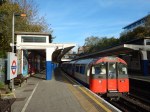

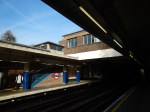

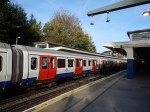
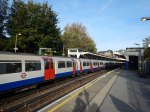
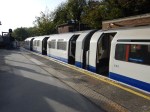
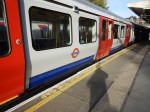
Note the difference of levels between the Piccadilly and District Line trains.
There would be no way to provide level access for both types of train using a Harrington Hump.
So is making a station that serves both deep-level and sub-surface lines, step-free, a problem that is still to be cracked?
This Google Map shows Ealing Common station.
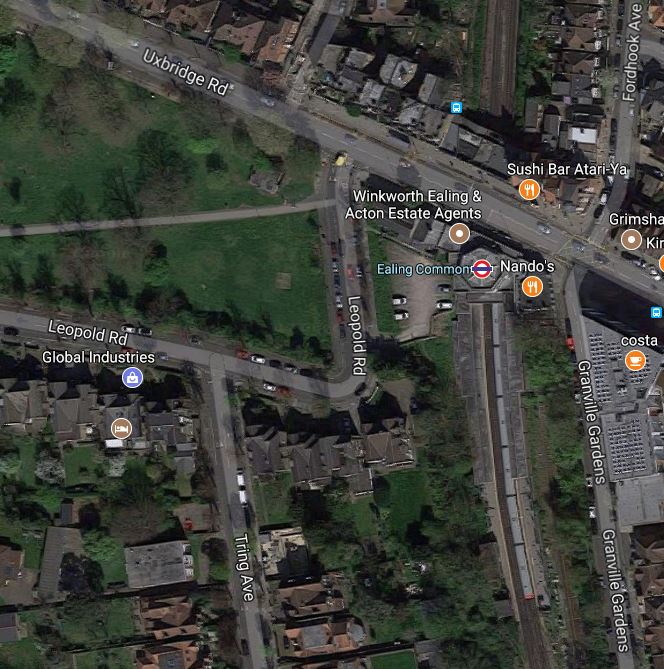
It doesn’t look that it is a station, where two extra platforms could be squeezed in, so both lines could have their own platforms.
Could Ealing Common station be one of the main reasons to serve Ealing Broadway station with the Piccadilly Line?
Acton Town Station
On a brief pass-through of Acton Town station, it would appear that the Ealing Common problem exists.
So making Acton Town station, a Piccadilly Line-only station, would ease making the station step-free, as it would only be served by one type of train.
Chiswick Park Station
Chiswick Park station only has platforms on the District Line and would need to be remodelled, if Ealing Broadway became the terminus of the Piccadilly Line.
One suggestion I found was to add two new District Line platforms to the Richmond branch.
This Google Map shows the station.
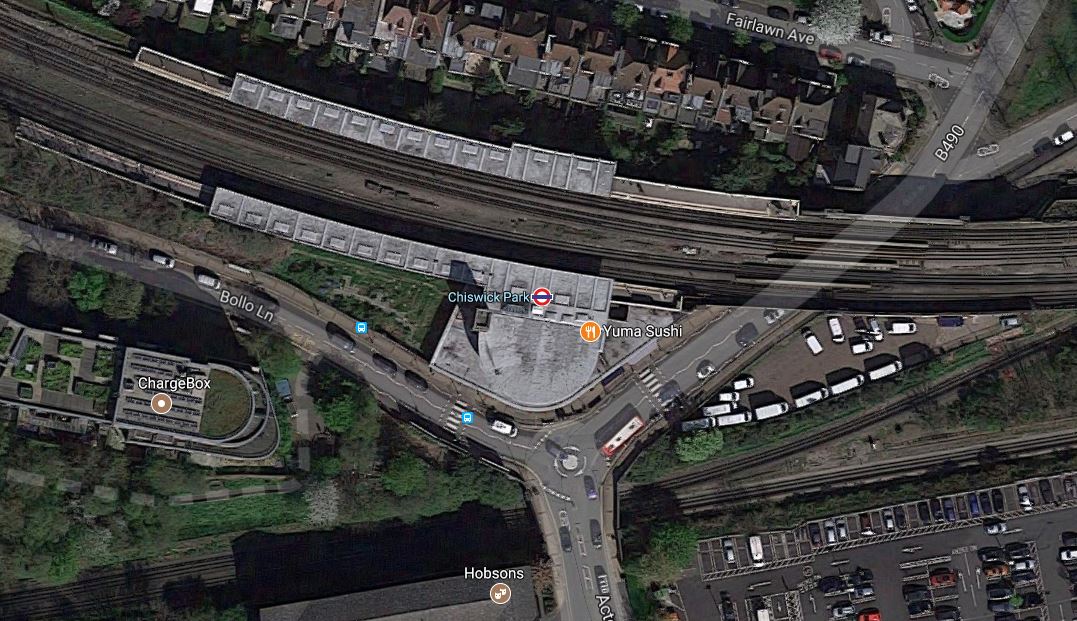
Note the Richmond branch passing South of the station.
Chiswick Park station is Grade II Listed and I’m sure that a good architect can find a more than acceptable solution.
Conclusion
It appears to me, there are two opposite forces on either side of a possible proposal to serve Ealing Broadway station with the Piccadilly Line, rather than the District Line.
- The District Line will form a loop South of Crossrail between Ealing Broadway and Whitechapel stations.
- Making a station step-free that handles both deep-level and sub-surface lines, is not an easy undertaking.
Running the Piccadilly Line to Ealing Broadway means that a change is required at Turnham Green, Hammersith or Barons Court stations to use the loop described in point 1.
But this change would enable the step-free access to be created in all stations in the area.
I think that the change of terminus will go ahead, with the following additions.
- Improved access to Ealing Common depot.
- Improved cross-platform access at Turnham Green, Hammersith or Barons Court stations.
- Two extra platform on the District Line at Chiswick Park station.
What started out as a simple change could end up as a substantial project.
But overall, because it sorts out step-free access in the area, I think it is a good proposal.
Specialist Trains Lead The Charge Against Leaf Fall on The Piccadilly Line
The title of this post is the same as the title of this press release on the Transport for London web site.
Last year, the Piccadilly Line suffered badly from leaves on the line as this article on the BBC, which is entitled Piccadilly Line delays: Wet leaves cause train shortage reported. This was the opening paragraph.
The Piccadilly Tube Line has been hit with major delays after half its trains were taken out of service as wet leaves on the track damaged their wheels.
Transport for London’s press release, talks about using RATs.
The two Rail Adhesion Trains (RATs) are part of a package of measures being introduced this Autumn to tackle wheel flats and prevent disruption.
A robust action plan to tackle leaf fall on the Piccadilly line is well underway for the Autumn months, TfL confirmed today.
It follows the publication of an independent report, commissioned by TfL, into leaf fall issues on the Piccadilly line that have led to delays and disruption on the line over the past two years.
Two 1973-stock trains have been converted into specialist engineering trains which will travel on the Piccadilly line treating rails to reduce the risk of poor adhesion. The adhesive material they dispense helps the train wheels grip the tracks during braking. When trains brake on slippery tracks it can cause the wheels to lock and subsequently wear down, an issue known as wheel flats.
Other measures TfL is taking to ensure that services on the Piccadilly line run as smoothly as possible this Autumn include:
- Aggressive vegetation clearance.
- Obtaining better weather prediction data.
- Better signage and information for drivers.
- Developing an Autumn leaf-fall timetable.
- Recruiting more maintenance staff and purchasing more spare wheels.
It’s certainly a comprehensive package of measures.
Crowded Roads In West London
Today, I tried to get to West Drayton station to have a lunchtime drink with an old mate from Cambridge, who had called me up yesterday, as he might have needed a second person to help him with one of his robotic machines.
But it all went pear-shaped at Paddington, where trains to West Drayton were very much delayed and I was advised to take the Underground to Greenford station and then use a bus.
But at Greenford, there wasn’t a bus map or anybody to ask, so in the end I took a bus to Ealing Hospital, where I thought I knew I could get a bus to West Drayton. But there wasn’t! So I thought about giving up and instead, I got a bus to Ealing Broadway station, to get back to Paddington. But I arrived at Ealing Broadway station, just before a train to West Drayton arrived. I caught that, had a drink with my friend and then caught a train back to Paddington. He didn’t need me to help, as all he needed was a pair of eyes to tell him what was happening at the sharp end of his machine and the client had turned up with his glasses.
So I achieved my objective and also had a wander round the Boroughs of Ealing and Hillingdon on buses and trains.
I trundle round North and East London most of the time and sometimes I even cross the River and go to the Deep South.
But I do find West London the most crowded, with buses slowed by all the traffic on the roads and infrequent very busy trains.
The West of London needs improvement in public transport.
I sometimes think, the traffic has got worse over the forty-six years, I had a driving licence.
Rail And Underground Lines
There are several lines going West from Central London, which include.
- The Chiltern Line from Marylebone to West Ruislip
- The Central Line to West Ruislip
- The Metroplitan Line to Uxbridge
- The Piccadilly Line to Uxbridge
- The Great Western Main Line tfrom Paddington to Reading and Heathrow
- The Piccadilly Line to Heathrow
Going further round, there are several lines from Waterloo going to the South West.
Only one line; the West London Line goes North South, although there used to be others.
The network is probably more sparse than some other directions from London.
Reliance on Cars And Buses
I think this rather thin coverage, puts a heavy radiance on cars and buses, which might explain the crowded roads.
Crossrail
Crossrail will bring improvement with the following Off Peak services in trains per hour (tph), along the slow lines of the Great Western Main Line.
- 4 tph to Heathrow Terminal 4
- 2 tph to Reading
- 2 tph to Maidenhead
Note.
- The central core tunnel probably has a limit of 24 tph.
- The service has a good balance between the various destinations.
- There will also be Great Western Railway services.
- Looking at the Crossrail schedule, there is scope to adjust the schedule on each branch.
I think that as Crossrail develops and the line and its passengers learn more about each other, the service pattern of Crossrail will change.
If I have a worry about Crossrail, it is that few of the stations towards Central London have many parking spaces, so will walking, cycling and the buses be adequate for Crossrail to tap its full potential?
The West London Tram
The West London Tram was proposed by Ken Livingstone in 2002.
These paragraphs from Wikipedia describes the tram and its route.
The West London Tram was a proposed on-street light rail line that was to run along the Uxbridge Road (A4020) corridor in West London, England. The scheme is promoted by Transport for London (TfL) but opposed by the councils of all three London Boroughs through which it would run. It was postponed indefinitely on 2 August 2007
The tram route was planned to run between Uxbridge and Shepherd’s Bush, serving Hillingdon, Southall, Hanwell, West Ealing, Ealing and Acton en route and would have completely replaced a number of equivalent London Bus routes.
If it had been built it would have had good connectivity to Crossrail and the Central Line. But the view of those against the project prevailed.
In my trip today, you could see why probably every car driver in the area, would be against a scheme like the tram. Only at places on the route, where there was a wide island of grass dividing the carriageways, would the tram not have increased congestion.
It looks like the thirty million pounds spent was wasted.
Crossrail And/Or West London Tram?
This Google Map shows the area around the three stations of Hanwell, West Ealing And Ealing Broadway.
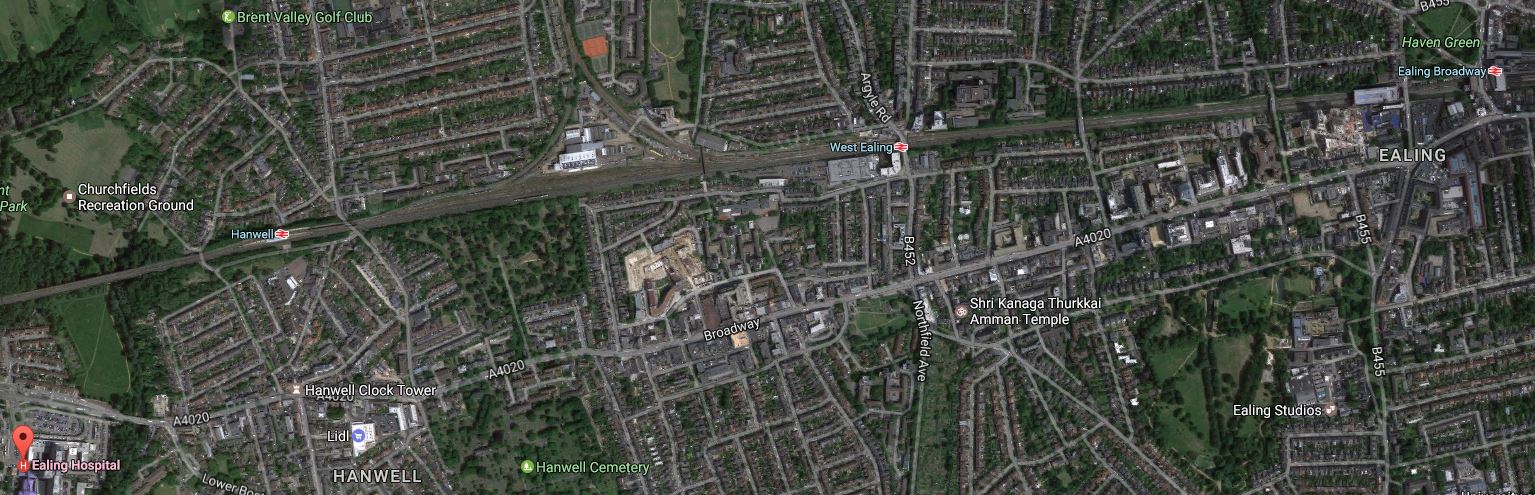
Great Western Main Line And The A4020 Through Ealing
Note.
- The Great Western Main Line across the middle.
- The A 4020 runs South of and parallel to the railway.
- Ealing Hospital is marked by the red arrow in the bottom left of the map.
I asked in the Header to this section if it should be And/Or between the projects.
Undoubtedly, it should be Or! Taxpayers can’t afford both!
In comparing the two, I believe the following points are valid.
- Trams stop about three or four more times than trains.
- The train is faster.
- The tram doesn’t serve Old Oak Common station or Heathrow.
- Trams annoy drivers in the same way that bendy buses do.
- Crossrail has a rich connection pattern compared to the tram.
- Pedestrians probably prefer trams, whilst drivers prefer trains.
The politicians decided and chose the trains.
Making More Of The Railways
If the streets are crowded can we use the existing railways to inject greater capacity into the existing railways in West London?
The key to this, as it sits in the middle of so many lines is the creation of a new station at Old Oak Common.
I will now summarise the possible rail projects that can be developed in West London
Chiltern Railways To Old Oak Common
Chiltern Railways have a capacity problem at Marylebone and one way to alleviate it would be for Chiltern to create a second terminal at Old Oak Common station, which could be accessed using an improved New North Main Line.
There is a real possibility of this project going forward and it could have many worthwhile features.
It would add another East-West route across West London, but with the comprehensive connectivity of Old Oak Common.
Chiltern Metro Creation
Wikipedia says this about a Chiltern Metro.
New Chiltern Metro Service that would operate 4+tph for Wembley Stadium, Sudbury & Harrow Road, Sudbury Hill Harrow, Northolt Park, South Ruislip and West Ruislip. This would require a reversing facility at West Ruislip, passing loops at Sudbury Hill Harrow, and a passing loop at Wembley Stadium (part of the old down fast line is in use as a central reversing siding, for stock movements and additionally for 8-car football shuttles to convey passengers to the stadium for events).[73] This ‘Chiltern Metro’ service was not programmed into the last round of franchising agreements.
When I wrote Could A Chiltern Metro Be Created? and came to the conclusion, that it might be possible, I got several positive responses.
Greenford Branch Improvements
The Greenford Branch Line connects the Great Western Main Line and the New North Line.
This map from carto.metro.free.fr shows the Northern end of the branch, where it joins the New North Line.
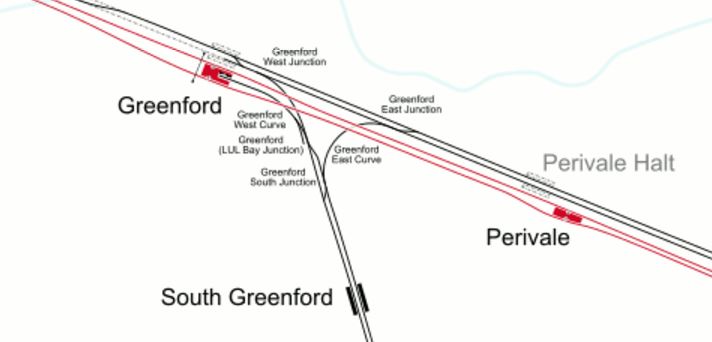
Northern End Of The Greenford Branch
Whilst this map from carto.metro.free.fr shows the Southern end of the branch, where it joins the Great Western Main Line.
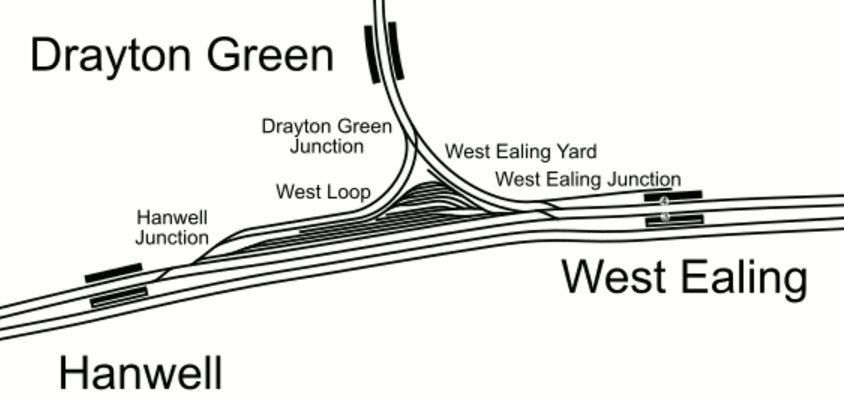
Southern End Of The Greenford Branch
What service the line will get after Crossrail opens has still to be decided,
- 4 tph between West Ealing and Greenford stations is certainly possible.
- There are those, including Ealing Council, who don’t like Greenford losing its direct connection to Paddington.
- A rebuilt Greenford station could incorporate Chiltern services.
As the connections at both ends of the branch allow trains to go in either an East or West direction, could this be useful in creating services between the two main lines?
Brentford Branch Reopening
I wrote about this in Could The Golden Mile In Houslow Get A Station?
The Brentford Branch could be a useful branch, worked by a shuttle train!
Hounslow Loop Line Improvements
The Hounslow Loop Line, which has a strong presence on both sides of the river and takes passengers to and from Waterloo, is being improved to increase capacity.
Could we see the Overground opening new services along the North London Line to perhaps Brentford, Hounslow and Feltham stations?
The route is used by freight trains, and Transport have suggested using the route to create an orbital Overground route.
Conclusions
The railways will take the strain in West London, after the abandonment of the West London Tram.
Why the Piccadilly Line is Struggling
Many Londoners and quite a few visitors have found problems with the servcice on the Piccadilly Line recently.
This article in the Standard is entitled Piccadilly line ‘should be shut down and Night Tube launch delayed until train shortage fixed’.
This is the first paragraph.
Rail union bosses have called for the Piccadilly line to be temporarily shut down and its Night Tube launch delayed until an ongoing “shortage of trains” is resolved.
That is drastic.
I have just found this article on the London Reconnections web site, which is entitled Wear and Lathing in Northfields: Why the Piccadilly Line is Struggling.
The article may not offer a solution, but it does offer the reasons for the shortage of trains.
Read it!
Heathrow Services Post Crossrail
To take some of the pictures for A Look At Stockley Junction, I took Heathrow Connect to the Airport..
My return ticket from Hayes and Harlington station, cost me £8.20 with a Senior Railcard, which must be one of the most expensive journeys per mile in the UK. Especially, as there are only two trains per hour (tph). Considering that I could have done the journey quicker yesterday, using a 140 bus, as the train was ten minutes late.
But it would be difficult to take the pictures I wanted from the bus.
Arriving at Heathrow, I thought that a hot chocolate would be in order, so I set off for Terminal 2.
Passenger friendly the journey is not, so as I wanted to get back, I returned to the station to catch the next train.
I did not see a single sign to Heathrow Connect, with this one being typical.
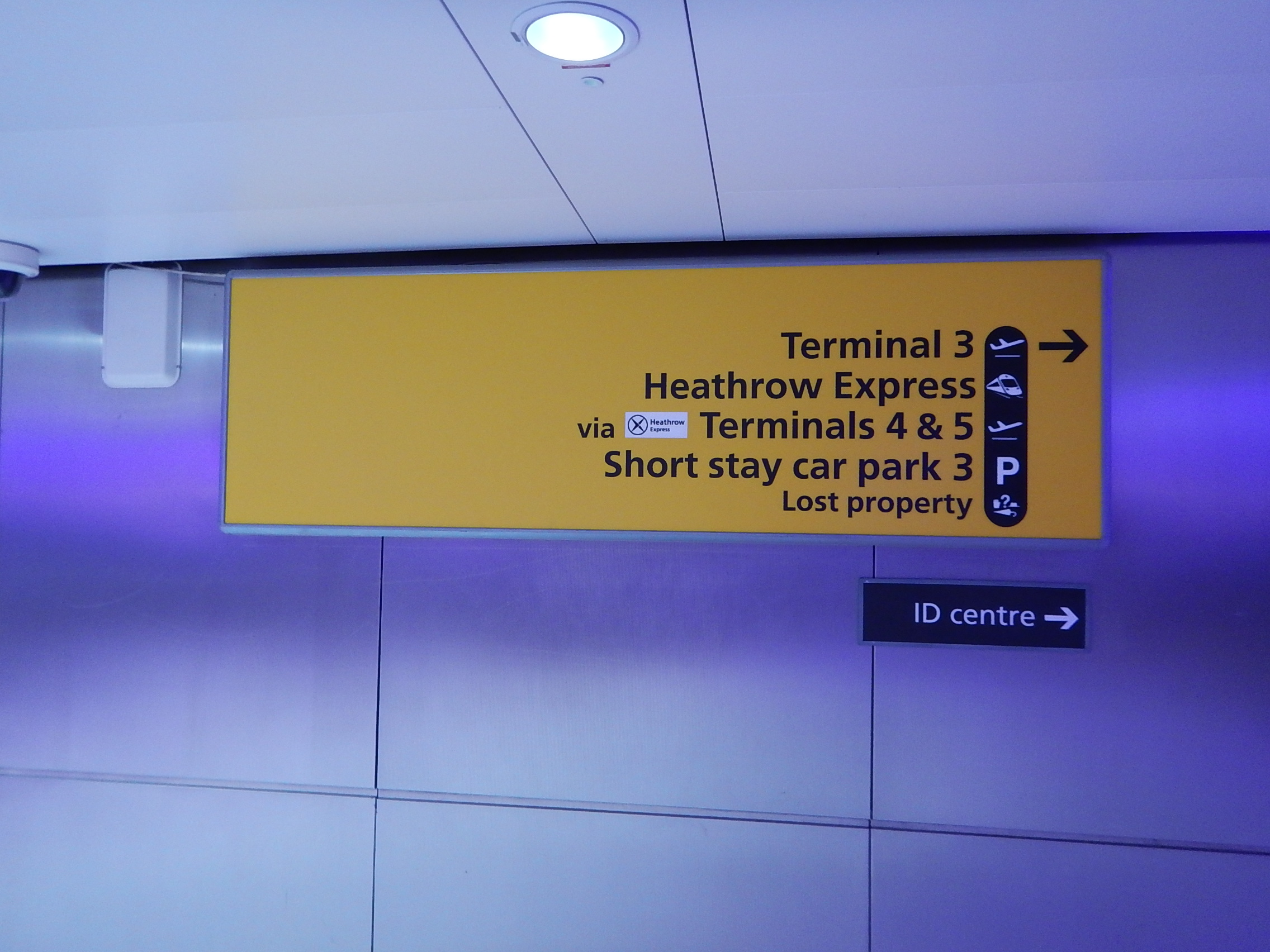
Where’s Heathrow Connect
I knew where to go, as I’d walked it.
Incidentally, it is easy enough to find the overpriced Heathrow Express, but how many passengers with a brain want to go to the disconnected Paddington?
Some like me might actually want to go to Hayes and Harlington or perhaps Maidenhead.
I didn’t ask, but I wonbder if the advice to go to Maidenhead, is to take Heathrow Express to Paddington and then get a train to Maidenhead. The Oracle (Nation Rail’s Journey Planner) recommends taking Heathrow Connect to Hayes and Harlington, but will all the staff.
Current Services To The Airport
There are four ways to get to Heathrow by public transport.
Heathrow Express – 4 tph to and from Paddington. – Overpriced
Heathrow Connect – 2 tph to and from a series of stations along the route to Paddington – Infrequent and overpriced.
Piccadilly Line – Slow, frequent, usually reliable and the most affordable.
Bus – For a lot of those living near the Airport, this is the preferred route.
This map from carto.metro.free.fr shows the layout of the rail and Underground lines.
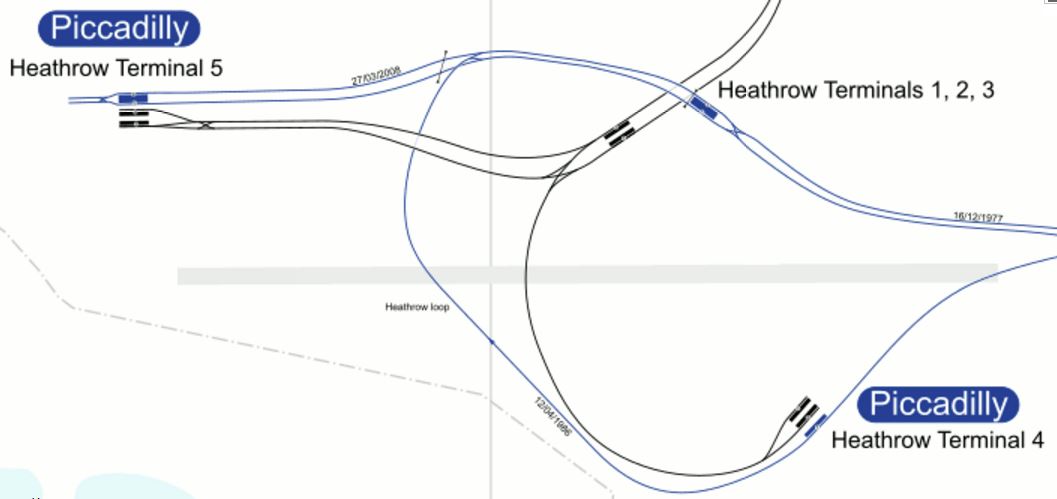
Rail And Underground Lines At Heathrow
Simple it isn’t!
But that is what you get if you dither over the next runway in the South-East for forty years.
Heathrow’s rail links are so very Topsy, unlike those at Birmingham, Edinburgh, Gatwick, London City, Luton, Manchester, Southend and Stansted.
Not all the others are perfect, but they’re getting better.
Crossrail
Crossrail will be the new wayto get to Heathrow and in some ways it is a replacement for Heathrow Connect. This is said under Future in the Wikipedia entry for Heathrow Connect.
From May 2018, Crossrail trains will replace all Heathrow Connect trains between London Paddington and Heathrow terminals 2, 3 and 4. Furthermore, as of December 2019 all services will run through the new tunnels at Paddington to central London destinations including Bond Street, Liverpool Street and Canary Wharf
So, it would appear that there will no substantial improvement until December 2019.
This is a detailed timetable, with particular reference to going between Heathrow and the City of London and Canary Wharf.
- May 2018 – Heathrow Connect will be taken over by Crossrail. We’ll certainly see better signage and service under Transport for London’s management.
- May 2018 – The Crossrail start schedule on Wikipedia, also shows that the shuttle between Heathrow Central (Terminals 1,2 and 3) and Terminal 4, will be transferred to Crossrail. Terminal 5 will be reached by using Heathrow Express from Heathrow Central.
- May 2018 – Heathrow Connect in the guise of Crossrail will be serving erminals 1,2, 3 and 4, but not Terminal 5. Will we be seeing new Class 345 trains and a higher frequency to Heathrow? I woulden’t be surprised if Heathrow Airport, try every trick to keep Crossrail out of the Airport, to protect the revenue on Heathrow Express.
- December 2018 – Crossrail services between Paddington and Abbey Wood will start, thus linking Paddington to the City of London and Canary Wharf. There will probably be a longish walk between the two parts of Crossrail at Pasddington, but the tunnel across London, will give Paddington the much need-connectivity, it’s needed since the Second World.
- May 2019 – Crossrail services between Paddington and Shenfield via Whitechapel will begin, thus meaning that many travellers East of Paddington, will use a single change there to get to and from Heathrow.
- December 2019 – The full Crossrail should open, meaning that there will be direct trains between Abbey Wood and Heathrow Terminal 4 calling at Canary Wharf, Liverpool St-Moorgate, Farringdon, Tottenham Court Road, Bond Street, Paddington, Heathrow Central and all the stations in between.
Trains into the Airport will be.
- 4 tph – Heathrow Express for Paddington, where many passengers will change to and from Crossrail.
- 4 tph – Crossrail to Abbey Wood.
One will be expensive and the other will be affordable and much more convenient, as it reaches the places passengers want to start or finish their journey.
It looks good, but there are a some questions to answer.
Is eight tph enough trains to and from the Airport?
If you compare Heathrow with Gatwick, Luton and Stansted, eight tph seems good.
However, I found this article in TravelWeekly, which is entitled Gatwick outlines plans for a train departure to London every three minutes.
It gives a very good summary of the train services that will run to Gatwick after Thameslink is completed.
- Four tph dedicated Gatwick Express trains to Victoria
- Six tph to Victoria – originating from East and West Coastway, Horsham/Littlehampton, and Three Bridges/Haywards Heath
- Four tph to Bedford via London Bridge – originating from Gatwick and Brighton
- Two tph to Cambridge via London Bridge – originating from Brighton
- Two tph to Peterborough via London Bridge – originating from Horsham
- Two tph to London Bridge – originating from Littlehampton/West Coastway, and Haywards Heath/Three Bridges.
That is a total of twenty trains to and from London and beyond and most of the South Coast from Southampton to Hastings.
How many better rail-connected airports are there anywhere in the world?
Luton and Stansted are also have aspirations to improve their rail links.
I think that passengers will press for increase in the frequency of services to the Airport and they’ll want more destinations.
After all Shenfield and Abbey Wood are planned to have 8 tph all day to and from Central London, with at least twice as many in the Peak.
How do passengers get to and from Iver, Langley, Maidenhead, Reading and all staions to the West of Hayes and Harlington?
A rail link into Terminal 5 from the West is planned, but something needs to be done before that is completed probably in the mid-2020s.
After December 2019, their will be four routes.
- Go to Paddington and use Heathrow Express – Expensive
- Go to Hayes and Harlington and take Crossrail into Heathrow Central – Requires two step-free changes of train.
- Take a coach from Reading.
- Go to Hayes and Harlington or West Drayton stations and use a local bus.
I can see something innovative being done at Hayes and Harlington station.
There is probably capacity between Heathrow Terminal 5 and Hayes and Harlington stations for a 4 tph shuttle in both directions, that would also solve the Terminal 5 connectivity problem.
Southall could even be an interesting alternative, as there is lots of space.
What Would Be My Solution?
I would use Hayes and Harlington station, as the interchange for Heathrow Airport.
In an ideal layout there would be three slow lines through Hayes and Harlington station, with two island platforms separating the lines. From the South, they would be.
- The Reading-bound (Up Slow) line.
- The Heathrow shuttle line, which would also be used by Crossrail trains going to and from Heathrow Terminal 4. This liine would be bi-directional.
- The London-bound (Down Slow) line.
Between the platforms would be two welcoming island platforms to give passengers a step-across interchange, between trains.
It would need a major rethink of the station.
But consider.
- Passengers from the West for Heathrow would just walk across the platform to get their train.
- Passengers for Heathrow Central could take any train.
- Passengers for Terminal 4 or Terminal 5 might need to wait a few minutes for an appropriate train.
- Crossrail passengers for Terminal 5, would change at Hayes and Harlington.
- Passengers from Heathrow for the West would just walk across the platform to get the train.
- No passenger would need to change platforms using the step-free bridge.
What is being provided at Hayes and Harlington station is very much a poor design.
Will the current Heathrow Connect service between Paddington and Heathrow Central and Terminal 4 be dropped?
I can’t see any point to it, after Crossrail has an all-stations service to the Airport from Paddington.
How do passengers get to and from Terminal 5?
I proposed the shuttle to do this, with passengers changing at either Hayes and Harlington or Heathrow Central stations, to a train going to either Terminal 4 or Terminal 5.
Will passengers be able to use contactless cards to the Airport?
I think if the decision was down to the Mayor, Transport for London or the people of London, Oyster and contactless bank cards would be a way of paying a fare to Heathrow, as it is to Gatwick.
Will passengers like me with Freedom Passes, be able to use Crossrail to Heathrow?
Boris said Yes and I suppose the current Mayor, Transport for London and card holders, will expect it to be possible, as it is on the Piccadilly Line.
Conclusion
The Heathrow spur of Crossrail has not been thought out too well!
 The Anonymous Widower